Photo-bombed by a gorgonopsid – it
could only happen to me! © Dr Karl Shuker)
Deriving their name from 'gorgos', an ancient Greek
word translating as 'dreadful', the gorgons are undoubtedly among the most
infamous, terrifying monsters in classical Greek mythology. A trio of
nightmarish sisters born to the ancient sea deities Phorcys and Ceto, each of these
three horrific entities was feared for the writhing, seething, sibilant mass of
living venomous serpents that composed her hair, and even more so for her
hideous visage's dreadful gaze, which was absolutely petrifying, literally – because
anyone who looked directly into her face and eyes was instantly and irrevocably
turned to stone.
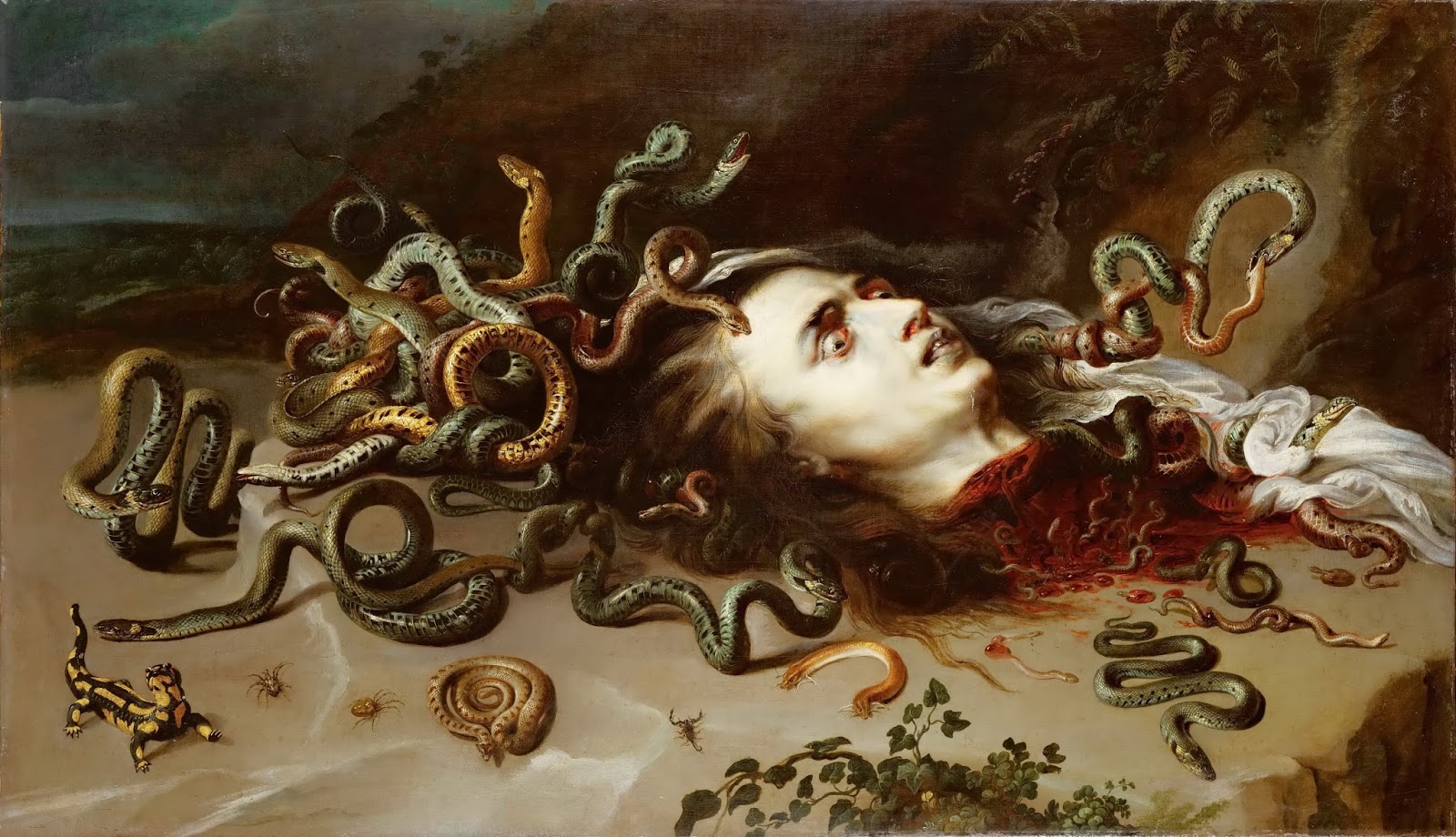
The decapitated head of Medusa, slain
by Perseus, as painted by Peter Paul Rubens, c.1617-1618; intriguingly, note
that among the snakes breaking free from her hair following her death is an
amphisbaena (head at each end of its body) directly below her head, and a very
strange-looking fox-headed serpent to the left of the amphisbaena (separating
the two is a scorpion) - click to enlarge (public domain)
Ironically, the two immortal gorgons, Stheno and
Euryale, scarcely feature at all in Greek mythology and are therefore all but
forgotten beyond the cloistered domain of classical scholars, even though one
might have expected that their invulnerable, inviolate nature coupled with
their lethal power of petrification would surely have set them in good stead
indeed as truly daunting opponents for any of the famous Greek heroes to
vanquish. However, it is commonly believed that their existence was a later
addition to an original myth of just a single, mortal gorgon, because there are
so many trinities of female monsters or other entities in Greek mythology (e.g.
the Graeae or Grey Sisters, the Furies or Erinyes, the Horae, the Charites or
Graces), so this may well explain, their virtual absence from classical legend.
(Interestingly, the premise of a 1964 British
horror movie made by Hammer Films, starring Christopher Lee and Peter Cushing, and
entitled The Gorgon was the survival into modern times of one of the two
immortal gorgons; but the film's researchers apparently made a major error,
because they named her as Megaera, who in Greek mythology wasn't a gorgon at
all, but was instead one of the three Furies, together with Tisiphone – erroneously
named in this same movie as the second immortal gorgon – and Alecto.)
Poster advertising the 1964 Hammer
Films horror movie The Gorgon (© Columbia Pictures/reproduced here on
the basis of non-commercial fair use only)
Conversely, it is the third gorgon, that single
mortal representative, who has seized virtually all of the public attention
afforded to this terrifying trio. Her name? Medusa.
Medusa's horror-laden history has assumed many
forms during the countless tellings and retellings by all manner of writers,
chroniclers, and narrators down through the ages – even including variants in
which she was originally a stunningly beautiful maiden but was transformed into
a merciless, embittered monster with deadly gaze after finding disfavour with
one or other of the Greek deities.
Perseus and the head of Medusa (© Simon Wyatt)
Irrespective of her origin, however, Medusa
was eventually slain by the demigod hero Perseus, who skilfully succeeded in
slicing off her head with his sword while only looking at her indirectly, via a
reflection in the highly-polished surface of his mirrored shield – a gift to
him from his divine protector, the goddess Athena.
Perseus and the gorgons, with Perseus holding up the decapitated head of Medusa; illustrated by Walter Crane for Nathaniel Hawthorne's A Wonder-Book For Girls and Boys, 1893 edition (public domain)
Perseus was the very first
of the classical Greek heroes, who went on to become the legendary founder of Mycenae. His father was the god Zeus, his mother Danaë, a
daughter of King Acrisius of Argos and his wife Queen Eurydice, whom Zeus famously
visited and impregnated in the guise of a shower of golden rain.
In later ages, carvings of Medusa's head were
incorporated in a number of classical architectural features, such as columns, arches,
door panels, decorative grilles, sarcophagi, fountains, statues, and mosaics,
to ward off evil spirits, and the image was also a popular depiction on
protective amulets. This visual device is known as a gorgoneion.
A gorgoneion entitled 'Medusa and the
Seasons', in a Roman mosaic found at Palencia, Spain, and dated at 167-200 AD (© Luis
Garcia/Wikipedia)
Today, Stheno and Euryale remain largely unknown;
but despite having been slain, Medusa still lives on, or at least her name and
that of her monstrous kind do – which is due not only to the popularity of her
memorable legend but also, in turn, because both 'gorgon' and 'Medusa' have
been applied to a wide range of very remarkable, entirely real creatures, some
living, others once-living. So permit me now to take you all on a brief, ShukerNature-led
visit to the extraordinary menagerie of Medusa.
HOW AN AQUATIC GORGON-HEAD BECAME AN INTERNET ALIEN
– OR WAS IT THE OTHER WAY ROUND?!
According to a report posted online during late
September 2014 by Britain's Sunday Express newspaper and written by
Levi Winchester, a 54-year-old Singapore fisherman named Ong Han Boon had recently captured
in waters off the southern Singapore island of Sentosa a creature so bizarre in appearance that he seriously wondered
whether it might be an alien, an extraterrestrial! Before releasing it back
into the sea, he filmed a short video of it that duly appeared in the
above-noted newspaper report (click here
to view it there),
and on 28 September a Singapore-based member of Facebook called Jr Saim publicly
shared the video on his FB timeline (click here
to view it on Facebook). The
video swiftly went viral, soon appearing – and still appearing – on numerous
news and video-sharing websites.
Still from the Singapore Gorgonocephalus video (© Ong Han Boon / inclusion here strictly on Fair Use/non-commercial basis only)
But what was the creature that it showed? Those of
an ophidiophobic disposition who have not already watched it might choose to
avert their eyes from the video, because the entity in it looks disturbingly
like a hideous matted wig composed of writhing, twisting, curling and uncurling
serpentine tresses – a veritable Medusa scalp, in fact. And nomenclaturally, if
not taxonomically, that is precisely what it is, because its scientific
binomial name is Gorgonocephalus caputmedusae – 'gorgon-headed Medusa head'.
Happily, however, this grotesque entity lacks the
petrifying power of its namesake, and it isn't of extraterrestrial origin
either, because in reality it is nothing more startling than a sea-dwelling starfish,
or, more specifically, a basket star. These particular invertebrates belong to
a taxonomic class of echinoderms known as ophiuroids, whose most famous members
are the notably long-limbed brittle stars.
Gorgonocephalus arborescens, from Alfred Edmund Brehm's famous multi-volume
animal encyclopaedia Tierleben ('Animal Life'), which was originally
published in 6 volumes during the 1860s and then republished as an expanded
10-volume second edition during the 1870s (public domain)
In a Gorgonocephalus basket star, however,
of which there are several species, each of the five arms radiating from its
central disc repeatedly divides and subdivides, yielding the somewhat disturbing,
wriggling mass of miniature snake-like 'armlets' so vividly captured in the
above video, and whose serpentine resemblance is heightened by their fleshy
covering of pink rubbery skin. For a much more appealing, stationary representation
of a Gorgonocephalus basket star, here is German biologist and artist Prof.
Ernst Haeckel's exquisite rendition:
Gorgonocephalus basket star, appearing in Prof. Ernst
Haeckel's gorgeously-illustrated, 2-volume tome Kunstformen der Natur ('Art
Forms in Nature'), published in 1904 (public domain)
And here's an illustration of a reddish-coloured
species named after the famous 19th-Century American zoologist and
geologist Prof. Louis Agassiz – Gorgonocephalus agassizi:
Gorgonocephalus agassizi, 1800s rendition (public domain)
When seeking prey, Gorgoncephalus takes up a
stationary position and then spreads out its innumerable tiny armlets like a
basket. Each of these small but highly dexterous armlets is equipped with hooks
and spines to seize and hold prey, normally krill or other planktonic forms,
which they then convey to the mouth on the underside of the animal's central
disc with the added assistance of a series of suctioned tube-feet.
A GORGON-GUTTED RIBBON WORM
No less grotesque and slightly stomach-churning
than the Gorgonocephalus video of 2014 was a more recent one, seemingly first
aired in May 2015 but again swiftly going viral and appearing on numerous websites, but featuring, as it turned out, another gorgon-dubbed
creature with equally discomforting behaviour. The video (whose original ownership is presently unknown to me) can be viewed here,
and shows a long blood-red worm-like creature originating in the seas off Thailand
but resting on someone's hand that suddenly releases from its mouth a long
thick white tube from which an intricate mass of white filaments shoot forth
and which momentarily writhe about before sticking to the person's hand –
almost as if this mini-monster has disgorged a gorgon's head of serpentine
hair! Nor is that my own peculiar impression – the same notion clearly occurred
to others too, because the generic name of the vermiform creature in question
is none other than Gorgonorhynchus. This roughly translates as 'gorgon-beaked',
though the beak in this instance is actually a proboscis.
Still from the video of the Thai Gorgonorhynchus nemertean everting its proboscis on a person's hand (copyright owner currently unknown to me / inclusion here strictly on Fair Use/non-commercial basis only)
As someone who studied such creatures during a
university project, I was very familiar with this animal's behaviour, repulsive
though it evidently seemed to many other viewers of the video, judging from
various comments posted concerning it. The creature is a nemertean, or ribbon
worm, Nemertea (aka Rhynchocoela) being a phylum of invertebrates whose members
are characterised by their often very long slender bodies and in particular by
their possession of a lengthy prey-capturing proboscis. This distinctive organ
is normally held inside the worm's mouth within its own sheath (the rhynchocoel)
and in an inverted, inside-out conformation, but when the worm encounters a
potential prey victim, it is instantly and quite explosively shot out through
the worm's mouth in everted form. The proboscis usually bears hooks at its tip
that seize the prey, and sometimes inject it with venom too, after which the
prey is swiftly hauled back inside the worm's body via the proboscis's
immediate muscle-powered retraction through the mouth in inverted form once
more.
Illustration of Gorgonorhynchus
reptens everting its branched proboscis after feeling threatened from being
touched (© Rachel Koning/Wikipedia)
In most nemerteans, the proboscis is a long, simple
tube, but in certain species, including those of the genus Gorgonorhynchus,
the tube possesses many branching sticky filaments that divide and subdivide in
a manner analogous to the armlets of the basket star Gorgonocephalus, and
which, again like the latter's armlets, wriggle and writhe as if they were a
multitude of tiny snakes, before wrapping themselves around the prey, encapsulating
it in an adhesive mass from which it cannot pull out, almost like the gossamer
produced by a spider. In effect, therefore, when the nemertean everted its
proboscis all over the person's hand, it was either stressed or feeling
threatened from being handled or it was reacting as if the hand were prey, and
hence was vainly attempting to wrap it up in its proboscis's sticky filaments.
GORGONS FROM PREHISTORY
Moving now from the present back to the (very)
far-distant past: in the mid to late Permian Period (265 to 252 million years
ago), when dinosaurs were still merely a future twinkle in the eye of
evolution, a reptile-originating lineage existed whose members were so
genuinely monstrous in form and size that in 1876 the great 19th-Century
palaeontologist Prof. Sir Richard Owen fittingly named them after Greek
mythology's own historical (albeit not prehistorical!) horrors, the gorgons.
For he christened their type genus and species Gorgonops torvus, after
which genus their entire taxonomic group (currently deemed a suborder) duly derived
its name – Gorgonopsia – in 1895, as dubbed by British palaeontologist Prof. Harry
G. Seeley.
Also called gorgonopsians, the gorgonopsids belong
to the taxonomic order of synapsid reptiles known as Therapsida, whose members are
often referred to colloquially as the mammal reptiles or mammal-like reptiles,
and do indeed belong to the same taxonomic clade, Theriodontia, as do true
mammals.
A life-sized animatronic gorgonopsid
on exhibition at the West Midlands Safari Park in England, August 2015 (© Dr Karl Shuker)
Gorgonopsids were among the largest of all
carnivorous vertebrates alive at that time (the biggest, Inostrancevia from
northern Russia, was up to 11.5 ft long, the size of a large bear or small rhinoceros,
with the aptly-named Titanogorgan maximus from Tanzania only slightly
smaller), and they were certainly the dominant ones. Even so, in genera such as
Gorgonops itself, native to what is now Africa, their most memorable features were their enormous sabre-like canine
teeth – so large that they almost projected below their lower jaw.
Gorgonopsids also had pillar-like legs that arose
from underneath their bodies like those of mammals rather than splaying from their
sides like reptiles. This important anatomical feature enabled them to move
more swiftly and energy-efficiently than their lumbering herbivorous prey,
which included some very large, hefty plant-eating reptiles known as pareiasaurs,
some of which, like Scutosaurus, were armoured for protection.
The gorgonopsid Inostrancevia
alexandri attacking the pareiasaur Scutosaurus karpinski (© Dmitry
Bogdanov/Wikipedia)
The gorgonopsids perished entirely during the mass
extinction at the end of the Permian, the only theriodont lineage to become
extinct during that catastrophic event, but they were sensationally resurrected
in CGI if not in life itself during the early 2000s by Britain's highly popular ITV sci-fi television show Primeval.
In the very first episode, originally screened in Britain on 10 February 2007, a marauding gorgonopsid of the genus Gorgonops
equipped with a monstrously large pair of upper canines confidently stepped
forth from out of the Permian and into the present day via a temporary gateway
through time known as an anomaly, wreaking havoc in Gloucestershire's Forest of
Dean, tenaciously stalking the perplexed scientists sent to deal with this ferocious
anachronistic therapsid, and vibrantly demonstrating to enthralled viewers everywhere
that carnivorous dinosaurs were not the only prehistoric predators that oozed
charisma and exuded terror in equal proportions. Moreover, another Gorgonops
featured in the final episode of this first series of Primeval.
A gorgonopsid on the prowl in Episode 1, Series 1 of Primeval (© ITV Studios/ProSieben/Impossible Pictures/Treasure Entertainment/M6 Films / inclusion here strictly on Fair Use/non-commercial basis only)
Nevertheless, bearing in mind that prior to Primeval
coming along, gorgonopsids were scarcely known beyond the palaeontological
community, to utilise one as the star monster in the opening episode of a
brand-new, potentially major new sci-fi show rather than going for the safer tried-and-trusted
option of a rampaging dinosaur was not only inspired but also very brave – and
yet, as it turned out, highly successful too. All of which only goes to show
that, clearly, you can't keep a good gorgon, or gorgonopsid, down!
Two African therapsids - the gorgonopsid
Rubidgea battling a dicynodont Oudenodon, as depicted on a
postage stamp issued in 1973 by Zambia, from my personal collection (©
Zambia postal service / inclusion here strictly on Fair Use/non-commercial basis only)
THE FRAGILE, STINGING SEA-FLOWERS OF MEDUSA
Needless to say, no documentation of real-life
gorgon namesakes could be complete without considering the most famous example
of all, named specifically after the most famous gorgon of all – Medusa herself.
In the phylum Cnidaria, there are two basic body
forms, both of which are produced by many species, but only one or the other by
some. The two body forms are the sessile, stalk-bodied, tentacle-headed, hydra-like
polyp; and the free-swimming, umbrella-shaped, often (but not always)
tentacle-fringed, jellyfish-like medusa. The principal taxonomic classes of
cnidarian are Hydrozoa (the hydrozoans, including the hydras, freshwater
jellyfishes, and siphonophores), Staurozoa (the stalked jellyfishes), Scyphozoa
(the true jellyfishes), Cubomedusae (the box jellyfishes), and Anthozoa (the
sea anemones and corals). Certain hydrozoans, scyphozoans, and cubomedusans all
produce a medusa form, many of which are usually equipped with long stinging
tentacles that fancifully resemble the living snakelock hair fringing the dread
face of Medusa, thereby earning the cnidarian medusa form its name, as coined
for it in 1752 by none other than Linnaeus himself.
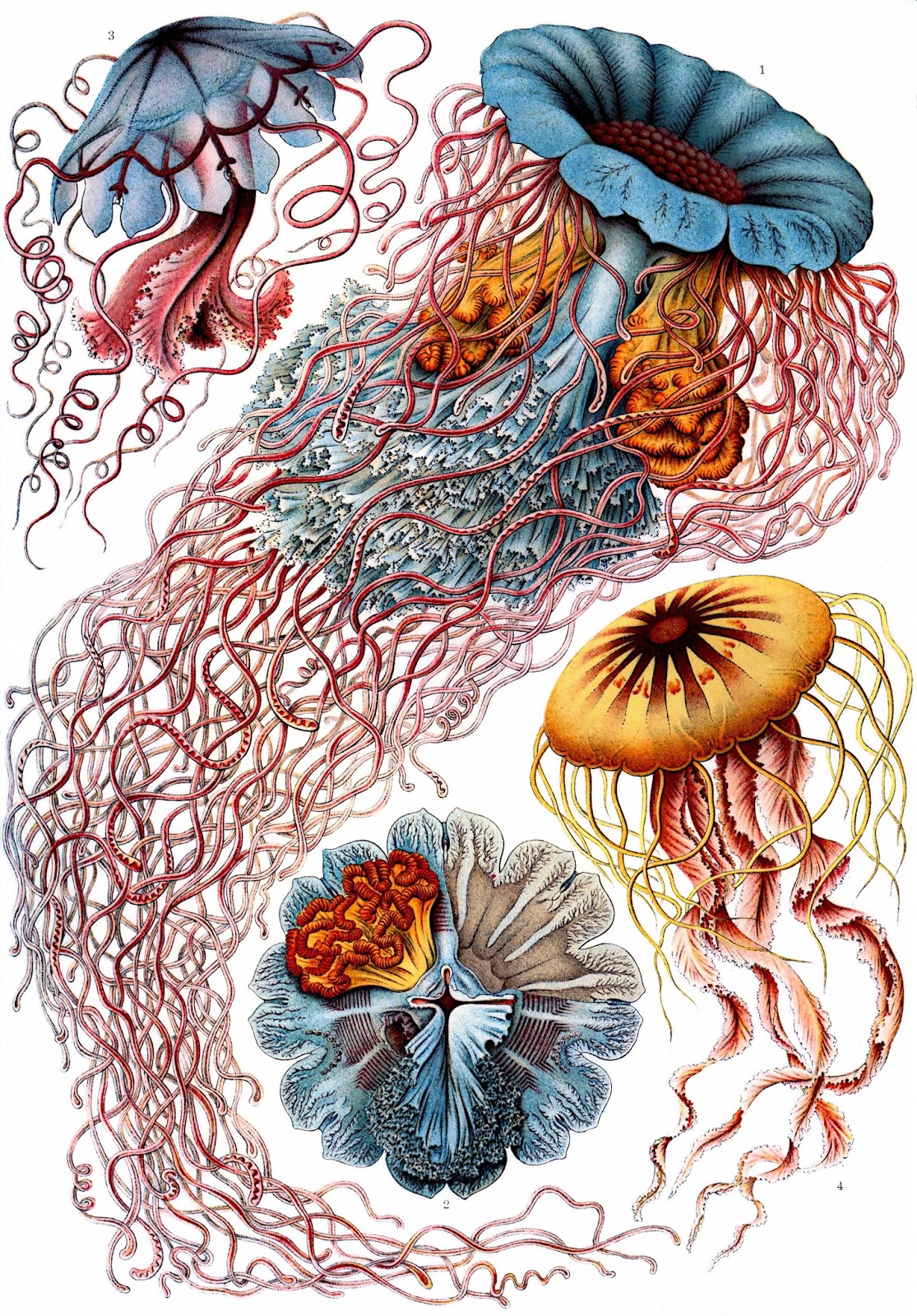
And so, what better way to bring to a memorable
close our visit to Medusa's menagerie than to savour some of the most
extravagantly exquisite illustrations ever produced of the varied types of cnidarian
medusae, often resembling bizarre, exotic sea-flowers, as contained within
Hackel's artistic masterpiece Kunstformen der Natur ('Art Forms in
Nature'), published in 1904. Please click the images to enlarge them.
Three species of Discomedusae, true
jellyfishes belonging to the class Scythozoa (public domain)
More Discomedusae (public domain)
Various species of Narcomedusae, a hydrozoan
order whose species normally lack a polyp stage (public domain)
Various species of Trachymedusae,
another hydrozoan order whose species never produce a polyp stage, only
reproducing sexually via medusae (public domain)
Various species of Leptomedusae or
thecate hydroids, a hydrozoan order whose species produce ensheathed polyp
colonies (the protective sheath is known as a theca or perisarc), as well as
sexually-reproducing medusae (public domain)
Views of the siphonophore Physophora
hydrostatica – like all siphonophores, what looks like a single large
complex organism equipped with bell, tentacles, etc, is in reality a
super-organism, consisting of an entire colony of highly-specialised individual
organisms, each of which is one of the super-organism's organs, e.g. one
organism is the bell, another organism is one of the tentacles, yet another is
another of the tentacles, etc (public domain)
More siphonophores (public domain)
Views of the helmet jellyfish Periphylla
periphylla, a deepsea species of true jellyfish or scyphozoan (public
domain)
Various species of Anthomedusae, the
athecate hydroids, a hydrozoan order whose species produce polyp colonies not
ensheathed in a protective sheath (the theca or perisarc), as well as sexually-reproducing
medusae (public domain)
Various species of Stauromedusae, the
stalked jellyfishes, sole members of the taxonomic class Staurozoa, whose
medusae are attached rather than free-swimming (public domain)
Various species of Cubomedusae, the
box jellyfishes, which include Flecker's sea wasp Chironex fleckeri, the
world's most venomous jellyfish, yet still-undiscovered by science in Haeckel's
time, and remaining so until the mid-1950s (public domain)
More Discomedusae, true jellyfishes belonging to the class Scyphozoa (public domain)
Various species of rhizostome Discomedusae,
true jellyfishes belonging to Scyphozoa (public domain)
More siphonophores (public domain)
More species of Discomedusae,
including the medusa of the familiar moon jellyfish Aurelia aurita (top
centre) (public domain)
Still more siphonophores (public domain)
Also commemorating Medusa, incidentally, are Medusaceratops
lokii (also commemorating Loki, the Norse god of evil), a late Cretaceous species
of ceratopsian horned dinosaur, which inhabited what is now Montana, USA, and
was formally named in 2010; and Medusagyne oppositifolia, the critically-endangered
Seychelles jellyfish tree, earning its genus name from the fancied resemblance
of its flower's gynoecium to Medusa's head, plus its common name from the
distinctive jellyfish-like shape of its dehisced fruit, and believed extinct
until some individuals were discovered on the island of Mahé during the 1970s.
The front cover of Prof. Ernst
Haeckel's truly beautiful book, Kunstformen der Natur (1904) (public domain)
And speaking of jellyfishes: how ironic it is that in
certain instances, creatures as beautiful as cnidarian medusae are also potentially
lethal, due to the potency of the venom produced by their tentacles' nematocysts
or stinging cells. Then again, how can we really expect anything else from
organisms that are, after all, specifically named after a legendary figure feared
not only for her thanatic eyes but also for the deadly nature of her living
tresses?
Me and my mate the gorgonopsid (© Dr Karl Shuker)
UPDATE - 31 August 2015
Today,
I received a scan of this very different, highly original, and totally delightful Medusa illustration,
drawn by crypto-enthusiast and friend Jane Cooper. Hidden amongst
Medusa's traditional serpentine hair strands are several that are
inspired by all manner of other creatures, including some notable
cryptozoological ones, such as Nessie, the Mongolian death worm, and the
Dover demon, as well as a very imposing terror bird. How many can you spot and identify?
Thanks Jane!!
Medusa goes crypto!! - click to enlarge (© Jane Cooper)
2nd UPDATE - 29 March 2018
Today I visited Valence House Museum in Dagenham, Essex, just outside
London, England, to see a wonderful exhibition entitled 'Dinosaurs, Harryhausen and Me', which featured a sizeable number of the iconic, priceless
dinosaur and monster models created by the legendary Ray Harryhausen and appearing in a
number of his famous Stop-Motion sci-fi and fantasy movies, including
Jason and the Argonauts (hydra, two fighting skeletons), The Valley of
Gwangi (Gwangi, Styracosaurus, Eohippus, Ornithomimus, Lope), Clash of
the Titans (Pegasus, Medusa, Bubo the living mechanical owl), Mysterious Island
(giant ammonite/nautiloid mollusc), One Million Years BC (Ceratosaurus), and First Men in the Moon (Grand/Prime Lunar the big-brained leader of the moon-ruling insectoid Selenites). The 'Me' in
the exhibition's title is none other than a longstanding Facebook friend
of mine, expert model maker Alan Friswell, who was personally appointed
by Ray to restore all of his priceless models, as some had suffered
damage and wear during the 40-odd years since they had originally been
made. Alan also very kindly made for me my wonderful Feejee mermaid.

With my Feejee mermaid that Alan Friswell made for me (© Dr Karl Shuker)
As
Alan is local to Dagenham, the Museum was keen to stage the exhibition,
which is proving extremely popular, and it was an absolute delight for
me to see at first hand so many of the awesome creations that captivated
me on screen when I first saw them as a youth and which still do when I
rewatch them today. A selection of framed artwork produced by Ray is also on display here, together with some of Alan's own stunning models, and entry is free. The exhibition lasts until 30 June 2018, so do try and visit, especially if, like me, you're a Harryhausen fan. Highly recommended!!
Click here to read my full review of this awesome exhibition. And here am I in an
almost too-close-for-comfort meeting with Medusa - notice how I am
taking good care not to look her in the eye...
Alongside Ray Harryhausen's original model of the gorgon Medusa, which appeared in his spectacular fantasy film Clash of the Titans (1981) (photograph © Dr Karl Shuker)






 Posts