Dr KARL SHUKER

Zoologist, media consultant, and science writer, Dr Karl Shuker is also one of the best known cryptozoologists in the world. He is the author of such seminal works as Mystery Cats of the World (1989), The Lost Ark: New and Rediscovered Animals of the 20th Century (1993; greatly expanded in 2012 as The Encyclopaedia of New and Rediscovered Animals), Dragons: A Natural History (1995), In Search of Prehistoric Survivors (1995), The Unexplained (1996), From Flying Toads To Snakes With Wings (1997), Mysteries of Planet Earth (1999), The Hidden Powers of Animals (2001), The Beasts That Hide From Man (2003), Extraordinary Animals Revisited (2007), Dr Shuker's Casebook (2008), Karl Shuker's Alien Zoo: From the Pages of Fortean Times (2010), Cats of Magic, Mythology, and Mystery (2012), Mirabilis: A Carnival of Cryptozoology and Unnatural History (2013), Dragons in Zoology, Cryptozoology, and Culture (2013), The Menagerie of Marvels (2014), A Manifestation of Monsters (2015), Here's Nessie! (2016), and what is widely considered to be his cryptozoological magnum opus, Still In Search Of Prehistoric Survivors (2016) - plus, very excitingly, his four long-awaited, much-requested ShukerNature blog books (2019-2024).

Dr Karl Shuker's Official Website - http://www.karlshuker.com/index.htm

IMPORTANT: To view a complete, regularly-updated listing of my ShukerNature blog's articles (each one instantly clickable), please click HERE!

IMPORTANT: To view a complete, regularly-updated listing of my published books (each one instantly clickable), please click HERE!

IMPORTANT: To view a complete, regularly-updated listing of my Eclectarium blog's articles (each one instantly clickable), please click HERE!

IMPORTANT: To view a complete, regularly-updated listing of my Starsteeds blog's poetry and other lyrical writings (each one instantly clickable), please click HERE!

IMPORTANT: To view a complete, regularly-updated listing of my Shuker In MovieLand blog's articles (each one instantly clickable), please click HERE!

IMPORTANT: To view a complete, regularly-updated listing of my RebelBikerDude's AI Biker Art blog's thematic text & picture galleries (each one instantly clickable), please click HERE!

Search This Blog


PLEASE COME IN, I'VE BEEN EXPECTING YOU...

PLEASE COME IN, I'VE BEEN EXPECTING YOU...
WELCOME TO SHUKERNATURE - ENJOY YOUR VISIT - BEWARE OF THE RAPTOR!


Showing posts with label tarzan. Show all posts

Wednesday, 20 March 2013

TARZAN'S SON AND THE NANDI BEAR

The issue of Gold Key's 'Korak Son of Tarzan' comic featuring his confrontation with the Nandi bear (Gold Key)

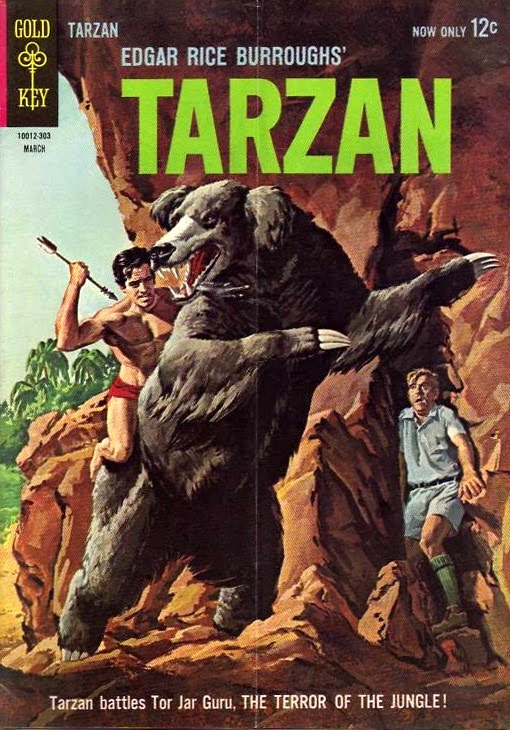
In a previous ShukerNature post (click here), I stated that as far as I was aware, the only comic ever to feature Africa's most ferocious mystery beast, the dreaded chemosit or Nandi bear, in a starring role was the March 1963 issue of Gold Key's 'Tarzan' - in which Edgar Rice Burroughs's most famous creation confronts and conquers the rapacious cryptid originating from Kenya's dense Nandi forest. This comic had been brought to my attention by Swedish Facebook friend and folklorist Håkan Lindh.

Now, Håkan has revealed an equally exciting sequel-style discovery - a second comic starring the Nandi bear. Moreover, keeping the history of cryptozoological confrontation in the family, as it were, the comic in question is none other than the April 1969 issue (#28) of Gold Key's 'Korak Son of Tarzan'!

As illustrated on its front cover (the picture that opens this present ShukerNature blog), the story is entitled 'Flight From Doom', and this time the Nandi bear is terrorising a race of mini-people, but is thwarted by Tarzan's son, Korak - only for the mini-people to turn on him! There's gratitude for you! Thanks for informing me of this second Nandi bear-featuring comic, Håkan!

The issue of Gold Key's 'Tarzan' comic featuring his confrontation with the Nandi bear (Gold Key)

Friday, 23 November 2012

THE BLACK LION VERSUS TARZAN!

Front cover of 'Tarzan' #218, 'The Trophy' (Joe Kubert/DC Comics)

In earlier ShukerNature posts of mine (click here and here), I have revealed that although a number of unconfirmed reports can be found in the archives of cryptozoology, as yet there is no conclusive evidence for the reality of black lions (i.e. lions exhibiting melanism), and that four much-circulated online photographs purporting to be of genuine black lions are nothing more than Photoshopped fakes.

Nevertheless, the very concept of a black lion is so captivating and compelling that it has been utilised very effectively in fiction. Perhaps the most stunning example of this was recently brought to my attention by Facebook friend Sefton Disney, and features a mighty confrontation between a magnificent black lion and a very formidable rival for the crown of African jungle king - Tarzan!

As seen in the illustration that opens this ShukerNature blog post, issue #218 of 'Tarzan', published by DC Comics, contains a story entitled 'The Trophy', and appearing on this comic's spectacular front cover is Tarzan fending off a ferocious black lion. This superb artwork was created by the late, great artist Joe Kubert.

Moreover, this is not the first time that Tarzan has done battle with a cryptid - check out a previous ShukerNature post of mine for details of his encounter with the terrifying Nandi bear and a separate adventure pitting him against a spotted lion (click here), plus his secret meeting with the reclusive mokele-mbembe (click here). Who needs cryptozoological field work in search of Africa's most elusive mystery beasts when all we have to do is send out Tarzan!!


NB - A Buy It Now button for pre-ordering my latest book, Cats of Magic, Mythology, and Mystery (CFZ Press: Bideford, 2012), will be available here and on my website very soon - so please check back often!


Tuesday, 13 March 2012

MYSTERY CATS IN SHOWBUSINESS - YOUR ASSISTANCE IS REQUESTED!

A still from the 'Tarzan' television series of the 1960s showing Tarzan (Ron Ely) alongside a black-headed leopard (still emailed to me by Bill Rebsamen)


The entertainment world may not be the most likely realm in which to encounter real-life mystery cats, but a number of intriguing examples have cropped up here from time to time, including the following two cases - neither of which has been resolved so far.


A BLACK TIGER IN THE CIRCUS?

Melanistic (all-black) specimens of leopards Panthera pardus (commonly termed black panthers) and jaguars P. onca are well known. Conversely, although there have been many reports of all-black tigers P. tigris (see my book Mystery Cats of the World, 1989, for the first - and still the most detailed - review of cases ever published), not a single specimen or skin of one has ever been formally submitted for scientific examination and verification.

Consequently, in the absence of a specimen, fully melanistic tigers are still regarded as cats of cryptozoology, even though there is no sound zoological or genetic reason why all-black mutants of this species should not arise from time to time. Hence I was greatly excited when I received an e-mail from Arkansas wildlife artist William M. Rebsamen on 3 October 1997 in which he recalled seeing a photo of a living black tiger in a book! According to Bill:

"I remember once seeing a large book about the history of the Ringling Brothers Circus and was surprised to find a clear photo of a big cat trainer with a "Black" tiger (you could still make out his stripes though) mixed in with his normal Bengals. Is this for real?"

If only I knew! However, the fact that its stripes could still be discerned against its fur's black background colouration is precisely what one would expect with a genuine melanistic tiger, just as the rosettes of black leopards and jaguars can be perceived against their fur's ebony ground colour when viewed closely or at certain angles.

Computer-generated mock-up of the likely morphology of a melanistic tiger (Dr Karl Shuker)

Needless to say, I lost no time in requesting any further information that Bill could recall concerning this fascinating disclosure, and on 15 October I received the following details:

"Sorry for the uncertainty of my memory concerning the black tiger photo but the best I can remember [is] it was a coffee table sized, hardcover book. My best recollection is that the title was "The History of Ringling Bros. and Barnum & Bailey Circus". I'm sure it would have been around 1974 or 1975 when I saw the book, new, in a bookstore at our local mall. The photo was in towards the middle of the book. It pictured a trainer in a cage with 4 or 5 bengals, one appearing to be black.

"I hope this isn't another case like the "Thunderbird Photo", but I can assure you, as a young kid of about 10 or 11 at the time, I was thoroughly fascinated with big cats and would go to the mall every Saturday for as long as that book store was in business and I would look at that photo. I don't know why it never crossed my mind to ask my mom to buy it for me. I do know that for that age I could distinguish big cat subtleties (like the still visible spots on a black leopard) and was amazed by this photo because it appeared to show stripes under the dark fur."


The late Mark Chorvinsky, Strange Magazine's founding editor and a longstanding friend of mine, had a lifelong interest and extensive knowledge of circus history, so I swiftly informed him of Bill's remarkable news, and Mark promptly contacted the Ringling Brothers Circus requesting any information that they could send concerning this melanistic mystery. Sadly, however, he never received any reply, but Bill and I have continued to collaborate fully in pursuing this compelling mystery in the hope of uncovering not only the photo but, as a result, proof that a living black tiger was actually maintained in captivity!

Another cryptozoological researcher who greatly assisted us was the late Scott T. Norman, from California. After receiving details from Bill, Scott conducted some extensive Internet searches and sent out many requests for information relating to this photo. Again, however, no further details were forthcoming.

Ringling Brothers Circus poster depicting a normal tiger

Has anyone reading this ShukerNature blog post seen the book and the all-important photograph inside it referred to by Bill? Or does anyone have any additional information concerning the possible presence of a black tiger in the Ringling Brothers Circus? If so, I'd greatly welcome any details that you could send to me or post here.


TARZAN AND THE BLACK-HEADED LEOPARD

Remarkably, the above feline enigma is not the only mystery cat from the realms of showbusiness whose apparent existence has been brought to my attention by Bill Rebsamen. Bill also very kindly alerted me to the curious black-headed leopard that appeared in an episode of the 'Tarzan' television series from the 1960s, starring Ron Ely in the title role. According to Bill, in the storyline of this particular episode Tarzan's sidekick was a 12-year-old boy from India who had made friends with a spotted leopard that was black from the neck up, and which was being pursued by evil fortune-hunting poachers. After a number of e-mails and Internet requests, Bill succeeded in obtaining a copy of a frame from the episode, shown above at the beginning of this ShukerNature post, depicting a black-headed leopard lying next to Ron Ely.

To my mind, this animal was probably 'created' in the series' make-up department, as the black head and neck colouration is precisely delineated from the spotted remainder of the beast, whereas one might have expected a rather more blurred demarcation if the leopard's pigmentation had been genuine. Also, I assume it is this odd colouration that made it so valuable (in the story) to the poachers, who would not have been so concerned about tracking a normal leopard. Bill, however, is not so sure, noting in a November 1997 e-mail to me:

"It seems to me this [the black-headed leopard] may fall under the "stranger than fiction category" when you ask the question as to why would someone go through the trouble of dyeing the leopard's head black for a syndicated TV show watched by people who would, for the most part, not realize the significance of this rarity?"

If its rarity is not specifically alluded to in the programme, then Bill does have a point. Also, it has to be conceded that transforming a leopard in this way would prevent any stock footage of leopards being used in that particular show (which is a common - and financially sensible! - practice when putting together a show containing a lot of animal footage).

Despite continued efforts, Bill did not succeed in his attempts to track down the show's producer, animal trainer, or anyone else with knowledge of this episode, in order to uncover the true identity and history of its melanocephalic animal star.

Annual from 1967 accompanying the 1960s 'Tarzan' television series starring Ron Ely

So once again, if anyone reading this ShukerNature post has any relevant information, I'd love to hear from you - it may not be too late even now to solve yet another feline mystery emanating unexpectedly from the entertainment world.


UPDATE - 29 March 2012

Yesterday, I learnt from American correspondent Shane Lea that he owned the full set of the 'Tarzan' episodes starring Ron Ely, and he promised to go through them in search of the elusive and enigmatic black-headed leopard. I mentioned that one episode was entitled 'Leopard on the Loose' - perhaps it featured in that one.

Later that same day, I was delighted to receive the following, extremely informative and illuminating email from Shane (thanks Shane!):

"Well, I tracked down and viewed the Tarzan episode w/the black-headed leopard in it. It is indeed called Leopard on the Loose. Interestingly enough, they actually refer to it as a black-headed leopard in the episode. Very interesting. My own feeling after having viewed it, and knowing it is a product of Hollywood, is that they might have used charcoal on the leopard's head. The reason is, the rosettes are clearly visible on the head and the head also has a faded look. Let's hope they didn't spraypaint the poor thing, but they got away with things in the sixties that today they never would...But, it is a great episode and the black-headed leopard looks real. At least we don't have to worry about it being green-screened or photoshopped, the leopard is real. Charcoal would rub right off and would be harmless to the animal. The other alternative, is that it really is a black-headed leopard! Maybe an aberration, one that went incompletely melanistic? They did say in the episode that it was rare, valuable and worth $4,000. That would be in 1966 dollars, in 2012 dollars, $52,000,000 LOL!...

"Manuel Padilla Jr., is Jai's real name. He played Tarzan's young sidekick in the series. The black-headed leopard was his pet in the show. If he is on Facebook, he might know or remember something regarding the leopard. The series executive producer was Sy Weintraub, although who knows if he is still around. Also, actor Russ Tamblyn played one of the poachers. Another producer was Jon Epstein, co-producer Don Brinkley. The animal supervisor, was Joseph S. Stewart. The episode was directed by Paul Stanley. I hope this helps. A black-headed leopard definitely sounds like something ERB - Edgar Rice Burroughs - would have written about. I think he included much fact in his science fiction. I am a huge ERB fan. No-one could write action like he could. He was one of the very best, that's why they named
Tarzana, Ca. after him!"

All I need to do now is find a DVD of this episode that is compatible for viewing using a British DVD player - sadly, American DVDs are not compatible. So watch this space for further developments!

Tuesday, 29 March 2011

TARZAN MEETS THE MOKELE-MBEMBE.


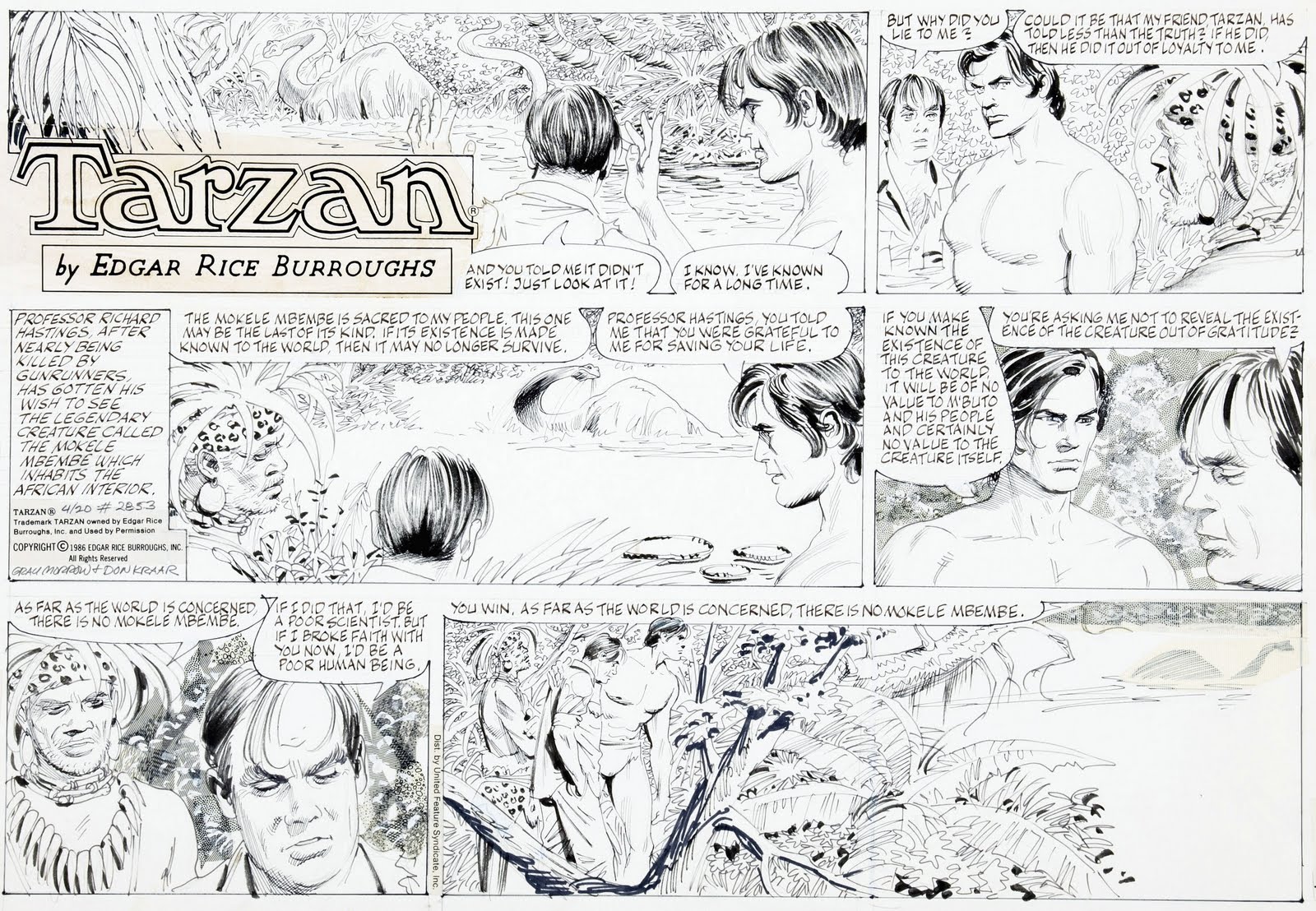
Not content back in 1963 with successfully battling a Nandi bear, in 1986 Tarzan encountered another of Africa’s cryptozooloogical heavyweights – the mokele-mbembe!

One of my many cryptozoological correspondents, the indefatigable Håkan Lindh from Sweden, who first brought the Tarzan-Nandi bear story to my attention (see here), informed me yesterday that the Tarzan Sunday comic strip ran a 12-issue story on Tarzan’s historic meeting with the mokele-mbembe, beginning in #2842 (2 February 1986) and ending in #2855 (20 April 1986). The story’s artist was Gray Morrow, and its writer was Don Kraar.

Unlike the Nandi bear, which was referred to within the story as a chalicothere yet was drawn as being entirely ursine in appearance, the mokele-mbembe is depicted exactly as described by real-life eyewitnesses. Namely, a long-necked, long-tailed sauropod dinosaur lookalike.

As I haven’t seen the entire run of strips constituting this story, I have no information to hand concerning the plot, or even how it begins and ends. So if anyone out there could post details, I’d greatly welcome them.

Friday, 25 March 2011

TARZAN AND THE NANDI BEAR

Front cover of Tarzan comic, March 1963, depicting Nandi bear (Gold Key)


A few days ago, Swedish correspondent Håkan Lindh briefly mentioned to me that he had once owned an issue of a Tarzan comic published by Gold Key during the 1960s that had featured a battle between Tarzan and a chemosit – one of the many names given to an East African cryptid most commonly known as the Nandi bear. In response to my request for further details, on 21 March 2011 Håkan posted the following fascinating account on my Facebook page:

"The issue where Tarzan fights the Nandi bear was published by Gold Key in March 1963. The story was simply called The Hunting of the Beast, but the beast was located to live in Nandi, and Tarzan also meets a proto-cryptozoologist that refer to it as "Nandi bear". It also looks a lot similar to a sloth bear.

"Tarzan was one of the comics that made me interested in cryptozoology, he seemed to stumble on lost valleys filled with dinosaurs and cavemen all the time, and even the hope for me to find something similar gave me hours of fun. :-)

"I also remembered that Tarzan at least once fought a spotted lion like the marozi, but I can´t remember if it was meant to show that particular cryptid. Hogarth draw that issue, but I lost it already in my teens so I can´t even remember the title of that adventure.


"Comics set in the jungle seems to have a fair share of cryptozoological connections. The Phantom found a living stegosaur in Africa, Mandrake caught a living Basilisk in South America (after proving a disputed photo was no hoax), and Tarzan had the whole of Pal-Ul-Don with its dinosaurs and tailed humans and apemen.

"And further away from the jungle, other comics, from Johnny Hazard, Donald Duck, Tintin, Mandrake etc found more living dinosaurs and plenty of yetis.

"So comics were indeed a lovely way to get introduced to cryptozoology if you were a kid in the sixties-seventies. :-) "

The Nandi bear featured extensively in Dr Bernard Heuvelmans’s classic tome On the Track of Unknown Animals (1958), and when I documented it almost 40 years later in one of my own books, In Search of Prehistoric Survivors (1995) I was able to include some accounts additional to and in some cases most-dating those discussed by Heuvelmans. By and large, however, this notoriously complicated and confusing cryptid seems lately to have gone out of fashion, as it were, with few (if indeed any) contemporary reports and little coverage in recent cryptozoological works.


Nandi bear, image #1 (Markus Bühler)

Having said that, here is what I wrote about it in my capacity as the cryptozoological contributor to the authoritative single-volume encyclopedia Chambers Dictionary of the Unexplained (2007):

NANDI BEAR

Ferocious man-eating African cryptid that in reality may be a composite beast, ‘created’ by the erroneous lumping together of reports describing several totally separate animals, known and unknown

“It is little wonder that pioneering cryptozoologist Dr Bernard Heuvelmans called it “an East African Proteus”, because few (if any) other terrestrial cryptids have been likened to so many different animals as the infamous man-devouring Nandi bear of Kenya’s Nandi district. Some eyewitnesses have likened this bloodthirsty creature to a bear, even though there are no known species of bear to be found anywhere in sub-Saharan Africa. Others have favoured a hyaena, albeit an extra-large, exceptionally hairy and ferocious version. Then there is the giant baboon counterpart, and even a grotesque variant likened by its one and only observer to a weird anteater (assuredly based upon an unexpected night-time encounter with an aardvark?). Not surprisingly, therefore, when attempting to disentangle these diverse strands in his book On the Track of Unknown Animals (1958), Heuvelmans sensibly proposed that the most likely explanation for such dramatic variation in descriptions of the Nandi bear is that the latter is actually a non-existent composite – i.e. ‘created’ by the erroneous lumping together of descriptions of several very different, totally separate animals.

“The ‘true’ Nandi bear, the cryptid whose descriptions most closely resemble a bear and which is sometimes called the chemosit (‘devil’), is, in Heuvelmans’s view, based upon sightings of very large, old, all-black specimens of the ratel or honey badger Mellivora capensis. Despite being a member of the weasel family, the ratel is remarkably ursine in overall appearance, especially when, in advanced years, its silver dorsal colouration darkens to black and thus matches the rest of its coat colour. It can also be exceedingly aggressive – so much so that not even a lion will dare attack it. Another version, conversely, known in Kenya’s Lower and Middle Tana River regions as the koddoelo, is much more baboon-like, but is considerably larger than any known species living today, as it allegedly measures 1.8 m long, and stands 1.08 m high at the shoulder. Extremely savage, it will attack humans on sight, has very large canine teeth and powerful forelegs. As recently as 650,000 years ago, a gorilla-sized baboon, Theropithecus oswaldi, did exist in Kenya, which, combining the gorilla’s stature with the ferocity of a baboon, would have indeed been a terrifying beast for any human to encounter. And if it has survived into the present-day, it would make an exceedingly convincing candidate for the koddoelo.

“As for the giant hyaena-like version of the Nandi bear, often termed the kerit or gadett (‘brain-eater’), but also sometimes chemosit: several separate candidates are on offer here. Some shot specimens have proven to be abnormally red-furred individuals of the spotted hyaena Crocuta crocuta; and unexpected encounters with the rare, heavily-maned brown hyaena Hyaena brunnea, capable of putting on a frighteningly belligerent display if threatened, have also been offered to explain Nandi bear reports. However, neither of these proposed solutions can explain the discovery of Nandi bear footprints that are hyaena-shaped yet as large as those of lions, or the shooting of two still-unidentified dark-furred beasts with rearward-sloping backs in the Nandi district during the late 1950s by Douglas Hutton that were later dismissed as ‘giant forest hyaenas’ (whatever they are!). A similar beast, with a lion-sized head, rearward-sloping back, long shaggy brown hair, and twice the size of a spotted hyaena, was shot in 1962 by the father of Nandi-born hunter Jamie McLeod. Tragically, however, its body was not preserved – especially as, very coincidentally, McLeod actually referred to it as a giant forest hyaena, even though science does not officially recognise any such species.

“The recent (geologically-speaking) prehistoric history of Kenya, conversely, does recognise a species that, if still alive today, would correspond perfectly with a hyaenid Nandi bear, as proposed by British cryptozoologist Dr Karl Shuker in his book In Search of Prehistoric Survivors (1995). Known as the short-faced hyaena Pachycrocuta brevirostris, it sported the typical sloping hyaenid outline but was the size of a lion, with enormous canine teeth, and was a more active hunter than its smaller, predominantly scavenging modern-day relatives. Such a creature could readily carry out the horrific attacks claimed for the Nandi bear by local people, and would certainly resemble the mystifying ‘giant forest hyaenas’.

“Alternatively (or perhaps even in addition to this), a second postulated prehistoric survivor that has been considered by various authors in relation to the Nandi bear is some form of chalicothere. These bizarre ungulates (hoofed mammals) had longer forelegs than hind legs, yielding a rearward-sloping back that gave them a surprisingly hyaenid outline, and in spite of their ungulate affinities possessed claws instead of hooves, which they used for digging up roots. A living chalicothere would certainly fit the description given by a number of Nandi bear eyewitnesses, and pictures of chalicothere reconstructions have even been identified by tribespeople here as the chemosit. Rinderpest seriously depleted the numbers of many ungulate species in Africa during the late 1800s, and according to native tribes the once-common Nandi bear also plummeted at this time, suggesting that it too may have succumbed to this disease – even though rinderpest does not normally kill carnivorous species, only ungulates. If, however, at least one type of Nandi bear is a reclusive species of chalicothere (i.e. a harmless but superficially hyaena-like ungulate, only occasionally seen by startled eyewitnesses and a victim of rinderpest), whereas the kills attributed to it are actually the work of genuine hyaenas, this would explain why its numbers have fallen in modern times and how an ungulate could be (albeit erroneously) blamed for the rapacious killing of humans. Indeed, with virtually no Nandi bear reports in recent years, it is possible that this most feared yet elusive of African cryptids may have already died out – lost to science before its controversial, confused identity was ever resolved.”


Chalicothere depicted upon a Russian postage stamp

As far as I am aware, the Tarzan comic mentioned by Håkan is the only one ever to feature the Nandi bear – or, specifically, the chemosit – in a starring role. Consequently, although Håkan has very kindly tracked down and emailed to me an electronic version of it (though, sadly, I haven’t been able to open it so far, as I do not know how to open files with the .cbz extension), I would very much to obtain a physical, hard-copy version too.

Meanwhile, as can be seen from the image opening this present Shukernature article – and which thus corroborates Håkan’s earlier comment - the comic’s front cover depicts the Nandi bear as being very ursine, and also extremely large!

I am now wondering whether anyone has a copy of this comic that, if they no longer want, they could possibly donate to me, or at least post here or send me a photocopy from it (for non-commercial, research purposes only) of one or more of Hogarth’s images of the Nandi bear. If you do, please post details here - and who knows, it may even help to incite a media-driven public revival of interest in this once-prominent but nowadays far-too-long-forgotten mystery beast!


Nandi bear, image #2 (Markus Bühler)


My sincere thanks as ever to Håkan for alerting me to this intriguing crypto-related comic and for sharing with me his own findings regarding it.

In addition, he has succeeded in tracking down an illustration of a page from the above-mentioned comic pitting Tarzan against a spotted lion. However, as can be readily seen from that illustration, reproduced below, although the lion in question is heavily spotted it is not a marozi. For whereas the latter mystery cat is relatively small, with only a very sparse mane even in the male, the lion in the comic is much bigger and has a full-sized mane.


Page from comic pitting Tarzan against a spotted lion (Gold Key?)


POSTSCRIPT

On 27 March 2011, I downloaded the free program CDisplay (at: http://download.cnet.com/CDisplay-Image-Display/3000-18488_4-10162238.html), which opens the .cbx format version of the 'Tarzan and the Nandi Bear' comic sent to me by Håkan. Intriguingly, I've now discovered that in the Nandi bear story, this cryptid is referred to as a chalicothere, yet it is depicted throughout as unquestionably ursine!

Also, click here to view the entire Tarzan-Nandi bear comic online!

UPDATE

On 23 April 2011, I visited Hay-On-Wye, the famous 'town of books' situated on the Welsh-English border, and containing more than 30 secondhand bookshops. One of these, Rose's Books, is devoted exclusively to children's books, and while browsing there I noticed a copy of the official Tarzan annual for 1967 (see photo below), published by World Distributors in conjunction with the popular television series from that same time period, starring Ron Ely as Tarzan. And, flicking through it, what should I find inside but the entire Nandi bear story (complete with its original title), reprinted exactly as it had appeared in the original March 1963 comic.