Dr KARL SHUKER

Zoologist, media consultant, and science writer, Dr Karl Shuker is also one of the best known cryptozoologists in the world. He is the author of such seminal works as Mystery Cats of the World (1989), The Lost Ark: New and Rediscovered Animals of the 20th Century (1993; greatly expanded in 2012 as The Encyclopaedia of New and Rediscovered Animals), Dragons: A Natural History (1995), In Search of Prehistoric Survivors (1995), The Unexplained (1996), From Flying Toads To Snakes With Wings (1997), Mysteries of Planet Earth (1999), The Hidden Powers of Animals (2001), The Beasts That Hide From Man (2003), Extraordinary Animals Revisited (2007), Dr Shuker's Casebook (2008), Karl Shuker's Alien Zoo: From the Pages of Fortean Times (2010), Cats of Magic, Mythology, and Mystery (2012), Mirabilis: A Carnival of Cryptozoology and Unnatural History (2013), Dragons in Zoology, Cryptozoology, and Culture (2013), The Menagerie of Marvels (2014), A Manifestation of Monsters (2015), Here's Nessie! (2016), and what is widely considered to be his cryptozoological magnum opus, Still In Search Of Prehistoric Survivors (2016) - plus, very excitingly, his four long-awaited, much-requested ShukerNature blog books (2019-2024).

Dr Karl Shuker's Official Website - http://www.karlshuker.com/index.htm

IMPORTANT: To view a complete, regularly-updated listing of my ShukerNature blog's articles (each one instantly clickable), please click HERE!

IMPORTANT: To view a complete, regularly-updated listing of my published books (each one instantly clickable), please click HERE!

IMPORTANT: To view a complete, regularly-updated listing of my Eclectarium blog's articles (each one instantly clickable), please click HERE!

IMPORTANT: To view a complete, regularly-updated listing of my Starsteeds blog's poetry and other lyrical writings (each one instantly clickable), please click HERE!

IMPORTANT: To view a complete, regularly-updated listing of my Shuker In MovieLand blog's articles (each one instantly clickable), please click HERE!

IMPORTANT: To view a complete, regularly-updated listing of my RebelBikerDude's AI Biker Art blog's thematic text & picture galleries (each one instantly clickable), please click HERE!

Search This Blog


PLEASE COME IN, I'VE BEEN EXPECTING YOU...

PLEASE COME IN, I'VE BEEN EXPECTING YOU...
WELCOME TO SHUKERNATURE - ENJOY YOUR VISIT - BEWARE OF THE RAPTOR!


Showing posts with label lungfish. Show all posts

Sunday, 17 May 2015

DROP BEARS, FEATHERED KANGAROOS, AND OTHER FRAUDULENT FAUNA DOWN UNDER

Reconstruction of the drop bear based upon traditional Australian lore (created by me using Magic Studio)

No country's corpus of traditional myths and folklore would be complete without also containing various tongue-in-cheek yarns concerning all manner of bizarre and sometimes deliciously deadly beasts that exist only in the twinkle of the storyteller's eye. And if those listening to these tall tales actually believe them, the twinkle becomes a veritable supernova!

Bearing in mind that even its authentic wildlife is truly extraordinary, it should come as no surprise to learn, therefore, that Australia's fauna of the fraudulent kind is particularly memorable, as demonstrated by the following selection of examples.

Artistic representation of the drop bear in life (© Tim Morris)

The most famous of these Antipodean ambiguities is the drop bear. Closely related to the koala but larger and darker in fur colour, the drop bear shares its cuddly appearance, but not its inoffensive nature. On the contrary, the drop bear is greatly feared by anyone journeying through heavily-wooded outback territory, because it is known to lie in wait on overhead branches, and should anyone walk unsuspectingly beneath, this monstrous marsupial will drop unerringly down upon and dispatch its hapless victim with its lacerating claws and savage teeth.
 
 
A drop bear all set to drop! (created by me using Magic Studio)
 
The only way to ensure safe passage through drop bear-inhabited terrain is to smear Vegemite behind your ears, which should be more than sufficient to deter even the most voracious drop bear.

Do these kangaroo feathers look like emu plumes to you?  :-)  (public domain)

Less daunting and much more exotic is the feathered kangaroo. The main claim to fame of this elusive creature is that its long white plumes are used to decorate the head-dress of certain Australian soldiers, namely the Australian Imperial Force (AIF) light horsemen.
 
 
A truly fantastic representation of the fanciful feathered kangaroo! (created by me using Magic Studio)

To the uneducated eye, these look remarkably like emu plumes, but when asked, the AIF themselves are happy to confirm, with straight faces manfully employed, that they are indeed kangaroo feathers.

Artistic representation of the gunni in life (© Connor Lachmanec)

Whereas North America has the jackalope, Australia boasts the gunni – an eyecatching marsupial equivalent, consisting of a wombat sporting a showy pair of antlers. To date, however, only one example has been procured – the handsome taxiderm specimen, complete with striped back and hindquarters, plus a distinct tail, formerly on display in the visitors’ information centre at the tourist town of Marysville in Victoria. It was presented to the centre by local ranger Miles Stewart-Howie, together with a detailed account of this pseudo-species’ equally fictitious history, which was duly displayed alongside it.

Tragically, however, this unique specimen was destroyed when the centre burnt down during the major onslaught of bushfires that raged through Victoria during February 2009.

The only known preserved specimen of the gunni, now destroyed (© Ken Irwin – reproduced here on a strictly non-commercial Fair Use basis for educational/review purposes only)

Staying with the subject of fabricated fauna Down Under: According to local tradition, a peculiar fish inhabited a single water-hole in Queensland’s Burnett River. Superficially, it resembled the Australian lungfish Neoceratodus forsteri that also lived in this river, but was instantly distinguished from that latter species and indeed from all known fishes by virtue of its long flat spatula-shaped beak.

19th-Century engraving of the Australian lungfish (public domain)

Dubbed the ompax by Australian ichthyologist Count Castelnau during the 1870s, a single specimen of it was eventually obtained, and its species was formally christened Ompax spatuloides. During the 1920s, however, the true nature of this specimen, and the ompax as a whole, was exposed, when a writer discovered that the specimen had been cleverly constructed from the body of a mullet, the tail of an eel, and the beak of a platypus! Exit the ompax from the ichthyological catalogue!

Sketches of the ompax from 1930 (public domain)

Incidentally: despite the fact that the drop bear is no more likely to be discovered than are any of the so-called 'fearsome critters' from North American lumberjack/frontier folklore (click here for three feline examples), this has not prevented it from being 'identified' by some as a possible surviving thylacoleonid or marsupial lion (which was distantly related to the koala).
 
Nor has it prevented a number of websites labelling the photograph presented below as depicting a bona fide drop bear, though I strongly suspect (or at least hope!) that they did so merely in jest, not as a serious statement of assumed fact.
 
 
Beware of the drop bear?!! (Photo-manipulator unknown/original photograph © Oz_drdolittle/Flickr – reproduced here on a strictly non-commercial Fair Use basis for educational/review purposes only)

What this startling photograph (popularly dubbed the 'Angry Koala') does portray is a very wet koala, but no genuine koala has jaws like those snarling in savage fury at the camera. In reality, they are the jaws of some carnivorous creature that have been deftly added by person(s) unknown via photo-manipulation techniques to a genuine photograph of a normal koala that was snapped on 30 January 2009 by an Australian photographer with the Flickr username Oz_drdolittle. It was one of three koalas sitting in a tree near his home in Adelaide, South Australia, during a 12-day heatwave, and which his garden's water sprinklers sprayed with water, thereby enabling them to cool down. Below is his original, non-manipulated photograph, sans snarling jaws:
 
 
The original, unmodified koala photograph (© Oz_drdolittle/Flickr – reproduced here on a strictly non-commercial Fair Use basis for educational/review purposes only)
 
Also, click here for his Flickr page that contains full details and additional photographs of what is now a world-famous koala, thanks to both its original unmodified picture and its drop bear 'alter ego' version having gone viral online during the past 6 years.

A drop bear 
– dropping! (created by me using Magic Studio)


Sunday, 5 August 2012

RIDDLE OF THE BURU, AND THE LUNGFISH LINK

African lungfish


After reading an interesting cryptozoology post on the CFZ Bloggo re the buru, which mentioned my theory that this remarkable Asian mystery beast may be a giant lungfish, here is my full coverage of this subject, excerpted from my book Extraordinary Animals Revisited (2007) after it had debuted in my book's original edition Extraordinary Animals Worldwide (1991). (Incidentally, I had originally posted this particular article on ShukerNature back on 31 January 2009, but in attempting to update it yesterday, it somehow was republished in its entirety here, thereby obliterating the earlier version.)

Known scientifically as dipnoans (‘double noses’) because they have external and internal nostrils, lungfishes are undoubtedly among the most unusual of all modern-day fishes, with an air-bladder modified into lungs (either single or paired) richly supplied with blood, paired fleshy fins, an odd but characteristic pointed tail, and an overall appearance reminiscent of some strange hybrid of eel and overgrown newt. Little wonder, then, that they so greatly perturbed zoologists when first discovered.

Although lungfishes have an extensive fossil history, only six modern-day species are known, which exhibit a curiously dispersed distribution. The first species to be brought to scientific notice was the tiny-finned, eel-like garamuru or South American lungfish Lepidosiren paradoxa, when in 1837 Dr Johann Natterer captured two specimens — one in a swamp on the Amazon’s left bank, and the other in a pool near Borba, on an Amazon tributary called the Madeira.

Next to be discovered were the four Protopterus species from Africa - P. aethiopicus, P. amphibius, P. annectens, and P. dolloi — slim-bodied with thin lengthy fins. And in 1870 the most primitive modern-day species was formally described from Queensland — Neoceratodus forsteri, the Australian lungfish. Much more robust than the others, with surprisingly sturdy, limb-like fins, and only a single lung (each of the other living lungfish species has a pair), Neoceratodus is considered sufficiently distinct to warrant its own taxonomic family; moreover, its teeth are so similar to those of the archaic fossil genus Ceratodus that it is thought of as a ‘living fossil’.

These, then, are the known present-day lungfishes — which, seemingly for no good reason, lack any type of Asian representative. Or do they? In fact, it is possible that until quite recently there was an extra species, much larger than the others, inhabiting certain swamplands in the Assam region of the Outer Himalayas.

In 1948, news correspondent Ralph Izzard of the London Daily Mail accompanied explorer Charles Stonor on a unique expedition to an eastern Himalayan swamp valley called Rilo, close to Assam’s Dafla Hills. The object of their expedition was to seek a mysterious creature called the buru, of which Stonor had learned during two trips made at the close of World War II with anthropologist J.P. Mills to another valley, to the north-east of these hills, called Apa Tani. According to the Apa Tani natives, the buru had been exterminated here when their ancestors had drained the valley’s swamplands. In contrast, the Rilo natives maintained that it still existed in their valley’s swamps.

Sadly, however, Stonor and Izzard failed to find any evidence for this assertion. Nevertheless, their searches were not wholly in vain. During the Apa Tani expeditions, Mills had meticulously recorded the detailed, quite matter-of-fact descriptions of the buru recounted by the Apa Tanis, which were based upon accounts passed down from their forefathers; and to those were added the largely comparable Rilo versions collected by Stonor and Izzard during their Rilo search. All of this information was carefully documented by Izzard in his subsequent book The Hunt For the Buru (1951), and the following is a summary of this animal’s description.

The buru was elongate, and roughly 11.5-13.5 ft in length - which included a 20-in head with a greatly extended, flat-tipped snout, behind which were its eyes. Its teeth were flattened, except for a single pair of larger, pointed teeth in both the upper and lower jaws, and its tongue was said to be forked. Its neck was about 3 ft long, and capable of being extruded or retracted. Its body was roundish, as was its tail, which tapered towards the tip, measured about 5 ft, and bore broad lobes running along the entire length of its upper and lower edges. The appearance of the buru’s limbs is somewhat uncertain: some of the natives attested that they were well-formed, roughly 20 in long, with claws; others asserted that they were nothing more than paired, lateral flanges, so that the animal seemed rather snake-like. Its skin was dark blue with white blotches and a wide white band down its body’s underside, and resembled that of a scaleless fish in texture.

As for the buru’s lifestyle, it was reputedly wholly aquatic, rarely venturing on to land even for a short time, but sometimes extending its neck above the water surface to utter a loud, bellowing sound. It did not eat fish. Lastly, but of particular interest, the Rilo natives said that when the swamps dried up during the dry season, the buru remained in the layers of mud and sludge on the swamp bottom.

Izzard believed that the buru might have been a modern-day species of dinosaur. Since his book, few writers have mentioned this mystery beast, and its identity remains very much a matter of controversy. In The Leviathans (revised 1976), the late Tim Dinsdale, the world-renowned Loch Ness monster authority, postulated from its description that it could have been some form of crocodile. Cryptozoologist Dr Roy P. Mackal, though, in Searching For Hidden Animals (1980), favoured a large species of water-dwelling monitor lizard. The riddle of the buru has intrigued me for a long time, and, after having given the matter some considerable thought, in this present book’s original incarnation, Extraordinary Animals Worldwide (1991), I offered a third contender - a giant lungfish. As I revealed, this identity provides a compelling correspondence relative to the buru’s general appearance and behaviour.


African Lungfish

One of the most awkward characteristics to explain when attempting to reconcile the buru with a large reptilian species is its tendency to remain ensconced within the swamp-bottom mud when the waters dry up during the dry season. Certainly it seems unlikely that either crocodiles or monitors would (or could) stay submerged in this manner for extended periods of time. In contrast, it is well known that Lepidosiren and two Protopterus species burrow into the mud when their streams dry out during the hot summer months, and remain duly encased, in a resting state called aestivation, until the water returns. Indeed, the first specimen of P. annectens brought to Europe from its native Gambia, in 1837, was transported here whilst still entombed within its cocoon of mud and secreted slime. If the buru is (or was) a lungfish, comparable behaviour could explain its otherwise anomalous actions during the dry season.

The buru’s head was said to terminate in a great snout, flattened at the tip. This is a fair description of the head of Lepidosiren and Protopterus, whose eyes, moreover, are closely aligned behind the snout - another buru characteristic. The teeth of lungfishes consist of rows that yield connected ridges borne on thickened, fan-shaped plates, flattened in form and thus comparing closely with the flattened teeth described for the buru. In some species, smaller tooth-plates occur that are less flattened and separate - these could explain the pointed pairs of teeth reported for the buru.

Lungfishes do not have long necks. However, a modern-day species with the eel-like body of Protopterus or (especially) Lepidosiren but with pectoral fins positioned further back on its body (thus paralleling the condition present in some extinct lungfish species) could appear to the untrained observer to have a long ‘neck’, as described for the buru. The buru’s round body and tapering tail are features exhibited by modern-day lungfishes, and the lobes of the buru’s tail could be explained as merely a slight elaboration of the normal tail-fin possessed by all living lungfishes (a characteristically primitive, pointed type referred to as being protocercal). Furthermore, the tail-fin of Protopterus is indeed split dorsally into slight flukes.

As for the buru’s limbs, the lungfish identity can provide a close correspondence whether they were true limbs with clawed feet (according to some native reports), or merely paired lateral flanges that made the animal seem snake-like (according to certain other native reports). On the one hand, Australia’s Neoceratodus has sturdy flipper-like pelvic and pectoral fins, with rough spiny edges that do resemble claws. And on the other hand, the fins of Protopterus and Lepidosiren are indeed little more than paired lateral flanges with no real resemblance to limbs, thereby enhancing these fishes’ anguinine appearance - to the extent that they could seem quite serpentine to a casual observer.

In actual fact, it is even possible that the buru had both types of limb (which would resolve the controversy regarding their shape). Like so many fish species, it might have been sexually dimorphic (i.e. possessing morphologically dissimilar sexes), with the limbs of one sex (probably the male) of more robust construction than those of the other.

The buru’s skin allegedly resembled that of a scaleless fish; closely conforming once again, the scales of Protopterus and Lepidosiren are concealed under a soft outer skin, so that they appear superficially scaleless. Also, whereas Lepidosiren and Neoceratodus are mostly brown in colour, Protopterus is pale pinkish-brown with dark blue-black blotches, so that it would not require too drastic a change in colour scheme to produce the buru’s bluish-brown shade and white blotches. Moreover, it is interesting to note that Africa’s Latimeria chalumnae, that celebrated lobe-finned fish known as the coelacanth – one of only two known survivors of an ancient piscean lineage (the other is the recently discovered Indonesian coelacanth L. menadoensis) and classed by some as the lungfishes’ closest living relative - is steely-blue in colour and dappled with numerous white blotches, only fading to a dull brown following its death.

The buru was alleged to be emphatically aquatic, rarely venturing onto land and never spending any length of time there. However, the natives stated that sometimes it had been seen raising its head up out of the water and making a bellowing noise. This scenario is one that has strong lungfish associations for me.

One of the most popular exhibits of the ichthyological practicals during my days as a zoology student at university was a living specimen of an African lungfish Protopterus, which was sometimes placed on display in order that we could observe its behaviour. As it happened, for much of the time there was actually very little that we could observe, because it would spend most of the practical resting motionless at the bottom of its tank. Every so often, however, and usually when everyone’s attention was diverted elsewhere, it would solemnly perform its pièce de resistance. All at once, without any prior warning, it would raise the front part of its large body upwards, until its head just touched the surface of the water. Sometimes it would then simply nudge the tip of its snout above the water surface, but if we were lucky (by now, everyone would have rushed up to its tank to watch its celebrated performance) it would actually raise its entire head, after which it would remain in this position for several minutes, ventilating.


South American lungfish

Although lungfishes have external nostrils, they breathe through their mouth, positioned at the very tip of the snout. This intake of air, readily perceived visually by the movements of its mouth and throat (proving that the lungfish is genuinely swallowing air) can also be very audible. The size of the buru was such that if it were truly a lungfish, the bellowing noise reported when its head was visible above the water might well have been the very audible result of its ventilation period.

According to native testimony, the buru was not piscivorous - in stark contrast to crocodiles and aquatic monitors. But what about lungfishes? It has been demonstrated that the diet of Protopterus depends upon its body size. Up to 1 ft long, it eats only insect larvae; between 1 and 2 ft, its diet is a mixture of insect larvae, snails, and the occasional fish; above 2 ft, it eats only snails. Among the other lungfishes, crustaceans are also popular (as is plant material with Neoceratodus). Thus a diet in which fish is only an insignificant inclusion is typical for lungfishes.

All in all, there would seem to be only one noteworthy discrepancy between the buru’s appearance and that of lungfishes - its forked tongue. This is a feature typical of monitors, certain other lizards, and snakes, but not of lungfishes. In view of the overwhelming degree of correspondence with lungfishes on other morphological grounds, however, it is quite probable that this feature was not a genuine component of the buru’s make-up, but rather a fictional flourish — especially as it is common amongst primitive tribes from many parts of the world to ascribe a forked tongue to a creature (sometimes even to another tribe’s members) that they fear or dislike.

In summary, on virtually every count a lungfish identity corresponds more than adequately with native descriptions of the buru. Overall, it seems to compare most closely with the elongate Lepidosiren or Protopterus, but its much larger size and possible Neoceratodus-like fins imply that it would have probably required a brand-new genus.

Worthy of brief mention is a second putative identity for the buru involving a strange type of freshwater fish (again previously unconsidered), a type which, although totally unrelated to lungfishes, provides some striking parallels with them, and hence with the buru. Last survivors of an ancient line, the bonytongues or osteoglossids have an oddly discontinuous distribution, existing in northern Australia, south-east Asia, West and Central Africa, and eastern South America - thus almost precisely mirroring the distribution of the lungfishes, except, of course, for Asia. Moreover, they are long, cylindrical species, the most famous being the mighty 7-ft-long arapaima or pirarucu Arapaima gigas of South America, with flattened head and snout, oddly shaped fins, and, most intriguing of all, an air-bladder modified as a lung - all features again exhibited by the lungfishes.

Most striking of all in terms of parallel lifestyles, however, is the bonytongues’ method of breathing. For most of the time they remain beneath the water surface, but every so often they raise their body upwards, and poke their mouth up through the surface to gulp air. Sounds familiar? On the other hand, unlike some lungfishes, bonytongues do not aestivate.

Nevertheless, it would require greater morphological changes to reconcile the buru with a bonytongue (even though there are already Asian forms) than with a lungfish. True, opponents of the lungfish identity might argue that the absence of any form of modern-day lungfish from Asia (though various fossil species have been found here) is a major obstacle to overcome. However, there is one final item of information that I have still to offer in favour of the lungfish identity, an item that could effectively provide this theory’s missing segment of credibility.

During my correspondence with Dr Roy Mackal regarding the buru, he informed me that he has collected excellent anecdotal reports that point to the existence in Vietnam of a 6-ft-long species of lungfish. Apart from being a zoological sensation, the discovery of such a creature would provide very considerable support for the identity of the buru as a larger, related species.

Clearly, as was shown in 1930 when the sole specimen of the enigmatic Australian paddle-nosed lungfish Ompax spatuloides was exposed as a hoax (constructed from a Neoceratodus head, mullet body, and platypus beak!), the lungfishes have a continuing potential for inciting violent controversy among scientists.


Australian lungfish

Sunday, 15 February 2009

SEEKING MEGA-CAECILIANS


The minhocão as envisaged by Lance Bradshaw (Lance Bradshaw)


I was very interested to read Richard Freeman’s recent blogs review on the CFZ bloggo, because one of them mentioned by him discusses the possibility that a South American subterranean cryptid known as the minhocão is a giant lungfish. This is a very early suggestion, long abandoned, but reminds me of when I first suggested a new identity for this cryptid back in 1995 within my book In Search of Prehistoric Survivors - namely, a giant caecilian. Prior to then, the prevailing view, as discussed by Dr Bernard Heuvelmans in his own book On the Track of Unknown Animals (1958), had been that it may be a surviving glyptodont – one of those tank-like, mace-tailed, prehistoric relatives of armadillos.

Following the publication of my idea, however, the caecilian theory soon supplanted the latter notion. Indeed, a year after my book had appeared in print, Heuvelmans himself abandoned his glyptodont identity for the minhocão in favour of my caecilian suggestion within his updated cryptozoological checklist - published in French in 1996 by Cryptozoologia as a special paper, and also constituting Chapter 8 of an unpublished Heuvelmans book entitled The Natural History of Hidden Animals.

Sadly, Heuvelmans failed to credit my book within his paper in relation to the caecilian identity, even though its preparation and publication had notably preceded his paper. However, I suppose I should not complain. After all, he did do me the very significant honour of sending me a personally signed copy of his paper, on the first page of which he had written:

“To Karl Shuker, the most brilliant of my disciples, B Heuvelmans” (see photo below).


And no – just in case anyone is thinking of asking – this is one cryptozoological item that I shall NOT be placing on eBay!!

Incidentally, during his many communications with me by letter (mostly) and phone in his later years, Heuvelmans came over to my way of thinking with regard to the putative identity of several cryptids, including not only my identification of the minhocão as a giant caecilian, but also the New Guinea devil pig as a palorchestid, my thoughts regarding certain mystery birds, and – returning, spookily, to giant lungfishes - my proposal that the buru was indeed a giant lungfish rather than either a lizard or a crocodile (thus relinquishing views expressed previously by him in his cryptozoological checklists). Had Heuvelmans lived longer, it would have been interesting to see how such changes of view would have been incorporated in his planned series of volumes documenting the mystery beasts of the world. Tragically, however, he was not able to complete most of them before his death, so we shall never know.

Returning to the minhocão: for those of you who may not have seen my coverage of this fascinating cryptid within my book In Search of Prehistoric Survivors, here is what I wrote:

THE MINHOCÃO - AN ANOMALY IN ARMOUR

Until the close of the Pleistocene, the armadillos in South America and southern North America shared their world with a group of distant relatives called the glyptodonts. These resembled armadillos to a certain extent - but on a gigantic scale, measuring up to 13 ft long. Their body armour was also of colossal proportions, comprising as much as 20% of these animals' entire weight. Consisting of a huge domed shell of fused polygonal bony plates on their back, with a bony covering on top of their head too, it undoubtedly conferred upon these beasts a distinct similarity to an armoured tank. As for their tail, this was positively medieval - long and armour-encircled, and additionally armed in some species with a mace-like, spike-bearing ball of solid bone at the tip, which was probably used in the same way as a mace too - flailing it at potential attackers.

According to the fossil record, the glyptodonts died out around 10,000 years ago, but if they had lingered into the present, we might expect their unique appearance to be sufficiently memorable for anyone spying these animals to provide a readily recognisable description. In reality, although there is evidence on file that has at one time or another offered hope to cryptozoologists that the glyptodonts are indeed still with us, the morphological comparability between the beasts seen and bona fide glyptodonts is of very varying quality.

The inhabitants of southern Brazil and Uruguay have often spoken of anomalous, furrow-like trenches of great depth that have suddenly appeared in the ground for no apparent reason (but often near to some sizeable lake or river), and which they claim to be the work of a mysterious serpentine creature called the minhocão.

It was a paper by zoologist Prof. Auguste de Saint Hilaire, published by the American Journal of Science in 1847, that first brought the minhocão to Western attention. Revealing that its name is derived from 'minhoca' - Portuguese for 'earthworm' - he stated:

"...the monster in question absolutely resembles these worms, with this difference, that it has a visible mouth; they also add, that it is black, short, and of enormous size; that it does not rise to the surface of the water, but that it causes animals to disappear by seizing them by the belly."

In his paper, de Saint Hilaire gave several instances in which horses, cattle, and other livestock had been supposedly pulled beneath the water to their doom when fording the Rio dos Piloes and Lakes Padre Aranda and Feia in Goyaz, Brazil. He believed that the minhocão was probably a giant version of Lepidosiren, the eel-like lungfish of South America.

Thirty years after de Saint Hilaire, German zoologist Dr Fritz Müller, residing in Itajahy, southern Brazil, provided further details regarding the minhocão, when in 1877 his account of its activities appeared in the journal Zoologische Garten - later reiterated and recycled in other European publications, including the eminent English journal Nature. Here it was revealed that the channels excavated by the minhocão are so deep that the courses of entire rivers have been altered, roads and hillsides have collapsed, and orchards have fallen to the ground - and it also offered some new insights into this enigmatic excavator's morphology.

In the region of the Rio dos Papagaios, in the province of Paranà, circa 1840s:

"A black woman going to draw water from a pool near a house one morning, according to her usual practice, found the whole pool destroyed, and saw a short distance off an animal which she described as being as big as a house moving off along the ground. The people whom she summoned to see the monster were too late, and found only traces of the animal, which had apparently plunged over a neighbouring cliff into deep water. In the same district a young man saw a huge pine suddenly overturned, when there was no wind and no one to cut it. On hastening up to discover the cause, he found the surrounding earth in movement, and an enormous worm-like black animal in the middle of it, about twenty-five metres [75 ft] long, and with two horns on its head."

In 1849, Lebino José dos Santos, a wealthy proprietor, was travelling near Arapehy in Uruguay when he learnt about a dead minhocão to be seen a few miles off, which had become wedged into a narrow cleft of rock and consequently died. Its skin was said to be: "...as thick as the bark of a pine-tree, and formed of hard scales like those of an armadillo".

And in or around 1870, one of these beasts visited the environs of Lages, Brazil:

"Francisco de Amaral Varella, when about ten kilometres distant from that town, saw lying on the bank of the Rio das Caveiras a strange animal of gigantic size, nearly one metre in thickness, not very long, and with a snout like a pig, but whether it had legs or not he could not tell. He did not dare to seize it alone, and whilst calling his neighbours to his assistance, it vanished, not without leaving palpable marks behind it in the shape of a trench as it disappeared under the earth."

In a detailed letter, published by the Gaceta de Nicaragua (10 March 1866), Paulino Montenegro included accounts of a similar creature from Nicaragua. Said to be covered with a skin clad in scales or plates, it: "...is described in general as a large snake, and called 'sierpe,' on account of its extraordinary size, and living in chaquites [pools or ponds]".

In his summary of this fascinating cryptozoological case, Nature's editor offered two possible identities for the minhocão. One, echoing de Saint Hilaire, was a giant lungfish. The other, which no doubt by virtue of its more sensational potential has attracted much more attention during subsequent years, was a living glyptodont.

Fossil skeleton of a glyptodont, showing its extraordinary degree of body armour (Dr Karl Shuker)

I have always viewed this latter theory with more than a little scepticism, for several reasons. First and foremost, I cannot believe that anyone would liken a beast as bulky and tank-like as a glyptodont, with a domed carapace on its back, to a giant worm or snake. Anything less serpentine than a glyptodont would be hard to imagine! In contrast, Lepidosiren is a notably elongate, anguinine (and anguilline) beast.

Although the description of horns and upturned nose could refer to the ears and snout of a glyptodont, it could equally apply to the slender, anteriorly-positioned pectoral fins of Lepidosiren, which also has a somewhat pig-like snout.

Another problem with the glyptodont identity arises when contemplating the exceedingly fossorial (burrowing) nature of the minhocão. It seems extremely unlikely that anything bearing such an immense amount of body armour - evidently for protection from attack by predators - would have either the need or the inclination for a fossorial mode of existence.

Creatures sharing this lifestyle, such as earthworms and moles, are conspicuously devoid of body armour - because they are not likely to encounter predators as frequently as if they spent their lives on the surface, and also because such armour would greatly impede burrowing activity. Fossil remains of glyptodonts provide no evidence at all for any extensive degree of underground activity. On the contrary, the excessive development of their carapace and the mace-like construction of their tail in some species clearly imply an expectation of frequent confrontation by large surface-dwelling predators equipped with fangs and claws.

True, the comparison by some eyewitnesses of the minhocão's scales to those of armadillos might seem to favour a glyptodont identity - but in reality, the reverse is true. Whereas the armadillos' armour is composed of a series of rings, in the glyptodonts those rings became fused, to yield their characteristic domed carapace, which consists of an elaborate mosaic of plates that bear no resemblance to armadillo armour. As recently as the late Pleistocene, there was a group of creatures somewhat midway in form between armadillos and glyptodonts, called pampatheres. Native to South America and also the southern U.S.A., some attained glyptodont dimensions, but their armour was of the ringed, armadillo form. Once again, however, they did not seem to be principally fossorial.

In contrast, although Lepidosiren lacks external scales this is a modern development, as the more primitive Australian lungfish Neoceratodus is profusely scaled, like ancestral lungfishes. Hence its scales do not exclude the minhocão from the lungfish identity.

Even its burrowing activity is consistent with a lungfish. Like some African lungfishes (Protopterus), during the dry season Lepidosiren aestivates - i.e. it secretes a protective cocoon around itself, and remains buried in the mud at the bottom of ponds or river beds in a self-induced state of suspended animation until the rainy season begins, whereupon it breaks out of its encapsulating cocoon and swims away.

According to the Nature report, the minhocão's deep trenches mostly appear after continued rain, and seem to start from marshes or river beds. This is just what one would expect of a giant lungfish - emerging from its subterranean seclusion with the rainy season's onset. Conversely, although armadillos can swim they only do so when required to - they are not normally aquatic; the same was probably true for the armour-laden glyptodonts.

19th-Century illustration of Lepidosiren, the South American lungfish

In short, although the size estimates for the minhocão are certainly exaggerated, taken as a whole I feel that its description is more applicable to an extremely large lungfish than to a glyptodont. I do have misgivings concerning the minhocão's supposed propensity for hauling livestock down into its watery domain - this is hardly what one might expect from a lungfish, even a giant one. In reality, however, it may simply be an effect of turbulence or a type of localised vortex for which the minhocão is being wrongly held responsible.

There is a further identity, however, that offers an even closer correspondence to the minhocão, yet which has never been previously suggested - an enormous form of caecilian.

Native to the tropics of Africa, Asia, Mesoamerica, and South America, and spending virtually their entire lives burrowing underground, the caecilians are little-known limbless amphibians with outwardly segmented bodies that are extraordinarily similar in external appearance to earthworms - except for their readily visible mouth, and a pair of sensory tentacles on their head that resemble horns or ears when protruded. This description corresponds perfectly with the minhocão's as penned by de Saint Hilaire.

In addition, although their skin feels smooth and slimy, many caecilians do possess scales (unlike other modern-day amphibians), embedded within the skin.

The largest caecilian known to science, Colombia's Caecilia thompsoni, is marginally under 5 ft long. However, a giant species with well-developed scales and a capacity for excavation matching its great size would make an extremely convincing trench-gouging minhocão. And if its scaling mirrored its body's external segmentation, it would resemble the ringed armour of armadillos - clarifying why eyewitnesses liken the minhocão's scaly skin to this armour.

South America's Typhlonectes caecilians inhabit rivers and lakes, so even the minhocão's aquatic inclinations are not incompatible with these apodous amphibians. Moreover, terrestrial caecilians often emerge above ground after heavy rainstorms - another minhocão correspondence. Also, caecilians are carnivorous, and grab their prey from below - a giant species with comparable behaviour might therefore resolve reports of livestock pulled under the water when crossing rivers and lakes reputedly frequented by minhocãos.

All in all, the identity of a giant caecilian for the minhocão provides so intimate a correspondence, not only morphologically but also behaviourally, that I personally see little (if any?) reason for looking elsewhere for an explanation of this mysterious subterranean monster.

Finally, as a piece of personal trivia, the first words that I ever read in Heuvelmans’s classic book On the Track of the Unknown Animals were those quoted above from the report that described the minhocão as a creature as big as a house. That was when I first saw the Paladin paperpack edition of his book in a shop as an early teenager, opened it at random, and read the first lines that I saw. However, the concept of a beast as big as a house seemed so ludicrous that I actually put the book back on the shelf and forgot about it. Fortunately, my mother had watched me reading it, and secretly bought the book for me as a birthday present. Who knows - had she not done so, I may never have become interested in cryptozoology, my writings and researches in this field would therefore never have occurred, and I would have never experienced the lifelong fascination and enjoyment with which cryptozoology has filled me. So I have a lot to thank the minhocão – and my mother – for!
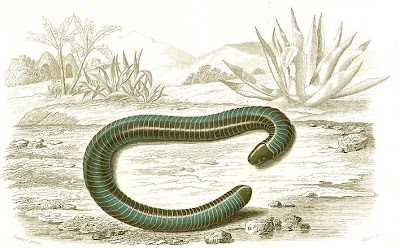


19th-Century colour engraving of a Siphonops caecilian