Dr KARL SHUKER

Zoologist, media consultant, and science writer, Dr Karl Shuker is also one of the best known cryptozoologists in the world. He is the author of such seminal works as Mystery Cats of the World (1989), The Lost Ark: New and Rediscovered Animals of the 20th Century (1993; greatly expanded in 2012 as The Encyclopaedia of New and Rediscovered Animals), Dragons: A Natural History (1995), In Search of Prehistoric Survivors (1995), The Unexplained (1996), From Flying Toads To Snakes With Wings (1997), Mysteries of Planet Earth (1999), The Hidden Powers of Animals (2001), The Beasts That Hide From Man (2003), Extraordinary Animals Revisited (2007), Dr Shuker's Casebook (2008), Karl Shuker's Alien Zoo: From the Pages of Fortean Times (2010), Cats of Magic, Mythology, and Mystery (2012), Mirabilis: A Carnival of Cryptozoology and Unnatural History (2013), Dragons in Zoology, Cryptozoology, and Culture (2013), The Menagerie of Marvels (2014), A Manifestation of Monsters (2015), Here's Nessie! (2016), and what is widely considered to be his cryptozoological magnum opus, Still In Search Of Prehistoric Survivors (2016) - plus, very excitingly, his four long-awaited, much-requested ShukerNature blog books (2019-2024).

Dr Karl Shuker's Official Website - http://www.karlshuker.com/index.htm

IMPORTANT: To view a complete, regularly-updated listing of my ShukerNature blog's articles (each one instantly clickable), please click HERE!

IMPORTANT: To view a complete, regularly-updated listing of my published books (each one instantly clickable), please click HERE!

IMPORTANT: To view a complete, regularly-updated listing of my Eclectarium blog's articles (each one instantly clickable), please click HERE!

IMPORTANT: To view a complete, regularly-updated listing of my Starsteeds blog's poetry and other lyrical writings (each one instantly clickable), please click HERE!

IMPORTANT: To view a complete, regularly-updated listing of my Shuker In MovieLand blog's articles (each one instantly clickable), please click HERE!

IMPORTANT: To view a complete, regularly-updated listing of my RebelBikerDude's AI Biker Art blog's thematic text & picture galleries (each one instantly clickable), please click HERE!

Search This Blog


PLEASE COME IN, I'VE BEEN EXPECTING YOU...

PLEASE COME IN, I'VE BEEN EXPECTING YOU...
WELCOME TO SHUKERNATURE - ENJOY YOUR VISIT - BEWARE OF THE RAPTOR!


Showing posts with label macaws. Show all posts

Sunday, 23 February 2014

DOMINICA'S DEAD PARROT - A PERFECT PICTURE OF MYSTERY?

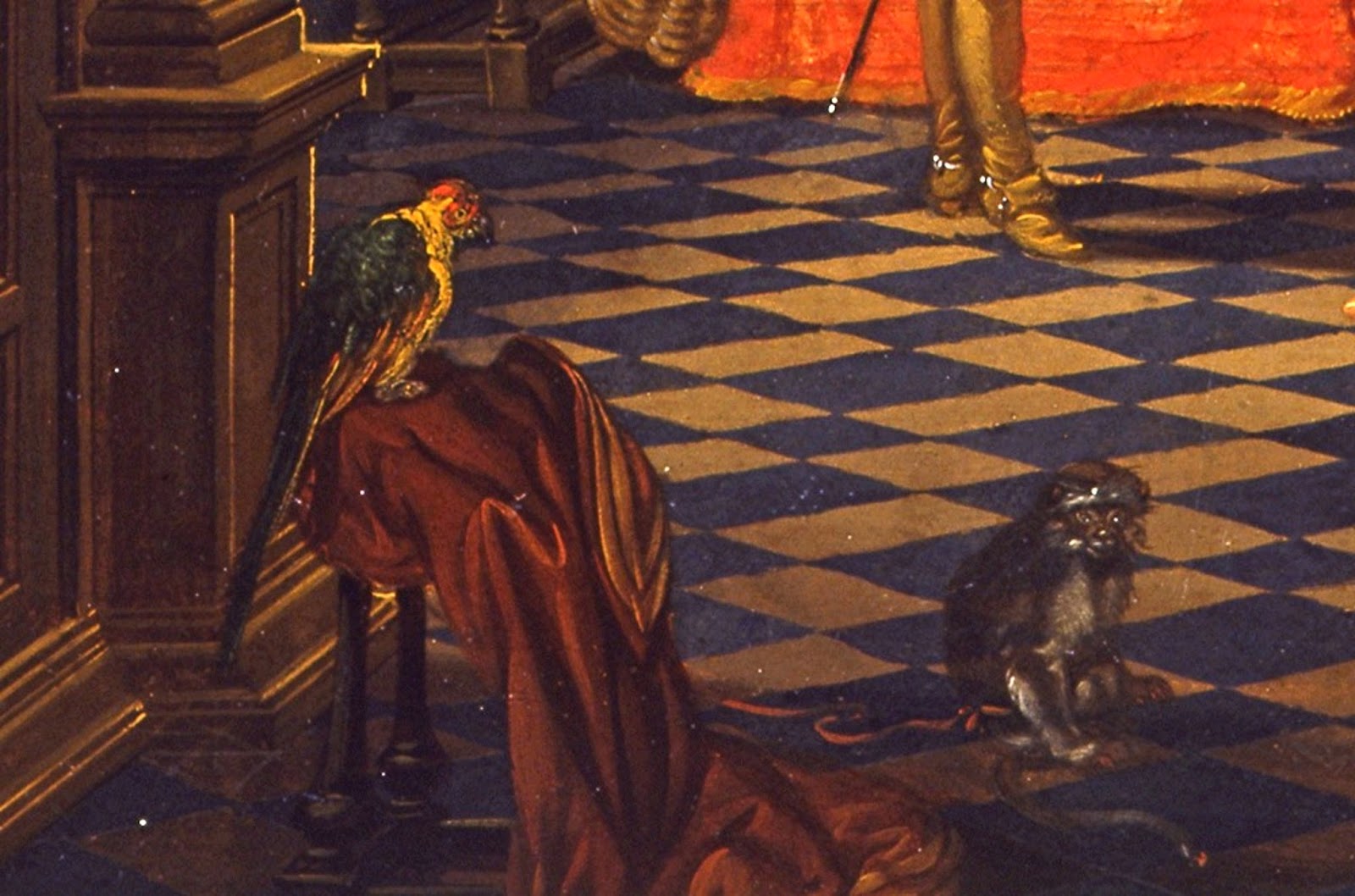
Close-up of the mystery parrot in Bartholomeus van Bassen's famous painting 'Renaissance Interior With Banqueters' (1618-1620) (this high-res image supplied to me courtesy of Michael Klauke, Associate Registrar for Collections at the North Carolina Museum of Art)

In various of my books, magazine articles, and ShukerNature blog posts, I have documented a number of mystery birds that have appeared in paintings by famous artists and which may conceivably represent lost species undescribed by science. In recent times, several additional examples have come to my attention, but perhaps the most significant of these is the following one, which may feature a hitherto-unrecognised depiction of a long-extinct bird officially known only from a single verbal description.

Bartholomeus van Bassen (1590-1652) was a celebrated Dutch architect and painter. Perhaps his most famous painting was 'Renaissance Interior With Banqueters' - an extremely detailed, sophisticated work of art that took from 1618 to 1620 to complete. Having said that, although I naturally cannot help but be highly impressed by its scale and by the architectural splendours and opulence that it depicts, the most fascinating aspect of it for me is an ostensibly insignificant bird perching upon a chair in this painting's bottom left-hand corner. Closer examination of this bird reveals it to be a parrot, but it does not appear to correspond with any species known to be living today. What could it be?

Bartholomeus van Bassen's famous painting 'Renaissance Interior With Banqueters' (1618-1620) (this high-res image supplied to me courtesy of Michael Klauke, Associate Registrar for Collections at the North Carolina Museum of Art)
Please click painting to view it in greatly-enlarged form.

Whenever an identification of a mystifying bird in a painting is attempted, it should always be borne in mind that artists have often included entirely fictitious examples in their works, simply to enhance their visual appeal. In this particular case, conversely, van Bassen's painting is so meticulously executed and so accurate in all other details, including those of other creatures included in it, that it seems highly unlikely that he would have added a made-up bird.

This fascinating case was first brought to my attention during spring 2012 ago by pet expert and fellow author David Alderton, with whom I have since corresponded in some detail concerning this mystery parrot. With regard to the possibility that it is an ornithological invention on van Bassen's part, David shares my own view that this is improbable:

"What I would say is that the other animals in the scene are very clearly recognisable. Based on its position in the painting, and its perch on rare/expensive material, this tends to suggest that this parrot is significant. It would have been rare and exotic of course - representing a flamboyant display of wealth in a very clear visual way, and I can't see it would have been a "fictional" bird."

So if we assume that the parrot represents a bona fide species, are there any that resemble it in some way?

On first glance, it recalls the Carolina parakeet Conuropsis carolinensis, a predominantly green-plumaged species with a bright yellow head marked with red. Once common in North America, it suffered greatly from habitat destruction, from being captured for the pet trade, and by being heavily persecuted due to its fondness for farmers' crops, until the last confirmed specimen died in Cincinnati Zoo in 1918. Closer observation, however, reveals a number of marked differences between this now-demised species and van Bassen's painted parrot.

John James Audubon's famous painting of Carolina parakeets (eastern subspecies)

The latter has golden-yellow underparts, whereas the Carolina parakeet's were green; it also has yellow lateral tail feathers whereas all of the Carolina's tail feathers were green; its wing primaries are red, not green like the Carolina's; the red markings on its head are more extensive than the Carolina's; and its relative proportions are very different from the Carolina's. Van Bassen's parrot has a much longer tail, a more powerful beak, and, judging scale from the chair upon which it is perched, a much larger overall body size. Indeed, in general appearance, the category of parrots that it most closely agrees with is the macaws.

Consequently, attempts to liken it to various small species of South American conure parakeet, such as the sun conure Aratinga solstitialis and the jenday conure A. jandaya, are not satisfactory either, unless of course the bird has been badly painted, with incorrect plumage and/or dimensions. For all of the reasons already discussed in relation to the prospect of its being a fictitious species, however, this notion seems untenable.

Two jenday conures (left and middle) and a sun conure (right) ((c) Chris Gladis/Wikipedia)

However closely one studies images of a painting, even close-up ones of a specific section of it, there can be no substitute for viewing the painting itself directly. Happily, David Alderton was able to do precisely this, when 'Renaissance Interior With Banqueters' was on display several years ago at the National Gallery in London. As a result, he noticed various features of the parrot not readily visible even in close-up images of it. These include the presence of a white brow line above its eye, and, of particular interest, the extensive amount of bare white facial skin – a feature that is characteristic of macaws. Usually this area is limited to the sides of the face around the eyes, and at the beak's base, but in van Bassen's bird it also extends onto the top of the head.

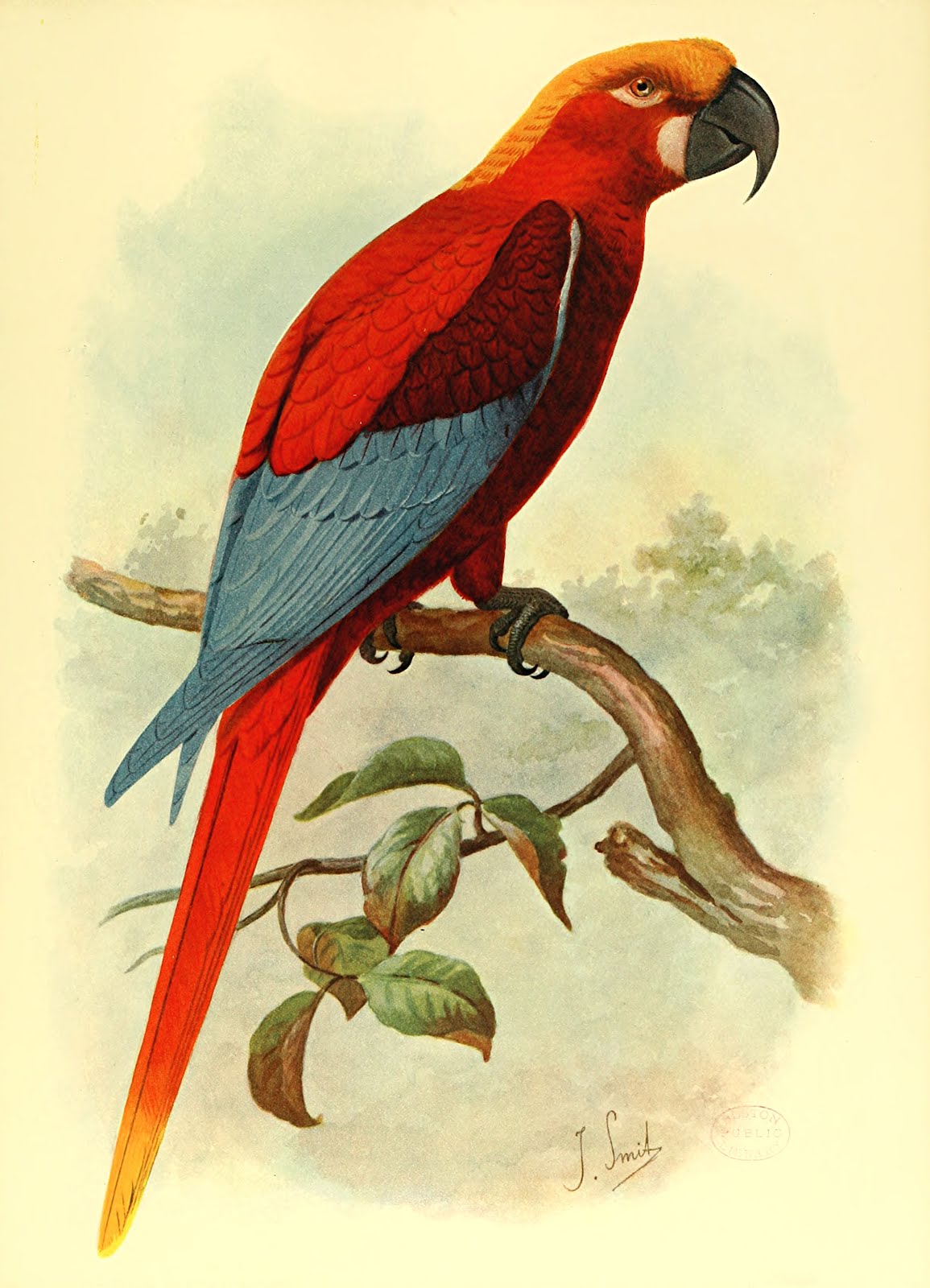
After viewing the bird directly in the painting, David wondered whether it may be a Cuban red macaw Ara tricolor, whose last confirmed wild specimen was shot in 1864, since when this species has been deemed to be extinct. However, in a short account of van Bassen's mystery parrot that he posted on his Pet Info Club website (http://www.petinfoclub.com/Collectibles/Painting_portrays_extinct_parrot.aspx), he conceded that the Cuban macaw's plumage exhibited certain noticeable differences from the latter's, which indeed it does. The most significant of these are the Cuban red macaw's blue wing primaries, its red cheeks, neck, and underparts, its red and blue tail feathers, and the much less extensive area of white facial skin. Exit the Cuban red macaw from further consideration.

Cuban red macaw (from Walter Rothschild's book Extinct Birds, 1907)

However, the Cuban red macaw is not the only extinct Caribbean macaw on record. Several additional species from a number of different West Indian islands – including Guadeloupe, Jamaica, Dominica, Hispaniola, and Martinique - have also been described and named (click here for a detailed ShukerNature article of mine investigating these mystery macaws). Yet whereas the Cuban is physically represented in various museums by a number of preserved specimens, these others are known only from eyewitness descriptions (plus some paintings based solely upon them, not directly upon living specimens). And some of those descriptions are so vague that ornithologists have dismissed certain of the Caribbean's 'lost' macaws as hypothetical species - originating from confusion with known parrots, or even based upon specimens of various South American species of macaw introduced into the West Indies as pets that may have subsequently escaped.

One of the most interesting of these Caribbean mystery macaws is the Dominican green and yellow macaw Ara atwoodi, named after traveller Thomas Atwood, whose History of the Island of Dominica (1791) contains the following informative account of it:

"The mackaw [sic] is of the parrot kind, but larger than the common parrot [this latter parrot actually constituting two separate but closely-related species of much smaller Amazon parrot], and makes a more disagreeable, harsh noise. They are in great plenty, as are also parrots in this island; have both of them a delightful green and yellow plumage, with a scarlet-coloured fleshy substance from the ears to the root of the bill, of which colour is likewise the chief feathers of the wings and tails. They breed on the tops of the highest trees, where they feed on the berries in great numbers together; and are easily discovered by their loud chattering noise, which at a distance resembles human voices. The mackaws cannot be taught to articulate words; but the parrots of this country may, by taking pains with them when caught young. The flesh of both is eat [sic = edible], but being very very fat, it wastes in roasting, and eats dry and insipid; for which reason, they are chiefly used to make soup of, which is accounted very nutritive."

It certainly must have been, because however plentiful these macaws were in Atwood's day, their numbers must have swiftly diminished thereafter, because his description is all that remains to suggest that they ever existed at all. No other reports of them, and no preserved specimens or paintings of living specimens, are known – unless...

A photoshop-created representation of the Dominican green and yellow macaw's possible appearance in life ((c) Rafael Silva do Nascimento)

There is no doubt that Atwood's description of the Dominican green and yellow macaw accords well with the parrot in van Bassen's painting - incorporating the precise configuration of its head's red colouration, its red wing feathers, and obviously its predominantly green and yellow plumage. True, Atwood did not mention any area of white on the Dominican macaws' faces, but it is worth noting that in some species of macaw this region turns red if the bird becomes excited, so perhaps he simply didn't observe any macaws when in a quiescent state, only when they were squawking animatedly while feeding.

Consequently, the only inconsistency in appearance between van Bassen's bird and Atwood's Dominican macaws is the mention of red tail feathers in his description, whereas the central tail feathers of van Bassen's parrot are green and the lateral ones are yellow. Perhaps, however, there was a slight degree of variation in the plumage colouration of the Dominican macaw (sexual dimorphism, for instance?) that could account for this discrepancy? In all other respects, the match is much closer than for any other species, living or extinct.

In 2011, a year before I made known to him the mystery parrot in van Bassen's painting, Brazilian bird artist Rafael Silva do Nascimento had prepared a beautiful painting of his, own reconstructing the likely appearance of the Dominican green and yellow macaw as based upon Atwood's description of it, which is reproduced here with Rafael's kind permission. As you can see, his macaw and van Bassen's parrot, prepared entirely independently of one another, accord very closely indeed, providing further confirmation of just how well Atwood's verbal description compares with van Bassen's painted bird.

Rafael Silva do Nascimento's painting of the Dominican green and yellow macaw ((c) Rafael Silva do Nascimento)

So could it be that the enigmatic parrot perched in this highly-renowned Dutch artist's early 17th-Century painting was a living Dominican green and yellow macaw, brought back to Europe as an eyecatching pet by (or for) a wealthy Dutch citizen? During that period, all manner of rare and extremely exotic fauna were being transported here from every known corner of the globe, many of which had never before been seen in Europe. Consequently, a colourful macaw would be nothing special or unexpected on that score.

What would be very special, and extremely unexpected, conversely, is if the macaw species in question subsequently became extinct but its exquisite appearance was preserved under the very nose of every art-lover in an extremely famous, spectacular painting, yet without its identity or zoological significance being recognised – until now?

If true, this is a great tragedy. After all, to paraphrase a certain classic comedy sketch from the golden age of British television, it may be an ex-parrot, but it had lovely plumage.


I wish to offer my sincere thanks to David Alderton for bringing this extremely intriguing crypto-ornithological mystery to my attention and for kindly sharing his thoughts and information concerning it with me; to Michael Klauke, Associate Registrar for Collections at the North Carolina Museum of Art, for most generously making available to me some high-resolution and close-up images of van Bassen's painting and its mystifying parrot; to Rafael Silva do Nascimento for very kindly permitting me to include his Dominican macaw painting here and also for providing me with a copy of Atwood's original description of Dominica's macaws; and to all of my Facebook friends who offered opinions and suggestions regarding this painted bird's possible identity when I posted an enquiry regarding it on my FB Wall in April 2012.
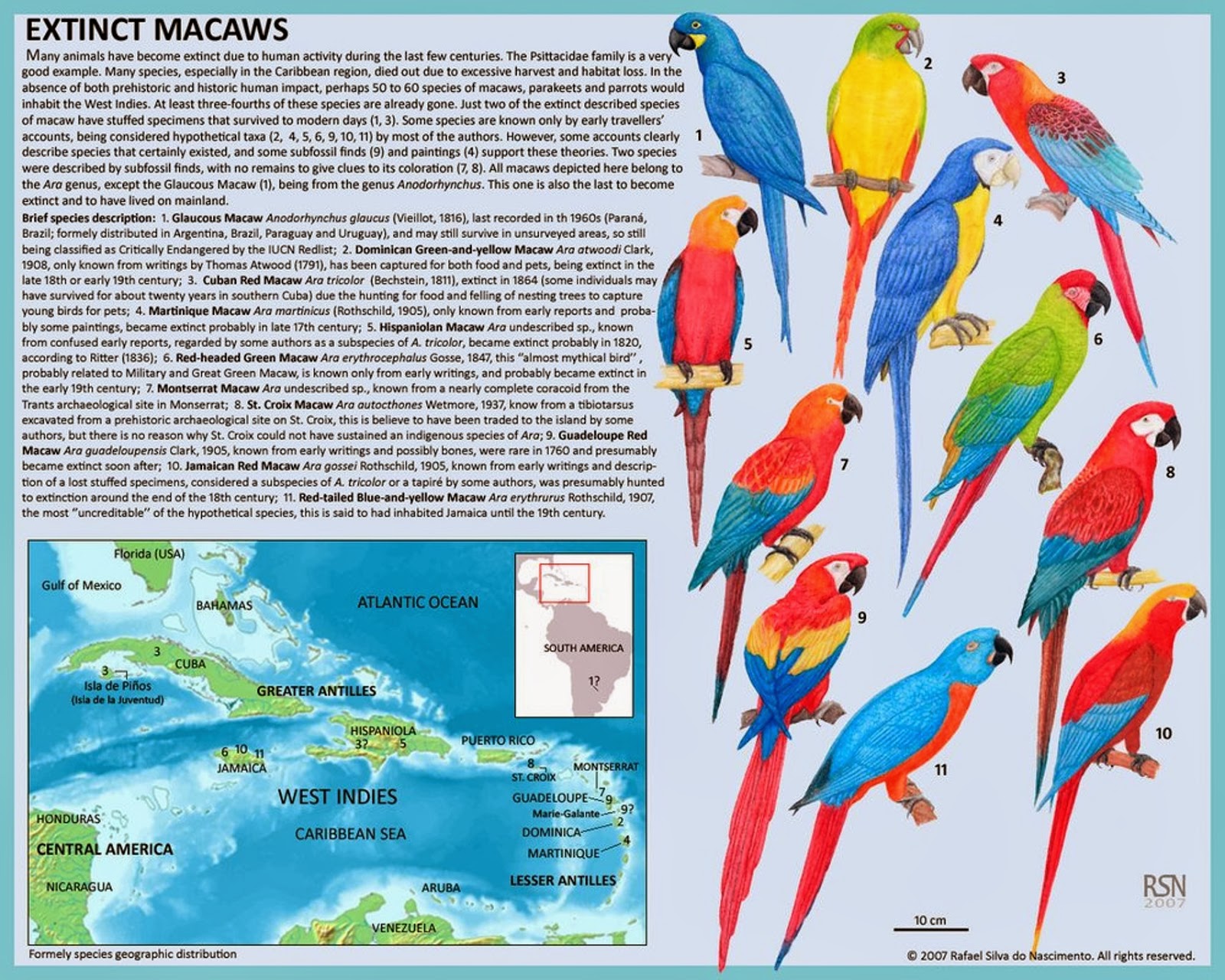
Reconstructions of the likely appearance of the various extinct species of West Indian macaw that have been reported by various travellers and subsequently named by scientists ((c) Rafael Silva do Nascimento)


Friday, 18 November 2011

WHATEVER HAPPENED TO THE PURPLE MACAW?

John G. Keulemans's painting of the purple macaw in Lord Walter Rothschild's Extinct Birds (1907)

Famed for their gaudy plumage, macaws come in many colours, but purple has never been one of them – or has it?

The genus Anodorhynchus – the so-called blue macaws - contains three present-day species (though one of them, the glaucous macaw, may have lately become extinct). Interestingly, in terms of plumage colouration, this genus's trio can be arranged in a very neat gradation, beginning with, as its name indicates, the intense hyacinth-blue shade of the hyacinth (or hyacinthine) macaw A. hyacinthinus, then moving subtly into the slightly more turquoise-blue hues of Lear's macaw A. leari, which then transforms further, yielding a paler, turquoise-green shade, in the aptly-named glaucous macaw A. glaucus.

Brazilian postage stamp portraying all three species of recognised Anodorhynchus macaw - hyacinth (left), glaucous (centre), Lear's (right)

But what if this colour gradation were also extrapolated in the opposite direction? That is, in addition to the hyacinth macaw's striking blue hue faintly greening into turquoise and thence even more so into a glaucus tone, how about deepening it, to yield a macaw whose plumage was a darker, predominantly violet or purple shade? If this quartet of macaws were then arranged in a continuous linear spectrum of transforming colour, running from purple into blue into turquoise-blue into pale turquoise-green, the line-up would be: purple macaw, hyacinth macaw, Lear's macaw, and glaucous macaw. Of course, the purple macaw is purely hypothetical – isn't it?

In reality, such a bird may indeed have existed. Based upon certain centuries-old eyewitness accounts, in 1905 no less an ornithological authority than Lord Walter Rothschild - founder of the famous ornithological museum at Tring in Hertfordshire (now part of London's Natural History Museum but still based at Tring) - formally described a mysterious long-extinct macaw-like bird from Guadeloupe, which he christened Anodorhynchus purpurascens, the purple macaw (also referred to by some authorities as the violet macaw, and sometimes accorded the incorrect specific name purpurescens). His description of it was published in volume 16 of the British Ornithologists Club's Bulletin.

A pair of photoshopped purple macaws (original source unknown to me)

Rothschild also included this species in his book Extinct Birds (1907), together with the specially-prepared colour plate included here in this ShukerNature post of mine. His original source of information was a brief account penned by a 'Don de Navarette', entitled 'Le gros Perroquet de la Guadaloupe [sic]', which appeared in Rel. Quat. Voy. Christ. (1838). This writer was actually none other than Martin Fernández de Navarrete y Ximénez de Tejada (1765-1844) - a Spanish sailor-historian who rediscovered an abstract by Spanish reformer-bishop Bartolomé de las Casas (1484-1566) of the log made by Christopher Columbus during his first voyage to the West Indies.

This account stated that according to Columbus, who visited the island in November 1493 during his second New World voyage, there lived on Guadeloupe a very large type of macaw that was entirely of a deep, intense violet/purple colour, and which the native Carib people referred to as the oné couli. No such bird lives there today, however, and neither a single preserved specimen nor even an illustration prepared directly by an eyewitness exists of this enigmatic purple macaw.

Conversely, until the early 18th Century, a second species of parrot with violet feathers definitely did live there. This was the Guadeloupe amazon parrot Amazona violacea, which was formally described and named by German naturalist Johann Friedrich Gmelin in 1789, around which time it became extinct, due to hunting for food and wholesale clearance of the forests in which it thrived.

John G. Keulemans's painting of the Guadeloupe amazon parrot in Lord Walter Rothschild's Extinct Birds (1907)

Although, just like the purple macaw, there is no known preserved specimen of the Guadeloupe amazon in existence, unlike the purple macaw this showy parrot is nonetheless known from good, consistent descriptions of it given by several naturalists (such as Jean-Baptiste Labat, and French zoologist Mathurin Jacques Brisson) and travellers (notably French missionary Jean-Baptiste Du Tertre). Consequently, in his authoritative book Extinct and Vanishing Birds of the World (2nd revised edit., 1967), ornithologist James C. Greenway Jr from the American Museum of Natural History suggested that Navarrete's description of the violet-plumed oné couli may in fact have been nothing more than "a careless description of A. violacea".

In my view, however, it would need to have been an exceptionally careless description in order to confuse a long-tailed parrot the size of a macaw with a much smaller, short-tailed amazon. Moreover, whereas the purple macaw was said to be entirely violet/purple, in the Guadeloupe amazon this particular colour was confined predominantly to its head and neck (and even there it was a slaty black-violet rather than an intense purple). In stark contrast, this amazon's back, tail, and much of its wings and underparts were deep green, with portions of its wings additionally sporting bright yellow, red, and jet-black feathers. Not only with regard to its size and shape, therefore, but also in relation to its multicoloured plumage, I fail to see how this species could in any way be mistaken for a wholly purple macaw.

Extinct and Vanishing Birds of the World (2nd revised edit., 1967) by James C. Greenway Jr

A second suggestion offered by Greenway, and one that is also supported by various other ornithological scholars, is that Guadeloupe's purple macaws may simply have been hyacinth or even Lear's macaws imported by trading natives into Guadeloupe from the South American mainland. Again, however, it is difficult to see how the unequivocally blue plumage of the former species or even the slightly more turquoise tones of the latter one could come to be described as deep violet or purple.

So here, leaving it lingering perpetually in a shadowy ornithological limbo as a avian of tantalising ambiguity unless any additional information concerning it should one day become available, is where we must take our leave of Guadeloupe's very perplexing purple macaw – a bird that may, or may not, have existed, but which, if it truly did, and was indeed a macaw, must surely have been one of the most beautiful creatures ever seen by the eyes of its extremely fortunate beholders.


UPDATE - DON'T FORGET ABOUT THE BLACK MACAW EITHER!

On 16 May 2012, I received a much-anticipated newly-published book – Extinct Birds, by Julian P. Hume and Michael Walters. Unquestionably the most detailed book ever prepared on the subject, it documents many extraordinarily obscure species and subspecies that, despite my longstanding interest in such birds, were new to me.

One of these was the black macaw Anodorhynchus ater, a truly cryptic species in every sense. It was first documented by De Laet in 1630, and then described by British naturalist Dr John Latham in 1781 (who dubbed it the black macaw), followed by German naturalist Johann F. Gmelin in 1788 (basing his description upon Latham's and christening it Psittacus ater – its first taxonomic name). According to these accounts, the black macaw was native to Guyana, but Hume & Walters consider it to be an invalid taxon based upon inadequate descriptions. I have yet to see the three accounts noted above, but if I can locate any of them, I will expand this section accordingly at a later date.

Incidentally, this mysterious macaw should not be confused with the very familiar hyacinth macaw A. hyacinthinus, which is occasionally dubbed the black macaw, due to its local Tupi Indian name, 'arara una', which translates literally as 'dark macaw' or 'black macaw' (even though its plumage is blue!).

A fake online photograph of a purple-plumaged macaw, resulting from computer modification by person(s) unknown of an online photograph of a hyacinth macaw (source unknown to me)


Friday, 21 October 2011

WHO'S A PRETTY MYSTERIOUS POLLY, THEN?

'Dodo and Red Parakeet' - c.1773, attributed to William Hodges


What is it with paintings of dodos and red parrots? In a previous ShukerNature post, I investigated the still-unidentified red mystery macaw depicted in a famous painting of the dodo by Flemish artist Roelandt Savery in 1626. Now, I've just discovered a contentious painting popularly assumed (but not confirmed) to be by English painter William Hodges (1744-1797) portraying a dodo, and what do I find also depicted in that painting? You've guessed it – another unidentified red mystery parrot!

William Hodges took part in Captain James Cook's second Pacific Ocean voyage (1772-1775), and is chiefly remembered today for the various paintings and sketches that he produced during that voyage, which visited a number of exotic Pacific locations, including Tahiti, Easter Island, and the sub-Antarctic, as well as South Africa's Table Bay in the south Atlantic.

Consequently, it came as something of a surprise to me recently when I came upon a certain painting, unsigned but generally attributed to Hodges, that portrayed a dodo Raphus cucullatus - a species native to Mauritius in the Indian Ocean until its extinction there around 1681, i.e. several decades before Hodges was even born. Clearly, therefore, assuming that he is indeed the artist who produced this work, Hodges cannot have painted his dodo from life, so he must have drawn his inspiration for it from depictions by other, earlier artists. And indeed, it does closely resemble dodos portrayed in various previous works (particularly Roelandt Savery's afore-mentioned dodo painting from 1626).

Roelandt Savery's 1626 dodo painting, featuring a red mystery macaw to the left, and an equally mysterious green and yellow macaw at top right

Entitled 'Dodo and Red Parakeet', and measuring 23 x 27.5 cm, this alleged Hodges oil on academy board painting is believed to have been produced in c.1773, and is part of the Rex Nan Kivell Collection, housed at the National Library of Australia. Indeed, it was Rex Nan Kivell who provided the controversial attribution of this painting to Hodges. Yet until now, it has seemingly attracted little zoological interest, and does not even feature in acclaimed bird painter-author Errol Fuller's very comprehensive book Dodo: From Extinction to Icon (2002).

In reality, however, it deserves very serious attention, not only on account of the question mark regarding the artist responsible for its creation but also due to the parakeet that it portrays – because this remarkable bird does not appear to resemble any known species alive today or extinct in historic times.

There is no indication of whether this parakeet and the dodo were painted to the same scale, so the parakeet's absolute size cannot be estimated from the painting. Incidentally, due to its long tail I refer to it as a parakeet rather than a parrot. Moreover, although in terms of relative proportions its slender, long-tailed form also recalls that of a macaw, it lacks the distinctive match of bare facial skin characterising all of these large or very large species, and it seems to possess a crest (albeit a somewhat wispy one), which no known species of macaw does. As for its highly distinctive colour combination of bright red head, back, underparts and tail coupled with deep bronze-green wings: when added to its body shape and crest, this collectively delineates it from all other parrots on record.

Curiouser and curiouser, as Alice - who famously encountered a dodo and a parakeet when visiting Wonderland - might well have said!

Sir Arthur Tenniel's famous illustration of Alice and the dodo (with the parakeet among the crowd of animals in the background); incidentally, Tenniel's dodo also seems to have been inspired by Savery's version

So what exactly is the alleged Hodges painting's mystifying crested red parakeet (is it even real, or just an invention of the artist?), where did it originate, and where did whoever the painting's artist is see it? So far, I have been unable to answer any of these telling questions – which is where, gentle readers, you come in!

If any of you have information relating to this intriguing painting, the identity of its artist, or, in particular, the enigmatic parakeet depicted in it, I would very greatly welcome any details that you could post here on ShukerNature or on my Facebook wall, or could email to me at karlshuker@aol.com – many thanks indeed!

UPDATE - 25 October 2011

After posting the above account on ShukerNature four days ago, I contacted two dodo authorities for their opinions concerning the alleged Hodges painting and, in particular, the enigmatic red parakeet depicted in it. One of these authorities was the afore-mentioned dodo author Errol Fuller, who emailed me his thoughts just a few hours after my blog post had appeared, and also kindly gave me permission to quote them. So here they are:

"The dodo element to the painting is clearly a derivative from the famous picture by Roelandt Savery that is now in The Natural History Museum. Whether it was copied directly from that picture or from a copy of it I can't, of course, tell. However, the parrot is another matter. In the Savery painting there is a parrot in the same place, but it is a macaw. My own suspicion is that this is just an invented parrot, just put in for decorative purposes - however, I could be wrong, and would be happy to be proved so. It certainly doesn't match any parrot that I know of, so if it is a genuine portrait of a bird, rather than a made up image, then it is something unknown.

"As far as the Hodges attribution is concerned, I can see nothing to stylistically link this with Hodges. My feeling is that it has nothing to do with him. Therefore there is no real reason to necessarily give the parrot a Pacific origin. There are, of course, a number of parrots from Mauritius known only by skeletal material, so if this is a genuine attempt to show Mauritian birds, it could be one of these. This is something of a conceptual leap, however."

This accords well with my own views, but it would be wonderful if some additional, physical evidence could be uncovered that might tilt the balance one way or the other, i.e. either towards the parakeet being an invention or towards it being a genuine, but seemingly unknown species. Just four days later, that elusive evidence arrived, in the form of a fascinating engraving.

Today, 25 October 2011, I received an email from the second dodo authority contacted by me, Jolyon ('Joe') C. Parish, whose own dodo book is due to be published soon; he is also in the process of establishing an accompanying website, 'The Dodologist's Miscellany'. Not only was he already familiar with the alleged Hodges painting, he had also encountered a pertinent engraving that I had not seen before, and which he kindly emailed to me with his reply, which was as follows:

"Strangely enough, I was just looking at the very same picture on the NLA website only a matter of hours before I got your message (what a coincidence!) There is an engraving in Broderip (1833)* [William J. Broderip, Vice-President of the Zoological Society of London at that time], which shows the dodo and parrot (albeit sans crest), taken from Savery’s British Museum painting (see attached). As Broderip does not mention Hodges, or indeed any painting with a dodo and red parakeet, in the article (or in his subsequent articles), it might indicate that the engraving was the original (taken from Savery’s painting, albeit with modification) and that the red parakeet picture was made afterwards, based on this. I don’t know the reasons for the attribution of the painting to Hodges.

"If the painting was made from the engraving, rather than vice versa, then the colouring would probably be imaginary (as with the parrot’s/parakeet’s head crest). It would be interesting to find out the reasons behind the attribution of the picture to Hodges and its date to decide the matter."

The dodo and parrot engraving in Broderip's article

What is so remarkable, and telling, about this engraving (which, incidentally, is an early one, long pre-dating Broderip's 1833 article) is that it is tantalisingly intermediate between Savery's dodo painting and the version attributed to Hodges. I have reproduced this engraving here, and as can be readily seen, not only is the dodo in it clearly based upon Savery's, but it also includes the macaw present in the top-right section of Savery's painting. However, in the engraving it has been transformed somewhat, so that although there are still sufficient similarities between the two parrots for there to be no question that the engraved version was indeed inspired by Savery's macaw, it has a number of noticeable differences too - differences, moreover, which the Hodges parakeet also exhibits and, in some cases, enhances even further, as with the crest.

The three images together, for direct comparison purposes (click pic to enlarge)

In my opinion, therefore, it seems likely that the engraving in Broderip's article was inspired by Savery's painting, and that the alleged Hodges painting was inspired by the engraving in Broderip's article, because the right-hand parrot exhibits a clearly visible transition in transformation from Savery's macaw to the Broderip engraving's parrot to the Hodges parakeet. Moreover, whereas both the engraving's dodo and the Hodges dodo are similar to Savery's, the Hodges dodo is virtually identical to the engraving's, thus providing further evidence that the alleged Hodges painting was inspired directly by the engraving, rather than directly by Savery's painting.

As a result, I now believe it unlikely that the Hodges mystery parakeet is anything other than an invention...or at least I did until 16 November 2011!

SECOND UPDATE - 16 November 2011

Today I received a greatly-welcomed email from David Alderton, an acclaimed authority on parrots and other cage-birds and webmaster of http://www.petinfoclub.com/ who had just read this present ShukerNature blog. Here are his thoughts:

"My immediate impression on seeing the William Hodges painting, which I hadn't seen before - was that the parakeet is actually a cardinal lory (Chalopsitta cardinalis) - see below - which ranges from eastern parts of Papua New Guinea to the Solomon Islands. These birds don't have a crest as such, but they can raise the feathers on their foreheads to some extent when excited, aggressive etc.. Their colouring is highly distinctive."

Indeed it is, as seen here:

Cardinal lory

There is no doubt that, crest notwithstanding (or simply artistic licence?), the Hodges red mystery parakeet does indeed closely recall the cardinal lory, though, if this is the correct identification, why the painting's artist should combine a Mauritius dodo with an Australasian parrot is unclear. Yet even if this is true, the fact that in general pose and outline the Hodges parakeet readily mirrors the Broderip engraving's parrot still suggests that the engraving directly inspired the painting. In short, it may well be that the latter's artist used a cardinal lory as his subject, but painted it in the same pose as the engraving's parrot.

Cardinal lories, painted by John Keulemans

Having said that, however, certain noteworthy morphological differences are definitely apparent between the cardinal lory and the Hodges red mystery parakeet, such as the lory's patch of white bare facial skin, its shorter tail, and of course its lack of a crest (to my mind, the crest of the mystery red parakeet seems more pronounced than I'd expect from merely some raised brow feathers). Echoing my sentiments are those also received by me today from Errol Fuller:

"I can see no real reason to associate the bird in the picture with the lory. Certainly they are both red with a darker colour on the wings - but so what? This isn't enough to make a match. The parrot in the engraving also has a darker colour on the wing so the painter may have got his inspiration from that. Also, you can't just ignore the crest and the fact that the painted image has a long tail - unlike the lory. So to sum up I don't think this putative identification gets us anywhere.

I still think the most likely solution is that this is just a parrot made up for decorative purposes. Otherwise, this is a hitherto unknown species. But this seems highly - very highly - unlikely to me."

In his email, Errol - who, remember, is not only an author but also a highly accomplished bird painter himself - went on to point out that artists cannot always be relied upon to "get things right", because it is not always their intention to paint true to life:

"Artists have all sorts of reasons for doing what they do. They aren't necessarily trying to tell the absolute truth. Some of them aren't actually capable of it!

"What could be interesting would be to know the date at which the print made its first appearance. If we knew this we could perhaps rule Hodges out of the equation. Incidentally, in my mind he's already ruled out!"

So although the cardinal lory provides the closest match among real species to the Hodges mystery red parakeet, it may be that whoever painted it was merely inspired by this lory, rather than seeking to prepare a true-to-life depiction of it.

I have the feeling somehow that this cryptozoological conundrum is going to run and run - or should that be fly and fly?!

*BRODERIP, William J. (1833). Dodo. Penny Mag. Soc. Diffus. Useful Knowl., 75: 209–211. [reprinted in 1837 within The Penny Cyclopaedia, 9: 47.]

My sincere thanks go to Errol Fuller, Joe Parish, and David Alderton for their much-valued comments and thoughts.

Saturday, 26 March 2011

MYSTERY MACAWS OF THE WEST INDIES.

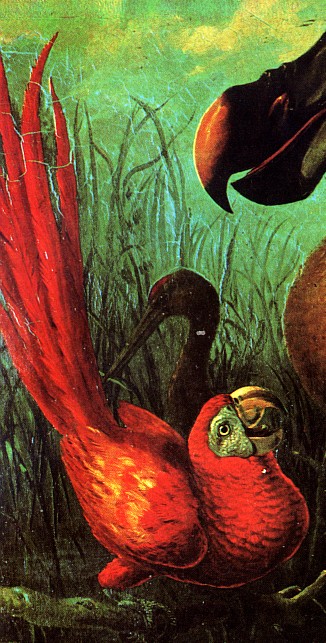
Close-up of the mysterious all-red macaw painted alongside the dodo in Keulemans's copy of Roelandt Savery's famous dodo painting


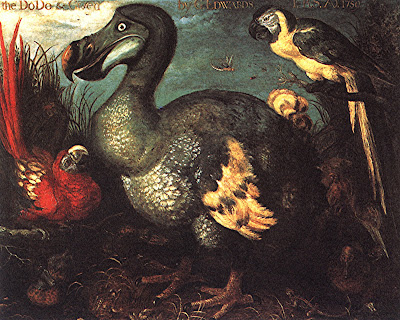
One of the most famous depictions of the dodo Raphus cucullatus is the beautiful oil painting by Flemish artist Roelandt Savery (1576-1639), which was painted in Holland in 1626. It was once owned by George Edwards (1694-1773), a very talented English bird painter and author in his own right, and it is now housed at London's Natural History Museum. This great work has become virtually the 'standard' notion of what the dodo looked like in life (though in more recent times, the veracity of its chubby form has been questioned), and has thus attracted great attention.

Roelandt Savery's famous dodo painting

In stark contrast, almost entirely ignored from an ornithological standpoint are the two very striking, colourful parrots that Savery painted to the dodo's immediate left and top-right in this same painting. Judging from their size and form, they are evidently macaws, but they do not resemble any known species. Apart from its green facial skin and some golden tinges to certain wing plumes, the left-hand macaw (seen in close-up in the illustration heading this present ShukerNature blog post) is almost entirely red. And the top-right macaw is totally green and yellow except for a black half-collar and white facial skin.

Interestingly, Japan's dodo expert Masauji Hachisuka owned a copy of Savery's painting, prepared by another famous but much later bird artist, John Gerrard Keulemans (1842-1912), which is a near-identical reproduction of Savery's, except that the colours of the macaws are more distinct (and the dodo itself is more brown than grey), emphasising the red plumage of the one bird and the green and yellow of the other.

Owned by Masauji Hachisuka, a copy by Keulemans of Roelandt Savery's dodo painting

If these macaws were meant to be real, it suggests that they may be lost (and possibly even undescribed) species, or unusual freak/hybrid individuals (but what happened to the specimens that they were based upon?). Or could they have been 'invented' by Savery purely as colourful support for the more prosaic plumage of the dodo? Or perhaps they did exist but Savery's depictions of them were based not upon physical specimens but instead upon inaccurate verbal descriptions of known species?

Oddly, the top-right macaw in Savery's painting looks very like the familiar blue and yellow macaw Ara ararauna of the South American mainland would look if its blue hues were completely replaced by green, so might it have been a rare colour mutant or even have been based upon a preserved, sun-faded skin? Or could the painting itself have faded? Even if any of these possibilities are true, however, and this macaw were indeed blue and yellow after all, it would still differ from A. ararauna - due to the fact that its under-tail coverts were yellow whereas those of A. ararauna are blue.

But what if it were genuinely green and yellow, and not blue and yellow? Although there is no species of macaw with almost exclusively green and yellow plumage alive today, two so-called green and yellow macaws, both now extinct, have been described and named from the West Indies. Having said that, one of these, the Jamaican green and yellow macaw Ara erythrocephala, which became extinct around 1842, also had a red head, blue wings, and a red-and-blue tail!

Jamaican green and yellow macaw Ara erythrocephala, from Lord Walter Rothschild's book Extinct Birds (1907)

But the other one, the Dominican green and yellow macaw Ara atwoodi, believed to have died out around 1800, was indeed predominantly green and yellow. Today, it is known directly only from a short description penned by Thomas Atwood (after whom it was named) in his The History of the Island of Dominica (1791). Here are the relevant pages:

Atwood's description of the Dominican green and yellow macaw as it appeared in his book

Could it be that at least one such bird was brought back to Holland, perhaps as a pet, over two centuries earlier, thereby explaining the tantalising bicoloured macaw in Savery's painting?

Dominican green and yellow macaw Ara atwoodi (Rafael Silva do Nascimento)

And what of Savery's other mystery macaw? Various red macaws seemingly existed several centuries ago on Guadeloupe and Hispaniola. Indeed, when visiting Guadeloupe in 1493, Christopher Columbus's landing party claimed to have observed "red parrots as large as chickens" there (or guacamayos, as referred to by the native Caribs at that time). Furthermore, during the 1650s, French missionary Jean-Baptiste Du Tertre described these very distinctive red macaws of Guadeloupe, which he termed the arras, as follows:

"The Arras is a sort of Parrot bigger than all the others. This is proved because those of Guadaloupe [sic] are larger than all the other Parrots, both those from the Islands as well as from the Mainland; while this Arras is larger than these by one third. It has the head, the neck, the belly and the back of the colour of fire; its wings are a mixture of yellow, azure, and crimson feathers; while the tail is entirely red and a foot-and-a-half long."

This bird has never been identified with any species alive today, but readily recalls Savery's mystery red macaw. Could a specimen brought back to Holland have thus been the model for his red macaw? Interestingly, in his book The Dodo and Kindred Birds (1953), Hachisuka included Keulemans's painting as the frontispiece and in the accompanying caption stated that the two macaws were indeed from the West Indies. Moreover, during the past few centuries the West Indies may have lost several endemic species of macaw.

Although I have since read more detailed accounts about them elsewhere, I first learned about the Caribbean's lost macaws from Purnell's Encyclopedia of Animal Life - an extremely comprehensive, authoritative six-volume wildlife encyclopaedia first published during the 1960s and edited by zoologists Drs Maurice Burton and Robert Burton - which included the following very succinct summary of most of them:

"The red macaw of Jamaica has not been seen since 1765 and the green and yellow macaw of the same island became extinct in the early 19th century. The Guadeloupe red macaw became extinct a century before this [i.e. during the early 1700s] and the Dominican green and yellow macaw in the late 18th Century. The Martinique macaw has not been heard of since 1640 and then there was one which has been called the mysterious macaw. No specimen of this is known but a description of it was published in 1658 - and that is all we know of it except that it lived on 'one of the West Indian islands'."

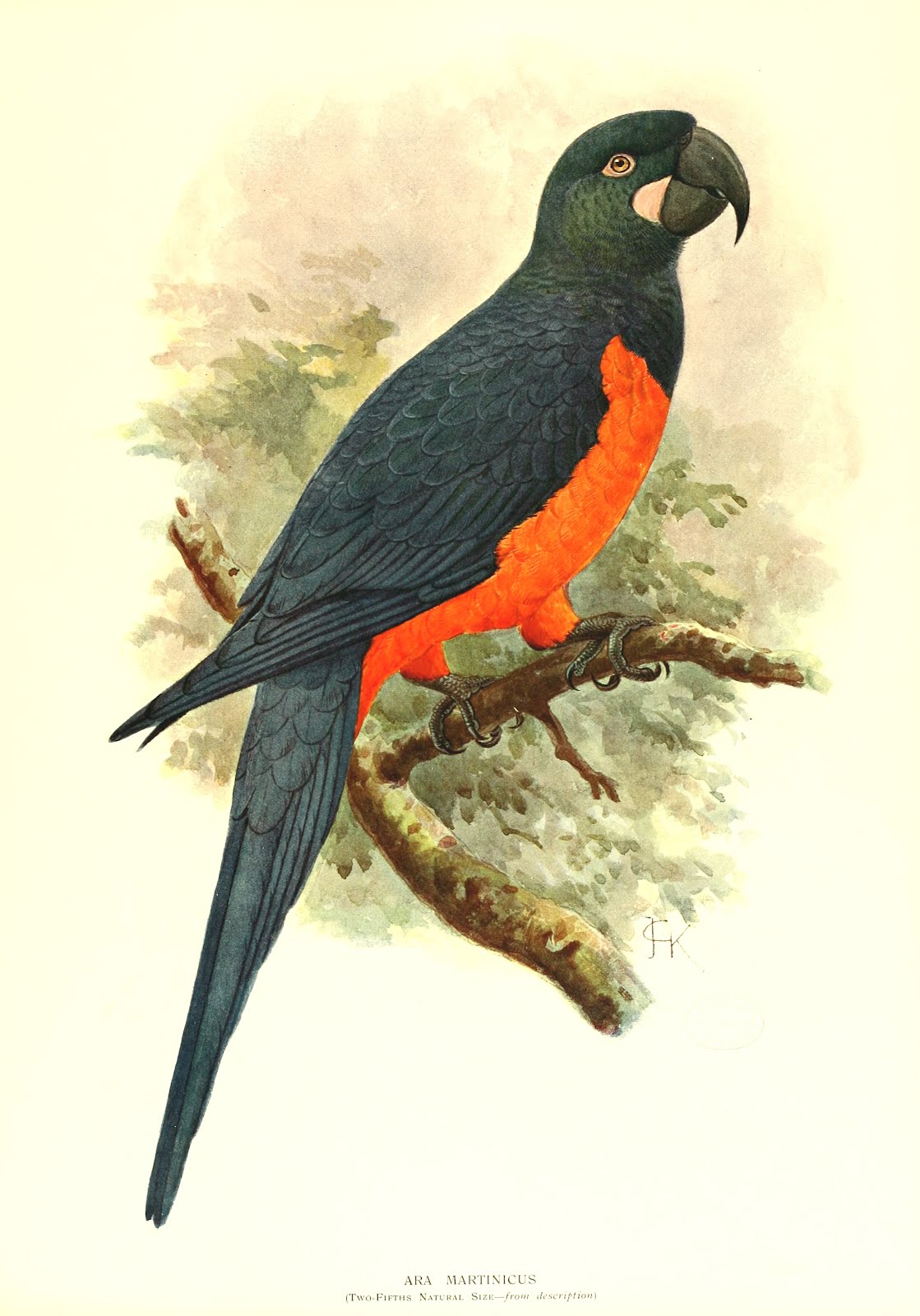
The red macaw of Jamaica is A. gossei, and is also known as the yellow-headed macaw; the Jamaican green and yellow macaw is A. erythrocephala; the afore-mentioned Guadeloupe red macaw, also known as the lesser Antillean macaw, is A. guadeloupensis; the Dominican green and yellow macaw is A. atwoodi; and the Martinique macaw is A. martinica. As for the 'mysterious macaw': this is A. erythrura, and nowadays it is also known as the red-tailed blue and yellow macaw, and is thought to have formerly existed either on Jamaica or on Martinique.

The 'mysterious macaw', aka the red-tailed blue and yellow macaw Ara erythrura (Gerard Keulemans, from Rothschild's Extinct Birds, 1907)

Additional erstwhile Caribbean macaws not noted above by the Burtons include the Cuban red macaw A. tricolor, the seemingly-unnamed Hispaniolan red macaw mentioned by me earlier, and the purple macaw Anodorhynchus purpurascens of Guadeloupe (click here for a ShukerNature post of mine devoted to this latter species and the even more obscure black macaw Anodorhynchus ater). Brief details and specially-commissioned full-colour paintings of most of the above forms appear in Lord Walter Rothschild's classic work Extinct Birds (1907); some of those illustrations are reproduced here.

Martinique macaw Ara martinica, from Rothschild's Extinct Birds (1907)

Yet because almost all of these ostensibly vanished macaws are known only from descriptions and paintings, not from any physical remains (the Cuban red macaw is the lone exception, being represented by several preserved specimens in various museums around the world), some ornithologists have discounted them as hypothetical species that may never have existed.

Cuban red macaw Ara tricolor, from Rothschild's Extinct Birds (1907)

Instead, they suggest, these intangible birds may have been based solely upon misidentified or inaccurately-described known species (possibly even escapee pets belonging to certain mainland South American species) or hybrids of known species.

Many very spectacular, multicoloured varieties of hybrid macaw have been bred in captivity. They include such well-established first-generation (F1) crossbreeds as the Catalina macaw (blue and yellow macaw x scarlet macaw), shamrock macaw (scarlet macaw x military macaw), harlequin macaw (blue and yellow macaw x red and blue macaw), calico macaw (red and blue macaw x military macaw), and even the intergeneric emerald macaw (Buffon's macaw x hyacinth macaw). Moreover, some of these F1 hybrid forms are themselves fertile, mating with various pure-bred macaws or other F1 hybrids to yield such exotic second-generation (F2) hybrids as the jubilee macaw (red and blue macaw x harlequin macaw), Camelot macaw (scarlet macaw x Catalina macaw), and Maui sunrise macaw (harlequin macaw x Catalina macaw). Remarkably, there are even some third-generation (F3) hybrid macaws on record, such as the Capri macaw (Camelot macaw x scarlet macaw) and the fiesta macaw (Camelot macaw x harlequin macaw).

Catalina macaw (Arkansas Lad/Wikipedia)

In addition, parrot expert Tony Pittman has mentioned to me that A. gossei might well have been A. tricolor brought or traded in from Cuba. He also noted that a very beautiful mutation of A. ararauna occurs naturally in Brazil where it is termed 'A. mosaica' (thereby providing a precedent for other mutations similarly occurring in the wild state and possibly even explaining some of the Caribbean's mysterious lost macaws).

Jamaican red macaw Ara gossei, from Rothschild's Extinct Birds (1907)

Irrespective of these latter contentious (albeit scientifically-named) macaw forms, however, there is always the intriguing possibility that there were others (certainly two, the enigmatic macaw of St Croix, St Vincent, A. autocthenes, known only from a single leg bone; and the unnamed Montserrat macaw, known from just a single coracoid) that died out before their physical appearance had even been documented - except, perhaps, for a couple of perplexing portraits alongside, ironically, the most famous demised bird of all, the dodo?

The extinct/mystery macaws of the West Indies (Rafael Silva do Nascimento)


POSTSCRIPT - MACAW MIX 'N' MATCH!

Over the years, I've acquired a number of cryptozoologically-relevant items from antique fairs, bric-a-brac markets, and even car boot sales, but sometimes what makes such a purchase so interesting is not what it is to begin with but what it can be converted into. This is well illustrated by the little figurine of a South American blue-and-yellow macaw A. ararauna that I purchased during the summer of 2012 for just £1.20 from a charity shop in Stratford-on-Avon.

Out of all of the lost Caribbean macaws the Dominican green-and-yellow macaw A. atwoodi has especially interested me because although today's surviving species of macaw collectively display a wide range of plumage colours and colour combinations, not a single species is predominantly green and yellow. Perhaps the nearest living species is the blue-and-yellow macaw, because if its blue feathers were replaced by green ones, it would then closely correspond with the reported appearance of the enigmatic A. atwoodi.

Seeing the little figurine of the blue-and-yellow macaw in the charity shop, it occurred to me that if I carefully repainted its blue plumage green, I could create my very own unique figurine of a Dominican green-and-yellow macaw! So I duly purchased it and took it back home, but then I had a change of plan. Why go to all the trouble of painstakingly painting the figurine by hand, and risk doing a less than perfect job, or even entirely ruining it, when all I needed to do was photograph the figurine, then convert its blue feathers into green ones digitally, on my computer? So that is what I did, and this is the result!

My original blue-and-yellow macaw figurine (left) and after being transformed digitally into a green-and-yellow macaw (right) (Dr Karl Shuker)

What a beautiful bird A. atwoodi must have been...always assuming of course that it did really exist to begin with!

My most sincere thanks to Rafael Silva do Nascimento for very kindly permitting me to include his beautiful macaw artwork in this ShukerNature blog post.

My very own Dominican green and yellow macaw figurine, courtesy of some CGI magic! (Dr Karl Shuker)


Monday, 11 May 2009

SOUTH AMERICAN MYSTERY BEASTS - Part 2

White-throated black jaguar (William Rebsamen)


A CRYPTOZOOLOGICAL CAT-ALOGUE FROM PERU

During several years of persistent field research, Peruvian zoologist Dr Peter Hocking has gathered convincing anecdotal testimony concerning at least four different kinds of mysterious Peruvian big cat all currently unrecognised by science.

One of these, reported from Peru's Ucayali and Pasco provinces, is particularly distinctive, because not only is it as large as a jaguar, but also it is said to be striped, just like a tiger. There is no known species of striped cat indigenous to South America, but reports of a large, highly elusive species of striped cat have previously been documented from Colombia and Ecuador. These latter reports are thought by some cryptozoologists to be evidence for the existence of a living species of sabre-toothed cat.

The second Peruvian mystery cat, known to the Amuesha native hunters and inhabiting the lower Palcazu River valley in Pasco province, is equally remarkable. It too is as large as a jaguar, but instead of possessing the jaguar's characteristic rosette markings, its entire body is uniquely patterned with solid black speckles. For this reason it has been variously nicknamed the speckled or mottled jaguar. Intriguingly, this description is reminiscent of another, equally cryptic cat, reported from Brazil and Guyana, and referred to by the Wapishana Indians as the cunarid din.

Peruvian mystery cat #3 allegedly resembles a giant black panther, is said to be twice as big as a jaguar, and is known to the Quechua Indians as the yana puma ('black puma'). Fully confirmed specimens of melanistic (all-black) pumas, however, are exceedingly rare, so perhaps it may be an unusually large version of melanistic jaguar instead, one whose coat markings are completely hidden by its fur's abnormally dark background colour.

As for the fourth member of this cryptic quartet, Hocking refers to it as the jungle lion - for good reason. According to rangers who have reported it in the Yanachaga National Park, this mystery cat has reddish-brown fur, is lion-sized, and has long hair around its neck.

The existence of four still-undiscovered species of big cat in Peru alone seems scarcely conceivable, even in this modern age of unexpected zoological surprises (such as the several notable new species of New World monkey, marmoset, and other mammal already discovered in South America during the 1990s and 2000s). Some may merely be unusual mutant forms of known species. However, Hocking's amassed evidence is not limited entirely to the anecdotal variety. In 1993, Hocking procured from Indian hunters the skull of what was said to be a female specimen of the striped mystery cat, which has since been passed to felid specialist Dr Steven C. Conkling for study. Moreover, he has also obtained the skull of an alleged 'speckled jaguar', which has been examined by a number of American zoologists, whose verdict is that it is notably different from the skull of any known cat.

Spurred on by these finds and comments, Hocking is continuing his search for physical evidence, such as pelts and, ultimately, entire carcases, with which to ascertain once and for all the true taxonomic identities of these feline riddles from Peru.

[Update: In 2014, a study was published in which the skulls from two of the above mystery cat types had been examined and their likely identities ascertained - click here to read my ShukerNature blog article concerning this.]

Nor is that the end of possible feline discoveries to be made in South America.

During a year-long expedition through Brazil in 1996-7, Dutch primatologist Dr Marc van Roosmalen - personally responsible for discovering most of the 1990s' and 2000s’ extraordinary number of new South American primates, as well as the giant peccary, dwarf lowland tapir, pygmy manatee, and other remarkable new mammals in South America - spied what he claims to be a new species of jaguar. He described it as being predominantly black, but readily distinguished from normal melanistic specimens by virtue of a distinctive white collar-like patterning around its throat, which he likened to that of the Brazilian giant otter, and also a lion-like (i.e. bushy-tipped?) tail.

IN PURSUIT OF THE ISNACHI

Peruvian mystery cat investigator Dr Peter Hocking has also been following up reports of a mysterious 'mega-monkey'. Several totally new species of monkey have already been discovered in South America during the 1990s, but according to Hocking a very spectacular example may still await formal disclosure in Peru. Referred to by the local Indians as the isnachi as well as by several other names too, their descriptions of it call to mind a monkey with a body as large as that of a chimpanzee, but with a baboon-like face, and a short tail. They also claim that it is rare but very fierce, so they avoid it whenever possible.

One of the isnachi's most characteristic activities is to rip apart the tops of chonta palm trees in order to obtain the tender vegetable matter inside. Consequently, its presence within a given locality can be readily confirmed simply by encountering trees damaged in this way, because the isnachi is the only animal strong enough to accomplish such a feat. Should such a creature as this be ultimately unveiled, it would constitute the biggest living species of South American monkey known to science

FINE FEATHERED FICTION - OR FACT?

Some highly controversial birds have been reported from South America. Notable among these is the glaucous macaw Anodorhynchus glaucus. This beautiful species, resembling the larger, famous hyacinth macaw but with sea-green shades to its plumage as well as the deep cobalt hues of its larger relative, was formally described in 1818, and seemingly had a wide distribution across this continent. Yet by the end of the 1800s, it had apparently become extinct in the wild, with just a few specimens left in captivity. In recent years, however, a number of odd-looking, sea-green-feathered birds officially deemed to be hyacinth macaws (or, in some cases, the slightly smaller, turquoise-tinged Lear's macaw) have turned up in aviaries around the world, which some experts claim to be bona fide glaucous macaws. One of the most noteworthy examples was a distinctive specimen imported into Britain by parrot breeder Harry Sissen in February 1992, on loan from France's Mulhouse Zoo, under the impression that it was one of a pair of Lear's macaws. Nevertheless, none of these has so far been confirmed as glaucous macaws - but if any are, this suggests that somewhere in the wilds of South America is an undiscovered population of this elusive, mysterious parrot.

The salt lakes beyond the Atacama desert in the high peaks of the Chilean Andes harbour three different types of flamingo - officially. Unofficially, however, there may be a fourth, still-undiscovered type. The local Indians inhabiting this region refer to the three known flamingos as the tococo (Andean flamingo), guaichete (Chilean flamingo), and chururo (James's flamingo) respectively. However, they also distinguish an additional type, which they speak of as the jetete. Bearing in mind that the breeding grounds of James's flamingo in this remote, scarcely accessible locality remained hidden to science until as recently as 1957, it would not be impossible that a new flamingo does indeed linger undetected here.

Also worthy of investigation are reports of a peculiar type of guan gathered by Peruvian zoologist Dr Peter Hocking. Guans are gallinaceous birds distantly related to pheasants and grouse, but found only in the New World. Numbering several different species, they generally possess fleshy facial wattles. However, rangers working in the Yanachaga National Park, in Peru's Pasco province, have informed Hocking that an all-black form of guan occurs amid the park's higher elevations that does not possess any wattles at all - unlike the known species of black guan, Aburri aburria, which also occurs in this park but only at lower elevations. Just a freak, wattle-lacking version, or a new species awaiting disclosure?

During the 1990s, the place to be for any enthusiastic cryptozoologist was Indochina, especially Vietnam and neighbouring Laos, where an extraordinary number of large new hoofed mammals and other species have been sensationally revealed to scientists. If the ongoing investigations of Drs Hocking, van Roosmalen, and Oren prove successful, however, we may well be looking to Peru and Brazil as the hotbeds of major cryptozoological revelations during the opening decades of the 21st Century.

Click here to read Part 1 of this article.