Dr KARL SHUKER

Zoologist, media consultant, and science writer, Dr Karl Shuker is also one of the best known cryptozoologists in the world. He is the author of such seminal works as Mystery Cats of the World (1989), The Lost Ark: New and Rediscovered Animals of the 20th Century (1993; greatly expanded in 2012 as The Encyclopaedia of New and Rediscovered Animals), Dragons: A Natural History (1995), In Search of Prehistoric Survivors (1995), The Unexplained (1996), From Flying Toads To Snakes With Wings (1997), Mysteries of Planet Earth (1999), The Hidden Powers of Animals (2001), The Beasts That Hide From Man (2003), Extraordinary Animals Revisited (2007), Dr Shuker's Casebook (2008), Karl Shuker's Alien Zoo: From the Pages of Fortean Times (2010), Cats of Magic, Mythology, and Mystery (2012), Mirabilis: A Carnival of Cryptozoology and Unnatural History (2013), Dragons in Zoology, Cryptozoology, and Culture (2013), The Menagerie of Marvels (2014), A Manifestation of Monsters (2015), Here's Nessie! (2016), and what is widely considered to be his cryptozoological magnum opus, Still In Search Of Prehistoric Survivors (2016) - plus, very excitingly, his four long-awaited, much-requested ShukerNature blog books (2019-2024).

Dr Karl Shuker's Official Website - http://www.karlshuker.com/index.htm

IMPORTANT: To view a complete, regularly-updated listing of my ShukerNature blog's articles (each one instantly clickable), please click HERE!

IMPORTANT: To view a complete, regularly-updated listing of my published books (each one instantly clickable), please click HERE!

IMPORTANT: To view a complete, regularly-updated listing of my Eclectarium blog's articles (each one instantly clickable), please click HERE!

IMPORTANT: To view a complete, regularly-updated listing of my Starsteeds blog's poetry and other lyrical writings (each one instantly clickable), please click HERE!

IMPORTANT: To view a complete, regularly-updated listing of my Shuker In MovieLand blog's articles (each one instantly clickable), please click HERE!

IMPORTANT: To view a complete, regularly-updated listing of my RebelBikerDude's AI Biker Art blog's thematic text & picture galleries (each one instantly clickable), please click HERE!

Search This Blog


PLEASE COME IN, I'VE BEEN EXPECTING YOU...

PLEASE COME IN, I'VE BEEN EXPECTING YOU...
WELCOME TO SHUKERNATURE - ENJOY YOUR VISIT - BEWARE OF THE RAPTOR!


Showing posts with label man-beasts. Show all posts

Saturday, 17 July 2021

'THE BOY WHO SAW BIGFOOT' - BOOKING MY REDISCOVERY AT LONG LAST OF A CRYPTOZOOLOGY NOVEL LONG LOST!

 
The very evocative front cover of my Weekly Readers Books hardback edition of The Boy Who Saw Bigfoot, a novel written by Marian T. Place and first published in 1979 by Dodd, Mead & Company (© Marian T. Place/Dodd, Mead & Company/Weekly Readers Books – reproduced here on a strictly non-commercial Fair Use basis for educational/review purposes only)

Friends and colleagues, including loyal ShukerNature readers, will be very familiar with my succession of searches in recent times for various unusual books, magazines, records, and artefacts that I once fleetingly encountered many years previously but inexplicably failed to purchase and which have eluded all of my attempts since then to identify and very belatedly buy them. Happily, however, quite a few of these recent searches by me have finally ended in success, and the cryptozoologically-relevant example documented here is one of them.

It was during the evening of 7 April 2021 when I scored this particular "identified at last after all these years" successes. On that occasion, my search had been the latest one in a lengthy succession spanning a quartet of decades, seeking a very specific bigfoot-themed novel that for so long had seemed no less elusive than its cryptid subject! Here is the back-story to my quest for it.

One Bank Holiday Tuesday during the early 1980s, my family and I visited the Welsh seaside city of Newport for the day, where, while walking around the shops in its central area (by my early 20s, I'd long since lost interest in sitting on a beach!), Mom and I came across a big second-hand bookshop. Needless to say, I swiftly entered it and began a perusal of its wares, especially as this shop was totally new to me.

While doing so, I chanced upon a slender hardback book with a very attractive drawn illustration that wrapped around its entire front cover, spine, and back cover, and which was mainly brown with some green, featuring a bigfoot on the front. I opened it, but when I discovered that it was a children's novel rather than a work of non-fiction, I placed it back on the shelf, and eventually left the bookshop without buying anything – a rare event indeed for me!

 
A typical shopping street in Newport city centre, Wales (© Paula Rogers/Wikipedia – CC BY-SA 2.0licence)

Once back home, however, as so often happens with me, I began to wish that I'd bought the book after all, even if only as a novelty or souvenir, as it wasn't expensive and I'd never seen it before. Unfortunately, Newport was a very considerable distance away from where we lived, so there was no question of travelling all the way back there to buy it. I've only visited Newport once since then, several years later, and although the shop was still there, the bigfoot book had gone.

Regrettably, I hadn't taken notice of either its title or its author while looking at this book's cover, my attention having been focused upon its very striking wraparound illustration instead. Nevertheless, the memory of it has occasionally popped into my head during the subsequent four decades, as it did again on 7 April. However, after having failed on several previous occasions, this time I was determined to track down this long-vanished volume and identify it. And after scouring through untold lists of bigfoot-entitled books that night on ebay, Abebooks, Amazon, etc, I did indeed finally find it!

I did so by entering "bigfoot children's novel 1970s" in Google's Image Search (because I'd seen the book during the early 1980s, I guessed that it had probably been published in the 1970s – any earlier would have been most unlikely because bigfoot wasn't a well-known cryptid prior to the 1968 Patterson-Gimlin film). Sure enough, up popped a picture of the entire cover of a book, front and back, featuring a wraparound illustration that immediately clicked in my memory – that was it, that was the very same cover whose striking image had stayed with me all these years!

The book turned out to be The Boy Who Saw Bigfoot, a 96-page hardback novel aimed at young people, written by American children's authoress and bigfoot seeker Marian T. Place, who has also written various other bigfoot-themed novels for youngsters (as well as one non-fiction book), which was first published in 1979 by New York-based publisher Dodd, Mead & Company. I soon found for sale online a reasonably-priced good-condition copy of the Weekly Readers Books hardback edition featuring that same iconic cover illustration and published that same year, which I purchased straight away. It arrived safely from the States about a fortnight later. So after more than 40 years, I finally own this hitherto nebulous novel, and I now look forward to reading it at last. Finally: here is that very memorable wraparound cover that finally solved for me the longstanding mystery of the missing bigfoot book:

 
The very eyecatching full wraparound cover from my Weekly Readers Books hardback edition of The Boy Who Saw Bigfoot (© Marian T. Place/Dodd, Mead & Company/Weekly Readers Books – reproduced here on a strictly non-commercial Fair Use basis for educational/review purposes only)


Saturday, 14 November 2020

OVER TO THE ORANG KARDIL – SUMATRA'S 'OTHER' ORANG PENDEK?

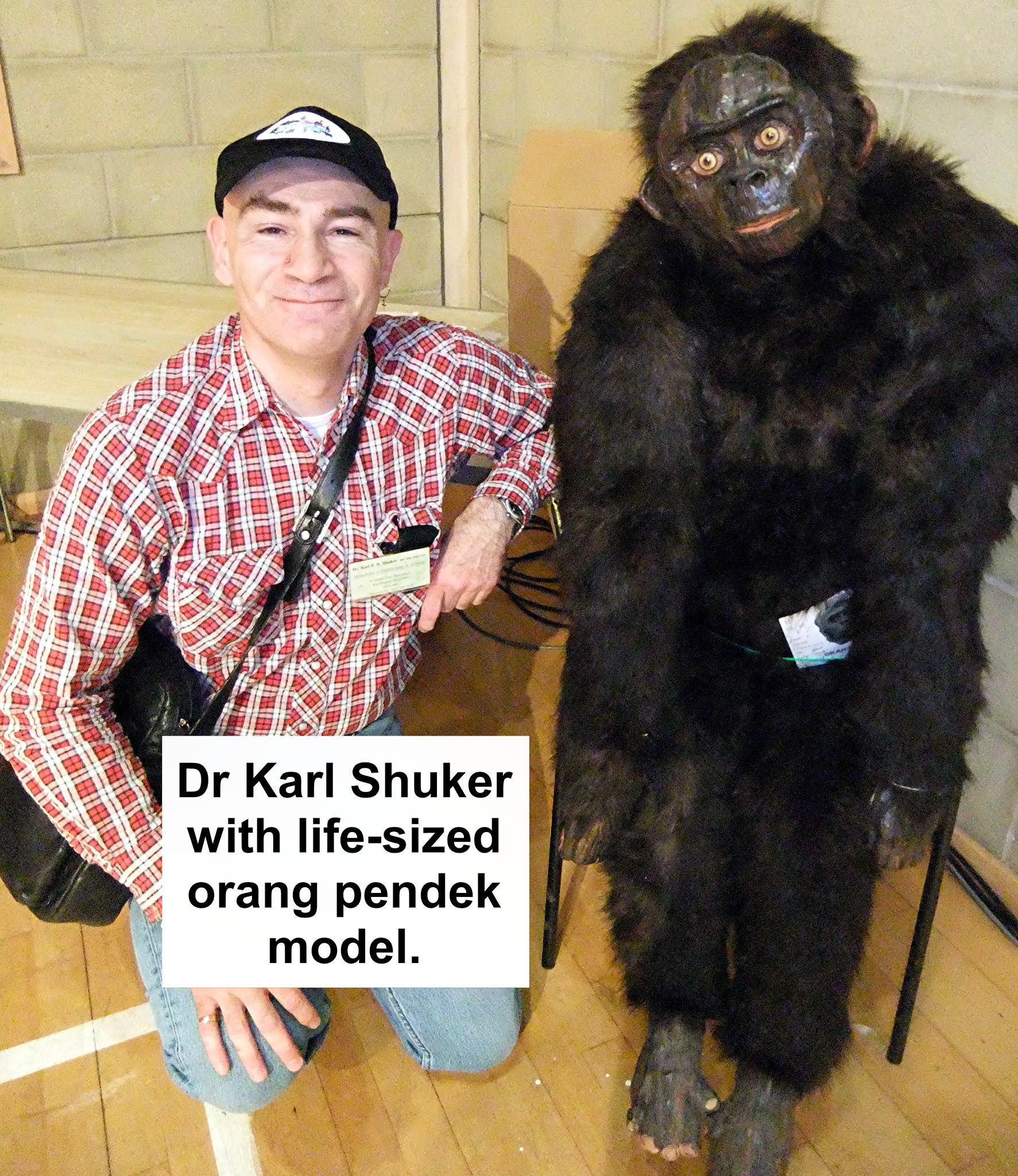
Alongside a life-sized representation of the orang pendek created for the CFZ (© Dr Karl Shuker / CFZ)

Once upon a long ago in the wonderful world of cryptozoology, only a single type of diminutive Indonesian mystery man-beast was widely reported – the orang pendek ('short man') or sedapa of Sumatra, in this southeast Asian country's Greater Sundas island group, reported by locals and Westerners alike for well over a century. Physically represented by unidentifiable hair samples and wholly distinct footprint casts, this reddish-furred, bipedal, tailless entity is usually said to stand a mere 3-4.5 ft tall.

Plaster cast of an alleged orang pendek footprint, revealing its very distinctive form (© Dr Karl Shuker)

Suggested identities on offer for the orang pendek have ranged from a terrestrial form of orang utan or gibbon to a bona fide human species, possibly even a relict representative of our own species' predecessor, Homo erectus. So far, so simple (relatively speaking).

An orang utan standing upright in the wild (© Tom Low/Wikipedia – public domain)

Then in 2003, the first skeletal remains of what, after much contention, is nowadays accepted by most researchers to have been a bona fide diminutive human species (rather than merely stunted, freak Homo sapiens) were found on the small island of Flores in Indonesia's Lesser Sundas group. Formally dubbed Homo floresiensis but known colloquially as Flores Man or the hobbit, it is believed to have only stood around 3.5 ft tall, and to have become extinct at least 50,000 years ago – or did it?

Replica skull of Flores Man aka the hobbit (© Dr Karl Shuker)

Researchers began hearing native folklore and stories concerning the ebu gogo, described not only as very short human entities but also as still very much alive in the wilder, more remote regions of Flores. If such beings really do exist, might they be living, modern-day representatives of Homo floresiensis? Some cryptozoological investigators have taken this line of speculation even further, by linking Flores Man with the Sumatran orang pendek, even though the latter seems taller and more ape-like, not to mention zoogeographically separate. But then came news of an additional component to the Indonesian man-beast/mini-human mystery that makes matters even more complex and potentially confusing.

A reconstruction of the orang pendek as a hairy ape-like biped (© Randy Merrill)

As publicised recently in a number of online articles and reports (click here to access one of them), Sumatra may also be home to a second, fundamentally different man-beast from the orang pendek, one which, moreover, is very reminiscent of the ebu gogo and, in turn, Flores Man. Known as the orang kardil (aka orang kardill), according to native testimony this entity is definitely some form of human, not ape, hunting aggressively with spears and even deemed to have killed villagers on occasion, but is even shorter in stature than the orang pendek.

Reconstruction of the possible appearance and stature of the ebu gogo compared with an average human (© Connor Lachmanec)

Consequently, is it possible that a truly miniature Indonesian species of human has existed at one time or another not just on Flores, due to its savage nature has infiltrated traditional Indonesian folklore under various local names such as ebu gogo and orang kardil, and may even still survive today in remote regions of Flores, Sumatra, and perhaps elsewhere in this multi-island country too? All of this is total conjecture, of course, but less than 20 years ago even Flores Man's own existence was entirely unknown to science.

Orang pendek, orang kardil, ebu gogo – are such entities more than just a briefly-glimpsed face in the forest? (© William M. Rebsamen)


UPDATE - 14 November 2020

Just a few hours after I uploaded my above article onto ShukerNature and posted links to it in my various Facebook groups, CFZ cryptozoologist Richard Freeman, who has led CFZ expeditions seeking the orang pendek in Sumatra, posted the following fascinating account regarding the orang kardil in my 'Beasts of Legend, Myth & Fantasy' FB group:

"Our late guide Sahar Dimus said that his father and a friend had encountered the Orang-kardill in 1981. The pair had been in a remote part of what is now Kerinci Sablat National Park trading rice for goods in isolated villages. One evening whilst camping in the jungle and cooking rice a tiny man like creature with long hair on the head but a naked body emerged from the rainforest and tried to steal the rice. Sahar's father's friend killed it with a parang (similar to a machete). Then more of the creatures ran out of the forest armed with bamboo spears and killed the man. They did not attack Sahar's father. Sahar said there had been no recent sightings of orang-kardill though there were many of orang-pendek. On my last Sumatran trip a large group of witnesses were gathered in Sahar's village close to Gunung Tuju. All had seen orang-pendek and / or its tracks but none had seen orang-kardill or had heard of any recent sightings. They were quite clear that the two were different."

Thank you so much for making this greatly-welcomed information available, Rich!


 2ND UPDATE - 15 November 2020

Earlier today, Indonesian Facebook friend Ben Haryo informed me of a third spelling for this entity's native name - 'orang kerdil'. He also informed me that the term:

"...means "dwarf" in our Indonesian language. We believe they exist as a race of very reclusive tribe of diminutive human-like creatures, but more human than spirits. Their counterparts are Tuyul who are not humans but evil genies."

Thanks very much, Ben, for these very valuable additional details!


Tuesday, 22 September 2020

A MISSING LINK DOUBLE-BILL - SAME TITLE, TWO VERY DIFFERENT CRYPTOZOOLOGY-LINKED MOVIES!

Publicity poster for Missing Link (1988) and front cover of official DVD for Missing Link (2019) (© David and Carol Hughes/Universal Pictures; (© Chris Butler/Annapurna Pictures/Laika/Universal Artists/AGC – both images are reproduced here on a strictly non-commercial Fair Use basis for educational/review purposes only)

Today, ShukerNature reviews two cryptozoology-themed movies with the same title – Missing Link – but dramatically different formats and approaches, as will be seen.


MISSING LINK (1988)

The full cover for the official VHS videocassette of Missing Link, the live-action movie released in 1988 (© David and Carol Hughes/Universal Pictures – reproduced here on a strictly non-commercial Fair Use basis for educational/review purposes only)

Directed and written by David and Carol Hughes, Missing Link is produced in the style of a wildlife documentary with a voiceover narration by actor Michael Gambon. It is set in Africa one million years ago, and follows a voyage of discovery across this continent by a lone adult male 'man-ape' belonging to the early hominin species Australopithecus robustus. He is seeking others of his own species after having fled from the direct ancestors of ours, Homo sapiens, when his entire family was viciously slaughtered by them, leaving him as the only remaining representative of his species in that area.

This very unusual movie is more than a little reminiscent of another one that I watched and reviewed here on ShukerNature not long ago, Jonathan Livingston Seagull, in that although there is not a great deal of plot, the cinematography (again the work of the Hugheses) is absolutely spectacular. Missing Link was filmed on location in various Namibian national parks filled with iconic African fauna such as lions, elephants, giraffes, gazelles, zebras, mongooses, wildebeests, and those veritable avian locusts the red-billed queleas, whose immense flocks swarm and swirl through the sky like living composite super-organisms.

The unnamed australopithecine is played by Peter Elliott, and the fur suit as well as the constructed head and face that transform him into the man-ape are very impressive indeed. Viewing this movie constantly reminded me of the much later TV documentary series Walking With Cavemen (first screened in 2003, it was a successor to the highly successful, ground-breaking Walking With Dinosaurs and Walking with Beasts series).

This memorable movie's unnamed, unconventional star – a lone surviving australopithecine ape-man (© David and Carol Hughes/Universal Pictures – reproduced here on a strictly non-commercial Fair Use basis for educational/review purposes only)

Certainly, Missing Link was indeed far ahead of its time, but its lack of any major storyline or dialogue (other than Gambon's occasional words) probably explained why it was not a commercial success when released, and why it is seemingly not available on DVD. (Following its cinema debut, it was released in VHS videocassette format, examples of which are occasionally listed for sale online, but these are usually quite pricey.)

This is a great shame, because Missing Link is very deserving of being seen, as a tragic testament to how our ancestors almost certainly contributed to these distant relatives' eventual extinction - unless the mysterious agogwe, séhité, kakundakari, and certain other diminutive hairy man-beasts reported across Africa in modern times are relict survivors?

Offering a taster of the dramatic wildlife vistas and compelling content of Missing Link, here is an official trailer for this very different but definitely must-watch movie.

  
MISSING LINK (2019)

Photographic still for Missing Link, the animated feature film released in 2019, with Dora the Yeti Elder seen at far right (© Chris Butler/Annapurna Pictures/Laika/Universal Artists/AGC – reproduced here on a strictly non-commercial Fair Use basis for educational/review purposes only)

Directed by Chris Butler, Missing Link is a delightfully droll animated crypto-classic originally released in early 2019, and tells the story of what is supposedly the very last sasquatch (a restrained but all the more hilarious vocal tour de force by Zach Galifianakis). Namely, a very sensitive male bigfoot named Susan (don't ask!), who hires adventurer Sir Lionel Frost (voiced with great aplomb by Hugh Jackman) to end his loneliness by transporting him to the Himalayas where he can be united with his nearest kin, the yetis. (Cryptozoological purists be warned: the yetis here are portrayed as having white fur, a traditional if mistaken representation, as according to local eyewitness reports these mystery man-beasts are actually brown- or red-furred.)

Along the way, they meet up with a former significant other of Sir Lionel, the feisty Adelina Fortnight (Zoe Saldana), and are pursued tenaciously by the evil henchmen of Frost's nemesis, the repressive, insane Lord Piggot-Dunceby (Stephen Fry). His obsessive goal is to prevent Frost's discovery of both Susan the bigfoot and the yetis of Shangri-La from ever becoming known to the world at large.

Speaking of which: my favourite character is the etiolated, secretive, and deliciously paranoid Yeti Elder, Dora, voiced with acerbic zeal by Emma Thompson. Also worth listening out for are Little Britain stars David Walliams as Lemuel Lint, Sir Lionel's former assistant, who barely escapes with his life from his ever-perilous role, and Matt Lucas as Mr Collick, the no-less neurotic assistant of Lord Piggot-Dunceby.

Publicity poster for Missing Link with the Loch Ness monster (© Chris Butler/Annapurna Pictures/Laika/Universal Artists/AGC – reproduced here on a strictly non-commercial Fair Use basis for educational/review purposes only) 

Full of the dry, quip-driven humour that always appeals to me, but with a hefty dollop of good old-fashioned visual slapstick thrown in too, Missing Link also includes many spectacularly eyecatching scenes (one of which features fellow cryptid Nessie, the Loch Ness monster!), but none more so than the splendorous ice palaces and hidden valley of the yetis. Watching this charming movie is without a doubt a very enjoyable and highly entertaining way to pass a birthday evening, so that is precisely what I did on my most recent birthday.

To prove my assertion, here is a very funny official trailer for Missing Link – and here is another one!

A version of this double-bill review of cryptozoology-linked movies can also be accessed here on my Shuker In MovieLand blog.


Friday, 31 July 2020

THIS CRYPTID WORLD: A GLOBAL SURVEY OF UNDISCOVERED BEASTS - BOOK #31 IS NOW PUBLISHED!


This Cryptid World: A Global Survey of Undiscovered Beasts (© Dr Karl Shuker/Brian Rau/Herb Lester Associates)


I'm very happy to announce that This Cryptid World, my 31st book, is now published, and I'm equally excited to reveal that in terms of its format it is totally unlike any publication that I have ever been involved with before. This is because instead of being a conventional book or bookazine, it is a double-sided fold-out poster guide-book!

Scientists estimate that more than 90 per cent of nature's species have yet to be discovered. With that in mind, this enthralling, unique cryptozoological publication asks you to set aside any scepticism, and allow it be your guide on a fascinating global tour of cryptids - creatures whose existence has yet to be formally substantiated by science.

Shocking desert worms, mystery cats, sea and lake monsters, man-beasts of many kinds, and countless other cryptids have been sighted across the globe, and reports continue. Some accunts seem credulous, others are more authoritative, yet all present us with the same question: can it be true?

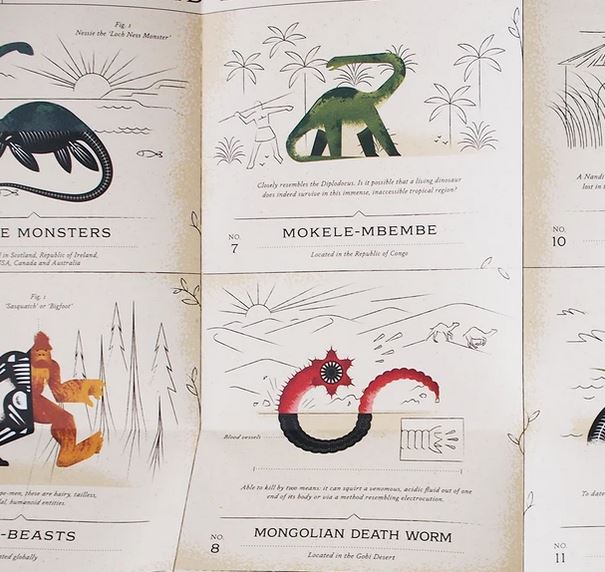
This sumptuous fold-out double-sided poster guide with text by yours truly and illustrations by Brian Rau documents an extremely diverse range of mystery beasts, outlining their characteristics, location, and sightings, all illustrated and charted on a world map. Its large format works equally effectively as a fold-out guide-book or as a double-sided poster, and comes in its own very elegant bespoke folder together with an additional stand-up 'tent' postcard depicting a jackalope.

Available to order from all good bookstores, and directly from the publisher, Herb Lester Associates, in quantities or singly. NB – it is not currently available directly from Amazon (their required discount was felt to be too substantial).

A few of Brian Rau's very stylish, diagrammatic cryptid illustrations featured on the reverse of my text and annotated world globe (© Dr Karl Shuker/Brian Rau/Herb Lester Associates)


Sunday, 16 February 2020

'BORDER' – A MINI-REVIEW OF A MAJOR MOVIE INSPIRED BY SCANDINAVIAN MYTHOLOGY AND CRYPTOZOOLOGY

Publicity poster for Border, featuring Eva Melander as Tina (© Ali Abbasi/John Ajvide Lindqvist/META Film/Black Spark Film & TV/Karnfilm/TriArt Film – reproduced here on a strictly non-commercial Fair Use basis for educational and review purposes only)

Last night, I watched a very strange Scandinavian fantasy movie, made in Sweden, but it was strange for all the right reasons. Entitled 'Border', it was directed by Ali Abbasi, produced by META Film/Black Spark Film & TV/Karnfilm, and released by TriArt Film in 2018. I'd wanted to see it for ages, but it only received limited cinema release here in the UK despite being an Academy Award nominee. Happily, however, I recently managed to purchase it on DVD.

Based upon an original short story entitled 'Gräns', written by John Ajvide Lindqvist, who also wrote this movie version's screenplay, 'Border' tells the story of a shy Swedish customs/border guard named Tina, whose decidedly homely physical appearance belies her remarkable gift for quite literally sniffing out human emotions, enabling her to detect by olfactory means if a person is feeling guilt, shame, anxiety, or other normally concealed traits. Needless to say, this unusual talent proves very useful in identifying incoming visitors to Sweden who are smuggling contraband or worse.

Always ill at ease with other people, Tina is only truly at peace when alone in the forest, among Nature - until an equally strange and homely-looking man named Vore appears on the scene, and to whom she is instantly attracted, especially when she discovers that just like her, he bears a mysterious scar at the base of his spine, as if something has been surgically removed, something like a tail...? Those readers of this mini-review who are au fait with Scandinavian mythology and/or manbeast-related cryptozoology will no doubt have already guessed where this plot is going. Suffice it to say that Tina finally learns the shocking truth that although they are humanoid, she and Vore are not human. But more shocks are to come, especially in relation both to a very disturbing investigation that she is involved in as part of her work, and also to her origin.

See the present ShukerNature article's Postscript to read the story of this delightful 'Border'-relevant entity (© Dr Karl Shuker)

This movie at times makes for very dark, bleak, desolate, and quite merciless but also very compelling viewing, its otherworldliness holding my interest and attention at all times, although the penultimate scene, when Tina finally visits the past that had been hidden from her throughout her life, is truly heart-rending. Having read a great deal on the subject of the entities that Tina and Vore are, I have to say that I strongly suspect that this movie's makers took great liberties when it came to depicting certain aspects relating to their, shall we say, procreative anatomy and behaviour, but perhaps I am simply ill-informed here (if I am, I hope that my Scandinavian friends and colleagues will educate me accordingly!).

Ideally, 'Border' could benefit from being dubbed into English, but its English subtitles more than adequately suffice, especially as the acting prowess of its two leading stars (Eva Melander as Tina, Eero Milonoff as Vore) is of such quiet (and occasionally not so quiet) intensity that very often words are not required, their visual strength is more than sufficient to tell the audience all that it needs to know. All in all, 'Border' is quite simply unlike any movie that I have ever seen before, truly bewitching, often disturbing, and ineffably sad, a very unexpected example of humanity's inhumanity to those who are different, for whatever reason. As for anyone who hasn't seen this movie but would like to know the true nature of Tina and Vore, let's just say that those who enjoy insulting, demeaning, and arguing with others on social media provide a major clue, albeit in name only - think about it...

Finally, please click here to view a trailer for 'Border' that is currently accessible on YouTube.

Another publicity poster for Border, featuring Eva Melander as Tina and Eero Milonoff as Vore (© Ali Abbasi/John Ajvide Lindqvist/META Film/Black Spark Film & TV/Karnfilm/TriArt Film – reproduced here on a strictly non-commercial Fair Use basis for educational and review purposes only)


POSTSCRIPT – CONTAINS 'BORDER' SPOILERS!!
If you don't want to discover what Tina and Vore were in 'Border', read no further!

About 13 years ago, I was walking round a local car boot sale at the end, while all of the sellers were packing away their unsold wares, ready to go home, when, lying amidst a forlorn pile of unsold items discarded by various sellers, and staring up at me disconsolately, was the delightful plush-furred, tufted-tailed, Scandinavian troll pictured in the two photographs included above and below by me in this present ShukerNature blog article.

I knew full well that, just like all discarded items there, his fate was to be loaded onto a lorry by one of the car boot sale's litter pickers and then tipped onto a fire and burnt. Needless to say, therefore, without further ado I picked him up, and found that he was perfectly clean and intact, but unwanted by his owner and unchosen by any of the buyers at the sale. So I duly took him back home with me. Ever since my rescuing him from his destined fiery fate, he has sat very happily upon a pile of postcards and CDs in my study, surveying his surroundings and clearly very content to be here, just as I am to have been able to save him and add him to my eclectic menagerie.

Don't you just love a happy ending!!

Rescued from a fiery fate! (© Dr Karl Shuker)