Dr KARL SHUKER

Zoologist, media consultant, and science writer, Dr Karl Shuker is also one of the best known cryptozoologists in the world. He is the author of such seminal works as Mystery Cats of the World (1989), The Lost Ark: New and Rediscovered Animals of the 20th Century (1993; greatly expanded in 2012 as The Encyclopaedia of New and Rediscovered Animals), Dragons: A Natural History (1995), In Search of Prehistoric Survivors (1995), The Unexplained (1996), From Flying Toads To Snakes With Wings (1997), Mysteries of Planet Earth (1999), The Hidden Powers of Animals (2001), The Beasts That Hide From Man (2003), Extraordinary Animals Revisited (2007), Dr Shuker's Casebook (2008), Karl Shuker's Alien Zoo: From the Pages of Fortean Times (2010), Cats of Magic, Mythology, and Mystery (2012), Mirabilis: A Carnival of Cryptozoology and Unnatural History (2013), Dragons in Zoology, Cryptozoology, and Culture (2013), The Menagerie of Marvels (2014), A Manifestation of Monsters (2015), Here's Nessie! (2016), and what is widely considered to be his cryptozoological magnum opus, Still In Search Of Prehistoric Survivors (2016) - plus, very excitingly, his four long-awaited, much-requested ShukerNature blog books (2019-2024).

Dr Karl Shuker's Official Website - http://www.karlshuker.com/index.htm

IMPORTANT: To view a complete, regularly-updated listing of my ShukerNature blog's articles (each one instantly clickable), please click HERE!

IMPORTANT: To view a complete, regularly-updated listing of my published books (each one instantly clickable), please click HERE!

IMPORTANT: To view a complete, regularly-updated listing of my Eclectarium blog's articles (each one instantly clickable), please click HERE!

IMPORTANT: To view a complete, regularly-updated listing of my Starsteeds blog's poetry and other lyrical writings (each one instantly clickable), please click HERE!

IMPORTANT: To view a complete, regularly-updated listing of my Shuker In MovieLand blog's articles (each one instantly clickable), please click HERE!

IMPORTANT: To view a complete, regularly-updated listing of my RebelBikerDude's AI Biker Art blog's thematic text & picture galleries (each one instantly clickable), please click HERE!

Search This Blog


PLEASE COME IN, I'VE BEEN EXPECTING YOU...

PLEASE COME IN, I'VE BEEN EXPECTING YOU...
WELCOME TO SHUKERNATURE - ENJOY YOUR VISIT - BEWARE OF THE RAPTOR!


Showing posts with label winged horses. Show all posts

Friday, 15 October 2021

HOW TO LOSE A CHIMAERA, IN ONE EASY LESSON!

 
Vintage picture postcard depicting the famous Chimaera of Arezzo bronze statue; it was originally part of a group, with Bellerophon and Pegasus fighting it (public domain)

How to lose a chimaera in one easy lesson? Simply see it, then promptly forget all about it, until far too much time has passed to make amends. See, I told you that it was easy! Confused? I was too, for a while – but let's begin at the beginning.

The year was 1980-ish, sometime in that decade anyway. It was during an afternoon in the Midlands town of Stratford-upon-Avon, famous not only in England but also internationally as the birthplace of a certain playwright, one William Shakespeare, to be precise. I was there with my family, as this was a favourite visiting locale for us on Sundays, because unlike in many other English towns back then, most shops in Stratford were open on the Sabbath due its huge popularity with overseas tourists.

 
Chimaera fountain at Arezzo, vintage postcard, 1952 (public domain)

And so it was on that fateful afternoon that I found myself in a large two-storey shopping complex in the centre of Stratford's shopping area, a complex that specialized in antiques. Its very spacious interior was divided up into numerous stalls, each stall rented out to a different antiques seller, so it collectively offered a vast range of objets d'art, curiosities, and exotica of every conceivable kind – in other words, a fascinating place in which to spend time browsing, at least for anyone like me with a decidedly eclectic range of interests.

In one corner of the downstairs storey was a stall whose lady vendor could usually be found whiling away the hours by knitting as potential purchasers eyed her wares. I can still vividly recall spotting on the floor amidst some other figurines a Jack Russell terrier-sized black sculpture in metal of what seemed to me to be a somewhat odd-looking lion, with a spiky mane, unusually slender haunches, and a long tail that curved up over its back instead of downwards. There also seemed to be something peculiar sticking up from its shoulders, but as I wasn't overly interested in this ostensibly misshaped, confusing creature, I never bothered to peer closer to see what that 'something peculiar' was. Instead, my gaze fell elsewhere, peering at other items in her stall before moving on to various stalls nearby – this complex contained a great many stalls, so in order to visit all or most of them, it paid not to linger or loiter too long at any single one.
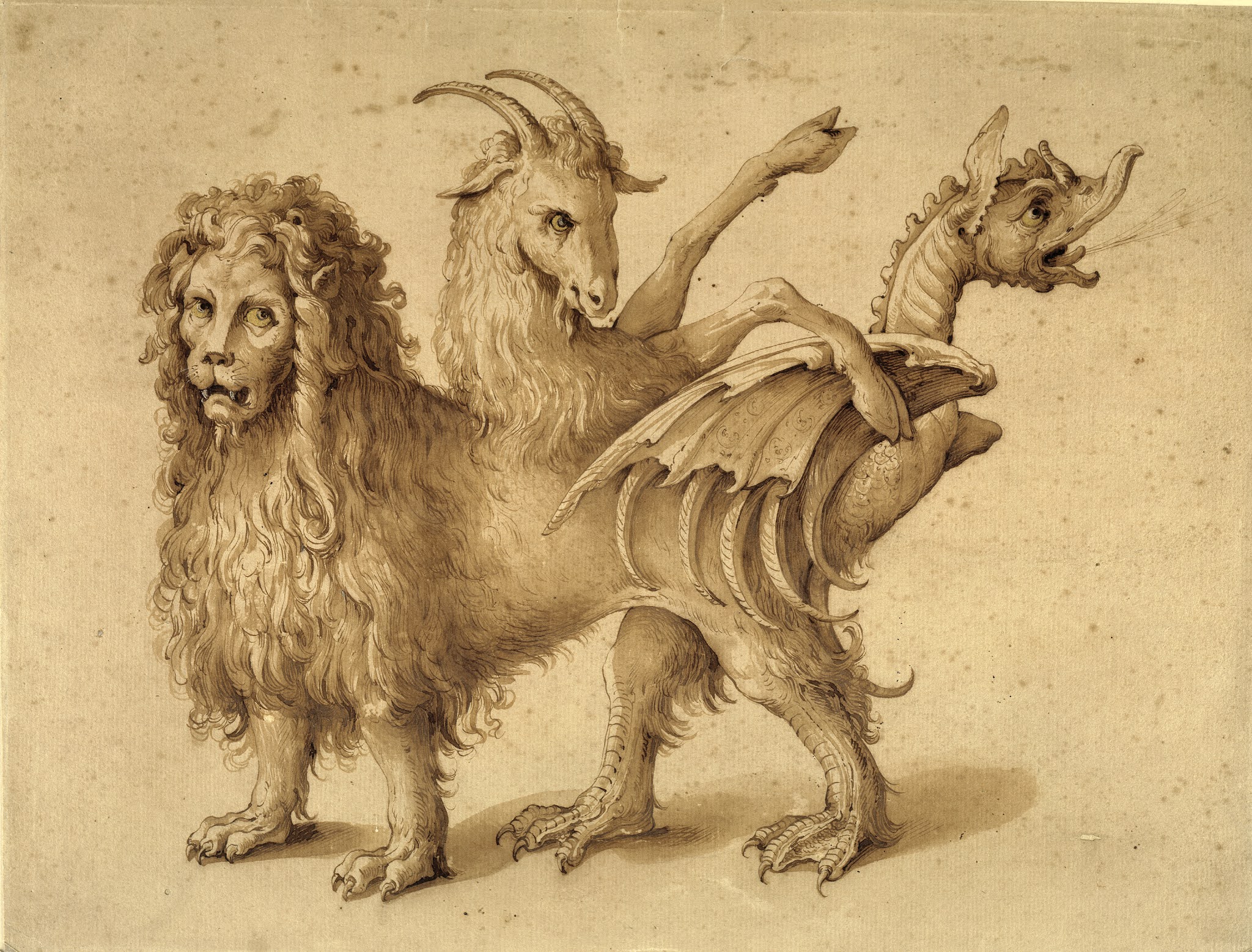
 
An inordinately elaborate chimaera, by Jacopo Ligozzi, created between 1590 and 1610 AD (public domain)

I thought nothing more of that strange-looking leonine statue for a long time, some years in fact, until one day I was idly flicking through a Larousse-published encyclopaedia of art that I'd lately purchased, and there, to my great surprise, was a photograph of a statue that looked exactly like the odd, spiky-maned lion that I'd seen during that long-gone Sunday afternoon visit to Stratford – except that it wasn't a lion after all. Instead, it was a chimaera (=chimera), and no ordinary chimaera either, always assuming of course that any chimaera can ever be considered ordinary. But what exactly IS a chimaera?

If you're unversed in Greek mythology, you may not have encountered the stirring legend of Bellerophon, Pegasus, and the Chimaera, so here are its edited highlights. The hideous semi-human monster Echidna had given birth to a number of horrific beasts, including the three-headed hell hound Cerberus, the two-headed monster hound Orthos, the many-headed Lernaean hydra, and the chimaera, which was yet another multi-headed horror.

 
An animatronic large-scale model of the chimaera (© Dr Karl Shuker)

This terrifying beast took the form of a huge lion, but unlike any normal member of the leonine pride, the chimaera bore a second head, in the form of a horned goat's, sprouting forth from between its shoulders or its upper back (recollections may vary, as I believe someone once said recently…?), and a third head, in the form of a venomous snake's, at the end of its long, ever-thrashing tail. Moreover, as if all of that were not already more than sufficiently deadly for anyone to deal with, the chimaera also breathed fire, jetting forth great flames of destruction from the jaws of its primary, leonine head.

In other words, this was an exceptionslly formidable beast for anyone to contend with, but most especially for the poor benighted inhabitants of  Caria in northern Anatolia, Turkey – because this is where the chimaera had taken up residence and was terrorizing the helpless populace, who had no answer to the perilous threat posed by an enormous monstrosity with three different heads and infernal flame-throwing capabilities.
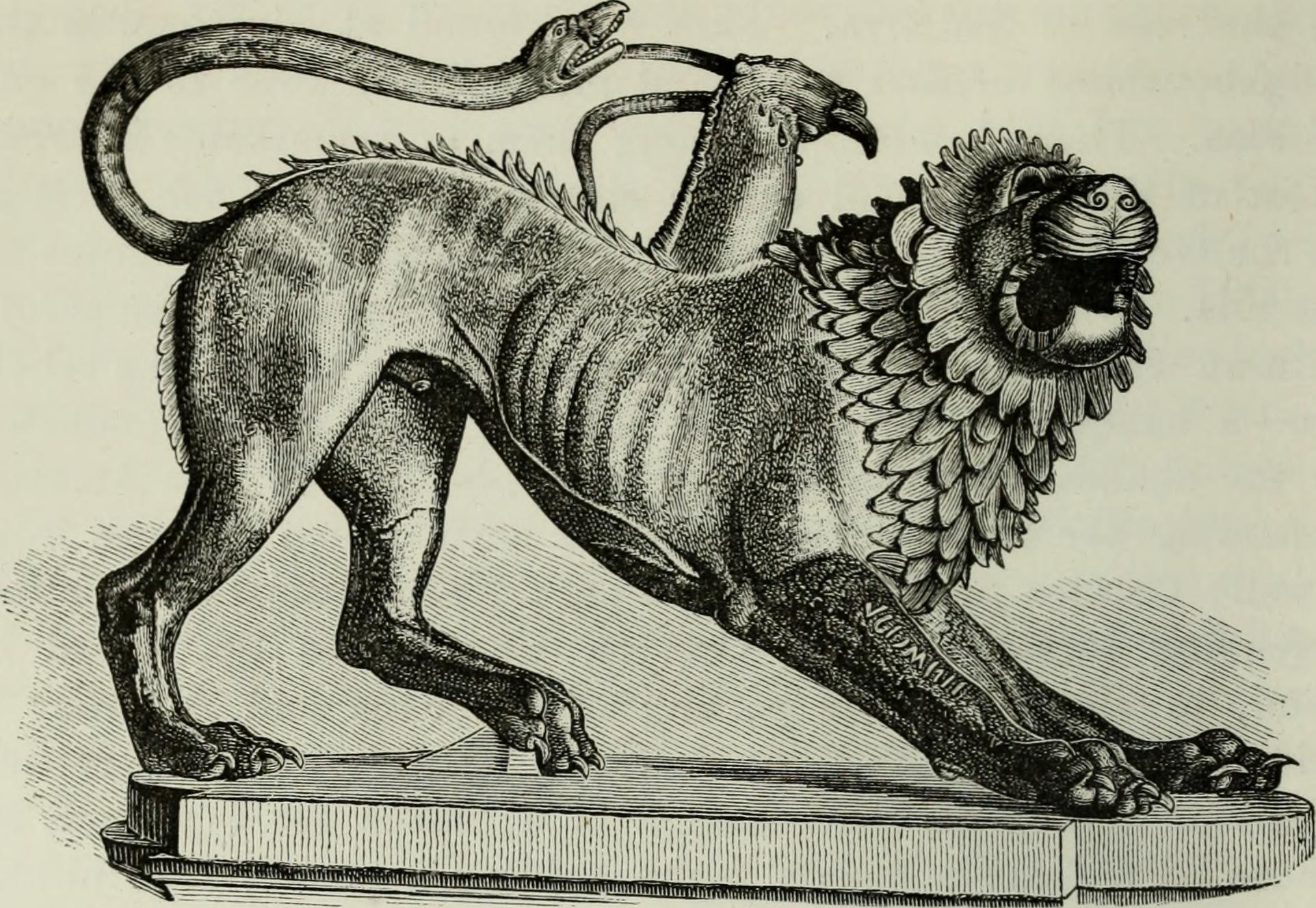
Two vintage engravings of the Chimaera of Arezzo bronze statue (top and bottom); and a vintage b/w photograph of it (middle) – note the dedicatory inscription to the god Tinia carved upon its right foreleg (all public domain)

In such a dire situation, the usual plan of action is for the terrified locals to send out for a hero to dispatch their hideous persecutor, but in this instance they did not have to do so, because just such a man had already been sent there, by his scheming uncle, King Iobates of Lycia in Anatolia, who fervently hoped that his heroic nephew would be killed by the chimaera, thereby foiling a prophecy claiming that his nephew would kill him instead.

The nephew in question was a mighty, fearless warrior-hero named Bellerophon, who arrived in Caria astride his equally mighty, fearless steed. Nor was this just any mighty, fearless steed either – in fact, it was none other than the magnificent winged horse Pegasus, previously untamed, but whom Bellerophon had successfully captured using the goddess Athena's enchanted golden bridle while it was drinking from a sacred spring on the citadel of Corinth in Greece, unaware of Bellerophon's stealthy approach.

 
Bellerophon on Pegasus slaying the chimaera – from Walter Crane's A Wonder Book For Girls and Boys (public domain)

Riding Pegasus, Bellerophon swiftly entered into battle with the chimaera, but even though his winged steed possessed the significant advantage of flight, it was a long and physically grueling onslaught before Bellerophon and Pegasus finally wore down this immensely powerful monster's vast reserves of strength. Doing so, however, finally enabled Bellerophon to slay it, by firing a spear tipped with a block of lead down its throat, whose fire melted the lead, thereby suffocating the chimaera, and freeing the people of Caria from its tyranny forever.

Encouraged by his great success, Bellerophon then decided to attempt an even more daring feat – to fly up through the sky upon Pegasus until he reached the very home of the gods themselves, who had hitherto remained forever concealed from human eyes in their lofty cloud-shielded domain at the very summit of Mount Olympus. This was something that no mortal had ever even attempted before, let alone achieved, but Bellerophon was intent upon doing so, and promptly set off, riding Pegasus ever upwards towards the divine dwelling place of the Greek deities.

 
An exquisite illustration from 1914 of Bellerophon riding Pegasus (public domain)

Zeus, however, was far from pleased about this. He had watched with pleasure as Bellerophon had dispatched the dreaded chimaera, but now his brow was creased with fury, his eyes thunderous with rage, as he witnessed Bellerophon's blasphemous ascent through the skies towards their rarefied Olympian home. Suddenly, Zeus had an idea – he sent forth a biting gadfly, down towards Bellerophon and his winged steed. When it reached them, the gadfly savagely bit Pegasus on his rump – which caused him to rear up in shock and pain, throwing an unsuspecting Bellerophon off his back, who plummeted headlong back down to Earth.

Miraculously, however, Bellerophon survived, by landing on a thorn bush that cushioned his fall, but its thorns blinded him, and he spent the rest of his days wandering the land piteously like a beggar, in abject misery – a sorry end indeed for a former hero and slayer of monsters.


Modern-day photographs depicting both sides of the Chimaera of Arezzo bronze statue (public domain / Wikipedia – CC BY-SA 3.0 licence)

Back now to my afore-mentioned Larousse-published encyclopaedia of art, and the photograph that I had seen in it was of a bronze statue of the chimaera, which had been unearthed by construction workers on 15 November 1553 at Arezzo, an ancient Etruscan and Roman city in Tuscany, Italy, and which dated back to approximately 400 BC.

Nowadays known officially as the Chimaera of Arezzo, and widely deemed to be the finest example ever uncovered of ancient Etruscan artwork, this spectacular statue is believed to have been a votive offering to the sky god Tinia – the supreme deity in Etruscan mythology. It stands 78.5 cm (2.5 ft) high, measures 129 cm (4.25 ft) in total length, and after passing through several different owners and holding locations it has been on permanent display at Florence's National Archaeological Museum in Tuscany since 1870.

 
Apart from its bright red colour, this is an identical replica of the Chimaera of Arezzo bronze statue, and was cast by the Ferdinando Marinelli Artistic Foundry (© Piero Paoletti/Wikipedia – CC BY-SA 4.0 licence)

 
Modern outdoor chimaera statue in stone inspired by the Chimaera of Arezzo bronze statue (© Thomas Shahan/Wikipedia CC BY 2.0 licence)

I now realized that what I had seen in that antiques stall at Stratford was a modern-day replica of this historically highly significant statue, a faithful facsimile of the Chimaera of Arezzo no less. Unfortunately, however, I hadn't realized back then what it was, so I hadn't thought to ask its price. True, the price may have been more than I could have afforded, but I’ll never know, because I never asked.

All that I do know is that in the 30-40 years that have passed since that monumental miss on my part, I have never once seen another contemporary reproduction of the Chimaera of Arezzo statue for sale, anywhere. But I live in hope…

 
My mother Mary Shuker and I being scrutinized by an animatronic chimaera at an exhibition of monsters held in Birmingham's art gallery during August 2008 (© Dr Karl Shuker)

Finally: The 2012 fantasy movie Wrath of the Titans, albeit playing fast and loose with classical Greek mythology as is Hollywod's wont,  contains an undeniably thrilling battle sequence between Perseus (as opposed to Bellerophon) and a winged chimaera - check out its sneaky serpentine tail in the following video clip:


Wednesday, 13 October 2021

MYSTERY BEASTS SERVED UP ON A PLATE, GREEK STYLE!

 
My newly-purchased modern-day Greek wall plate featuring some very mysterious creatures depicted upon it please click photograph to enlarge it for close-up viewing purposes (© Dr Karl Shuker)

On Tuesdays and Fridays, the (very) small outdoor market in my West Midlands, England, home town is largely devoted to bric-a-brac and collector's stalls, selling all manner of curiosities and exotica amidst the more traditional DVDs, stamps, books, medals, toys, records, ornaments, and suchlike – so naturally I'm a frequent visitor!

Yesterday, the very first stall that I walked up to included among its varied array of objects for sale the large and very ornately decorated terracotta Greek wall plate whose photograph opens this present ShukerNature article. Although only a modern-day creation, unsigned and unstamped, its sizeable 11-inch diameter coupled with its striking portrayal of several different animals in classical Greek style rendered this exquisite wall plate an extremely eyecatching item of artwork very worthy of being displayed, and its previous owner had evidently thought so too, because a wall-hanger frame was still attached to its reverse side.

What attracted me to this plate most of all, however, was the precise nature of the animals depicted upon it, because whereas some were readily identifiable, others were much more mysterious. Consequently, I decided to ask its price, although I strongly suspected that such a beautiful object, especially one that was in excellent condition too, would not be cheap.  When I asked the seller, a look of intense concentration immediately fixed itself upon his face, and he proceeded to stand there for several moments, in deep, rapt contemplation. How much would he decide to ask for it, I wondered - £5, £10, possibly even more? After what seemed like an eternity, the seller finally reached a decision and turned slowly towards me, as I awaited with quiet dread the size of the figure that he was about to quote me.

"20p," he said.

Never had a 20p coin ever exited anyone's pocket and found itself in someone else's hand as rapidly as did the 20p coin that I used to purchase this absolute bargain!

Picking up the surprisingly heavy but thoroughly wonderful wall plate that was now mine, all mine, I placed it gingerly inside a plastic carrier bag and then that inside another one, to ensure that nothing else that I may purchase there would knock against it and possibly chip its beautiful surface, and then I walked happily away, another item of potential cryptozoological interest to add to my collection.

When I arrived back home, I unwrapped the plate and spent some time perusing its portrayed beasts. First and foremost to attract my attention was the gorgeously-detailed fabulous beast depicted at its centre, which I readily recognized to be a Greek sphinx, combining a lion's body with a woman's head, and winged. Egyptian sphinxes, conversely, combine a lion's body with a man's head, and are not winged.

 
Close-up of the Greek sphinx depicted at the centre of my Greek wall plate (© Dr Karl Shuker)

Turning now to the various beasts decorating the plate's perimeter, I could see straight away that two of them were a pair of maned lions, depicted near to bottom-left and bottom-right of the plate:

The two maned lions depicted on my Greek wall plate (© Dr Karl Shuker)

This left four other creatures still to identify, and this is where it became rather more difficult, at least initially. Three of these – positioned bottom-centre, near top-left and near top-right – were depictions of a very distinctive, unusual type of bird. It sported a long swan-like or goose-like neck, but its plumage's form and colouration did not match that of any swan or goose native to either Greece or its environs that I could think of. And yet it did seem strangely familiar somehow.

 
The three mystery birds depicted on my Greek wall plate (© Dr Karl Shuker)

After giving the matter some thought, I then gave thanks to the fact that I was not only a lover of classical mythology but also a stamp collector, because an image had suddenly popped into my mind – the image of one specific postage stamp featuring the classical Greek demi-god hero Heracles (aka Hercules) battling a flock of avian man-eaters known as the Stymphalian birds (click here to access my detailed investigation of these creatures elsewhere on ShukerNature).

In 1982, Monaco had commemorated the famous Greek legend of Heracles by issuing a series of postage stamps that each illustrated one of his twelve great labours. And among those labours was his slaying of the ferocious lake-dwelling Stymphalian birds, which reputedly possessed long necks and huge wings of brass. Moreover, the three birds depicted on that particular stamp definitely bore a marked resemblance to the tantalizing trio portrayed upon my Greek wall plate.

 
The Monaco postage stamp depicting Heracles fighting the Stymphalian birds (© Monaco Postal Service – reproduced here on a strictly non-commercial Fair Use basis for educational/review purposes only)

Consequently, although I cannot be absolutely certain, it seems reasonable to assume that my plate's mystery birds are indeed representations of these mythological feathered monsters. Indeed; the plate's modern-day Greek artist may even have been directly inspired by that particular Greek-themed Monaco stamp when designing his birds for it.

All that now awaited my attention and attempts to identify it was the very intriguing animal portrayed at top-centre on my plate. Looking closely at it, I felt that it most closely resembled some form of big cat. Unquestionably, its face, body shape, and paws were all decidedly feline, but if so, which cat could it be?

For whereas the creature's chest was very noticeably spotted, like that of a leopard, its tail was just as noticeably tufted, like that of a lion. Yet it did not possess a mane like the instantly recognisable pair of lions portrayed elsewhere on the plate both sported. Perhaps it was meant to be a lioness rather than a lion, but if so, why was its chest spotted? Equally, why only its chest, why not the remainder of its body as well, which is what you would expect if, tufted tail notwithstanding, it was intended to be a representation of a leopard? All very mystifying.

And a day later it remains very mystifying, because despite having given the matter much thought during the interim period between then and now, I am still unable to offer a plausible identity for this semi-mottled mystery beast. Perhaps it was simply an invention of the artist, a fictitious entity playfully added to the plate's panoply of authentic classical Greek fauna from reality and mythology (back in early times, lions did exist here). Alternatively, might it even be an attempt by him to portray a leopon, a hybrid of lion and leopard? Or could it be some fabled Greek beast unfamiliar to me? I shall continue to investigate this pictured puzzle, but if any ShukerNature reader can offer me any suggestions of their own, I'd greatly welcome receiving them.

 
The unidentified mystery beast depicted on my Greek wall plate, ostensibly combining morphological features of the lion and the leopard (© Dr Karl Shuker)

Finally: this particular example is one of several modern-day Greek wall plates decorated with exquisite depictions of mythological beasts and deities that I have purchased down through the years at various bric-a-brac markets and car boot sales.

I recently featured one of them, depicting a famous statue portraying the horrific death of the Trojan priest Laocoön and his sons at the jaws and coils of a pair of giant snakes sent forth from the sea by Poseidon, in a ShukerNature article of mine examining this famous Greek/Trojan legend (click here to access it). Here it is again:

 
Modern-day Greek wall plate depicting the famous statue 'Laocoön and His Sons' (© Dr Karl Shuker)

And below are some of the others:

 
Modern-day Greek wall plate depicting a pair of beautiful winged steeds pulling the sun chariot of Apollo across the sky (© Dr Karl Shuker)

 
Modern-day Greek wall plate depicting the slaying of the minotaur by Theseus (© Dr Karl Shuker)

 
Modern-day Greek wall plate depicting Odysseus bound to the mast of his ship to prevent him from being lured to his death by the deadly singing of the three sirens surrounding the vessel (© Dr Karl Shuker)

 
Modern-day Greek wall plate depicting Hermes, Artemis, and Apollo, with one of Artemis's sacred deer beside her (© Dr Karl Shuker)

 
Modern-day Greek wall plate depicting Zeus, Hera, and Nike (© Dr Karl Shuker)

 
Lastly, just to be different, my resin statuette of the Greek sea god Poseidon (© Dr Karl Shuker)