Dr KARL SHUKER

Zoologist, media consultant, and science writer, Dr Karl Shuker is also one of the best known cryptozoologists in the world. He is the author of such seminal works as Mystery Cats of the World (1989), The Lost Ark: New and Rediscovered Animals of the 20th Century (1993; greatly expanded in 2012 as The Encyclopaedia of New and Rediscovered Animals), Dragons: A Natural History (1995), In Search of Prehistoric Survivors (1995), The Unexplained (1996), From Flying Toads To Snakes With Wings (1997), Mysteries of Planet Earth (1999), The Hidden Powers of Animals (2001), The Beasts That Hide From Man (2003), Extraordinary Animals Revisited (2007), Dr Shuker's Casebook (2008), Karl Shuker's Alien Zoo: From the Pages of Fortean Times (2010), Cats of Magic, Mythology, and Mystery (2012), Mirabilis: A Carnival of Cryptozoology and Unnatural History (2013), Dragons in Zoology, Cryptozoology, and Culture (2013), The Menagerie of Marvels (2014), A Manifestation of Monsters (2015), Here's Nessie! (2016), and what is widely considered to be his cryptozoological magnum opus, Still In Search Of Prehistoric Survivors (2016) - plus, very excitingly, his four long-awaited, much-requested ShukerNature blog books (2019-2024).

Dr Karl Shuker's Official Website - http://www.karlshuker.com/index.htm

IMPORTANT: To view a complete, regularly-updated listing of my ShukerNature blog's articles (each one instantly clickable), please click HERE!

IMPORTANT: To view a complete, regularly-updated listing of my published books (each one instantly clickable), please click HERE!

IMPORTANT: To view a complete, regularly-updated listing of my Eclectarium blog's articles (each one instantly clickable), please click HERE!

IMPORTANT: To view a complete, regularly-updated listing of my Starsteeds blog's poetry and other lyrical writings (each one instantly clickable), please click HERE!

IMPORTANT: To view a complete, regularly-updated listing of my Shuker In MovieLand blog's articles (each one instantly clickable), please click HERE!

IMPORTANT: To view a complete, regularly-updated listing of my RebelBikerDude's AI Biker Art blog's thematic text & picture galleries (each one instantly clickable), please click HERE!

Search This Blog


PLEASE COME IN, I'VE BEEN EXPECTING YOU...

PLEASE COME IN, I'VE BEEN EXPECTING YOU...
WELCOME TO SHUKERNATURE - ENJOY YOUR VISIT - BEWARE OF THE RAPTOR!


Showing posts with label orang pendek. Show all posts

Saturday, 14 November 2020

OVER TO THE ORANG KARDIL – SUMATRA'S 'OTHER' ORANG PENDEK?

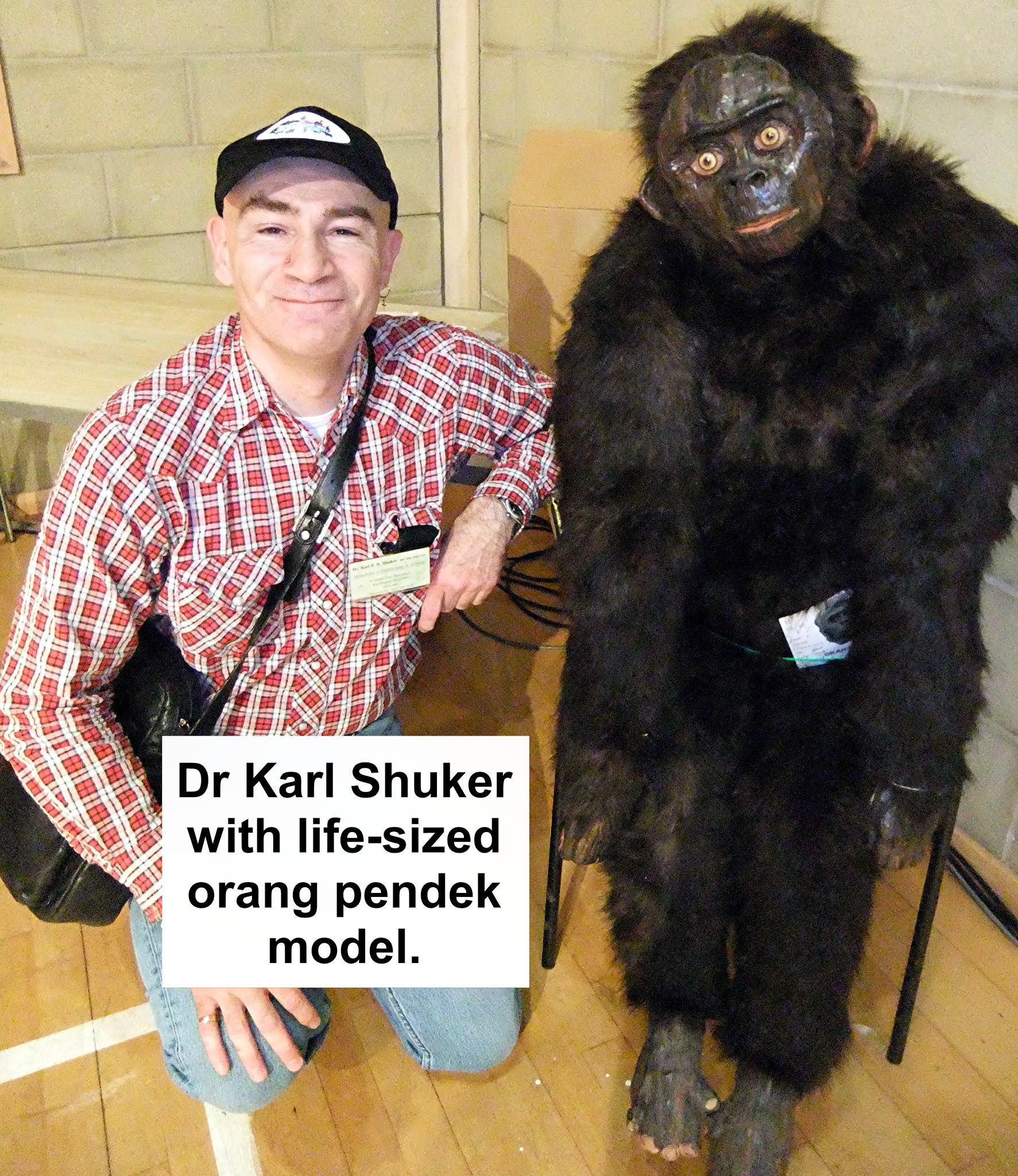
Alongside a life-sized representation of the orang pendek created for the CFZ (© Dr Karl Shuker / CFZ)

Once upon a long ago in the wonderful world of cryptozoology, only a single type of diminutive Indonesian mystery man-beast was widely reported – the orang pendek ('short man') or sedapa of Sumatra, in this southeast Asian country's Greater Sundas island group, reported by locals and Westerners alike for well over a century. Physically represented by unidentifiable hair samples and wholly distinct footprint casts, this reddish-furred, bipedal, tailless entity is usually said to stand a mere 3-4.5 ft tall.

Plaster cast of an alleged orang pendek footprint, revealing its very distinctive form (© Dr Karl Shuker)

Suggested identities on offer for the orang pendek have ranged from a terrestrial form of orang utan or gibbon to a bona fide human species, possibly even a relict representative of our own species' predecessor, Homo erectus. So far, so simple (relatively speaking).

An orang utan standing upright in the wild (© Tom Low/Wikipedia – public domain)

Then in 2003, the first skeletal remains of what, after much contention, is nowadays accepted by most researchers to have been a bona fide diminutive human species (rather than merely stunted, freak Homo sapiens) were found on the small island of Flores in Indonesia's Lesser Sundas group. Formally dubbed Homo floresiensis but known colloquially as Flores Man or the hobbit, it is believed to have only stood around 3.5 ft tall, and to have become extinct at least 50,000 years ago – or did it?

Replica skull of Flores Man aka the hobbit (© Dr Karl Shuker)

Researchers began hearing native folklore and stories concerning the ebu gogo, described not only as very short human entities but also as still very much alive in the wilder, more remote regions of Flores. If such beings really do exist, might they be living, modern-day representatives of Homo floresiensis? Some cryptozoological investigators have taken this line of speculation even further, by linking Flores Man with the Sumatran orang pendek, even though the latter seems taller and more ape-like, not to mention zoogeographically separate. But then came news of an additional component to the Indonesian man-beast/mini-human mystery that makes matters even more complex and potentially confusing.

A reconstruction of the orang pendek as a hairy ape-like biped (© Randy Merrill)

As publicised recently in a number of online articles and reports (click here to access one of them), Sumatra may also be home to a second, fundamentally different man-beast from the orang pendek, one which, moreover, is very reminiscent of the ebu gogo and, in turn, Flores Man. Known as the orang kardil (aka orang kardill), according to native testimony this entity is definitely some form of human, not ape, hunting aggressively with spears and even deemed to have killed villagers on occasion, but is even shorter in stature than the orang pendek.

Reconstruction of the possible appearance and stature of the ebu gogo compared with an average human (© Connor Lachmanec)

Consequently, is it possible that a truly miniature Indonesian species of human has existed at one time or another not just on Flores, due to its savage nature has infiltrated traditional Indonesian folklore under various local names such as ebu gogo and orang kardil, and may even still survive today in remote regions of Flores, Sumatra, and perhaps elsewhere in this multi-island country too? All of this is total conjecture, of course, but less than 20 years ago even Flores Man's own existence was entirely unknown to science.

Orang pendek, orang kardil, ebu gogo – are such entities more than just a briefly-glimpsed face in the forest? (© William M. Rebsamen)


UPDATE - 14 November 2020

Just a few hours after I uploaded my above article onto ShukerNature and posted links to it in my various Facebook groups, CFZ cryptozoologist Richard Freeman, who has led CFZ expeditions seeking the orang pendek in Sumatra, posted the following fascinating account regarding the orang kardil in my 'Beasts of Legend, Myth & Fantasy' FB group:

"Our late guide Sahar Dimus said that his father and a friend had encountered the Orang-kardill in 1981. The pair had been in a remote part of what is now Kerinci Sablat National Park trading rice for goods in isolated villages. One evening whilst camping in the jungle and cooking rice a tiny man like creature with long hair on the head but a naked body emerged from the rainforest and tried to steal the rice. Sahar's father's friend killed it with a parang (similar to a machete). Then more of the creatures ran out of the forest armed with bamboo spears and killed the man. They did not attack Sahar's father. Sahar said there had been no recent sightings of orang-kardill though there were many of orang-pendek. On my last Sumatran trip a large group of witnesses were gathered in Sahar's village close to Gunung Tuju. All had seen orang-pendek and / or its tracks but none had seen orang-kardill or had heard of any recent sightings. They were quite clear that the two were different."

Thank you so much for making this greatly-welcomed information available, Rich!


 2ND UPDATE - 15 November 2020

Earlier today, Indonesian Facebook friend Ben Haryo informed me of a third spelling for this entity's native name - 'orang kerdil'. He also informed me that the term:

"...means "dwarf" in our Indonesian language. We believe they exist as a race of very reclusive tribe of diminutive human-like creatures, but more human than spirits. Their counterparts are Tuyul who are not humans but evil genies."

Thanks very much, Ben, for these very valuable additional details!


Friday, 24 October 2014

CAVEAT LECTOR – LET THE READER BEWARE OF FAKE CRYPTOZOOLOGICAL NEWS STORIES ON SATIRE WEBSITES

A 4.3-metre-long female great white shark caught and photographed in the shark nets off Zinkwazi beach, South Africa, on 31 August 2009 (as reported here), which was subsequently rebranded as a 15-ton giant prehistoric shark caught alive and photographed off Pakistan in 2014 according to a fabricated report recently featured on a satire website (photograph's copyright owner unknown to me)

Even though it commonly occurs, something that is by no means widely realised is the appearance on certain websites of cryptozoological news reports that initially seem to be extremely significant and exciting but which in reality are invariably and completely fictitious.

The 'certain websites' that I am referring to here are so-called satire news sites, of which there are a sizeable number, and which to the casual eye appear to be genuine, factual news websites, but whose entire content, regardless of subject matter, is actually pure fiction (although the images used in them have sometimes originated in earlier, unrelated factual stories on genuine news websites). To be fair, I freely concede that most of these sites do include a small but readily visible disclaimer, usually at the top or bottom of their front page, which when clicked states categorically what they are and what their stories are.

Unfortunately, however, these disclaimers are frequently overlooked by readers, as a result of which many fake stories of a cryptozoological nature that have originated on satire websites subsequently make regular and repeated appearances on bona fide cryptozoological sites and social website pages. Posted there by crypto-enthusiasts unfamiliar with satire sites, they often generate a great deal of conjecture and confusion until their true nature is revealed by more experienced web-surfers.

One satire website that has produced quite a few crypto-themed reports during the course of its existence is World News Daily Report (click here), whose disclaimer reads as follows:

"World News Daily Report is a news and political satire web publication, which may or may not use real names, often in semi-real or mostly fictitious ways. All news articles contained within worldnewsdailyreport.com are fiction, and presumably fake news. Any resemblance to the truth is purely coincidental, except for all references to politicians and/or celebrities, in which case they are based on real people, but still based almost entirely in fiction."

Yet in spite of its disclaimer's presence and unequivocal wording, a number of this satire website's fun stories have nonetheless attracted serious albeit misguided attention in various mainstream sites and social pages devoted to cryptozoology and anomalies or controversies of nature. These stories include the following list (NB - list updated by me on 17 December 2014):

* Mysterious Remains of a Whale Found in a Field in Utah.
Click here
5 December 2014.

* Smithsonian Admits to Destruction of Thousands of Giant Human Skeletons in Early 1900's.
Click here
3 December 2014.

Mexican Drug Smugglers Eaten Alive by Giant Squids After Boat Sinks Near Coast of California.
Click here
26 November 2014.

* Ireland: Archaeologists Discover Remains of New Humanoid Species.
Click here
18 November 2014.

Jurassic Plant Brought Back to Life After 200 Million Years.
Click here
12 November 2014.

Pterodactyl Sighting in New Guinea Terrorizes Villagers, Alarms Authorities
Click here
27 October 2014.

Archeologists Unearth Giant Human Remains Near Stonehenge.
Click here
1 October 2014

* 15-Ton Prehistoric Shark Captured Off Coast Of Pakistan.
Click here
23 September 2014.

Scotland: Nessie Sighting Brings Surge Of Enthusiasm In Favor Of Scottish Independence.
Click here
15 September 2014

Indonesia: Ape Man Creature Shot Down In Borneo Jungle.
Click here
14 September 2014

Giant Man-Eating Catfish Finally Caught In Mekong River.
Click here
28 August 2014

New York: 600-Pound Alligator Shot Down in Central Park.
Click here
5 August 2014.

Russia: Mammoth Embryo Brought Back to Life.
Click here
13 July 2014.

Nepal: Frozen Caveman Discovered in Himalaya.
Click here
12 June 2014.

Pet Jerboa Crosses Europe to Reunite With Family.
Click here
9 April 2014.

M’Bokolokolo Creature Sighted in Nigeria.
Click here
26 March 2014.

* 200 Million Years Old Dinosaur Egg Hatches in Berlin Museum.
Click here
20 February 2014.

Indonesia: Tiger Rhinos Almost Extinct, According to Experts.
Click here
13 January 2014.

* Thailand: Snakegirl Attracts Crowds of Pilgrims and Tourists.
Click here
6 January 2014.

Giant Lobster Invades Beach House in Canada.
Click here
21 December 2013.

Malawi: Rare Specimen of Duckhorse Sighted During Safari.
Click here
11 December 2013.

New Specie [sic] of Centipedes Discovered Near Fukushima [radiation-mutated circular centipede with no head or posterior end!].
Click here
2 December 2013.

China: Tiger Squirrel Wreaks Havoc in Small Village.
Click here
1 December 2013.

Chinese Scientists Clone Pig with Wings.
Click here
29 November 2013.

3-Meter Tall Squirrel Killed by Army After Bloody Rampage.
Click here
26 November 2013.

Climbers Encounter Sasquatch in Colorado.
Click here
18 November 2013.

So if you've previously read any of these reports and presumed that they described major breakthroughs in cryptozoological or mainstream zoological discovery – think again!

Finally: for a useful annotated listing of notable satire websites and other prominent online sources of faux journalism, click here.


UPDATE: 12 August 2017

Today, I rechecked all of the above articles, and discovered that only six of them are still online, so I have now identified them with a red asterisk (*) at the beginning of their titles. However, I did also note that there are plenty of newer ones on that site..

Contrary to satire news reporting, Nessie did not make any appearance at the time of the recent vote for Scottish independence – judging from this delightful illustration, her attention was clearly elsewhere! (© Jane Cooper)


Friday, 29 November 2013

FROM KING CHEETAHS TO KOOLOOKAMBAS - VOLUME 2 OF THE JOURNAL OF CRYPTOZOOLOGY IS NOW AVAILABLE TO PRE-ORDER


The orang pendek of Sumatra in Indonesia's Greater Sundas island group has attracted considerable cryptozoological attention, but could there also be diminutive yet previously less-publicised man-beasts existing still-undiscovered by science on Indonesia's much smaller Lesser Sundas island of Flores?

Does an ornate 16th-century painting from India's Mughal Empire hold the key to the former existence in Asia of a mystery cat analogous to Africa's king cheetah?

How can the vast diversity of reports appertaining to mysterious freshwater cryptids across the length and breadth of Spain be explained?

What is the taxonomic identity of the koolookamba, a longstanding African mystery ape known not only from reports but also from captive specimens - just an aberrant version of chimpanzee, or a taxonomically discrete form in its own right, or even a bona fide chimpanzee-gorilla hybrid?

These are the fascinating subjects and thought-provoking questions under consideration in the papers contained within Volume 2 of the Journal of Cryptozoology - the world's only peer-reviewed scientific periodical devoted to mystery animals - which is now available to pre-order here. Don't miss it!

Engravings from 1896 of Mafuca, the most famous koolookamba to have been exhibited in captivity


Wednesday, 2 February 2011

FEELING BLUE ABOUT SHUKERNATURE! REVIEWING THE TOP TEN POSTS

Trunko in blue (Lance Bradshaw)


Let me confirm immediately that my blog is NOT making me feel depressed! On the contrary, thanks to the interest and comments that my posts here continue to generate from their readers, and the prospect of compiling an entire book based upon them, I have never felt more buoyant about ShukerNature since its inception just over two years ago. No, the reason for this post's blue-headed title stems from a quite remarkable, wholly unexpected, and (at least to me) truly inexplicable discovery that I have just made after reviewing the statistics for ShukerNature.

Several sets of stats concerning a person's blog are available for inspection by him/her on Blogger, and perhaps the most interesting set is the Top 10 posts of all time for that blog. In the case of ShukerNature (on which I have uploaded well over 100 posts of mine so far), I was extremely intrigued by the result - so much so, in fact, that I felt it warranted a blog post of its own!

So here is the Top Ten ShukerNature posts of all time - be prepared for some surprises!


#1: The mystery blue spider of Yorkshire (25 August 2010)

#2: Behold, Trunko!! (Trunko exclusive #1) (6 September 2010)

#3: Trunko, two more photographs (Trunko exclusive #2) (9 September 2010)

#4: South Africa's hairless blue horse (24 March 2010)

#5: Dragons of Babylon and dinosaurs of the Bible (18 January 2011)

#6: Smethwick devil (4 September 2010)

#7: Orang pendek (24 November 2010)

#8: Blue tigers (17 May 2009)

#9: The last Harpagornis (14 July 2010)

#10: A diversity of devil-fishes (6 March 2009)


And as if this listing were not already surreal enough, the post at #1 has been viewed more times than all of the next nine posts combined - but why?!

As far as I can see, the evident (and only?) moral that can be drawn from this entertaining little exercise in blog analysis is that from now on I should clearly concentrate all of my efforts on writing about blue animals!

And if I really want to maximise my readership, the ideal subject to write about would be a blue-furred devilish version of Trunko! So if anyone ever happens to encounter such an entity out there, please do let me know!

Wednesday, 24 November 2010

ORANG PENDEK - AN APE-HAIRED HOMINID?


Orang pendek, based upon eyewitness descriptions (Tim Morris)


A few days ago, Danish zoologist Lars Thomas announced on the CFZ bloggo the long-awaited outcome of his analyses of the putative orang pendek hairs collected by the CFZ team during its 2009 expedition to Sumatra. In summary, Lars revealed that whereas the hairs' DNA was most similar to that of humans (as demonstrated via DNA studies by his Copenhagen University colleague Tom Gilbert), their structure compared more closely with that of apes (specifically, the orang utans). These intriguing, unexpected findings have since elicited a degree of controversy, with some readers speculating that the CFZ team's findings are inconclusive, as the two sets of results appear to contradict one another and surely must be mutually exclusive, i.e. only one set can be correct, not both.

However, this may not be the case at all. On the contrary, I agree entirely with team member Richard Freeman, who has suggested that BOTH sets of results could be correct - IF the orang pendek is in fact a hominid with ape-structured hair (Tom Gilbert has categorically denied, incidentally, that there might have been contamination of ape DNA with human DNA or vice-versa). On first sight, such a suggestion might seem unlikely, but in reality I documented a very notable, fully-confirmed, yet equally surprising precedent to this situation many years ago.

Before I come to that, however, I'd like to quote here the concise consideration of possible orang pendek identities on offer that I wrote in an orang pendek article of mine that was published in Paranormal Magazine just a few months before the 2009 CFZ Sumatra Expedition set off, and which, in the light of that expedition's subsequent findings, remains relevant:

"If the orang pendek truly exists, what could it be? Always assuming that it is indeed something more than a misidentified familiar species already known to exist within the areas of Sumatra from which it is reported, such as a gibbon or the sun bear Helarctos malayanus (which can rear up onto its hind legs and can leave deceptively humanoid footprints), three principal contenders are on offer.

"The first of these is an unrecorded population of the Sumatran orang utan Pongo abelii. Although this species of great ape once existed throughout Sumatra, it has long since become extinct in all but this island’s northern extent, so any orang utans discovered in the orang pendek’s Kerinci Seblat heartland would be a major zoological find. Having said that, however, the orang pendek’s morphology, habitually bipedal mode of locomotion, and semi-carnivorous behaviour provide scant similarity with those of the orang utan, and Kerinci locals shown pictures of the latter ape by cryptozoologists readily differentiate between it and the mysterious orang pendek.

"Identity #2 for the orang pendek is a completely separate species of ape presently unrecorded by science, at least in the living state. This identity is favoured by Adam Davies among others. Suggestions include a giant gibbon or an unknown specialised species of orang utan, adapted for bipedal, terrestrial activity. Richard Freeman has opined that it may be a descendant of the Miocene ape Sivapithecus (also ancestral to the orang utan).

"The third, and, if correct, most exciting, revolutionary identity on offer for the orang pendek is a primitive species of hominid, separate from Homo sapiens. Traditionally, the most popular option within this category of identity is our own ancestral species Homo erectus, inspired at least in part by the famous ‘Java Man’ discoveries on Sumatra’s neighbouring island. However, a fundamental morphological flaw with any theory involving a surviving hominid has always been the much smaller size of the orang pendek – until, that is, the discovery of Flores Man was revealed in 2004. Coupled with reports of orang pendek-like entities called the ebu gogu said to have existed on Flores until very recently, some cryptozoologists (myself included) now look towards a living representative of Flores Man as a convincing explanation of the hitherto-bemusing riddle of the orang pendek’s identity."

And now, the precedent that I mentioned earlier (and first documented over 20 years ago!) for a creature whose DNA corresponds most closely to one taxon whereas its hair structure is more similar to a quite different taxon. I refer, of course, to the king cheetah. Genetically, it has been fully confirmed to be nothing more than a genetic freak variety of the normal spotted cheetah Acinonyx jubatus, and hence is referred to scientifically as Acinonyx jubatus var. rex. Its ornate coat patterning of stripes, swirls, and blotches is merely a phenotypic expression of a mutant allele of a gene homologous to the gene responsible for blotched tabby coat patterning in domestic cats.

Consequently, it came as a huge surprise when, as I documented in my very first book, Mystery Cats of the World (1989), the structure of its hair was examined:

"Hair samples which they [king cheetah researchers Paul and Lena Bottriell] had submitted to the Institute of Medical Research in Johannesburg revealed that the cuticular scale pattern of king cheetah guard hair compared much more closely with that of leopards than with that of spotted cheetahs."

Cheetahs and leopards not only belong to separate feline genera but also are only very distantly related. Suddenly, an unknown hominid whose hair structure is more similar to that of apes is not so unlikely after all, is it?

Wednesday, 17 February 2010

MADAGASCAR'S ELUSIVE MEGA-LEMURS AND MINI-MEN


Restoration of Palaeopropithecus ingensin life (Markus Bühler)


The fourth largest island in the world, Madagascar is a veritable miniature continent, brimming with extraordinary animals found nowhere else in the world, including such exotic avifauna as vangas and neodrepanidids, remarkable reptiles that include boas more closely-related to counterparts in South America than to any Old Word snakes plus the world’s greatest diversity of chameleons, and, most famous of all, its wonderful assemblage of lemurs and exotic striped civets. Yet as if all of these were not exciting enough, only a few centuries ago in some cases this zoological treasure trove of endemics also boasted some truly astonishing animals – and none more so than its impressive number of giant lemurs far bigger than anything known to exist today. Today, of course, these creatures are long gone – or are they? Read this investigation of Madagascar’s most astonishing mystery beasts – and decide for yourself.

TRATRATRATRA GOODBYE…?
In 1658, after having resided in Madagascar for a number of years as its governor, French explorer Admiral Étienne de Flacourt published a major tome, Histoire de la Grande Isle de Madagascar, which documented his experiences and discoveries here. It contains a wealth of zoological information, some of which is also of cryptozoological interest, including the following passage:

"Trétrétrétré [or tratratratra in English] is an animal as big as a two-year-old calf, with a round head and a man’s face; the forefeet are like an ape’s, and so are the hindfeet. It has frizzy hair, a short tail and ears like a man’s…One has been seen near the Lipomani lagoon in the neighbourhood of which it lives. It is a very solitary animal, the people of the country are very frightened of it and run from it as it does from them."

At the time, this report was dismissed by European naturalists as nothing more than native folklore. Also discounted were the description and accompanying sketch of what appears to have been the same or at least a very similar unidentified species, but in this instance called the thanacth, documented by André Thévet in his Cosmographie Universelle (1575); the creature in question had been brought to him, while based on the Red Sea, as a curiosity to see by natives from an unspecified eastern land that some authorities now believe may have been Madagascar.

A few centuries later, however, palaeontologists in Madagascar began unearthing fossilised remains of enormous lemurs, which, when dated, proved in some cases to be from creatures that had only died out a few hundred years earlier. Moreover, reconstructions of the likely appearance in life of certain of these animals seemed more than a little reminiscent of the mystifying tratratratra.

Consequently, in his seminal cryptozoological book On the Track of Unknown Animals (1958), Dr Bernard Heuvelmans boldly proposed that this latter mystery beast may indeed have been a surviving representative of the sloth lemur Palaeopropithecus ingens, a giant lemur shown from radiocarbon dating of subfossil remains to have existed until at least the 1500s. As big as a chimpanzee, somewhat sloth-like when in trees but probably at least partly terrestrial due to its large size and weight, Palaeopropithecus would have appeared very spectacular and somewhat awe-inspiring to the native people - hence, if indeed synonymous with the tratratratra, their fear of it.

However, it is now known that Palaeopropithecus had a very pronounced snout, which contrasts with the man-like (and thus presumably flattened) face described by de Flacourt for the tratratratra. Conversely, a second identity offered for it by Heuvelmans, the large extinct lemur Hadropithecus, did have a relatively flattened, ape-like or humanoid face (in stark contrast to the decidedly long-muzzled, canine faces of most known modern-day lemurs), and is known to have existed until around 1000 years ago.


Model of Palaeopropithecus by Markus Bühler (image courtesy of Markus Bühler)

It has lately been confirmed that the giant lemurs were hunted – quite probably into extinction - by humans (who first reached Madagascar around 2000 years BP - Before Present). In April 2002, at a meeting of the American Association of Physical Anthropology, a team of scientists from Massachusetts University and Oxford’s Natural History Museum revealed that some remains of Palaeopropithecus ingens and Megaladapis (another extinct giant lemur, see below) from Taolambiby (a subfossil site in southwestern Madagascar), which were originally collected back in 1911 but only lately studied, showed classic signs of butchering. As the scientists pointed out, the characteristics of the tool-induced bone alterations (sharp cuts near joints, spiral fractures, and percussion striae) suggested dismembering, skinning, and filleting.

Moreover, the giant lemurs also suffered from habitat destruction via extensive deforestation. Nevertheless, there are still areas of dense, remote Madagascan forest little-visited by humankind even today, where reports of bizarre beasts continue to emerge from time to time. One of the most pertinent of these reports relative to the tratratratra controversy was published in Jane Wilson’s fascinating book Lemurs of the Lost World (1990). After mentioning de Flacourt’s account of this cryptid, she notes:

"Although this description may be distorted, it is the last accepted sighting of the now extinct giant lemurs. A few may have survived until the 1930s, however, when a French forester came face to face with an animal sitting four feet high and described it as being unlike other lemurs he had seen. It did not have a muzzle but was like a gorilla with ‘the face of one of my ancestors’."

Or the face of the last tratratratra, perhaps? Although unlikely, it is not impossible that a very small, relict population of at least one species of giant lemur does still persist in Madagascar, highly elusive, nocturnal, and actively avoiding humans whenever possible.

ON THE TRACK OF THE TOKANDIA
In earlier works, the tratratratra was often synonymised with another giant Madagascan lemur, the so-called koala lemur Megaladapis edwardsi. Like Palaeopropithecus, this species is now known from dated subfossil remains to have still existed as recently as 1500, and may well have met its demise at the hands – and weapons – of humans. It derives its common name from the outward similarity of its general body form to that of Australia’s familiar koala – but a koala on a gigantic scale, as this tree-dwelling lemur sported a skull the size of a gorilla’s, and weighed a massive 75 kg or so. It had proportionately long forearms, extraordinarily cow-like jaws, a very elongate face, huge grasping hands and feet, and quite possibly a short tapir-like nasal trunk. Although clearly adapted for life in the trees, its huge size indicated that this monstrous lemur may well have spent quite a lot of time on the ground.


Megaladapis edwardsi (Markus Bühler)

The extended shape of its face and heavy bovine jaws clearly argue against Megaladapis being one and the same as the tratratratra, and in later publications this identification has indeed been discounted in favour of Palaeopropithecus or Hadropithecus, as already discussed here. However, there is another Madagascan mystery beast that Megaladapis does compare well with – a huge, largely terrestrial mammal known as the tokandia. Just like modern-day sifakas and certain other lemurs, the tokandia is said to move on the ground via a series of bounds or leaps, but also jumps into trees, where it spends time too. Moreover, unlike the tratratratra, the face of the tokandia is claimed by the locals not to be man-like, but its cries are allegedly very like those of humans. Accordingly, Dr Heuvelmans and other cryptozoologists have identified the tokandia with Megaladapis. Whether it still exists today, conversely, is another matter entirely, as there do not seem to be any modern-day accounts of the tokandia. Also, even in the least-accessible surviving forests of Madagascar, a koala-shaped lemur the size of a bear would surely be somewhat difficult to overlook.

Megaladapis reconstruction from 1902.


NO KIDDING, IT WAS A KIDOKY
Having said that, there is tantalising evidence that some other form of very large, still-undiscovered species of lemur does still exist in this insular mini-continent. During late July and early August 1995, Fordham University biologist Dr David A. Burney and Madagascan archaeologist Ramilisonina conducted ethnographical research at three remote southwestern Madagascan coastal villages, in particular Belo-sur-mer. Here, interviewing the local people, they collected testimony from eyewitnesses describing three different mysterious beasts, two of which may well be species still unknown to science. One of these creatures was referred to as the kidoky, and according to consistent local descriptions (obtained by interviewing the eyewitnesses completely independently of one another) it apparently resembles those relatively large, principally tree-dwelling lemurs known as sifakas. However, in terms of overall size the kidoky was said to be much larger.

One such animal was reputedly sighted as recently as 1952, by an educated villager called Jean Noelson Pascou. When interviewed by the two scientists, Pascou was adamant about what he had seen, and stated that the kidoky had dark fur, but with a white spot below its mouth and another one upon its brow.

When on the ground, sifakas move via a very characteristic series of sideways bipedal bounds and if threatened will flee up into the trees. In contrast, the kidoky allegedly flees by running away in a series of short, forward leaps reminiscent of a baboon’s mode of locomotion, and usually remains on the ground, rather than taking to the trees. Its face is quite round and man-like, but its loud whooping call is more similar to that of the decidedly dog-headed indri (currently the largest known species of living lemur).

As noted by the two scientists, in terms of overall morphology and lifestyle the kidoky brings to mind two officially extinct genera of giant lemur – Archaeolemur and Hadropithecus, both of which exhibited terrestrial adaptations and were the closest equivalents in lemur terms to the baboons. Like other giant lemurs, however, they are assumed to have died out several centuries ago – but if the testimony of Pascou and other Belo-sur-mer villagers are to be believed, this assumption may well be premature.

THE HABÉBY – A LEMUR IN SHEEP’S CLOTHING?
One of the most mystifying of all Madagascan cryptids is the habéby. Also called the fotsiaondré, it is likened both in size and in overall appearance to a large white sheep, with long furry ears, and a long muzzle, whose coat is dappled with brown or black, and whose feet are reputedly cloven. The Betsileo tribe aver that it inhabits the wastelands of the Isalo range, and that it can sometimes be seen on moonlit nights. For – bizarrely for any sheep – the habéby is claimed to be strictly nocturnal, which presumably explains why it is also said to have very large staring eyes, another very unsheep-like characteristic. Equally odd, if it is indeed a sheep, is that there has never been any report or any tradition of horned habébys, i.e. habéby rams.

Faced with these disconcerting inconsistencies with any typical ovine identity, it is little wonder that zoologists have considered it much more feasible that the habéby is (or was) an elusive species of very large terrestrial lemur, which would explain its night-time activity and associated large eyes. Of course, lemurs are not cloven-footed, but perhaps a predominantly terrestrial, giant form may have evolved superficially hoof-like claws to assist its locomotion on the ground.

MAKING AN ASS OF THE MANGARSAHOC
Equally unexpected in Madagascar are reports of a mysterious white ass with huge ears that almost cover its face. This unlikely-sounding beast is referred to as the mangarsahoc, and, like the tratratratra, was briefly documented by Admiral de Flacourt in his great tome:

"Mangarsahoc is a very large beast, which has a round foot like a horse’s and very long ears; when it comes down a mountain it can hardly see before it, because its ears hide its eyes; it makes a loud cry in the manner of an ass. I think it may be a wild ass."

In 1770, this strange creature was also reported by the Comte de Modave, who claimed that it lived some 10 leagues from Fort Dauphin, and that the local tribespeople were terrified of it:

"[Yet] at bottom it is but a wild ass; many are found in this part of the island, but you must look for them in the woods, for they never leave these lonely places and are hard to approach."

Intriguingly, tracks of hooves said to be from the mangarsahoc have actually been found, and several sightings have been reported in the Ankaizinana forests as well as in the Bealanana and Manirenjy districts, according to Heuvelmans. Yet no specimen has ever been obtained, and, as with the habéby, Heuvelmans was more inclined to deem this evanescent creature a giant lemur than a hoofed, ungulate mammal. Tellingly, it has a vile reputation among the native people, who firmly believe that the mere sight of it will bring bad luck. This seems an unusual superstition to become attached to a wild horse, yet is of the very same kind often associated with some of the more striking, nocturnal lemurs – in particular, for instance, the rather eerie-looking (albeit entirely harmless, inoffensive) aye-aye.

So could the mangarsahoc once again be an undiscovered species of very large, terrestrial, pseudo-hoofed lemur? Or might it instead be a non-existent composite beast, engendered by confusion between Madagascar’s extra-large lemurine cryptids and a very different mystery beast, the tongue-twistingly-named kilopilopitsofy?

KALANORO – MADAGASCAR’S LITTLEFOOT
Perhaps it is only fitting that on such a cryptozoologically paradoxical island as Madagascar, where there are alleged sightings of giant lemurs, elephant birds, and dwarf hippos, there should also be reports not of a bigfoot-type man-beast comparable to those reported from many other regions of the world, but rather a littlefoot – an elusive hairy ape-man, yet of only very short height. Known as the kalanoro, many accounts of it exist, including the following detailed example, published in 1886 by G. Herbert Smith within the Antananarivo Annual:

"We next come to the forest, and from there we get endless stories of the Kalanoro, a sort of wild-man-of-the-woods, represented as very short of stature, covered with hair, with flowing beard, in the case of the male, and with an amiable weakness for the warmth of a fire. An eye-witness related that once, when spending a night in the heart of the forest, he lay awake watching the fire, which had died down to red embers, when suddenly he became aware of a figure answering to the above description warming himself at the fire, and apparently enjoying it immensely. According to his story, he put a summary end to the gentleman’s enjoyment by stealing down his hand, grasping a stick, and sending a shower of red-hot embers on to his unclothed visitor, who immediately, and most naturally, fled with a shriek. Another tells how, on a similar occasion, the male appeared first, and after inspecting the premises and finding, as well as a fire, some rice left in the pot, summoned his better half; the pair squatted in front of the fire and – touching picture of conjugal affection – proceeded to feed one another!

"One must confess that the creature described looks suspiciously like one of the larger sorts of lemur; but in a village near Mahanoro, and on the verge of the forest, the inhabitants say that very frequently these wild people come foraging in their houses for remnants of food, and may be heard calling to one another in the street. "

Back in the 1930s, French palaeontologist Prof. Charles Lamberton speculated that perhaps the kalanoro was based upon folk memories of the last Hadropithecus, the large extinct lemur mentioned earlier in this feature that had a remarkably human profile. However, I am not convinced by a lemur identity for this cryptid, and I certainly disagree with Smith in his view that the kalanoro as described by him in his reports resembles a large lemur. On the contrary, it seems much more humanoid than lemurine, and nowhere was there any mention of a tail. Yet with the exception of the largest officially-living lemur, the near-tailless indri, lemurs generally have very lengthy, noticeable tails. So unless there is a completely unknown, dramatically different species of lemur out there whose evolution has yielded a veritable human counterpart, tailless and bipedal, it seems much more likely that if the kalanoro is more than just a Madagascan counterpart of the Western world’s Little People or fairy folk (or even mermaid – some kalanoro accounts claim that it is amphibious and female!), it may well be a primitive form of human.

Certainly, it bears more than a passing resemblance to reports of Sumatra’s elusive orang pendek or ‘short man’, which in turn has been associated lately with the startling discovery on the nearby Indonesian island of Flores of a dwarf fossil species of human, Homo floresiensis. Could the kalanoro be something similar? Tragically, we may never know, for although it was clearly once a well-known entity on Madagascar, the days when it would visit people’s fires and forage in their houses for food seem long gone - just like, apparently, the kalanoro itself.

In his book’s coverage of Madagascan creatures of cryptozoology back in 1958, Dr Bernard Heuvelmans wrote:

"In Madagascar fortunate circumstances have almost enabled us to watch the extinction of the giant fauna of the past, but we have missed our opportunity."

Judging from the reports presented here before you, it is not entirely beyond hope that small numbers of one or more species of giant lemur may still linger in the most inaccessible, least visited regions of this extraordinary island.