Dr KARL SHUKER

Zoologist, media consultant, and science writer, Dr Karl Shuker is also one of the best known cryptozoologists in the world. He is the author of such seminal works as Mystery Cats of the World (1989), The Lost Ark: New and Rediscovered Animals of the 20th Century (1993; greatly expanded in 2012 as The Encyclopaedia of New and Rediscovered Animals), Dragons: A Natural History (1995), In Search of Prehistoric Survivors (1995), The Unexplained (1996), From Flying Toads To Snakes With Wings (1997), Mysteries of Planet Earth (1999), The Hidden Powers of Animals (2001), The Beasts That Hide From Man (2003), Extraordinary Animals Revisited (2007), Dr Shuker's Casebook (2008), Karl Shuker's Alien Zoo: From the Pages of Fortean Times (2010), Cats of Magic, Mythology, and Mystery (2012), Mirabilis: A Carnival of Cryptozoology and Unnatural History (2013), Dragons in Zoology, Cryptozoology, and Culture (2013), The Menagerie of Marvels (2014), A Manifestation of Monsters (2015), Here's Nessie! (2016), and what is widely considered to be his cryptozoological magnum opus, Still In Search Of Prehistoric Survivors (2016) - plus, very excitingly, his four long-awaited, much-requested ShukerNature blog books (2019-2024).

Dr Karl Shuker's Official Website - http://www.karlshuker.com/index.htm

IMPORTANT: To view a complete, regularly-updated listing of my ShukerNature blog's articles (each one instantly clickable), please click HERE!

IMPORTANT: To view a complete, regularly-updated listing of my published books (each one instantly clickable), please click HERE!

IMPORTANT: To view a complete, regularly-updated listing of my Eclectarium blog's articles (each one instantly clickable), please click HERE!

IMPORTANT: To view a complete, regularly-updated listing of my Starsteeds blog's poetry and other lyrical writings (each one instantly clickable), please click HERE!

IMPORTANT: To view a complete, regularly-updated listing of my Shuker In MovieLand blog's articles (each one instantly clickable), please click HERE!

IMPORTANT: To view a complete, regularly-updated listing of my RebelBikerDude's AI Biker Art blog's thematic text & picture galleries (each one instantly clickable), please click HERE!

Search This Blog


PLEASE COME IN, I'VE BEEN EXPECTING YOU...

PLEASE COME IN, I'VE BEEN EXPECTING YOU...
WELCOME TO SHUKERNATURE - ENJOY YOUR VISIT - BEWARE OF THE RAPTOR!


Showing posts with label gaffs. Show all posts

Wednesday, 26 February 2025

"BRING ME THE HEAD OF KING KONG!" – A SHUKERNATURE PICTURE OF THE DAY

 
Vintage photograph of a man-made pantomime stage prop in the form of a giant primate head (but NOT derived from a real, dead animal) (public domain/Wikipedia)

It’s been quite a while since I last posted a 'ShukerNature Picture of the Day', but this particular photograph seemed an ideal candidate for such a role, especially as it's one that I've been meaning to blog about for ages, so here it is, together with what I've managed to uncover concerning its nothing if not visually striking subject.

Needless to say, had I encountered this picture recently I would probably have simply assumed it to be an AI-generated image and therefore may not have investigated it, as the head was certainly far too big to be from any type of anatomically-feasible primate, even one of the cryptozoological kind.

In reality, however, I first encountered it online some years ago (on Wikipedia, if memory serves me correctly), and its arresting appearance was such that I decided to do whatever I could to identify exactly what it depicted and where it had originated. Here is what I discovered.

As indicated by this present ShukerNature post's tongue-in-cheek title, parodying the biblical Salome's imperious demand to King Herod Antipas for John the Baptist's head (served on a platter, which it duly was!), I had initially wondered whether this public-domain photo may have been in some way related to the original, classic King Kong monster movie released by RKO Radio Pictures in spring 1933, directed by Marian C. Cooper and Ernest B. Schoedsack, and starring Fay Wray alongside this movie's titular stop-motion mega-star created by celebrated animator Willis H. O'Brien. Perhaps it was a spare giant ape head for close-up shots, or used for publicity purposes?

Although that idea ultimately proved false, I suspect that it nonetheless contains an element of relevance to the latter movie. For what I finally found out was that the object in this photo is actually a gaff, in this instance specifically a stage prop that had featured in a major pantomime performed just a few months after the release of King Kong, so it seems possible that the prop was inspired by this film, which had proved such a massive hit worldwide earlier that same year.

 
Publicity photo-still of American actress Fay Wray promoting the 1933 film King Kong (public domain)

According to an unidentified, tantalizingly-brief newspaper report published on 11 December 1933 that had contained the photo, what it depicted was a 4.5-ft-tall giant ape or monkey head made from cardboard and paper (NOT from the remains of any real, dead animal) that had been specially constructed by a stage props company for a pantomime staged in Glasgow, Scotland, during the winter 1933/34 pantomime season.

Sadly, the report gave no further details, not even naming the pantomime in question or the theatre where it was staged. According to the Panto Archive website's comprehensive listing of Glasgow pantomime venues and productions (click here to view the entire list), the only pantomime staged in Glasgow during the 1933/34 season was 'Babes In The Wood', at the Theatre Royal, and featuring veteran Scottish music hall comedian Tommy Lorne (1890-1935) as its principal star.

Perhaps, therefore, the giant monkey/ape head had appeared in it in the capacity of a guardian to the babes abandoned in the wood, or possibly as a comic bogeyman-type character. This is only speculation on my part, however, as I have been unable to discover any further information concerning either the head itself or the pantomime in which it appeared, but I did succeed in locating a second newspaper photo of it. Dating from the same period, but this time showing the head of a man inside the prop's gaping mouth and a woman standing alongside it, this second photo can be accessed here. I wonder if this eyecatching effigy still survives somewhere, stored away, perhaps, in the vaults of some theatre or stage props provider?

At any rate, we can all be reassured now by the comforting knowledge that somewhere deep within the cloud-shrouded Skull Island of make-believe movie-land, the real King Kong is still striding majestically through his stop-motion domain with his huge head held high, still firmly attached to his mighty neck and shoulders, whereas, tragically, the same cannot be said for John the Baptist's.

Speaking of Skull Island: be sure to click here to read my full review of the more recent King Kong-starring monster movie Kong: Skull Island in my film review blog, Shuker In MovieLand.

 
Me with a gargantuan statue of King Kong at Wookey Hole's Dinosaur Valley in Somerset, southwest England, on 29 August 2010 (© Dr Karl Shuker)


Friday, 25 January 2019

CELEBRATING TEN YEARS OF SHUKERNATURE, VIA ITS ALL-TIME TOP TEN ARTICLES


My ShukerNature blog's official banner, very kindly designed for me by Mark North (© Dr Karl Shuker)

Yes indeed – this week is a very momentous occasion in the history of my ShukerNature blog, because it was exactly 10 years ago this week, on 20 January 2009 to be precise, that I uploaded onto it my very first (albeit very short) article (click here to access it), and the rest, as they do say, is history.

So what better way to celebrate ShukerNature's tenth anniversary than to present (in what is its 652nd article) a clickable listing of its all-time top ten articles, as determined by their respective total number of visitor hits received. And here they are, with their total hit counts as of right now included in brackets following their links:


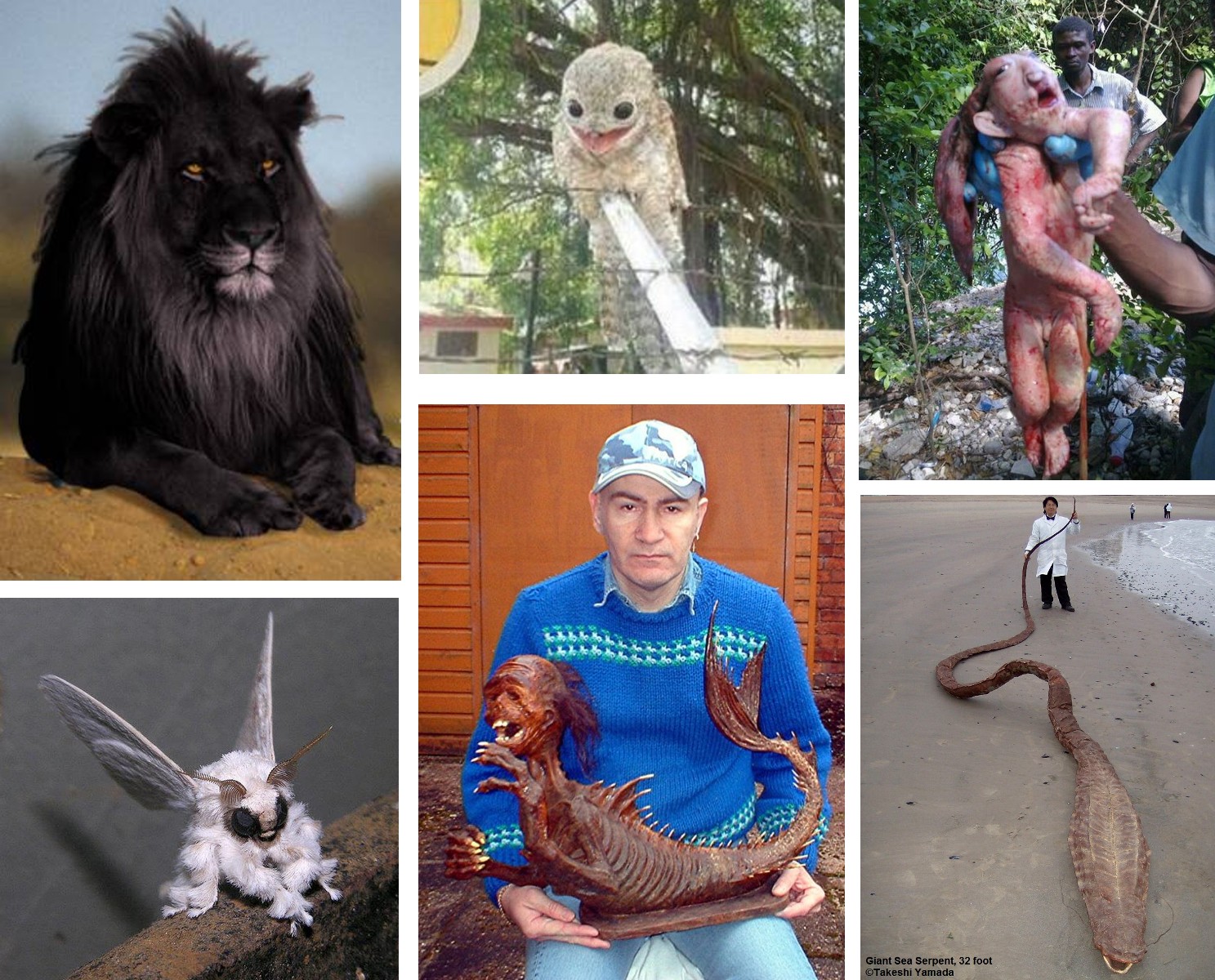
Judging from the subjects covered by the above articles, melanistic mystery cats seem to be of considerable interest to ShukerNature readers, as no fewer than three of the top ten articles (out of a total of no fewer than 652) are devoted to the investigation of such creatures and, in particular, alleged photos of such. Intriguing images also form the basis of a further four, purportedly portraying such diverse entities as an unexpectedly fluffy moth, a bizarre bird with a gargantuan gape, a monstrously huge grasshopper, and a grotesque being likened to an incongruous human-rabbit hybrid but likely to have been something much less extraordinary yet far more tragic.

Stir into this singular mix some truly bizarre beasts conjured forth into tangible existence by the creative genius of a celebrated master in manipulation and design, plus the perennially-popular saga of merfolk, and never forgetting a remarkable amphibian whose memorable external appearance has earned for it from the ever-imaginative media an even more memorable monicker, and the result is a listing of fascinating subjects that could not be found together anywhere else online, only here on ShukerNature, along with 642 other no less enthralling and entertaining topics too.

Subjects covered in some of my top ten ShukerNature blog articles (mermaid photo (© Dr Karl Shuker; Venezuelan poodle moth © Arthur Anker; giant sea serpent gaff photo © Takeshi Yamada; © of the other photos unknown to me but presented here on a strictly non-commercial Fair Use basis only)

So here's hoping that they will continue to be of interest to readers for a long time to come, and that I will be able to continue adding further ones to their elite company.

Finally, I'm happy to say that my long-awaited, long-promised ShukerNature book will be published during this coming spring, containing an exceedingly varied selection of my blog's articles in expanded, updated form, fully illustrated throughout in colour, and supplemented by a very extensive bibliography of sources consulted by me during their preparation. Look out here on ShukerNature for further updates as I receive them.

The original and extremely beautiful artwork specially prepared for the front cover of my forthcoming ShukerNature book by renowned artist Anthony Wallis (© Dr Karl Shuker/Anthony Wallis)


Monday, 26 February 2018

THE MERMAID OF HARALDSKAER - THE FISHY TALE OF A FISHY TAIL (AND SKELETON!) DISPLAYED AT THE DANISH NATIONAL MUSEUM


The mermaid of Haraldskaer's skeleton, exhibited at the Danish National Museum, Copenhagen, in 2012 (© Danish National Museum – reproduced here on a strictly educational, non-commercial Fair Use basis, for review purposes only)

Only a few days after watching, and greatly enjoying, Guillermo del Toro's wonderful fantasy movie The Shape of Water, concerning a captured amphibious humanoid (click here to read my review of it), earlier today I was asked on Facebook whether I knew anything about the subject of a striking photograph currently doing the rounds on social media sites, including the Fortean Times Appreciation Group on FB. Happily, I knew quite a lot about it, so here is the remarkable history of the mermaid of Haraldskaer.

The photograph in question is the one that opens this present ShukerNature blog article of mine, and shows what seems on first sight to be the skeleton of a mermaid. The photo had been shared on the Fortean Times Appreciation FB group from another such group, Pictures in History, where some brief details of its supposed origin and nature had been provided, and which are as follows.

Allegedly, this skeleton is that of a mermaid that had been found at Haraldskaer in mainland Denmark by a farmer while ploughing his field. And according to a more detailed description presented alongside it at the Danish National Museum in Copenhagen where the mermaid of Haraldskaer was first displayed, in 2012, it was about 18 years old, with long thick hair and long sharp canines, and also had a purse that contained a shark's tooth, a snake's tail, a mussel shell, and a flower (just like any self-respecting mermaid would be expected to keep inside her purse). Its species is claimed to be Hydronymphus pesci, believed extinct since the end of the 17th Century, and apart from a missing left hand the skeleton is complete, much more so than the only other known H. pesci skeleton, apparently held at the Hermitage Museum in St Petersburg, Russia, which lacks a tail. Moreover, this species is believed to belong to the Asian lineage of merfolk, thereby making the finding of specimens in Europe especially rare.

Close-up of the tail of the Haraldskaer mermaid skeleton (© Danish National Museum – reproduced here on a strictly educational, non-commercial Fair Use basis, for review purposes only)

Altogether a fascinating history, but, needless to say, entirely fictitious. In fact, as Danish zoologist and cryptozoological researcher Lars Thomas has kindly informed me, the Haraldskaer mermaid skeleton, complete with shark-inspired tail, was manufactured by Mille Rude, a Danish artist, for a special exhibition staged at the Danish National Museum, Copenhagen, during 2012. Rude took her inspiration from the very famous real discovery in 1835 of Haraldskaer Woman - the naturally-preserved body of a young woman found in Haraldskaer Bog, and dating back to approximately 490 BC (pre-Roman Iron Age).

In 2013, the mermaid skeleton was displayed at the Art Museum in Vejle on the east coast of the Jutland peninsula, constituting western Denmark, and a year later it was aptly exhibited in the manatee enclosure at Odense Zoo in central Denmark (manatees are popularly deemed to be the inspiration for mermaid sightings). In 2016, its perambulations took it to the Maritime Museum in Elsinore, Denmark, where it remains on display today. So far, so straightforward, but this is cryptozoology, albeit featuring in this instance an unequivocal cryptozoological gaff (an artificially constructed specimen). Consequently, nothing is ever that straightforward, as will be revealed a little later here.

Humorous 19th-Century illustration of a beautiful mermaid clearly less than impressed by the decidedly homely appearance of her supposed real-life inspiration, a manatee (public domain)

Meanwhile: One of the most famous tourist attractions in Denmark is Erik Eriksen's charming bronze statue of the eponymous character in Hans Christian Andersen's delightful 1837 fairytale The Little Mermaid. Eriksen's sculpture, measuring just 50 in high and weighing 385 lb, was officially unveiled  on 23 August 1913, residing on permanent display thereafter upon a rock at the edge of Copenhagen's harbour. Since then, it has been visited, posed alongside, and photographed by millions of tourists from all over the world, including my mother and myself back in 1979, and is officially classed as a National Treasure of Denmark

For much of 2010, however, this fish-tailed icon was temporarily absent from her accustomed site at the harbour side when she starred instead in the Danish Pavilion at the 2010 World Expo, held in Shanghai, China, remaining there from late March to 20 November. So forlorn and forsaken was the rocky prominence upon which she had sat for generations, gazing wistfully across the waters, however, that a plan, or, to be precise, a prank, was hatched to replace her there, if only for a very short time, but with something equally fishy – in every sense.

Erik Eriksen's statue of the Little Mermaid (© Dr Karl Shuker)

And so it was that on Maundy Thursday 2010, the skeleton of a mermaid duly appeared in the statue's stead, sitting in a similar pose on a plaster replica of her rock but placed very near to hers, and heralded with the somewhat macabre announcement to the media that the Little Mermaid had returned. After residing there for two hours, during which time it had attracted considerable attention and photo-snapping from locals and tourists alike, the skeleton was removed (to ensure that the fickle Danish weather did not damage it) and taken to the Natural History Museum of Denmark, in Copenhagen, where it was on public display throughout the Easter holiday period. But what is the true nature of this very striking specimen?

It is, of course, another gaff – this time consisting of a human skeleton down to and including its hips, plus the tail of a swordfish Xiphias gladius. Its creation and the prank of placing it briefly on show at the harbour during the Little Mermaid's Chinese leave of absence was the brainchild of  Hanne Strager, at that time the head of exhibitions at the Natural History Museum of Denmark, in Copenhagen, and it certainly attracted immense interest – and not just in spring 2010. It had actually been created a few years earlier at the museum, to feature in an exhibition there devoted to legendary creatures, and had been specifically structured to mimic the pose adopted by the Little Mermaid statue. But what has any of this to do with the Haraldskaer mermaid skeleton? I'm glad that you asked.

The Natural History Museum of Denmark's mermaid skeleton gaff, posed upon a plaster replica of the Little Mermaid statue's rock (© Natural History Museum of Denmark, Copenhagen – reproduced here on a strictly educational, non-commercial Fair Use basis, for review purposes only)

Photographs of the Haraldskaer mermaid skeleton have been circulating widely online for some years, and far more so, unfortunately, than the facts behind them, so that these pictures have incited (and continue to incite) much speculation as to whether the skeleton is actually genuine. Not only that, in an all-too-familiar trend seen on the Net with unusual images, they have even inspired various entirely new, but equally fictitious histories for it.

Consequently, I have seen some sites claiming that the skeleton has been the subject of much controversy since being discovered in Poland(!), and even in Indonesia – one site affirming that it had been discovered in Surabaya, on the island of Java. Worst of all, however, is that all of the media reports that I have read concerning it, even those from ostensibly respectable sources, have either been incomplete or decidedly ambiguous, inasmuch as they have implied that the Haraldskaer mermaid skeleton (created by Rude) and the mermaid skeleton placed briefly on the plaster replica of the Little Mermaid statue's rock (and whose creation was overseen by Strager) are one and the same, when in reality they are entirely different, albeit extremely similar specimens. Hence I wish to thank Lars Thomas most sincerely for revealing to me the true situation, and thereby assisting me to bring to a close the exceedingly curious and hitherto highly-confused case of the two mermaid skeletons, and also to Richard S. White and Markus Bühler for arousing my suspicions regarding the online sources consulted by me when originally preparing this blog article. Indeed, it now means that this article of mine may well be the only account presently online that provides an accurate, non-conflated coverage of these two gaffs.

A popular expression is that you can't keep a good man (or woman) down. Neither, it would seem, can you keep a good mermaid (or two) down; nor, at the risk of mixing metaphors further, can the internet let sleeping mermaids lie – not even ones that never existed to begin with!

My mother Mary Shuker and I visiting the Little Mermaid in 1979 (© Dr Karl Shuker)


Wednesday, 19 August 2015

FAN-TAILED MERMEN AND SCALY SEA BISHOPS


The version of the Russian merman-depicting lubok that was sent to me by Robert Schneck (public domain)

On 18 August 2015, Facebook friend Robert Schneck kindly brought to my attention on my FB timeline a fascinating illustration that I had never seen before, and which opens this current ShukerNature blog article. As far as I am aware, it has not previously attracted any notable cryptozoological attention, so I've been conducting some investigations into it, whose findings I am now presenting here as follows.

The illustration is a Russian lubok, which, to quote from the Wikipedia entry for such images, is:

"…a Russian popular print, characterized by simple graphics and narratives derived from literature, religious stories and popular tales. Lubki prints were used as decoration in houses and inns. Early examples from the late 17th and early 18th centuries were woodcuts, then engravings or etchings were typical, and from the mid-19th century lithography…Folklorist Dmitri Rovinsky is known for his work with categorizing lubok. His system is very detailed and extensive, and his main categories are as follows: "icons and Gospel illustrations; the virtues and evils of women; teaching, alphabets, and numbers; calendars and almanacs; light reading; novels, folktales, and hero legends; stories of the Passion of Christ, the Last Judgement, and sufferings of the martyrs; popular recreation including Maslenitsa festivities, puppet comedies, drunkenness, music, dancing, and theatricals; jokes and satires related to Ivan the Terrible and Peter I; satires adopted from foreign sources; folk prayers; and government sponsored pictorial information sheets, including proclamations and news items". Jewish examples exist as well, mostly from Ukraine. Many luboks can be classified into multiple categories."

The lubok under discussion here shows what appears to be some form of merman-like entity (though with hind limbs instead of a single fish-tail) that had been netted at sea, but no doubt some details concerning this case were contained in the Cyrillic-script text included above the lubok's image. Seeking a translation of this text online, I came upon a very extensive one on professional artist Aeron Alfrey's Monster Brains blog (click here).

It stated that the merman lubok's text did indeed describe a strange aquatic humanoid, one which had been caught in Spain, and that the image had been created by an anonymous folk artist in 1739. What was particularly interesting, however, was that this blog then provided not just a translation of the text, but also a version of the merman lubok that contained additional Cyrillic text underneath the image – text that was not present in the version that Robert had found and sent to me – thus explaining why the translation was so lengthy. So here is this more detailed version of the merman lubok:

The version of the merman lubok containing additional text (public domain)

Incidentally, the source of both the lubok with additional text and the translation of it as presented on Monster Brains was given by this latter blog as http://www.rollins.edu/Foreign_Lang/Russian/Lubok/lubnews.html– but this page can no longer be found online. Meanwhile, here is the translation of the full text as provided by the Monster Brains blog:

"A copy [of the news] from the Spanish town of Vigo from the 6th of April. The fishermen of the village of Fustin (Enfesta?) caught a sea monster or the so-called water man and with great difficulty dragged him by force in the net ashore. This amazing and rarely seen monstrum or sea wonder is from head to foot about 6 feet tall. Its head resembles a stake and is so smooth that it does not have even one hair on the top, only at the bottom it has a beard with long strands. The skin on its head and on the whole body is black and in some places covered with thin hair. The neck of this water old man is extremely long and the body unusually long and thick but in many respects it resembles the human body. The forearms and arms are very short, the palms are quite short, while the fingers are very long and up to the first joint, like a goose's feet, they are grown together and from there they go like human fingers. Its extraordinarily long nails resemble animals' and even though this monstrosity has low hanging breasts, it is, by all indications, of masculine gender. Its loins are short and grown together to the knees, and the shins are not very long either, but they are separated. Even though its feet are quite similar to human, the large toes hang quite close to each other like duck's feet. On its heels it has fish's scales, and on the skin of its back at the very bottom a bone has grown. A fin sticking out from it is just like a woman's fan, about 12 inches long, and when it opens it reaches even more than 12 inches. This was excerpted from the printed St. Petersburg News, received on the 20th of May of this, 1739, year, and the above news were reported in the No. 41."

I subsequently found this same translation and version of the merman lubok on another site, The Hermitage (click here), which is artist Rina Staines's Tumblr blog. She credits the translation to the same no-longer-available page source as Aeron's Monster Brains did, but additionally names the translator himself as one Alexander Boguslawski, and dates his translation as being from the year 1999. (Incidentally, call me paranoid, but in view of the highly mysterious nature of the entity depicted in this particular lubok, I do wish that the translator's surname had not included 'Bogus' in it!)

As can be readily seen, both the verbal description and the visual depiction of this entity reveal an exceedingly bizarre being – one so bizarre, in fact, that it is difficult to know how to assess it. Could it be some grossly-deformed human, perhaps? Or might it be a sea creature of known species but whose form has been distorted out of all recognition by some woefully-inaccurate verbal description spawned by the Chinese whispers syndrome from source to documentation, and illustrated by someone who did not see the creature itself but was instead entirely reliant upon the mutilated verbal account resulting from the Chinese whispers syndrome? Or is it possible that it truly was some extraordinary entity of a type still unknown to science – a veritable merbeing?

Regarding the option of this alleged merman being a severely deformed human: its cone-shaped head might have been an indication of microcephaly, as exhibited by certain individuals on record who have been dubbed 'pinheads'; its scaly skin may have been a possible allusion to ichthyosis; and its conjoined loins to the knees is a trait of sirenomelia, the so-called mermaid syndrome. However, it would surely be very unlikely (as well as exceedingly unlucky and unfortunate) for any one person to exhibit all of these very different, congenitally unrelated, and morphologically extreme conditions.

In any case, the single most outstanding morphological feature described for this entity is without doubt its apparent tail fin, depicted as a very large, multi-coloured, fan-like structure and described in similar vein too. If that feature is genuine, and could indeed open and close as claimed in the description, then we can evidently eliminate a teratological human from further consideration, because I cannot envisage how any congenital condition, however extreme, could create a structure even vaguely reminiscent of this fin.

Another scaly merman-like entity with hind limbs, as documented in The Animal Book, written by famous Italian humanist and Renaissance author Pietro Candido Decembrio (1399-1477), commissioned by Ludovico Gonzaga, Marquis of Mantua, and published in 1460, with its illustrations added during the next century – click here for more anomalous entities featured in this book (public domain)

Could the lubok have resulted from a much-distorted description of some known (but possibly not overly familiar?) sea beast? There is no doubt that the medieval and Renaissance bestiaries are full of grotesque illustrations of beasts known to modern-day science but not so familiar to layman observers back then. Yet even if so, it would surely require a truly massive stretch of the imagination and all but entirely unrestrained, unlimited powers of mis-description to yield a bipedal humanoid being with a conical cranium, four limbs, and a huge caudal tail fin from anything as zoologically mundane as a pinniped, cetacean, sirenian, or shark, for instance.

As for it constituting a bona fide merman: I have documented elsewhere on ShukerNature (click here) some very intriguing cases of mysterious carcases that have been put forward at one time or another as evidence for the reality of merfolk, and which, if the descriptions of such carcases were accurate (none of them, tragically, was retained or scientifically examined), cannot be readily identified with any known marine life-forms. Consequently, although I freely admit that the reality of such entities is very remote, I am loathe to discount entirely the possible existence of some kind of specialised sea-dwelling mammal that bears a superficial resemblance to the fabled mermaids and mermen of classical legend.

Of course, there is also a fourth possible explanation, and which may well be the most plausible – namely, that the entire report was a journalistic hoax, or at the very least merely a relocated rehash of some earlier account from the annals of early natural history. In relation to this latter prospect, when he sent me the abridged version of the merman lubok Robert mentioned that the entity's pointed head reminded him of the sea bishop.

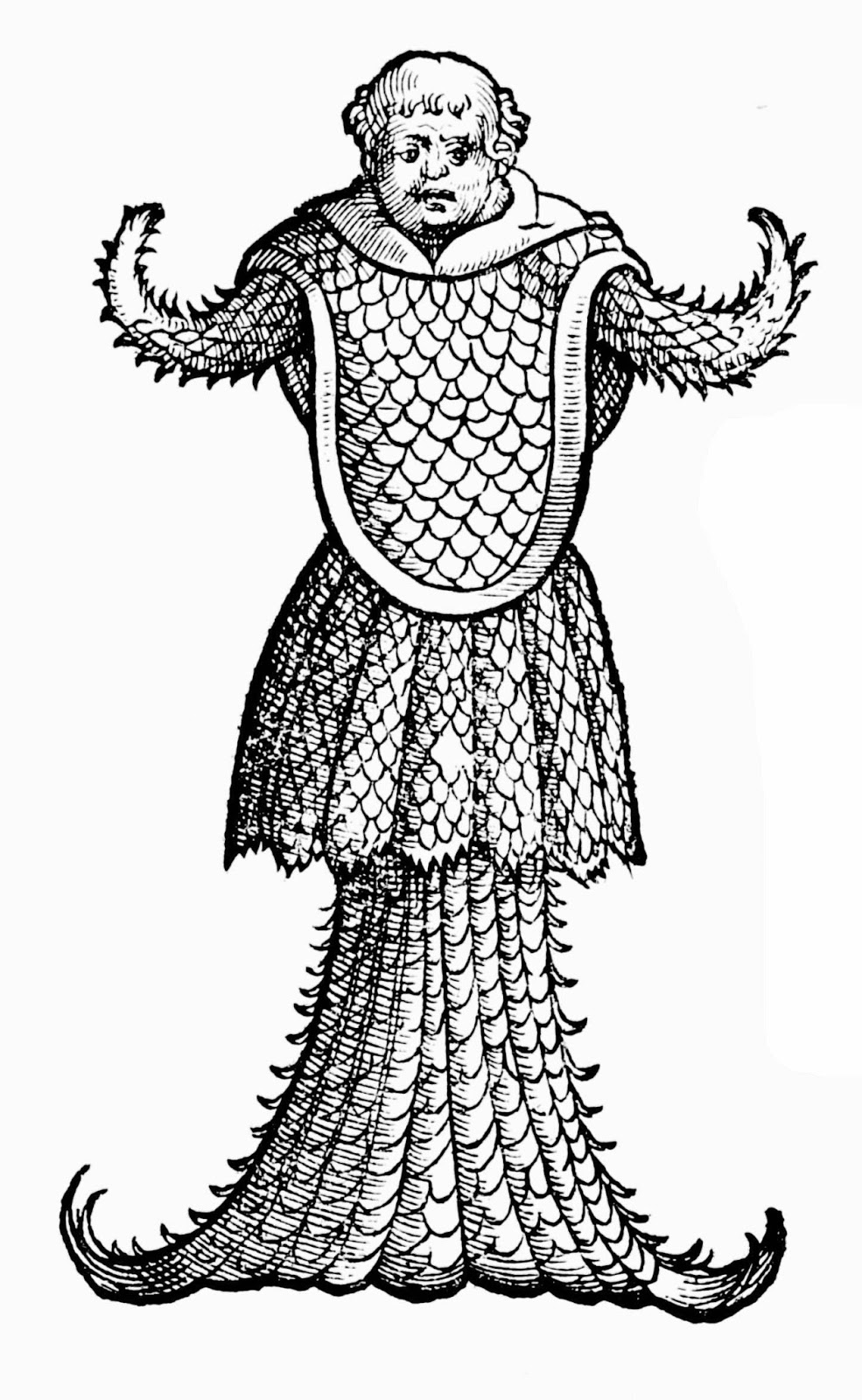
Lovers of bestiaries will be very familiar with this latter creature and its scaly-skinned image, which, in the tradition of bestiary and proto-encyclopaedia compilers for many centuries, has been reproduced with minor variations in numerous works dating from the mid-1500s onwards.

As far as I can tell, the sea bishop's earliest documentation was in French naturalist French Belon's work De Aquatilibus (1553), followed a year later by French marine biological researcher Guillaume Rondelet in his own tome Libri de Piscibus Marinis (1554), where he recorded a sighting of it from 1531 in the Baltic Sea off Poland by physician Gisbertus Germanus. Rondelet's work also contained an illustration of this sea bishop, but perhaps the most famous depiction of it appeared in 1558, as an engraving in the fourth volume of Swiss naturalist Conrad Gesner's monumental multi-volume, 4500-page Historia Animalium (1553-1558):

Engraving of the sea bishop, from Conrad Gesner's Historia Animalium (public domain)

This extraordinary sea monster was portrayed as a highly anthropomorphic humanoid-fish composite, and its sighting in 1531 was during Gesner's own lifetime (1516-1565). However, there is some confusion as to the creature's subsequent fate (not documented by Gesner).

Some sources state that it was captured alive and taken to the King of Poland, who wished to keep it, and was also shown to a group of Catholic bishops, to whom it gestured, appealing to be released, whereupon the bishops granted its wish and the creature in return made the sign of the Cross before disappearing back into the sea. (If nothing else, this is an interesting example not merely of ecclesiastical solidarity but also of the popular belief dating back as far as the time of Plato, 428/427 or 424/423 – 348/347 BC, that everything on land has a counterpart in the sea.) Other sources, conversely, document a sadder, less familiar end for the sea bishop, claiming it was actually caught off Germany, not Poland, and died in captivity three days later after refusing to eat (but I wonder if this story's differing location may originate from some confusion involving the name of its eyewitness, Gisbertus Germanus?).

Another well known version of the classic sea bishop illustration appeared in Johann Zahn's Specula Physico-Mathematico-Historica Notabilium ac Mirabilium Sciendorum (1696):

The sea bishop as depicted in Zahn's tome (public domain)

There is no doubt that the Spanish merman portrayed in the Russian lubok is reminiscent of the Baltic sea bishop, especially if the latter's billowing fin-like cloak is equated with the merman's fan-like caudal fin:

Spanish merman compared with Baltic sea bishop (public domain)

So if the sea bishop may provide a precedent of sorts, or possibly even a direct source or inspiration, for the Spanish merman, what might the sea bishop itself have been?

In his magnum opus, Gesner had also included an engraving and description of another mysterious 'human fish', the so-called sea monk. Again, this had been previously documented by Rondelet in his Libri de Piscibus Marinis, and by Belon in De Aquatilibus, but it was Gesner's coverage of it that first brought this creature to widespread attention. Here is Gesner's engraving:

Engraving of the sea monk, from Conrad Gesner's Historia Animalium (public domain)

This marine monster had allegedly been caught off Norway according to Gesner (or in the Øresund, the strait separating Sweden from the eastern coast of the large Danish island of Zealand, according to some other sources) in 1546, once again during Gesner's own lifetime, but its carcase was not retained; instead it was swiftly buried as an abomination on the orders of the Danish king, Christian IIII. In subsequent centuries, however, it has attracted (and still attracts today) considerable interest and controversy as to what it may have been.

Japetus Steenstrup's comparison of two versions of the sea monk engraving with, at centre, a giant squid (public domain)

Identities that have been proffered by various researchers include a giant squid (by 19th-Century Danish zoologist Japetus Steenstrup and more recently by giant squid chronicler Richard Ellis), an angel shark Squatina squatina (a large, dorsoventrally flattened species commonly dubbed a monkfish after its superficially monk-like form, proposed in 2005 by St Andrews University ecologist/mathematician Dr Charles Paxton and co-researcher Dr Robert Holland from the Freshwater Biological Association), a walrus (by veteran cryptozoologist Dr Bernard Heuvelmans), and various species of phocid seal.

Yet whereas I can see points in favour for each of the above creatures as identity contenders for the sea monk, I can see none for any of them as identity contenders for the sea bishop.

The angel shark or monkfish Squatina squatina, vintage illustration from 1877 (public domain)

As with the sea monk, I have encountered various attempts to reconcile the sea bishop with some form of squid. Yet even if we equate the sea bishop's markedly pointed head with the pointed rear portion of a squid's body, its two hefty-thighed legs are a poor substitute for the ten long slender arms and tentacles of a squid – unless we can envisage a squid whose eight shorter arms are united and obscured within some form of web-like interconnecting membrane, thereby explaining the bishop's cloak, with the latter's two legs being the longer prey-capturing tentacles of the squid?

Alternatively, bearing in mind that it was meant to be a sea bishop, might this creature's very pointed head have simply been an exaggerated (or even a completely fabricated) description, in order to provide it with an equivalent of sorts to a real bishop's mitre? It's all very tenuous, to say the least, and offers even less likelihood as a reasonable explanation for the Spanish merman with its caudal fanned fin.

In an interesting Folklore journal paper from 1975, W.M.S. Russell and F.S. Russell proposed that the sea bishop may actually have been a skilfully executed gaff along the lines of the Jenny Haniver. In their paper, they revealed how they had actually created a couple of Jenny Hanivers in the form of sea bishops, using two small alcohol-preserved specimens of the thornback skate Raja clavata.

A much-reproduced engraving of a Jenny Haniver, from Ulisee Aldrovandi's tome Monstrorum Historia (1642) (public domain)

For now, however, in the absence of any tangible evidence for their identities, both the sea bishop engraving and the Russian lubok's Spanish merman remain pictorial enigmas, which may bear little if any resemblance to the original creature(s) that they depict – always assuming of course that any such creature ever existed to begin with!

I plan to pursue the Spanish merman now via a different route, investigating whether other, preferably Spanish reports of its alleged capture exist – any discoveries will be included here as updates.

My sincere thanks to Robert Schneck for kindly bringing the Russsian merman lubok to my attention.

Sea monk and sea bishop sharing a page in Conrad Gesner's Historia Animalium (public domain)


Saturday, 23 May 2015

TOPKAPI'S MUMMIFIED CROCODILE BOY AND AMERICA'S MONKEYFIED ALLIGATOR MEN - A CURIOUS QUARTET OF GENUINE FAKES!


Postcard depicting Jake the Alligator Man (© Marsh's Free Museum)

On 1 March 1992, Turkish archaeologists publicly announced the discovery of an extraordinary Egyptian mummy in the vaults of Istanbul's famous Topkapi Palace Museum during some recent restoration work there. It was concealed inside a wooden sarcophagus (whose form confirmed it as having originated in ancient Egypt), and when carefully unwrapped it was found to consist of the upper parts of a young boy fused to the lower half of a crocodile!

The explanation for this bizarre specimen is still unknown. Some researchers have speculated that the boy may have been killed and partially eaten by the crocodile while bathing (or after accidentally falling) in Egypt's Nile River – and that in order for him to possess a complete body with which to pass into the afterlife, his parents arranged for his reptilian murderer to be killed and for the section of its body corresponding to the devoured portion of their son's to be attached to the boy's remains. However, this theory seems no less grotesque than the mummy itself!

Photocopy of a photograph - click to enlarge - depicting Topkapi's mummified crocodile boy being examined by the museum's Assistant Director of Restoration and Conservation, Behçet Erdal – from a report dated 1 March 1992 in the Turkish newspaper Meydan (© Meydan – photocopy courtesy of Paul Sieveking/Fortean Times via Izzet Goksu)

A more plausible possibility is that the pseudo-conjoined mummy was deliberately created as a sacred artefact or offering by worshippers of Sebek (aka Sobek), ancient Egypt's crocodile-headed god of rivers and lakes. It may even have been produced as a clever fraud for exhibition purposes – in modern times, such specimens are popularly referred to as gaffs; if so, this would make it one of the earliest gaffs ever recorded.

Line drawing from 1885 of Sebek, ancient Egypt's crocodile-headed deity (public domain)

As yet, I have not succeeded in discovering whether this unique specimen is on public display at Topkapi. So if anyone reading this ShukerNature blog article can provide me with some relevant details, I'd be very grateful.

Similar monstrosities were once very popular in carnivals and sideshows, especially in America, and at least one such creation still is today. Known as Jake the Alligator Man and constituting the upper half of a monkey skeleton skilfully attached to the lower half of a small alligator, this famous specimen has been on display for many years at Marsh's Free Museum [http://www.marshsfreemuseum.com/] – a thoroughly fascinating, highly-recommended exhibition of wonders and curiosities in Long Beach, Washington (not California, as often erroneously claimed) – and is said to be more than 75 years old.

Jake the Alligator Man (© imhavingfun42/Wikipedia)

Indeed, every year for almost a decade now there has been an official Annual Jake the Alligator Man 75th Birthday Party held in Long Beach. A short YouTube video of Jake on display at Marsh's Free Museum can be viewed here.

Incidentally, a much more common variant on this particular gaff theme is of course the so-called 'Feejee mermaid' (named after the famous specimen exhibited by American circus showman Phineas T. Barnum in 1842), which consists of the upper half of a monkey sewn to the lower half of a large fish.

19th-Century engraving of Barnum's Feejee mermaid (public domain)

Jake was purchased by the founders of Marsh's Free Museum in 1967 from an antique store in California, for the princely sum of $750, and was allegedly created by a New York-based firm known as Nelson Supply House. Jake subsequently featured in a series of highly entertaining albeit fictitious reports published by the American tabloid Weekly World News and beginning on 9 November 1993, which claimed that it had been found alive in a Florida swamp!

The headline from the first in the series of Jake the Alligator Man reports from Weekly World News (© Weekly World News)

More recently, a man named Josh brought a similar gaff into the curiosities shop Obscura featured in the Science Channel TV show Oddities, and sold it to the shop's proprietors for $450. A YouTube video of this interesting episode, uploaded by Science Channel on 1 June 2011 and showing the gaff in close-up detail, can be viewed here.

The Oddities alligator man (© Science Channel)

I also know of a third American alligator man specimen, but, sadly, its present whereabouts are apparently unknown (or at least to me). I have on file a copy of a report from 1996 written by Chris L. Murphy from the organisation Progressive Research, based in British Columbia, Canada. In his report, Chris documented his recollections of what appears to have been an outstanding alligator man, which he encountered while visiting the little town of Seaside, in Oregon, during the summer of 1976. Going into a large general store in the centre of the town, he discovered that it contained a free museum, and exhibited in that museum, housed inside a glass case, was a remarkable specimen labelled as an Alligator Boy. In his report, Chris described it as follows:

"The creature in the case was human looking to about its navel, and the rest of its body was that of an alligator. The human part was "upright," fairly erect as I recall. I studied the creature for a long time and reasoned that it was the body of a child, say about two years old, that had been fused onto the body of a small alligator. The child's body was "mummy-like" in appearance but still had considerable detail. I recall especially its hair, which was very fine and white, very much like the hair one would find on a child of this age, except for the color.

"The process used to fuse the bodies was certainly very exacting. The smooth skin of the child melded in with the scaly alligator skin very gradually, making the creature appear very realistic. I carefully studied the head, hands (which were very small), arms and other parts of the body and reasoned that it would be very difficult to fake something of that nature. In other words, I believe the human portion of the creature was the body of a real child. Unfortunately, there was no literature on the exhibit, and I did not take a photograph of it."

Chris revisited Seaside in or around 1993, intending to photograph the alligator boy, but when he arrived in town he discovered that the general store and its in-house museum were gone, replaced by a clothing store. When Chris spoke to a couple concerning the store and its alligator boy, the man informed him that he'd lived in Seaside most of his life and remembered this specimen well, but stated that some time before the store had closed down, it had been robbed and the alligator boy stolen from it.

A second postcard depicting Jake the Alligator Man (© Marsh's Free Museum)

Another Seaside resident, the proprietor of a jewellery store there, informed Chris that there was an alligator man on display at a free museum in Long Beach, Washington (Jake the Alligator Man at Marsh's Free Museum, obviously) and wondered whether this could be the same specimen as the one that had vanished from Seaside's erstwhile store-museum. Anxious to pursue this potential lead, on his way back home to British Columbia Chris stopped by in Long Beach and visited its alligator man. However, he could see straight away that this was a totally different specimen, its body held at an angle, not erect, and, at least in Chris's opinion, of inferior workmanship to the Seaside specimen that he had seen back in 1976. Moreover, he was able to chat with the museum's owner in Long Beach, who confirmed that he had purchased Jake in California (and a decade before Chris had seen the Seaside specimen anyway), and was unaware of any comparable gaffs anywhere else.

Having not seen the Seaside specimen personally, I am reluctant to discount Chris's opinion that it incorporated the head and upper body portion of a real human child, but it does seem more likely that these constituents of this gaff were actually derived from a monkey. Having said that, however, gaffs can be inordinately sturdy (especially if well-constructed), and hence are sometimes extremely old – dating back to times when, whereas albeit entirely abhorrent today, the prospect of such a macabre exhibit having been purposefully created would have been neither unthinkable nor impossible, as exemplified by Topkapi's mummified crocodile boy.

Meanwhile: whatever happened to the Seaside alligator boy? (Not only is it not Jake the Alligator Man, it is not the specimen sold on Oddities either, because the latter's body was not erect in posture but instead was held at an angle, just like Jake's.) Does it still exist today, and, if so, where is it? And are there still other alligator man gaffs also out there? If you know of any, or have any information concerning the presently lost Seaside specimen, please post details here on ShukerNature – thanks again!

Two Turkish newspaper reports from 1 March 1992 - click to enlarge - concerning the Topkapi mummified crocodile boy, one from Meydan, the other from Hürriyet Daily News (© Meydan/(© Hürriyet Daily News - photocopies courtesy of Paul Sieveking/Fortean Times via Izzet Goksu)


UPDATE: 24 May 2015 - CURIOUSER AND CURIOUSER...

After reading my above blog article and perusing the two photographs of Topkapi's mummified crocodile boy, longstanding crypto-correspondent Hodari Nundu was intrigued by the presence of a crocodile's head and apparent upper body portion within the sarcophagus but at the opposite end to the mummy's human head, and he wondered if in reality the mummy was actually composed of the head and upper body portion of a boy fused at the posterior edge of the boy's upper body portion to the posterior edge of the upper body portion of a crocodile, with its neck and head still present too. In other words, is it a veritable amphisbaena in mummified form, i.e. consisting of a single body with a head at each end (the boy's head at one end of the body, the crocodile's at the other)? If so, this would make the mummy even more bizarre than it already appeared to be. 

Yet according to both of the Turkish newspaper reports, as well as a subsequent report in the UK's prestigious Sunday Times newspaper for 8 March 1992, it was definitely the lower body portion of a crocodile that was fused to the boy's upper body portion (the Sunday Times report even referred specifically to the mummy incorporating the crocodile's tail). Also worth recalling is the mention in the Turkish reports of the theory that perhaps the boy's parents had arranged for the portion of the boy eaten by the crocodile (which was obviously his lower body portion, because his upper portion and head are incorporated into the mummy) to be replaced by the corresponding body portion of the crocodile (hence the crocodile's lower body portion) in order for their son to possess a whole body with which to pass into the afterlife.

Consequently, two different explanations for this ostensible contradiction come to mind. Either the crocodile head and upper body portion are not actually attached to the mummy but are merely lying on top of its crocodilian lower body portion and tail, thereby obscuring them from view in the photographs (the crocodile head and upper body portion presumably therefore having also been placed inside the sarcophagus, rather than merely being discarded, after the composite mummy had been produced and laid in there); or the Turkish newspaper reports (and thence that of the Sunday Times, which most likely obtained its information from Turkish media sources) were in error, and that in reality the mummy is indeed a crocodile-human amphisbaena in terms of its composition and construction.

Also today, on my 'Animal Discoveries and Curiosities' Facebook group's page, Hodari posted the following data:

"I did find some stuff online, including a Turkish news report from 2007 according to which the mummy would soon be put in display at the Topkapi Palace Museum. The story states that the mummy’s age has not been determined even though it was submitted to the carbon 14 test; the age of the boy when he died was between seven and eight. According to the director of the Topkapi museum, the legend says that the boy was the son of an Egyptian dignitary who fell into the Nile and was eaten by a crocodile. The reptile was then killed with the boy still inside, and mummified. However, at least two sources state that more than one half child half crocodile mummies have been found throughout Egypt, and that the Topkapi “specimen” is only one of several. Which I find strange since one would expect such rarities would be better known. One of the sources does include a possible explanation; Harpocrates (the child-like aspect of the god Horus) is often represented as stepping or standing on top of a crocodile, which represents the chaotic and malignant forces of the universe, so according to them, the child emerging from the crocodile would have a similar meaning."

Thanks, Hodari! Occurring in late Greek mythology as developed in Ptolemaic Alexandria, Egypt, and adapted from the ancient Egyptian child-god Horus, Harpocrates was a child-deity, the god of silence and secrecy. He was variously portrayed in art forms standing in human form upon the back of a crocodile, or emerging from the jaws of a crocodile, or possessing either the entire lower body portion and tail of a crocodile or the tail alone of a crocodile.

Following up these leads, I have just discovered online a photograph of a drachm coin originating in Alexandria and dating from the time of the Roman emperor Trajan (reigned 98-117 AD) that depicts Harpocrates with the tail of a crocodile:

Crocodile-tailed Harpocrates on Trajan-dated drachm coin from Alexandria, Egypt (© Aeqvitas.com)

And here is a depiction of a crocodile-bodied Harpocrates on a silver ring in the collections of the University of Michigan's Kelsey Museum of Archaeology at Ann Arbor (click here for full details):

Close-up of silver ring depicting Harpocrates with a crocodile's body (© Christopher A. Faraone, Ann Arbor, Kelsey Museum of Archaeology)

Could it be, therefore, that Topkapi's mummified crocodile boy was intentionally created as a physical representation of Harpocrates? 

With all of these new developments and findings to hand, I am now even more eager than before to obtain further information concerning this unique specimen, so that its true nature can be confirmed. So if you have any details, please post them here - thanks very much!


2ND UPDATE: 17 July 2018 - THE TOPKAPI CROCODILE GIRL!

My above-proposed 'amphisbaena' identity for the Topkapi crocodile boy has been proved correct. On 7 July 2018, Turkey's Hürriyet Daily News published an exclusive, revelatory article concerning Topkapi Palace's enigmatic crocodile boy mummy, and included the first detailed, close-up photograph of it to be released publicly, which was snapped on 6 July. (Versions of this report later appeared in various British newspapers - click here to read London's The Sun report of 9 July, as it contains an excellent presentation of the photograph.) The article revealed that the mummy's human portion was indeed attached to the upper body portion and head of a crocodile (not its lower portion and tail), so was, as I suggested earlier here, a veritable amphisbaena. Moreover, it was not from a boy after all, but had instead been derived from a girl, and no ordinary girl either – nothing less, in fact, than a princess, albeit a currently unidentified one, hailing from ancient Egypt. The mummy had been brought from Egypt to Turkey during the reign (1861-1876) of Ottoman Sultan Abdülaziz. It was kept at Yildiz Palace in Istanbul (which was the sultan's official residence at that time), until, after one of the palace servants used it to play a joke upon another worker there, Ottoman Sultan Abdul Hamid II (r.1876-1909) duly 'exiled' the mummy to the older palace of Topkapi, where it has remained ever since. My thanks to Hodari Nundu for bringing to my attention today the Hürriyet Daily News article.
 
This ShukerNature blog article is a greatly-expanded, fully-updated version of a short account of mine that originally appeared in my book The Unexplained: An Illustrated Guide to the World's Natural and Paranormal Mysteries (1996).