Dr KARL SHUKER

Zoologist, media consultant, and science writer, Dr Karl Shuker is also one of the best known cryptozoologists in the world. He is the author of such seminal works as Mystery Cats of the World (1989), The Lost Ark: New and Rediscovered Animals of the 20th Century (1993; greatly expanded in 2012 as The Encyclopaedia of New and Rediscovered Animals), Dragons: A Natural History (1995), In Search of Prehistoric Survivors (1995), The Unexplained (1996), From Flying Toads To Snakes With Wings (1997), Mysteries of Planet Earth (1999), The Hidden Powers of Animals (2001), The Beasts That Hide From Man (2003), Extraordinary Animals Revisited (2007), Dr Shuker's Casebook (2008), Karl Shuker's Alien Zoo: From the Pages of Fortean Times (2010), Cats of Magic, Mythology, and Mystery (2012), Mirabilis: A Carnival of Cryptozoology and Unnatural History (2013), Dragons in Zoology, Cryptozoology, and Culture (2013), The Menagerie of Marvels (2014), A Manifestation of Monsters (2015), Here's Nessie! (2016), and what is widely considered to be his cryptozoological magnum opus, Still In Search Of Prehistoric Survivors (2016) - plus, very excitingly, his four long-awaited, much-requested ShukerNature blog books (2019-2024).

Dr Karl Shuker's Official Website - http://www.karlshuker.com/index.htm

IMPORTANT: To view a complete, regularly-updated listing of my ShukerNature blog's articles (each one instantly clickable), please click HERE!

IMPORTANT: To view a complete, regularly-updated listing of my published books (each one instantly clickable), please click HERE!

IMPORTANT: To view a complete, regularly-updated listing of my Eclectarium blog's articles (each one instantly clickable), please click HERE!

IMPORTANT: To view a complete, regularly-updated listing of my Starsteeds blog's poetry and other lyrical writings (each one instantly clickable), please click HERE!

IMPORTANT: To view a complete, regularly-updated listing of my Shuker In MovieLand blog's articles (each one instantly clickable), please click HERE!

IMPORTANT: To view a complete, regularly-updated listing of my RebelBikerDude's AI Biker Art blog's thematic text & picture galleries (each one instantly clickable), please click HERE!

Search This Blog


PLEASE COME IN, I'VE BEEN EXPECTING YOU...

PLEASE COME IN, I'VE BEEN EXPECTING YOU...
WELCOME TO SHUKERNATURE - ENJOY YOUR VISIT - BEWARE OF THE RAPTOR!


Showing posts with label Greek mythology. Show all posts

Friday, 15 October 2021

HOW TO LOSE A CHIMAERA, IN ONE EASY LESSON!

 
Vintage picture postcard depicting the famous Chimaera of Arezzo bronze statue; it was originally part of a group, with Bellerophon and Pegasus fighting it (public domain)

How to lose a chimaera in one easy lesson? Simply see it, then promptly forget all about it, until far too much time has passed to make amends. See, I told you that it was easy! Confused? I was too, for a while – but let's begin at the beginning.

The year was 1980-ish, sometime in that decade anyway. It was during an afternoon in the Midlands town of Stratford-upon-Avon, famous not only in England but also internationally as the birthplace of a certain playwright, one William Shakespeare, to be precise. I was there with my family, as this was a favourite visiting locale for us on Sundays, because unlike in many other English towns back then, most shops in Stratford were open on the Sabbath due its huge popularity with overseas tourists.

 
Chimaera fountain at Arezzo, vintage postcard, 1952 (public domain)

And so it was on that fateful afternoon that I found myself in a large two-storey shopping complex in the centre of Stratford's shopping area, a complex that specialized in antiques. Its very spacious interior was divided up into numerous stalls, each stall rented out to a different antiques seller, so it collectively offered a vast range of objets d'art, curiosities, and exotica of every conceivable kind – in other words, a fascinating place in which to spend time browsing, at least for anyone like me with a decidedly eclectic range of interests.

In one corner of the downstairs storey was a stall whose lady vendor could usually be found whiling away the hours by knitting as potential purchasers eyed her wares. I can still vividly recall spotting on the floor amidst some other figurines a Jack Russell terrier-sized black sculpture in metal of what seemed to me to be a somewhat odd-looking lion, with a spiky mane, unusually slender haunches, and a long tail that curved up over its back instead of downwards. There also seemed to be something peculiar sticking up from its shoulders, but as I wasn't overly interested in this ostensibly misshaped, confusing creature, I never bothered to peer closer to see what that 'something peculiar' was. Instead, my gaze fell elsewhere, peering at other items in her stall before moving on to various stalls nearby – this complex contained a great many stalls, so in order to visit all or most of them, it paid not to linger or loiter too long at any single one.

 
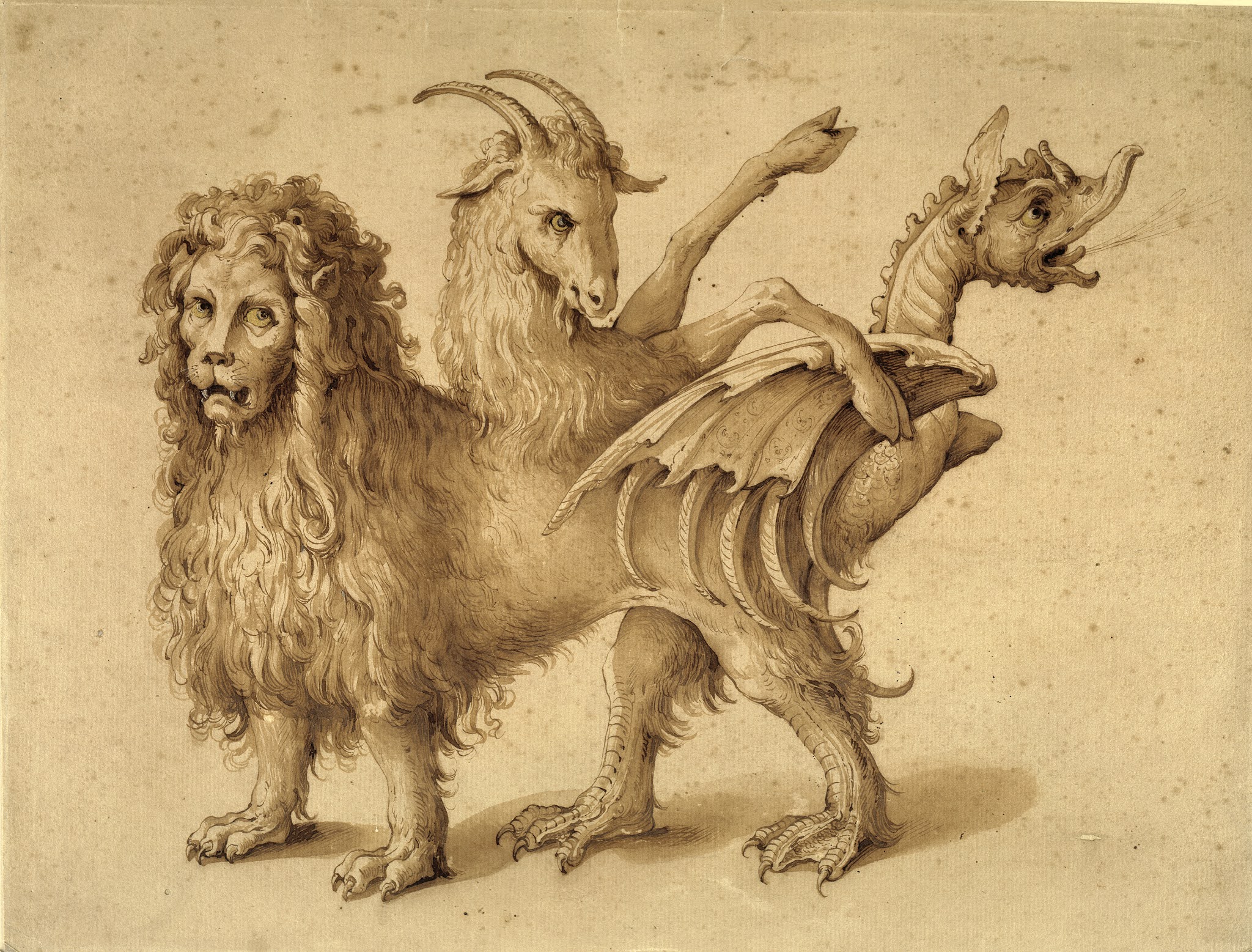
An inordinately elaborate chimaera, by Jacopo Ligozzi, created between 1590 and 1610 AD (public domain)

I thought nothing more of that strange-looking leonine statue for a long time, some years in fact, until one day I was idly flicking through a Larousse-published encyclopaedia of art that I'd lately purchased, and there, to my great surprise, was a photograph of a statue that looked exactly like the odd, spiky-maned lion that I'd seen during that long-gone Sunday afternoon visit to Stratford – except that it wasn't a lion after all. Instead, it was a chimaera (=chimera), and no ordinary chimaera either, always assuming of course that any chimaera can ever be considered ordinary. But what exactly IS a chimaera?

If you're unversed in Greek mythology, you may not have encountered the stirring legend of Bellerophon, Pegasus, and the Chimaera, so here are its edited highlights. The hideous semi-human monster Echidna had given birth to a number of horrific beasts, including the three-headed hell hound Cerberus, the two-headed monster hound Orthos, the many-headed Lernaean hydra, and the chimaera, which was yet another multi-headed horror.

 
An animatronic large-scale model of the chimaera (© Dr Karl Shuker)

This terrifying beast took the form of a huge lion, but unlike any normal member of the leonine pride, the chimaera bore a second head, in the form of a horned goat's, sprouting forth from between its shoulders or its upper back (recollections may vary, as I believe someone once said recently…?), and a third head, in the form of a venomous snake's, at the end of its long, ever-thrashing tail. Moreover, as if all of that were not already more than sufficiently deadly for anyone to deal with, the chimaera also breathed fire, jetting forth great flames of destruction from the jaws of its primary, leonine head.

In other words, this was an exceptionslly formidable beast for anyone to contend with, but most especially for the poor benighted inhabitants of  Caria in northern Anatolia, Turkey – because this is where the chimaera had taken up residence and was terrorizing the helpless populace, who had no answer to the perilous threat posed by an enormous monstrosity with three different heads and infernal flame-throwing capabilities.

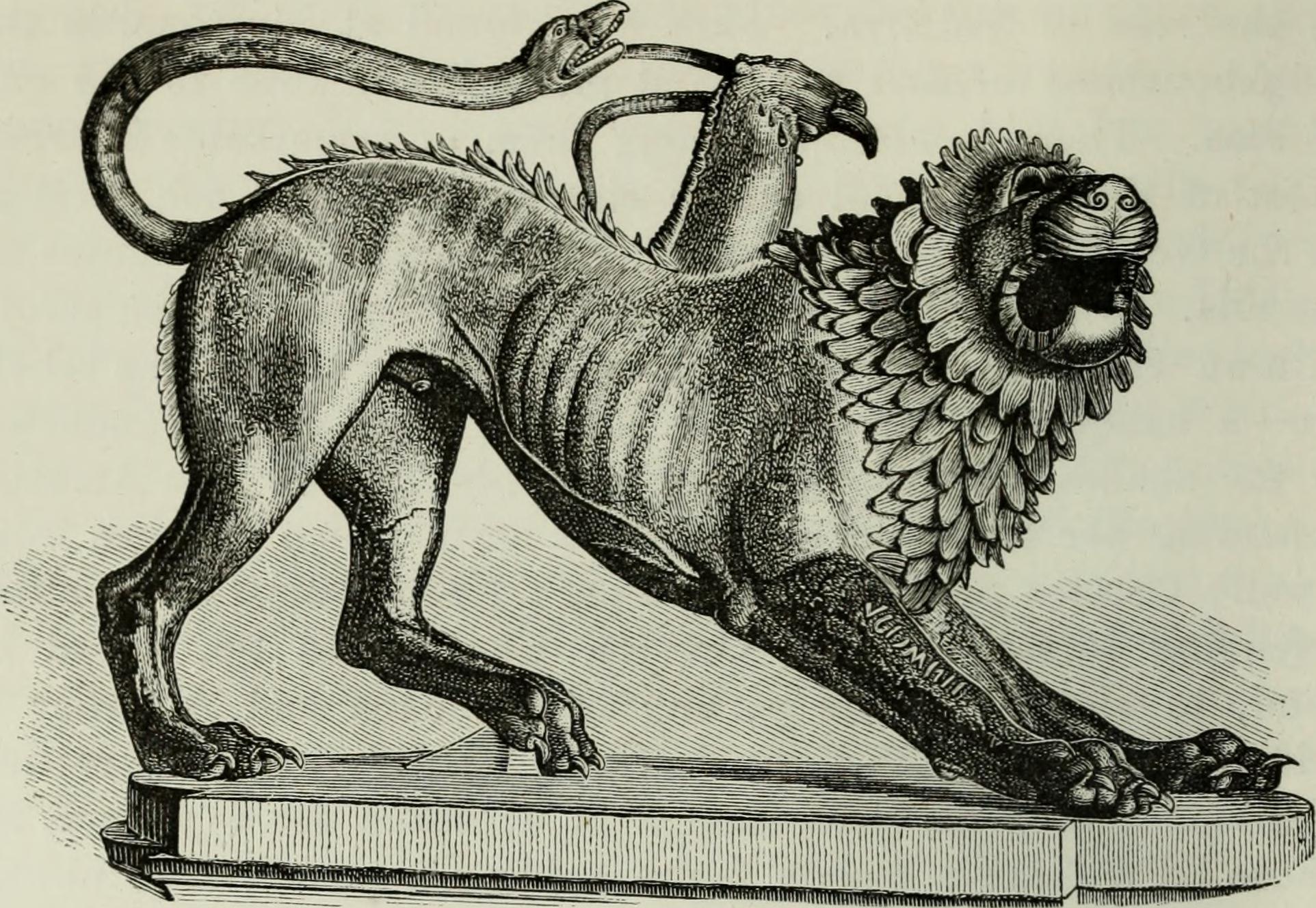
Two vintage engravings of the Chimaera of Arezzo bronze statue (top and bottom); and a vintage b/w photograph of it (middle) – note the dedicatory inscription to the god Tinia carved upon its right foreleg (all public domain)

In such a dire situation, the usual plan of action is for the terrified locals to send out for a hero to dispatch their hideous persecutor, but in this instance they did not have to do so, because just such a man had already been sent there, by his scheming uncle, King Iobates of Lycia in Anatolia, who fervently hoped that his heroic nephew would be killed by the chimaera, thereby foiling a prophecy claiming that his nephew would kill him instead.

The nephew in question was a mighty, fearless warrior-hero named Bellerophon, who arrived in Caria astride his equally mighty, fearless steed. Nor was this just any mighty, fearless steed either – in fact, it was none other than the magnificent winged horse Pegasus, previously untamed, but whom Bellerophon had successfully captured using the goddess Athena's enchanted golden bridle while it was drinking from a sacred spring on the citadel of Corinth in Greece, unaware of Bellerophon's stealthy approach.

 
Bellerophon on Pegasus slaying the chimaera – from Walter Crane's A Wonder Book For Girls and Boys (public domain)

Riding Pegasus, Bellerophon swiftly entered into battle with the chimaera, but even though his winged steed possessed the significant advantage of flight, it was a long and physically grueling onslaught before Bellerophon and Pegasus finally wore down this immensely powerful monster's vast reserves of strength. Doing so, however, finally enabled Bellerophon to slay it, by firing a spear tipped with a block of lead down its throat, whose fire melted the lead, thereby suffocating the chimaera, and freeing the people of Caria from its tyranny forever.

Encouraged by his great success, Bellerophon then decided to attempt an even more daring feat – to fly up through the sky upon Pegasus until he reached the very home of the gods themselves, who had hitherto remained forever concealed from human eyes in their lofty cloud-shielded domain at the very summit of Mount Olympus. This was something that no mortal had ever even attempted before, let alone achieved, but Bellerophon was intent upon doing so, and promptly set off, riding Pegasus ever upwards towards the divine dwelling place of the Greek deities.

 
An exquisite illustration from 1914 of Bellerophon riding Pegasus (public domain)

Zeus, however, was far from pleased about this. He had watched with pleasure as Bellerophon had dispatched the dreaded chimaera, but now his brow was creased with fury, his eyes thunderous with rage, as he witnessed Bellerophon's blasphemous ascent through the skies towards their rarefied Olympian home. Suddenly, Zeus had an idea – he sent forth a biting gadfly, down towards Bellerophon and his winged steed. When it reached them, the gadfly savagely bit Pegasus on his rump – which caused him to rear up in shock and pain, throwing an unsuspecting Bellerophon off his back, who plummeted headlong back down to Earth.

Miraculously, however, Bellerophon survived, by landing on a thorn bush that cushioned his fall, but its thorns blinded him, and he spent the rest of his days wandering the land piteously like a beggar, in abject misery – a sorry end indeed for a former hero and slayer of monsters.


Modern-day photographs depicting both sides of the Chimaera of Arezzo bronze statue (public domain / Wikipedia – CC BY-SA 3.0 licence)

Back now to my afore-mentioned Larousse-published encyclopaedia of art, and the photograph that I had seen in it was of a bronze statue of the chimaera, which had been unearthed by construction workers on 15 November 1553 at Arezzo, an ancient Etruscan and Roman city in Tuscany, Italy, and which dated back to approximately 400 BC.

Nowadays known officially as the Chimaera of Arezzo, and widely deemed to be the finest example ever uncovered of ancient Etruscan artwork, this spectacular statue is believed to have been a votive offering to the sky god Tinia – the supreme deity in Etruscan mythology. It stands 78.5 cm (2.5 ft) high, measures 129 cm (4.25 ft) in total length, and after passing through several different owners and holding locations it has been on permanent display at Florence's National Archaeological Museum in Tuscany since 1870.

 
Apart from its bright red colour, this is an identical replica of the Chimaera of Arezzo bronze statue, and was cast by the Ferdinando Marinelli Artistic Foundry (© Piero Paoletti/Wikipedia – CC BY-SA 4.0 licence)

 
Modern outdoor chimaera statue in stone inspired by the Chimaera of Arezzo bronze statue (© Thomas Shahan/Wikipedia – CC BY 2.0 licence)

I now realized that what I had seen in that antiques stall at Stratford was a modern-day replica of this historically highly significant statue, a faithful facsimile of the Chimaera of Arezzo no less. Unfortunately, however, I hadn't realized back then what it was, so I hadn't thought to ask its price. True, the price may have been more than I could have afforded, but I’ll never know, because I never asked.

All that I do know is that in the 30-40 years that have passed since that monumental miss on my part, I have never once seen another contemporary reproduction of the Chimaera of Arezzo statue for sale, anywhere. But I live in hope…

 
My mother Mary Shuker and I being scrutinized by an animatronic chimaera at an exhibition of monsters held in Birmingham's art gallery during August 2008 (© Dr Karl Shuker)

Finally: The 2012 fantasy movie Wrath of the Titans, albeit playing fast and loose with classical Greek mythology as is Hollywod's wont,  contains an undeniably thrilling battle sequence between Perseus (as opposed to Bellerophon) and a winged chimaera - check out its sneaky serpentine tail in the following video clip:


Thursday, 30 September 2021

LAOCOÖN, HIS SONS, AND POSEIDON'S CRESTED SERPENTS FROM THE SEA

 
The famous ancient Greek marble statue, 'Laocoön and His Sons', unearthed within an Italian vineyard in 1506, depicting the Trojan priest Laocoön and his twin sons being slain by a pair of huge serpents (public domain/Wikipedia)

In February 1506, a magnificent, mostly-intact marble statue in the Hellenistic baroque style was unearthed within the grounds of a vineyard owned by a Felice de Fredis, near Santa Maria Maggiore, Italy. As his great interest in classical works was well known, Pope Julius II was duly informed of the statue's discovery, and he in turn swiftly sent a team of experts to the vineyard in order to evaluate it personally and report back to him; the team included a young Michelangelo.

The statue consisted of three human figures, of which the central, adult male figure was approximately life-sized, whereas the two male youths flanking him were slightly less so, thereby enhancing the central figure's dramatic appearance. The faces and bodies of all three figures were contorted and twisted with tortured agony and fear – and for good reason. Two huge snakes were coiled around this unfortunate human trio, savagely attacking them with lethal intent. The statue was taken to the Vatican, where it has remained on public display ever since in one of its museums.

There has been much controversy as to whether this very dynamic work of art is one and the same as a certain statue written about in ancient works, and which dated back to the 2nd Century BC; or whether it is a somewhat later copy of that early statue (which some believe may actually have been created from bronze, not marble); or whether it is a much later, original work, possibly inspired by but not a direct copy of the 2nd-Century BC statue. One or other of the last two options is now deemed the most likely identity.

 
A vintage engraving of the statue 'Laocoön and His Sons', in which the illustrator has restored the missing portions to portray how the statue may have originally appeared when complete and unbroken (public domain)

The time period of this vineyard-unearthed statue's creation has also attracted dissension, with proffered dates ranging from c.200 BC to the 70s AD, with an approximate time-span of 27-BC-68 AD being the most favoured nowadays. Moreover, it is believed to have spent some time adorning the palace of the Roman Emperor Titus (reigned 79-81 AD). Its creators may have been a trio of Greek sculptors from Rhodes – namely, Agesander, Athenodoros, and Polydorus.

One aspect concerning the vineyard statue for which there is absolutely no controversy, however, is who and what it depicts, because the fraught scene in question is one of the most famous in all of classical Graeco-Trojan mythology. The central figure is the Trojan priest Laocoön, and the two youths are his twin sons Antiphantes (aka Antiphas) and Thymbraeus. Accordingly, the title by which this statue is officially known in the art world is 'Laocoön and His Sons'.

But what is of particular interest and relevance to this present ShukerNature article is the zoological nature of the giant serpents lethally encircling the doomed trio's bodies, which are named Porces and Chariboea (aka Curissia or Periboea). Based upon the statue alone, they simply look like muscular, constricting snakes, quite possibly inspired by the African rock python Python sebae, often kept as a pet in ancient Greece and Rome too. Consequently, they have been readily accepted as such by some authors. Conversely, ancient written accounts of their morphology and origin suggest something rather more exotic.

 
An African rock python (public domain)

As with the specific identity and age of the statue, there is contention regarding the precise background of Laocoön and why the snakes – or whatever they are – were attacking him and his sons, with different ancient sources making differing claims. As this is not the relevant place to examine and discuss in detail each of these sources and claims, suffice it to say therefore that the three major claims are that Laocoön was:

A Trojan priest who warned the Trojans not to trust the huge wooden horse offered to them as a gift by the opposing Greeks; his warning went unheeded and the Trojans fatally wheeled the horse into their city, thereby precipitating their destruction at the hands of the Greek soldiers concealed inside it, but to punish him for trying to prevent the horse from being accepted, the goddess Athena (the Greeks' divine supporter) sent two giant snakes to kill him and his sons.

Or: A Trojan priest of Apollo who broke his oath of celibacy by fathering his sons, so as a punishment Apollo sent two giant snakes to kill him and his sons.

Or: A Trojan priest of Poseidon who desecrated his temple by indulging in sexual intercourse within its perimeter, so as a punishment Poseidon sent forth two great serpents of the sea across the waves to kill him and his sons.

 
Engraving of Laocoön and his sons being attacked by giant snakes from the sea, in Speculum Romanae Magnificentiae, c.1516-20 (public domain)

Of these, the third version is the one most commonly cited and favoured, and is featured dramatically within ancient Roman poet Virgil's classic epic The Aeneid (written 29-19 BC):

Two snakes from Tenedos (I shudder to think of it) come on over the peaceful sea unwinding their huge coils and swim abreast towards the shore. Their breasts rise among the billows, their bloody crests tower over the waves; their flanks skim the abyss, and their vast tails curve in sinuous coils, the waves carrying the spume. Already they have reached the beach: their burning eyes shine, red with blood and flame; their tongues, like a dart, flicker in their mouths, which they lick, hissing...

Tenedos is an island in Turkey where according to legend the Greeks hid their army, to fool the Trojans into believing that the war between their two nations was finally over – a treacherous ruse augmented by their deceitful gifting to the Trojans of the Trojan Horse.

 
Vintage illustration of the oarfish (aka giant oarfish or ribbonfish) (public domain)

Way back in the 1970s, I studied sections of The Aeneid (including the above one) as part of my Latin O-Level course, and I can still well remember thinking how very reminiscent Poseidon's fire-crested sea serpents were of a certain huge and highly distinctive species of marine fish. Moreover, when I subsequently acquired and read veteran cryptozoologist Dr Bernard Heuvelmans's classic tome In the Wake of the Sea-Serpents (1968), I discovered that I wasn't the only one to have recognised this similarity. Here is what Heuvelmans wrote:

The colour of these snakes' crests makes one suspect that Virgil's terrific picture may be inspired, in parts at least, by one of the most mysterious of the world's larger fishes, the oarfish Regalecus glesne...It is long and serpentine, and right along its spine is a crest of bright coral red which it can raise into a sort of plume on its head.

Just how long this surreal but wholly inoffensive ribbon-like fish can be is very much a matter for conjecture, as I examined in an entire chapter devoted to it within my book A Manifestation of Monsters (2015), and also here on ShukerNature. It is certainly known to measure over 30 ft long, but some plausible if unconfirmed lengths of up to 50 ft have also been documented.

 
A Greek wall plate of mine depicting the vineyard-unearthed 'Laocoön and His Sons' statue (© Dr Karl Shuker)

Consequently, whereas the vineyard statue's visual portrayal of Laocoön and his sons' dreadful fate at the coils of their constricting nemeses was probably more naturalistic, merely inspired by pythons, verbal versions of the Laocoön legend like that of Virgil in which the giant serpents were huge crested snakes of the sea sent across the waves by Poseidon were more melodramatic, and conceivably inspired by rare sightings and strandings ashore of the spectacular oarfish. (They certainly do not recall any of the known, elapid species of sea snake currently documented.) Or, as Heuvelmans put it:

It is therefore more likely that the two serpents from Tenedos whose "bloody crests tower over the waves" were modelled on oarfish. There is even less doubt that these huge fragile fish could not have done the least harm, even to a newborn baby left upon the beach. But poetic licence will explain much...

Indeed it will.

 
My replica in resin from Greece of the 'Laocoön and His Sons' statue (© Dr Karl Shuker)


Thursday, 16 April 2020

JASON AND THE GOLDEN FLEECE - MORE THAN A MYTH?

The front cover of the issue of Fate Magazine (vol. 42, no. 9, issue #474, September 1989) containing my original article on the possible reality behind the classic Greek legend of Jason and the Golden Fleece (© Fate Magazine – reproduced here on a strictly non-commercial Fair Use basis for educational and review purposes only)

One of my very first articles published by Fate Magazine concerned the exciting possibility that the classic Greek legend of the hero Jason and his epic quest aboard his ship the Argo for the magical Golden Fleece at Colchis may have been based at least to a degree upon reality, especially with regard to the Fleece itself. It appeared in the September 1989 issue of Fate, whose front cover, depicting this famous story, opens the present ShukerNature article. Eight years later, my article was republished in my compendium book From Flying Toads To Snakes With Wings (1997), containing an extensive selection of my Fate articles. Now, 23 years on again, and this time expanded and partly rewritten, my investigation of Jason and the Golden Fleece finally makes its long-awaited debut on ShukerNature.

The grim shadow of a raised sword fell across the pale, tensed body of Prince Phryxus as he lay upon the sacrificial slab, awaiting certain death at the hand of his own father, King Athamas of Orchomenus. This city in ancient Greece had once been rich and prosperous, but that year its crop of corn had failed, and its people were starving. Due to a false prophecy originating from Queen Ino, Phryxus's wicked stepmother who hated him, Athamas mistakenly believed that his city's crop failure was a curse inflicted by the gods and could only be lifted by the sacrifice to them of his beloved son, Phryxus. Happily, however, Ino's evil plan was known to the gods, who chose to thwart it in a most spectacular manner.

Phryxus striving to hold on to Helle as she falls from Chrysomallus's back into the sea - depicted in an ancient Roman fresco, 45-79 AD, Pompeii (© Stefano Bolognini/Wikipedia, copyright-free for private or commercial use when copyright owner is attributed)

Suddenly, as Athamas's sword was poised to strike the fatal blow that would slay Phryxus, a golden stream of light poured forth from the clouds directly overhead. The king and the gathered congregation of spectators stared up in surprise, and as they did so the clouds parted and a magnificent winged ram with a shimmering fleece of pure gold appeared. The ram was Chrysomallus, sent by the messenger god Hermes to rescue the boy prince. As soon as Chrysomallus alighted on the ground, Phryxus ran to him and sat astride his broad woolly back. So too did Phryxus's young sister, Helle, whom Ino also hated.

Moments later, like a brilliant golden meteor, Chrysomallus was soaring speedily through the sky, journeying eastwards. Just as they were flying over the narrow stretch of sea dividing Europe and Asia, however, Helle looked down, and became so giddy that she fell off Chrysomallus's back, plummeting into the waves where she drowned. From then on, this sea was called the Hellespont. Chrysomallus, meanwhile, flew onwards with Phryxus until they reached the land of Colchis, in what is today the republic of Georgia. There, Phryxus was welcomed by Aeëtes, king of Colchis, but Chrysomallus died, and his glorious golden fleece was hung in a sacred grove, guarded by a dragon. Many years later, the fleece would be the focus of an epic quest by a Greek prince called Jason and his bold crew, the Argonauts, sailing from Iolcus to Colchis via the Black Sea aboard their famous ship the Argo, and assisted by Aeëtes's own daughter Medea in their successful bid to steal the fleece, sailing back to Iolcus with it afterwards.

Children's book illustration from 1902 or earlier, depicting Phryxus and Helle, based upon the above-reproduced Pompeii fresco (public domain)

Down through the ages, many ideas have been aired with regard to the Golden Fleece not having been a literal, physical sheep fleece of any kind, but rather a metaphor or a figurative description for something else entirely. Suggestions have included such diverse options as royal power, a book on alchemy, a technique of writing in gold on parchment, the forgiveness of the Gods, a rain cloud, a land of golden corn, the spring-hero, the sea reflecting the sun, the gilded prow of Phryxus's ship, the riches imported from the East, the wealth of technology of Colchis (see later here), a covering for a cult image of Zeus in the form of a ram, a fabric woven from sea silk, and a symbol representing the trading of fleeces dyed with the valuable, highly-prized pigment Tyrian purple (procured from the purple dye murex Bolinus brandaris, and various related species) for Georgian gold. Each of these, and more, has its own supporters, but none has achieved a consensus of scholarly acceptance.

Moreover, most people assume that this entire story is nothing more than a fanciful Greek myth anyway, dating back 3000 years but with no basis in fact. Quite apart from the ostensible fairytale aspect of a golden-fleeced ram, there was no firm evidence to suggest that Greek ships could even have reached the Black Sea prior to the 7th Century BC, when they are known to have colonised this region. However, not everyone has dismissed the legend quite so readily.

Purple dye murex Bolinus brandaris (public domain)

In May 1984, a classics scholar called Tim Severin and a team of modern-day Argonauts set out aboard their own Argo, sailing from Volos (site of Iolcus) in Thessaly, Greece, to Vani (site of Colchis) in western Georgia. Their goal was to recreate Jason's alleged voyage - and thus prove that such a journey could truly have taken place in those far-off days. In order to achieve as intimate a degree of verisimilitude as possible, Severin's specially-designed Argo was patterned on ancient Aegean vessels by naval architect Colin Mudie. It was then built by Greek shipwright Vasilis Delimitros, who crafted it from the same Aleppo pine used by Bronze Age Greek seafarers. When complete, it measured 54 ft in length.

Spanning 1500 nautical miles from the Aegean Sea through the Dardanelles (Hellespont), the Sea of Marmara, the Bosporus, and thence along the Black Sea's Turkish perimeter to his Georgian destination at its eastern limit, Severin's voyage in this new Argo took three months. It was often arduous, but it was also successful - thereby indicating that Jason and the Argonauts' epic journey aboard the Argo was indeed possible even back in those bygone times of ancient Greece. Moreover, as revealed in his fascinating book The Jason Voyage (1986), Severin also learned some interesting items of information relevant to the Golden Fleece.

Tim Severin (© Aaron D Linderman/Wikipedia - GNU Free Documentation Licence)

This legend is very popular in Georgia even today - where it is taught in schools, and even commemorated in product names, such as a 'Golden Fleece' brand of cigarettes. In addition, western Georgia once harboured a thriving cult of ram worshippers that lasted from the middle Bronze Age into the modern era - as confirmed by such archaeological finds as a bronze ram's head totem dating from the 18th Century BC, and ram's head bracelets moulded from gold that date from the 4th Century BC. There is even an old Georgian folktale of a golden ram tethered by a golden chain in a mountain cave filled with golden treasure.

Severin also learned that the traditional method of prospecting for gold in Georgia, a method dating back countless centuries, is to anchor in a gold-rich stream bed the fleece of a sheep - because the fleece's wool is very effective at trapping particles of gold. After it has been left in the stream for a time, the result will be a fleece impregnated with gold - in other words, a golden fleece! True, it will hardly compare to its magnificent legendary counterpart, but it may have been sufficient to inspire such a legend long ago.

Two Georgian gold coins commemorating the Golden Fleece legend (public domain)

The possibility that this activity is the origin of the Golden Fleece account is certainly intriguing, but it is not a recent revelation. As far back in time as the 1st Century BC, the Greek geographer/historian Strabo had made the same suggestion. He suggested that it may have been an ordinary fleece that had been used to trap gold washed down the River Phasis. Particles of gold would have remained ensnared among its fibres, resulting in a fleece that at least upon casual observation might well have appeared to be composed of gold-bearing wool. Although a most ingenious idea, it is surely unlikely that such a superficially deceptive artefact could not only have retained its illusion intact during inevitable closer examination but also have become sufficiently famous to engender one of Greek mythology's most enduring legends.

Dr George Hartwig mentioned in The Subterranean World (1875) that modern-day gold prospectors still use sheep fleeces for this purpose in several different gold-bearing countries. However, he also noted that this was not taken by many authorities as proof that the Golden Fleece was itself a fleece with gold-ensnared fibres. On the contrary, many felt that the quest by Jason and his Argonauts to Colchis was not for a Golden Fleece at all, but for this wealthy city's gold itself, with the fleece being nothing more than a means of obtaining such gold and having no significance of its own. In short, the Golden Fleece's present-day prominence in mythology might be due to erroneous telling and retelling of the ancient myths down through the ages, with the object of Jason's quest (the gold of Colchis) becoming confused with the means of obtaining it (an ordinary sheep fleece).

Strabo – 19th-Century engraving (public domain)

Although both of these theories are undoubtedly compelling in their simplicity, they are not the only explanations on offer for the origin of the Golden Fleece legend. Another solution, offered by several different researchers, is one that seeks to explain the Golden Fleece in a very different manner - as a misinterpreted and/or mythified reference to fine-wooled fleeces. There are three principal classes of wool:

1)  Carpet wool (very coarse, and hair-like; used for making carpets and rugs).
2) Cross-bred wool (familiar, weaving-quality; produced by the majority of British sheep breeds).
3) Fine wool (valuable and lustrous, with exceedingly fine fibres lacking a central medulla; generally obtained today from Merino sheep).

Vintage illustration of a Merino ram (public domain)

In a paper published by the British scientific journal Nature on 13 April 1973, Dr M.L. Ryder and Dr J.W. Hedges from the ARC Animal Breeding Research Organisation at Edinburgh, Scotland, noted that the legend of the Golden Fleece may actually refer to fine wool. Moreover, in their paper they documented a sample of cloth composed of fine wool that was obtained from a Scythian tomb in the Crimea, and which dated back to the 5th Century BC. If their reconciliation of the Golden Fleece legend with fine wool is correct, this Scythian sample is thus of particular significance. Its age and Crimean locality collectively confirm that fine wool was indeed associated with the Black Sea region, and at a time near that of the Golden Fleece's appearance and Jason's quest for it.

Nevertheless, in 1932 a paper had already appeared in the Proceedings of the Royal Society (of London) that was destined during the 1980s to suggest a much more literal solution to the Golden Fleece mystery than a gold-bearing artefact, a substitute for gold itself, or a mythification of early fine-woolled sheep.

Jason with the Golden Fleece, depicted upon a tin-glazed earthenware plate created in c.1540 AD (public domain)

The paper in question was written by Drs Claude Rimington and A.M. Stewart of the Wool Industries Research Association of Leeds, in West Yorkshire, England, and concerned itself with a previously uninvestigated pigment. Raw wool comprises the wool fibres and 'yolk'. This latter component in turn consists of ether-soluble grease (secreted by the sheep's sebaceous skin glands), and a water-soluble substance known as suint (secreted by the sheep's sweat glands). In their paper, Rimington and Stewart recorded that a golden-brown colouration existed in varying intensities within the suint of certain sheep, its intensity of colour depending upon the animals' diet and age, and also influenced by conditions stimulating sweat.

Following their analysis of the composition and secretion of this mysterious pigment (which they termed lanaurin - meaning 'golden wool'), Rimington and Stewart concluded that it was a pyrrolic complex. That is to say, a compound whose chemical structure is based upon a ring of four carbon atoms and one nitrogen atom. Moreover, they believed it to be related to the bile pigment bilirubin - a reddish substance originating via the breakdown of the well-known respiratory pigment haemoglobin, and normally secreted into the bile by the liver in many mammalian species.

Modern-day sculpture of the Golden Fleece hanging in its sacred grove and protected by a dragon, on display at Sochi in Russia (public domain)

Rimington and Stewart suggested that the appearance of lanaurin resulted from an enhanced destruction of haemoglobin within the sheep so afflicted; they also confirmed that it was conveyed through the skin of such sheep into their wool via the sweat glands. Furthermore, not only did this compound occur within the wool of golden-coloured sheep, it was also found within their urine, which in turn was excessively pigmented. Comparisons were drawn between golden-woolled sheep and inherited acholuric jaundice in humans, with the suggestion that as with this type of human jaundice, the golden-wool condition in sheep may be genetically based.

Further researches into this intriguing area of biochemistry took place in the years to come. Chemical analyses became more precise, and chemical nomenclature diversified - substances inducing jaundice becoming known as icterogenic agents. By the early 1960s, examples of abnormal golden colouration had been reported and studied not only in sheep but also in rabbits (see the series of papers by Rimington and colleagues published during this period in the Royal Society's Proceedings), and it emerged that a number of natural and synthetic icterogenic agents belonged to a group of chemicals known as the pentacyclic triterpenoids. In other words, they are organic compounds produced in animals and also plants by combination into larger molecules of units each containing five carbon atoms arranged in the characteristic pattern present in isoprene (a simple-structured substance used in the manufacture of rubber).

'The Golden Fleece' by Herbert James Draper, 1904, oil on canvas (public domain)

By 1963 and in partnership with J.M.M. Brown and Barbara Sawyer, Rimington's continuing researches in this field had uncovered some important new information. They revealed that the golden-wool condition in sheep could also be induced by environmental means - namely, the ingestion by sheep of leaves from certain plants (especially shrubs of the genus Lantana). These plants contained pentacyclic triterpenoids that poisoned the liver of such sheep, thus preventing the normal excretion of bilirubin into the bile - resulting instead in its passage (together with that of various related pigments) into the skin and wool suint of those animals, thereby bestowing upon their wool the golden appearance reported in Rimington's earlier studies.

So here we have an environmentally-stimulated phenomenon that produces sheep (and rabbits!) with golden-coloured wool. Not surprisingly, therefore, it was only a matter of time before this circumstance was mooted as the solution to the fabled Golden Fleece itself. And in a letter to Nature published on 23 June 1987, this was indeed proposed in that context by Dr J. Smith, a researcher in physical chemistry at Melbourne University, Australia.

Jason bringing Pelias the Golden Fleece and a winged victory prepares to crown him with a wreath - Side A from an Apulian red-figure calyx crater, in the Louvre, Paris (public domain)

In his letter, Dr Smith recalled an earlier portion of the Golden Fleece legend. Namely, the section in which its ovine bearer appeared during a period of severe famine in Greece, having been sent by Hermes to rescue two children due to be sacrificed by their evil stepmother Ino, in an attempt to appease the gods and thereby end the famine. Smith noted that during modern-day periods of famine in New Zealand, sheep there were often fed upon leaves from trees by their distraught farmer owners. He then postulated that under similar conditions in Greece, farmers may well have fed their sheep upon leaves from the extensively cultivated olive tree Olea europea. And it just so happens that the olive tree's leaves contain great amounts of oleanolic acid, which is the basic substance from which the known icterogenic pentacyclic triterpenoids are derived.

Tests carried out with rabbits by Brown, Rimington and Sawyer in the 1960s had readily revealed that small amounts of oleanolic acid did not induce any icterogenic activity. Conversely, as argued by Smith, when present in much greater concentrations - as in the leaves of the olive tree (and particularly in those subjected to draught stress, as experienced in famine conditions) - oleanolic acid could exert a deleterious effect upon the liver of sheep, and in turn bring about abnormal golden discolouration of wool. In short, the Golden Fleece legend may have been based upon sightings of sheep that, during the famine periods experienced by Greece in earlier days, had been fed upon olive tree leaves, whose high triterpenoid content had ultimately caused their fleeces to be stained with golden bile pigments.

A 5,000-year-old European olive tree (© Mujaddara/Wikipedia - CC BY-SA 3.0 licence)

Although, as Smith himself admitted, this is all speculative, there is no doubt that it offers an exceedingly beguiling solution to the legend - and one, moreover, that actually corresponds very closely not just with its principal but also with its more peripheral portions.

At the same time, however, some contrary evidence also exists – which was brought to attention via a follow-up letter published in Nature on 5 November 1987 and written by research chemists Drs Patrick Moyna and Horacio Heinzen from the Faculty of Chemistry in Uruguay's Universidad de la Republica. They reported that oleanolic acid is contained in even greater concentrations in certain other plant sources - for example, it accounts for up to 50% of the content of grapes' epicuticular wax. Yet this does not appear to have any toxic effect upon humans consuming the grapes - in contrast to the outcome that one would have predicted, judging from the arguments offered with sheep and olive leaves. However, Moyna and Heinzen did not provide any references in relation to sheep and grapes, and it is well known that the gastrointestinal tract and its associated organs in humans differ very considerably in morphology and physiology from those of sheep.

The Golden Fleece, depicted upon an ancient Greek vase (public domain)

The concept of liver-damaged sheep with discoloured yellowish wool stained by bile pigments certainly fails to conjure forth the romantic image evoked by the stirring legend of the Golden Fleece. However, the prosaic practicality of science is rarely able to match the imaginative wonder of illusory fable and fairytale.

In March 1991, yet another theory was highlighted, again by Dr ML. Ryder. In an Oxford Journal of Archaeology paper, he discussed evidence not only for the two afore-chronicled theories concerning fine wool and the using of fleeces to collect gold from water, but also for the possibility that the legend stemmed at least in part from fleeces sporting genetically-induced tan-coloured fibres rather than white ones. Clearly, the allure and intrigue of the Golden Fleece is as much alive in modern times as it was 3000 years ago in ancient times. Not bad for a mere myth…?

The Colchis princess Medea, the Golden Fleece, and its dragon guardian – plate from an old Russian children's book (public domain)

A final scientific curiosity linking sheep and gold that is well worth mentioning here is the occurrence of reports from many parts of the world down through the years concerning sheep that supposedly possess teeth plated with gold! These still appear spasmodically in the media even today, yet as far back as 25 August 1920 in a paper published by the Proceedings of the Linnean Society of New South Wales, Thomas Steel revealed that the golden colour was due merely to the reflection of light from the overlapping of thin films of encrusting tartar, deposited on the teeth by the animals' own saliva. As for the tartar - far from being gold, or even iron pyrites ('fool's gold'), this had been conclusively shown to be nothing more exciting (or valuable!) than impure calcium phosphate and organic matter. In Crete, it is widely believed that sheep there sporting golden teeth have been eating the herb nevrida Polygonum ideaum over a lengthy period of time, as investigated in an online article here that contains photographs of gold-stained sheep teeth.

It was Shakespeare who said: "All that glisters is not gold", and judging from the subjects investigated in this article, he certainly had a point!

Erasmus Quellinus II – 'Jason with the Golden Fleece', 1630 (public domain)