The version of the Russian merman-depicting
lubok that was sent to me by Robert Schneck (public domain)
On 18 August 2015, Facebook friend Robert Schneck kindly brought to
my attention on my FB timeline a fascinating illustration that I had never seen before, and which
opens this current ShukerNature blog article. As far as I am aware, it has not
previously attracted any notable cryptozoological attention, so I've been
conducting some investigations into it, whose findings I am now presenting here
as follows.
The illustration is a Russian lubok, which, to
quote from the Wikipedia entry for such images, is:
"…a Russian popular print,
characterized by simple graphics and narratives derived from literature,
religious stories and popular tales. Lubki prints were used as decoration in
houses and inns. Early examples from the late 17th and early 18th centuries
were woodcuts, then engravings or etchings were typical, and from the mid-19th
century lithography…Folklorist Dmitri Rovinsky is known for his work with
categorizing lubok. His system is very detailed and extensive, and his main
categories are as follows: "icons and Gospel illustrations; the virtues
and evils of women; teaching, alphabets, and numbers; calendars and almanacs;
light reading; novels, folktales, and hero legends; stories of the Passion of
Christ, the Last Judgement, and sufferings of the martyrs; popular recreation
including Maslenitsa festivities, puppet comedies, drunkenness, music, dancing,
and theatricals; jokes and satires related to Ivan the Terrible and Peter I;
satires adopted from foreign sources; folk prayers; and government sponsored
pictorial information sheets, including proclamations and news items".
Jewish examples exist as well, mostly from Ukraine. Many luboks can be classified
into multiple categories."
The lubok under discussion here shows what appears
to be some form of merman-like entity (though with hind limbs instead of a
single fish-tail) that had been netted at sea, but no doubt some details concerning
this case were contained in the Cyrillic-script text included above the lubok's
image. Seeking a translation of this text online, I came upon a very extensive one on professional artist Aeron Alfrey's
Monster Brains blog (click here).
It stated that the merman lubok's text did indeed
describe a strange aquatic humanoid, one which had been caught in Spain, and that the image had been created by an
anonymous folk artist in 1739. What was particularly interesting, however, was
that this blog then provided not just a translation of the text, but also a
version of the merman lubok that contained additional Cyrillic text underneath
the image – text that was not present in the version that Robert had found and sent
to me – thus explaining why the translation was so lengthy. So here is this
more detailed version of the merman lubok:
The version of the merman lubok containing
additional text (public domain)
Incidentally, the source of both the lubok with
additional text and the translation of it as presented on Monster Brains was
given by this latter blog as http://www.rollins.edu/Foreign_Lang/Russian/Lubok/lubnews.html– but this page can no longer be found online. Meanwhile, here is the
translation of the full text as provided by the Monster Brains blog:
"A copy [of the news] from the
Spanish town of Vigo from the 6th of April. The fishermen of the village of Fustin (Enfesta?) caught a sea monster or the
so-called water man and with great difficulty dragged him by force in the net
ashore. This amazing and rarely seen monstrum or sea wonder is from head to
foot about 6 feet tall. Its head resembles a stake and is
so smooth that it does not have even one hair on the top, only at the bottom it
has a beard with long strands. The skin on its head and on the whole body is
black and in some places covered with thin hair. The neck of this water old man
is extremely long and the body unusually long and thick but in many respects it
resembles the human body. The forearms and arms are very short, the palms are
quite short, while the fingers are very long and up to the first joint, like a
goose's feet, they are grown together and from there they go like human
fingers. Its extraordinarily long nails resemble animals' and even though this
monstrosity has low hanging breasts, it is, by all indications, of masculine
gender. Its loins are short and grown together to the knees, and the shins are
not very long either, but they are separated. Even though its feet are quite
similar to human, the large toes hang quite close to each other like duck's
feet. On its heels it has fish's scales, and on the skin of its back at the
very bottom a bone has grown. A fin sticking out from it is just like a woman's
fan, about 12 inches long, and when it opens it reaches even
more than 12 inches. This was excerpted from the printed
St. Petersburg News, received on the 20th of May of this, 1739, year, and the
above news were reported in the No. 41."
I subsequently found this same translation and
version of the merman lubok on another site, The Hermitage (click here), which is artist Rina Staines's Tumblr blog. She credits the translation to the same no-longer-available page
source as Aeron's Monster Brains did, but additionally names the translator himself as
one Alexander Boguslawski, and dates his translation as being from the year 1999.
(Incidentally, call me paranoid, but in view of the highly mysterious nature of
the entity depicted in this particular lubok, I do wish that the translator's
surname had not included 'Bogus' in it!)
As can be readily seen, both the verbal description
and the visual depiction of this entity reveal an exceedingly bizarre being –
one so bizarre, in fact, that it is difficult to know how to assess it. Could
it be some grossly-deformed human, perhaps? Or might it be a sea creature of
known species but whose form has been distorted out of all recognition by some
woefully-inaccurate verbal description spawned by the Chinese whispers syndrome
from source to documentation, and illustrated by someone who did not see the
creature itself but was instead entirely reliant upon the mutilated verbal
account resulting from the Chinese whispers syndrome? Or is it possible that it
truly was some extraordinary entity of a type still unknown to science – a
veritable merbeing?
Regarding the option of this alleged merman being a
severely deformed human: its cone-shaped head might have been an indication of
microcephaly, as exhibited by certain individuals on record who have been
dubbed 'pinheads'; its scaly skin may have been a possible allusion to
ichthyosis; and its conjoined loins to the knees is a trait of sirenomelia, the
so-called mermaid syndrome. However, it would surely be very unlikely (as well
as exceedingly unlucky and unfortunate) for any one person to exhibit all of
these very different, congenitally unrelated, and morphologically extreme
conditions.
In any case, the single most outstanding
morphological feature described for this entity is without doubt its apparent
tail fin, depicted as a very large, multi-coloured, fan-like structure and
described in similar vein too. If that feature is genuine, and could indeed
open and close as claimed in the description, then we can evidently eliminate a
teratological human from further consideration, because I cannot envisage how
any congenital condition, however extreme, could create a structure even
vaguely reminiscent of this fin.
Another scaly merman-like entity with
hind limbs, as documented in The Animal
Book, written by famous Italian humanist and Renaissance author
Pietro Candido Decembrio (1399-1477), commissioned by Ludovico Gonzaga, Marquis
of Mantua, and published in 1460, with its illustrations added during the next
century – click here for more anomalous entities featured
in this book (public domain)
Could the lubok have resulted from a much-distorted
description of some known (but possibly not overly familiar?) sea beast? There
is no doubt that the medieval and Renaissance bestiaries are full of grotesque
illustrations of beasts known to modern-day science but not so familiar to layman
observers back then. Yet even if so, it would surely require a truly massive
stretch of the imagination and all but entirely unrestrained, unlimited powers
of mis-description to yield a bipedal humanoid being with a conical cranium,
four limbs, and a huge caudal tail fin from anything as zoologically mundane as
a pinniped, cetacean, sirenian, or shark, for instance.
As for it constituting a bona fide merman: I have
documented elsewhere on ShukerNature (click here)
some very intriguing cases of mysterious carcases that have been put forward at
one time or another as evidence for the reality of merfolk, and which, if the
descriptions of such carcases were accurate (none of them, tragically, was
retained or scientifically examined), cannot be readily identified with any
known marine life-forms. Consequently, although I freely admit that the reality
of such entities is very remote, I am loathe to discount entirely the possible
existence of some kind of specialised sea-dwelling mammal that bears a
superficial resemblance to the fabled mermaids and mermen of classical legend.
Of course, there is also a fourth possible
explanation, and which may well be the most plausible – namely, that the entire
report was a journalistic hoax, or at the very least merely a relocated rehash
of some earlier account from the annals of early natural history. In relation
to this latter prospect, when he sent me the abridged version of the merman lubok
Robert mentioned that the entity's pointed head reminded him of the sea bishop.
Lovers of bestiaries will be very familiar with
this latter creature and its scaly-skinned image, which, in the tradition of
bestiary and proto-encyclopaedia compilers for many centuries, has been reproduced
with minor variations in numerous works dating from the mid-1500s onwards.
As far as I can tell, the sea bishop's earliest
documentation was in French naturalist French Belon's work De Aquatilibus
(1553), followed a year later by French marine biological researcher Guillaume
Rondelet in his own tome Libri de Piscibus Marinis (1554), where he
recorded a sighting of it from 1531 in the Baltic Sea off Poland by physician Gisbertus
Germanus. Rondelet's work also contained an illustration of this sea bishop,
but perhaps the most famous depiction of it appeared in 1558, as an engraving in
the fourth volume of Swiss naturalist Conrad Gesner's monumental multi-volume,
4500-page Historia Animalium (1553-1558):
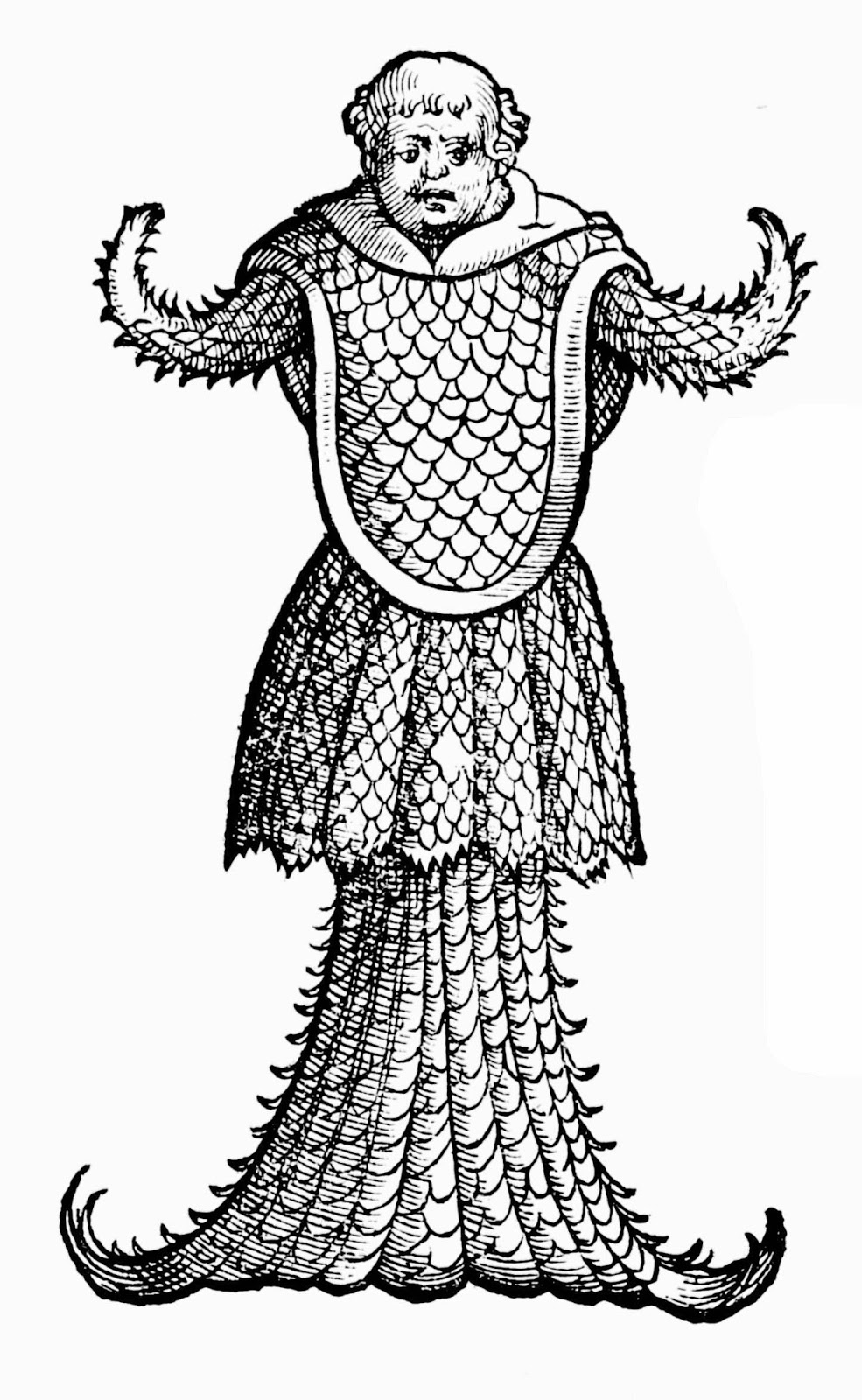
Engraving of the sea bishop, from
Conrad Gesner's Historia Animalium (public domain)
This extraordinary sea monster was portrayed as a
highly anthropomorphic humanoid-fish composite, and its sighting in 1531 was during
Gesner's own lifetime (1516-1565). However, there is some confusion as to the
creature's subsequent fate (not documented by Gesner).
Some sources state that it was captured alive and
taken to the King of Poland, who wished to keep it, and was also shown to a
group of Catholic bishops, to whom it gestured, appealing to be released,
whereupon the bishops granted its wish and the creature in return made the sign
of the Cross before disappearing back into the sea. (If nothing else, this is
an interesting example not merely of ecclesiastical solidarity but also of the
popular belief dating back as far as the time of Plato, 428/427 or 424/423 –
348/347 BC, that everything on land has a counterpart in the sea.) Other
sources, conversely, document a sadder, less familiar end for the sea bishop,
claiming it was actually caught off Germany, not Poland, and died in captivity
three days later after refusing to eat (but I wonder if this story's differing
location may originate from some confusion involving the name of its
eyewitness, Gisbertus Germanus?).
Another well known version of the classic sea
bishop illustration appeared in Johann Zahn's Specula
Physico-Mathematico-Historica Notabilium ac Mirabilium Sciendorum (1696):
The sea bishop as depicted in Zahn's
tome (public domain)
There is no doubt that the Spanish merman portrayed
in the Russian lubok is reminiscent of the Baltic sea bishop, especially if the latter's billowing
fin-like cloak is equated with the merman's fan-like caudal fin:
Spanish merman compared with Baltic sea bishop (public domain)
So if the sea bishop may provide a precedent of
sorts, or possibly even a direct source or inspiration, for the Spanish merman,
what might the sea bishop itself have been?
In his magnum opus, Gesner had also included an
engraving and description of another mysterious 'human fish', the so-called sea
monk. Again, this had been previously documented by Rondelet in his Libri de
Piscibus Marinis, and by Belon in De Aquatilibus, but it was
Gesner's coverage of it that first brought this creature to widespread
attention. Here is Gesner's engraving:
Engraving of the sea monk, from
Conrad Gesner's Historia Animalium (public domain)
This marine monster had allegedly been caught off Norway
according to Gesner (or in the Øresund, the strait separating Sweden from the
eastern coast of the large Danish island of Zealand, according to some other
sources) in 1546, once again during Gesner's own lifetime, but its carcase was
not retained; instead it was swiftly buried as an abomination on the orders of
the Danish king, Christian IIII. In subsequent centuries, however, it has
attracted (and still attracts today) considerable interest and controversy as
to what it may have been.
Japetus Steenstrup's comparison of
two versions of the sea monk engraving with, at centre, a giant squid (public
domain)
Identities that have been proffered by various
researchers include a giant squid (by 19th-Century Danish zoologist Japetus
Steenstrup and more recently by giant squid chronicler Richard Ellis), an angel
shark Squatina squatina (a large, dorsoventrally flattened species commonly dubbed a
monkfish after its superficially monk-like form, proposed in 2005 by St
Andrews University ecologist/mathematician Dr Charles Paxton and co-researcher Dr Robert Holland from the Freshwater Biological Association), a walrus (by
veteran cryptozoologist Dr Bernard Heuvelmans), and various species of phocid seal.
Yet whereas I can see points in favour for each of
the above creatures as identity contenders for the sea monk, I can see none for
any of them as identity contenders for the sea bishop.
The angel shark or monkfish Squatina squatina, vintage illustration from 1877 (public domain)
As with the sea monk, I have encountered various attempts
to reconcile the sea bishop with some form of squid. Yet even if we equate the
sea bishop's markedly pointed head with the pointed rear portion of a squid's
body, its two hefty-thighed legs are a poor substitute for the ten long slender
arms and tentacles of a squid – unless we can envisage a squid whose eight
shorter arms are united and obscured within some form of web-like interconnecting
membrane, thereby explaining the bishop's cloak, with the latter's two legs being
the longer prey-capturing tentacles of the squid?
Alternatively, bearing in mind that it was meant to
be a sea bishop, might this creature's very pointed head have simply been an
exaggerated (or even a completely fabricated) description, in order to provide
it with an equivalent of sorts to a real bishop's mitre? It's all very tenuous,
to say the least, and offers even less likelihood as a reasonable explanation
for the Spanish merman with its caudal fanned fin.
In an interesting Folklore journal paper
from 1975, W.M.S. Russell and F.S. Russell proposed that the sea bishop may
actually have been a skilfully executed gaff along the lines of the Jenny
Haniver. In their paper, they revealed how they had actually created a couple
of Jenny Hanivers in the form of sea bishops, using two small alcohol-preserved
specimens of the thornback skate Raja clavata.
A much-reproduced engraving of a
Jenny Haniver, from Ulisee Aldrovandi's tome Monstrorum Historia (1642)
(public domain)
For now, however, in the absence of any tangible
evidence for their identities, both the sea bishop engraving and the Russian
lubok's Spanish merman remain pictorial enigmas, which may bear little if any
resemblance to the original creature(s) that they depict – always assuming of
course that any such creature ever existed to begin with!
I plan to pursue the Spanish merman now via a
different route, investigating whether other, preferably Spanish reports of its
alleged capture exist – any discoveries will be included here as updates.
My sincere thanks to Robert Schneck for kindly
bringing the Russsian merman lubok to my attention.
Sea monk and sea bishop sharing a
page in Conrad Gesner's Historia Animalium (public domain)




 Posts
Posts