Dr KARL SHUKER

Zoologist, media consultant, and science writer, Dr Karl Shuker is also one of the best known cryptozoologists in the world. He is the author of such seminal works as Mystery Cats of the World (1989), The Lost Ark: New and Rediscovered Animals of the 20th Century (1993; greatly expanded in 2012 as The Encyclopaedia of New and Rediscovered Animals), Dragons: A Natural History (1995), In Search of Prehistoric Survivors (1995), The Unexplained (1996), From Flying Toads To Snakes With Wings (1997), Mysteries of Planet Earth (1999), The Hidden Powers of Animals (2001), The Beasts That Hide From Man (2003), Extraordinary Animals Revisited (2007), Dr Shuker's Casebook (2008), Karl Shuker's Alien Zoo: From the Pages of Fortean Times (2010), Cats of Magic, Mythology, and Mystery (2012), Mirabilis: A Carnival of Cryptozoology and Unnatural History (2013), Dragons in Zoology, Cryptozoology, and Culture (2013), The Menagerie of Marvels (2014), A Manifestation of Monsters (2015), Here's Nessie! (2016), and what is widely considered to be his cryptozoological magnum opus, Still In Search Of Prehistoric Survivors (2016) - plus, very excitingly, his four long-awaited, much-requested ShukerNature blog books (2019-2024).

Dr Karl Shuker's Official Website - http://www.karlshuker.com/index.htm

IMPORTANT: To view a complete, regularly-updated listing of my ShukerNature blog's articles (each one instantly clickable), please click HERE!

IMPORTANT: To view a complete, regularly-updated listing of my published books (each one instantly clickable), please click HERE!

IMPORTANT: To view a complete, regularly-updated listing of my Eclectarium blog's articles (each one instantly clickable), please click HERE!

IMPORTANT: To view a complete, regularly-updated listing of my Starsteeds blog's poetry and other lyrical writings (each one instantly clickable), please click HERE!

IMPORTANT: To view a complete, regularly-updated listing of my Shuker In MovieLand blog's articles (each one instantly clickable), please click HERE!

IMPORTANT: To view a complete, regularly-updated listing of my RebelBikerDude's AI Biker Art blog's thematic text & picture galleries (each one instantly clickable), please click HERE!

Search This Blog


PLEASE COME IN, I'VE BEEN EXPECTING YOU...

PLEASE COME IN, I'VE BEEN EXPECTING YOU...
WELCOME TO SHUKERNATURE - ENJOY YOUR VISIT - BEWARE OF THE RAPTOR!


Showing posts with label black panther. Show all posts

Wednesday, 6 December 2017

DELINEATING THE DARKER SIDE OF LEOPARDS - ARE SOME MYSTERY CATS PSEUDO-MELANISTIC?


Chromolithograph from the PZSL, 3 March 1885, depicting the first Grahamstown pseudo-melanistic leopard as it would probably have looked in life, based upon its pelt's appearance (public domain)

To date, my very first book, Mystery Cats of the World, originally published in 1989 and now long out of print (but not out of copyright, incidentally), has yet to be republished. Regrettably, however, considerable chunks of its content can be found in uncredited and sometimes extensively plagiarised form on the Net within a number of websites. Consequently, unless readers of those particular sites are already familiar with my book, they will probably be entirely unaware that it is the original source of such material.

To redress at least a portion of this very unfortunate and frustrating situation, I am therefore presenting herewith the full text from my book concerning one of the most eyecatching but rarest categories of feline enigmas on record. Namely, pseudo-melanistic leopards, and their potential relevance to the identity of certain cryptozoological cats. My book was the first to document this very intriguing, thought-provoking subject in detail, including the discovery of pseudo-melanistic leopard specimens in both Asia and Africa, but once again its coverage has since been copied profusely online by others yet with very varying degrees of associated acknowledgement. I am also expanding its coverage, by incorporating some additional information and illustrations that I have encountered with regard to such cats during the period of almost 30 years that has passed since my book was published.


A MYSTERY FROM MALABAR

In certain parts of Asia, black panthers (i.e. melanistic specimens of the leopard Panthera pardus constituting a visibly distinctive morph resulting from the expression of the recessive non-agouti mutant allele of the agouti gene and described in more detail later here) are more common than the normal, spotted wild-type morph of the leopard. Conversely, pseudo-melanistic individuals from this continent are exceedingly rare, so much so in fact that I have only ever read of one confirmed specimen. It was originally documented in 1915 by H.O. Collins, as referred to fully below, within the Bulletin of the South California Academy of Science. Here is its noteworthy history.

Normal spotted wild-type version of the leopard (© JanErkamp/Wikipedia - CC BY SA 3.0 licence)

One of the magnificent and mysterious feline skins on record was purchased in December 1912 by Holdridge Ozro Collins from G.A. Chambers of Madras [now Chennai], India. Its predominant colour was an elegant glossy black and was described in 1915 by Collins as follows:

The wide black portion, which glistens like the sheen of silk velvet, extends from the top of the head to the extremity of the tail entirely free from any white or tawny hairs.

He goes on to say:

In the tiger, the stripes are black, of an uniform character, upon a tawny background, and they run in parallel lines from the center of the back to the belly. In this skin, the stripes are almost golden yellow, without the uniformity and parallelism of the tiger characteristics, and they extend along the sides in labyrinthine graceful curls and circles, several inches below the wide shimmering black continuous course of the back. The extreme edges around the legs and belly are white and spotted like the skin of a leopard....The skin is larger than that of a Leopard but smaller than that of a full grown Tiger.

The cat had been killed in Malabar, south-western India, earlier in 1912, and so unusual was its exceedingly handsome skin that Chambers had been totally unable to classify it, so that he wondered whether it could actually represent some hitherto unknown form of felid. To obtain an answer, Chambers had sent it to Madras's Government Museum for official identification. He subsequently received a letter from J.R. Henderson of the museum, who stated that, although the species was certainly leopard, it constituted a variety that he had never before seen. Collins also sought scientific advice concerning its status, and learnt from Dr Gerrit S. Miller Jnr, curator of the Smithsonian Institution's Division of Mammals in Washington DC, USA, that it was indeed a black leopard, but not of the normal melanistic type.

A normal melanistic leopard, aka black panther (© Qilinmon/Wikipedia - CC BY-SA 3.0 licence)

In fact, this remarkable skin was that of a pseudo-melanistic leopard, an extremely rare mutant known even today from only from a handful of specimens. In a normal melanistic leopard (i.e. black panther), its coat's background colour is abnormally dark, but its coat's rosettes are unchanged (so they can often still be spied in shadow-like form against its coat's dark background colouration, rather like a pattern on watered silk, when viewed at certain angles and in certain lighting conditions). Conversely, in a pseudo-melanistic leopard its coat's background colour is normal (orange-yellow) but is largely obliterated by abnormal fusion (nigrism) and multiplication (abundism) of the rosettes.

In extreme cases of pseudo-melanism, as demonstrated by Collins's specimen, this fusion and multiplication of the rosettes can be so extensive that virtually the entire upper body is covered in a solid mass of black colouration, with only occasional gaps present through which its coat's normal background colour is visible (appearing as orange streaks or spots). Faced with such a bizarre skin, it is little wonder that its owners had wondered whether it constituted a major zoological discovery.

King cheetah (© Steve Jurvetson/Wikipedia/Flickr - CC BY 2.0 licence)

Incidentally, less extreme occurrences of nigrism and abundism in the cheetah Acinonyx jubatus are responsible for the ornately striped and blotched pelage of a rare but very distinctive morph dubbed the king cheetah Acinonyx jubatus var. rex, which was once mistakenly thought to be a separate species from the normal spotted version. There are also a few visibly-comparable leopard counterparts to this cheetah variety on record, which I have duly referred to in my writings as king leopards. One Indian specimen, recorded as recently as 2012 from the Parambikulam forests in Kerala's Palakkad district, has sometimes been referred to online as a pseudo-melanistic leopard but its extent of abundism and nigrism is much less pronounced than that of the Malabar specimen or any of the Grahamstown specimens discussed below – instead, it is a classic king leopard.


A BEWILDERMENT OF BLACK LEOPARDS IN AFRICA

Surprisingly, and in stark contrast to the extremely abundant black panther of Asia, very few records exist of melanistic leopards in Africa. Considering that this latter continent has numerous localities whose habitats and climate correspond closely with those in Asia that support black panthers, the reason for this anomaly is quite obscure. In fact, the only areas from which true (i.e. non-agouti) melanistic leopards have been recorded with certainty are Ethiopia and Cameroon, plus the forests of Mount Kenya and Kenya's Aberdares mountains.

Yet, if we also take heed of the many unconfirmed reports of predominantly black, leopard-like cats from several other African regions, it would seem that African panthers of one form or another are (or were) more widespread - and varied - than science supposes.


SOUTH AFRICA'S MELANOTIC MYSTERY CATS

A mysterious felid of quite remarkable appearance was killed by a Mr F. Bowker during the early 1880s in a hilly, scrub-covered district 40 miles northeast of Grahamstown, in South Africa's Eastern Cape Province, and its flat skin was sent by him to German-born British zoologist Dr Albert Günther at London's Natural History Museum, where it remains today. Its coat's background colour was tawny, brightening to a rich orange gloss on the shoulders. Rosettes were virtually absent, being replaced mostly by numerous small separate spots, but these had coalesced dorsally to yield an unbroken expanse of black, stretching from its head right along to its tail base. In contrast to this specimen's richly hued upperparts, however, its underparts were principally white with large black spots, as in typical leopards, and it also bore the facial markings characteristic of this species. Its total length was 6 ft 7 in (including a 2.5- ft tail).

Dr Albert Günther (public domain)

Günther had initially entertained the possibility that this singular cat was actually a naturally-occurring leopard-lioness hybrid. However, as he reported on 3 March 1885 in the Proceedings of the Zoological Society of London (his report also containing the spectacular full-colour chromolithograph that opens this present ShukerNature blog article), Günther's detailed examination of its skin had ultimately revealed certain very specific but taxonomically significant features which, in combination with its already-noted leopard features, persuaded him that, despite its exotic colour scheme, its owner had indeed been nothing more than a leopard after all - albeit of a very spectacular pseudo-melanistic variety (and comparable with the Malabar specimen noted earlier in this ShukerNature blog article).

A year later, Günther received a second, even darker, glossier flat skin from a specimen of this same pseudo-melanistic variety, which had been shot at Collingham, approximately 20 miles from Grahamstown, and subsequently presented as a donation to London's Natural History Museum by its then-owner Reverend Nendrick Abraham (President of the Grahamstown Natural History Society). Utilising the detailed account contained in Abraham's accompanying letter, Günther formally documented this skin on 6 April 1886, once again in the Proceedings of the Zoological Society of London.
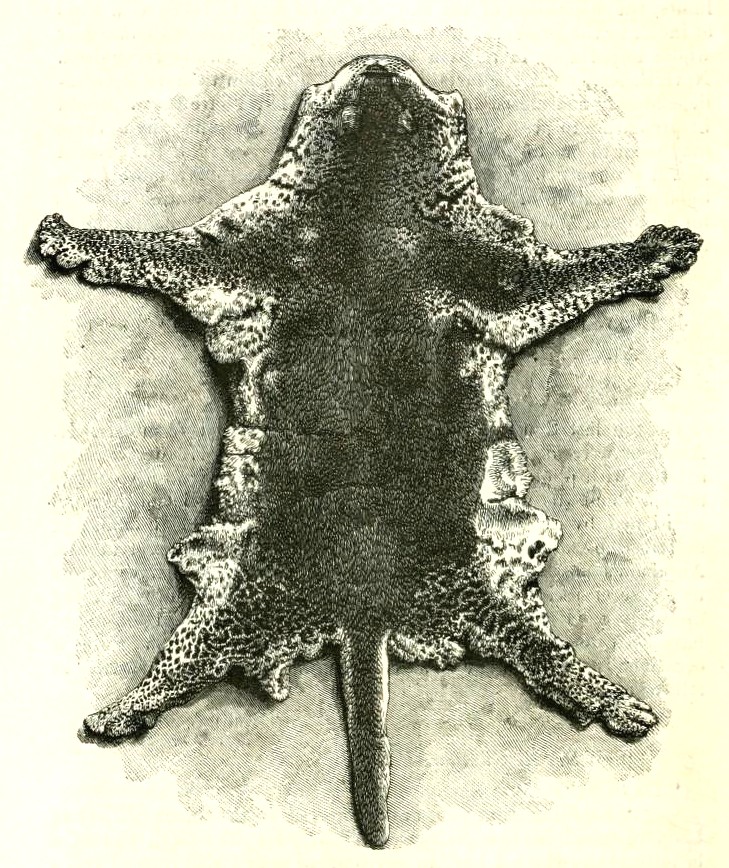
B/w photograph from the PZSL, 6 April 1886, of the flat skin from Abraham's Collingham-derived pseudo-melanistic leopard (public domain)

At least seven other, less striking pseudo-melanistic examples have been recorded (although, tragically, some of these no longer exist), including two pelts and sightings of two living specimens as reported by Abraham in his letter to Günther, but only from South Africa's Eastern Cape Province and none at all since the 20th Century's opening decade, as documented in 1987 by Dr Jack Skead (a former director of the Kaffrarian Museum in King William's Town) within a major review entitled Historical Mammal Incidence in the Eastern Cape. Skead's work was brought to my attention via some references to it in a CFZ Yearbook 1997 article on these exotic-looking leopards authored by Chris Moiser, who with fellow wildlife writer David Barnaby had viewed and photographed a mounted specimen at the Izoko South African Museum in Cape Town two years earlier.

In his PZSL report for 3 March 1885 concerning Bowker's pelt, Günther had dubbed this spectacular pseudo-melanistic leopard variety Felis leopardus [=Panthera pardus] var. melanotica. As a result, sometimes these extremely unusual felids are alternatively termed melanotic leopards.

As noted above, the Izoko South African Museum in Cape Town famously has on display a mounted specimen of a pseudo-melanistic leopard. In his CFZ Yearbook 1997 article, Chris Moiser revealed that this was purchased from a professional taxidermist based in Grahamstown in November 1898, and had apparently been shot 15.5 miles south of that town. Although somewhat faded with age nowadays, appearing brown rather than black, it is still visually arresting, as seen here:

The mounted pseudo-melanistic leopard on display at the Iziko South African Museum in Cape Town (© Lew Viergacht)

My sincere thanks to Lew Viergacht for so kindly making his two excellent photographs of this remarkable specimen available to me for inclusion in this ShukerNature blog article.


THE DAMASIA – DARK LEOPARD OR NEW SPECIES?

Well worth considering is whether a comparable variety could be the explanation for a still-unidentified African felid known as the damasia, which dwells - not surprisingly? - in Kenya's Aberdares [already documented in my book as the home of a controversial, diminutive form of spotted lion known as the marozi, as well as melanistic leopards, i.e. black panthers].

The damasia was referred to in a letter sent to The Field by G. Hamilton-Snowball and published on 9 October 1948, concerning his sighting of spotted lions on these mountains. In it, he also recalled that during the 1920s he had shot a creature that he had taken to be a leopard, albeit a very large, dark specimen. Yet when his Kikuyu attendants saw it, they announced that it was not a chui (leopard) but a damasia, and that a damasia was as different from a leopard as a simba (lion) was from a marozi. Apparently the damasia is well known to the Aberdares natives but is always mistaken by non-locals for a leopard.

Painting of a pair of marozis or Kenyan spotted lions, based upon a preserved skin and eyewitness descriptions (© William M. Rebsamen)

Tropical Africa's native tribes frequently classify animals by way of criteria very different from those used by scientists. Often an individual animal that is of a colour or size different from that of normal specimens of the same species, or an individual that is notably more aggressive than others of its own species, is given an entirely separate name by the natives and thought of as being of a form totally different from the more typical members of its species. Therefore it is certainly possible that, despite the Kikuyus' firm denial, the damasia really is just a dark-coloured (pseudo-melanistic?) leopard.

Since genuine black (melanistic) leopards are on record from the Aberdares, it would be interesting to learn whether the natives class them as leopard or damasia. Alternatively, considering that the Aberdares' primeval forests already house one mystery cat, in the form of the marozi, it is not inconceivable that they are hiding further zoological surprises too.


THE NDALAWO – BLACK-AND-GREY CRYPTO-CAT OF UGANDA

This Ugandan mystery carnivore was described by game warden Captain William Hichens in a Discovery article of December 1937 as follows: "...a fierce man-killing carnivore, the size and shape of a leopard, but with a black-furred back shading to grey below". A ndalawo skin was actually procured on one occasion but was sent out of the country before it could receive formal scientific attention. Consequently, its identity was never ascertained, and its whereabouts are now unknown.

African wildlife authority Captain Charles Pitman had previously recorded in his book A Game Warden Among His Charges (1931) that the ndalawo seemed to be a "partly melanistic leopard" (note the word 'partly', indicating that it was not a normal black panther), practically devoid of spots but displaying a few typical leopard markings on the extremities and round the lower jaw. This more detailed description is reminiscent of that cited by Günther for P. pardus var. melanotica; certainly, pseudo-melanistic leopards have paler underparts, unlike the uniformly-dark melanistic black panthers.

Second view of the mounted pseudo-melanistic leopard at the Iziko South African Museum (© Lew Viergacht)

Based upon pelage considerations alone, it is not implausible that the ndalawo may indeed prove to be a pseudo-melanistic leopard (albeit a less showy version than those from South Africa). However, there is more than just its pelage to consider: the ndalawo exhibits some rather unexpected traits for a mere leopard. For example, it allegedly hunts in threes or fours, and whilst hunting it gives voice to a most peculiar laugh. These traits are indicative of a hyaena.

Yet as Hichens pointed out, the ndalawo is very greatly feared as an exceedingly ferocious beast, whereas even the oldest woman in a native kraal is more than prepared to shoo away a hyaena that comes too close. If the ndalawo is a form of leopard, it is a very unusual one; in fact, out of all of the black mystery cats of Africa discussed here, the ndalawo is surely the one most likely to represent a hitherto unknown felid species.

Vintage sepia photograph of the Iziko South African Museum's mounted pseudo-melanistic leopard specimen as featured in The Mammals of South Africa, Vol 1 (1900), authored by the museum's then-director, W.L. Sclater, and showing how much darker it was a century ago than it is today, light-induced fading having taken its toll down through the intervening decades (public domain); my sincere thanks to Facebook friend Velizar Simeonovski for kindly bringing this illustration to my attention.


OTHER PSEUDO-MELANISTIC BIG CATS

Pseudo-melanistic specimens have also been confirmed from other big cat species, most notably the tiger P. tigris, with several examples recorded from Similipal and elsewhere in India (although these are often referred to incorrectly as melanistic specimens by the media), as documented by me in various publications (and also here on ShukerNature).

Exquisite painting of a pseudo-melanistic tiger in life as inspired by photographs of various pseudo-melanistic tiger pelts; produced specifically for me by William M. Rebsamen, it first appeared in an article of mine published by the now-defunct British monthly magazine All About Cats in its January-February 1999 issue, then again later that same year in my book Mysteries of Planet Earth (1999) (© William M. Rebsamen)

In addition, I once saw a close-up full-colour photograph of an exceedingly handsome pseudo-melanistic jaguar in captivity, but unfortunately I have no further details concerning this specimen.


AN ARTICLE OF MINE ON PSEUDO-MELANISTIC LEOPARDS

Finally: In addition to the above coverage directly excerpted and expanded from my Mystery Cats of the World book, I have also documented pseudo-melanistic leopards (albeit only briefly this time) in my second, more recent feline-themed book, Cats of Magic, Mythology, and Mystery (2011), as well as in a two-page article published by All About Cats in its May-June 1997 issue. Within that article, I was granted exclusive permission by David Barnaby and Chris Moiser to reproduce a colour photograph snapped by them in August 1995 during their viewing of the mounted specimen at the Iziko South African Museum, which I did. Regrettably, however, as with my writings about such cats, this photo has since turned up on various websites but without any accompanying credit given to David and/or Chris (hence in my opinion it seems unlikely that their permission for such sites to use it has been obtained, or even sought).

For those of you who may not have seen my All About Cats article, here it is – please click on each of its two scanned pages to enlarge it for reading purposes.

My two-page All About Cats article from May-June 1997 on the subject of pseudo-melanism and melanism in leopards and other big cats (© Dr Karl Shuker)


Monday, 15 May 2017

HERMAN MELVILLE'S POLYNESIAN MYSTERY CAT - A WHALE OF A CRYPTO-TALE?


Did Herman Melville see a spectral black cat in Polynesia? (public domain)

For obvious reasons, it's always particularly interesting to learn of a possible cryptozoological encounter featuring a famous person. So I am greatly indebted to German mystery beast investigator Ulrich Magin for very kindly bringing to my attention recently the following example, hitherto-unpublicised online in a cryptozoological context.

The eyewitness in question is none other than Moby-Dick author Herman Melville, who documented his intriguing sighting – a veritable whale of a crypto-tale, no less! – in one of his non-fiction books, namely Typee: A Peep At Polynesian Life (1846). Describing time spent on the Polynesian island of Nukuheva in the Marquesas group, he included the following memorable lines:

As for the animal that made the fortune of my lord mayor Whittington, I shall never forget the day that I was lying in the house about noon, everybody else being fast asleep; and happening to raise my eyes, met those of a big black spectral cat, which sat erect in the doorway, looking at me with its frightful goggling green orbs, like one of those monstrous imps that tormented some of the olden saints! I am one of those unfortunate persons, to whom the sight of these animals is at any time an insufferable annoyance.

Thus constitutionally averse to cats in general, the unexpected apparition of this one in particular utterly confounded me. When I had a little recovered from the fascination of its glance, I started up; the cat fled, and emboldened by this, I rushed out of the house in pursuit; but it had disappeared. It was the only time I ever saw one in the valley, and how it got there I cannot imagine. It is just possible that it might have escaped from one of the ships at Nukuheva. It was in vain to seek information on the subject from the natives, since none of them had seen the animal, the appearance of which remains a mystery to me to this day.

What I find very intriguing about this report is how Melville ostensibly changed his opinion as to the nature of the cat during his description of it. For whereas in the first paragraph he referred to it as spectral and likened it to a saint-bothering imp, thereby implying that it appeared to be some form of paranormal, zooform entity, in the second paragraph he suggested that it may have escaped from a visiting ship, thus indicating that it was merely some absconded kitty of the corporeal kind.

True, his 'spectral' description may simply have been metaphorical rather than literal, but whatever the cat was, it was apparently not native to Nukuheva, and does indeed remain a mystery, not just in Melville's day either, but also right up to the present day, just over 170 years after his book was first published.

Herman Melville – oil painting by Asa Weston Twitchell (public domain)


Friday, 15 April 2016

AN AMERICAN MYSTERY BLACK PANTHER DEPICTED IN A FAMOUS MODERN-DAY PAINTING


'Story Told By My Mother', painted in 1955 by Carroll Cloar (© Memphis Brooks Museum of Art, Tennessee, USA – reproduced here on a strictly non-commercial Fair Use basis only)

In various previous ShukerNature articles, I've documented several fascinating examples of apparent cryptids depicted by famous artists. Now, I am adding yet another such example to this select company.

I am very grateful to American correspondent David McAvoy for bringing to my attention a remarkable painting on display at the Memphis Brooks Museum of Art in Tennessee, USA. Entitled 'Story Told By My Mother', and opening this present ShukerNature article, it was produced in 1955 by highly-acclaimed Arkansas-born artist Carroll Cloar (1913-1993), and depicts a snow scene in which a woman is stepping briskly away from a very large black panther-like cat standing at the edge of some trees.

David informed me that it was inspired by tales that Cloar had heard from his mother concerning so-called black panthers that had once roamed Arkansas. Moreover, David himself hails from Arkansas, and he mentioned that he has heard such stories for as long as he can remember. Indeed, mysterious, unidentified big cats of black panther-like appearance (i.e. resembling melanistic leopards, which are uniformly black in background coat colouration) have been reported all over North America for centuries.

A black panther (melanistic leopard) (© Dr Karl Shuker)

Leopards of course are not native to the New World, so if such beasts are indeed roaming the wilds here, they can only be escapee or released individuals from captivity. However, their eyewitnesses often claim that these cats are not black leopards anyway (nor black jaguars either, although normal spotted jaguars have been confirmed to exist at least in certain southern states such as Arizona and California on a fairly regular basis in earlier times), but are instead black pumas. (Other names for pumas, incidentally, include cougars, mountain lions, catamounts, painters, and - very confusingly - panthers.) Yet no such cat form has ever been scientifically confirmed from North America, only two such specimens have been procured in tropical Latin America, and no captive individuals are currently known to exist anywhere (I have previously documented one possible example exhibited at London Zoo during the 1800s). Moreover, all three of these latter specimens were not uniformly black anyway, but were only black dorsally; ventrally, they were much paler.

In short, even if they do occur, black pumas are exceptionally rare as far as physical evidence for their reality is concerned, and those few confirmed specimens do not match the sightings of large all-black felids in North America. Bearing in mind that countless normal-coloured pumas (i.e. either tawny or grey) have been shot there, however, and also bearing in mind that in view of the numerous reports of black panther-like cats on file from this continent, whatever this cat form may be it does not appear to be especially rare, why are no North America specimens ever forthcoming if it is indeed a melanistic version (morph) of the puma? This apparent paradox remains a major riddle for New World cryptozoology to solve, but at least we do now have an additional and most interesting, unexpected piece of evidence supporting the existence of black panther-like cats in North America, regardless of their formal taxonomic identity.

For a comprehensive examination of the black puma controversy, please click here, and see also my books Mystery Cats of the World and Cats of Magic, Mythology, and Mystery.


Sunday, 18 October 2015

WALT DISNEY AND THE BLACK PUMA THAT NEVER WAS


What are North America's mystery black panthers – escapee/released melanistic leopards, or native all-black pumas? (© William Rebsamen)

Time to debunk another crypto-controversy, though in this case it's not a deliberate hoax, merely a mixture of confusion and absence of the required facts.

As I have documented elsewhere on ShukerNature (click here), physical evidence for the reality of melanistic (all-black) pumas Puma concolor (aka cougars, mountain lions, painters, etc) in North America is conspicuous only by its absence. Certainly, large all-black cats often nicknamed panthers or black panthers (names more correctly applied to melanistic specimens of the leopard Panthera pardus) have been frequently reported from many parts of the United States and Canada too, but none has ever been made available for scientific examination resulting in a confirmed identification (even outside North America, I only know of two verified dorsally black, ventrally paler pumas – one shot in Costa Rica, the other in Brazil; I know of no verified all-black pumas from anywhere). So what do we have in the following video clip?

Several times lately, correspondents have drawn my attention to a certain brief clip of film, which keeps appearing, disappearing, and reappearing on YouTube. It's back again at present, so view while you can here. Judging from the comments present beneath it on YouTube, viewers seem to think shows a genuine film of a genuine all-black (melanistic) puma attacking and killing a dog. The reality is very different.

For reasons that I shall give below, this is clearly not a genuine all-black puma, it is simply a normal one that has been dyed black all over in order to resemble North America's elusive mystery black panthers of cryptozoological acclaim. Nor is this a real, non-fiction video either – it is merely a clip from the 1977 'Wonderful World of Disney' television movie entitled The Ghost of Cypress Swamp, starring Jeff East and Vic Morrow.

A computer-generated image of what a melanistic puma may look like (© Dr Karl Shuker)

As a massive life-long Disney fan, I used to watch this series avidly as a youngster, as well as its equally excellent predecessor, 'Walt Disney's Wonderful World of Color', and as you'd expect, I can still remember seeing the black puma clips from this particular movie, though I have to confess that prior to re-watching it on YouTube in relation to the black puma segments, the rest of it was somewhat of a haze now, almost 40 years later. Curiously, although shown in England, it has apparently never been released in the USA, its unfamiliarity therefore possibly helping to explain why clips from it featuring the cosmetically-created black puma have been mistakenly assumed by some online viewers to depict real scenes featuring a real black puma.

The whole movie can be viewed on YouTube here, and actually contains two such clips. In the first clip (the one that attracted the online comments by viewers assuming that it was a genuine film), beginning at 2.47 minutes into the film, the cat kills a youth's dog (the youth played by Jeff East); then in the second clip  at 1.24.55, it attacks the youth's new dog, this clip continuing (with a brief break during which the youth runs home for his gun) for the next couple of minutes before the dog is rescued alive and well by the youth who then shoots the cat dead after it attacks his father. There are also several briefer clips of the cat stalking a deer, prowling through the swamp, etc. As for movie's general storyline, here is the plot synopsis accompanying it on YouTube: "Set in swamplands in Georgia his dog is attacked by a panther called Weakfoot. Later he [Jeff East's character] is captured by a wild man living in the swamps and believed to be dead".

So, why do I not think that this all-black puma is genuine? In a few clips in the film, the black dye has seemingly rubbed off or has been licked off by the puma from parts of its face (or had not fully stained to begin with?), especially around the eyes, and on the mouth and nose (most noticeably at 15:41), revealing its normal paler fur. As already noted above, the only confirmed black pumas were dark dorsally but paler ventrally, not uniformly black (i.e. they were not melanistic pumas). And if this cat had truly been a black puma, it would have been so valuable and rare that it would have been one of the biggest, most famous stars in Hollywood in its own right, as famous as Lassie and Rin Tin Tin.

So, as film cops always say at the denouement of a crime case: move on, people - nothing to see here.


UPDATE - 19 October 2015

Continuing with American black mystery panthers in movies: the infamous John Wayne/Susan Hayward movie The Conqueror (1956) also featured what looked like a puma with all-black pelage - so I've now watched the relevant segment from the film to check this out. Moreover, I have since learnt from Facebook friend and fellow crypto-enthusiast Ian C. Thomas that the cat was indeed a puma, but once again dyed black. Here is the relevant information (including a photo), as excerpted from the website Poseidon's Underworld (click here to access it in full). Thanks, Ian!

She [Susan Hayward] was supposed to have a scene involving a black panther (a tiny snippet of which still remains) in which she kicked it in the rear, but there were many issues. The panther was so ill-tempered [but wouldn't you be if someone was trying to kick you in the rear?!] that it went to maul her, then it was replaced with a puma painted black, but the beast kept licking all of the paint off itself!

And here is what an article on this film that appeared here on the London Telegraph newspaper's website had to say about that particular scene's attempt to utilise the original black panther:

At some point a distinctly non-indigenous black panther was shipped in to ‘liven up’ the background of one scene. Except that it then attacked Susan Hayward, attempting to take a bite out of her arm.

Several other corroborating accounts concerning the black panther and the dyed-black puma that replaced it in The Conqueror can be found online.


2ND UPDATE - 1 February 2017

Following up a very welcome lead posted by a reader in the comments below, I checked out the original source material upon which the above Disney movie was based. It proved to be a novel entitled Weakfoot, written by Linda Cline and first published in 1975. It was reprinted a year later, retitled as The Ghost of Cramer's Island. The novel takes place in the early part of the 20th Century, and is set in and around the Okefenokee Swamp, which straddles the Georgia-Florida border in the USA. In the novel, Weakfoot is an adult female black puma who is eventually shot, but her cubs survive, and they too are black.

Futura paperback reprint of Weakfoot by Linda Cline (© Linda Cline/Futura, reproduced here on a strictly non-commercial Fair Use basis only)


Further information concerning the likelihood (or otherwise) of black pumas existing can also be found in my two books on mystery cats – Mystery Cats of the World (1989) and Cats of Magic, Mythology, and Mystery (2012).


Saturday, 11 January 2014

EXPOSING ONLINE FAKES AND FRAUDS OF THE CRYPTOZOOLOGICAL KIND – A SHUKERNATURE TOP TEN LISTING

A monstrous discovery? (©  Alan E. Friswell)

The internet is the natural home of some very unnatural creatures – fakes, frauds, and the falsely identified. Many of them attract only fleeting, transient attention before being soundly exposed and permanently discredited. However, there is also a hardcore set whose members simply refuse to die – being revived time and time again by unsuspecting novice researchers who are bewitched by their superficial strangeness and fail to realise that their faux nature has been unveiled on numerous previous occasions. So here, in no particular order, are ten of the most noteworthy (and notorious) examples, all of which I have investigated at one time or another and have either personally exposed the truth behind them or have discovered who else has done so.


#1 - A LIVING SEA SCORPION?

(© Crawley Creatures / inclusion here strictly on Fair Use/non-commercial basis only)

And where better to begin than with this extremely striking photograph? As can be seen, it portrays someone holding what appears on first sight to be a recently-dead eurypterid or sea scorpion, which, if genuine, would be an astonishing discovery, bearing in mind that the most recent confirmed specimens died out during the Permian-Triassic mass extinction approximately 252 million years ago. I have seen the following report accompanying this photo on several Facebook group and individual pages, but its earliest online appearance seems to be on the Paranormal Geeks Radio website on 13 April 2013. Here's the report:

"In 1971 farmer Ted Litton caught this weird animal alive in his artificial pond in Lilac, TX, & got his pic in the paper. 8 hours later his farm was besieged by Army soldiers wearing decontamination suits. They drained the pond, leaving an odd, spheroid cavity in the bottom. Litton says the Army dismissed his beast as a freak of nature yet they confiscated it, promising him 5 grand (which never materialized).”

Needless to say, however, as I discovered when subjecting this photograph to a Google Image search, the reality soon proved to be very different. In fact, the eurypterid was a prop, an animatronic model, to be precise, produced for the BBC television series Sea Monsters (2003) by the award-winning special-effects design company Crawley Creatures, based in the UK. Here is a link to their website that shows this exact-same photograph:

http://www.crawley-creatures.com/Gallery.aspx?Job=76

As for the eurypterid model, it represents the Ordovician genus Megalograptus, which is one of the earliest eurypterids on record.


#2 – THE NORTH AMERICAN BLACK PANTHER FROM SOUTH AFRICA

(© Kevin Richardson / inclusion here strictly on Fair Use/non-commercial basis only)

Since the beginning of October 2013, the above photograph has been circulating widely online, appearing not only in a number of Facebook groups but also on a wide variety of websites, many of which claim that the black panther (i.e. melanistic leopard) that it depicts was recently photographed in the wild somewhere in North America. It is precisely where that has incited controversy, with a number of different States variously cited, including Oklahoma, Louisiana, Georgia, Tennessee, and Texas. Once again, however, after subjecting the photo to a Google Image search I swiftly uncovered its true provenance, which proved to be South Africa. Indeed, as I discovered from the following online article, dated 20 March 2013, which contains and originated this photo:


the animal in question is a black panther named Coal, one of two (both born in 2003) present in captivity and in the care of conservationist Kevin Richardson at the Dinokeng Nature Reserve in Gauteng, South Africa. Clearly, therefore, person(s) unknown had subsequently utilised the photo in fake reports claiming that it had been snapped in North America. (Also worth noting, incidentally, is that the grass in this photo is an African species, not a North American one.)


#3 – THE HUMAN-DOG HYBRID

(© Patricia Piccinini / inclusion here strictly on Fair Use/non-commercial basis only)

This extraordinary photograph has been the subject of much online speculation since as far back as 2005, and has even featured in various YouTube videos. Lurid claims that its subjects were bona fide human-canine hybrids are widespread, and also that it is a skilfully-produced Photoshop creation. In reality, neither of these is correct, because what it really is…is a very remarkable sculpture, as revealed in the following link:


As explained there, the sculpture is entitled 'The Young Family', and was created by Australian artist Patricia Piccinini in 2002. It was manufactured from silicone, polyurethane, leather, plywood, and human hair, measures 80 x 150 x 110 cm, and is part of a larger work entitled 'We Are Family'.


#4 – THE WORLD'S LARGEST TORTOISE?

(© Kadokawa Pictures / inclusion here strictly on Fair Use/non-commercial basis only)

This memorable photograph recently reappeared in the following online article, dated 25 September 2013:

but it has been circulating online in similar accounts for quite a while prior to that (I have found web reports of it dating back as far as August 2012). The article claims that this mega-tortoise, measuring 30 ft long and weighing well over 2380 lb, had been discovered in a Brazilian stretch of the Amazon River after killing local farmers' livestock, and was around 529 years old. As anyone familiar with Japanese 'monster' films would soon confirm, however, the photo is merely a still from the popular movie Gamera the Brave, produced in Japan by Kadowara Pictures in 2006 – as verified by the following French website page:


#5 – BLACK LION 'FAUX-TOGRAPHS'

(?© martincito1/tumblr.com)

Four separate photographs of alleged black lions have been circulating online for more than 2 years, and as I have documented in my books Mystery Cats of the World (1989) and Cats of Magic, Mythology, and Mystery (2012), several unconfirmed sightings of such animals have been reported from various regions of Africa, but no verified specimen has ever been documented. So what were the animals in the online photos? As I revealed in two exclusive ShukerNature investigations:


and


three of these four black lion photographs were photoshopped versions of original images depicting normal, tawny-coloured lions. And the fourth black lion photo was a photoshopped version of an original image of a rare white lion – I successfully tracked down all four of the original images online.


#6 – MULTI-HEADED COBRAS

(original source/copyright holder unknown to me)

Another popular, perennial subject represented online by a wide variety of fake images is the multi-hooded (and –headed) cobra. Claimed in some reports to constitute living nagas or Indian snake deities, they were, as I soon revealed in another ShukerNature investigation:


to be nothing more than clever Photoshop creations. Indeed, there is even a video on YouTube that provides a step-by-step guide on how to create your very own multi-hooded cobra 'faux-tograph'.


#7 – THE GIANT SEA SERPENT OF TAKESHI YAMADA

(© Dr Takeshi Yamada / inclusion here strictly on Fair Use/non-commercial basis only)

This very spectacular photo has incited much discussion online in recent years – which is very strange, bearing in mind that even the most cursory Google Image search will rapidly reveal that the 32-ft-long sea serpent depicted in it is in reality a very adept creation of master monster-maker Dr Takeshi Yamada. Indeed, as I revealed in the following ShukerNature article:


it is just one of many fascinating examples of so-called rogue taxidermy produced over the years by Yamada. Others include a chupacabra snail, a vampire monkey, a Mongolian death worm, a whip-tailed tree octopus, and an eight-legged spider dog!


#8 – EXPLAINING A VERY FISHY SEA SERPENT - A SHUKERNATURE EXCLUSIVE!

(© Alan E. Friswell)

In stark contrast to Yamada's example, this eyecatching sea serpent photograph has greatly perplexed many people (and continues to do so), judging from the contradictory claims and comments concerning it that have appeared in online discussions and even in YouTube videos. Its portrayed location has been variously stated to be a beach in Hawaii, South Australia, and the Philippines. Moreover, no-one has been able to identify the creature that the photo depicts, but some bizarre suggestions have been offered, including an oarfish – which looks nothing like it! Happily, however, this photo poses no such problems for me – because, as now exclusively revealed here on ShukerNature, I just so happen to know who created it! None other than a good friend of mine, expert monster/dinosaur model-maker Alan E. Friswell, as he revealed to me in October 2013:

"I drew this sea serpent in photoshop in 2009, to accompany an article that I wrote for the CFZ [Centre for Fortean Zoology] blog page."

Evidently, therefore, it had subsequently been lifted by person(s) unknown and passed off by them as a real, unidentified creature. This is exactly how so many online cryptozoological hoaxes arise. Someone like Alan innocently creates a fictitious beast as artwork, but then other persons deliberately pass it off as a genuine animal. Indeed, this is precisely what happened with some of the black lion photos too, and also with the next case in our listing.


#9 – ARACHNOPHOBES BEWARE - THE ANGOLAN WITCH SPIDER

(© Paul Santa Maria / inclusion here strictly on Fair Use/non-commercial basis only)

This dramatic photograph must have sent shivers down the spine of many an arachnophobic viewer since it first appeared online more than 2 years ago. It often appeared with an account describing it as an Angolan witch spider. Here's one version of that account:

"It's a new spider called the Angolan witch spider. They migrated from South America [very odd, since Angola is in Africa!]. They primarily eat dogs and cats. In Texas this abnormally large spider was found on the side of this home. It took several gun shots to kill it."

When I first saw the photo a year or so ago, I readily identified its subject as a wolf spider, albeit one of wholly implausible size. And sure enough, a little online detective work on my part soon traced the truth behind the terror, as fully documented in the following website account:

http://www.hoax-slayer.com/angolan-witch-spider.shtml

It reveals that the photograph was produced via Photoshop as a joke by artist-musician Paul Santa Maria, who uploaded it onto his Facebook page, where it remained for just a few hours before he took it down again. But that was still sufficient time for it to be copied by someone onto their own page, from where it soon went viral. The bogus account of it being an Angolan witch spider was attached to it by person(s) unknown – and the rest, as they say, is history.


#10 – THE RAINBOW OWL IS A HOOT!

(copyright holder unknown to me)

A year ago, several correspondents alerted me to the above photograph and an accompanying report, circulating on Facebook and elsewhere online, concerning what was claimed to be a rare but remarkable species of owl. It is known as the rainbow owl on account of its gaudy, multicoloured plumage, and according to the report it is native to the USA and China (an oddly discontinuous zoogeographical distribution, to say the least!) but was hunted into near-extinction during the early 20th Century due to coveters of its beautiful feathers. Moreover, it has an unusually melodious call, and is so attracted to music and human singing that researchers seeking it in the field know that they will greatly increase their chances of finding specimens if they bring along a portable stereo. The author of this intriguing report was one Dr Claudia Weatherfield of the University of Toldeo.

Needless to say, as someone with a longstanding ornithological interest yet who had no prior knowledge whatsoever of any such species, I was instantly suspicious. And rightly so, as it turned out, because some online investigations soon led me to the following webpages contained on two websites devoted to exposing hoaxes, and which fully justified my concern:

http://www.snopes.com/photos/animals/rainbowowl.asp

http://urbanlegends.about.com/od/animalkingdom/ss/Rainbow-Owl.htm

They revealed that there is no University of Toldeo; nor any Claudia Weatherfield working even at the similarly-named University of Toledo. The photograph was clearly a computer-modified version of some other image, and sure enough the original photo proved to be of a barred owl Strix varia - a common North American species unadorned by any rainbow-hued plumage.


Who knows – perhaps now, finally, all of these tenacious phoneys will be laid to rest forever…but with their exceptional history and capacity for resurrection, I wouldn't bet on it!

Another photograph of Dr Takeshi Yamada's incredible 32-ft sea serpent (© Dr Takeshi Yamada / inclusion here strictly on Fair Use/non-commercial basis only)