Dr KARL SHUKER

Zoologist, media consultant, and science writer, Dr Karl Shuker is also one of the best known cryptozoologists in the world. He is the author of such seminal works as Mystery Cats of the World (1989), The Lost Ark: New and Rediscovered Animals of the 20th Century (1993; greatly expanded in 2012 as The Encyclopaedia of New and Rediscovered Animals), Dragons: A Natural History (1995), In Search of Prehistoric Survivors (1995), The Unexplained (1996), From Flying Toads To Snakes With Wings (1997), Mysteries of Planet Earth (1999), The Hidden Powers of Animals (2001), The Beasts That Hide From Man (2003), Extraordinary Animals Revisited (2007), Dr Shuker's Casebook (2008), Karl Shuker's Alien Zoo: From the Pages of Fortean Times (2010), Cats of Magic, Mythology, and Mystery (2012), Mirabilis: A Carnival of Cryptozoology and Unnatural History (2013), Dragons in Zoology, Cryptozoology, and Culture (2013), The Menagerie of Marvels (2014), A Manifestation of Monsters (2015), Here's Nessie! (2016), and what is widely considered to be his cryptozoological magnum opus, Still In Search Of Prehistoric Survivors (2016) - plus, very excitingly, his four long-awaited, much-requested ShukerNature blog books (2019-2024).

Dr Karl Shuker's Official Website - http://www.karlshuker.com/index.htm

IMPORTANT: To view a complete, regularly-updated listing of my ShukerNature blog's articles (each one instantly clickable), please click HERE!

IMPORTANT: To view a complete, regularly-updated listing of my published books (each one instantly clickable), please click HERE!

IMPORTANT: To view a complete, regularly-updated listing of my Eclectarium blog's articles (each one instantly clickable), please click HERE!

IMPORTANT: To view a complete, regularly-updated listing of my Starsteeds blog's poetry and other lyrical writings (each one instantly clickable), please click HERE!

IMPORTANT: To view a complete, regularly-updated listing of my Shuker In MovieLand blog's articles (each one instantly clickable), please click HERE!

IMPORTANT: To view a complete, regularly-updated listing of my RebelBikerDude's AI Biker Art blog's thematic text & picture galleries (each one instantly clickable), please click HERE!

Search This Blog


PLEASE COME IN, I'VE BEEN EXPECTING YOU...

PLEASE COME IN, I'VE BEEN EXPECTING YOU...
WELCOME TO SHUKERNATURE - ENJOY YOUR VISIT - BEWARE OF THE RAPTOR!


Showing posts with label sky beasts. Show all posts

Sunday, 11 October 2020

'THE WIND WHALES OF ISHMAEL' - A SHUKERNATURE BOOK REVIEW

 
Published in 1973, this is the Quartet Books paperback edition of The Wind Whales of Ishmael (1971) (© Philip José Farmer/Quartet Books – reproduced here on a strictly non-commercial Fair Use basis for educational/review purposes only)

I have recently launched a new, occasional blog entitled Shuker's Literary Likings, in which I shall be reviewing novels and short story collections that I have particularly enjoyed reading down through the years - please click here to access it. Moreover, some of these works of fiction will include ones that have relevance to non-fiction or speculative subjects covered in ShukerNature. So to give you a direct example of this overlapping of interests, here is one of my recently posted literary reviews from my new blog:

The Wind Whales of Ishmael is a science fiction novel written by American sci fi/fantasy author Philip José Farmer (1918-2009) and originally published in 1971. Conceived as a sequel of sorts to Herman Melville's classic whaling novel Moby Dick (1851), it is set on Earth but in a far-distant future where the oceans have long since vanished and their former leviathans, the whales and the sharks, have evolved into huge aerial sky-beasts. However, these gargantuan yet exceptionally lightweight creatures are hunted not only by each other but also by a new breed of whalers who no longer set forth in maritime ships to pursue this aerial megafauna but instead in sky vessels. Here is this engrossing and highly original novel's official blurb:

With no more noise than of a ghost gliding over the ocean, the sea disappeared.

And Ishmael, lone survivor of Ahab's Pequod and now of the Rachel, falls through the empty sea-space, down through layers of membrane – into another world. Earth, but not the Earth he knows. A world where the sea has condensed through Time's evaporation; a world where whales fly and the sky is a swarm with floating animals and plants; a world of bloodsucking palsied vegetation, shaking land – and the Purple Beast of the stinging death.

But where there are whales, a whaler from another age can always find a home…

The Wind Whales of Ishmael is a startlingly imaginative tale of a weird, nightmare world from one of America's foremost science fiction writers.

There have been many editions of this novel since its original publication almost 50 years ago, but none of them boasts more spectacular front cover artwork than the edition detailed and depicted above. Its extraordinary wind whale and the tiny human whaler figure standing boldly if precariously upon its enormous bulbous head with harpoon poised are the sublime artistic creations of Bob Habberfield – a prolific front cover illustrator for sci fi and fantasy novels (particularly those of Michael Moorcock). Indeed, it was this vibrant illustration that originally attracted my attention and duly cajoled me into purchasing this edition when I spotted it in a local secondhand bookshop one afternoon during the early 1980s.

 
Yet as The Wind Whales of Ishmael is a science fiction novel, why have I devoted an entire ShukerNature post to it? In fact, it also has cryptozoological relevance, because the concept of sky beasts existing has long been aired from a real-life, non-fiction standpoint too, and by several different researchers. Moreover, it is a concept that has always fascinated me, inasmuch as Nature famously abhors a vacuum, yet the vast skies above us and the immense atmosphere surrounding our planet seem inexplicably lacking in sizeable creatures that have evolved specifically and exclusively to inhabit this rarefied upper zone, never sinking down to the ground until felled by death itself.

Over the years I have comprehensively chronicled the extremely radical, highly remote, yet tenaciously tantalizing cryptozoological possibility that perhaps such creatures do exist, remaining exceedingly elusive amid the most distant clouds and loftiest levels within Earth's atmosphere, only very rarely spied by our planet's gravity-grounded inhabitants, and that even when they are so observed, are mistakenly assumed to be alien spacecraft or suchlike, when in reality they are indeed UFOs, but living ones, not mechanical.

For more information, please click here to access on ShukerNature an extensive cryptozoology article on the subject of currently hypothetical sky beasts and cloud creatures.

I have also devoted a very detailed chapter to the history and investigation of alleged bona fide sky beasts in my book Dr Shuker's Casebook: In Pursuit of Marvels and Mysteries, whose front cover portrays me in the company of two gelatinous sky medusae (courtesy of incredibly talented artist friend Philippa Foster) – see below.

Little wonder, then, why I find this novel so enthralling as well as entertaining to read – giving me a veritable whale of a time, in fact!


Tuesday, 20 November 2018

'LOFTY ABODES', BY PHILIPPA FOSTER – A REVIEW


Front cover of Lofty Abodes by Philippa Foster (Text and cover artwork © Philippa Foster)

Over the years, I have been very fortunate and privileged that a number of my cryptozoological articles and books have contained exquisite illustrations by the extremely talented artist Philippa Foster. One of her most beautiful and, indeed, spectacular artworks, featuring a pair of ethereal sky medusae, even featured on the front cover of one of my books, Dr Shuker's Casebook (2008).

Knowing of and sharing Philippa's abiding love of the countryside and all of nature's endearing, enduring works, as well as her interest in magical realms, I have wondered on more than one occasion whether one day she may venture beyond the art world and into the written word too during her depictions of these mutually fascinating subjects, and I'm delighted to say that recently she did indeed do so.

Front cover of Dr Shuker's Casebook featuring sky medusae backdrop by Philippa Foster (© Dr Karl Shuker/CFZ Press; front cover artwork © Philippa Foster)

The result is an absolutely charming story for children entitled Lofty Abodes, written and published by Philippa, which I read a while ago and thoroughly enjoyed.

Set in the Brecon Beacons of Wales, and unfurling under the watchful eyes of the Red Sandstone Guardians, it weaves a magical, enchanted tale featuring both the familiar and also various cryptozoological creatures that make their home in this famously spectacular realm in Great Britain, from lonely trolls and friendly red kites to a glow worm city, rollicking rabbits, and a tantalising assortment of teasing puzzles and riddles too.

Back cover of Lofty Abodes by Philippa Foster (Text and cover artwork © Philippa Foster)

Significantly, it also includes something that Philippa (and I) consider very important (but sadly all too rare nowadays) in books for youngsters – a happy ending. Why do children's authors seem obliged lately to include some gritty, heartless denouement to their stories? The real world is gritty and heartless enough – surely the whole point of fiction, especially children's fiction, is escapism, to flee from the hardships of existence if only for a little while by seeking the warm, comforting, uplifting solace of a story in which the world is a finer, happier place, where worries can be forgotten and dreams of a better land and life can be born, nurtured, and, who knows, possibly even retained and given substance to when their dreamers have returned to grim reality.

With Christmas rapidly approaching, it gives me great pleasure to introduce Lofty Abodes here on ShukerNature, as I am certain that it would make a delightful and much-treasured gift for children, and not just young ones but children of all ages, for anyone, in fact, who carries in their heart the joy and unadulterated love of nature and wild things that they first experienced as children. Copies can be purchased directly from Philippa via her website, and also here on Amazon's UK website when available there.


Wednesday, 23 January 2013

EVEN MORE SKY BEASTS - RETURN OF THE LIVING UFOS?

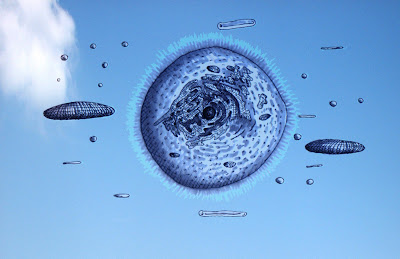
Artistic representation of sky beasts (Tim Morris)

In previous ShukerNature blog posts (click here and here), I have examined the remarkable theory put forward independently by several ufologists down through the decades that at least some UFOs may actually be undiscovered flying organisms – sky beasts. That is, highly specialised life forms adapted for an exclusively aerial existence amid the atmosphere encircling our planet, and thereby occupying a fundamental ecological niche that would otherwise be inexplicably ignored by the normally highly-productive nature of evolutionary radiation. And in those posts of mine, I have presented various reports that may relate to such organisms.

On 14 January 2013, I received another such report, which was sent to me by veteran American UFO investigator and eyewitness Ben Garfield after he had read my previous above-noted posts. Moreover, Ben has very kindly granted me permission to document it in ShukerNature, so here it is:

"I've been researching ufos for nearly 40 years now since my first sighting back in 74...What I saw on May 3rd 2010 [at McHenry, Illinois] has me convinced there are living things that fly in our skies that we are not being told about....I've read thousands of reports and found many that were very similar to what I saw...Some of these date back to the wave of 1947...While I was sitting in the shade waiting to do my afternoon chores...I live on a hobby farm...I was looking at clouds forming towards the west....A small reflection caught my eye...This was in the upper section of the cloud which was at 8500 feet + or -....I focused on that point of light and saw several objects that were diving in and out of a cloud...They would dive out in a slight arc then a reflection of the sun was made...As soon as the reflection occurred they would zig zag or stairstep climb back in...I don't know how many for sure there were but at least three or four...At first I thought they were giant birds but later ruled that out because birds don't fly vertical that high and that fast ......I would like a response because you seem like someone that will listen to what I have to say.....From all of the reports that I have read I am starting to see a pattern to their behavior....These objects were forming a semi circle going counter clockwise.....They reacted to the sun's reflection....These were not birds nor airplanes."

Ben has also supplied an account of his above sighting to http://worldufophotosandnews.org, which can be accessed here.

After I emailed Ben concerning it, I received a further response from him on 21 January 2013, which included the following additional information relevant to his sighting:

"What I have found in many similar reports is they do this circling manoeuver to signal others from afar to join in...shortly after, all depart at high speed... Paul Hill, Scientist and author of Unconventional Flying Objects....Read section II Performance...A must read, Takes five minutes....But he thinks they're scout ships.....I think different."


Paul Hill was a well-respected NASA scientist when he experienced a UFO sighting during the early 1950s. This prompted him to undertake three decades of research into their physical properties, propulsion, dynamics, etc, by the end of which he confirmed that despite many claims to the contrary, they did not defy the laws of physics as we currently know them, but acted entirely within their known boundaries. As Ben, notes, however, Hill believed UFOs to be the product of technology rather than nature (for a useful online synopsis of Hill's UFO-related work and beliefs, click here). So where does that leave Ben's sighting?

I am not a ufologist, and naturally I am aware that there are a number of unusual and/rare meteorological and astronomical phenomena that can create aerial light flashes, examples of which are documented in the relevant volumes within William Corliss's excellent and highly prolific 'Sourcebook Project' series. However, as a zoologist I am certainly intrigued by the ostensibly animate, active nature of movement exhibited by the objects observed by Ben.

Has anyone else sighted objects similar to these? If so, I'd be interested to receive details here, or any pertinent thoughts as to their possible nature or identity.

For an extensive coverage of the sky beast theory of UFOs, check out my book Dr Shuker's Casebook (CFZ Press: Bideford, 2008).


Tuesday, 18 September 2012

MORE SKY BEASTS?– SOME HITHERTO-UNPUBLISHED SIGHTINGS OF AERIAL ANOMALIES


In an earlier ShukerNature blog post (click here), I documented one of my favourite if very radical theories appertaining to mystery creatures. Namely, that some UFOs may actually be living entities – i.e. highly-specialised, undiscovered species of atmosphere-inhabiting sky beast, adapted for an exclusively airborne existence in a vast rarefied realm in the uppermost reaches of our planet where, very oddly in terms of evolutionary diversity, no species endemic to it have ever been formally disclosed.

After he read that blog post, I was contacted on 24 July 2012 by Facebook friend Chris Bond from Sheffield in South Yorkshire, England, who revealed to me that he had personally observed some anomalous aerial phenomena that he could not explain, but whose activity seemed somewhat reminiscent of living organisms. Chris sent me a detailed account of his sightings, together with an illustration of one of them, and has very kindly permitted me to chronicle them here as a follow-up to my previous ShukerNature sky beast article.

Are the vast skies far above us inhabited by extraordinary life forms still awaiting formal scientific discovery?

Chris described his first sighting as follows:

"The first relevant one that I remember took place in Mount Ambrose in Cornwall in maybe 1991. I used to stand outside my grandparents bungalow smoking roll-ups and, as the sky is relatively clear there, I used to watch the satellites pass overhead. One of these "satellites" was very strange. It looked like a regular satellite or medium magnitude star, but I can only describe its movement as how I would imagine a nautilus moves at speed or some other marine animal. The object would instantly brighten and shoot forward some distance, then dim as it slowed down until it was no longer visible. Then it would repeat the process, moving across the sky in bursts of energy. At the time it reminded me of some sort of marine animal propelling itself by shooting water out through its shell, in pulses, from some vague memory of footage of something similar seen many years before."

Sighting #2 was no less intriguing:

"The second was even stranger. One spring morning in 1992, at around 4 am, I was walking home from my brother's in Plymouth and there's a spot by Patna Place where the ground drops and, over a wall, you can see most of Plymouth Sound below. I noticed in the distance what looked like a very bright star, but this one was bright red. After some minutes, and as it grew closer, I began to see the actual shape of the object. I can only describe it as like a massive glowing red seagull. The wings didn't flap; it glided, silently, and the air all around it glowed red. It's difficult to gauge the actual size, but it gave the impression of being very large; passenger jet or larger, but with a very organic shape, just like a seagull. I watched it cross the whole sky over Plymouth Sound, maybe 10-15 minutes in total. I checked for others who might have seen it, but nothing. Any fishermen out on the Sound at the time were no doubt scanning the deep for Morgawr."

Love it!

Chris's third sighting, which is certainly the strangest of them all, inspired him to prepare this drawing. He states that it accurately portrays the movement and arrangement of the objects that he witnessed, but he has transferred the setting from Plymouth to Cornwall (hence Chun Quoit) for artistic regions.

Drawing depicting the aerial objects featured in Chris's third sighting (Chris Bond)

Here is his description of this sighting:

"The third is, to me, the most profoundly curious of the lot. I always got the feeling that it was some kind of message, but have never yet fathomed the meaning; maybe something to do with cell division. This too was in Plymouth, at 12:25am on 4 April 1996, at the back of my flat on Allendale Road. I wrote it down immediately so as not to forget anything. It was a particularly good night for astronomy. Very clear! There was a total lunar eclipse at that very time; the moon was bright orange-red. The comet Hyakutake was also visible, though hidden to me at that point due to my house being in the way. I was studying the eclipse when I caught an incredibly bright star in the corner of my eye, slowly rising up from the horizon; again it was bright red. Initially, I thought that the colour may have due to the eclipse, but soon realised that it was way too bright, and that the moon would in no way affect the colour of a star some distance away in the sky. My attention turned to the star. When it had reached a point roughly 45 degrees up from the horizon it suddenly stopped dead and for a few seconds it just sat there, brightly twinkling. Then, it suddenly "exploded" into two, of equal size and magnitude to the first. These two stopped a short distance away from each other. The two then repeated the division, forming 4; then again, to form 8. They were by this point arranged in a formation which reminded me of Cassiopeia, but a bit larger. The objects stayed there for a few seconds, then suddenly shot off towards the opposite horizon at breakneck speed; keeping the Cassiopeia-like formation the whole way, until they disappeared in the direction of Cornwall. After they disappeared I looked down at a cat which was sat a few feet away from me; it was still looking up at the sky. The whole episode was completely silent and I can only describe the objects and their movement as unearthly, and very beautiful. The Red Arrows performed over Plymouth a few days later, and they looked like slugs in the sky in comparison. There were no clouds and I'm certain that they weren't lasers. There is nothing that I could even vaguely compare to them. I saw a close friend the next day and before I'd had a chance to say anything he informed me that he'd seen UFOs "dancing" around the comet the night before. I read reports in UFO Magazine a month or two later that similar objects had been seen over Dorset that night, about an hour before my sighting; and therefore just prior to the eclipse."

Chris also mentioned a fourth sighting, which he made while in the company of a friend, and which, though seemingly less allied to the sky beast category of UFO sightings than the previous three, is worth including here if only because Chris feels that all four observations may be in some way connected, in spite of their morphological disparity:

"The last is probably less relevant to your blog post, so I will be brief. About 3 years ago now, at Beacon near Camborne in Cornwall, a friend was giving me a lift in his car. As we were pulling up to his drive he pointed out an object moving in the sky, at maybe 100m above the rooftops. It appeared to me like an upturned black dustbin, and of about the same size, and was rotating on an axial tilt of about the same as the earth at roughly one rotation per second, maybe slightly slower. It was moving through the sky at a fairly slow pace, but seemed effortless and mechanical, but very precise. It did not deviate in its trajectory whatsoever and did not seem affected by breezes. Its movement reminded me of a drone or radio controlled vehicle. It disappeared towards Redruth, the view obscured by the houses. My friend...had never seen anything similar in his life, although he did once witness a large black cat cross the road at Newbridge near Penzance.

"I feel that the first two of these sightings may interest you in regard to your blog post. The second two, maybe less so, but to me the four seem related, but that might just be my mind trying to make some sense of experiences for which I have very little explanation."

What an interesting series of reports, of which the second and third were particularly intriguing to me. I've read about UFOs splitting into twos or other multiples, almost like celestial cellular division! And who knows - if these really were sky beasts, that is precisely what may have been occurring. The 'seagull' sighting is also reminiscent of others in this genre - the organic 'feel' to the object has been reported many times. Indeed, the company of nine 'flying saucers' famously sighted on 24 June 1947 by private pilot Kenneth Arnold as they flew at supersonic speeds past Mount Rainier in Washington State, USA, were subsequently likened by him to space jellyfishes. I'm not sure what to make of sighting #1 - I can understand what Chris meant when he referred to its motion, but it's rather different from other putative living UFOs that I've read about.

Photograph of Kenneth Arnold with a drawing of one of the nine objects sighted by him on 24 June 1947 (http://podcastufo.com/blog/kenneth-arnold/)

Having said that, I freely confess that I am certainly no expert in ufology – which is where, gentle readers, you come in. Chris has mentioned to me that Sighting #3 was reported to PUFORG, who printed a report at the time, and a short version of the same was published in UFO Magazine some months later, but otherwise this is the first time that the details presented here have been made public. Consequently, if you can add any suggestions, opinions, or additional information regarding the phenomena sighted and reported by Chris, we'd both be very pleased to receive them here.

For more information concerning sky beasts, check out my book Dr Shuker's Casebook: In Pursuit of Marvels and Mysteries (CFZ Press: Bideford, 2008).


Thursday, 1 December 2011

SKY BEASTS, NOT SPACE CRAFT - UNMASKING THE UFOS?


'Cosmic Leap' – Sky medusae painting (Philippa Foster)


"Unknown, luminous things, or beings, have often been seen, sometimes close to this earth, and sometimes high in the sky. It may be that some of them were living things that occasionally come from somewhere else."

Charles Fort - Lo!


It has often been said that Nature abhors a vacuum – and evolution certainly does. Every conceivable niche upon planet Earth has been populated by life forms – on land, in freshwater and the seas, beneath layers of rock far below the earth’s surface, even buried within the formless ooze on the ocean beds and encircling their scorching water-spewing hydrothermal vents. Yet, inexplicably, there is one lone but vast ecological niche that has remained totally untouched by such animate activity – the rarefied atmospheric layers above and encompassing our world. True, insects, bacteria, birds, bats, and various other living entities spend varying extents of time in the sky, but there is no known life form that has evolved to live exclusively here, never venturing groundward except to die. There are no sky beasts, or cloud creatures – or are there?

One of the most intriguing UFO explanations on offer is that at least some of these elusive aerial entities are not alien spacecraft or anything else from beyond our planet. Instead, they are living creatures – huge, fast, and exceedingly fragile, but life forms nonetheless, highly-specialised for an absolute existence high above our earthbound domain. In my recent book Dr Shuker’s Casebook (2008), I devoted a lengthy chapter to this fascinating, but previously largely-forgotten scenario, which has helped to revive interest in the sky beast theory - one that, as will now be seen, is certainly greatly deserving of renewed attention.
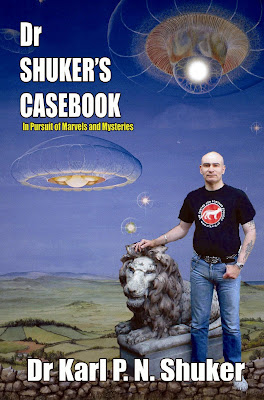
Dr Shuker's Casebook (CFZ Press: Bideford, 2008)


CRITTERS AHOY!
Down through the decades, a sky beast identity for UFOs has been championed by a number of writers and researchers, of which the most famous must surely be Trevor James Constable, who spent over 20 years investigating this subject, and published two books. The first of these, They Live in the Sky, came out in 1958, but the second, The Cosmic Pulse of Light, published in 1976 and then again, in abridged form, in 1978 as Sky Creatures: Living UFOs, brought this fascinating notion to a much wider audience than it had ever before reached.
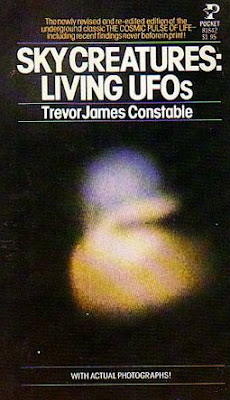
Sky Creatures (1978) – Trevor James Constable

Constable considered the sky beasts – or ‘critters’, as he dubbed them – to resemble gigantic unicellular amoebae, but encased in a metallic or mica-like outer shell or capsule, and with the majority of their bodies composed of plasma, the fourth state of matter, comprising an ionised gas. Although some critters may be as small as a few centimetres, others could be several kilometres long, and remain hidden on most occasions from humans by virtue of their ability to reflect infra-red light, thus rendering them invisible to our eyes – except if they change colour, thereby temporarily reflecting light within the electromagnetic spectrum’s visible section.

Yet even if critters are usually beyond our range of vision, their presence can still be detected, for according to Constable they can actually be photographed – using infra-red film and appropriate filters. In his books, he published a number of photos depicting supposed critters snapped by him in the skies above California’s Mojave Desert, and one of his acolytes, Richard Toronto, duplicated Constable’s attempts in this same locality during 1977, obtaining similar pictures. Their photos have never been exposed as hoaxes (though Kodak representatives have suggested that Toronto’s critters may be nothing more exciting than dirty fingerprints and drying spots), and show several different morphological types. These include fusiform entities, giant amoeboid blobs, huge bladder-shaped objects, gigantic discs, and even some with curiously reptilian ‘beaks’. Moreover, cine-films taken by Constable show that these objects change shape as they move through the sky, and are luminous.


IN SEARCH OF IDEOPLASMS
Another dedicated supporter of the sky beast theory was John Philip Bessor, whose own interest in such a concept was in no small way inspired by Kenneth Arnold’s historic sighting on 24 June 1947 of a phalanx of nine UFOs while flying a Callair aeroplane near Mount Rainier in Washington State, USA. What fascinated Bessor in particular concerning this encounter (which heralded the modern-day wave of UFO interest and sightings worldwide) was Arnold’s belief that what he had seen were: “…living organisms, sort of like sky jellyfish” – far removed from today’s popular spacecraft image for UFOs.

Kenneth Arnold holding a sketch of one of the UFOs sighted by him

Bessor later stated that, in his view, UFOs were a form of living creature (which he christened an ideoplasm) composed of a highly attenuated substance, enabling them to materialise or dematerialise at will, utilising telekinetic energy for propulsion. As would be echoed by Constable in relation to his critters, Bessor opined that these entities must be capable of becoming visible, invisible, and changing colour, all very rapidly. He even submitted his thoughts to the U.S. Air Force, and, remarkably, was informed by them that they considered his notion to be “one of the most intelligent theories we have received” regarding the possible nature and identity of UFOs.

Yet another theory of sky beasts, proposed during this same era of thought regarding UFOs, was that of Countess Zoe Wassilko-Serecki. Authoring a number of articles on this subject, she deemed it plausible that such entities were enormous, glowing, stratosphere-inhabiting creatures resembling gargantuan bladders of colloidal silicones, containing a central core of insubstantial matter but otherwise composed predominantly of pure energy. She claimed that they appeared spherical when stationary but became fusiform when moving, and so diffuse at higher levels as to appear virtually invisible.

In addition, hydrophone inventor John M. Cage, commenting upon how closely the pursuit of aircraft by UFOs resembled that of dolphins with ships, suggested that some UFOs may be sentient beings feeding upon negative electricity. And in his book The Circlemakers (1992), veteran psychical investigator Andrew Collins speculated that perhaps some cropfield circles may be created by energy released by biological UFOs when swooping downwards from the skies.
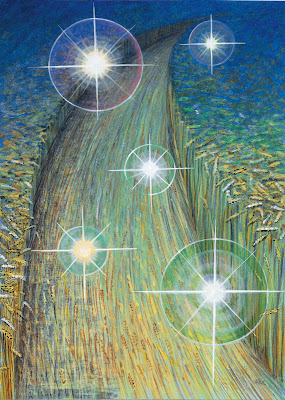
'Guiding Lights' – a painting of biological UFOs flying over a cropfield circle (Philippa Foster)


FOO FIGHTERS, ANGELS, AND OTHER MINI-SKY BEASTS
Not all sky beasts may be enormous and often invisible. Certain much smaller and more readily discernible (but no less perplexing), luminous, spherical entities are on record that may also be variations upon the fundamental sky beast theme. Take, for instance, the foo fighters.

Usually white or red in colour, and highly animate, these small balls of light (BOLs) were (in)famous during World War II for appearing on the outside of aeroplanes in flight and dancing around them, to the bewilderment of their pilots. At first, the Allies and the Axis powers each thought that foo fighters were a secret weapon developed by the other side to detract fighter pilots from their missions – until eventually it was realised that British, American, French, German, and Japanese pilots were all seeing them! The most mystifying aspect, however, was these BOLs’ apparent ‘intelligence’, because they would swiftly move out of reach if the pilots tried to swat them, but would tenaciously pace alongside if the planes tried to out-fly them, and behaved in what can only be described as a playful, even inquisitive manner. Consequently, veteran BOL investigator Vincent Gaddis boldly proposed that perhaps foo fighters were indeed sentient entities, composed of pure energy yet possessing a basic level of intelligence, and supported earlier claims that UFOs were comparable, albeit much bigger, life forms – a view also subscribed to by Constable.
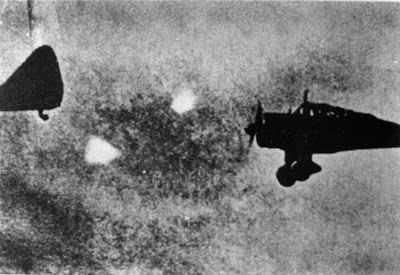
Archive photo of foo fighters near airborne planes during World War II

Interestingly, foo fighters could not be detected by radar. Moreover, a kind of converse foo fighter has also been reported. Known as gizmos or angels, these objects are small, rapidly moving, and again display suspiciously sentient behaviour, sometimes even flying in small groups moving in precise formations. Yet whereas gizmos do show up on radar, and exhibit a very characteristic, idiosyncratic trace pattern readily distinguishable from birds, aircraft, insects, ionised air masses, and other known airborne objects, they are invisible to the human eye.
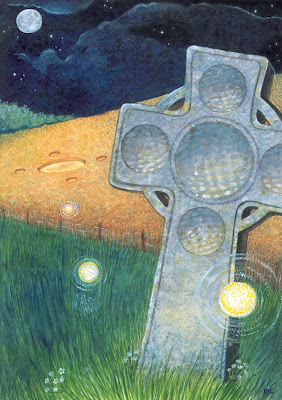
Are BOLs living entities? (Philippa Foster) 


SERPENTS OF THE SKY
Very different from sky beasts, big or small, are sky serpents or sky fishes, spasmodically reported from all around the world. One of the most famous examples was the so-called ‘sky eel’ viewed by countless eyewitnesses during two successive nights in early September 1891 in the sky above Crawfordsville, Indiana. It was said to wriggle like a swimming fish, was white, luminous, and measured approximately 6 m long. Hovering around 100 m above the ground, but sometimes swooping even lower, it wheezed loudly and emitted hot air, but lacked any discernible head or tail. The Crawfordsville sky eel was subsequently 'explained' as a flock of killdeer (a species of plover).

A huge entity resembling a writhing serpent with yellow stripes was seen floating over a farm in Bonham, Texas, one day in June 1873. And in May 1888, a hissing counterpart was reported from Darlington County, South Carolina. Back in 1762, a twisting sky serpent was spied for six minutes as it illuminated from on high the Devon town of Bideford on 5 December. More recently, in March 1935, a Scandinavian sky serpent was reported over southern Norway and Denmark, and in December of that same year another one was witnessed twice in the sky above Cruz Alta, Brazil.

The most popular explanation for these is that they are meteorological phenomena known as fire drakes - on account of their fiery countenance and superficially dragonesque form - caused by charged particles accelerated in solar flares and diverted by the Earth’s magnetic field, so that they enter the upper atmosphere, yielding streams of wavering light. Nevertheless, in some reports the eyewitnesses were convinced that what they had seen was a bona fide living creature.

Sky dragon – merely a meteorological phenomenon, or something more? 


STAR ROT, OR DEAD SKY BEASTS?
A mysterious phenomenon that has been recorded for centuries but never fully explained is star rot, also known as pwdre ser or gelatinous meteors. As its last-mentioned name suggests, often what appears to be a meteor or shooting star is seen streaming across the sky, then later, at the site where it is thought to have landed, samples of a strange jelly-like substance are found. Samples of this star rot that have been formally analysed have unmasked a diversity of identities, including various species of algae, fungi, slime moulds, and even the semi-digested remains of food regurgitated by birds. However, some samples have defied identification, and others have quite literally disappeared even as they were being collected, leaving behind nothing more than an odd smell or a greasy trace to verify their erstwhile existence.
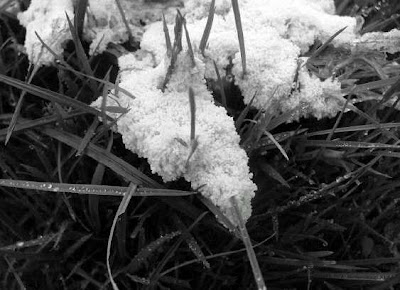
Pwdre ser (CFZ)

Perhaps the most dramatic explanation for these more mystifying samples of star rot, as suggested by Bessor, is that they are actually the mortal remains of sky beasts that have died and plummeted downwards from their lofty abode in the sky to the ground far below, leaving nothing more than transient masses of jelly as corpses, with the earlier-spied streams of light in the sky the release of their dying bodies’ energy.


LEGLESS IN NEW GUINEA
When skins of New Guinea’s exotically-plumed birds of paradise were first brought back to Europe, in 1522, naturalists were very surprised to discover that they did not possess flesh, blood, bones, or feet. Consequently, they mistakenly deduced that these gorgeous, ethereal-looking, and seemingly near-weightless birds spent their whole lives permanently airborne, feeding upon an ambrosial diet of nectar and dew like feathered sylphs, descending earthward only to die. In reality, however, as they subsequently discovered, the reason for these birds’ insubstantial nature was that when preparing their skins for sale, the New Guinea natives routinely but with great skill removed all of their bodies’ fleshy parts, leaving only their feathers, wings, head, and beak!

Greater bird of paradise – scientifically named Paradisea apoda ('footless') in recognition of the erstwhile, erroneous belief that these birds genuinely lacked feet and were permanently airborne 


MYSTERY OF THE RODS
Often cited as examples of atmospheric creatures, rods are cylindrical objects, often just a few centimetres long but sometimes much bigger, with wings or a rapidly-undulating lateral membrane. These enigmatic objects cannot be seen with the naked eye but have frequently been photographed and filmed, their most notable researcher, José Escamilla, having done so many times. Likened by believers in their status as unknown life forms to flying centipedes, rods have been dismissed by sceptics as camera artefacts, digital distortions, and known, living creatures such as insects or even birds. Arguments have raged for years, but in May-June 2005, research staff at China’s Tonghua Zhenguo Pharmaceutical Company provided a satisfactory solution. Setting up huge collecting nets, they filmed many rods flying inside them, but when they then inspected these nets’ contents, all that they found were moths and other insects. Subsequent investigation revealed that their filmed rods were artefacts – normal insects ‘transformed’ into rods by an optical illusion resulting from their video camera’s slow recording speed. It is now believed that what is happening is that when a fast-flying insect such as a moth is filmed by video equipment, its wings move too rapidly to produce a clean image. Instead, a time-lapse of its wings occurs, which yields the mysterious wings or undulating membrane of the rod, with the rod itself being the time-lapsed body of the flying moth. If so, and it certainly seems the most plausible explanation, we can spare the rod from any further consideration as a bona fide cryptid of any kind, let alone one of sky beast relevance or affinity.
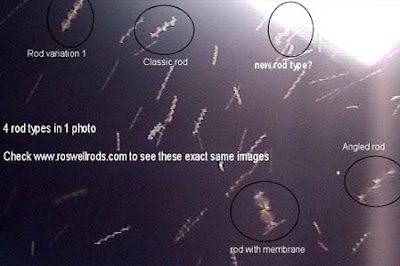
A selection of rod types 


SKY BEASTS ON JUPITER?
 In 1977, Cornell University astrophysicist Dr E.E. Salpeter and eminent astronomer Prof. Carl Sagan published a paper in the Astrophysical Journal Supplement outlining their thoughts on the possible presence of life on Jupiter, and the likely forms that it may take, existing amidst this gargantuan gas planet's clouds. They concluded that much of whatever life might indeed reside there may well parallel the ecology of Earth's ocean fauna - yielding Jovian equivalents to our plankton, fishes, and larger fish-eating marine predators (turtles, sharks, etc), and which the two scientists have termed sinkers, floaters, and hunters respectively.

A fractal picture of space jellyfish

Salpeter and Sagan postulated that they could be enormous sac-like organisms, filled with helium, and propelling themselves through the planet's atmosphere by controlled expulsion of this gas from their bodies. However, they did not consider these airborne balloon-like beasts to be wholly conjectural. In fact, they suggested that the presence of such creatures (perhaps even attaining a total diameter of many miles in the case of the Jovian 'hunters') may explain the frequent occurrence over the planet of clearly-perceived areas of red colouration.

The two scientists hoped that this prospect could be examined by the close-up cameras that would be focused upon Jupiter by the U.S.'s Mariner 11 and 12 space probes after their launch later in 1977, but no evidence to support the existence of these (or any other) Jovian life forms was found. Even so, the ideas of Salpeter and Sagan remain plausible relative to the likely nature of life on that huge gaseous world, should any truly exist there. Back in 1971, moreover, the scenario of colossal sky jellyfishes on Jupiter had been the basis for one of Arthur C. Clarke's most famous science-fiction stories, 'A Meeting With Medusa'.
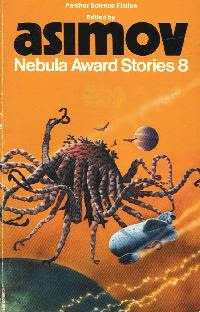
'A Meeting With Medusa' – Arthur C. Clarke

Another notable science-fiction novel significantly featuring sky beasts (and which is a particular favourite of mine) is Philip Jose Farmer's The Wind Whales of Ishmael (1972), set on Earth but in the far-distant future, in which the oceans have long since dried up, with the creatures that once thrived in them having evolved into a diverse panoply of exclusively airborne sky beasts instead. These from vast clouds of tiny aerial krill counterparts and the huge wind whales that feed upon them to the smaller but highly-aggressive sky sharks and even a species of sky jellyfish that periodically hovers above forests into which it sends down its stinging, heat-sensitive tentacles to detect the body heat of the terrestrial life forms upon which it preys.


More recently, in 2005, the concept of a carnivorous species of space jellyfish invading Earth and causing havoc was the basis of a decidedly strange Japanese science-fiction film, 'Dogora'.

'Dogora'


FINAL THOUGHTS: SKY BEASTS AS STRATOSPHERIC FISHES?
If a pebble is thrown into a pool, its fishes and other occupants flee in all directions, but soon venture back to see what had caused the disturbance. Several sky beast investigators claim that the same principle explains sightings of UFOs. Sometimes they are coming down towards earth to feed upon energy released by energy-releasing sources such as TV transmitters, power stations, etc. In addition, and again like aquatic creatures, which migrate to deeper levels to avoid weather-related disturbance at the water surface, perhaps the sky beasts migrate vertically downwards to avoid bad weather in higher atmospheric strata. On other occasions, however, could their appearances at lower levels be due to simple curiosity regarding disruptions to their airy kingdom caused by those pesky terrestrial creatures known as Homo sapiens sending all manner of strange objects skyward? As I noted in Dr Shuker’s Casebook:

"For millions of years, the upper reaches of the sky have remained sacrosanct from contact by the realms of land and sea below. Here, according to the sky beast theory, these metrically vast but materially insubstantial entities have evolved in supreme isolation, unsullied and undisturbed by events on Earth. Since the early 20th Century, however, aeroplanes have roared on silver wings through the sky beasts’ cathedrals of clouds, rockets have surged relentlessly upwards like volleys of scorching arrows, and nuclear explosions have spewed forth their deadly emissions in bilious contempt upon the once-immaculate roof of the world. Is it any wonder, therefore, as argued by Cage and the Countess, that UFO sightings are increasing? The sky beasts are cautiously venturing down, to discover what is happening in the frenetic zones far beneath their own languid kingdoms of air and space."

Sky beasts (Tim Morris)