Could
modern-day chalicotheres occasionally emerging from the Nandi and Kakamega Forests' dense,
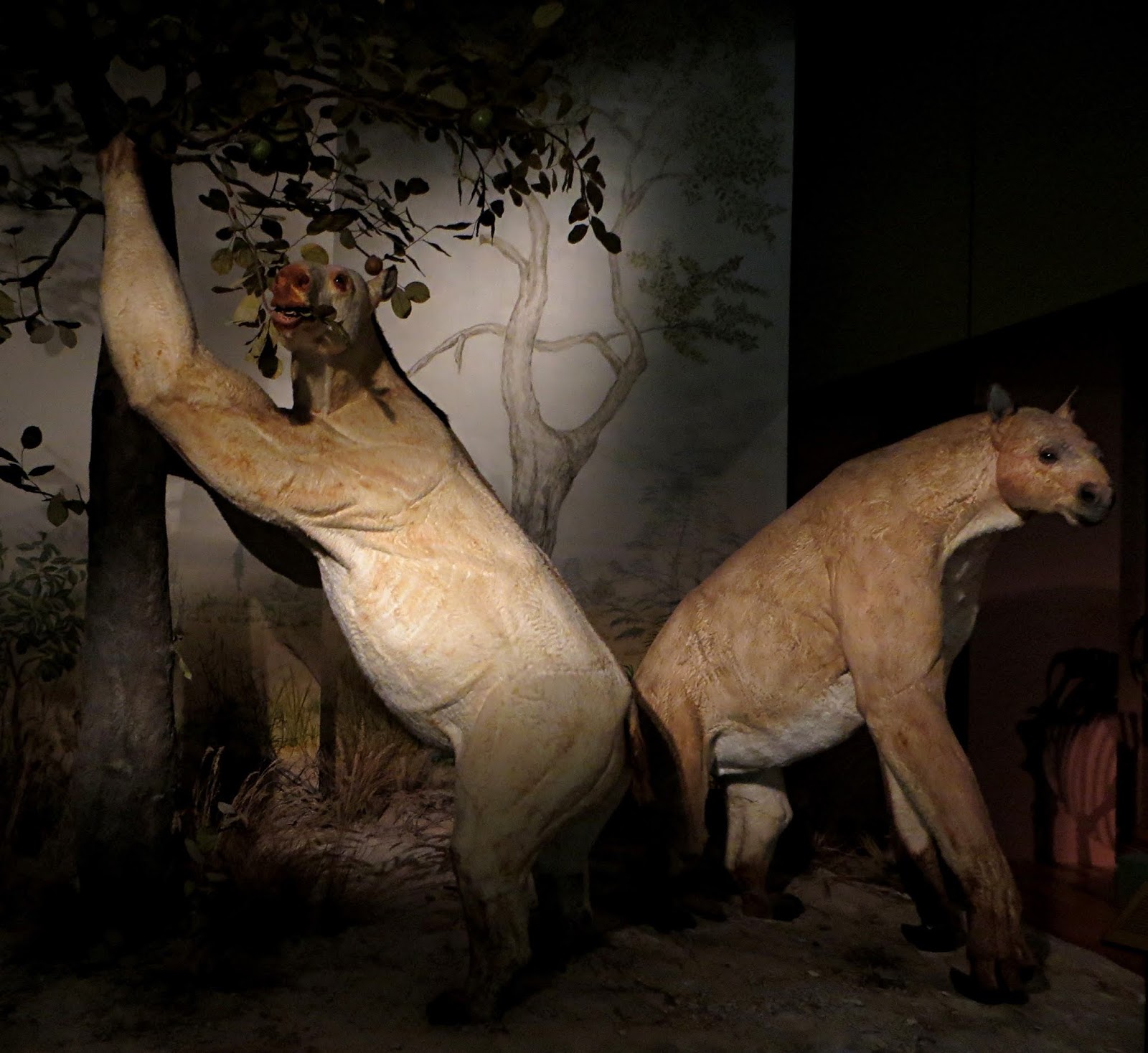
shadowy interior explain reports of the formidable Nandi bear? Depicted here
are two life-sized Anisodon grande chalicothere models at the Natural History Museum
in Basel,
Switzerland (©
Ghedoghedo-Wikipedia – CC BY-SA 4.0 licence)
Periodically come reports from the Kakamega forests
in Kenya of sightings of the Nandi bear. The beast is described as having a
gorilla-like stance with forelimbs longer than the hind, with clawed feet like
a bear and with a horse-like face. Could the beast be a survivor of the
chalicothere, thought to have become extinct in East Africa during the
Pleistocene? The description above would fit with the skeletal remains of these
extraordinary animals.
R.J.G.
Savage and M.R. Long – Mammal Evolution
One of the most
formidable, ferocious mystery beasts on record, the Nandi bear of western Kenya's
Nandi and neighbouring Kakamega forest regions was once widely reported, but
lately it seems to have gone out of fashion – or even out of existence –
because there do not appear to have been any documented sightings of it for
many years. Consequently, the Nandi bear (aka chemosit, kerit, koddoelo, khodumodumo, and gadett) is seldom
referred to nowadays, even by cryptozoologists. As a result, this present
ShukerNature blog article is the first in a planned occasional series whose
intention is to raise awareness and interest once again in this long-forgotten
yet thoroughly fascinating cryptid, which remains one of my all-time
favourites.
As discussed by veteran
cryptozoologist Dr Bernard Heuvelmans in On the Track of Unknown Animals
(1958) and further assessed in my own books In Search Of Prehistoric Survivors and Still In Search Of Prehistoric Survivors, the
Nandi bear seems to have been many things to many people, inasmuch as it was
apparently a composite creature, i.e. 'created' from the erroneous lumping
together of reports describing several taxonomically discrete animals. Some of
these are already known to science, but others may not be, at least in the
living state.
Reconstruction
of Africa's
supposedly long-extinct giant short-faced hyaena (public domain)
They include:
old all-black ratels (honey badgers) Mellivora capensis; some form of
extra-savage giant baboon; erythristic (freakishly red-furred) spotted hyaenas Crocuta
crocuta and/or a supposedly long-extinct lion-sized relative called the
short-faced hyaena Pachycrocuta brevirostris; the aardvark Orycteropus
afer; perhaps even a relict true bear like the supposedly-extinct Agriotherium
or one related to (or synonymous with) the Atlas bear Ursus arctos crowtheri,
which still existed in North Africa until as recently as the 1870s; and, most
fascinating of all, a putative surviving species of chalicothere.
The latter were
bizarre perissodactyl (odd-toed) ungulates that possessed claws instead of
hooves, and which may have been somewhat hyaena-like in superficial appearance
(due to their rearward-sloping back) but were much larger in size. According to
the fossil record, chalicotheres lingered on until at least as recently as one
million years ago in Africa, but died out
earlier elsewhere in the world.
Artistic
representation of a living chalicothere (© Hodari Nundu)
The prospect of
a modern-day chalicothere being responsible for certain Nandi bear reports was
popularised by Heuvelmans in his book On the Track..., but in spite of
common assumption to the contrary, he definitely did not originate this notion.
Instead, it was presented and discussed at length as far back as 1931, by
Captain Charles R.S. Pitman in the first of his two autobiographical works, A
Game Warden Among His Charges. Moreover, it was briefly alluded to even
earlier, by Dr Charles W. Andrews in his Nature article from 1923
regarding the finding of chalicothere fossils in Central Africa. Even the
renowned Kenyan palaeoanthropologist Louis S.B. Leakey contemplated it in an Illustrated
London News article of 2 November 1935. Certainly, the
idea has long held a particular fascination for me, because it alone could
provide a reasonable explanation why the Nandi bear has seemingly vanished.
Artiodactyls
(even-toed ungulates, e.g. cattle, antelopes, giraffes, pigs) were devastated
by an epidemic of rinderpest (a morbillivirus) that swept across southern Africa during the late
19th Century. In 1995, it was revealed that a distantly-related
morbillivirus was comparably deleterious to horses (which, like chalicotheres,
are perissodactyls). So could a morbillivirus have wiped out a chalicotherian
Nandi bear? None of the other Nandi bear identities would be affected by such a
disease, so if only these identities were components of the Nandi bear
composite (i.e. with no ungulate component ever involved), we would expect
Nandi bear reports to be still surfacing, whereas in reality none has emerged
for years.
Chalicothere
skeletons (public domain)
Someone else who
was very intrigued by the concept of a chalicotherian Nandi bear was British author
and wildlife educator Clinton H. Keeling (click here to access a rare vintage photograph from 1955 depicting Clinton and his wife, on Shutterstock's website), whose death in 2007 robbed the
international zoological community of a uniquely knowledgeable expert on the histories
and exhibits of zoological gardens, circuses, and menageries (travelling and
stationary) throughout Britain and overseas, both in the present and in the
past. During the course of a long, productive life as a zoo curator and also
travelling widely to schools with animals to entertain and educate generations
of children concerning the wonders of wildlife, Clinton wrote and
self-published over 30 books (but all of which, tragically, are fiendishly
difficult to track down nowadays) documenting wild animal husbandry and also
the histories of demised and long-forgotten animal collections.
These works are
a veritable treasure trove of extraordinary information and insights that are
very unlikely to be found elsewhere, providing details of some truly remarkable
and sometimes highly mysterious creatures that were at one time or another on
display in Britain – and which in Clinton's opinion may
have included at least three living chalicotherian Nandi bears!
Sivatherium (an
extinct 'antlered' giraffid) and chalicothere models (© Markus Bühler)
Frustratingly,
however, I have never managed to obtain a copy of any of Clinton's books. So
after he published a summary of his Nandi bear accounts from two of them in the
form of a short article appearing within the July 1995 issue of the Centre for
Fortean Zoology's periodical Animals and Men, I wrote to him requesting
further information. In response, he kindly wrote me a very detailed letter,
dated 3 July 1995, documenting
all that he knew about this extremely exciting possibility and also regarding
various other cryptozoological subjects.
Its contents
made enthralling, thought-provoking reading, but I have never blogged its Nandi
bear section (or even any excerpts from it) – until now. So here, for the very
first time on ShukerNature, is Clinton Keeling's full and thoroughly fascinating
account of that tantalising bygone trio of unidentified captive beasts in Britain that just may
have been living Nandi bears:
Rest assured I shall be happy to assist
you in any way possible concerning the "Nandi Bear", of which I am
convinced at least three specimens have been exhibited in this country –
although their owners had no idea what they were...
I think it would be best if I were to
quote directly from two of my books...in this way you'll know as much as I do
when you've finished reading. The following – I'll call it NB1 [i.e. Nandi Bear
Case #1] – is from my book Where the Crane Danced, written in 1983; I'm
dealing with the earliest travelling menageries:
"The first one I have been able to
learn anything about must have been operating in the 1730s, and although not
even its name has been recorded I was absolutely thrilled to discover that it
contained what might well have been proof that an animal that most people
relegate to the Loch Ness Monster bin really did exist – and comparatively recently
too. In a nutshell, I have always been interested in the mysterious creature
usually referred to as the Nandi Bear, which might still exist on the Uashin
Gishu Plateau in Kenya; some people swear it was/is a belated Chalicotherium, a
primitive ungulate with claw-like hooves which officially became extinct long
ago, while others pooh-pooh the whole tale as an utter fabrication. Those who
claim to have seen it, though, and they are many, all talk of a Hyena-like
creature with the head of a Bear [some descriptions, however, offer the
converse description, i.e. hyaena-headed and bear-bodied]. And please note this
menagerie that might have shown one was operating getting on for two centuries
before Kenya was opened up by Europeans, so in other
words no-one had heard of it then. I first came upon this intriguing
possibility when looking through some old numbers of Animal and Zoo Magazine,
the long-defunct publication I mentioned in Where the Lion Trod [another
of Clinton's books]. In the edition for February
1938 it stated that a reader in Yorkshire had found a bill "two hundred years old" that read:
"Posted
at the sign of the Spread Eagle, Halifax. This is to give
notice, to all Gentlemen, Ladies and others, that there is to be seen at the
sign of the Coffee House, a curious collection of living creatures..."
"It then went on to list its
attractions, chiefly Monkeys and smallish carnivores, the last of which was:
"A
young HALF and HALF; the head of a Hyena, the hind part like a Frieseland
[Polar? [this query was inserted by Clinton]] Bear."
"Now it would certainly not have
been a Hyena, or a Bear, as clearly whoever penned the advertisement apparently
knew what they looked like, so one is left to ponder on this curiosity, which
sounds so much like descriptions of that weird threshold-of-science creature
which has so often been seen by sober people of high reputation as it has gone
slinking through the long grass in the African night."
Chalicothere painting seen at
Twycross Zoo in Leicestershire, England (© Dr Karl Shuker/Twycross Zoo –
reproduced here on a strictly non-commercial Fair Use basis, for
educational/review purposes only)
NB2 [Nandi Bear Case #2] comes in my Where
the Macaw Preened (1993), and its source is interesting. In Where the
Crane Danced I dealt in some detail with Mander's Menagerie, a huge display
second in size only to Bostock and Wombwell's, and which finally came off the
road in 1875. As a result of this, I was contacted by a Mrs Rosanne Eccleston
of Telford, Shropshire, who is a descendant of the Manders.
She sent me a facsimile of an extremely lengthy advert, placed in a York
newspaper in November 1869 which was, in effect, a stocklist of the show at
that time (it included such unexpected items as Ligers); Mander was [a] very
experienced animal-man, but sometimes he got his geographical area of
distribution wrong, usually – and this could be significant – when he'd
obtained a rare or obscure species (i.e. not what I call a Noah's Ark animal –
Lion, Tiger, Bear, etc.) about which he knew little or nothing. Anyway, I quote
directly from the end of the section on Mander's Menagerie in WTMP [Where
the Macaw Preened]:
"I've deliberately left what I
consider to have been the most remarkable exhibits until the last, so we can
savour them for the marvels that I think they could have been. Oddly
enough, they were one of the few species to be given what's clearly the wrong
area of distribution.
"Listed as "Indian Prairie
Fiends" they were described as:
Most
wonderful creatures. Head like the Hippopotamus. Body like a Bear. Claws
similar to the Tiger, and ears similar to a Horse.
"That's all, and forget the inference
to North America [i.e. the prairie portion of the name applied to these
creatures in the listing], as there's nothing in that part of the world that
has ever resembled anything like this, but, descriptions given by Africans
apart, this is the best word-picture of the Chimiset or Nandi Bear I've ever
happened upon.
"Many people, I know, relegate this
astonishing creature to the same category as the Loch Ness Monster and other
twilight beasts which might or might not exist, but here I feel they are being
unjust as the question should really be "does it still
exist?", as of all the "mystery" animals this is the one
scientific sceptics come nearest to accepting, as paleontologists have learned
a great deal about the Chalicotherium – which is believed to be the origin of
the Nandi Bear. In short, it resembled a nightmarish (no pun intended) Horse –
in fact it was related to the Equines – which had huge claws and preyed upon
other animals, in fact many Africans have stated how fierce it is, and how
destructive to their livestock ("Fiends", I trust you've noticed; the
only implication so far of viciousness – again, it fits). Readers of WTCD
[Where the Crane Danced] will recall my suggestion that a menagerie
touring northern England in the 1730s also boasted a young specimen – which is
at least perfectly possible, as there now seems little doubt that a small
relict population of Chalicotheriums (Chalicotheria?) hung out on the Uashin
Gishu Plateau in East Africa until the very end of the 19th Century,
when it was wiped out by the great rinderpest epidemic of 1899. Remember, it was
an ungulate, despite not having hooves and eating flesh. What a pity Mr Mander
didn't think anyone would be interested to learn what he fed his specimens
on!"
All of which brings up some fascinating
points. For a start, on the face of it, it sticks out a mile that the two
reports are of completely different animals, but whereas the
"Halifax" creature was a classic description of the beast seen so
often in Africa a century ago, the "York" one is a word-perfect
reconstruction of modern assessments of what the chalicotherium must have
looked like – even to the Horse-like (Hippopotamus) head and massive claws. I
agree it sounds paradoxical, but here are good descriptions of the creatures
seen in the field by traveller and tribesman, and the armchair explorers' and
scientists' word-picture of what it must have resembled. In other words,
there's a strong case for each.
An extremely impressive brief can be
made for Mander's animals, as it's the only species in his list with a
"made-up" name; all others either have appellations still in use, or
old but then perfectly acceptable ones, such as "Yaxtruss" for Yak
and "Horned Horse" for Wildebeests: this one alone has an outlandish
name. It's very highly significant, too, that again it's the only one to be
described in detail – presumably on the assumption that most people would know
what a Camel or a Zebra or a Kangaroo was. In other words Mander, who most
certainly knew an extremely wide range of species, hadn't the slightest idea of
what the Indian Prairie Fiends really were.
I cannot emphasise strongly enough that
whatever these animals were, they would certainly have been on show, and more
or less as described, as contrary to popular belief, the showmen of yesterday
might have exaggerated the size or physical attributes of their exhibits, but
they certainly didn't advertise what they hadn't got. They were not fools, and
knew full well the measures a mob of 19th Century colliers,
artisans, idlers and toughs would take if it thought it was being swindled or
"conned".
Most unfortunately it didn't enter the
heads of these very materialistic travellers to keep Occurrences Books (other
than places visited and money taken) so unfortunately we'll probably never know
how these I.P.F.s [Indian Prairie Fiends] were obtained, how many there were,
their diet, how long they lived, or – very important – what became of them. I
mention this because there was often an arrangement with museums whereby
unusual cadavers were eagerly purchased (in Weston Park Museum, Sheffield, for
example, there are two hybrid big Cat cubs purchased long ago from a travelling
show) so I suppose it's just possible, in some dusty storeroom, there
could be a couple of interesting skulls or pelts.
Scale
illustration depicting an American chalicothere Moropus elatus alongside
an average-sized human in silhouette form (© Nobu Tamura-Wikipedia – CC BY-SA 4.0 licence)
As can be
readily appreciated, the extensive Nandi bear sections quoted above from Clinton's letter to me constitute
a captivating and very thought-provoking communication, to say the least!
However, it contains certain assumptions that need to be addressed and
rectified.
First and
foremost: contrary, to Clinton's claims, the chalicotheres were not
carnivorous, they were wholly herbivorous – a major conflict with the Nandi
bear's bloodthirsty rapaciousness that Heuvelmans sought to explain by
speculating that perhaps the occasional sight of so extraordinary a beast as a
chalicothere, armed with its huge claws, was sufficient for a native observer
to assume (wrongly) that they had spied a bona fide Nandi bear. In other words,
even if there are any living chalicotheres, these perissodactyl ungulates are
only Nandi bears by proxy. Having said that, however, as I pointed out in my two
prehistoric survivors books, certain other perissodactyls, such as some zebras,
tapirs, and most notably the rhinoceroses, can be notoriously bellicose if
confronted. If the same were true of chalicotheres, one of these horse-sized creatures
with formidable claws and an even more formidable, highly aggressive defensive
stance would definitely make a veritable Nandi bear, even though it wouldn't
devour its victim afterwards.
A
family of American chalicotheres, Moropus, with one of the adults savagely
seeing off a couple of snarling Daphoenodon bear-dogs or amphicyonids, as
depicted in an exquisite palaeoart mural produced by Jay Matternes and
exhibited at the Smithsonian Institution, in Washington DC, USA (public domain)
When referring
to the Halifax mystery beast (NB1), Clinton wondered
whether the "Frieseland [sic] bear" that it was likened to was a
polar bear. In reality, however, the only bears native to Friesland, which is part
of the present-day Netherlands, are brown
bears Ursus arctos. Consequently, this suggests that the animal's hind
parts resembled a brown bear's, not a polar bear's.
My greatest
concern, however, is Clinton's determination to believe that the Halifax
mystery beast and the York mystery beasts (NB2) were the same species (even
after stating himself that at least on first sight the two reports describe two
totally different types of animal). Personally, I fail to see how a
hyaena-headed owecreature can be
one and the same as a hippo-headed creature – unless, perhaps, these were
simply differing ways of emphasising that the creatures had big, noticeable
teeth? In the same way, likening their ears to those of horses might indicate
that, as with horses' ears, theirs were noticeable without being prominent.
Alternatively (or additionally?), describing an animal's head as hippo-like may
imply that it had large, broad nostrils and/or mouth.
Is
this what a Nandi bear trophy head might look like if it were truly a
chalicothere? Many renowned hunters sought the Nandi bear during the early 20th
Century, hoping to add to their collections of mounted heads and pelt rugs a
specimen of what they no doubt considered to be the ultimate trophy animal, but
none succeeded. (The above photograph depicts an Ancylotherium
chalicothere model head from the 'Walk With Beasts' exhibition temporarily held
at London's
Horniman Museum.)
(© Jim Linwood-Wikipedia – CC BY 2.0 licence)
Clinton's statement
that the hippo-headed York cryptids
corresponded with a chalicothere's appearance cannot be countenanced, because
chalicotheres' heads were horse-like (which hippos aren't), and chalicotheres
didn't have big teeth. So even if the hippo-head comparison was just an
allusion to the size of the York cryptids'
teeth, a chalicothere identity is still ruled out for them.
My own view is
that if either of the two cryptid types documented here were a Nandi bear, it
is more likely to have been the hyaena-headed, bear-bodied Halifax animal. Even
so, this latter beast sounds very reminiscent of a scientifically-recognised
but publicly little-known species whose distinctive appearance would certainly
have made it a most eyecatching exhibit. Today, three species of true hyaena
exist, two of which – the striped hyaena Hyaena hyaena and the
earlier-mentioned spotted hyaena – are familiar to zoologists and laymen alike.
The third, and rarest, conversely, is seldom seen in captivity and is elusive
even in its native southern African homeland.
An
early, vintage photograph of a brown hyaena in captivity (top); and a modern-day
photo of another captive specimen belonging to this same species (bottom) (public domain / © Markus Bühler)
This reclusive
species is the brown hyaena H. brunnea, which just so happens to combine
a hyaena's head with a dark brown shaggy-furred body that is definitely ursine
in superficial appearance (as I can personally testify, having been fortunate
enough to espy this species in the wild in South Africa), and especially so in
the eyes of a zoologically-untrained observer. So could the Halifax mystery beast
have been a sub-adult brown hyaena, captured alive alongside various more
common African species and then transported to Britain with them,
where it was destined to be displayed to a wide-eyed public that had never
before seen this exotic-looking species? It is certainly not beyond the realms
of possibility, and is a more plausible identity than a Nandi bear.
As for the
Mander cryptids, an identity very different from that of a Nandi bear but
equally cryptozoological in nature came to mind as soon as I first read Clinton's account of
them.
Might Mander's 'prairie fiends' have
been living ground sloths? Here is a life-sized museum model of a ground sloth
in quadrupedal pose (© Alexandre Paz Vieira/Wikipedia – CC BY-SA 4.0 licence)
Clinton discounted
their 'Indian prairie fiend' name by accurately stating that nothing resembling
them is known from North America. But what if
they had come from South America instead? The
'Indian' reference could simply have been in relation to whichever native
Indian tribe(s) shared their specific distribution in South America. And could it
be that 'prairie' was nothing more than an alternative name for 'pampas',
perhaps substituted deliberately by Mander as he knew that 'prairie' would be a
more familiar term than 'pampas' to his exhibition's visitors?
But does the
South American pampas harbour a creature resembling those cryptids exhibited by
Mander? Until at least as recently as the close of the Pleistocene epoch a mere
11,700 years or so ago, this vast region (encompassing southernmost Brazil,
much of Uruguay, and part of Argentina) did indeed harbour large shaggy
bear-like beasts with huge claws, noticeable ears, plus sizeable nostrils and
mouth. I refer of course to the ground sloths – those burly, predominantly
terrestrial relatives of today's much smaller tree sloths. Moreover, the pampas
has hosted several modern-day sightings of cryptids bearing more than a passing
resemblance to ground sloths – and thence to the Mander mystery beasts.
Reconstruction
and skeleton of a living ground sloth in upright pose (public domain / © Dr
Karl Shuker)
Some species of
ground sloth were truly gigantic, but others were of much more modest
proportions, and there is no doubt that a medium-sized species of surviving
ground sloth would solve a number of currently unresolved cryptozoological
conundra, not least of which is the identity of the mystifying Mander beasts.
Specimens of many other South American beasts were commonly transported from
their sultry homelands and exhibited in Europe back in the
days of travelling menageries here. Could these have included a couple of
ground sloths? In addition, armed with such huge claws a cornered ground sloth
might well be more than sufficiently belligerent if threatened or attacked to
warrant being dubbed a fiend.
So, who knows -
perhaps the hypothetical dusty museum storeroom postulated by Clinton as a repository
for some mortal remains of the Nandi bear may contain some modern-day ground
sloth cadavers instead? It certainly wouldn't be the first time that surprising
and highly significant zoological discoveries have been made not in the field
but within hitherto unstudied or overlooked collections of museum specimens.
Holding
my very own model of a chalicothere…and Nandi bear? (© Dr Karl Shuker)
NB – This ShukerNature blog article is based upon
an earlier Fortean Times article of mine that subsequently reappeared as
a chapter in my book A Manifestation of Monsters.
Regrettably, however, in both of those previous incarnations a very rare (for
me) and admittedly only minor yet nonetheless unfortunate error inexplicably
crept in, but which via this present ShukerNature blog version I have finally
been able to correct. Specifically in the FT and book versions, the antepenultimate
paragraph in my account, which opens with the words "But does the South
American pampas…", erroneously contains the name 'Halifax' (twice) when the correct name should have been
'Mander'; and also this same error occurs once in the penultimate paragraph,
opening with the words "Some species of ground sloth". As seen above,
however, I have made the necessary corrections in this blog version, so anyone
owning my FT article and/or my Manifestation book can now either
mentally or physically amend them accordingly there too.
The most extensive coverage of the enigmatic Nandi
bear's history and possible identity (or identities) included in any modern-day
work can be found in my book Still In Search Of Prehistoric Survivors, which also
contains a comprehensive coverage of putative ground sloth survival.
UPDATE #1 - 10 May 2019
As can be seen from the correspondence below in the Comments section, it would now seem possible that the true identity of Mander's so-called Indian prairie fiends was, of all things, the Tasmanian devil! However, as I have since discovered when investigating this most intriguing lead, the reality may be rather more complex, so I shall be pursuing and presenting my thoughts and findings concerning it all in a future ShukerNature blog article. Meanwhile, I confess to being surprised that Clinton Keeling, unquestionably among the most knowledgeable of all authorities on the history of British menageries, had seemingly never encountered any of the newspaper reports either cited in the Comments section here or additionally uncovered by me that claim Mander's Indian prairie fiends to have been Tasmanian devils. Had he done so, I feel sure that he would have published an account of this, and modified accordingly his opinion concerning it.
UPDATE #2 - 10 May 2019
Also today, I was delighted to discover that in 1979, a new genus of African chalicothere from the Miocene epoch had been formally named, based upon the discovery of some fossil remains consisting of portions of a chalicothere limb. But why did this discovery and naming delight me? Because the name that had been chosen for this new genus was - wait for it! - Chemositia !! Clearly, speculation concerning the possibility that the Nandi bear (aka chemosit) was a surviving species of chalicothere had not gone unnoticed in the palaeontological world. And as if this were not delightful enough, guess where the remains of Chemositia had been unearthed? Kenya!!
Reconstruction of the likely appearance in life of the chalicothere Anisodon grande (© Dmitri Bogdanov/Wikipedia - CC BY-SA 3.0 licence)




 Posts
Posts