Dr KARL SHUKER

Zoologist, media consultant, and science writer, Dr Karl Shuker is also one of the best known cryptozoologists in the world. He is the author of such seminal works as Mystery Cats of the World (1989), The Lost Ark: New and Rediscovered Animals of the 20th Century (1993; greatly expanded in 2012 as The Encyclopaedia of New and Rediscovered Animals), Dragons: A Natural History (1995), In Search of Prehistoric Survivors (1995), The Unexplained (1996), From Flying Toads To Snakes With Wings (1997), Mysteries of Planet Earth (1999), The Hidden Powers of Animals (2001), The Beasts That Hide From Man (2003), Extraordinary Animals Revisited (2007), Dr Shuker's Casebook (2008), Karl Shuker's Alien Zoo: From the Pages of Fortean Times (2010), Cats of Magic, Mythology, and Mystery (2012), Mirabilis: A Carnival of Cryptozoology and Unnatural History (2013), Dragons in Zoology, Cryptozoology, and Culture (2013), The Menagerie of Marvels (2014), A Manifestation of Monsters (2015), Here's Nessie! (2016), and what is widely considered to be his cryptozoological magnum opus, Still In Search Of Prehistoric Survivors (2016) - plus, very excitingly, his four long-awaited, much-requested ShukerNature blog books (2019-2024).

Dr Karl Shuker's Official Website - http://www.karlshuker.com/index.htm

IMPORTANT: To view a complete, regularly-updated listing of my ShukerNature blog's articles (each one instantly clickable), please click HERE!

IMPORTANT: To view a complete, regularly-updated listing of my published books (each one instantly clickable), please click HERE!

IMPORTANT: To view a complete, regularly-updated listing of my Eclectarium blog's articles (each one instantly clickable), please click HERE!

IMPORTANT: To view a complete, regularly-updated listing of my Starsteeds blog's poetry and other lyrical writings (each one instantly clickable), please click HERE!

IMPORTANT: To view a complete, regularly-updated listing of my Shuker In MovieLand blog's articles (each one instantly clickable), please click HERE!

IMPORTANT: To view a complete, regularly-updated listing of my RebelBikerDude's AI Biker Art blog's thematic text & picture galleries (each one instantly clickable), please click HERE!

Search This Blog


PLEASE COME IN, I'VE BEEN EXPECTING YOU...

PLEASE COME IN, I'VE BEEN EXPECTING YOU...
WELCOME TO SHUKERNATURE - ENJOY YOUR VISIT - BEWARE OF THE RAPTOR!


Showing posts with label legends. Show all posts

Monday, 12 January 2015

PHANTOM WHITE DOGS AND CELTIC FAIRY HOUNDS


A fairy hound, one of the Cwn Annwn - the hounds of Annwn, the Celtic Otherworld (© Simon Wyatt)

Characterised by their sable-hued pelage, blazing red eyes, spectral nature, and their traditional association with disaster and death, the zooform phenomena known as Black Dogs have been extensively documented. Equally mysterious, but far less familiar, are their pallid counterparts, the White Dogs and fairy hounds. Nevertheless, these canine phantoms are by no means rare.

One of Great Britain's most famous White Dogs is Gally-trot, reported in the North Country and Suffolk, which resembles a bullock-sized dog with a white shaggy coat. Gally-trot earns its name from its tendency to chase after anyone who runs away from it, and from its fearsome demeanour ('Gally' translates as 'to frighten'). What may be the same apparition has also been recorded specifically from a marshy pool near Burgh, in Suffolk, called Bath Slough.

During the years leading up to World War II, a White Dog was often seen racing across the road linking the Norfolk villages of Great and Little Snoring, and on one occasion an unsuspecting motorist drove directly through it! Equally intangible is the white hound of Cator Common, Dartmoor, which, in one particularly memorable modern-day instance, abruptly disappeared in full view of a lady who had stretched out her hand to stroke it.

A pack of White Dogs

Even more extraordinary, as brought to my notice by cryptozoologist Jan Williams, is the White Dog reported from Leek Brook in Staffordshire. Just like its Black Dog equivalent, East Anglia's Old Shuck, this particular White Dog has no head! Another Black Dog trait mirrored by certain White Dogs is their association with chains - as demonstrated by the white hound of Bunbury, Cheshire, which is normally observed dragging a length of chain behind it.

A few Black Dogs have actually materialised inside churches, and there is at least one White Dog on file with a similar claim to fame. Resembling a ghostly white hound, this preternatural beast reputedly appears inside the church at Pluckley, Kent - not too surprising a locality, perhaps, as Pluckley is popularly deemed 'the most haunted village in England'.

Mystery beast investigator Neil Arnold has publicised a fascinating but hitherto little-known, present-day sighting of a White Dog. One evening during the early 1950s, a soldier based at an army camp inside Richmond Park was returning to the camp after visiting London when he noticed that the park's deer seemed unusually disturbed. Suddenly, several deer raced by him in a state of great panic, and when he looked behind them he was amazed to see a huge, pure-white hound, of hideous appearance with immense teeth, chasing after them. However, it was no normal, corporeal dog. Instead of running across the ground, this uncanny entity was racing through the air, at a height of about 1 ft above the ground!

The Richmond Park White Dog (© C. Martin)

Although most reports of White Dogs emanate from Great Britain, there are varied traditions elsewhere too. For instance: Lamper, the Hebridean death dog, is white, and runs round in circles to warn of an impending death. Werewolf lore has it that the loup-garou (French werewolf) can assume the guise of a White Dog. And in Romania, gypsies claim that many cemeteries here are occupied by white spirit wolves, which guard the living by discovering and destroying any vampires that may arise within these graveyards.

In his book Animal Ghosts (1913), veteran ghost investigator Elliott O'Donnell recalled how an acquaintance called Rappaport had encountered a pack of spectral hounds one winter's night on the slope of Russia's Ural Mountains. Headed towards a lake, Rappaport had been riding aboard a horse-drawn coach when a fierce pack of wolves had begun pursuing it. Despite his success in shooting some of them, however, Rappaport and the coach driver, Ivan, feared that they would soon be overwhelmed by the savage, snarling horde. Then, without any warning, the air was filled with a loud baying sound. Racing towards their coach was another canine pack. However, this one was composed not of wolves but of enormous white hounds. At the sight of these weird beasts, the wolves turned tail and fled:

"On came the hounds - more beautiful dogs I had never seen; as they swept by, more than one brushed against my knees, though I could feel nothing save intense cold. When they were about twenty yards ahead of us, they slowed down, and maintained that distance in front of us till we arrived on the shores of the lake. There they halted, and throwing back their heads, bayed as if in farewell, and suddenly vanished. We knew then that they were no earthly hounds, but spirit ones, sent by a merciful Providence to save us from a cruel death."

Lancashire's gabriel hounds are phantom dogs that race through the air, rather like the Richmond Park beast, and are sometimes said to be luminous white in colour, but are readily distinguished from 'normal' canine spectres (white or otherwise) by having human heads.

A fire-breathing White Dog (Johannes Gehrts)

Another pack of ghostly White Dogs has been reported near Wellington in Somerset, whose open-mouthed members allegedly emit flame from between their jaws as they race along. This case has been investigated by renowned British folklorist Ruth L. Tongue, who has linked it to the longstanding British tradition of fairy hounds.

Also known as hounds of the hill, fairy hounds are said to be the hunting dogs of the Little People, who dwell in hollow hills. And according to Welsh mythology, a pack of these ethereal creatures, known as the Cwn Annwn, was also owned by Arawn, King of Annwn - the Celtic Otherworld. Resembling large white hounds with long slim legs, they are characterised by their ruby-red ears and eyes.

Celtic fairy hounds - the Cwn Annwn (© Roger Garland)

Researching Somerset fairy hounds, Ruth Tongue noted a modern sighting near Priddy. The eyewitness was a man who had seen two huge dogs, taller than Irish wolfhounds but with a rough white coat and red ears, walking by him, on the other side of the road, making no noise. According to local lore, he had been very lucky, because if they had walked by him on the same side of the road, or had uttered any sound, he would have surely died.

In her book Forgotten Folk-Tales of the English Counties (1970), Tongue included a story recalled in 1917 by a Mrs Foden of Long Mynd, and also known in Cheshire, with a similar variant in Irish folklore. It concerns a labourer's young assistant who was going home from work late one night when he saw a huge dog, larger than a calf, with a rough white coat and red ears, lying in some bushes. Thinking at first that it was a foot-sore foxhound, he collected some soothing dock leaves to wrap around its feet. After collecting them and calling the dog to him, however, he realised that it was "...one of the fairy hounds from the hill who bring death or ill-luck".

Although badly frightened, the boy boldly bandaged the animal's paws, then wished it good night before continuing his journey home. Nothing untoward happened to him, but one dark evening in November he was going back home along that same road when a huge demonic goat-like beast confronted him, with glowing green eyes. Transfixed with fear, the boy was certain that he would be killed - when suddenly a huge White Dog with red ears appeared from nowhere and ferociously attacked the goat-beast, enabling the boy to escape. Click here for my own detailed retelling of this folktale in an earlier ShukerNature post.

A porcelain fairy hound (© Dr Karl Shuker)

Of course, such tales as this could be dismissed as nothing more than charming but wholly fictitious folklore...except for the fact that such animals are still being reported today. Each year at sunrise on Midsummer Day, a ghostly priest reputedly enters West Kennet Long Barrow, a Neolithic tomb overlooking Silbury Hill in Wiltshire, and is followed by a spectral White Dog with red ears. A similar beast with fiery eyes is said to appear each evening at midnight in a Neolithic burial chamber called the Devil's Den, at Fyfield, also in Wiltshire.

Old traditions die hard, and those featuring White Dogs and fairy hounds are no exception.

A White Dog


Tuesday, 4 September 2012

LIONS AND SATYRS AND DRAGONS, OH MY! – CAR BOOT SALES AND CRYPTOZOOLOGY #2

My Persepolis stone relief replica (Dr Karl Shuker)


I am very fond of modern-day replicas of ancient artwork that are popularly sold as tourist souvenirs at the sites in question (tragically, the multi-million-pound price tags of the originals place them a little outside my available budget right now!), and over the years I've been fortunate enough to acquire several interesting, good-quality examples at various car boot sales and bric-a-brac fairs, and which relate in some manner or other to mystery animals.

My most recent addition, purchased for just 50p (!) at a car boot sale three weeks ago and illustrated at the beginning of this ShukerNature blog post, is a large stone replica of a lion-depicting relief that appears on the left-hand staircase of Darius the Great's Apadana Palace at Persepolis in what is now Iran, and dating from the 6th Century BC - as I and several Facebook friends collectively discovered during some recent FB-mediated detective work (special thanks to Mandy Holloway, Penny Odell, and Kirst d'Raven!).

Specifically, the carving depicts two Elam tribesmen bringing a couple of lions as tributes to King Darius, as lions were sacred animals in the religion of Zoroastrianism that prevailed at Persepolis.

My replica relief and, superimposed, a section of the original version at Persepolis (Dr Karl Shuker and Wikipedia)


Curiously, however, even though the adult lion is evidently a female (she has teats) and the lion being carried is obviously only a cub (as evidenced by its small size), both are portrayed with luxuriant manes. Could this simply a stylistic convention? Yet if so, why are there normal, maneless lionesses depicted on various other Assyrian reliefs, such as the Royal Lion Hunt series from the North Palace at Ninevah (645-635 BC), now held at the British Museum? Alternatively, freak lionesses with manes have occasionally been confirmed both in the wild and in captivity, so such a specimen would not be unknown, though the maned cub remains unexplained.

A few months earlier, and at a separate car boot sale, I invested £4 in the purchase of this very different but equally interesting lion-depicting replica. A paperweight, it consists of a hefty lump of solid rock, one face of which has been sliced across, upon which a lion in mosaic-style has then been carved, after which the face's surface has been carefully smoothed to yield a highly-polished finish.

My unidentified lion paperweight (Dr Karl Shuker)

Although I have definitely seen photos of lions portrayed in a similar (if not identical) style, which may have been of ancient Greek or Roman provenance, I have so far been unable to trace any of them, so at present the identity of the original artwork upon which this modern-day replica is based remains a mystery to me. Consequently, if anyone reading this ShukerNature blog post recognises it, I would greatly welcome any pertinent information.

The same applies to this modern replica of an ancient stone bust of a satyr, which I purchased for £5 from a charity shop in King's Heath, Birmingham, last year. There is a label underneath, written in Greek, which correctly identifies it as a satyr (those half-human, half-goat entities from classical Greek mythology that spent their days liberally imbibing wine and libidinously fraternising with nymphs), and gives the date of the original bust as c.400 BC, but I haven't been able to identify or locate the latter so far. Once again, therefore, any pointers would be very gratefully received!

My Greek satyr bust replica (Dr Karl Shuker)

Yet another unsourced modern-day replica acquired at a car boot sale is this small but attractive wooden tableau depicting St George dispatching his pesky dragon foe. It greatly resembles various early Turkish portrayals of this famous, much-represented scene, but as yet I haven't encountered an exact match for it. So any thoughts or suggestions would indeed be most welcome!

My replica of a early Turkish (?) portrait of St George and the Dragon (Dr Karl Shuker)


Tuesday, 17 July 2012

THE TENGU - AN EXCLUSIVE EXCERPT FROM MY FORTHCOMING BOOK, 'CREATURES OF SHADOW AND NIGHT'

Tengu (Andy Paciorek)


Earlier this month, a very different book of mine was formally accepted for publication by Coachwhip of Landisville, USA (the company that also published my most recent book in print, The Encyclopaedia of New and Rediscovered Animals, 2012). A most exciting venture and a marked departure from my previous books and writing style, it is entitled Creatures of Shadow and Night, and in it I shall be retelling the folklore and legends of a wide range of sinister and decidedly dark supernatural entities of the night, most of which are relatively or entirely unknown outside their respective homelands. Moreover, each of my verbal portrayals will be accompanied visually by a spectacular full-colour illustration specially prepared by highly-acclaimed graphics artist Andy Paciorek. Now, presenting a tantalising taster of what is to come, here as a ShukerNature exclusive is one of the entries from our book, combining my text with Andy's artwork. We hope that you enjoy it!


THE TENGU

They look like men, until they extend their shadow-pinioned wings and soar skyward. They speak like men, until they turn around and reveal their vulturine faces and hooked raptorial beaks. Mercurial, mischievous, merciless, the Japanese tengus of forest and mountain, and also their Filipino counterparts the alan, can be many things; they will even offer comfort and assistance to humans sometimes - but only sometimes...

The evening had grown dark, but to the Buddhist priest, journeying through the densest, gloomiest portion of the great forest, and enveloped in its grim shroud of shadows, it made little difference. And yet, just up ahead, he was certain that he could discern something glimmering, something that grew steadily brighter as he drew nearer. Suddenly, the thick foliage fell aside, and as he stepped out into a clearing, he gasped in surprise.

Suspended from a sturdy branch of the tall tree standing at the very centre of the clearing was what looked exactly like an enormous birdcage, but a birdcage wrought of gleaming, lustrous gold, which glowed so brightly that the priest was forced to shield his eyes as he gazed at it.

And as he did so, he realised that the cage was not empty. Hanging upside-down inside it was an extraordinary creature – or was it a human? Just like the cage, it too glowed, but with a strange phosphorescence that disturbed yet also delighted the priest, drawing him ever closer until he stood directly before it. Looking through the cage’s bars, his eyes met those of the creature, who seemed to be wrapped in a long feathered cloak, and whose eyes held his in thrall.

Suddenly, the priest felt an uncontrollable desire to open the cage, to become one with its uncanny occupant, but how? He had no key. Still staring into the creature’s unblinking, unfathomable eyes, he felt his hand rise towards the door of the cage. Instinctively, he pulled it back, but then, relenting, he allowed his hand to move forward again, until it rested upon the door’s ornate keyhole. He heard a single faint click, and saw the door begin to swing open, and then...nothing!

The priest’s eyes felt heavy and dim as he struggled to open them, as if they had been bound with a thousand cobwebs of deftly-spun silver. And there, standing before him, stood the tengu. Oh, he recognised it now, and as he looked at it, the tengu’s feathered ‘cloak’ unfurled, transforming into a pair of huge wings. It looked at the priest for a long, silent moment, then threw back its bald avian head, opened its sharp curved beak, and laughed – a terrible, screaming, heart-tearing sound that echoed through the clearing.

Its wings opened fully, and without warning the tengu rose rapidly into the sky, circling above the clearing just once before wheeling far away through the sombre night, leaving behind the hapless priest, imprisoned inside its bright golden cage for however long it would be before anyone else came through this lonely forest and found him there. Or - if days became weeks, or months, or years, or a lifetime - found what was left of him there...

This ShukerNature exclusive was an excerpt from Creatures of Shadow and Night, written by Dr Karl Shuker and illustrated by Andy Paciorek, which will be published by Coachwhip Publications (Landisville).


Monday, 23 April 2012

ST GEORGE AND A VERY POLYMORPHIC DRAGON

St George and the Dragon, painted as a wyvern-like creature by Paris Bordon (Dr Karl Shuker)


Today, 23 April, is St George's Day. So here, by way of celebration, is the never-before-seen unedited version of my retelling of the famous legend of St George and the Dragon that appeared in my book Dragons: A Natural History (1995). Interestingly, as seen from the illustrations included here, down through the ages artists have visualised St George's reptilian foe in an unparalleled diversity of shapes, sizes, colours, and forms – everything, in fact, from a serpent dragon and lindorm to a wyvern and both wingless and winged classical dragons. Verily, a polymorphic dragon forsooth!

Here's one I slew earlier! (Dr Karl Shuker)


ST GEORGE AND THE DRAGON OF SILENE

It was the dawn of the 3rd Century AD - and now it was also the dawn of the doom-laden day that the king of Silene, in Libya, had long been awaiting with icy dread. For today, his beloved, only daughter would be sacrificed to the marsh-dwelling monster that had been terrorising his land for what seemed like an eternity of hope-enveloping horror.

A 15th-Century plaque from Georgia, depicting St George slaying an unusually attractive dragon adorned with multicoloured tesselate scaling

He could still recall with painful clarity this baleful beast's first appearance - a huge winged dragon with long, spiralling tail and olive-green, crocodilian scales, venturing forth from Silene's vast, unpenetrated swamplands many months ago, and choking the countryside with stifling, stench-laden clouds of poisonous vapour that blighted everything it embraced.

Sir Edward Coley Burne-Jones portrayed St George's reptilian aggressor as a mail-encased crocodilian form of wingless classical dragon

In an attempt to quell its venomous violation of Silene, the local farmers had fed the monster with two sheep each day - a strategy that succeeded until the day came when there were no more sheep, whereupon the reptilian tyrant recommenced its own strategy, of devastation by asphyxiation. That was when, with heavy heart and mortified soul, the king had finally agreed to the daily sacrifice of a child, in the hope of assuaging the dragon's wrath long enough for some miracle to deliver Silene from this animate abomination.

A rare beast indeed – this early depiction of St George and the dragon by an artist unknown (at least to me!) depicts the dragon as a winged lindorm!

The days, and the weeks, had fled by, and no miracle had appeared - until at last, the morning had come when it was now the turn of the king's own daughter, the fair princess Alcyone, to be tied to a stark wooden stake at the swamp's perimeter and surrendered to the loathsome creature concealed within it. No-one suspected that the miracle for which the king and everyone else in Silene had prayed so earnestly and for so long was about to occur.

Yurigor Bachev's dazzlingly spectacular portrayal of St George battling a wyvernesque dragon

Bound upright to the stake, the princess had been standing there for only a few moments when her face grew ashen with fear, for she had heard the sounds of thunderous footsteps approaching ever nearer - assuredly the herald of her impending doom. Suddenly, however, she realised that the sounds were emanating not from the swamp ahead, but from the plains directly behind her, so she craned her neck back to discover what, or who, was responsible - and saw a tall knight, ensheathed in silver-grey armour with a breast-plate of white, upon which was emblazoned a scarlet cross. He had just dismounted from a cream-coated charger, and was carrying a long lance and a white shield, adorned once again with a cross of scarlet, as he walked briskly towards the tethered maiden.

Leonard Porter's beautiful portrayal of the popular, romanticised image of St George and the dragon, with the latter as a small but archetypal winged classical dragon

It did not require much explanation from the princess to acquaint the knight fully with the situation - and he in turn wasted little time in lengthy accounts concerning himself. His name was George, he had grown up in Cappadocia, eastern Turkey, and had been a soldier in the Roman army before becoming converted to Christianity. Now he served under no-one but God, spreading the Lord's word wherever he journeyed.

This wonderful stained-glass window (artist unknown) overlooking the staircase at my home portrays St George's vanquished antagonist as a serpent dragon, sans limbs and wings

A corporeal manifestation of evil, the dragon embodied everything that George had pledged to confront and conquer - and so, heedless of her pleas to save himself while there was still time, George untied the princess and stood in her stead, valiantly prepared for battle with her monstrous foe. He did not have to wait long. Without warning, the dense reed beds fronting a steaming quagmire close by were thrust apart, as a great reptilian head borne upon a powerful neck forced its way through them, followed by a massive body supported on four muscular limbs, and a lithe tail twisting furiously like a living corkscrew.

Carpaggio's breathtaking masterpiece, portraying the dragon in classical four-limbed winged mode

During his travels through many strange lands, George had seen all manner of vile, misbegotten apparitions, but nothing prepared him for the wave of nauseous revulsion that swept over him as he beheld the dragon of Silene. Dripping with bilious, stinking slime that emphasised the livid hue of its scales, the hideous creature resembled a misshapen, obscene pile of rotting meat - green with putrefaction, oozing with decay, and reeking of death.

Portrayed here by Jost Haller, the dragon is disconcertingly mammalian in form - so much so, in fact, that I find myself feeling a distinct pang or two of unease when viewing its demise

Longing to avert his eyes and nose from such a sickening presence but intent upon vanquishing it from the face of the earth, George raised his right arm, and was just about to plunge his lance into the monster's head when two shapeless lumps flanking its neck's broad base suddenly burst into life - and to his bewilderment, George found himself surrounded by a flurry of blazing eyes. Everywhere he looked, they glowed and dazzled him, hypnotising him with their terrible allure - until he raised his arm again, and hurled the lance with all his might into the very heart of this spellbinding vista of unblinking, dancing orbs.

St George and the Dragon, painted as an ocellate-winged wyvern by Paolo Uccello

A terrible scream rent the air, and the eyes vanished. No longer mesmerised by their movement, the knight looked down - and there lay the dragon, still alive but mortally wounded, his great lance protruding through its upper jaw and into its throat. And over its body, like an ornate shroud, lay its immense wings - whose bright ocellated markings, resembling an array of brilliant eyes, had so effectively bewitched George's vision.

George, by George! - St George and a classical winged dragon, as painted by George Scott

Running to him in delight came the princess Alcyone, and once they had tied the girdle of her dress around the subdued dragon's neck they returned on horseback to her father's castle, leading the monster alongside George's mighty steed. There, in return for the knight's promise to slay the dragon, the overjoyed king and subjects of Silene willingly agreed to be baptized by him and thus be converted to the Christian faith. True to his word, George beheaded their onetime oppressor forthwith, and after bidding farewell to Alcyone her valorous deliverer rode away, into a future that would shortly transform him into a Christian martyr, and, many centuries later, into a certain race of medieval Crusaders' patron saint - thereafter to be known forever as St George of England.

St George and the Dragon, painted by Rogier van der Weyden

Of course, if you're wondering how I could have just stood by and allowed such a cryptozoologically-priceless specimen as a dragon be cruelly slain by St George, the answer is that I didn't - and here's the evidence! Cute little guy, isn't he? ;-)

With a fiery little friend! (Dr Karl Shuker)

Thursday, 5 April 2012

THE ASWANGS OF ANTIPOLO - VAMPIRE DEMONS OF THE PHILIPPINES.

Berbalangs resemble humanoid bats (Richard Svensson)

I have long planned to write a novel, especially one infused with elements of fantasy and featuring traditional but little-known mythological entities, but other projects have so far taken up all of my available time. However, I am currently experimenting during whatever spare time I can find by writing short stories in this specific vein, interspersed with factual commentary. Here is one of my stories.

Today, tales of vampires are largely confined to novels, television series, and films, especially in the Western world. In the Philippines, conversely, the fear of what are widely considered there to be real, and very dangerous, supernatural bloodsuckers, lives on – as do, at least allegedly, these entities themselves. Nor is there just one type of Filipino vampire either. On the contrary, a bewildering, somewhat interchangeable array of forms and sexes have been reported, named, and classified. Among the best-known are the berbalangs of Mapun Island, which resemble monstrous humanoid bats but whose astral essence departs their physical bodies at nights to infiltrate those of sleeping humans, whereupon these fiendish horrors feed upon their victims’ entrails. The predominant category of Filipino vampires, however, comprises the aswangs.

These demonic sanguinivores are very skilful shape-shifters, so it is by no means easy to identify one with certainty. A dog, a cat, a bird, a bat, any fairly large, poorly seen ‘thing with wings’, a wild pig, and, most seductive and dangerous of all, a young, beautiful woman – a single aswang can adopt any or all of these guises to approach its intended target and beguile anyone who may be protecting the latter person. Moreover, they are assisted by a number of other beings, acting as familiars, including certain small birds, and a bizarre large-fanged, spotted, furry beast known as the sigbin, which has been likened by some investigators to the West Indian chupacabra!

The aswang’s favourite targets are unborn children and freshly-buried corpses. Not surprisingly, therefore, the months of pregnancy in a region reputedly blighted by these foul creatures are a time of fear and great danger for women, as is the wake after a funeral, when everyone is on full alert to the possibility that it will be infiltrated by a disguised aswang, intent upon devouring the corpse.

Even today, an unexpected miscarriage or stillborn child is often blamed upon some undetected visitation by an aswang, and it is widely believed that if an aswang succeeds in removing and consuming a corpse, it will replace the cadaver with a detailed facsimile adeptly constructed from banana leaves or other vegetable matter.

Nor are such superstitions and folk-beliefs limited to isolated rural areas. With the sole exception of the Ilocos region in the northwest portion of Luzon (the Philippines’ largest island), the entire Philippine archipelago is still heavily infused and infested with legends, lore, and religious dread of aswangs and their hideous practices. The epicentre of such belief, however, is unquestionably the Visayan region (a group of isles south of Luzon), particularly the western provinces of Capiz (on Panay Island), Iloilo, and Antique. Indeed, Capiz is widely claimed to be the most supernatural locality within the entire Filipino nation, and homes here are routinely adorned even today with garlic bulbs, holy water, and other aswang repellents.

But if any one city can be singled out as the vampire capital of the Philippines, it has to be Antipolo, just 25 km or so east of the country’s capital, Manila, and situated in the southern portion of Luzon. Here, aswangs are said to be glimpsed on a frequent basis, but never more so than during the Holy Week (the equivalent there of Easter), and attracting a zenith of reports during the three days between Jesus Christ’s death and His resurrection.

Movie poster for 'Aswang' - a smash-hit film released in the Philippines in 2011 (Regal Entertainment)

Of the varied forms adopted by the aswangs, the most formidable is the human version, sometimes confused with a mere witch or hag, but which is known as the manananggal. Being humanoid, it bears more of a resemblance to western vampires than do the other, animal-assuming aswang types, but in addition to being vulnerable to such well known vampire deterrents as garlic, bright sunlight, and salt, the manananggal can also be warded off using such exotica as spices (particularly ginger), vinegar, the sword-like bill of a swordfish, and the tail of a stingray. Again like western vampires, the manananggal can fly, but it doesn’t change into a bat to accomplish this. On the contrary, its modus operandi for becoming airborne is far more grotesque and terrifying than that, as will now be revealed here.

The following scenario is a reconstruction of a typical manananggal incident according to local lore, in which I’ve attempted to incorporate as many of the strange and unexpected facets of this age-old but tenacious Filipino myth as possible:

Ever since she had arrived with her father in Antipolo several years earlier, Rosa had always been shy and retiring. Pleasant and respectful, certainly, but never outward-going or even overly communicative. Her father blamed himself, as fathers always do, believing that because her mother had died giving birth to her, he as a man had been unable to endow her with those innately-feminine social skills that other young women here seemed to possess in such abundance.

Still, as she had now reached the age when certain other aspects of her personality and appearance had begun to attract the attention of the local youths, soon she may no longer be her father’s responsibility anyway. Also, as she was training to be a midwife, it would not be long before she would be self-sufficient financially too. How time had flown, he mused – it seemed only yesterday that she had still been just a girl, tightly holding his hand when they had disembarked from the train that had taken them far from their previous home in a small rural village where nothing much ever happened to the ceaseless bustle and clamour of the big city - Antipolo.

Yet even here, shadows of the past, and ancient irrational fears, still linger. Tonight, Rosa would be going to the home of Maria, a friend, and staying with her overnight until her brother arrived there from overseas, where he would remain until Maria, now seven months pregnant, gave birth to her child. Prior to then, Maria had been living with her sister, but she had moved out that morning to live thereafter in a different area of the city in order to be nearer her new job, which left Maria alone in the house that they had been sharing. But what was so problematic about Maria living alone in their house now? She was a healthy, perfectly capable woman, and it was only for one night after all. The explanation was a single word – and the word was ‘manananggal’.

Even in the 21st Century, the age of ultra-technology and medical advances beyond the wildest dreams of all previous generations, and even in as modern a city as Antipolo, the age-old terror of night demons, and manananggals in particular, still surfaced at certain times, especially at wakes and during the nine months of pregnancy. So much so, in fact, that families did everything possible to ensure that pregnant women were never left alone at night, not even for a single evening, until the baby had been born. And even afterwards, right up until the baby had become a teenager, its parents would always be watchful, and never more so if they happened to live on the city’s outskirts, as Maria did, where the jungles and unploughed meadowlands threatened ever to encroach upon the swathe of civilisation that had been savagely carved out of their wild, verdant territory by humankind.

And so, before evening had chance to fall, Rosa was setting off on foot, walking swiftly through a series of fields that offered the speediest pathway to her friend’s house, and thus avoiding the hideously congested thoroughfares whose traffic belched smoke and noise unceasingly. In contrast, only a single car drove past as she walked along this lonely rural route.

However, every step that she took was being matched by someone – or, rather, something far less welcome, and infinitely more terrifying. True, it looked like a young woman right now, but not for much longer would it do so. The manananggal – for that is indeed what it was - came to a large group of tall trees whose shadows amalgamated and coalesced like a wide black pool, hidden completely from view. Stepping into this pool of shadows, the manananggal took off its human clothes and hid them in some bushes. Then an incredible transformation took place.

Its human face’s complexion blanched to a ghostly pallor, a pair of long sharp fangs grew downwards until they protruded from its half-closed mouth, which lengthened until it resembled the jaws of some malign reptile, and emerging from their tip, flickering evilly, was a slender red fork-tipped tongue, closely resembling that of some vile serpent. But most terrible of all were its eyes. Gone were its round blue human irises, and in their stead was a pair of vertical golden slits, each one containing an even thinner black slit.

But if, somehow, anyone had been watching all of this, not even that latter dramatic change of form would have prepared them for the horrifying climax to this unholy metamorphosis. Without any prior warning, a dark horizontal ring spontaneously encircled the creature’s still-human waist. Then, a mere instant later, incredibly, the top half of the manananggal’s body - everything from its waist upwards - abruptly separated from its lower half. And as it did so, a pair of splits appeared in the skin concealing its shoulder blades, and out of these splits unfurled a pair of very large, dark, bat-like wings, whose flapping leathery pinions carried it aloft into the air, leaving behind the creature’s lower body half and legs, standing there as lifeless as the bottom portion of a tailor’s dummy in a shop window, but completely hidden from sight amid the shadows of the trees.

Artistic reconstruction of a manananggal (Tim Morris)

It is always imperative for a manananggal to locate a secure hiding place for its lower half, because if anyone finds it while the manananggal is away, they can kill this vampire merely by sprinkling salt or smearing sand, garlic, or ash upon the lower half’s open edge, or by burning it entirely. For when the manananggal returns, if it cannot rejoin its two halves to become whole again it dies.

By now, the sky was growing dark, and the grotesque half-manananggal flew swiftly on to the home of Maria. But would it find her still alone – had it arrived in time? It soon had its answer – in the form of a series of strange cries, sounding just like ‘tik-tik’, which were being given voice to by a small owl-like bird sitting on the roof. At a casual glance, it could have been mistaken for a real owl, but a closer look would have revealed that its fine feathers were actually hairs, not plumes, and its eyes glowed an infernal red. This was the manananggal’s hellish familiar or lookout, the tiktik, named after its cries - which confirmed to the manananggal that the house’s occupant was still alone.

The manananggal’s tongue thrashed like a veritable serpent, and two golden drops of venom drooled from its jaws. Now, just one more transformation was needed. Its human half-body became amorphous as it hovered just outside the house, remoulding itself into a new form, one that included a fairly long, repulsively-wrinkled body, and two slender hind legs with three toes on each foot, together with the large wings that remained unchanged from its previous incarnation. Its elongate head possessed a pair of huge glowing ovoid eyes, a red slit-like mouth, and, most bizarre of all, an extremely lengthy, slender proboscis that emerged from its large black nose, and undulated sinuously in front of its malevolent face.

Artistic representations of the manananggal's proboscis-nosed form (Ben Male)

As expected, the doors and windows were all tightly closed, and a roaring fire in the hearth prevented any possibility of entering down the chimney. But like all vampires, the manananggal was not bereft of ways in which to enter a seemingly impenetrable, unbreachable building. The roof was thatched, and it did not take the manananggal long to burrow through a weak patch of thatching until it had forced its way into the top storey of the house. Silently it flitted downstairs, its acute sense of smell confirming that Maria was there, and not in any of the bedrooms as it had initially anticipated. Sure enough, there she was, sitting in a large chair close to the fire, where, no doubt lulled by its comforting warmth, she had fallen asleep – and so had never seen that the bottle of special protective plant oil standing on a shelf close by was bubbling and frothing, warning of the manananggal’s presence.

The manananggal was now on the floor, and was stealthily walking towards her on its two legs, its large wings folded up and held over its back. Its serpentine proboscis flickered and twitched incessantly. Already it could smell and even taste in the air the scent of its prey – Maria’s unborn baby!

After just a few moments, the manananggal was squatting directly in front of Maria, on the floor at her feet. On account of her size and the very advanced stage of her pregnancy, Maria was wearing only a large maternity dress with no uncomfortable underwear to grip tightly. Slowly, the manananggal’s long proboscis rose upwards, cautiously, ensuring that it did not wake Maria as it gradually moved up between her calves and thighs, steadily approaching her vagina, which would in turn lead directly to her baby inside her womb. And once the proboscis reached the baby, it would apply its suckered tip to the helpless foetus and drain it not only of blood but also of its very life force until it died, murdered within its own mother’s body by a foul creature of nightmare. Had the foetus been smaller, just a few weeks old, the manananggal would have sucked it out entirely and consumed it.

Just a few more centimetres and its proboscis would be there, and then... But before it could even contemplate that, the still of the night was abruptly broken by a series of very loud ‘tik-tik’ cries directly overhead. It was the manananggal’s familiar – something was wrong, somebody must be approaching the house! The manananggal’s proboscis retracted instantly, but at the same moment Maria awoke, the tiktik’s cries having shaken her out of her deep warmth-induced slumber. Her eyes opened, and the first thing that she saw was a hideous rat-like horror on the ground at her feet. But even as she stared at it, it began to shuffle off on its two legs and a large pair of bat-like wings opened up above its back.

Involuntarily, Maria snapped open her mouth and screamed at the top of her voice, over and over again, shrieking and howling with uncontrollable hysterical terror and horror at what she had seen - what she knew to be a manananggal! Then she saw the table nearby, and the large box on it, which had been left there by her sister that very morning. They had both joked about it at the time, especially about some of its bizarre contents, never believing that these would ever be needed – but they were sorely needed now. For what the box contained was a wide selection of items guaranteed, at least according to traditional Filipino lore, to dispel manananggals. But surely this was all just superstition – wasn’t it? Yet the manananggal was only too real, so perhaps these assorted objects’ power would be too.

Quickly, Maria opened the box and tipped its contents out on the table. They were certainly an extraordinarily diverse, eclectic assemblage. A red pouch full of ginger and coins. The dried penis of a horse. A faded photograph of her grandmother. A bag of salt. A whip fabricated from the somewhat desiccated tail of a stingray. A long silver dagger. Scrabbling among them, she grabbed the bag of salt and hurled its contents over the retreating manananggal, which let forth an ear-splitting screech as its skin began to burn and sizzle where the salt had landed upon it.

Raising its head, its eyes glowing in fury, the manananggal turned around, and then stepped forward towards her, its red mouth open wide in hissing rage. Swiftly, Maria snatched up the horse penis in one hand and her grandmother’s photo in the other, and brandished them towards the approaching vampire. Instantly, it stopped in its tracks, its golden eyes now flashing in panic, because phallic objects and images of elderly women are items that, for reasons long since lost in the mists of bygone ages, induce outright terror in the minds of all manananggals. It opened its wings fully, in an attempt to fly up and away from the frightening objects, but as it did so, Maria began thrashing at it with the stingray-tail whip, hoping that its sharp barbs would pierce the manananggal’s skin - already blistered and raw from the effects of the salt.

Just as she did so, however, a loud beating was heard upon the main door. Rosa! She’d arrived at last! Why had it taken her so long? Maria shouted out, just to make sure that it was indeed Rosa – but it wasn’t. It was her brother, Juan! Maria raced to the door, unbolted it, hauled it open, and dragged a startled Juan inside. Without saying a word, she pointed at the manananggal, flapping overhead, and handed him the silver dagger, because if he could stab this loathsome entity with a weapon fashioned from silver, it would die. But even as Juan grasped the dagger, the manananggal had spotted an escape route. In the rush to get Juan inside, Maria hadn’t closed the door!

In the space of a second, the manananggal had flown through the still-ajar door and out – onwards and away into the night sky, accompanied by the tiktik, and free to attempt further attacks elsewhere. But at least the nightmare for Maria and her unborn child was over (although her brother swiftly placed a circle of protective coins from the red pouch on the floor all around her as she sat back on the chair, just in case). Juan had managed to catch an earlier train, which was why he was here tonight, and not the following morning as expected - but as Rosa had never appeared, that was just as well.

The manananggal flew back to the group of trees where it had concealed its lower half. When it reached them, it transformed back into its human upper half, which then settled upon its lower, and united with it at once, becoming a whole woman again. Afterwards, it swiftly dressed itself in the human clothes that it had originally been wearing but which it had concealed with its lower half earlier that evening. Then back towards the city walked Rosa – for the manananggal and Rosa were, of course, one and the same entity.

But they hadn’t always been. When the original Rosa, the real daughter of her father, was four years old, one hot febrile night a manananggal had surreptitiously found its way into her bedroom while she was asleep, and had silently drained her of her life force until she was dead. Then, once again without making even the faintest of sounds, it had stripped Rosa’s clothes from her small cold body, which it had then devoured entirely, before shape-shifting itself into an exact likeness of her when alive, then dressing itself in her clothes. And no-one, not even Rosa’s own father, had ever suspected that anything was amiss. Or at least, not until, down through the years, an inordinate number of pregnant women in their village and others nearby had suffered miscarriages, given birth to stillborn babies, and in some cases had even experienced what had appeared to be an unexplained total reabsorbing of the foetus while still only a few weeks old.

Eventually, suspicious fingers had begun to point towards the withdrawn, uncommunicative, secretive Rosa. And even though her father had angrily denounced all such accusations, pointing out that they had lived together ever since Rosa’s birth – it was not as if Rosa had been adopted by him and was therefore of unknown origin, or had even been separated from him for any length of time – finally he had decided that they should move far away, which is what had brought them to Antipolo.

But once again, miscarriages and stillborn babies had lately been occurring with increasing frequency in areas of the city close to theirs, and sometimes near to their own home. However, the city was far bigger than their village, and Rosa knew that the number of cases overall was too small to attract unwelcome attention. So she would be safe, and would remain undetected here for a long time, assuaging her bloodlust without fear of discovery.

Back home, Rosa sat in her room, getting ready for dinner with her father downstairs. Her father – she smiled as those words entered her mind. Even at the heights of her bloodlusts, her father was the one human figure that had always remained inviolate, never at risk of being attacked by her, because as a child and even as a teenager she had depended entirely upon him to protect her physically from those who had grown suspicious, and also to dispel rumours that might otherwise have led to formal investigations. Of course, now that she was no longer a teenager, now that she was a grown woman soon to qualify as a midwife – and trembling with something akin to erotic ecstasy at the thought of the unchallenged access that this job would give her to pregnant women! – from now on she would be able to stand up for herself. Her father would no longer be invaluable, or even valuable. On the contrary, he was now entirely disposable.

And as she reflected upon this, her face glimmered with a pale, unearthly glow, as for just the briefest of instants her eyes became golden vertical slits, and a pair of long venom-dripping fangs momentarily materialised. Then, the voice of her father called up to her, to tell her that dinner was now ready. Instantaneously, her face became that of his obedient daughter Rosa again, except for the faintest of smiles that lingered as she stood up. After all, she speculated, tonight would be as good a time as any to bring this charade to an end, and the death of her father would appear to anyone examining his body to have been caused by nothing more dramatic than a massive heart attack. The shock of her father’s sudden, unexpected demise would even very conveniently explain why she hadn’t gone to Maria’s house that evening as promised. She walked out of her bedroom, closed the door, and walked along the landing towards the stairs. Yes, it was time...

Downstairs, her father stood motionless, willing his mind and his heart to accept what must be done. A few minutes earlier, he had received a phone-call from a near-hysterical Maria, who, with her brother Juan’s help, had somehow managed to convey what had happened with the manananggal, and that they fervently hoped all was well with Rosa, as she had never arrived at Maria’s house. When he put the phone down, Rosa’s father was ashen and shaking. He knew very well that Rosa had set out, because a friend driving by in his car had happened to see her walking through the fields not far from Maria’s house. Yet when Rosa had unexpectedly arrived back home only a few hours later, she had gone straight to her room without even speaking, let alone explaining why she hadn’t stayed at Maria’s. He had naturally assumed that she would explain everything at dinner, but the horrific news from Maria had driven all other thoughts from his mind – all other thoughts but one, that is.

So, it had indeed begun again, and closer to home in every sense this time than ever before. After all, Maria was a good friend. How could it be? It cannot be, surely – and yet, it must be. No longer was there any other explanation. No longer could there be any further attempt to brush aside such events as mere coincidences.

He glanced at an open drawer in his writing desk, then looked down at his hand, at what he had taken out of that drawer and was now holding, which gleamed brightly even in the evening’s subdued light. It was a long slender dagger, with a razor-sharp blade. A silver dagger.

He stood in the shadows at the foot of the stairs, and waited. Yes, it was time...

With my very own berbalang! (Dr Karl Shuker)

Monday, 21 November 2011

“AND HAST THOU SLAIN THE PERYTON?” - AN ANTLERED ATLANTEAN

A peryton ((c) Pat Burroughs)


Evil can assume many guises, and not all of them are ugly or repellent. On the contrary, in the shadowy, sequestered realm of legendary non-human entities that were once widely believed to be real, there are numerous examples of alluring, deceiving, malign beasts of murderous beauty and deadly innocence, as epitomised by the following lesser-known but invariably lethal monsters of hoof and antler.

According to fable, the perytons were once a mighty race of noble beasts that inhabited the mountainous peaks of Atlantis. Here they lived in peace with all living things, until humanity’s evil gradually spread like a vile cancer across the entire expanse of this vast and glorious island continent. Eventually even the gods despaired of the Atlanteans, whose skills in the dark arts threatened the existence of the entire world, and so it was decided that Atlantis and all of its heathen practitioners must be destroyed. The gods duly besieged the continent with earthquakes, tidal waves, plagues, and, most catastrophic of all, an immense volcanic eruption that decimated Atlantis and finally sank this once-illustrious land beneath the waves, staining with blood and ash the turquoise waters of the Mediterranean.

Just before it vanished forever, however, the perytons were able to flee, flying far from their doomed homeland to find sanctuary amid the high peaks of Greece and also, on the far side of the Mediterranean, those of Carthage and elsewhere in North Africa. Here these formidable creatures vowed to take relentless, bloody revenge on all mankind for the annihilation of their idyllic Atlantean domain. If a peryton saw an opportunity to kill a human, it would take it unhesitatingly, and would be assured of success on account of its invulnerability to all weapons created by men. Moreover, once a peryton had killed a human, it would gain a prize valued beyond all others by these creatures. Fortunately for humanity, however, each peryton could only kill a single human with impunity – after that, its invulnerability was lost and it too could therefore be slain. But what were perytons – what did they look like? As will be revealed here, a peryton was unlike anything else that had ever existed, and so could not be mistaken for anything else – except, that is, when it resorted to a unique form of dark, fatal trickery.

After their enforced exile from Atlantis, a mighty flock of these lethal beasts had attacked a mighty Roman fleet led by the celebrated general Scipio as its flotilla of four-score war ships and countless accompanying transport vessels journeyed across the Mediterranean to sack Carthage, and the perytons had inflicted terrible carnage before they were eventually repelled with unparalleled success by Scipio’s formidable troops. Since then, the perytons had remained concealed and aloof from humans in their mountainous retreats, humiliated by their unwonted defeat and gradually diminishing in numbers as the centuries slipped by, until they had become largely forgotten by the world beyond their remote peaks, relegated like the harpies, the minotaur, and other monstrosities of long ago to the neverland of nightmare. But very occasionally, a nightmare can become a reality...

An interesting variation - Una Woodruff's spectacular painting of a blue, horned peryton in her superb book Inventorum Natura (1979), which attempts to recreate the lost journal of Pliny the Elder ((c) Una Woodruff - reproduced here on a strictly non-commercial Fair Use basis for educational/review purposes only)

It had been a weary journey for the once-valiant, now-broken knight crusader, returning to his Greek homeland not in jubilation but rather in desolation for all of his dead and dying comrades, and accompanied only by his faithful squire. During the past weeks, they had ridden far indeed from the hideous scenes of bloodshed and mayhem that they had experienced for so long but had now left behind amid the corpse-strewn battlefields of the Holy Crusade. Yet those same scenes, and even worse ones, still rampaged with unending fervour in their shattered minds and within every nightmare that their fevered, ever-disturbed bouts of sleep generated.

And now, scarcely had they returned home before their friends, neighbours, and other townsfolk had beseeched the knight to seek out and vanquish a mysterious monster that had supposedly been glimpsed from time to time amid the dark, forbidding mountains close by during his absence. No-one was certain of the beast’s appearance, but all were certain that it existed. And so, armed with lance and shield, the knight, accompanied once more by his trusty squire, set off along the lonely path that wound its way up through the forests towards the plenitude of caves and caverns that pitted the mountainsides like pockmarks on the face of a titan.

Who knows what the knight would face if he did indeed encounter a monster there? Having said that, the dread beasts of ancient Greek tradition were just stories and legends, weren’t they? And even if they had been real once upon a time, surely that time was long since past now? Then again, certain of those entities were said to be immortal, such as the twin sisters of Medusa - she of the petrifying stare and snake-locked hair. Could that be what lay ahead, lurking in wait for him – the last of the gorgons? Or might it instead be a conflagrating multi-headed dragon, or even a hag-faced harpy with foul wings and fouler breath, ready to tear him apart with her crooked beak and talons of steel?

 
Peryton image created by me using Magic Studio

At least such thoughts, unpleasant though they unquestionably were, had succeeded in supplanting those previously tenacious images of the battlefield’s carnage. So, in a strange way, the knight’s mood had actually begun to lighten and lift as he and his squire continued their cautious ascent along the mountain path.

By now, their little town had been left far behind, so far that it could no longer be clearly discerned even from their lofty vantage point. And ahead? A grey vista of cliff faces, cloud-embraced peaks, and shadowy cave mouths surrounded them. The monster, if it did indeed exist, could be anywhere – so where should they begin their search?

As if in answer to their unspoken question, a cry suddenly echoed forth from the bowels of a tall but fairly narrow cave to their left, whose entrance was at the end of a high corridor-like passage through some rocks. The knight and his squire paused, listening closely, and the cry came again. It was a human voice, surely, a man’s voice, calling out for help, pleading to be rescued before the monster appeared!
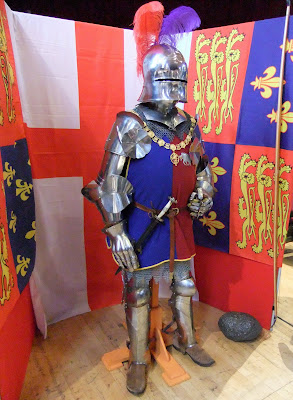
Armed and ready for mortal combat ((c) Dr Karl Shuker)

The knight and squire rode closer, but the knight was well aware from the ancient legends and superstitious folklore of his land that many monsters had successfully lured men and women to their doom by skilfully imitating a human voice. And so the knight called out, in the direction of the passage, for whoever was crying forth to show himself, and thus prove that he was human.

For a few moments there was silence, then came the sound of something moving slowly down the passage, until a shadow fell upon the exposed rock face at the passage’s entrance. It was the shadow of a man, a little stooped, perhaps, as if elderly or ailing, but undeniably human.

When the knight saw this, he and his squire rode up, approaching the entrance – but just before they reached it, the knight’s horse gave a wild neigh of fear and tried to swerve away, shaking in terror. Yet all that could be seen was the lone shadow of the man.

 
Peryton image created by me using Magic Studio
 
The knight looked away from the entrance as he sought to gain control of his panicking steed, which by now was thrashing its head from side to side and frothing madly in uncontrollable fright. And so it was his squire that saw who – or, rather, what – emerged from the passage to confront them.

Hearing his squire’s shrieks of horror, the knight turned back to look at the cave, and there, rearing up on its hind legs, was a beast that even in his wildest nightmares he had never thought of as anything other than fable and lurid fantasy. Yet here it was right now – only too real, and only too ready to kill him. It was a peryton!

On first sight it resembled a huge stag, sporting a pair of magnificent branching antlers, but as it reared directly in front of him, flailing its gleaming hooves, an enormous pair of plumed wings, sprouting from its shoulders, spread forth like the very pinions of Pegasus. And instead of fur, this unnatural creature was clothed in dark-green plumage, like some monstrous miscegenation of deer and tropical bird.
 
 
Peryton image created by me using Magic Studio

But most bizarre and uncanny of all was its shadow, which confirmed the creature’s identity as a bona fide peryton, albeit quite possibly the very last of its kind remaining on Earth. For there, cast upon the rock face as before, was not the shadow of a winged, feathered deer but instead the perfect facsimile of a human shadow – that which had fooled and lured the knight and his squire to the lair of this terrifying relic from an earlier world, whose eyes of fire and savage mien revealed only too readily its murderous intent.

For if a peryton should succeed in killing a human, not only would it rid the world of yet another member of the race that it would forever blame for the destruction of its own species’ blessed homeland, it would also gain something uniquely precious for itself – its own true shadow, the shadow of a peryton. Even so, upon killing a human a peryton would lose its resistance to man-made weapons, but that was a small price to pay – and it was evident that the peryton confronting the knight and his squire was more than willing to pay it.

All of this the knight knew only too well, as did his squire. In short, to vanquish this monster from a vanished land one of them must meet a grisly end - gored to death by the peryton’s antlers, then ripped asunder and trampled into the earth by its razor-sharp hooves. Undaunted, however, the knight swiftly dismounted from his nervy steed, and with shield and lance at the ready he slowly advanced on foot, signalling to his squire to stay back and hold his horse fast, in case he should need it. Perhaps the peryton possessed some vulnerable spot not spoken of in the old stories and myths – if so, he would find it, or die in the attempt.
 
 
Peryton image created by me using Magic Studio

Lowering its great head, the peryton eyed the knight with vibrant hatred, then charged toward him like a bull before a matador, but the knight fended it off with his burnished shield, rather than with a cloak of scarlet, which directed beams of sunlight into its eyes, temporarily blinding the raging creature and granting the knight precious moments in which to scrutinise it at close range in the hope of spying some weakness, some flaw, that might engineer its destruction.

But there was none.

If only he had known before ascending the mountain that the monster he would face there would be a peryton, he could have prepared himself accordingly, by abandoning human weapons and utilising the natural elements instead, against which the peryton had no invincibility. Fire or water to drive the creature back into its cavernous hideaway, and then perhaps the triggering of an avalanche in this unstable, rocky terrain, in order to imprison it inside the cave forever with a barrage of falling boulders sealing the entrance. That strategy might have succeeded, but now, now it was all too late.
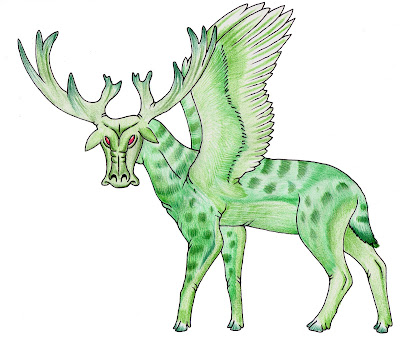

A further representation of a peryton ((c) Tim Morris)

Time and again the peryton charged, and each time the knight deflected it with his shield, in a chilling dance of would-be death, but he was tiring. Months of fighting in the Crusade and weathering the most traumatic and draining of living conditions had severely weakened him – a lengthy respite from all forms of conflict was what he needed to recuperate, not a mortal battle with a monster of the peryton’s stature and power.

Suddenly, as he attempted yet another feint of the peryton’s antlers with his shield, the knight lost his footing, dropping his lance onto the ground as he stumbled backwards, falling awkwardly against the trunk of a tree. And in those few seconds while he struggled with the weight of his armour to stand upright, the peryton saw its opportunity and charged directly at him, hitting him with such force that his armour’s breastplate split down the centre, exposing his chest to the sharp tines of the peryton’s antlers. They pierced his torso with such force, impaling him upon themselves, that the peryton was momentarily pinned by its own antlers into the tree’s hard trunk, before, with a mighty heaving movement, it hauled them back out.

Freed from their deadly tines, the body of the dying knight slumped to the ground. His head turned one last time, to look at his squire, who stood transfixed with horror and rage at his master’s fate, and he smiled gently. By meeting his own demise at the antlers of the peryton, he had saved his squire, who had also been his friend for more years than either of them could remember, and so there was no shame in his defeat, only quiet thankfulness. The knight closed his eyes, and then, finally at peace with a world in which he had lately seen so much turmoil and terror, he died.

And at that same moment, the peryton let out a roar of triumphant joy, for as it gazed at its shadow against the rock face, the shadow began to shiver and tremble. Its outline became blurred and its form extended and expanded, rapidly transforming – until, within just a few moments, the shadow of a man had metamorphosed into the shadow of a peryton.
 
 
Peryton image created by me using Magic Studio

Exultant, the peryton opened its great wings, ready to depart elsewhere, to seek out a more remote land where, now that it was no longer impervious to human weapons, it could live on in safety and anonymity. But still it gazed at its new shadow, delighting in its appearance after dreaming of and waiting so long for this supreme moment, this ultimate triumph.

And so it never saw the squire creep across the ground and seize the lance of his dead master, and it never saw the squire take the lance in his right hand, pull back his arm, and take deadly aim with the lance at the peryton’s own chest. It never heard the squire’s muttered prayer to the God who had kept him and his master safe during the horrors of the Crusade, and it never felt the strong breeze that seemed to blow in from nowhere, lifting, bearing, and empowering the lance as the squire hurled it with all his might at the peryton’s chest.

The squire’s aim, guided surely by the divine breeze, found its mark – spearing the shocked peryton through the very centre of its beating heart, skewering it like a moth impaled upon a lepidopterist’s pin. Open-mouthed, the peryton turned its head to meet the flushed face of the squire, and as it sank to its knees, the last vision that the slain peryton saw was the squire’s own eyes, suffused with the raging, glowing fire of retribution as he watched with grim satisfaction the peryton’s death. He had avenged his master, his friend, and as he knelt before the knight’s body in thankful prayer for his success in doing so, the breeze momentarily caressed his cheek before disappearing as swiftly and mysteriously as it had arisen - leaving the squire in silent vigil.

Here in the mountains, he would remain, guarding the knight’s body throughout the oncoming hours of nightfall and darkness in a lone vigil, until the dawn’s first light, when he would then descend the winding path leading to their little town and seek help there in transporting with all due reverence and care his master back home, for the last time.
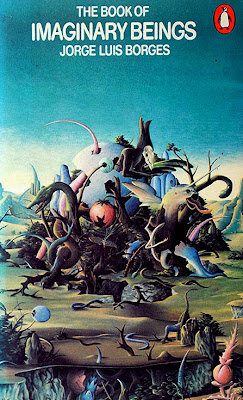
The Book of Imaginary Beings by Jorge Luis Borges (featuring Peter Goodfellow's fantastic front cover painting)

According to Jorge Luis Borges’s classic work The Book of Imaginary Beings (1969), which is often said to be the first modern-day book to document perytons, all of the information concerning these creatures that is known today is derived from a 16th-Century Fez rabbi’s historical treatise, or, rather, from the now-lost work of an unnamed scholar from ancient Greece that the rabbi had quoted in his own treatise. Borges asserted that until the outbreak of World War II, the single known copy of that treatise was held in the University of Dresden’s library. Tragically, however, perhaps as a result of the severe bombing of this German city by the Allies, or of the Nazis’ own notorious book-burning sessions, by the end of the war the rabbi’s unique manuscript had gone missing, and has never been found again – nor, indeed, has any additional copy of it.

Having said that, some authorities have suggested that Borges invented the entire peryton myth himself (including his assertions concerning the supposed erstwhile existence of the rabbi’s treatise, as well as another claim by him, that a sibyl had foretold – wrongly – that a phalanx of perytons would destroy Rome); and that, in fact, there was no peryton lore or tradition whatsoever prior to his book. However, there are several notable sources of winged deer information and portrayals (especially in heraldry, Western architecture and sculpture, early Hindu art, occultism, and even antique jewellery) that very considerably pre-date the publication of Borges’s book. Whether they are meant to represent genuine perytons is unclear, but they certainly exist.

As noted, for instance, in K. Krishna Murthy’s book Mythical Animals in Indian Art:

"The winged deer or stag...gets its sculptural representation more than once in the early Indian sculptures. However, the best specimens of the winged stags can be seen in the reliefs of Sanchi. A clear example of two winged stags sitting back to back occurs on the front of the northern Torana gateways."

Nor should we – or, indeed, could we – overlook the visual extravaganza that constitutes the glorious fountain replete with golden statues of winged deer that forms part of the huge garden around La Granja – the sumptuous palace in Segovia, Spain, that was built in 1721-24 by Philip V.

Perhaps the most distinctive British example is the ornate statue of a winged stag sitting upright on its haunches that is just one of many large, intricately-detailed sculptures of fantastic beings forming part of the elaborate fountain in the courtyard of West Lothian’s Linlithgow Palace. Nowadays, this Scottish palace is largely in ruins internally, but the fountain still survives and dates back to the reign of King James V (1512-1542).

Statue of a green winged stag at Linlithgow Palace ((c) amyhooton/deviantart)

Although the fountain’s winged stag statue may simply represent a composite heraldic beast, it is interesting to note that algal growth has turned it green in colour – the same colour that the perytons were said to be. Just a coincidence? Perhaps the next time that anyone visits this fountain, they should take note of the shadow cast by the winged stag’s green statue. If the shadow resembles a winged stag, then clearly all is well – but what if it resembles a man...?

A second photo of Linlithgow Palace's winged stag statue