The largest species of sea turtle ever
known to have existed was Archelon ischyros, which lived some 70 million
years ago during the Late Cretaceous Period in the seas around what is now
North America.
The largest specimen on record measured over 13 ft long and
roughly 16 ft across from flipper to flipper.
Leathery turtle on beach (public domain)
In comparison, the largest species known to
exist today, the leathery (leatherback) turtle Dermochelys coriacea,
attains a maximum recorded length of a 'mere' 9.8 ft, but averages only 6-7 ft.
However, reports of substantially larger
sea turtles are also on file – veritable behemoths, in fact, which if their
existence were ever scientifically confirmed would rival even the mighty Archelon
itself.
FATHER-OF-ALL-THE-TURTLES
In his classic if highly controversial tome
In the Wake of the Sea-Serpents (1968), Belgian cryptozoologist Dr
Bernard Heuvelmans postulated the existence of a number of hypothetical
creatures to explain hundreds of reports of sea serpents from around the globe.
One of them was what he termed the 'Father-of-All-the-Turtles' – a name
originally given by native Sumatran fishermen to a traditional sea deity in
which they vehemently believe, and which allegedly assumes the guise of a
gargantuan marine turtle.
Father-of-All-the-Turtles (© Tim Morris)
Alternative sea serpent classification
systems subsequently devised by other cryptozoologists have also included this
category, and there are several notable eyewitness accounts on file indicating
that a turtle of truly immense size may indeed have been encountered in various
far-flung maritime localities.
GIANT TURTLES
IN ANTIQUITY AND MEDIEVAL TIMES
Perhaps the earliest report dates back as
far as the 3rd Century AD. This was when Roman scholar Claudius
Aelianus (popularly known merely as Aelian), writing in his 17-volume treatise De
Natura Animalium, referred to the existence in the Indian Ocean of turtles
so colossal in size that their huge shells – said to be as much as 23.5 ft in
circumference – were sometimes used by the native people as roofing material!
Modern-day sceptics have claimed that if such shells truly existed, they must
have been fossils. And it is certainly true that portions of fossilised shells
from the land-living prehistoric giant tortoise Megalochelys [=Colossochelys] atlas have been unearthed in the rich deposits of
Nepal's Siwalik Hills. Yet fossil shells would surely have been too brittle and
much too heavy for roofing purposes.

Writing in his own magnum opus, Geography,
which he completed in 1154 AD, Muhammad al-Idrisi, a notable Moroccan Islamic
traveller, cartographer, and archaeologist, referred to comparably immense
turtles, up to 20 cubits (33 ft) long, living in the Sea of Herkend, off the
west coast of Sri Lanka, whose females contained up to a thousand eggs.
Although he never personally visited Asia, he collated considerable amounts of
detailed information from Islamic explorers and merchants, and recorded on
Islamic maps. Having said that, however, turtles generally lay no more than a
hundred eggs at a time, not a thousand, so perhaps some such reports were
exaggerated (which may also account for the huge size claimed for these Herkend
turtles?).
CHRISTOPHER
COLUMBUS AND ANNIE L. HALL
Possibly the most famous eyewitness of a
reputed mega-chelonian was none other than New World discoverer Christopher
Columbus. In early September 1494, along with several of his crew, he witnessed
an extraordinary creature likened to a whale-sized turtle with a visible pair
of flippers and a long tail that kept its head above the water surface while
swimming by as his vessels were sailing east along the southern coast of what
is now the Dominican Republic, occupying the right-hand half of the Caribbean
island of Hispaniola.
Posthumous painting allegedly depicting Christopher Columbus, by
Sebastiano del Piombo, 1519; no confirmed paintings of Columbus are currently
known (public domain)
On 30 March 1883, while aboard the schooner
'Annie L. Hall' in the North Atlantic's Grand Banks, Captain Augustus G. Hall
and his crew spied what they initially took to be an upturned vessel but which,
when they approached to within 25 ft of it, proved to be an enormous turtle. By
comparing its dimensions with those of their vessel, they were able to estimate
its total length as being at least 40 ft, its width as 29.5 ft, and its height
from its carapace's apex to its plastron or under-shell's most ventral point as
29.5 ft. Even its flippers were immense – each one approximately 20 ft long.
Not surprisingly, the captain deemed it inadvisable to attempt capturing this
shell-bearing leviathan!
TURTLES OF A
(VERY) DIFFERENT COLOUR!
During the 1950s, two ultra-giant turtles
were reported that were highly distinctive due not only to their great size but
also to their very unusual colouration. One of these was an alleged 14-ft-long
yellow turtle witnessed on 8 March 1955 by L. Alejandro Velasco while stranded
on a raft off Colombia's Gulf of Urabá. Its claimed length is greater than that
of the largest leathery turtle on record.
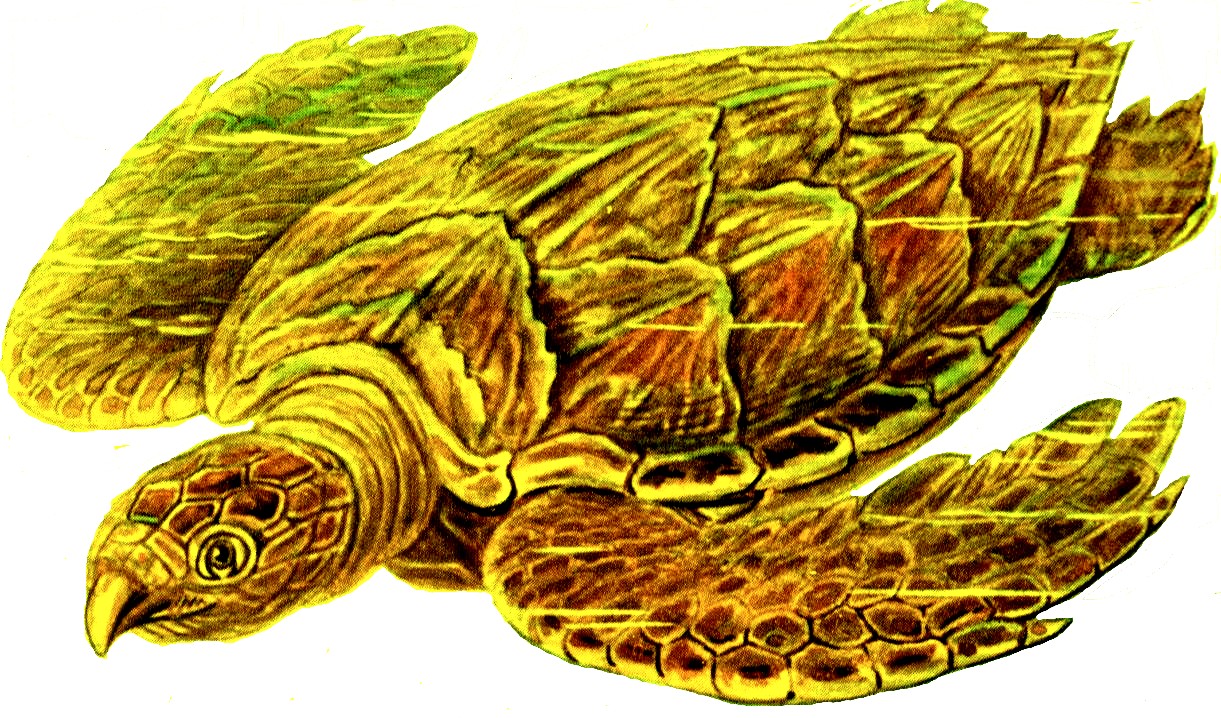
Using a hawksbill turtle as its basis, a species native to the
waters off Colombia, might the mysterious Colombian yellow sea turtle have
looked something like this? (© Dr Karl Shuker)
The other was a 44-ft-long pure-white
turtle with 14-ft flippers that was sighted south of Nova Scotia, Canada, in
June 1956 by crew on board the cargo steamer 'Rhapsody'. According to their
account, this huge creature could raise its head 8 ft out of the water.
ENCOUNTERING
THE SOAY BEAST
Perhaps the most famous and controversial
modern-day sighting of an alleged giant sea turtle occurred just a few years
later, off the Scottish Inner Hebridean island of Soay. On 13 September 1959,
while fishing here for mackerel, holidaying engineer James Gavin and local
fisherman Tex Geddes were very startled to observe an extremely large sea
creature swimming directly towards their boat, its head and back readily
visible above the sea surface, until it was no more than 60 ft away.
According to their description, documented
in a major Illustrated London News report of 4 June 1960, the head of
this remarkable beast was definitely reptilian and resembled a tortoise's, with
lateral eyes and a rounded face plus a horizontal gash for a mouth when closed,
but it was as big as a donkey's, and the neck was cylindrical. The exposed
portion of its back was humped in shape, and running down the centre was a
series of triangular-shaped spines or serrations, like the teeth of a saw. The
animal was so close that when it opened its mouth to breathe, emitting a very
loud whistling roar, they could see the red lining inside, and what looked like
loose flaps of skin hanging down from the roof, but there were no teeth.
Sketches of Soay Beast's alleged appearance, from Illustrated London News, 4 June 1960 ((©
Illustrated London News – reproduced
here on a strictly non-commercial Fair Use basis for educational/review
purposes only)
After remaining in sight for five minutes,
their extraordinary visitor dived forward and vanished beneath the water
surface, then emerged again almost a quarter of a mile away, before
disappearing completely as they watched it. Moreover, the crews of two lobster
boats, fishing north of Mallaig on the Scottish mainland, also spied this
mysterious creature, much to their alarm!
Due to its mid-dorsal serrations, British
zoologist Dr Maurice Burton wondered whether it may have been an escapee
iguana, but the remainder of the Soay beast's description does not correspond
with such an identity at all, and much more readily recalls a chelonian. Moreover,
certain terrapins even possess dorsal serrations, though terrapins are of
course freshwater species, not marine.
COULD
UNDISCOVERED MEGA-TURTLES EXIST TODAY?
Reading through the above reports, various
objections to the possibility of giant turtles existing undiscovered by science
soon come to mind, but are they insurmountable? For instance: all known species
of sea turtle have only short tails, so the long tail of the specimen sighted
by Columbus and his crew is unexpected. Yet there are no sound anatomical or
physiological reasons why a long-tailed species might not exist. In any case,
it may be that at least part of the tail's length was an optical illusion,
caused by the wake created as it swam by.
The odd colours of the two specimens
reported during the mid-1950s pose another problem. However, perhaps the yellow
colouration of the Colombian individual was merely due to reflected sunlight,
or it might have been a rare xanthic (yellow mutant) individual. Equally, the
white 'Rhapsody'-spied turtle may conceivably have been an albino or leucistic
specimen – such individuals have been reported from many reptilian species,
even ones as large as crocodiles and alligators. Indeed, a scan through Google
will soon turn up a number of spectacular photographs of leucistic sea turtle
specimens, confirming that such creatures can indeed arise (click here
to see them). Having said that, some hawksbill turtles Eretmochelys imbricata can appear golden-brownish in colour, and
even some non-leucistic green turtles Chelonia
mydas look quite pale. Nevertheless, they do not attain the huge sizes
claimed for the Colombian and 'Rhapsody' specimens respectively.

Exquisite vintage illustration of a leathery turtle by Ernst
Haeckel, 1902 (public domain)
The cold-water regions in which the
'Rhapsody' specimen and the Soay beast were sighted argues on first sight
against their being reptiles. However, the leathery turtle is famed for its
ability to withstand coldwater temperatures, and of particular note in relation
to the Soay case is the remarkable but fully-confirmed fact that in August 1971
a leathery turtle was caught near Mallaig!
If mega-turtles do truly exist, they must
be at least predominantly pelagic in occurrence, otherwise they would have been
seen far more frequently. Yet even if this is so, surely they would have been
observed on land at some point, coming ashore to lay their eggs? Possibly –
then again, there are countless small, remote, uninhabited tropical islands and
island groups that have never been visited by humans. Indonesia, for instance,
consists of over 17,500 islands, and more than 7,100 constitute the
Philippines.
Alongside the model of a gigantic sea turtle hatchling at Birmingham
Sea Life Centre, 2013 (© Dr Karl Shuker)
So perhaps it is beneath the coastal sands
of tiny isles such as these, emerging at night for just a few hours only once
every 2-3 years and far removed from prying human eyes or from other potential
sources of danger to their precious offspring, where these shy reptilian giants
(so adept when at sea but so vulnerable when on land) entrust their precious
eggs and, while depositing them, their own lives too, before returning once
more to the safety of their vast maritime domain.
Who knows? One day, possibly, an intrepid
adventurer may visit one of these anonymous specks of land and there encounter
a trail of huge flipper prints left behind by some great chelonian Man Friday.
Olive ridley
sea turtles Lepidochelys olivacea ashore
on a Mexican beach (© Claudio Giovenzana/Wikipedia – CC BY-SA 3.0 licence)
This ShukerNature blog article is excerpted
and adapted from my book Mirabilis: A
Carnival of Cryptozoology and Unnatural History.






 Posts
Posts