Dr KARL SHUKER

Zoologist, media consultant, and science writer, Dr Karl Shuker is also one of the best known cryptozoologists in the world. He is the author of such seminal works as Mystery Cats of the World (1989), The Lost Ark: New and Rediscovered Animals of the 20th Century (1993; greatly expanded in 2012 as The Encyclopaedia of New and Rediscovered Animals), Dragons: A Natural History (1995), In Search of Prehistoric Survivors (1995), The Unexplained (1996), From Flying Toads To Snakes With Wings (1997), Mysteries of Planet Earth (1999), The Hidden Powers of Animals (2001), The Beasts That Hide From Man (2003), Extraordinary Animals Revisited (2007), Dr Shuker's Casebook (2008), Karl Shuker's Alien Zoo: From the Pages of Fortean Times (2010), Cats of Magic, Mythology, and Mystery (2012), Mirabilis: A Carnival of Cryptozoology and Unnatural History (2013), Dragons in Zoology, Cryptozoology, and Culture (2013), The Menagerie of Marvels (2014), A Manifestation of Monsters (2015), Here's Nessie! (2016), and what is widely considered to be his cryptozoological magnum opus, Still In Search Of Prehistoric Survivors (2016) - plus, very excitingly, his four long-awaited, much-requested ShukerNature blog books (2019-2024).

Dr Karl Shuker's Official Website - http://www.karlshuker.com/index.htm

IMPORTANT: To view a complete, regularly-updated listing of my ShukerNature blog's articles (each one instantly clickable), please click HERE!

IMPORTANT: To view a complete, regularly-updated listing of my published books (each one instantly clickable), please click HERE!

IMPORTANT: To view a complete, regularly-updated listing of my Eclectarium blog's articles (each one instantly clickable), please click HERE!

IMPORTANT: To view a complete, regularly-updated listing of my Starsteeds blog's poetry and other lyrical writings (each one instantly clickable), please click HERE!

IMPORTANT: To view a complete, regularly-updated listing of my Shuker In MovieLand blog's articles (each one instantly clickable), please click HERE!

IMPORTANT: To view a complete, regularly-updated listing of my RebelBikerDude's AI Biker Art blog's thematic text & picture galleries (each one instantly clickable), please click HERE!

Search This Blog


PLEASE COME IN, I'VE BEEN EXPECTING YOU...

PLEASE COME IN, I'VE BEEN EXPECTING YOU...
WELCOME TO SHUKERNATURE - ENJOY YOUR VISIT - BEWARE OF THE RAPTOR!


Showing posts with label merfolk. Show all posts

Monday, 26 February 2018

THE MERMAID OF HARALDSKAER - THE FISHY TALE OF A FISHY TAIL (AND SKELETON!) DISPLAYED AT THE DANISH NATIONAL MUSEUM


The mermaid of Haraldskaer's skeleton, exhibited at the Danish National Museum, Copenhagen, in 2012 (© Danish National Museum – reproduced here on a strictly educational, non-commercial Fair Use basis, for review purposes only)

Only a few days after watching, and greatly enjoying, Guillermo del Toro's wonderful fantasy movie The Shape of Water, concerning a captured amphibious humanoid (click here to read my review of it), earlier today I was asked on Facebook whether I knew anything about the subject of a striking photograph currently doing the rounds on social media sites, including the Fortean Times Appreciation Group on FB. Happily, I knew quite a lot about it, so here is the remarkable history of the mermaid of Haraldskaer.

The photograph in question is the one that opens this present ShukerNature blog article of mine, and shows what seems on first sight to be the skeleton of a mermaid. The photo had been shared on the Fortean Times Appreciation FB group from another such group, Pictures in History, where some brief details of its supposed origin and nature had been provided, and which are as follows.

Allegedly, this skeleton is that of a mermaid that had been found at Haraldskaer in mainland Denmark by a farmer while ploughing his field. And according to a more detailed description presented alongside it at the Danish National Museum in Copenhagen where the mermaid of Haraldskaer was first displayed, in 2012, it was about 18 years old, with long thick hair and long sharp canines, and also had a purse that contained a shark's tooth, a snake's tail, a mussel shell, and a flower (just like any self-respecting mermaid would be expected to keep inside her purse). Its species is claimed to be Hydronymphus pesci, believed extinct since the end of the 17th Century, and apart from a missing left hand the skeleton is complete, much more so than the only other known H. pesci skeleton, apparently held at the Hermitage Museum in St Petersburg, Russia, which lacks a tail. Moreover, this species is believed to belong to the Asian lineage of merfolk, thereby making the finding of specimens in Europe especially rare.

Close-up of the tail of the Haraldskaer mermaid skeleton (© Danish National Museum – reproduced here on a strictly educational, non-commercial Fair Use basis, for review purposes only)

Altogether a fascinating history, but, needless to say, entirely fictitious. In fact, as Danish zoologist and cryptozoological researcher Lars Thomas has kindly informed me, the Haraldskaer mermaid skeleton, complete with shark-inspired tail, was manufactured by Mille Rude, a Danish artist, for a special exhibition staged at the Danish National Museum, Copenhagen, during 2012. Rude took her inspiration from the very famous real discovery in 1835 of Haraldskaer Woman - the naturally-preserved body of a young woman found in Haraldskaer Bog, and dating back to approximately 490 BC (pre-Roman Iron Age).

In 2013, the mermaid skeleton was displayed at the Art Museum in Vejle on the east coast of the Jutland peninsula, constituting western Denmark, and a year later it was aptly exhibited in the manatee enclosure at Odense Zoo in central Denmark (manatees are popularly deemed to be the inspiration for mermaid sightings). In 2016, its perambulations took it to the Maritime Museum in Elsinore, Denmark, where it remains on display today. So far, so straightforward, but this is cryptozoology, albeit featuring in this instance an unequivocal cryptozoological gaff (an artificially constructed specimen). Consequently, nothing is ever that straightforward, as will be revealed a little later here.
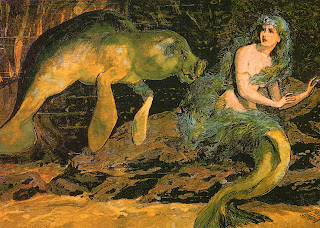
Humorous 19th-Century illustration of a beautiful mermaid clearly less than impressed by the decidedly homely appearance of her supposed real-life inspiration, a manatee (public domain)

Meanwhile: One of the most famous tourist attractions in Denmark is Erik Eriksen's charming bronze statue of the eponymous character in Hans Christian Andersen's delightful 1837 fairytale The Little Mermaid. Eriksen's sculpture, measuring just 50 in high and weighing 385 lb, was officially unveiled  on 23 August 1913, residing on permanent display thereafter upon a rock at the edge of Copenhagen's harbour. Since then, it has been visited, posed alongside, and photographed by millions of tourists from all over the world, including my mother and myself back in 1979, and is officially classed as a National Treasure of Denmark

For much of 2010, however, this fish-tailed icon was temporarily absent from her accustomed site at the harbour side when she starred instead in the Danish Pavilion at the 2010 World Expo, held in Shanghai, China, remaining there from late March to 20 November. So forlorn and forsaken was the rocky prominence upon which she had sat for generations, gazing wistfully across the waters, however, that a plan, or, to be precise, a prank, was hatched to replace her there, if only for a very short time, but with something equally fishy – in every sense.

Erik Eriksen's statue of the Little Mermaid (© Dr Karl Shuker)

And so it was that on Maundy Thursday 2010, the skeleton of a mermaid duly appeared in the statue's stead, sitting in a similar pose on a plaster replica of her rock but placed very near to hers, and heralded with the somewhat macabre announcement to the media that the Little Mermaid had returned. After residing there for two hours, during which time it had attracted considerable attention and photo-snapping from locals and tourists alike, the skeleton was removed (to ensure that the fickle Danish weather did not damage it) and taken to the Natural History Museum of Denmark, in Copenhagen, where it was on public display throughout the Easter holiday period. But what is the true nature of this very striking specimen?

It is, of course, another gaff – this time consisting of a human skeleton down to and including its hips, plus the tail of a swordfish Xiphias gladius. Its creation and the prank of placing it briefly on show at the harbour during the Little Mermaid's Chinese leave of absence was the brainchild of  Hanne Strager, at that time the head of exhibitions at the Natural History Museum of Denmark, in Copenhagen, and it certainly attracted immense interest – and not just in spring 2010. It had actually been created a few years earlier at the museum, to feature in an exhibition there devoted to legendary creatures, and had been specifically structured to mimic the pose adopted by the Little Mermaid statue. But what has any of this to do with the Haraldskaer mermaid skeleton? I'm glad that you asked.

The Natural History Museum of Denmark's mermaid skeleton gaff, posed upon a plaster replica of the Little Mermaid statue's rock (© Natural History Museum of Denmark, Copenhagen – reproduced here on a strictly educational, non-commercial Fair Use basis, for review purposes only)

Photographs of the Haraldskaer mermaid skeleton have been circulating widely online for some years, and far more so, unfortunately, than the facts behind them, so that these pictures have incited (and continue to incite) much speculation as to whether the skeleton is actually genuine. Not only that, in an all-too-familiar trend seen on the Net with unusual images, they have even inspired various entirely new, but equally fictitious histories for it.

Consequently, I have seen some sites claiming that the skeleton has been the subject of much controversy since being discovered in Poland(!), and even in Indonesia – one site affirming that it had been discovered in Surabaya, on the island of Java. Worst of all, however, is that all of the media reports that I have read concerning it, even those from ostensibly respectable sources, have either been incomplete or decidedly ambiguous, inasmuch as they have implied that the Haraldskaer mermaid skeleton (created by Rude) and the mermaid skeleton placed briefly on the plaster replica of the Little Mermaid statue's rock (and whose creation was overseen by Strager) are one and the same, when in reality they are entirely different, albeit extremely similar specimens. Hence I wish to thank Lars Thomas most sincerely for revealing to me the true situation, and thereby assisting me to bring to a close the exceedingly curious and hitherto highly-confused case of the two mermaid skeletons, and also to Richard S. White and Markus Bühler for arousing my suspicions regarding the online sources consulted by me when originally preparing this blog article. Indeed, it now means that this article of mine may well be the only account presently online that provides an accurate, non-conflated coverage of these two gaffs.

A popular expression is that you can't keep a good man (or woman) down. Neither, it would seem, can you keep a good mermaid (or two) down; nor, at the risk of mixing metaphors further, can the internet let sleeping mermaids lie – not even ones that never existed to begin with!

My mother Mary Shuker and I visiting the Little Mermaid in 1979 (© Dr Karl Shuker)


Monday, 23 January 2017

AFTER EIGHT YEARS OF SHUKERNATURE THE BLOG, A FIRST GLIMPSE OF SHUKERNATURE: THE BOOK!


Early version of Anthony Wallis's awesome front-cover artwork for ShukerNature Book 1 – thanks, Ant!! (© Anthony Wallis/Dr Karl Shuker)

Due to some recurrent internet-connection problems during the past few days, I omitted to mark a memorable day in the history of my ShukerNature blog – its eighth anniversary, which occurred on 20 January 2017. So, better late than never, I am doing so now – by presenting herewith the very first sneak preview of my next book, which is none other than the long-awaited, long-promised compendium of some of my blog's most unusual and popular articles. Or, to put it another way – welcome to ShukerNature: The Book - or, to give it its full title, ShukerNature Book 1: Antlered Elephants, Locust Dragons, and Other Cryptic Blog Beasts.

My blog was scarcely two years old when, after asking among my many Facebook friends and colleagues whether a compilation volume of some of my blog articles would be of interest to them, I received a resoundingly positive response. And so I began planning it accordingly, alongside various other writing projects. However, as sometimes happens, life – and death – had other plans for the direction in which my future would take. Or, as my wise little Mom used to remind me gently if I railed against my dreams and ambitions faltering or falling into disarray: "Man proposes, but God disposes" (which is a translation of the Latin phrase 'Homo proponit, sed Deus disponit', from Book I, chapter 19, of The Imitation of Christ by the German cleric Thomas à Kempis).


And so it was that my ShukerNature book was set to one side, and other projects that for one reason or another needed to take precedence were duly completed and published in its stead. Notable among these were my second, long-planned, and extremely comprehensive dragons book – Dragons in Zoology, Cryptozoology, and Culture; a wide-ranging compilation of my most notable Loch Ness monster writings – Here's Nessie!; and of course my massively-enlarged, fully-updated prehistoric survivors book – Still In Search Of Prehistoric Survivors.

These are all now published, and in the meantime the very many additional blog articles that I have continued to research, write, and post each year have provided me with an immensely expanded list of possible examples to include in my eventual ShukerNature compendium. And now, at last, much of this book is indeed written – all of the main text, in fact, barring any last-minute changes or additions – and it will be published later this year.


Moreover, I am both thrilled and delighted that its front cover artwork is being produced by none other than a longstanding Facebook friend who is also a brilliant artist – Anthony Wallis. I am very lucky that no fewer than three of my previous books' front covers are graced by spectacular artwork that has been either produced (two) or co-produced (one) by Ant. Namely, Mirabilis (2013), The Menagerie of Marvels (2014), and Here's Nessie! (2016) (this last-mentioned book's front cover featuring both a very vibrant long-necked seal reconstruction of Nessie by Ant and a beautifully evocative plesiosaurian monsters by moonlight scene by Wm Michael Mott).

So here, opening this present ShukerNature blog article as a first glimpse of ShukerNature Book 1, is an early version of Ant's wonderful front-cover artwork for it – thank you so much, Ant, for bringing to life so vividly and with such incredible skill a unparalleled diversity of obscure, hitherto-overlooked, but effortlessly spellbinding mystery beasts that will not be found together in any other book. And so, the countdown to its publication has begun – the wait will soon be over…

An affectionate illustrative pastiche (left) by another longstanding artist friend, Mark North, inspired by and in tribute to the classic front-cover artwork of the international non-fiction bestseller Supernature (right), written by Dr Lyall Watson and first published in 1973, whose title partly inspired the naming of my blog – click here for more details (© Lyall Watson/Coronet Books / © Mark North)


Wednesday, 13 April 2016

FROM BARGUEST AND BOOBRIE TO BLUE MEN OF THE MINCH - A SHUKERNATURE SELECTION OF ESOTERIC ENTITIES FROM THE BRITISH ISLES


A Blue Man of the Minch (I found this image online some time ago, unsourced and uncredited, but it looks like it may be a modified version – by person(s) unknown – of a picture from highly-acclaimed London-based photographer Chris Parkes's spectacular 'All that Glitter is Green' series; if so, © Chris Parkes, and thus used here on a strictly non-commercial, Fair Use basis only; also, please click here to visit Chris Parkes's website and see some of his wonderful photographs)

The British Isles are said to contain more ghosts than anywhere else in the world. Less well-known is that a remarkable diversity of monsters, mythological creatures, and mystery beasts have also been reported from these ancient lands, as will be seen here in this exclusive ShukerNature selection of some notably esoteric entities from my homeland. The trick, however, is trying to decide which category each of them belongs to - fact or fable, legend or reality, the natural world or the supernatural realm - a perilous choice that I will leave, gentle reader, to you!


BAISTE-NA-SCOGHAIGH
It is not widely known that Britain can lay claim to its very own indigenous species of unicorn. Yet according to Hebridean folklore, the lochs on the Inner Hebrides island of Skye are home to just such a creature, called the baiste-na-Scoghaigh (aka biasd na Srogaig). Despite its long legs, however, its bulky, lumbering form renders it more akin to a rhinoceros than to the elegant unicorn of classical legend; and as it can assume human form, this deceptive creature is technically a were-unicorn. See also here for more details.

Is this what the baiste-na-Scoghaigh looks like? (public domain)


BARGUEST
One of England's most dreadful bogey-beasts, the barguest is able to assume several different guises, but its most common form is as a huge, shaggy-furred black dog with enormous fiery eyes, and sometimes even a pair of horns. According to tradition, this spectral hound haunts lonely areas of wasteland in Yorkshire, but especially between Wreghorn and Headingley Hill, near Leeds. Its appearance is widely believed to foretell an impending death, usually of some important figure living locally, and is often accompanied by fearful howling, baying, and sometimes the sound of rattling chains.

Beware of the barguest! (© Jane Cooper)


BLUE MEN OF THE MINCH
The Minch is a strait separating the largest Outer Hebridean island, Lewis-and-Harris, from the Scottish mainland. According to local maritime tradition, it is also home to a fierce race of mermen, distinguished from other fish-tailed folk by their vivid blue skin. Happily, however, their fondness for attacking sailors can be readily countered, simply by berating them exclusively in rhyme!


BOOBRIE
Scottish Highland lore describes the boobrie as a black lake-dwelling bird with white marks upon its neck and breast, resembling the great northern diver Gavia immer but very much bigger, and deadlier. For whereas divers (or loons, as these birds are referred to in North America) are content to feed upon fishes, the boobrie will allegedly seize any sheep or cow that dares venture near this monstrous bird's aquatic abode, and haul it beneath the water, thereafter to feed upon its drowned carcase.


HAIRLESS BLUE HORSE
During 1868, a very unusual horse was exhibited at London's famous Crystal Palace. Not only was it completely hairless, but its skin was blue, so that it looked as if it had been sculpted from some rare form of oriental blue marble. This singular steed had been captured on the plains of South Africa by a merchant called Lashmar in 1860, and had been associating with a herd of those now-extinct, incompletely-striped zebras known as quaggas. The fate of the hairless blue horse after its Crystal Palace days is unknown - as is its identity. Could it have been a freak quagga, rather than merely a freak domestic horse run wild? See also here for more details.

Photoshopped image of a horse resembling the Crystal Palace-exhibited curiosity described here (© Daisiem worth1000 – reproduced here on a strictly non-commercial Fair Use basis only)


LOUGH DUBH MONSTER
One day in March 1962, schoolteacher Alphonsus Mullaney and his son went fishing to Lough Dubh ('Black Lake') in County Galway, Ireland...and caught a monster instead. Suddenly, their line became taut, and when they attempted to reel in their catch, they saw to their horror that they were hauling up an incredible water beast like nothing ever reported before - or since. The size of a cow, it had short thick legs, small ears, dark grey skin covered in short bristles, and a large hippopotamus-like face - with a sharp rhinoceros-like horn on the end of its snout! Not surprisingly, the two anglers fled away, but when they returned with a posse of local men, the lake's mysterious monster had vanished again. See also here for further details.

Artistic representation of the Lough Dubh monster (© Orbis Publishing - reproduced here on a strictly non-commercial Fair Use basis only)


LYMINSTER KNUCKER
An unexpectedly loquacious English dragon, the knucker lived in a deep pool near the church at Lyminster, close to Arundel, in Sussex. Unfortunately, however, it developed a great liking (in the gastronomic sense!) for sheep, pigs, and even the odd farmer or two...until a local youth called Jim Puttock came along. After deliberately over-feeding the knucker with a heavy pudding that gave it severe indigestion, Puttock promised to provide a remedy for curing its stomach ache. The remedy in question, albeit decidedly unorthodox, was also undeniably effective - after engaging it in seemingly innocent conversation, Puttock abruptly wielded his trusty sword and chopped off the knucker's head!


MINIATURE WOLVES OF ACHILL ISLAND
According to Irish tradition, County Mayo's Achill Island was home to a type of small wolf-like beast long after true wolves had died out elsewhere in the British Isles. They were said to resemble normal wolves in overall appearance except for their relatively small stature. No such creatures have been reported here in recent times, however, so even if they really did once exist they have now presumably died out.


ORKNEY BOAR-WHALE
According to Swedish archbishop Olaus Magnus (1490-1557), an extraordinary sea monster resembling a hybrid of whale and wild boar was sighted in the sea north of Scotland's Orkney Islands in 1537. In bestiary compiler Conrad Gesner's tome, Nomenclator Aquatilium Animantium... (1560), this Orcadian boar-whale was depicted with the head and body of a boar but with scales instead of fur, flippers instead of feet, and a fish-like tail. Not surprisingly, it has never been identified.

The Orkney boar-whale as depicted in Gesner's tome (public domain)


RENWICK COCKATRICE
During the demolition of an old church at Renwick in Cumbria, northern England, during 1733, workmen were terrified when a huge winged apparition rose up out of the foundations, for in appearance it closely resembled a cockatrice. According to legend, this was a lethal dragonesque monster combining reptilian scales,  leathery bat-like wings, and a snake-like tail with the feathered body and also the wattled, coxcomb-surmounted head of a farmyard rooster, and which was hatched by a toad from a shell-less egg laid by a cockerel! As this hideous creature sallied forth, the Renwick villagers fled in all directions - except for one brave man named John Tallantine. Armed with a lance hewn from the rowan tree, which is famed for its reputed power in warding off evil, Tallantine pursued the cockatrice into the churchyard, and after a fierce battle he succeeded in slaying it. As a reward, the grateful people of Renwick decreed that for ever afterwards Tallantine's descendants would be exempt from paying tithes. A copy of an account describing this alleged occurrence is preserved in Renwick's current church.

Cockatrice, depicted by Wenceslaus Hollar, 1600s (public domain)


ST SEONAN'S MONSTER
Like an amphibious cyclops, this maned water monster had a single eye gleaming brightly in the centre of its forehead. It also had a whale's fluked tail, and a mighty chest that sounded like a pair of huge bellows when it exhaled its scorching breath. It frequented the island of Iniscathy (aka Inis Cathaigh), located in Ireland's Shannon Estuary, and whenever it sharpened its razor-sharp iron talons, sparks of fire would dance upon the island's rocky surface. Eventually, however, it was allegedly banished by St Seonan.


SCREAMING WHITE RABBIT
Reputedly, an eerie spectral rabbit, pure white in colour and emitting a hideous screaming cry, has been encountered spasmodically in an area of Cobridge in northern Staffordshire, England, that is known locally as The Grove. It is claimed that this white rabbit is the restless ghost of teenager John Holdcroft, who was strangled to death by fellow teenager Charles Shaw one day in August 1833 after Shaw had accused him of cheating at a game of pitch and toss. Terrified by what he had done, Shaw hung a noose around his friend's neck and tried to pretend that he had committed suicide, but he later confessed to the murder and was sentenced to transportation. As for the rabbit, its eldritch shrieks are supposedly John Holdcroft's death screams.


WINGED FEATHERED SNAKES
Remarkably, until as recently as the early 1800s some local inhabitants believed that creatures apparently resembling winged feathered snakes congregated in large numbers within the wooded vales of Penllyne and Penmark in Glamorgan. Extraordinarily beautiful, they had shimmering bodies whose scales sparkled like multicoloured jewels, rainbow-hued crests, and outspread plumed wings. Despite their flamboyant finery, however, Glamorgan's feathered flying snakes were reputedly slaughtered like common vermin by farmers, on account of their taste for the farmers' poultry, until at last they were completely exterminated. See also here for more details.

Depiction of one of the winged feathered snakes that appeared on the front cover of the original 1997 American edition of my book From Flying Toads To Snakes With Wings (© Dr Karl Shuker/Llewellyn Publications)


YELPING BEAST OF MANY COLOURS
Finally, but staying with extraordinarily beautiful creatures: Loosely connected to the Arthurian corpus of legends and originally composed anonymously in French during the 1300s, Perceforest is a 6-volume prose romance presenting a fictionalised origin of Great Britain. One memorable scene from it features Maronex the Gilded Knight, magnificently bedecked in brilliant golden armour, encountering a huge and equally dazzling, rainbow-hued creature that gave voice to ear-splitting yelping cries when it was pursued by him after it seized a stag in its jaws. Hence it is generally referred to as the Yelping Beast or the Beast of Many Colours. After dropping the deer as it fled headlong through the forest, the Yelping Beast finally reached its lair, a dense thicket in the midst of a deep marsh, and successfully eluded Maronex when his horse became enmired up to its belly in the marsh's black mud. Although Maronex was eventually able to free his horse, he conceded that it would be perilous in the extreme to attempt any further pursuit of the Yelping Beast through such treacherous, potentially lethal terrain, so he reluctantly turned back, his multicoloured quarry far beyond his reach by now. The creature's penchant for exceedingly loud yelping cries, incidentally, readily calls to mind comparable behaviour described for the snake-headed, leopard-bodied, hart-footed Questing Beast in traditional Arthurian legend.

The Yelping Beast of Many Colours and Maronex the Gilded Knight, from Royal 19 E II mss, Perceforest, Anciennes croniques Dangleterre, faictz et gestes du roy Perceforest, et des chevaliers du Franc Palais, version transcribed by David Aubert in late 1400s, Holland (public domain)


Wednesday, 19 August 2015

FAN-TAILED MERMEN AND SCALY SEA BISHOPS


The version of the Russian merman-depicting lubok that was sent to me by Robert Schneck (public domain)

On 18 August 2015, Facebook friend Robert Schneck kindly brought to my attention on my FB timeline a fascinating illustration that I had never seen before, and which opens this current ShukerNature blog article. As far as I am aware, it has not previously attracted any notable cryptozoological attention, so I've been conducting some investigations into it, whose findings I am now presenting here as follows.

The illustration is a Russian lubok, which, to quote from the Wikipedia entry for such images, is:

"…a Russian popular print, characterized by simple graphics and narratives derived from literature, religious stories and popular tales. Lubki prints were used as decoration in houses and inns. Early examples from the late 17th and early 18th centuries were woodcuts, then engravings or etchings were typical, and from the mid-19th century lithography…Folklorist Dmitri Rovinsky is known for his work with categorizing lubok. His system is very detailed and extensive, and his main categories are as follows: "icons and Gospel illustrations; the virtues and evils of women; teaching, alphabets, and numbers; calendars and almanacs; light reading; novels, folktales, and hero legends; stories of the Passion of Christ, the Last Judgement, and sufferings of the martyrs; popular recreation including Maslenitsa festivities, puppet comedies, drunkenness, music, dancing, and theatricals; jokes and satires related to Ivan the Terrible and Peter I; satires adopted from foreign sources; folk prayers; and government sponsored pictorial information sheets, including proclamations and news items". Jewish examples exist as well, mostly from Ukraine. Many luboks can be classified into multiple categories."

The lubok under discussion here shows what appears to be some form of merman-like entity (though with hind limbs instead of a single fish-tail) that had been netted at sea, but no doubt some details concerning this case were contained in the Cyrillic-script text included above the lubok's image. Seeking a translation of this text online, I came upon a very extensive one on professional artist Aeron Alfrey's Monster Brains blog (click here).

It stated that the merman lubok's text did indeed describe a strange aquatic humanoid, one which had been caught in Spain, and that the image had been created by an anonymous folk artist in 1739. What was particularly interesting, however, was that this blog then provided not just a translation of the text, but also a version of the merman lubok that contained additional Cyrillic text underneath the image – text that was not present in the version that Robert had found and sent to me – thus explaining why the translation was so lengthy. So here is this more detailed version of the merman lubok:

The version of the merman lubok containing additional text (public domain)

Incidentally, the source of both the lubok with additional text and the translation of it as presented on Monster Brains was given by this latter blog as http://www.rollins.edu/Foreign_Lang/Russian/Lubok/lubnews.html– but this page can no longer be found online. Meanwhile, here is the translation of the full text as provided by the Monster Brains blog:

"A copy [of the news] from the Spanish town of Vigo from the 6th of April. The fishermen of the village of Fustin (Enfesta?) caught a sea monster or the so-called water man and with great difficulty dragged him by force in the net ashore. This amazing and rarely seen monstrum or sea wonder is from head to foot about 6 feet tall. Its head resembles a stake and is so smooth that it does not have even one hair on the top, only at the bottom it has a beard with long strands. The skin on its head and on the whole body is black and in some places covered with thin hair. The neck of this water old man is extremely long and the body unusually long and thick but in many respects it resembles the human body. The forearms and arms are very short, the palms are quite short, while the fingers are very long and up to the first joint, like a goose's feet, they are grown together and from there they go like human fingers. Its extraordinarily long nails resemble animals' and even though this monstrosity has low hanging breasts, it is, by all indications, of masculine gender. Its loins are short and grown together to the knees, and the shins are not very long either, but they are separated. Even though its feet are quite similar to human, the large toes hang quite close to each other like duck's feet. On its heels it has fish's scales, and on the skin of its back at the very bottom a bone has grown. A fin sticking out from it is just like a woman's fan, about 12 inches long, and when it opens it reaches even more than 12 inches. This was excerpted from the printed St. Petersburg News, received on the 20th of May of this, 1739, year, and the above news were reported in the No. 41."

I subsequently found this same translation and version of the merman lubok on another site, The Hermitage (click here), which is artist Rina Staines's Tumblr blog. She credits the translation to the same no-longer-available page source as Aeron's Monster Brains did, but additionally names the translator himself as one Alexander Boguslawski, and dates his translation as being from the year 1999. (Incidentally, call me paranoid, but in view of the highly mysterious nature of the entity depicted in this particular lubok, I do wish that the translator's surname had not included 'Bogus' in it!)

As can be readily seen, both the verbal description and the visual depiction of this entity reveal an exceedingly bizarre being – one so bizarre, in fact, that it is difficult to know how to assess it. Could it be some grossly-deformed human, perhaps? Or might it be a sea creature of known species but whose form has been distorted out of all recognition by some woefully-inaccurate verbal description spawned by the Chinese whispers syndrome from source to documentation, and illustrated by someone who did not see the creature itself but was instead entirely reliant upon the mutilated verbal account resulting from the Chinese whispers syndrome? Or is it possible that it truly was some extraordinary entity of a type still unknown to science – a veritable merbeing?

Regarding the option of this alleged merman being a severely deformed human: its cone-shaped head might have been an indication of microcephaly, as exhibited by certain individuals on record who have been dubbed 'pinheads'; its scaly skin may have been a possible allusion to ichthyosis; and its conjoined loins to the knees is a trait of sirenomelia, the so-called mermaid syndrome. However, it would surely be very unlikely (as well as exceedingly unlucky and unfortunate) for any one person to exhibit all of these very different, congenitally unrelated, and morphologically extreme conditions.

In any case, the single most outstanding morphological feature described for this entity is without doubt its apparent tail fin, depicted as a very large, multi-coloured, fan-like structure and described in similar vein too. If that feature is genuine, and could indeed open and close as claimed in the description, then we can evidently eliminate a teratological human from further consideration, because I cannot envisage how any congenital condition, however extreme, could create a structure even vaguely reminiscent of this fin.

Another scaly merman-like entity with hind limbs, as documented in The Animal Book, written by famous Italian humanist and Renaissance author Pietro Candido Decembrio (1399-1477), commissioned by Ludovico Gonzaga, Marquis of Mantua, and published in 1460, with its illustrations added during the next century – click here for more anomalous entities featured in this book (public domain)

Could the lubok have resulted from a much-distorted description of some known (but possibly not overly familiar?) sea beast? There is no doubt that the medieval and Renaissance bestiaries are full of grotesque illustrations of beasts known to modern-day science but not so familiar to layman observers back then. Yet even if so, it would surely require a truly massive stretch of the imagination and all but entirely unrestrained, unlimited powers of mis-description to yield a bipedal humanoid being with a conical cranium, four limbs, and a huge caudal tail fin from anything as zoologically mundane as a pinniped, cetacean, sirenian, or shark, for instance.

As for it constituting a bona fide merman: I have documented elsewhere on ShukerNature (click here) some very intriguing cases of mysterious carcases that have been put forward at one time or another as evidence for the reality of merfolk, and which, if the descriptions of such carcases were accurate (none of them, tragically, was retained or scientifically examined), cannot be readily identified with any known marine life-forms. Consequently, although I freely admit that the reality of such entities is very remote, I am loathe to discount entirely the possible existence of some kind of specialised sea-dwelling mammal that bears a superficial resemblance to the fabled mermaids and mermen of classical legend.

Of course, there is also a fourth possible explanation, and which may well be the most plausible – namely, that the entire report was a journalistic hoax, or at the very least merely a relocated rehash of some earlier account from the annals of early natural history. In relation to this latter prospect, when he sent me the abridged version of the merman lubok Robert mentioned that the entity's pointed head reminded him of the sea bishop.

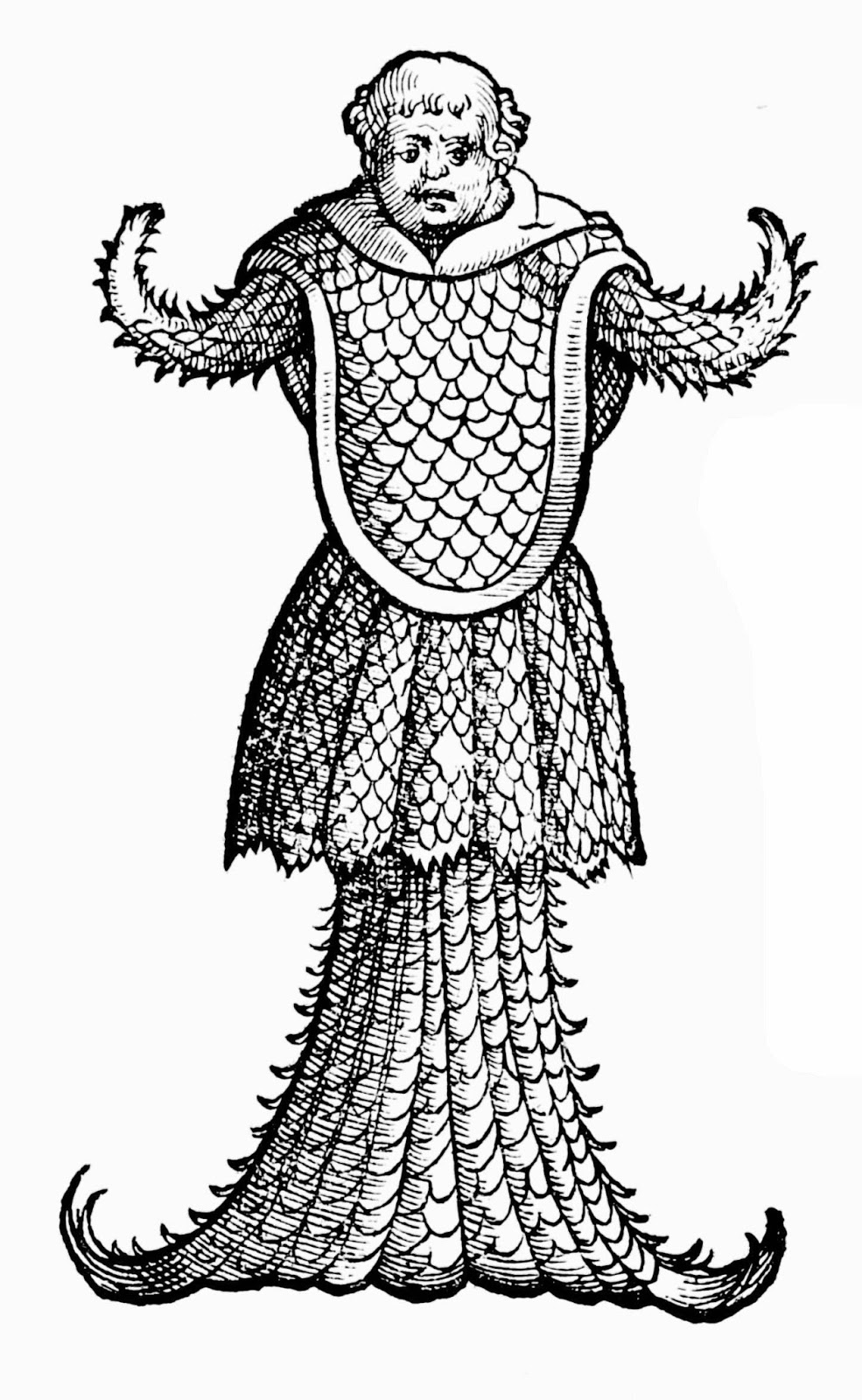
Lovers of bestiaries will be very familiar with this latter creature and its scaly-skinned image, which, in the tradition of bestiary and proto-encyclopaedia compilers for many centuries, has been reproduced with minor variations in numerous works dating from the mid-1500s onwards.

As far as I can tell, the sea bishop's earliest documentation was in French naturalist French Belon's work De Aquatilibus (1553), followed a year later by French marine biological researcher Guillaume Rondelet in his own tome Libri de Piscibus Marinis (1554), where he recorded a sighting of it from 1531 in the Baltic Sea off Poland by physician Gisbertus Germanus. Rondelet's work also contained an illustration of this sea bishop, but perhaps the most famous depiction of it appeared in 1558, as an engraving in the fourth volume of Swiss naturalist Conrad Gesner's monumental multi-volume, 4500-page Historia Animalium (1553-1558):

Engraving of the sea bishop, from Conrad Gesner's Historia Animalium (public domain)

This extraordinary sea monster was portrayed as a highly anthropomorphic humanoid-fish composite, and its sighting in 1531 was during Gesner's own lifetime (1516-1565). However, there is some confusion as to the creature's subsequent fate (not documented by Gesner).

Some sources state that it was captured alive and taken to the King of Poland, who wished to keep it, and was also shown to a group of Catholic bishops, to whom it gestured, appealing to be released, whereupon the bishops granted its wish and the creature in return made the sign of the Cross before disappearing back into the sea. (If nothing else, this is an interesting example not merely of ecclesiastical solidarity but also of the popular belief dating back as far as the time of Plato, 428/427 or 424/423 – 348/347 BC, that everything on land has a counterpart in the sea.) Other sources, conversely, document a sadder, less familiar end for the sea bishop, claiming it was actually caught off Germany, not Poland, and died in captivity three days later after refusing to eat (but I wonder if this story's differing location may originate from some confusion involving the name of its eyewitness, Gisbertus Germanus?).

Another well known version of the classic sea bishop illustration appeared in Johann Zahn's Specula Physico-Mathematico-Historica Notabilium ac Mirabilium Sciendorum (1696):

The sea bishop as depicted in Zahn's tome (public domain)

There is no doubt that the Spanish merman portrayed in the Russian lubok is reminiscent of the Baltic sea bishop, especially if the latter's billowing fin-like cloak is equated with the merman's fan-like caudal fin:

Spanish merman compared with Baltic sea bishop (public domain)

So if the sea bishop may provide a precedent of sorts, or possibly even a direct source or inspiration, for the Spanish merman, what might the sea bishop itself have been?

In his magnum opus, Gesner had also included an engraving and description of another mysterious 'human fish', the so-called sea monk. Again, this had been previously documented by Rondelet in his Libri de Piscibus Marinis, and by Belon in De Aquatilibus, but it was Gesner's coverage of it that first brought this creature to widespread attention. Here is Gesner's engraving:

Engraving of the sea monk, from Conrad Gesner's Historia Animalium (public domain)

This marine monster had allegedly been caught off Norway according to Gesner (or in the Øresund, the strait separating Sweden from the eastern coast of the large Danish island of Zealand, according to some other sources) in 1546, once again during Gesner's own lifetime, but its carcase was not retained; instead it was swiftly buried as an abomination on the orders of the Danish king, Christian IIII. In subsequent centuries, however, it has attracted (and still attracts today) considerable interest and controversy as to what it may have been.

Japetus Steenstrup's comparison of two versions of the sea monk engraving with, at centre, a giant squid (public domain)

Identities that have been proffered by various researchers include a giant squid (by 19th-Century Danish zoologist Japetus Steenstrup and more recently by giant squid chronicler Richard Ellis), an angel shark Squatina squatina (a large, dorsoventrally flattened species commonly dubbed a monkfish after its superficially monk-like form, proposed in 2005 by St Andrews University ecologist/mathematician Dr Charles Paxton and co-researcher Dr Robert Holland from the Freshwater Biological Association), a walrus (by veteran cryptozoologist Dr Bernard Heuvelmans), and various species of phocid seal.

Yet whereas I can see points in favour for each of the above creatures as identity contenders for the sea monk, I can see none for any of them as identity contenders for the sea bishop.

The angel shark or monkfish Squatina squatina, vintage illustration from 1877 (public domain)

As with the sea monk, I have encountered various attempts to reconcile the sea bishop with some form of squid. Yet even if we equate the sea bishop's markedly pointed head with the pointed rear portion of a squid's body, its two hefty-thighed legs are a poor substitute for the ten long slender arms and tentacles of a squid – unless we can envisage a squid whose eight shorter arms are united and obscured within some form of web-like interconnecting membrane, thereby explaining the bishop's cloak, with the latter's two legs being the longer prey-capturing tentacles of the squid?

Alternatively, bearing in mind that it was meant to be a sea bishop, might this creature's very pointed head have simply been an exaggerated (or even a completely fabricated) description, in order to provide it with an equivalent of sorts to a real bishop's mitre? It's all very tenuous, to say the least, and offers even less likelihood as a reasonable explanation for the Spanish merman with its caudal fanned fin.

In an interesting Folklore journal paper from 1975, W.M.S. Russell and F.S. Russell proposed that the sea bishop may actually have been a skilfully executed gaff along the lines of the Jenny Haniver. In their paper, they revealed how they had actually created a couple of Jenny Hanivers in the form of sea bishops, using two small alcohol-preserved specimens of the thornback skate Raja clavata.

A much-reproduced engraving of a Jenny Haniver, from Ulisee Aldrovandi's tome Monstrorum Historia (1642) (public domain)

For now, however, in the absence of any tangible evidence for their identities, both the sea bishop engraving and the Russian lubok's Spanish merman remain pictorial enigmas, which may bear little if any resemblance to the original creature(s) that they depict – always assuming of course that any such creature ever existed to begin with!

I plan to pursue the Spanish merman now via a different route, investigating whether other, preferably Spanish reports of its alleged capture exist – any discoveries will be included here as updates.

My sincere thanks to Robert Schneck for kindly bringing the Russsian merman lubok to my attention.

Sea monk and sea bishop sharing a page in Conrad Gesner's Historia Animalium (public domain)