Dr KARL SHUKER

Zoologist, media consultant, and science writer, Dr Karl Shuker is also one of the best known cryptozoologists in the world. He is the author of such seminal works as Mystery Cats of the World (1989), The Lost Ark: New and Rediscovered Animals of the 20th Century (1993; greatly expanded in 2012 as The Encyclopaedia of New and Rediscovered Animals), Dragons: A Natural History (1995), In Search of Prehistoric Survivors (1995), The Unexplained (1996), From Flying Toads To Snakes With Wings (1997), Mysteries of Planet Earth (1999), The Hidden Powers of Animals (2001), The Beasts That Hide From Man (2003), Extraordinary Animals Revisited (2007), Dr Shuker's Casebook (2008), Karl Shuker's Alien Zoo: From the Pages of Fortean Times (2010), Cats of Magic, Mythology, and Mystery (2012), Mirabilis: A Carnival of Cryptozoology and Unnatural History (2013), Dragons in Zoology, Cryptozoology, and Culture (2013), The Menagerie of Marvels (2014), A Manifestation of Monsters (2015), Here's Nessie! (2016), and what is widely considered to be his cryptozoological magnum opus, Still In Search Of Prehistoric Survivors (2016) - plus, very excitingly, his four long-awaited, much-requested ShukerNature blog books (2019-2024).

Dr Karl Shuker's Official Website - http://www.karlshuker.com/index.htm

IMPORTANT: To view a complete, regularly-updated listing of my ShukerNature blog's articles (each one instantly clickable), please click HERE!

IMPORTANT: To view a complete, regularly-updated listing of my published books (each one instantly clickable), please click HERE!

IMPORTANT: To view a complete, regularly-updated listing of my Eclectarium blog's articles (each one instantly clickable), please click HERE!

IMPORTANT: To view a complete, regularly-updated listing of my Starsteeds blog's poetry and other lyrical writings (each one instantly clickable), please click HERE!

IMPORTANT: To view a complete, regularly-updated listing of my Shuker In MovieLand blog's articles (each one instantly clickable), please click HERE!

IMPORTANT: To view a complete, regularly-updated listing of my RebelBikerDude's AI Biker Art blog's thematic text & picture galleries (each one instantly clickable), please click HERE!

Search This Blog


PLEASE COME IN, I'VE BEEN EXPECTING YOU...

PLEASE COME IN, I'VE BEEN EXPECTING YOU...
WELCOME TO SHUKERNATURE - ENJOY YOUR VISIT - BEWARE OF THE RAPTOR!


Showing posts with label dogs. Show all posts

Monday, 2 March 2009

DOG DREAMING

Sam, my West Highland white terrier, as a puppy (Dr Karl Shuker)


Much as I like cryptozoology, my interests in animal mysteries and anomalies are not entirely limited to that field, as many of you know - which is why my blog is entitled ShukerNature, rather than ShukerCrypto or suchlike. So here, just for a change, is a departure into animal symbolism and mysticism.


DOG DREAMING: UNMASKING THE HOUNDS OF MORPHEUS.


Bearing in mind that the dog was first domesticated by humanity around 9500 years ago and has famously become 'man's best friend' in the animal world, it is hardly surprising that our dreams should often contain canine incursions - or, as a scholar of classical Greek mythology may prefer to dub them, the hounds of Morpheus. But do these visitations have any symbolic significance? Could they comprise subconscious messages - even warnings, perhaps?

As will be seen, according to the traditional lore and legends associated with dream divining, the answers to such questions depend upon a variety of different factors. These include the identity of the owner of the dog featured in your dream, the dog's behaviour towards you, its activities, and even its specific breed or morphological appearance.

WHOSE DOG ARE YOU?

Symbolically, the dog personifies loyalty, faithfulness, friendship, and affection. Generally speaking, these traits are also personified by a dog encountered by you in a dream - provided that, in your dream, you are the dog's owner. If your dream dog is in good health, this is supposedly a reflection of your finances' healthy outlook. Similarly, if it should play with you in an affectionate manner, this indicates an impending improvement in your fortunes, and success with any romantic liaison that you may enter into in the near future.

Indeed, so potent is the benevolence represented by a dream dog owned by you that even if it should disturb you by barking or snarling at you, this simply means that you will achieve success against scheming, treacherous false friends. That, at least, was the opinion of Thomas Tryon, a celebrated 17th Century dream diviner from Bilbury, Gloucestershire, and author of A Treatise of Dreams and Visions... (1695). Tryon also claimed that if your dream dog tears your clothes, this should be taken as a warning that one of your enemies is saying bad things about you or even threatening your job.

If the dog in your dream is owned by someone else (particularly a stranger), however, it supposedly represents a profound enemy, and should be treated with great care.

STOP, LOOK, LISTEN

Paying close attention to the activities of a dream dog provides important clues to the nature of the message conveyed by its visitation, at least according to the lore of dream-divining.

For example, a dog seen swimming implies that good fortune and happiness lie easily within your grasp; and your future undertakings will surely be successful if you dream of taking a journey alone but with a dog following closely behind you. Equally, if you should be approached in a dream by a friendly dog, especially a white one, success in your romantic or business life will soon come to you. Conversely, if a black dog should approach you, beware - this is not a good omen. Indeed, this interpretation probably stems from the age-old legends of phantom Black Dogs, whose appearances often presage disaster or death. Similarly, dreaming of a howling dog is said to be unlucky - no doubt derived from primitive, fanciful superstitions offering equally woeful claims regarding dogs baying mournfully at the moon.

Dreaming of dogs engaged in hunting other animals, such as foxes, allegedly prophecies an unexpected increase in the speed of your future undertakings. And a dream featuring a dog killing a snake is said to symbolise good luck (for you, if not for the snake!). But if you should be bitten by a dog in your dream, then you will suffer a loss - or, at the very least, be deceived by your loved one. So make sure that you don't tease a dream dog!

VARIETIES OF DREAM DOGS

According to the early dream interpreters, different breeds, sizes, and types of dream dog had very different meanings - most of them notably moralistic.

For instance, a pursuing bloodhound should be taken as a warning that you are about to face a great temptation, which, if succumbed to, could cause great problems for you. Moreover, if you should be startled by the sudden appearance of a sizeable mastiff, this symbolises a considerable inconvenience that you will experience if attempting to better yourself in the future. Nor should you feel comforted by a seemingly innocuous, pleasing dream featuring one or more fancy pet dogs, because such a dream would expose you as a vain, selfish exhibitionist, overly fond of ostentation. And dreaming of small dogs is supposedly a reflection of inherent small-mindedness and frivolity! Chihuahuas, take note!

Not surprisingly, the appearance of a mad, rabid dog in a dream traditionally represents a failure to succeed (as does an unkempt or emaciated dog), and even the impending onset of some dire illness. But who would have guessed that a many-headed Cerberus-lookalike personifies your frustrated attempts to achieve too many goals at once?

A WOLF IN DREAM'S CLOTHING?

As a rule, the domestic dog's wild relations do not fare very well at the hands of the dream diviner. Should you ever dream of encountering a wolf, for instance, this dream is reputedly warning you that one of your business associates not only is a thief, but also is someone who cannot be trusted with secrets, as he or she will betray you if the opportunity presents itself. If you dream of hearing a wolf howl, this indicates that there is a secret alliance of rivals seeking to overcome you, albeit honestly, in future business deals.

As may be anticipated, dream foxes epitomise slyness, but also envy and betrayal by your working associates. And if you chase a fox in your dream, this is traditionally interpreted as a prediction that you are about to pursue a risky professional or romantic course of action. Even a tame, friendly fox should not be trusted in a dream, or so they say.

So when you next dream about a dog, remember that it may portend some highly significant event in your future. Alternatively, of course, it may simply mean that you like dogs!

Sunday, 8 February 2009

DEITIES OF THE CANINE KIND


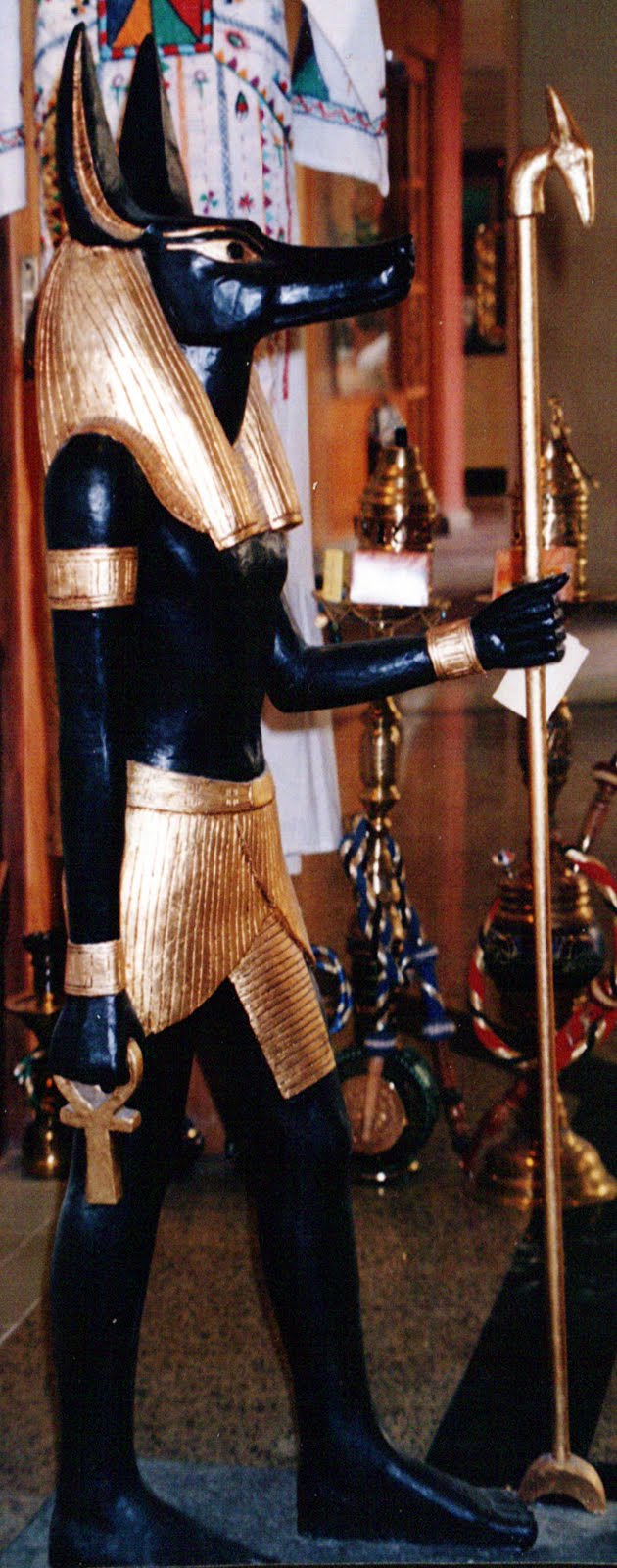
Anubis statue, Cairo (Dr Karl Shuker)

The worship of the cat as a god in ancient Egypt and elsewhere is well known, but less familiar is the diversity of canine deities that have also been venerated in various cultures.


ANUBIS - JACKAL-HEADED GOD OF ANCIENT EGYPT

Probably the most famous canine deity of all is Anubis - the jackal-headed son of Osiris, god of the underworld, and Nebthet, a funeral goddess. Sometimes represented as a coal-black, bushy-tailed jackal or pointed-eared dog in a crouched or lying down position, Anubis was worshipped in Egypt from c.2700 BC to the close of ancient Egyptian history in c.400 AD, and was venerated extensively at the necropolis in Memphis. He originated as a god of putrefaction, but eventually emerged with a more specific (and less unappetising) role - as the mortuary god who presided over embalming. Indeed, Egyptian priests supervising official embalmers wore jackal-headed masks to signify the presence of Anubis during these preparations. Moreover, according to traditional Egyptian lore, Anubis invented funeral rites, presiding over the funeral and mummification of his own father, Osiris.

Once mummification of a dead person is complete, it is Anubis who leads the dead into the presence of his father, Osiris, in the underworld, to be judged by him. Anubis also weighs the dead person's heart, in the Hall of the Two Truths, to determine its ultimate fate.

Another, less familiar canine-headed deity of Egyptian mythology is Upuaut. Originally a warrior god, Upuaut is variously represented as a dog-headed, jackal-headed, or even wolf-headed man who leads the funeral cortege at the festivals of Osiris. He also steers the boat of the sun as it journeys through the dark realm of the night between dusk and dawn.

HERMANUBIS AND THE ORIGIN OF THE WEREWOLF MYTH?

After the Greeks and Romans took over Egypt, the cult of Anubis became assimilated with that of the Greek messenger god, Hermes, and a new, combined deity was created - Hermanubis. Just like Anubis, Hermanubis was represented as a canine-headed man, but his functions changed. Instead of being strongly associated with funeral rituals and embalming, emphasis was placed upon his role as a guide, leading the souls of the dead through the underworld. Moreover, just like Hermes, Hermanubis came to be portrayed with winged sandals, and held a staff or caduceus, with two snakes entwined around it, in his hand.

Nevertheless, as with the priests of Anubis, those of Hermanubis wore canine masks - a tradition leading scholar Hugh Trotti in 1990 to propose a most intriguing theory. By the first century AD, worship of Hermanubis had spread beyond Rome-ruled Egypt, reaching Rome itself - where Germanic troops recruited into the Roman armies would have seen statues of this canine god, as well as his dog-headed priests. Such sights would no doubt have been remembered and spoken of by the Germanic people after the Roman Empire's fall - and Trotti has speculated that distorted accounts of these may ultimately have inspired legends of werewolves, i.e. humans who could transform themselves into wolves.

XOLOTL - A CANINE GOD OF THE AZTECS

Another notable canine deity is Xolotl, one of the principal gods of Aztec mythology in ancient Mexico, who created mankind by leading them up from the spirit world and bestowing upon them the gift of fire. Due to his magical ability to assume any shape, Xolotl has been depicted in many forms, but is most commonly represented as an oddly-formed dog, with rear-running feet, and ears that can point backwards or forwards.

Xolotl is the twin of the sky god Quetzalcoatl, and represents the evening star, Venus, hauling the sun downwards each evening into the gloomy vault of night. A deity with varied associations, he is also the god of twins (as a twin himself) and ball games, as well as a deity of the underworld, corresponding to the Pek or lightning dog of Maya mythology. Today, Xolotl's name is still linked to dogs in zoological nomenclature, though only very indirectly - sharing it with the axolotl, a form of aquatic Mexican salamander, whose larval form is reminiscent of a dog and hence is sometimes referred to as a water-dog.

BHAIRAVA AND HIS CANINE STEED

In Hindu lore, Bhairava, a door guardian, is a fearsome canine deity. One of the forms assumed by the god Siva, he is often portrayed either as a huge black dog, or as a human riding a black dog. Terrifying to behold, Bhairava has many arms, three eyes, long matted hair, and sometimes has a serpent entwined around his body, with a collar of skulls around his neck. Food sellers plying their ware outside Indian temples dedicated to Siva sell tiny dogs carved out of sugar, which can then be presented as an offering to Bhairava.

In northern India, a canine deity was formerly worshipped by certain Dravidians. So too were dogs in Nepalese villages, during a special festival called Khicha Puja, in which a garland of flowers was deferentially placed around the neck of every dog in each village.

ST GUINEFORT - THE AMAZING STORY OF A CANINE CANONISATION

Down through the ages, many saints have been accredited with miraculous powers, or have led unusual lives, but one of the most remarkable histories on record must surely be that of St Guinefort, who may well be the only canonised greyhound!

It was in c.1250 AD when a Dominican priest called Stephen of Bourbon first learnt of the tomb of St Guinefort, located in a sacred grove within the remote Dombes region north of Lyons, France. Upon further enquiry, he was amazed to discover that this saint had actually been a greyhound, which had been wrongly blamed for the death of a local lord's infant. Only after it had been slain by the enraged lord was the discovery made that in reality the dog had been protecting the baby from a snake. Stricken with guilt and remorse for his rash action, the lord erected a tomb, in which the dog's bones were placed.

Soon, stories began to emerge of miracles occurring at the site of this tomb, featuring the inexplicable restoration to good health of sick children brought here by their parents, and the dog duly became known as St Guinefort. Stephen of Bourbon, however, was horrified by what he deemed to be this unholy, sacrilegious activity, and swiftly instigated the destruction of the tomb and its grove. Yet the cult of St Guinefort survived in secret long after Stephen of Bourbon's own demise, with a chapel dedicated to the slightly re-named Saint-Guy le Fort existing in the 17th Century on the site of the original tomb, and with the greyhound saint's name restored to its original form by the 1800s. Even today, St Guinefort's story is well known in the Dombes region, and researchers have revealed possible links between this history and the famous Welsh legend of Gelert - another noble dog that died a martyr. They do say that every dog has its day - but in St Guinefort's case, it has lasted several centuries!