Dr KARL SHUKER

Zoologist, media consultant, and science writer, Dr Karl Shuker is also one of the best known cryptozoologists in the world. He is the author of such seminal works as Mystery Cats of the World (1989), The Lost Ark: New and Rediscovered Animals of the 20th Century (1993; greatly expanded in 2012 as The Encyclopaedia of New and Rediscovered Animals), Dragons: A Natural History (1995), In Search of Prehistoric Survivors (1995), The Unexplained (1996), From Flying Toads To Snakes With Wings (1997), Mysteries of Planet Earth (1999), The Hidden Powers of Animals (2001), The Beasts That Hide From Man (2003), Extraordinary Animals Revisited (2007), Dr Shuker's Casebook (2008), Karl Shuker's Alien Zoo: From the Pages of Fortean Times (2010), Cats of Magic, Mythology, and Mystery (2012), Mirabilis: A Carnival of Cryptozoology and Unnatural History (2013), Dragons in Zoology, Cryptozoology, and Culture (2013), The Menagerie of Marvels (2014), A Manifestation of Monsters (2015), Here's Nessie! (2016), and what is widely considered to be his cryptozoological magnum opus, Still In Search Of Prehistoric Survivors (2016) - plus, very excitingly, his four long-awaited, much-requested ShukerNature blog books (2019-2024).

Dr Karl Shuker's Official Website - http://www.karlshuker.com/index.htm

IMPORTANT: To view a complete, regularly-updated listing of my ShukerNature blog's articles (each one instantly clickable), please click HERE!

IMPORTANT: To view a complete, regularly-updated listing of my published books (each one instantly clickable), please click HERE!

IMPORTANT: To view a complete, regularly-updated listing of my Eclectarium blog's articles (each one instantly clickable), please click HERE!

IMPORTANT: To view a complete, regularly-updated listing of my Starsteeds blog's poetry and other lyrical writings (each one instantly clickable), please click HERE!

IMPORTANT: To view a complete, regularly-updated listing of my Shuker In MovieLand blog's articles (each one instantly clickable), please click HERE!

IMPORTANT: To view a complete, regularly-updated listing of my RebelBikerDude's AI Biker Art blog's thematic text & picture galleries (each one instantly clickable), please click HERE!

Search This Blog


PLEASE COME IN, I'VE BEEN EXPECTING YOU...

PLEASE COME IN, I'VE BEEN EXPECTING YOU...
WELCOME TO SHUKERNATURE - ENJOY YOUR VISIT - BEWARE OF THE RAPTOR!


Showing posts with label moonrat. Show all posts

Saturday, 23 January 2016

LET'S ALL LOOK OUT FOR THE LAVELLAN


A 19th-Century painting of some aquatic shrews (public domain)

In an earlier ShukerNature blog article, I documented a quite small and little-known but thoroughly fascinating if somewhat macabre mystery beast from Scotland known as the earth hound (click here) – and now, here is a second one, the lavellan.

According to local lore in Caithness and Sutherland, apparently the stronghold of this cryptid, the lavellan is – or was – a rodent with flashing eyes, a disproportionately-large mouse-like or rat-like head, and similar body colouration too. However, it was larger than a rat, had an exceedingly venomous bite, was also a blood-sucker, and inhabited marshes as well as deep water-filled hollows in rivers.

A water vole - one identity that has been proposed for the lavellan (© public domain)

Any cattle drinking from a body of water containing a lavellan would invariably die, and, bizarrely, this creature could inflict lethal injuries upon livestock from a distance too, from as far away in fact as approximately 100 ft, though the precise mechanism responsible for this fatal activity is never elucidated in such reports. Yet, paradoxically, if farmers had sick animals, they could be cured if they drank water in which the pelt from a dead lavellan had been dipped.

Interestingly, its name in Scottish Gaelic is also applied to the water shrew Neomys fodiens (which, interestingly, does have a weakly venomous bite) and the water vole Arvicola amphibius, both species having been identified as the lavellan by various authors. Yet the latter creature was supposedly much larger than either of them. Conversely, in John Fleming's book History of British Animals (1828), he claimed that it was likely to be the stoat Mustela erminea, because in early highland lore the stoat supposedly exuded some kind of "foul matter" that was toxic to horses and other animals.

A stoat - another identity proposed for the lavellan (public domain)

The lavellan's most diligent modern-day investigator is naturalist Raymond Bell, who has memorably dubbed it a 'giant vampire shrew' in various talks and writings that he has prepared on this subject. He has speculated that it may have been at least in part nothing more than a fictitious bogey-beast invented by parents to ward their children away from deep water, or even an attempt to explain away mysterious diseases arising in livestock. However, he also concedes that some bona fide creature might have been at the core of the lavellan legend too, but what that creature was may never be determined.

(As an entertaining digression, 1959 saw the release of a Ray Kellogg-directed science-fiction film that went on to become a highly popular cult movie - The Killer Shrews, in which visitors to a remote island are terrorised by giant mutant shrews. The most famous aspect of the film is that whereas close-ups of the shrews utilise hand-puppets, wider shots of the entire creatures feature coonhounds dressed up to look like shrews! A sequel, Return of the Killer Shrews, was produced in 2012. Both films starred James Best.)

Promotional poster for The Killer Shrews (© McLendon-Radio Pictures Distributing Company – reproduced here on a strictly non-commercial Fair Use educational/review basis only)

Incidentally, a real-life creature that has been colloquially dubbed a giant killer shrew is Deinogalerix koenigswaldi, which lived during the late Miocene Epoch (11.3-5.6 million years ago) on what was then the Italian island of Gargano, now the Gargano Peninsula. With a skull length of 8 in and a total body length of 2 ft, it occupied the ecological niche filled today by dogs and cats. Yet in spite of its generic name (Deinogalerix translates as 'terror shrew'), it was actually a giant species of gymnure or hairy hedgehog, a group of eulipotyphlan insectivores whose largest modern-day representative is the wonderfully-named moonrat Echinosorex gymnura (click here for a ShukerNature article devoted to this very distinctive mammal).

It is fascinating to consider that the ostensible familiarity of Great Britain's extensively-studied, exhaustively-documented natural history can nevertheless still harbour such riddles as the lavellan and the earth hound. But will their mysteries ever be solved? Perhaps someone reading this present article of mine has the answer to that question and, if so, I very much look forward to hearing from you!
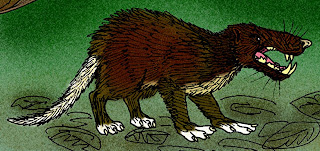
Artistic restoration of Deinogalerix koenigswaldi in life (© Stanton Fink (aka Apokryltaros)/Wikipedia CC BY 3.0 licence)


This ShukerNature blog article was excerpted and expanded from my book The Menagerie of Marvels – further information has been collected by Raymond Bell, who may in due course submit a formal paper on this cryptid to the Journal of Cryptozoology, the world's only peer-reviewed scientific journal devoted to mystery animals, published annually. Look out for Vol. 4, coming soon!


Thursday, 20 September 2012

UNMASKING THE MOONRAT - A HAIRY HEDGEHOG THE SIZE OF A CAT!


The nominate black-furred subspecies, E. g. gymnura, of the moonrat (Constance Warner)

As a child, animals with unusual names always held an intense fascination for me. So it was inevitable that I would want to learn more about the moonrat!

Sadly, I soon discovered that in spite of its exotic appellation, this wonderful creature, known scientifically as Echinosorex gymnura, does not actually come from the moon, but it is such an amazing-looking animal that anybody could be forgiven for wondering whether it may do! In fact, the marvellous moonrat is from southeastern Asia (specifically the Thai-Malay Peninsula and the islands of Sumatra and Borneo).


The marvellous moonrat (Dr David Kirshner)

It was first brought to scientific attention in 1821, by Sir Stamford Raffles, who discovered it in Sumatra and mistakenly deemed it to be a new species of civet, duly dubbing it Viverra gymnura. Certain other early investigators of this mysterious mammal were equally confused by it, categorising it as a marsupial!

In reality, however, the moonrat is the largest of several species of insectivore that are known as gymnures ('naked tails'). This is because their very long slender tails are almost hairless and covered in scales, rather like snakes! Equally ophidian is the loud, threatening hiss that the moonrat gives voice to if confronted by predators or by other moonrats invading its territory.

Moonrat postage stamp, Malaysia 2008

With a head and body length of 13-16 in, a tail of 8-12 in, and weighing up to 2.75 lb, the moonrat looks very like a gigantic rat - a rat wearing a black mask, and as big as a domestic cat! (In Borneo, moonrats lack the mask because here, uniquely, they are predominantly white all over in colour.) It even occupies a similar ecological niche to true rats. Taxonomically, however, this deceptive animal is something very different, because its closest relatives are not the rodents but the hedgehogs.

For although, outwardly, it doesn't look anything like one, when its anatomy is examined the moonrat is swiftly revealed to be a kind of extra-large, long-tailed hedgehog - but one that is covered in long coarse hair instead of spines.


The moonrat's very distinctive, predominantly white Bornean subspecies, E. g. alba (FactZoo.com)

The moonrat's external appearance has some other surprises too. Its very lengthy, mobile snout is plentifully supplied with exceptionally long, bristly whiskers - as are its eyebrows. These whiskers are extremely sensitive to touch, and probably help the moonrat to gauge in the dark whether it is thin enough to pick its way through tight crevices while active at night. Also assisting it do this is the remarkable shape of its body, which although looking very burly from the side, is actually surprisingly narrow, allowing it to squeeze through gaps that seem scarcely wide enough to let it pass. So too do its very short legs.

The moonrat inhabits dense forests and swamps, usually near water. A good swimmer, it is fond of eating fishes, frogs, crabs, clams, and other aquatic creatures, as well as worms and insects. Despite its size and eyecatching appearance, however, as well as the facts that it was first documented scientifically as long ago as 1821 (by Sir Stamford Raffles no less, who named it a year later) and has a lifespan of up to 5 years in its native habitat, the moonrat remains one of the world's most mysterious mammals. This is because it is incredibly shy and hence is rarely seen in the wild.

19th-Century engraving of a moonrat

One peculiar thing that we do know about its wild habits, however, is that when the female moonrat makes a nest in which she subsequently gives birth to two babies, the fluid that she secretes from a pair of glands under her tail to mark the nest's entrance possesses a strong ammonia content and has a potent smell that closely resembles rotten onions or garlic! (The male also secretes this same fluid when marking his territory.) So even if our eyes are unsuccessful in catching sight of moonrats, our nose should have far less trouble locating their nests!

The moonrat's memorable name has assisted it in becoming an unlikely villain in a delightful children's book written by Helen Ward. Entitled The Moonrat and the White Turtle and originally published in 1990, it also contains Ward's beautiful full-colour illustrations. Moonrat is the greatly-feared leader of a rascally band of pirate rats, and is driven by one unquenchable ambition – to steal the moon out of the sky and add it to his vast glittering trove of ill-gotten treasure! But does he succeed with his nefarious plot, and who or what is the White Turtle? I'll leave you to discover this excellent book and find out for yourself!


There is also a Los Angeles-based rock group called The Moonrats, but I'm unsure whether their name was gymnure-inspired, or just inspired!

Finally: all that remains to be answered is where the moonrat itself obtained its noteworthy name. However, this appears to be one mystery that is destined to remain unanswered, because in spite of considerable research, I have so far been unable to trace any explanation of its origin. So if anyone can enlighten me concerning this, I'd love to hear from you!


UPDATE: 23 March 2014

While discussing the moonrat with Australian naturalist Dr David Kirschner (who also kindly permitted me to include his moonrat illustration here), David offered up a very thought-provoking potential explanation for the origin of this species' very unusual common name, moonrat, which again he has permitted me to include here:

"As for the common name, if I had to guess it would have probably originated with the Bornean subspecies, E. gymnura alba, as I would imagine an all white, nocturnal mammal would be quite visible on a bright moonlit night."

Indeed, taking this line of thought even further, such an animal would be so eyecatching and unearthly in appearance if viewed upon a bright moonlit night that the more fanciful of observers may even have imagined it (albeit only in jest) to have originated directly from the moon itself - hence 'moonrat'!

Sheet of moonrat-depicting postage stamps issued by Malaysia in 2008