Mammalian Hybrids, 2nd edition (1971) – its front cover depicts a young zebronkey at Colchester ZooBack in the early 1970s, when still a child, I read with great interest that Colchester Zoo in Essex had on display a remarkable creature known as a zonkey or zebronkey – a hybrid of zebra and donkey. Sadly, however, even though my parents took me to numerous zoos all over Britain during my childhood and teenage years, somehow we never did visit Colchester's, and as there were no such hybrids anywhere else in the country at that time, this meant that I never did see one of these fascinating animals.
All of that changed a mere 40-odd years later, however, when, just over a week ago, on Saturday 31 March 2012, to be exact, I had the great pleasure of visiting Donkey Rescue UK, based just outside Bridgnorth in Shropshire. For here, not only did I finally see a zonkey, I was also fortunate enough to see a zeedonk and a zorse.
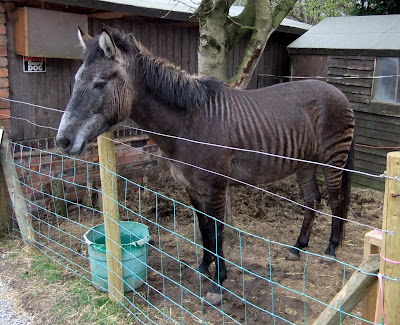 Zulu, Donkey Rescue UK's beautiful zorse (Dr Karl Shuker)
But what exactly are zorses, zonkeys, and zeedonks, not to mention zebroids, zebryls, zeehorses, zebrulas, zebrasses, zebrets, zonies, hebras, donkras, quorses, and a host of other equally strange-sounding equids on record, and how do they (or do they) all differ from one another? Let me now explain – or try to!
The terminology for zebra
Equus spp. x domestic horse
E. caballus, zebra
Equus spp. x domestic donkey
E. asinus, and the respective reciprocal crosses is nothing if not confusing, to say the very least. For instance: in the past, 'zebroid' was usually applied to zebra x horse crossbreeds in either direction, but is nowadays most commonly used as a generic term for all equid hybrids featuring zebras.
'Zorse' is the term most widely applied to any ♂zebra x ♀horse hybrid (other terms in use for this hybrid type are 'zebrula', 'zebrule', 'zebryl', 'zeehorse', 'zebra mule', and 'golden mule'). The rarer reciprocal cross (♂horse x ♀zebra) is known as a hebra, horbra, zebrinny, or zebret. And the offspring of a ♂zebra and a ♀pony is a zony.
The terms 'zonkey' and 'zeedonk' can be found commonly in use as generic terms for all zebra x donkey hybrids. Moreover, 'zonkey' is also applied more specifically as a term for ♂zebra x ♀donkey hybrids. Other terms for these include 'zebronkey' (aka 'zebonkey'), and 'zebrass'. Similarly, 'zeedonk' is also applied more specifically to the much less common reciprocal cross; another term for this latter hybrid is 'donkra'.
ZULU'S A ZORSE, OF COURSE, OF COURSE!The first of the three zebroids that I encountered at Donkey Rescue UK was a beautiful zorse, called Zulu. Almost five years old, Zulu is currently the only zorse in the UK, and came here from the USA. His father is a Grant's zebra
Equus quagga boehmi (a subspecies of the plains zebra) and his mother is a grey Arab horse. As can be seen in my photos, his black stripes overlay his coat's brown background colouration, and although this will fade to grey in years to come, his stripes will remain black. Apparently his senses are more acute than those of a horse.
 Zulu the zorse at Donkey Rescue UK (Dr Karl Shuker)
Zorses are by no means a modern-day creation. On the contrary, they were being bred as long ago as the 19th Century. One notable example from that period was a very handsome male specimen called Romulus, as seen here when photographed as a one-year-old in 1899.
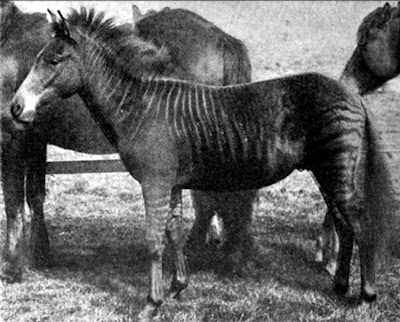 Romulus, a zorse from 1899
Moreover, zonies bred by mating Chapman's zebras
E. q. chapmani with ponies were utilised by the Boers during the South African Wars (1879-1915) as transport animals, particularly for hauling heavy guns. One of these zonies, captured by British forces, was presented by Lord Kitchener to King Edward VII, which the king in turn placed in the Zoological Society of London's care on 19 July 1902, by which time it was two years old. The following illustration of this zony appeared in the Society's
Proceedings for 1903:
 The zony given to the Zoological Society of London by Edward VII
Even so, zorses didn't attract widespread public attention until the late 1940s, following the successful breeding of Grevy's zebra
E. grevyi x horse hybrids on the farm of African explorer Raymond Hook, situated near to Nanyuki in Kenya. It all began when Hook captured an 18-month-old male Grevy's zebra in 1944, and introduced it to his farm's herd of horses. The young zebra was soon adopted by one of the herd's mares acting as a foster mother, it grew to adulthood, and from the age of six until its retirement 14 years later it regularly mated with various of the mares to yield a continuing supply of Grevy's zorses. In 1955, the first of these (born in 1949) was sold to an exhibition in Florida called 'Africa USA', where it received notable publicity, so afterwards Hook sold many more Grevy's zorses to zoos and parks worldwide.
In general appearance, a Grevy's zorse possesses its mother's background coat colouration. However, its father's characteristic fine striping is readily apparent upon its face and legs, and to varying extents upon its body too, running down from the dark line along its spine almost as far as its pale underparts.
In contrast, a Grevy's hebra - bred from the reciprocal cross ((♂horse x ♀Grevy's zebra) - exhibits a less pronounced degree of striping.
Zorses and hebras bred from other zebra species have comparable appearances to their respective Grevy's-bred counterparts, although their limbs actually possess more stripes than those of their pure-bred zebra parent if they have been sired by a stallion belonging to any of the subspecies of the plains zebra
E. quagga [=
burchelli].
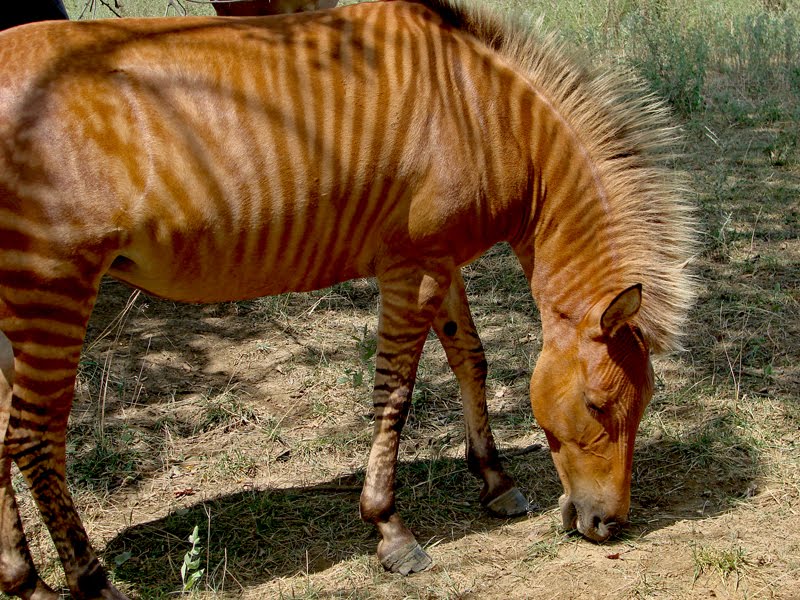
If a patterned horse, such as a roan, Apaloosa, pinto, piebald, or skewbald, is mated with a zebra, the hybrid offspring possesses stripes, but usually only on the non-white areas. If the horse was chestnut or bay, some exceptionally beautiful hybrids known as golden zorses or golden zebras can result.
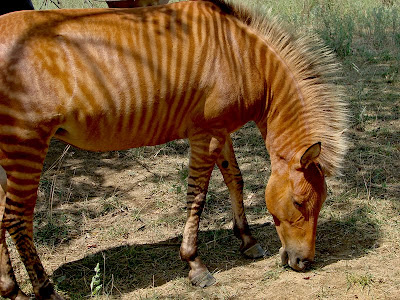 A golden zorse – the exquisite progeny of a zebra and a chestnut/bay horse
Perhaps the most celebrated hebra on account of its extremely unusual, eyecatching coat patterning is Eclyse, born during 2007 at a safari park at Schloss Holte Stukenbrock, Germany, to a ♂horse and a ♀zebra. Her father, a tobiano pinto, has sizeable areas of white coat colouration, and as these result from the expression of a dominant depigmentation gene, Eclyse inherited this same gene and bears comparable white areas on her own coat. As a result, the striping that she inherited from her zebra mother is confined to her coat's pigmented (i.e. non-depigmented) areas, thus creating her exceptional degree of non-continuous patterning.
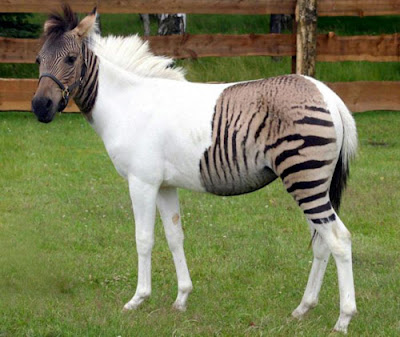 Eclyse, probably the most eyecatching zebra x horse hybrid ever seen
Grevy's zorses and hebras are invariably sterile, for whereas the horse possesses 64 chromosomes (32 pairs), Grevy's zebra only has 46 chromosomes (23 pairs), with the resulting hybrid possessing 55 chromosomes (27 pairs plus a single unpaired chromosome). The differences in chromosome numbers are also marked between the horse and the other two zebra species. Even so, there is some evidence to suggest that fertile female hybrids bred from horses and Chapman's zebras are occasionally fertile.
In addition to selling Grevy's zorses to zoos, Raymond Hook used some in place of mules (♂donkey x ♀horse hybrids) as pack animals on his farm, and he discovered not only that they were blessed with more agreeable temperaments than pure-bred Grevy's zebras but also that they worked as efficiently as mules. Similarly, zorses bred from Chapman's zebras and again used for pack work in their native lands have proven to be strong, active, and intelligent, as well as being more resistant than horses to sleeping sickness spread by tsetse flies.
In view of such commendable attributes, it is quite likely that in the future zorses will eventually become recognised more for their practical usefulness than for their current popularity as engaging zoo and park exhibits. And indeed, they are currently being bred in Africa for use in trekking on Mount Kenya.
ZAMBI THE ZONKEY
In recent times, the zorse type most frequently displayed in zoos is probably the version bred from Grant's zebra, such as Zulu. Yet even this is far less often on show than zonkeys or zebronkeys, i.e. hybrids bred from ♂zebras and ♀donkeys – of which Zambi at Donkey Rescue UK is a delightful example. Others include the zebra x donkey hybrids bred at Colchester Zoo from the early 1970s onwards, the last of which, a female called Shadow, died at the ripe old age of 34 on 3 April 2009.
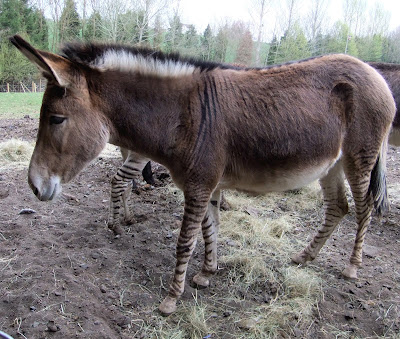 Zambi the zonkey at Donkey Rescue UK (Dr Karl Shuker)
Arriving here in December 2011, Zambi has a Grevy's zebra as her father and a Giant Mammoth Jackston donkey as her mother. And as the latter donkey breed is known for its great size, it is possible that when fully grown, Zambi will be the largest zebra x donkey hybrid in existence, or at the very least in Europe, because no other hybrids of her particular parentage are known here at present.
Like all zebronkeys, Zambi is a very handsome, striking animal, due to the marked contrast of such hybrids' donkey-like shape and body colouration with the heavy bands of striping present all down their pale legs. Much fainter stripes are sometimes present upon the body too, as with Zambi.
 Zambi has a very striking black-and-white mane (Dr Karl Shuker)
After having finally seen a zebronkey in the flesh, it is easy to understand why more than one writer in the past has labelled this equine hybrid "a donkey in pyjamas"!
Certainly the singularly attractive appearance of zebronkeys, especially when young (as evinced by the incorrigibly cute youngster from Colchester Zoo pictured on the front cover of the 1971 second edition of Annie P. Gray's standard work
Mammalian Hybrids – see this present ShukerNature post's opening picture), will guarantee their continuing popularity in zoos, parks, and other wildlife centres. Like zorses, zebronkeys are normally sterile, but fertile female specimens have occasionally been reported.
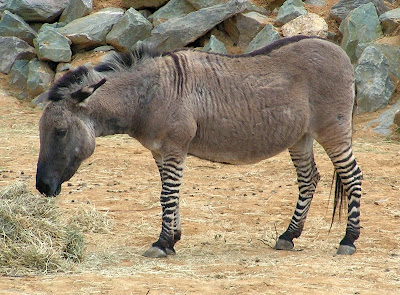 A zonkey (aka zebronkey) at Colchester Zoo in 2004 (Sannse/Wikipedia)
Some Grant's zebronkeys were used in the past as pack animals in Kenya, and proved to be strong workers, but were apparently less intelligent and more difficult to work with than zorses.
A ZEEDONK NAMED ZEE
Described on Donkey Rescue UK's 'Donkey Mixtures' webpage (click
here) as "very much a zebra – disguised as a donkey!" on account of her very strong and bossy zebra-like personality, Zee was bred in the Netherlands and came to the UK in 2011.
 Zee the zeedonk at Donkey Rescue UK (Dr Karl Shuker)
She is the rarest member of Donkey Rescue UK's trio of zebroids because she is an example of the much less common reciprocal cross between zebras and donkeys – a zeedonk or donkra - having a standard donkey as her father and a Grant's zebra as her mother.
A TRIPLE ZEBROIDRarest of all zebroids, however, must surely be the triple hybrid once exhibited at London Zoo and documented as follows by none other than Charles Darwin in his book
The Variation of Animals and Plants Under Domestication (1868):
"Many years ago I saw in the Zoological Gardens a curious triple hybrid, from a bay mare, by a hybrid from a male ass and female zebra. This animal when old had hardly any stripes; but I was assured by the superintendent, that when young it had shoulder-stripes, and faint stripes on its flanks and legs. I mention this case more especially as an instance of the stripes being much plainer during youth than in old age."
This triple hybrid's father was thus a fertile male donkra, a great rarity in itself.
QUORSES AND HUAGGAS?If the above-mentioned triple hybrid is the rarest zebroid, then the most controversial zebroids must surely be ones that allegedly featured as one of their parents the now-extinct quagga
E. q. quagga.
 A captive female quagga at London Zoo in 1870, which was the only living quagga specimen ever photographed.
The only partially-striped zebra, being fully striped upon its face, neck, and shoulders, but entirely lacking stripes upon its legs and hind regions, and only faintly striped upon the mid-portion of its body, this very distinctive subspecies of the plains zebra was once common on the veldt of South Africa. Following persecution at the guns of hunters for its meat and hide, however, it was eventually wiped out entirely in the wild, and the last surviving captive specimen, at Amsterdam Zoo, died in 1883.
Intriguingly, several decades prior to this tragic end, there were several claims of hybrids having been bred between quaggas and horses.
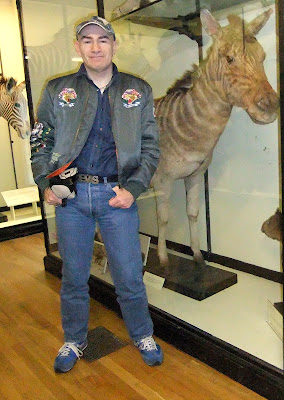 Standing alongside a taxiderm quagga at Tring Natural History Museum (Dr Karl Shuker)
Not everyone accepts these claims, however, believing that the zebras involved were not quaggas but Burchell's zebra
E. q. burchelli. Having said that, this is a controversy within a controversy, because researches have recently revealed that this unusual zebra subspecies - also known as the bontequagga, characterised by distinctive pale-brown shadow stripes present between the normal dark ones, and allegedly becoming extinct approximately 40 years after the quagga - was not a valid subspecies at all.
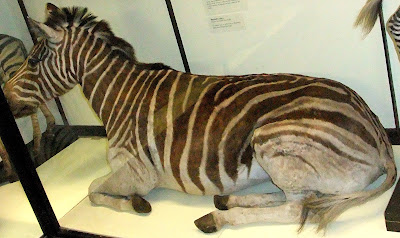 Taxiderm specimen of Burchell's zebra at Tring Natural History Museum (Dr Karl Shuker)
Instead, it had merely been based upon aberrantly-patterned individuals belonging to the neighbouring, still-extant Damara zebra subspecies,
E. q. antiquorum, and that some specimens of Damara zebra alive today show precisely the same characteristics as those documented for Burchell's zebra. So even though the latter version never existed as a discrete taxonomic form, it is no longer extinct! In short, Burchell's zebra and the Damara zebra are nowadays classed as one and the same subspecies, but due to the laws of nomenclatural precedence this unified subspecies is known not as
E. q. antiquorum but instead as
E. q. burchelli, because the latter name had been officially published in the scientific literature earlier than the former one.
 Living zebras at Etosha, in Namibia, exhibiting the characteristic appearance of Burchell's zebra
Probably the most famous alleged quagga-derived zebroid is a female hybrid bred in 1815 by Lord Morton (George Douglas, 16th Earl of Morton) from a supposed ♂quagga x ♀chestnut Arab horse mating. What may be a colour depiction of this specimen appeared in an 1841 tome by British army officer and naturalist Charles Hamilton Smith entitled
The Natural History of the Horse, and was labelled as the first foal of a brood mare and a quagga. Here it is:









 Posts
Posts