Dr KARL SHUKER

Zoologist, media consultant, and science writer, Dr Karl Shuker is also one of the best known cryptozoologists in the world. He is the author of such seminal works as Mystery Cats of the World (1989), The Lost Ark: New and Rediscovered Animals of the 20th Century (1993; greatly expanded in 2012 as The Encyclopaedia of New and Rediscovered Animals), Dragons: A Natural History (1995), In Search of Prehistoric Survivors (1995), The Unexplained (1996), From Flying Toads To Snakes With Wings (1997), Mysteries of Planet Earth (1999), The Hidden Powers of Animals (2001), The Beasts That Hide From Man (2003), Extraordinary Animals Revisited (2007), Dr Shuker's Casebook (2008), Karl Shuker's Alien Zoo: From the Pages of Fortean Times (2010), Cats of Magic, Mythology, and Mystery (2012), Mirabilis: A Carnival of Cryptozoology and Unnatural History (2013), Dragons in Zoology, Cryptozoology, and Culture (2013), The Menagerie of Marvels (2014), A Manifestation of Monsters (2015), Here's Nessie! (2016), and what is widely considered to be his cryptozoological magnum opus, Still In Search Of Prehistoric Survivors (2016) - plus, very excitingly, his four long-awaited, much-requested ShukerNature blog books (2019-2024).

Dr Karl Shuker's Official Website - http://www.karlshuker.com/index.htm

IMPORTANT: To view a complete, regularly-updated listing of my ShukerNature blog's articles (each one instantly clickable), please click HERE!

IMPORTANT: To view a complete, regularly-updated listing of my published books (each one instantly clickable), please click HERE!

IMPORTANT: To view a complete, regularly-updated listing of my Eclectarium blog's articles (each one instantly clickable), please click HERE!

IMPORTANT: To view a complete, regularly-updated listing of my Starsteeds blog's poetry and other lyrical writings (each one instantly clickable), please click HERE!

IMPORTANT: To view a complete, regularly-updated listing of my Shuker In MovieLand blog's articles (each one instantly clickable), please click HERE!

IMPORTANT: To view a complete, regularly-updated listing of my RebelBikerDude's AI Biker Art blog's thematic text & picture galleries (each one instantly clickable), please click HERE!

Search This Blog


PLEASE COME IN, I'VE BEEN EXPECTING YOU...

PLEASE COME IN, I'VE BEEN EXPECTING YOU...
WELCOME TO SHUKERNATURE - ENJOY YOUR VISIT - BEWARE OF THE RAPTOR!


Showing posts with label mystery elephants. Show all posts

Friday, 24 January 2020

MORE PHOTOGRAPHS OF MOTTY - THE ELEPHANT OF SURPRISE AS NEVER BEFORE SEEN

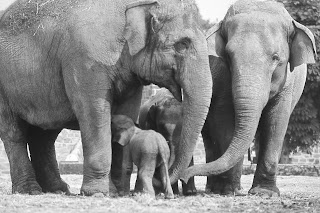
Motty with his mother Sheba at Chester Zoo in 1978 (© Dave Haynes)

On 1 March 2011, I uploaded here on ShukerNature an expanded version of an article of mine that had previously been published by the British monthly magazine Fortean Times. It's not very often that an animal can truly be described as unique, but the subject of that article really was. Named Motty and born at Chester Zoo, England, on 11 July 1978, he was the world's one and only confirmed hybrid of an African elephant and an Asian elephant. And as these species are housed in separate genera, Motty was not only an interspecific hybrid, he was also an intergeneric one. In fact, prior to his highly unexpected birth, it was not thought possible that an offspring resulting from a mating between an African and an Asian elephant could even occur – but Motty's arrival proved everyone wrong.


Tragically, however, this very surprising little newcomer died only 11 days after being born, and in spite of his extraordinary identity Motty was all but forgotten for many years thereafter – until, that is, my article (the most detailed account of Motty ever published) restored him very deservedly to public attention and piqued the interest of entirely new generations of readers. Moreover, as a result of my article's level of popularity, various readers sent to me extra information concerning Motty and also several additional photographs of him, none of which had previously been made public, as well as some remarkable visual reconstructions of what he may have looked like had he survived into maturity, all of which I duly posted in a couple of follow-up ShukerNature articles (click here and here to view them).


Now, I am delighted to say that after perusing those articles of mine, a further reader contacted me on 16 and 17 January 2020 to share with me (and also, very kindly, to permit me to share here with you) some more Motty photographs, again previously unseen and therefore making their public debut here. The reader in question is Dave Haynes, who was a keeper at Chester Zoo during Motty's all-too-brief life, and who not only recalled seeing him but also snapped some photos of him with his Asian elephant mother, Sheba. So here, by kind permission of Dave, are his photographs, offering new and very precious visual insights into the little miracle that was Motty.

Motty and Sheba with keepers Ray Packwood (left) and Paul (© Dave Haynes)

All five photographs here are reproduced courtesy of their owner and copyright holder, Dave Haynes – thank you so much, Dave!


Monday, 16 February 2015

MOTTY AS AN ADULT? – IS THIS WHAT THE WORLD'S ONLY INTERGENERIC HYBRID ELEPHANT WOULD HAVE LOOKED LIKE HAD HE SURVIVED TO MATURITY?


Motty as a calf (above) and a photo-manipulated image (below) of what he may have looked like had he survived to adulthood (photo courtesy of Derek G. Lyon/Chester Zoo; photo-manipulation by Paul Willison of public-domain photograph of adult bull African elephant)

For 11 days, a little elephant calf called Motty was the world's first (and remains its only) intergeneric hybrid elephant, resulting from an unanticipated mating between a male African elephant Loxodonta africana and a female Asian elephant Elephas maximus at Chester Zoo, England, in July 1978. In my previous ShukerNature article (click here), the second of two documenting this truly unique animal (click here for my first one), I mentioned that I had often wondered what Motty would have looked like if he had survived to maturity, and I mourned the fact that we shall never know. This is of course perfectly true, we can only speculate – but now, I'm delighted to reveal that such speculation has acquired an astonishing and thoroughly fascinating visual form.

Facebook friend and computer art enthusiast Paul Willison shares my interest in what the adult appearance of Motty might have been. Consequently, after reading both of my Motty articles and noting that in overall body form (especially with regard to his long slimmer legs and large triangular, pointed ears) Motty seemed somewhat closer to Loxodonta than Elephas, Paul used his photoshop skills to transform the adult bull African elephant present in each of two public-domain photographs into what may conceivably be accurate images of Motty as a fully-mature elephant. Paul utilised as his morphological guides the photographs of Motty as a calf that appear in my articles, plus my detailed verbal description of him, which was based in turn upon an official account of Motty prepared by Derek G. Lyon, who was Chester Zoo's chief veterinary surgeon at the time of this remarkable little elephant's existence there.

And here they are.

Photoshopped adult bull African elephant #1, now exhibiting the unique complement of morphological characteristics possessed by Motty as a calf (public domain image photo-manipulated by Paul Willison)

And:

Photoshopped adult bull African elephant #2, now exhibiting the unique complement of morphological characteristics possessed by Motty as a calf (public domain image photo-manipulated by Paul Willison)

If these two photographs are directly compared with their respective original, non-photoshopped versions (see below), it can be readily seen how Motty's composite, intergeneric morphology might well have yielded when translated into adult form an elephant that looked dramatically different from any that had ever been seen before, one that was singularly imposing and impressive.

For although he is likely to have retained the overall stature and body proportions of his African elephant father as well as his single large frontal skull dome, Motty would also most probably have retained his paired posterior skull domes inherited from his Asian elephant mother, as well as her species' very distinctive convex back, greater number of toes per foot, and her single trunk-tip digit – features that do not occur in African elephants (the latter possess two trunk-tip digits).

Original, unmodified African elephant photo #1 (above), and the 'Motty-fied' version (below) (public domain; public domain image photo-manipulated by Paul Willison)

And:

Original, unmodified African elephant photo #2 (above), and the 'Motty-fied' version (below) (public domain; public domain image photo-manipulated by Paul Willison)

Nor is this the end of the story. As Paul swiftly recognised and brought to my own attention after completing his photo-manipulations, the resulting images predicting the possible adult appearance of Motty bear more than a passing resemblance (aside from shorter tusks and larger ears) to a certain proboscidean that is spectacularly different from anything alive today – nothing less, in fact, than the gargantuan Columbian mammoth Mammuthus columbi, one of the most awe-inspiring prehistoric mammals of all time.

Native to North America and traditionally believed to have become extinct around 12,500 years ago (but possibly a few millennia later, due to the existence of certain contentious fossil remains that have yielded more recent dates), adult males of this stupendous creature stood 13 ft tall at the shoulder, even overshadowing all but the most exceptional of today's African elephants. It also sported enormous tusks, almost 14 ft long in some instances.

Yet due to this species' very close taxonomic affinity to the woolly mammoth M. primigenius (indeed, DNA evidence suggests that the Jefferson mammoth M. jeffersonii of North America might actually have been a naturally-occurring hybrid of the Columbian mammoth and woolly mammoth), it may well have possessed characteristics recalling Elephas, because the woolly mammoth is certainly more closely related to the modern-day Asian elephant genus than to the African one.

Model of the Columbian mammoth on exhibition last year at the Natural History Museum, London (© Dr Karl Shuker)

Also worthy of note here is that some mammalian hybrids, ligers (lion x tigress hybrids) being a well-known example, actually attain dimensions exceeding those achieved by both of their progenitor species. Is it possible, therefore, that an adult Motty might have surpassed even his African elephant father in stature, thereby providing yet another parallel with the mighty Columbian mammoth?

Of course, all of this is speculation – entertaining, certainly, but completely speculative nonetheless. Even so, perhaps we should not be too surprised after all to discover that Motty, a hybrid deftly combining the African elephant's basic build and proportions with the more specific idiosyncrasies of the Asian elephant, may in adulthood have superficially recalled the Columbian mammoth – a fascinating outcome that, if correct, makes his demise even more tragic than ever, our modern-day world possibly having lost the nearest morphological evocation of the majestic but long-bygone Columbian mammoth that anyone will ever see.

My sincere thanks to Paul Willison for so kindly preparing and making available to me for inclusion here the photo-manipulated images of Motty's possible adult appearace.

Life-sized model of the Columbian mammoth on exhibition last year at the Natural History Museum, London (© Dr Karl Shuker)


Saturday, 14 February 2015

THE RETURN OF MOTTY, THE MIRACLE HYBRID ELEPHANT - UNVEILING SOME NEVER-BEFORE-SEEN PHOTOGRAPHS OF HIM!


Motty and his mother at Chester Zoo, July 1978 (© Mike Poustie, c/o Chris Poustie)

In an earlier ShukerNature article (click here). I documented the birth and tragically-short but zoologically-immortal, never-to-be-forgotten life of a truly unique animal – a little elephant called Motty. He has been referred to as the miracle elephant, and for good reason, because he was something that science had previously rejected as an outright impossibility – a hybrid between an African elephant Loxodonta africana (Motty's father) and an Asian elephant Elephas maximus (Motty's mother). No intergeneric elephant hybrid had ever been recorded before, and none has since, and almost certainly never will be ever again.

Motty was born at Chester Zoo, England, on 11 July 1978, but his arrival was totally unanticipated by everyone at the zoo, because although a male African elephant was being maintained together with some female Asian elephants there and had been seen mating with them, no-one had expected any offspring to result from such liaisons, because the genetic differences between the two genera that the African and Asian elephants respectively represent were deemed too great for such an event to occur. But somehow, incredibly, an offspring did result – Motty. Sadly, however, just 10 days after his zoologically historic birth, little Motty died, and a post-mortem revealed that he had been suffering from an unsuspected outbreak of necrotic enterocolitis plus E. coli septicaemia.

Motty was subsequently preserved as a taxiderm specimen and has been held ever since in the vast stores of London's Natural History Museum, but he has never been publicly displayed, which is a great shame, because such an extraordinary animal would surely attract considerable attention and interest.

Head-and-back view of Motty with his mother (© Mike Poustie, c/o Chris Poustie)

Due to his all-too-brief existence, very few images of Motty exist. However, he was photographed by Derek G. Lyon, who was Chester Zoo's chief veterinary surgeon at that time, and Derek has very kindly made his photos of Motty available to me to incorporate in any of my writings. Some of these pictures were duly included, therefore, in my previous Motty article on ShukerNature. As seen when viewing them (click here), they readily reveal the complex intermingling of morphological characteristics drawn from Motty's two very different progenitor species and embodied in his own singular appearance.

Now, moreover, I am delighted and very excited to announce that some additional Motty photographs have been brought to my attention – photos that have never previously been seen in public, but which, once again, have very kindly been made available to me by their owner for inclusion in my writings.

On 24 May 2013, a reader who identified himself only as Chris posted a short message beneath my original Motty article on ShukerNature informing me that he had actually seen Motty alive during a visit to Chester Zoo in mid-July 1978 with his father and brother when he was 6 years old, and that his father had snapped some colour photos of Motty. Chris promised to scan and email the photos to me if I'd like to see them. I swiftly confirmed that I would definitely like to see them, and on 3 January 2015 Chris sent them to me, revealing that his full name was Chris Poustie and his father's was Mike Poustie. Moreover, in a follow-up email, he stated that both of them were happy for me to utilise the photos as I wished in my publications and researches.

So now, officially unveiling them as a ShukerNature world-exclusive, here are some of the Poustie photos of Motty, interspersed throughout this present ShukerNature article – thanks very much, Mike and Chris!

Detailed view of Motty with his mother (© Mike Poustie, c/o Chris Poustie)

Once again, as with Derek's photos, they perfectly capture for all time Motty's fascinating intergeneric morphology, a composite creation unlike any other, and proof that whatever the odds, however implausible the prospect, somehow life will always find a way to express itself.

Whenever I think of Motty, I always wonder what he would have looked like had he survived to maturity. Would he have retained his unique combination of characters from both species, or would those inherited by him from one species have largely obliterated those inherited by him from the other? Might he have attained the huge size of his father – indeed, might he have even surpassed it, just like ligers (lion x tigress hybrids) often exceed the dimensions of both of their progenitor species?

Sadly, we will never know, and can only ever speculate. However, I feel sure that whatever appearance Motty would have assumed as an adult, it could not have been anything other than magnificent and marvellous – just as marvellous, in fact, as his very existence had been, and always will be.


UPDATE - 16 February 2015

I mentioned earlier in this present ShukerNature article how sad it was that we shall never know what Motty would have looked like had he survived into adulthood, only that whatever form his appearance may have taken, it would certainly have been unique, marvellous, and magnificent. But now, in another ShukerNature world-exclusive, thanks to a couple of amazing illustrations we may finally have an idea after all of just what the mature Motty could have looked like. And as if that were not extraordinary enough, what makes this new insight even more astonishing is a totally unexpected similarity to one of the world's most spectacular prehistoric mammals. Intrigued? Confused? Excited? Click here, and all will be revealed!

Full view of Motty with his mother (© Mike Poustie, c/o Chris Poustie)


Sunday, 11 January 2015

A JUMBO-SIZED REVELATION FROM CHINA - STRAIGHT-TUSKED ELEPHANTS IN HISTORIC TIMES?


Models of straight-tusked elephants Palaeoloxodon (© Apotea/Wikipedia)

As recently as 3000 years ago, elephants were still living wild in northern China, which may come as something of a surprise to many people. But something far more surprising concerning them has lately been proposed.

It had long been assumed that these were Asian elephants Elephas maximus, because this familiar modern-day species still exists today in southern China. However, researches conducted by a team of scientists from Shaanxi Normal University and Northwest University in Xi'an and from the Institute of Geographic Sciences and Natural Resources Research in Beijing, and published on 19 December 2012 in a Quaternary International paper, sensationally divulged that the northern China elephants seemingly belonged to an entirely separate, ostensibly long-extinct genus, Palaeoloxodon – housing the straight-tusked elephants.


Might Palaeoloxodon warrant an entry in my book In Search of Prehistoric Survivors?

Until now, China's Palaeoloxodon species (as yet unnamed) was thought to have died out at the Pleistocene-Holocene boundary, approximately 10,000 years ago. However, the Chinese team's findings indicate that it was still alive at least 7000 years longer, into historic times – a veritable prehistoric survivor, in fact.

The team's revelations were based upon their re-examination of 3000-year-old fossil teeth hitherto believed to have been from Elephas but now recognised to belong to Palaeoloxodon; and their reinterpretation of 33 northern Chinese elephant-shaped bronze wares from the Xia, Shang, and Zhou dynasties (c. 4100-2300 years ago) whose trunks all had two grasping finger-like digits, whereas the trunk of E. maximus only ever has one, thus suggesting that these bronzes may depict Palaeoloxodon, not Elephas.

Possible Palaeoloxodon depicted by ancient Chinese ware, with two-fingered trunk-ending ringed in red (© Quaternary International)

Not everyone agrees that this partial resurrection of Palaeoloxodon in China is valid, however, with fossil elephant experts Drs Adrian Lister and Victoria Herridge claiming that the supposed dental differentiating features are merely contrast artefacts created by the low resolution of the photographs as published in the Chinese team's paper and that these features do not appear in better-quality photographic reproductions. They also note that cultural and iconographical aspects appertaining to Chinese art at the time of the bronzes' creation might reconcile their double-digited trunks with Elephas after all, not requiring the need to resurrect Palaeoloxodon.

In short, it is likely that this intriguing subject will attract further palaeontological scrutiny and contention for some time to come.

Ornate sculpture of an Asian elephant Elephas maximus (© Dr Karl Shuker)


Thursday, 3 July 2014

THE CURIOUS CASE OF ROTHSCHILD'S LOST TUSK AND THE NON-EXISTENT ELEPHANT PIG - AN ENDURING CRYPTOZOOLOGICAL CONUNDRUM FROM AFRICA

Afrochoerus purposefully portrayed here as originally conceived when first discovered, i.e. erroneously sporting the tusks of a prehistoric elephant (© Hodari Nundu/deviantart.com)

I first came upon the following crypto-case many years ago when browsing through Dr Bernard Heuvelmans's book Les Derniers Dragons d'Afrique (Plon: Paris, 1978), and it has fascinated me ever since. Recently, I obtained some additional, previously-undisclosed information concerning it, and which turned out to be something of a conundrum in itself. Consequently, it is high time that I finally presented the remarkable story behind one of the most intriguing and potentially significant examples on record of an apparently lost specimen of possible cryptozoological relevance. So here it is – the story, that is, not the specimen itself, sadly!

It all began in an Ethiopian ivory market, one of many in this country's capital, Addis Ababa, back in the opening years of the 20th Century (when Ethiopia was still called Abyssinia). In 1904, Baron Maurice de Rothschild and French zoologist Henri Neuville were visiting this particular ivory market during an East African expedition when they noticed a very odd-looking tusk on a stall owned by some ivory merchants from India. Although in excellent condition, supposedly of modern age (i.e. not fossilised, though possibly several centuries old), and superficially similar to an elephant tusk but with a very dark patina, in terms of length it only measured 0.56 m (22 in) in a straight line and only 0.74 m (29 in) following its curve, so it was smaller than most elephant tusks of comparable proportions that they had previously sold. In addition, it bore a series of longitudinal, regularly-spaced, narrow grooves or corrugations on what appeared to be its upper side and a single long but very broad groove on its apparent underside, instead of being smooth-surfaced like regular elephant tusks. Consequently, it had not attracted interest from potential buyers.

Three different views of the mystery tusk purchased in Addis Ababa by Rothschild and Neuville, as depicted in their 1907 paper documenting it

The ivory merchants were unable to provide any information regarding this odd tusk's original geographical provenance or from what type of animal it had been obtained. Indeed, they considered it not to be a tusk at all, but rather some form of horn. Nevertheless, intrigued by its strangeness, and no doubt encouraged by its lower-than-normal price, Rothschild and Neuville duly purchased it. Moreover, while still in East Africa, Neuville was informed by some Somali hunters and camel herders that tusks like this one came from an aquatic, hippopotamus-sized creature of great strength, whose tusks curved downwards to the ground, and which inhabited certain very large East African lakes. According to them, one of these lakes is what is now known as Lake Abaja (formerly called Lake Margherita) where they claimed to have seen a living specimen, and another such lake is situated on the border of Kenya and Uganda.

Following their return to Europe, Rothschild and Neuville's unusual zoological purchase was exhibited at three separate scientific meetings. Namely, the Société Philomathique of Paris on 14 January 1905; the Zoological Society of London on 14 November 1905 (where it was presented by Lord Walter Rothschild, distantly related to Maurice de Rothschild, who was a lifelong zoological researcher and prodigious collector of wildlife specimens that he housed at his own personal natural history museum at Tring in Hertfordshire); and the Academy of Sciences, Paris, on 11 December 1905. (Oddly, a short notice in the Zoological Society's Proceedings documenting the tusk's exhibition there claimed that two such tusks, not one, had been obtained by Rothschild and Neuville and had been exhibited at the Society.)

Rothschild and Neuville then prepared an extensive scientific paper documenting their anomalous tusk, which was published on 15 October 1907 in the French journal Archives de Zoologie Expérimentale et Générale (4th Series), was over 50 pages long, and was aptly entitled 'Sur une Dent d'Origine Énigmatique'. In it, they compared the tusk closely with a range of others, including those of elephants, hippos, walruses, and wild pigs, as well as a large selection of freak, malformed elephant tusks housed at London's Natural History Museum and elsewhere. However, Rothschild and Neuville claimed that not only externally but also in terms of its internal grain structure as seen when viewed in cross-section, it differed markedly from all of them, and even from known fossil species of tusked mammal – to such an extent, in fact, that they considered it plausible that this unique specimen did indeed derive from some still-undiscovered animal species, exactly as claimed by the Somalis.

Line illustration of the Rothschild-Neuville mystery tusk, from their 1907 paper documenting it

Although referred to for the sake of convenience as a tusk both here in the present ShukerNature blog article and also in the Rothschild-Neuville paper, this enigmatic object was technically a tusk section, not a complete tusk, having been sectioned some way between its tip and its base, with the latter not being present. From their examination of it, Rothschild and Neuville considered that had it been present in its entirety, it would have been almost semi-circular in shape, and that the section preserved was probably derived from a right-hand tusk. Intriguingly, the tip showed no sign of having been sharpened, whereas elephants tend to sharpen their tusks' tips on hard objects that they encounter. From the trace of the pulp cavity remaining, the authors considered it likely that their perplexing tusk had exhibited continuous growth in life, like elephant tusks, rather than like normal teeth that do not grow continuously through life.

The Rothschild-Neuville mystery tusk was totally devoid of enamel (moreover, it occurs only at the onset of tusk development in elephants, whereas a thick layer is present in hippo tusks; enamel occurs at the tip in walrus tusks, though this tends to be worn off as the animal matures). However, there was a layer of cement, which, although not particularly thick, was very extensive (a cement layer replaces the enamel layer in elephant tusk development). As for its anomalous grooves, superficially similar structures are also borne upon the surface of hippo tusks, but their arrangement is very different from that of the Rothschild-Neuville mystery tusk's grooves. This is also true of the grooves that sometimes occur on wild pig tusks, and those present on various teratological tusks from elephants that were examined by the authors. Several distinctive traits can be found in diseased examples of elephant tusks, but none of those traits was exhibited by their mystery tusk, which appeared to be perfectly healthy, thus eliminating another possible explanation of it. For further morphological and histological details, please consult the meticulous description in their original paper.

A couple of hippopotamus tusks, the upper one revealing the grooves on its upper side, the lower one revealing those on its underside (© Dr Karl Shuker)

Having assessed all of their mystery tusk's characteristics, Rothschild and Neuville concluded that it compared more closely with elephant tusks than with those of any other mammal, but that even with these it also exhibited notable differences. Consequently, their preferred hypothesis was that it had therefore originated from a species of large mammal still unknown to science but probably most closely related to proboscideans (Proboscidea is the taxonomic order containing elephants).

Notwithstanding this exciting possibility, however, the Rothschild-Neuville mystery tusk rapidly sank into zoological obscurity following their paper's publication in October 1907, with only Heuvelmans's aforementioned documentation of it in his 1978 book briefly raising its profile. And yet with modern-day advances in microscopical, chemical, and genetic analyses readily available, surely a re-examination of this specimen utilising these techniques might unlock the secret of its original owner's still-cryptic taxonomic identity? Quite possibly, if only this mystery tusk's current whereabouts were known.

Les Derniers Dragons d'Afrique, 1978 (front cover illustration © Alika Lindbergh/Plon)

French cryptozoologist Michel Raynal was in direct, frequent correspondence with Heuvelmans for many years, and I recently learnt from him that Rothschild and Neuville had deposited their mystery tusk at France's National Museum of Natural History in Paris and that it had been accorded its own accession number. However, he had been told by Heuvelmans about 20 years ago (Heuvelmans died in 2001) that the tusk could not be found there by the museum staff when he (Heuvelmans) had requested sight of it, not even when he had given them its correct accession number. So it had probably been lost many years earlier. But what was Heuvelmans's opinion concerning the possible identity of the mysterious creature from which the Rothschild-Neuville tusk had originated? This is where the story becomes even more intriguing, because Heuvelmans expressed two very different opinions concerning this issue – one publicly, another one privately.

The more conservative (relatively speaking) of the two is the opinion that he expressed publicly, in his book Les Derniers Dragons d'Afrique (1978).  Here he suggested that the unrevealed tusk-bearer may be an unknown species of proboscidean. In his classic book On the Track of Unknown Animals (1958), Heuvelmans had referred to a cryptic aquatic proboscidean, the so-called water elephant,  which I have also reviewed in various of my own writings, particularly in my book In Search of Prehistoric Survivors (1995) and most recently on my ShukerNature blog (click here).

Said to inhabit certain Congolese lakes (Lord Walter Rothschild had collected reports appertaining to this cryptid there and also in Tanzania as well as South Africa, as noted in the Rothschild-Neuville paper), and sighted on two separate occasions during the first decade of the 20th Century by French explorer M. Le Petit, the water elephant, as its name suggests, allegedly spends much of its time submerged, only emerging onto land during the evening. It is readily distinguished from normal elephants morphologically too, via its very elongate, ovoid head and its extremely short, tapir-like trunk. However, it is also said to lack tusks. If so, while again distinguishing it from normal elephants, by definition this characteristic also eliminates it from consideration as the originator of the Rothschild-Neuville mystery tusk.

Artistic representation of the Congolese water elephant (© Markus Bühler)

Nevertheless, following publication of the Rothschild-Neuville paper, Le Petit was urged by Paris's National Museum of Natural History to pursue reports of a similar creature supposedly inhabiting Lake Chad in West Africa. Moreover, according to an article penned by Prof. Emile Trouessart in the 21 January 1911 issue of the French periodical La Nature, Le Petit would be accompanied by noted French zoologist Dr Emile Gromier, and the suggestion was that both the West African water elephant and the unknown originator of the Rothschild-Neuville mystery tusk may be a living deinothere.

Deinotheres were very large and highly unusual proboscideans known only from fossils, and characterised by their lower jaw's downward-curving pair of tusks. A deinothere had been discounted by Rothschild and Neuville in their paper as a plausible identity for their tusk's originator, but Heuvelmans did not discount a relatively small, amphibious, scientifically-undetected modern-day version out of hand when documenting the water elephant and the Rothschild-Neuville tusk in his books. As for the planned expedition to Lake Chad: I have been unable to discover whether Le Petit and Gromier ever did go there – but even if they did, they certainly didn't find a deinothere.

Reconstruction of a deinothere (© Dmitry Bogdanov/Wikipedia)

Heuvelmans's second, privately-expressed opinion as to what creature the Rothschild-Neuville mystery tusk may have come from is even more radical than an undiscovered species of probiscidean. In a couple of emails sent to me by Michel Raynal during June 2014, Michel stated:

"In Heuvelmans's dossier on the tooth in Lausanne [the site of his Centre de Cryptozoologie], I noticed that there is an article on Afrochoerus, making me think that Heuvelmans believed that the "owner" of this tooth was more or less related to this fossil suid…

"Heuvelmans seemed to believe that it was a living Afrochoerus (he even told me, when I visited his "centre de cryptozoologie" in the 1980s, "je sais ce que c'est" = I know what it is).

"However, Afrochoerus tusks are somewhat different."

They are indeed! In fact, the tusks of this African fossil pig once yielded a very notable controversy of their own.

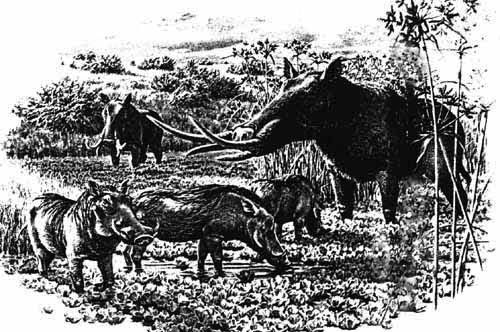
Dating from the Pliocene epoch, Afrochoerus nicoli was formally described in 1942 by celebrated palaeontologist Dr Louis Leakey from the famous Olduvai fossil deposits in Tanzania, with substantial additional finds excavated there in subsequent years. Its most striking features were the tusks originally uncovered with it, which were disproportionately long, and in early reconstructions, portraying it with these huge tusks pointing forward, it resembled a bizarre hybrid of wild pig and mastodont!

Erroneous restoration of Afrochoerus as an elephant-tusked giant warthog alongside modern-day warthogs (picture source unknown to me)

In fact, this was quite prophetic, because palaeontologists now know that these tusks weren't suid (pig) tusks at all, but were in reality from Stegotetrabelodon – a genus of fossil gomphothere elephant! What had happened was that Afrochoerus had been based upon cranial remains of a bona fide fossil suid called Metridiochoerus compactus, the giant warthog, that had been discovered in close proximity to some tusks from Stegotetrabelodon, but which had been mistakenly assumed to be all from the same animal. In short, Afrochoerus – the extraordinary 'elephant pig' - was a non-existent composite, whereas the real tusks of M. compactus are nothing more than slightly larger versions of those possessed by modern-day warthogs, and project sideways, not forwards.

Accurate reconstruction of Metridiochoerus (© Nobu Tamura/Wikipedia)

Consequently, although he apparently did not realise it, by favouring Afrochoerus as the identity of the Rothschild-Neuville tusk's owner at the time that he did, Heuvelmans was still supporting a proboscidean candidate (albeit a different one from the deinothere option), because the tusks to which he was comparing the latter mystery tusk were actually elephant tusks, not pig tusks.

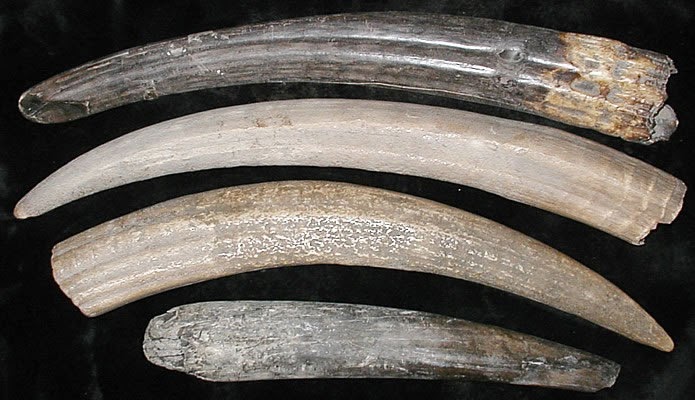
But could this mystery tusk have derived from something other than a proboscidean? When I inspected the illustrations of it in the Rothschild-Neuville paper, images of walrus tusks immediately came to mind, even though the authors had discounted this possibility in their paper. True, there are certain discrepancies. The underside of walrus tusks have a single wide groove (just like the mystery tusk), but the upper side typically bears only a series of very fine longitudinal cracks of varying lengths. Also, walrus tusks are generally long and fairly straight, whereas if Rothschild and Neuville were correct in assuming that in its entirely their tusk would have been almost semi-circular in shape, this would also argue against a walrus tusk as its identity. So too does the dark brown patina exhibited by their tusk.

A batch of confiscated illegally-trafficked walrus tusks and tusked walrus skulls as well as some polar bear pelts (© US Fish and Wildlife Service)

However, I have seen photos of walrus tusks that do bear deep longitudinal grooves. Moreover, when I recently consulted Paolo Viscardi, the natural history curator at London's Horniman Museum, who also favours a walrus tusk as the best candidate for this enigmatic specimen, he stated:

"Walrus tusks can also be quite strongly curved and if they [Rothschild and Neuville] were extrapolating the curve and complete length based on pulp cavity extent beyond the sawn region, they may have been wildly out if they didn't have Walrus in mind, since Walrus cavity space is less extensive than what we see in something like an Elephant or Hippo."

Moreover, although the authors stated that it was not a fossil tusk, fossil walrus tusks do sometimes have a dark patina.

Walrus tusks, including fossil specimens displaying a very dark patina (click here for image source)

But how would a walrus tusk have reached the ivory market of Addis Ababa anyway, bearing in mind that walruses only occur in the Arctic Ocean and the subarctic zones of the Atlantic and Pacific Oceans? Fellow Rothschild-Neuville tusk researcher Matt Salusbury, author of the book Pygmy Elephants (2013) in which this specimen is briefly referred to, suggested in an email to me of 30 June 2014 that whalers and immigrants from Scandinavia all en route to South Africa just prior to the tusk's appearance in Addis Ababa may have brought it with them.

Intriguingly, in South Africa's Orange Free State there are ancient bushman cave paintings that portray an unidentified creature bearing a remarkable resemblance to a walrus, and which has been colloquially dubbed the jungle walrus. The most famous one (portrayed below), which appeared in Rock-Paintings in South Africa (1930) by George William and Dorothea Bleek, can be found in a cave in Brakfontein Ridge, which was at one time (and perhaps still is?) contained within the grounds of a farm called 'La Belle France'. Just an imaginary beast, or a bona fide cryptid with possible relevance to the Rothschild-Neuville tusk?

The mysterious 'jungle walrus' as depicted in a cave painting at Brakfontein Ridge, South Africa

Of course, as noted earlier here, if only the Rothschild-Neuville tusk could be scientifically examined utilising the plethora of modern-day techniques readily available nowadays, its secrets would soon be teased out and laid bare. Yet as also noted earlier here, it was apparently lost long ago somewhere within the labyrinthine interior of its final resting place, the National Museum of Natural History in Paris – or was it?

Matt Salusbury has informed me (click also here) that he is currently pursuing the tantalising possibility that the tusk may not have been mislaid but simply mislabelled, and is hoping to have its accession number rechecked and also those of comparable specimens there, such as walrus tusks, to determine whether this most mystifying specimen is actually hiding in plain sight - not lost at all, therefore, merely overlooked. He is also the accession logs at London's Natural History Museum, the Zoological Society of London, and the Tring Natural History Museum, too just in case the tusk was transferred from Paris to any of these English repositories. I wish Matt every success in his exciting undertaking, and very much hope to be able to announce here soon that the Rothschild-Neuville mystery tusk has indeed resurfaced – which would be a major success for contemporary cryptozoology. So watch this space!

Line drawings from Heuvelmans's 1978 book based upon the photo of three views of the mystery tusk that appeared in the Rothschild-Neuville paper of 1907 (© Plon)


Friday, 14 September 2012

THE PINK-TUSKED BLACK ELEPHANT - A FORGOTTEN CHINESE PUZZLE


My painted wooden figurine of a black Asian elephant, with pink-suffused tusks supplied by computer magic! (Dr Karl Shuker)


In his book The Vermilion Bird (1967), concerning life in T'ang Dynasty China (618-907 AD), Edward H. Schafer referred to a highly distinctive type of elephant:

"One T'ang source [namely, Ch'ing I Lu, by T'ao Ku] tells of a race of black elephants with small pink tusks in Hsun and Lei [corresponding to the Leizhou Peninsula and southeastern Guangxi Province]. Perhaps this describes the true Chinese race itself, whose furious representatives had been subdued by the agents of the kings of Shang [the Chinese dynasty spanning c.16th-11th Century BC]...The naturally pink ivory of the local elephants was well favoured, indeed as equal to the ivory imported from overseas."

Yet as such creatures certainly do not exist today, one might be forgiven for assuming that they owe more to local legend than zoological reality - which is why it came as such a surprise to discover that this elephantine enigma has actually been assigned its own official scientific name.

In his volume Some Extinct Elephants (1955), Sri Lankan zoologist Dr P.E.P. Deraniyagala formally classified it as a discrete subspecies of the Asian elephant, dubbing it Elephas maximus rubridens ('pink-tusked'). Formerly native to eastern China as far north as the Yellow River, this elephant's attractively-tinted tusks proved so sought-after that it had been hunted into extinction by c.1500 BC. Elephants do still exist elsewhere in China, but these belong to the Asian elephant's Indian subspecies.

Black elephants were often illustrated by Mughal artists in India, such as this 17th-Century example, depicting black elephants from the stable of a Mughal ruler, but their tusks were white, not pink

Yet as there are no pink-tusked black Chinese elephants in existence any more, what did Deraniyagala use as his type specimen, upon which to base his formal description of this long-vanished subspecies? Remarkably, he selected for that purpose an antique Chinese bronze statuette - or, to be precise, an illustration of this statuette - present within the collections of Chicago's Field Museum of Natural History. The illustration had been published in 1925 by Berthold Laufer, Curator of Anthropology at the museum, within one of the museum's own publications, a 78-page anthropology leaflet (#21) entitled Ivory in China.

Illustration of a Chinese bronze elephant statuette from Laufer's leaflet

Today, conversely, the name Elephas maximus rubridens is generally listed merely as a synonym of Elephas maximus indicus, the Indian elephant. So except for the museum's statuette, it is as if the pink-tusked pachyderms with ebony hides never existed – unless somewhere, hidden away amid the vast collections of some museum or even as artefacts in some personal collection, there may still be a few surviving tusks or skins from this most unusual of elephants!

Many thanks to cryptozoological researcher Richard Muirhead and veteran chronicler of Sinian forteana Steve Moore for providing me with details regarding this previously-obscure, long-lost, creature.

Some very dark (painted?) elephants at a mosque in the centre of a Mughal fort in Rajasthan (www.rajasthan-tour-travel.net)

Tuesday, 1 March 2011

THE ELEPHANT OF SURPRISE - REMEMBERING MOTTY

Motty (photo courtesy of Derek G. Lyon/Chester Zoo)


Over the years, I have documented a vast array of animal reports that contain a truly remarkable element of surprise. In this present example, the element was an elephant – and his name was Motty.

Thirty-three years ago, he was a creature that the zoological world had previously deemed impossible. Yet for just over 10 days back in 1978, by virtue of his mere existence, Motty defied every scientific pronouncement. Had he lived further, ultimately reaching maturity, he may well have become one of the most famous animals on the planet. Sadly, however, it was not to be, and because of his tragically short life, Motty soon slipped into obscurity. Today, conversely, more than three decades on, it is high time that this truly singular animal should be remembered and returned to the spotlight, for Motty was indeed unique – the only intergeneric hybrid elephant that has ever been and probably will ever be.

Today, long after the demise of such notable prehistoric pachyderms as mammoths, mastodonts, and deinotheres, there are just two living genera of proboscideans. These are: Elephas, housing the single Asian species of elephant, E. maximus; and Loxodonta, housing the two closely-related species of African elephant (until recently deemed merely to be subspecies of a single species), the savannah elephant L. africana and the forest elephant L. cyclotis. There have been well-attested cases of hybridisation between the two African species, and also between various subspecies of the Asian elephant. Conversely, for reasons not only of basic zoogeography in the wild state but also of fundamental genetics, it was not thought possible, even in captivity, for Asian and African elephants to be able to produce viable young.

Consequently, even when, in early 1978, one of Chester Zoo’s female Asian elephants, Sheba, started showing signs of a pregnancy, zoo staff initially dismissed the prospect out of hand, because the only male elephant there at that time was Jumbolino, an African elephant. True, Jumbolino had been seen mating with her in the past, but the genetic differences between the two genera that Sheba and Jumbolino represented were such that no significance was attributed to these occurrences.

Motty taking a rest with his mother close by (photo courtesy of Derek G. Lyon/Chester Zoo)

The first physical sign that something more than mere sex may have taken place was the development of a noticeable fluid-filled sac, midway between her two pairs of legs, on the ventral surface of Sheba’s abdomen in February 1978, which proceeded to swell, until by May it was roughly 60 cm long and 10 cm wide. Yet still not suspecting a pregnancy was responsible, zoo staff treated it with an oral diuretic (Vetidrex), and by July it had disappeared. However, a new symptom had appeared by then – pronounced enlargement of the left-hand-side of Sheba’s abdomen, culminating on 10 July by the onset of parturition. Genetic differences or not, Sheba was pregnant.

Although her condition, once recognised, had been closely monitored, the climax still took everyone by surprise. On the morning of 11 July, Sheba walked out of the elephant house as usual with the other elephants, and then at 9.20 am, without warning, and in full view of her keepers, she casually gave birth to a small male calf. His size, weakness, and lack of hair clearly indicated that he was premature, probably by 6 weeks or so. Moreover, as this was her first surviving calf, Sheba seemed very unsure how to treat the new arrival, and gently but firmly pushed him down whenever he attempted to stand. At this point, the keepers moved in, leading the other elephants back into the elephant house, and because Sheba had no milk due to her calf’s premature arrival they proceeded to bottle-feed him hourly with cow’s milk, a vitamin supplement, and plenty of glucose for energy, coupled with colostrum obtained from Sheba.

By the end of 12 July, the calf – subsequently dubbed Motty after Chester Zoo’s founder, George Mottershead who had died just 2 months earlier – had become stronger, and after some assistance from the staff had succeeded in standing. He was also being aided by Sheba, whose maternal instinct by now had awakened, and he even managed to walk a few faltering steps. And by Day 5 (15 July) she was also allowing him to suckle fully, after initially pushing him away.

Whatever doubts had been entertained in the past that an intergeneric elephant hybrid was possible were emphatically swept away by this living, breathing refutation, because Motty’s entire morphology was a complex and thoroughly fascinating composite of maternal Elephas and paternal Loxodonta characteristics. To begin with, whereas the back of Elephas is arched and that of Loxodonta is concave, Motty’s back was both – possessing a central hump but also a pelvic one. His head exhibited a similar ambiguity, for although his brow was sloping with a single frontal dome like Loxodonta, he also sported the smaller paired posterior skull domes characteristic of Elephas. Even his trunk was an intergeneric compromise – heavily wrinkled like that of Loxodonta, but with only a single digit at its tip like Elephas (Loxodonta has two trunk digits). Adding to his Elephas features were his feet, as they bore five toenails on each front foot and four on each hind foot (more than in savannah Loxodonta elephants), but his Loxodonta heritage reasserted itself in his longer slimmer legs and his larger pointed ears.

Motty with his mother, readily revealing his complex intergeneric combination of features (photo courtesy of Derek G. Lyon/Chester Zoo)

By the end of his first week, Motty seemed to be doing just fine, suckling enthusiastically and sleeping well, receiving care and protection from his mother, and gentle interest from the other elephants. Testing a sample of his faeces suggested that he had a mild bowel infection, but as all else seemed so satisfactory, the decision was made not to treat it because his own immune defences would most probably be more than adequate to deal with it.

On Day 8 (18 July), Motty seemed restless and troubled, and when examined it was found that his umbilical scar had become infected, so this was treated at once with a course of antibiotics, and his condition soon showed an improvement. This was sustained throughout Day 10 (20 July), and was enhanced by supplementary feeds of cow’s milk containing added vitamins. By now, it looked likely that the world’s most extraordinary elephant had won his earlier fitness battle, and would go on from strength to strength. Sadly, however, sometimes appearances can only too readily deceive.

At 9 am on Day 11 (21 July), the keepers arrived to start work at the elephant house as usual – only to discover to their horror that Motty was comatose and dying. Immediately, the zoo’s vets began emergency heart massage and artificial respiration, and also injected a cardiac stimulant as well as providing him with extra warmth, but all to no avail. Less than an hour later, little Motty the miracle elephant was dead. A full autopsy discovered that he had been suffering from an unsuspected outbreak of necrotic enterocolitis – parts of the large intestine’s wall possessed dead tissue, becoming almost perforated – plus E. coli septicaemia. It seems likely that Motty’s weakened immune system – due in turn not only to his premature birth but also to his hybrid identity – had been insufficient to combat these conditions.

Motty with his mother and Chester Zoo's other female Asian elephants (photo courtesy of Derek G. Lyon/Chester Zoo)

Yet even though, tragically, Motty was no more, the very fact that he had indeed once existed was surely enough to have immortalised him not just in the media – which covered his all-too-brief life with considerable enthusiasm – but also in the scientific literature, for he was, after all, truly unique. In reality, conversely, nothing could have been further from the truth. Indeed, the lack of formal zoological interest in Motty was in its way every bit as surprising as Motty himself. To quote an extensive online history of Motty by Sam Whitbread:

"…the coverage by scientific journals was significant by its absence. Here was an animal the like of which had never been seen before and, it is almost certain, will never be seen again. Indeed, it was almost as though the world of science had chosen to turn its back on this unique event and ignore that the impossible had occurred. Specialist elephant journals and publications did recognise the birth for what it was but the International Zoo Yearbook merely made a casual mention of the birth in their reference section and IZN only carried a brief note."

Nor was that all. Following the autopsy, Motty’s skin was professionally mounted by a London taxidermist and after a short time in storage back at Chester Zoo was taken by Michael Brambell, the zoo’s director, to the British Museum (Natural History), where the zoo hoped that Motty would be placed on permanent display to be seen by as many people as possible. To date, however, he is still in storage, preserved securely for posterity but still unseen by the general public. How fitting it would now be, therefore, more than 30 years after his birth, for the zoological marvel that was once Motty to be commemorated and celebrated at last in a public exhibition, restoring to prominence a too-long-forgotten wonder who spent all too little time in our world.

I wish to offer my sincere thanks to Derek G. Lyon, who was chief veterinary surgeon at Chester Zoo during Motty's time there, for kindly making available to me his veterinary report identifying the cause of Motty's death, and also the images included here.


UPDATE - 14 February 2015

Exciting news! Very few images of Motty exist, due to his all-too-short existence. Just over a month ago, however, a correspondent sent me a series of colour photographs of Motty, snapped in mid-July 1978 by his father during a visit to Chester Zoo by him, my correspondent (then aged 6), and my correspondent's brother. These photos have never been released publicly, but my correspondent and his father have very kindly permitted me to use them in any of my publications. And so it is with great pleasure that I now officially unveil these previously-unseen, hitherto-unknown pictures of Motty as a ShukerNature world-exclusive! Click here to see them!


UPDATE - 16 February 2015

I have always thought how sad it is that we shall never know what Motty would have looked like had he survived into adulthood, only that whatever form his appearance may have taken, it would certainly have been unique, marvellous, and magnificent. But now, in another ShukerNature world-exclusive, thanks to a couple of amazing illustrations we may finally have an idea after all of just what the mature Motty could have looked like. And as if that were not extraordinary enough, what makes this new insight even more astonishing is a totally unexpected similarity to one of the world's most spectacular prehistoric mammals. Intrigued? Confused? Excited? Click here, and all will be revealed!


UPDATE - 24 January 2020

Some additional, previously-unpublished photographs of Motty have been brought to my attention by the person who snapped them and who has very kindly given me permission to include them on ShukerNature - so be sure to click here to view these exciting new pictures!


Motty, resting at his mother's feet (photo courtesy of Derek G. Lyon/Chester Zoo)