Dr KARL SHUKER

Zoologist, media consultant, and science writer, Dr Karl Shuker is also one of the best known cryptozoologists in the world. He is the author of such seminal works as Mystery Cats of the World (1989), The Lost Ark: New and Rediscovered Animals of the 20th Century (1993; greatly expanded in 2012 as The Encyclopaedia of New and Rediscovered Animals), Dragons: A Natural History (1995), In Search of Prehistoric Survivors (1995), The Unexplained (1996), From Flying Toads To Snakes With Wings (1997), Mysteries of Planet Earth (1999), The Hidden Powers of Animals (2001), The Beasts That Hide From Man (2003), Extraordinary Animals Revisited (2007), Dr Shuker's Casebook (2008), Karl Shuker's Alien Zoo: From the Pages of Fortean Times (2010), Cats of Magic, Mythology, and Mystery (2012), Mirabilis: A Carnival of Cryptozoology and Unnatural History (2013), Dragons in Zoology, Cryptozoology, and Culture (2013), The Menagerie of Marvels (2014), A Manifestation of Monsters (2015), Here's Nessie! (2016), and what is widely considered to be his cryptozoological magnum opus, Still In Search Of Prehistoric Survivors (2016) - plus, very excitingly, his four long-awaited, much-requested ShukerNature blog books (2019-2024).

Dr Karl Shuker's Official Website - http://www.karlshuker.com/index.htm

IMPORTANT: To view a complete, regularly-updated listing of my ShukerNature blog's articles (each one instantly clickable), please click HERE!

IMPORTANT: To view a complete, regularly-updated listing of my published books (each one instantly clickable), please click HERE!

IMPORTANT: To view a complete, regularly-updated listing of my Eclectarium blog's articles (each one instantly clickable), please click HERE!

IMPORTANT: To view a complete, regularly-updated listing of my Starsteeds blog's poetry and other lyrical writings (each one instantly clickable), please click HERE!

IMPORTANT: To view a complete, regularly-updated listing of my Shuker In MovieLand blog's articles (each one instantly clickable), please click HERE!

IMPORTANT: To view a complete, regularly-updated listing of my RebelBikerDude's AI Biker Art blog's thematic text & picture galleries (each one instantly clickable), please click HERE!

Search This Blog


PLEASE COME IN, I'VE BEEN EXPECTING YOU...

PLEASE COME IN, I'VE BEEN EXPECTING YOU...
WELCOME TO SHUKERNATURE - ENJOY YOUR VISIT - BEWARE OF THE RAPTOR!


Showing posts with label dwarves. Show all posts

Monday, 27 June 2016

REMEMBERING PEDRO – THE MISSING MINI-MUMMY OF WYOMING


Two views of Pedro plus one of his x-rays from 1950 (Wikipedia/public domain)

In a two-part ShukerNature article (click here and here) from 2009, I documented a wide range of accounts concerning mysterious dwarf-like or pygmy-like humanoid entities that have been reported across the length and breadth of North America, and are often colloquially – and collectively – referred to as littlefeet. One of the most interesting of these was Pedro, the so-called mini-mummy or mountain mummy of Wyoming, because this was an actual specimen (not just an eyewitness report or a tale from traditional folklore). Also, it had been discovered in a most unexpected location, and subsequently featured in a very intriguing chain of events. Back in 2009, my article's documentation of Pedro was fairly brief, but since then I have investigated this mystifying entity in further detail, enabling me to flesh out or highlight various aspects of its story that had previously been somewhat obscure, contradictory, or totally confused in other accounts accessed by me. Consequently, I am now presenting here a much-expanded, updated version of my original ShukerNature coverage of Pedro.

Pedro's extraordinary modern-day history may have begun one day in October 1932 (but see later for an alternative claimed date), when gold-prospectors Cecil Main (spelt 'Mayne' in some accounts) and Frank Carr blasted a hole through the wall of a ravine in the San Pedro Mountains, about 65 miles southwest of the city of Casper, Wyoming - and made a momentous discovery. The wall had been hiding a small, room-like, hitherto-sealed cavern, which contained a ledge, 2.5 ft off the ground. And sitting on that ledge, in cross-legged pixie-like pose, with its arms folded across its chest, was the mummy of a diminutive humanoid figure, with a sitting height of less than 7 in and a total height of only 14 in.

Front view of Pedro (public domain)

Sporting a tanned if wrinkled bronze-coloured skin, barrel-shaped body, well-preserved penis, large hands, long fingers, low brow, very wide mouth with large lips, and broad flat nose, this strange figure resembled a smirking old man, who seemed almost to be winking at its two amazed discoverers, because one of its large eyes was half-closed. Nevertheless, it was evident that this entity had been dead for a very long time, and its death did not appear to have been a pleasant one. Its head was abnormally flat, and was covered with a dark gelatinous substance - later examinations by scientists suggested that its skull may have been smashed by an extremely heavy blow, and the gelatinous substance was congealed blood and exposed brain tissue. Also, some reports claim that it had a broken clavicle (or scapula in certain others), as well as some broken vertebrae, and pointed "front teeth".

Due to its mountain provenance, this remarkable specimen was soon dubbed Pedro by the media, following its discovery's announcement in a report by the Casper Tribune-Herald newspaper on 21 October 1932 (but once again see later for an alternative claimed date).

When Main and Carr brought Pedro back home with them to Casper, it was widely denounced as a hoax, though some locals believed that it may indeed be one of the Little People long deemed in traditional lore to exist in the mountains. Carr died shortly afterwards, and in April 1934 Main sold Pedro to Homer F. Sherill from Crawford, Nebraska, who subsequently exhibited it encased inside a large glass dome as a curio at a circus there (as well as at several sideshows elsewhere), where it was seen by Eugene Bashor in 1936. Although he was only a boy at that time, Bashor was so fascinated by Pedro's enigmatic appearance that he went on to become a leading, longstanding investigator of North American mini-mummy and littlefoot reports.

Sideshow poster for Pedro (public domain)

Sherill owned Pedro for at least 7 years, but somehow this anomalous little entity subsequently turned up at Jones Drug Store in Meeteetse, a small town in Park County, Wyoming, where it remained on display until it was spied there one day in the mid-1940s by Ivan Goodman, a used car salesman from Casper, who reputedly purchased it from the drug store's owner, Floyd Jones, for several thousand dollars. Thereafter, Goodman utilised Pedro's eyecatching appearance to attract people to his car lot, and for which it became an unofficial mascot, with images of it being placed by Goodman in advertisements for his auto dealership. Moreover, it was during its period of ownership by Goodman that Bashor saw Pedro for a second time, in 1948, sitting on Goodman's desk.

In 1950, Goodman permitted some interested scientists to examine his 'mascot' in an attempt to uncover its true nature. The most detailed examination, including an x-ray analysis, was conducted by anthropologist Dr Henry ('Harry') Shapiro from New York's American Museum of Natural History. According to a Casper Tribune-Herald report of 5 March 1950, this study confirmed that Pedro was not a fake but did indeed contain a complete if minuscule skeleton, a fully-fused skull (seemingly verifying that it was an adult humanoid, not an infant), plus a full set of teeth. Some accounts have even claimed that Shapiro opined that Pedro had been approximately 65 years old upon death; others, conversely, alleged that he had identified it as an infant - yet another source of controversy regarding Pedro.

In that same newspaper report, Goodman himself was quoted as stating: "After an exhaustive study by the scientists it was agreed that it was the only specimen known of a human race of that type which perhaps dated back a million years". However, such a dramatic claim as this seems unlikely to have been made by the scientists, so it may well have originated from the canny Goodman instead - possibly as an additional means of publicising his car business. Unfortunately, there is no way of knowing for sure, because Goodman died later that same year.

Side view of Pedro (public domain)

Just before his death, Goodman loaned Pedro to Leonard Wadler, a New York businessman, for study purposes. However, it was never returned to Goodman's family, and Wadler moved to Florida soon afterwards, allegedly dying there during the 1980s. But what happened to Pedro? No-one knows, because no-one has been able to trace Wadler's precise movements and whereabouts once he had acquired Pedro. One report claimed that Wadler's family was contacted by (unnamed) investigators some time after his death enquiring where Pedro may now be, but that they had no idea either.

In a bid to rectify this regrettable situation, John Adolfi from Syracuse, New York, owner of the Bibleland Studios website, publicly announced on 3 February 2005 via a Casper Star-Tribune report by Brendan Burke that he would pay $10,000 for Pedro, if it still existed. He would then submit Pedro for DNA analyses, more x-ray studies, and magnetic resonance imaging in order to determine once and for all its precise identity. So far, however, Adolfi's reward remains unclaimed.

Reward poster for Pedro, issued by John Adolfi of Bibleland Studios (© John Adolfi/Bibleland Studios – reproduced here on a strictly non-commercial Fair Use basis only)

Incidentally, back on 13 November 1936 one of Pedro's original discoverers, Cecil Main, had signed an official affidavit containing what he claimed to be the true facts behind their notable find, and which was sworn in Scotts Bluff County, Nebraska, and officially recorded in Hot Springs County, Wyoming, on 16 August 1943. Oddly, however, this document contains what would appear to be some glaring inconsistencies with other versions of events.

In it, Main stated that Pedro had been discovered by them in June 1934. Conversely, as already noted in this present ShukerNature article, a report documenting that event had allegedly been published in the Casper Tribune-Herald on 21 October 1932, followed by additional articles published by this same newspaper in that same year, at least according to Brendan Burke's above-mentioned Casper Star-Tribune report from 2005. Here is what Burke wrote in it:

Mayne was prospecting for gold near Pathfinder Reservoir when an explosion he detonated revealed a small cave, according to a Oct. 21, 1932, article in the Casper Tribune-Herald. Inside the cave Mayne found the mummified remains of what looked like a tiny human.

Debate about the mummy's nature started soon after it was found. Some said it was a hoax. Others said it was the mummified remains of a baby. And others said it was one of the little people spoken about in Indian legends, according to Casper Tribune-Herald stories from 1932.

So if these supposed Casper Tribune-Herald reports from 1932 do indeed exist, then Main's claimed date of June 1934 was clearly incorrect. Main also alleged in his affidavit of November 1936 that Pedro was "now owned by Homer F. Sherill, and located in the Field Museum in Chicago, Illinois". Yet once again, contemporary reports claim that Main had actually sold Pedro to Sherill in April 1934 (i.e. two months before it had even been discovered, according to the discovery date given in Main's affidavit). Moreover, as noted by Rebecca Hein in an undated online article concerning Pedro accessible within the WyoHistory website:

Archivist Armand Esai notes that the Field Museum has no record of the mummy's presence during that time. The item still could have been there on loan or for identification, but because it was not part of the museum's official collection, the mummy was not listed in the records.

As seen, the discrepancies between different accounts as to whether Shapiro had (or had not) claimed that Pedro exhibited certain adult characteristics are by no means the only contentious, contradictory aspects of Pedro's post-discovery history.

Pedro inside his glass dome, with ruler to show size (public domain)

Fortunately, at least Pedro's original x-ray plates are still on file and thus confirmed, as are some vintage photographs of it, including those presented here. Moreover, not long after Pedro's initial discovery by the two prospectors, a Mexican shepherd called José Martinez reputedly found another mummy and six separate skulls on a ranch in the same vicinity. After soon suffering a number of mishaps, however, Martinez considered them to be jinxed, so he swiftly replaced them where he had found them.

Other mini-mummies have also been reported over the years from elsewhere in the U.S.A. One of the most noteworthy of these was a 3-ft-tall, red-haired specimen discovered on a ledge in Kentucky's famous Mammoth Cave, and exhibited widely during the 1920s, which seemed to be only a few centuries old (later radiocarbon-dating studies, however, revealed that it was 3,000-4,000 years old). During 1922, sheep-herder Bill Street claimed to have found several small skulls and whole mummies in Montana's Beartooth Mountains, but their present whereabouts are unclear. Two young men on a day off from the Civilian Conservation Corps in 1933 came upon a dead pygmy with sharp teeth in Wyoming's Wind River Mountains, but both died soon afterwards, and others who saw it allegedly died from severe illnesses.

In 1969, author John 'Ace' Bonar visited orthopaedic specialist Richard Phelps in Casper to see the preserved head of a mysterious tiny humanoid that he was displaying at that time in his shop. Bonar learnt that the head had originally been taken from a cliff near Wyoming's Muddy Gap. After Phelps's death in 1980, his daughter donated the preserved pygmy head to the University of Wyoming in Laramie, where it is still said to be today.

According to Bonar, the husband of Winnie Cardell from Alcova, Wyoming, also owned a mini-mummy - until he loaned it to a college professor, who never returned it. A specimen closely resembling Pedro, meanwhile, attracted media attention in January 1979 when it was loaned to Californian antique appraiser Kent Diehl of San Anselmo for examination. Just under 1 ft long, with an indentation at the back of the head indicating brain injury as the cause of death, the mummy was supposedly found in Central America during 1919, but Diehl would not publicly identify the family from Marin, California, that presently owns it.

This anterosuperior view of the head of an anencephalic human foetus demonstrates the disorganised connective tissue membrane that covers the top of the skull in the absence of the calvarium or skullcap (public domain)

Some researchers consider Pedro to have been a grossly-malformed human child or foetus - possibly with anencephaly, a teratological condition in which the brain has not developed fully (if at all) during foetal maturation. This latter identity was proposed for Pedro by anthropologist Prof. George W. Gill from the University of Wyoming after examining photos of it first shown to him by his students in 1971. Moreover, in 1994, after appearing with Eugene Bashor on an episode of the TV show Unsolved Mysteries hosted by Robert Stack and dealing with Pedro, Gill was contacted by a rancher from Cheyenne (Wyoming's capital) claiming to own a mini-mummy. This one proved to be a tiny blond-haired girl, only 4 in high, and dubbed Chiquita, which one of the rancher's (great-)grandfathers (reports differ) had purchased from a sheep-herder in or around 1929 and which had been kept ever since inside a trunk in his home's attic.

When Gill examined Chiquita and DNA analyses were conducted upon it, assisted by the Denver Children's Hospital, he found that it was indeed an anencephalic Native American infant (examination of a femur removed from this mini-mummy had revealed that its distal ends had not closed, a sign of infancy). In their book Mountain Spirit: The Sheep Eater Indians of Yellowstone (2006), Lawrence L. Loendorf and Nancy M. Stone stated that radiocarbon dating tests had indicated that it was around 500 years old.

With regard to Pedro, conversely, if its adult characteristics allegedly revealed by Shapiro during his 1950 study were genuine, and not erroneous identifications (or erroneous claims made by the media), they would seem to contradict an anencephalic status for it. (Incidentally, one report read by me claiming that Gill had studied Pedro's x-rays directly after Shapiro had conducted his own 1950 study of them, and that it was Shapiro who had personally given the x-rays to Gill at that time, is clearly in error, because in 1950 Gill was still only a youth.)

One of Pedro's x-rays from 1950 (public domain)

Also, why was Pedro placed on the ledge and then sealed away inside that small room-like cavern within the Pedro Mountains? After all, this does seem not only a very purposeful but also a very strange and extreme action for anyone to take with merely a malformed infant. And who placed it there anyway?

As documented in my 2009 two-part ShukerNature article on littlefeet, there are many Amerindian traditions of mysterious races of dwarves or pygmies. And some of these allegedly kill their own kind when they become old or infirm by beheading them, or by smashing their skulls - in precisely the way that Pedro and its Central American lookalike may have met their deaths. Just a coincidence?

Artistic representation of a North American littlefoot (© Tim Morris)

The story of Pedro the Wyoming mini-mummy is undoubtedly one of the most muddled, contradictory histories that I have ever investigated, so much so that I seriously doubt at this late stage in the proceedings, over 80 years since its discovery by Main and Carr, whether an entirely accurate course of events concerning this very enigmatic little entity will ever be pieced together.

Meanwhile, documenting Pedro in his book Stranger Than Science (1959), veteran mysteries investigator Frank Edwards made the following pertinent comment:

Scientists from far and near have examined this tiny fellow and have gone away amazed. He is unlike anything they ever saw before. Sitting there on the shelf in Casper, visible, disturbing evidence that science may have overlooked him and his kind much too long.

Moreover, just as there are two sides to every coin, in his own book The Monster Trap (1976) Peter Haining offered an equally disturbing, obverse view:

For as some of the more serious-minded of the old people of Casper who were alive at the time of the discovery will tell you, they believe the little man was one of a whole race of barbaric dwarf people who once lived in the region in ancient times. And they get the distinct impression from looking at him that he had been sitting there behind the stone wall for thousands of years waiting for someone - or something - to return.

Now just suppose, they go on with the merest hesitation, that the long-awaited return of what-ever-it-might-be has taken place - and it has found nothing there...

Seemingly not for thousands of years, but still a chilling little vignette, to say the least. And who knows - perhaps it really would have been best in this instance to have let sleeping dogs lie, or dormant dwarves dream on?

If anyone owns (or can obtain) copies of any of the Casper Tribune-Herald newspaper reports that were allegedly published in 1932 (and hence almost two years before the date of Pedro's discovery as claimed in Cecil Main's affidavit), I would love to see them! Thanks very much.

NB – As far as I aware, all illustrations included in this article are in the public domain (unless stated otherwise), including the x-rays (according to Wikipedia's entry for Pedro, they are in the public domain for the following reason: "Copyright expired because the work was published without a copyright notice and/or without the necessary copyright registration."), but in any case I am including all of them here on a strictly non-commercial Fair Use basis only.

Casper historian Bob David holding Pedro in a pre-1950 photograph (public domain)


Tuesday, 10 February 2015

SURREAL SYNCEPHALI – A TRIPLICATE LAMB FROM HUNGARY, AND RIPLEY'S DOUBLE-BODIED DONKEY


Engraving of an extraordinary triple-bodied, single-headed lamb that reputedly existed in Hungary in 1620

Many years ago, a correspondent sent me a photocopy of the remarkable engraving that opens this present ShukerNature article. It depicts what was allegedly a living lamb with three fully-formed bodies united by a single head. According to the caption included in the engraving, this extreme developmental monstrosity (the study of such freaks is known as teratology, which translates as 'the study of monsters') had been seen in Klausenburg, Hungary, during July 1620. (Incidentally, I have never been able to trace the original source of this engraving, so if anyone reading my article has any information concerning it, I'd welcome all details. Also: Klausenburg was technically part of Transylvania during the 1600s, which in turn was assimilated into Hungary before eventually becoming part of present-day Romania.)

A developmental monstrosity born with a single head but two bodies is known technically as a syncephalus or monocephalus, and is basically a pair of incompletely-separated (conjoined) twins in which, during embrogeny, the head (cephalic) portion of the originally-single embryo has not differentiated into two separate heads but has instead remained as a solitary undivided unit, thus developing into only a single head, whereas the body portion of the originally-single embryo has split into two halves with each half developing into a body. (Less common and more deleterious to survival is the reverse derivation of a syncephalus, in which a pair of separate twins originally develop but the heads of the two twins subsequently fuse during embryogeny with one head becoming reabsorbed into the other.) There is, however, a great deal of variation on record with regard to the degree of body-portion splitting occurring, so that in some cases the two bodies remain joined together rather than separating from each other – as seen with the following syncephalic lamb, illustrated in an early engraving of unknown origin (at least to me).

Engraving of a syncephalic lamb displaying incomplete separation of its two bodies

Examples of syncephaly have been recorded from many different animal species, including our own Homo sapiens. However, because of internal anatomical complications, not to mention the physiological strain of a single head attempting to maintain full neurological control and metabolic functioning of two bodies, syncephalic individuals possessing totally discrete bodies rarely survive for very long following birth. (In contrast, bicephalic or dicephalous individuals, possessing a single body but two heads, do sometimes survive to maturity, especially in certain creatures such as terrapins and snakes – click here for more information concerning two-headed snakes.)

Consequently, the concept of a surviving syncephalic lamb that possessed not just two but three completely separated bodies seemed too surreal, let alone too implausible, to warrant even the most cursory of considerations. So I simply filed away the engraving in one of my folders of teratological material and forgot all about it – until last Friday, 6 February 2015. For that was when I paid a visit to a very special attraction and saw something there that totally challenged my previous assumptions concerning syncephalic animals and their likelihood of surviving for any notable length of time following birth – and, in turn, made me think again about that anomalous triplicate lamb from Hungary.

Robert Ripley, founder of the Ripley's Believe It Or Not! franchise (public domain/Wikipedia)

The attraction in question was Ripley's Believe It Or Not! Odditorium London (click here to visit its official website). Situated on the corner of London's Piccadilly Circus, this is a spectacular six-storey exhibition centre that is packed throughout with bizarre curiosities and interactive displays celebrating the famous books, TV shows, and newspaper strips documenting all manner of incredibly weird yet wonderful people, animals, buildings, creations, and much much more that were originally compiled, collected, and drawn by entrepreneur-cartoonist Robert Ripley (1890-1949) for his countless publications.

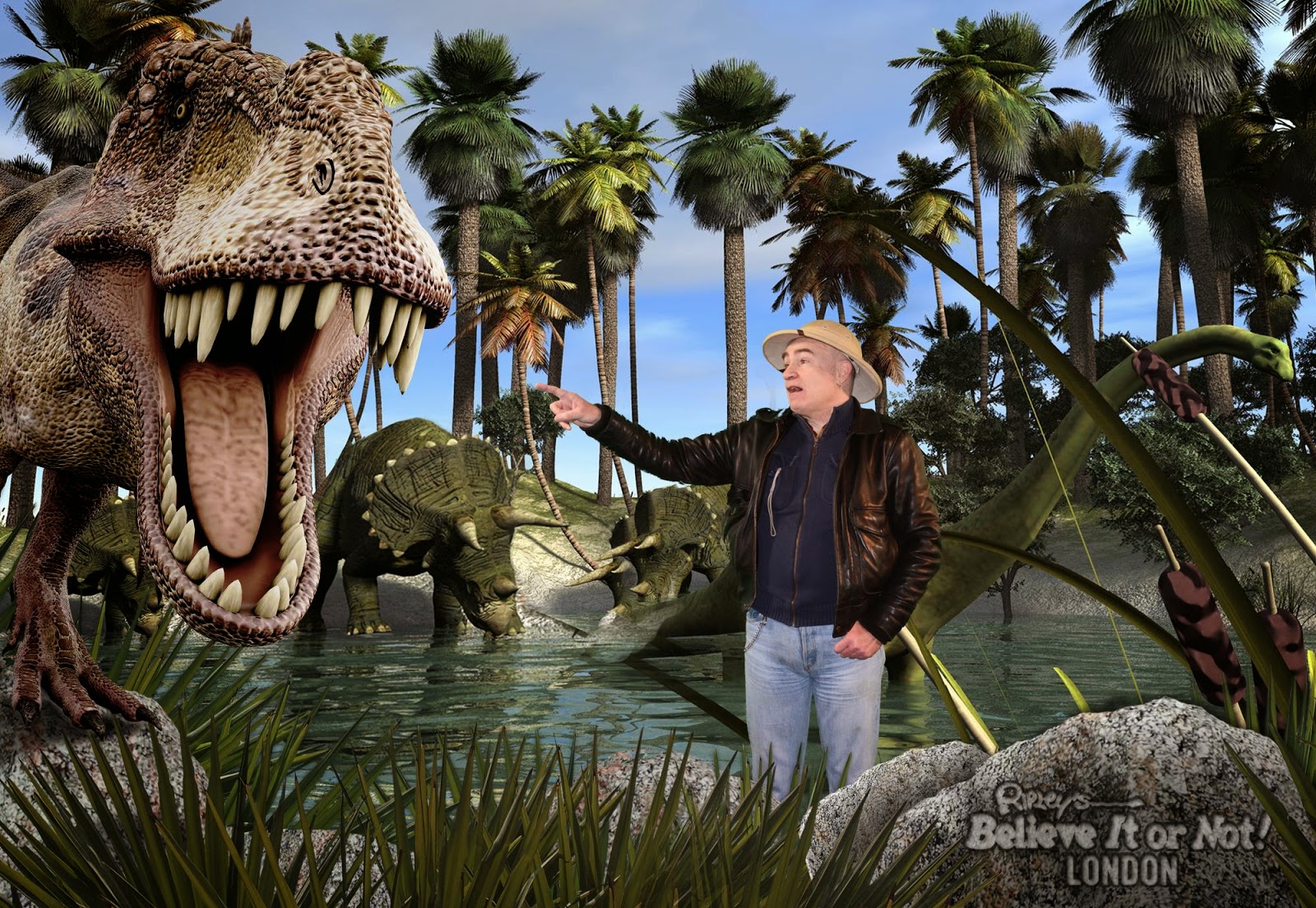
Experiencing some Mesozoic mayhem at Ripley's Believe It Or Not! Odditorium London (© Dr Karl Shuker)

As a zoologist, it was obviously the various –and extremely varied – animal attractions that particularly interested me, and I was certainly not disappointed in the array on display. There are many Ripley's Believe It Or Not! Odditoriums worldwide, especially in the USA (but with London's being the largest one of all), and they have become synonymous with teratological animals. There was certainly a goodly selection here in London (some of which were actual taxiderm specimens, others models of real specimens), including several two-headed creatures, animals with extra (supernumerary) limbs (a condition known as polymelia), and other equally curious caprices.

One such creature was a rooster with three separate legs that had been found in 1998 in England (exact location not specified), and was on display alongside a five-legged lamb (its right hind limb was a double leg), again from England and found during the early 1990s.

A three-legged rooster and a five-legged lamb – two polymelic animals at Ripley's Believe It Or Not! Odditorium London (© Dr Karl Shuker)

The two-headed lamb standing close by had been born in Shandong, China, in 2006, and both of its heads were fully functioning, with separate personalities.

Ripley's two-headed lamb from Shandong, China (© Dr Karl Shuker)

Just behind it was a pair of conjoined ('Siamese') piglets, joined back-to-back but with separate necks and heads (thus constituting a lesser version of the controversial rachipagus condition, in which conjoined twins are joined dorsally from the back of their heads down the entire length of their backs). These conjoined piglet twins were apparently similar in form to a pair possessed by the eminent Russian tsar Peter the Great (1672-1725), who famously owned a sizeable collection of scientific curiosities (click here for more information concerning this).

The conjoined piglets at Ripley's Believe It Or Not! Odditorium London (© Dr Karl Shuker)

Just inside the entrance to the odditorium was a taxiderm specimen of an adult black-and-white Friesian cow, which looked totally normal – until I realised that a fully-formed fifth leg complete with hoofed foot was growing outwards and upwards from between its shoulders! This bizarre teratological condition is called notomelia, and indicates that during this cow's embryogeny a supernumerary, aberrantly-located limb bud had developed. Alternatively, but more dramatically, as an example of what could be termed pseudonotomelia it is possible that the cow had originated as a pair of twins but that one of these two twins had subsequently degenerated and had been almost totally reabsorbed into the other one during their embryonic development, with only the single limb providing external evidence of the absorbed twin's former existence as a separate entity. (A very similar instance of notomelia, featuring a male Friesian calf, was published in the July 2014 issue of the Canadian Veterinary Journal.)

Ripley's notomelic Friesian cow possessing a dorsally-sited supernumerary leg, plus the heads and forequarters of a small white two-headed calf (© Dr Karl Shuker)

Here's another two-headed calf that was on display:

Two-headed calf at Ripley's Believe It Or Not! Odditorium London (© Dr Karl Shuker)

And here's an albino alligator, complete with ruby-red eyes:

Albino alligator at Ripley's Believe It Or Not! Odditorium London (© Dr Karl Shuker)

There were also a number of life-sized models of famous human curiosities. At one extreme was a model of Alypius, a dwarf from Alexandria during ancient Egyptian times, who was only 43 cm (17 in) tall, and whose fitting punishment for committing treason was imprisonment inside a parrot cage!

Model of Alypius at Ripley's Believe It Or Not! Odditorium London (© Dr Karl Shuker)

And at the other extreme, standing in front of a full-sized American mastodon skeleton that only served to emphasise his truly exceptional stature, was a full-sized model of Robert Wadlow (1918-1940), immortalised in the record books as the world's tallest man. Suffering from pituitary-induced gigantism, when he died aged just 22 years old he was already a little over 8 ft 11 in tall, and was still growing. Indeed, had he grown just under one inch more, he would have been the only confirmed 9-ft-tall human ever recorded. Standing alongside this real-life giant's model, even at a respectable 5 ft 10 in tall I still felt totally overshadowed by him, and overawed too.

Standing alongside the life-sized model of Robert Wadlow at Ripley's Believe It Or Not! Odditorium London (© Dr Karl Shuker)

Equally eyecatching was a full-sized bust of a man exhibiting hypertrichosis, also known as werewolf syndrome as persons displaying this condition of extreme hairiness were once believed by the superstitious to be lycanthropes.

Bust of a man exhibiting hypertrichosis at Ripley's Believe It Or Not! Odditorium London (© Dr Karl Shuker)

Also well worthy of attention was the conical, elongated skull of an ancient Peruvian, its extreme shape having resulted from the practice prevalent then and there of using tightly-wrapped cloth, boards, and rope to distort the shape of a child's growing skull via rigorous binding.

Manually-distorted conical skull of an ancient Peruvian at Ripley's Believe It Or Not! Odditorium London (© Dr Karl Shuker)

Yet despite all of these wonders and marvels, the specimen that startled me most at Ripley's Believe It Or Not Odditorium London was not actually on physical display there. Instead, it appeared – and even then only very fleetingly – on  a video being played in loop format on a screen close to most of the teratological animal specimens. The video showed a selection of teratological animals that were on display at various odditoriums around the world, and also included some footage of certain of these animals when they were still alive. Watching this video, I was astonished when a couple of seconds of film was shown of a living, seemingly adult, and clearly perfectly healthy syncephalic donkey, which consisted of a single head to which were connected two completely separated, fully-formed bodies!

By the time that my mind had registered this astonishing image, the video had moved on to showing other specimens, so I waited until it looped back to the beginning and then looked out for the donkey footage. After studying it intently when it reappeared, there was no doubt in my mind about what I had seen. It was indeed as I'd thought it to be on first viewing, both in form and in condition, though even now I struggle to comprehend how such a creature could survive to maturity – two independent four-legged bodies linked to a single controlling head.

After then waiting for the footage to come round a third time, when it did so I snapped a photo of this amazing donkey-in-duplicate, which although of poor quality would serve as a visual record of it for my files, and I vowed to investigate the matter further when I returned home. After all, if such a creature could truly exist and survive to adulthood, even the ostensibly impossible triplicate-bodied syncephalic lamb of Hungary suddenly seemed less implausible.

My photographic record of the syncephalic donkey as featured in the video shown at Ripley's Believe It or Not! Odditorium London (© Dr Karl Shuker/Ripley's Believe It or Not! Odditorium London)

And sure enough, my online researches have indeed confirmed the donkey's reality. Named Rascal, he was a miniature donkey owned by farmer Paul Springer whose farm is situated near Mineral Point, Wisconsin, USA. Paul's longstanding interest in teratological livestock has led him over the years to purchase a number of specimens that exhibit some anatomical peculiarity but are otherwise healthy and not suffering in any way, and allow them to live out a full, happy life on his farm instead of being slaughtered by their original owners either for their meat or simply because they were different.

Paul's first purchase was a six-legged calf called Boldegard during the 1970s, who went on to enjoy a long 14-year life on Paul's farm, followed by a range of other animals with extra legs, additional horns, two heads, or, in Rascal's case, one head and two bodies. Following their eventual deaths, half a dozen of the most striking individuals have been sold by Paul to the Ripley's Believe It Or Not! franchise for exhibition in various of their odditoriums. So it is possible that Rascal is on display in one of them, somewhere in the world. Consequently, if any of my readers have seen him, and can send me details, I'd very much like to receive them here – many thanks indeed in advance!

How uplifting it is to read of Paul Springer's compassion for all of the out-of-the-ordinary creatures that he has rescued from certain premature death. When asked in a media interview (WSAW.com 15 November 2009) what compelled him to rescue and care for animals with abnormalities, his answer was as inspirational as it was direct:

"There's something about them that maybe I feel sorry for. I give them a life. Most people will put them down and sell them. I am proud of them. People who see them, it gives them a chance to realize that everything isn't [normal], whether it be human beings or pigs or people or cats or dogs, we're not all born normal. Just because somebody has a handicap, they shouldn't be shunned. They should be given every chance, and love and attention that's possible."

Amen to that!

Rascal when alive (© Paul Springer)


Friday, 18 September 2009

FINDING OUT ABOUT 'FINDING OUT'!

Naga king, from Finding Out (Angus McBride)


Scottish cryptozoologist Alan Pringle has brought to my attention a very intriguing mystery of the cryptozoologically-related kind. Back in 1970 or 1971, at a friend's home, he saw a complete set of a magazine partwork series containing at least 30-40 issues, on an encyclopaedic or scientific theme (possibly aimed at children), and entitled Finding Out.

However, it was not their contents, but their covers, that attracted his particular interest and attention, because each issue's back cover featured an animal or entity from the myths and legends of the world, including a number that have cryptozoological relevance. A very dramatic, full-colour illustration of the creature occupied one half of the cover's page, with accompanying text occupying the other half.

The creatures that Alan can definitely remember appearing in this set of covers included the western dragon, eastern dragon, siren, tokoloshe, leshy, thunderbird, Midgard serpent, Assyrian winged bull, minotaur, centaur, bunyip, Egyptian ammut (soul eater), sphinx, and harpy. Others that he thinks may have been present include the werewolf, vampire, unicorn, cyclops, zombie, and banshee.

Alan has never seen this partwork again (and has long since lost contact with the friend who owned it), but he can still vividly recall some of the back covers due to their very eyecatching nature. I have certainly never seen them, and despite their dramatic appeal they do not seem to have been reproduced in any other publication. Moreover, in a letter to me from Phil Hide of Aylesbury, I learned that he actually owns most issues of this partwork up to volume 11, and that it was published by Purnell & Sons. Unfortunately, none of those particular issues' covers has any cryptozoology painting!

Happily, however, I have also received a letter from Alex Lamprey of Cardiff, who owns seven issues from volumes 16 and 17, and each of these issues' covers does depict a mystery beast or legendary entity. These are: sea serpents, bunyips, the cailleach-bheur, morrigan, gnomes, the Little People, and lamassu. Obviously, therefore, this series of illustrations did not begin until sometime after volume 11. The artist responsible for them was Angus McBride.

If there is anyone else out there who has seen this partwork (or, better still, owns an edition of it ior at least a run of those issues with cryptozoological back covers), or can offer any extra details, I'd love to hear from you.


STOP PRESS: 20 February 2011.

I'm delighted - and extremely grateful - to say that Alex Lamprey has very kindly donated to me his above-mentioned seven copies of Finding Out. They arrived this weekend, and their Angus McBride back-cover illustrations are every bit as spectacular as I'd hoped for! Needless to say, these near-legendary magazines (at least in my eyes!) now constitute a greatly-treasured addition to my library and images archive, and I shall be keeping a sharp lookout for the remaining 23 issues with McBride zoomythological back covers in order to complete my collection. Meanwhile, a massive THANK YOU!! to Alex for fulfilling a long-held ambition of mine to own at least some of them.


STOP PRESS: 3 March 2011.

Click here to read the fully-illustrated version of my ShukerNature blog post containing today's very exciting news! Thanks to the kindness of correspondent Ivan Waldock, who owns all 36 issues of Finding Out that possess cryptozoological/mythological back cover illustrations, and has sent me a scan of every one of them, I have been able at long last to provide the full set here online!


Sunday, 12 April 2009

NORTH AMERICA'S ELUSIVE BABYFEET – Part 2.

Reward poster for Pedro, the missing Wyoming mini-mummy


Herewith the second part of my survey of North America’s mysterious babyfeet and other littlefeet (click here for Part 1). If anyone out there has details of further examples, or additional information regarding any of those documented here (especially news regarding the Wyoming mini-mummy’s current whereabouts), I’d be very interested in receiving them.

THE GEOW-LUD-MO-SIS-EG OF NEW BRUNSWICK

Proving that Little People are not a Northwest idiosyncrasy, however, Amerindian traditions regarding such entities are also on file from the Northeast, notably New York State. Here, as revealed in Edmond Wilson's book Apologies to the Iroquois, at least two tribes of dwarves supposedly lived among the Tuscaroras. One of these tribes possessed extraordinary powers of healing and would sometimes treat injured or ailing Iroquois in exchange for gifts of tobacco, but the other tribe preferred to play tricks instead, unless appeased with tobacco.

Much further south, within Louisiana's Mississippi Delta, reports have periodically emerged concerning a race of 'little red men', according to Peter Haining, writing in Ancient Mysteries (1977). About the size of ten-year-old children, they allegedly inhabit the secluded depths of the bayous, where they are as adept at climbing trees as monkeys.

And even further south, in New Mexico, there is an ancient Cochiti legend telling of how the Pueblo tribe of the Stone Lions was attacked by a fierce race of pygmies. Full details are preserved in the 29th Annual Report of the Bureau of American Ethnology (1907-1908).

Nor are mystery mini-humanoids confined exclusively to the United States within the North American continent. Moving northwards across the 49th Parallel, southeastern Canada can also lay claim to a version - the Geow-lud-mo-sis-eg. These entities are commonly met with in the vicinity of water, such as marshy ground, riverbanks, brooksides, or lake shores. Fond of playing tricks on humans, they display a particular delight in finely braiding (with consummate skill) strands of hair on the tails of horses, cows, and other domestic animals.

Their lore has been extensively researched by writer Pat Paul, of the Maliseet Nation, who lives on the Tobique Indian Reserve in New Brunswick. Once frequently spied, nowadays the Geow-lud-mo-sis-eg are rarely reported, but they do not appear to have entirely vanished.

Several years ago, one of the Tobique elders and his wife looked out of their home's window one night during a heavy downpour of rain and saw three of these dwarves sitting around an outdoor fireplace. In keeping with the ancient lore concerning these strange beings, the fire burning in this open-air fireplace remained fully lit and blazing, in spite of the torrential rain pouring down upon it. Moreover, minute stone beads supposedly manufactured by the Geow-lud-mo-sis-eg have been found at the Passammaquoddy Nation (Sebayik) Reservation in Maine. Measuring 0.04-1 inch long, each of these beads is composed of a shale-like material, and contains a hole enabling the thread to pass through.

Far more remarkable, however, but tragically lost (or at least mislaid) are the pygmy coffins and corpses found on an unidentified island by Captain Luke Foxe during the early 1630s while exploring the Hudson Bay/Baffin Island region of northeastern Canada. In 1635, Foxe recorded his extraordinary find in his journal as follows:

"The newes from the land was that this Iland was a Sepulchre, for that the Salvages [sic] had laid their dead (I cannot say interred), for it is all stone, as they cannot dig therein, but lay the Corpes upon the stones, and well them about with the same, coffining them also by laying the sides of old sleddes above, which have been artificially made. The boards are some 9 or 10 ft long, 4 inches thicke. In what manner the tree they have bin made out of was cloven or sawen, it was so smooth as we could not discerne, the burials had been so old. And, as in other places of those countries, they bury all their Vtensels [utensils], as bowes, arrowes, strings, darts, lances, and other implements carved in bone. The longest Corpes was not above 4 foot long, with their heads laid to the West...their Corpes were wrapped in Deare [deer] skinnes...They seem to be people of small stature."

Although Foxe's sailors took away the wooden boards to be used as firewood, they did not disturb the pygmy corpses, but the island in question has never been satisfactorily identified, thereby ruling out the possibility of launching any modern search for further relics here.

WYOMING'S MINI-MUMMY

Iromically, the most contentious North American mini-humanoid on record is one that was actually formally examined by scientists. Yet it still remains mystifying, with a history full of contradictory claims.

This specimen's extraordinary history began one day in October 1932 (or June 1934 in some accounts), when gold-prospectors Cecil Main (spelt 'Mayne' in some reports) and Frank Carr blasted a hole through the wall of a ravine in the San Pedro Mountains, about 65 miles southwest of the city of Casper, Wyoming - and made a momentous discovery. The wall had been hiding a small, room-like, hitherto-sealed cavern, which contained a ledge. And sitting on the ledge, in cross-legged pixie-like pose, with its arms folded across its chest, was the mummy of a diminutive humanoid figure, with a sitting height of less than 7 in and a total height of only 14 in.

Sporting a tanned if wrinkled bronze-coloured skin, barrel-shaped body, large hands, long fingers, low brow, very wide mouth with large lips, and broad flat nose, this strange figure resembled a smirking old man, who seemed almost to be winking at its two amazed discoverers, as one of its large eyes was half-closed. Nevertheless, it was evident that this entity had been dead for a very long time, and its death did not appear to have been a pleasant one. Its head was abnormally flat, and was covered with a dark gelatinous substance - later examinations by scientists suggested that its skull may have been smashed by an extremely heavy blow, and the gelatinous substance was congealed blood and exposed brain tissue. Due to its mountain provenance, this remarkable specimen was soon dubbed Pedro by the media, following its discovery's announcement in a report by the Casper Tribune-Herald newspaper on 21 October 1932.

To cut a long and highly controversial (not to mention often contradictory) story short, Pedro became the property of used car-dealer Ivan Goodman from Casper, who purchased it during the mid-1940s from Floyd Jones, a drug store owner in the small Wyoming town of Meeteetse, where it had been on display for some years. In 1950, Goodwin made Pedro available for scientific examination, the most detailed of which, including x-ray analysis, was conducted by anthropologist Dr Henry Shapiro from the American Museum of Natural History. According to a subsequent Casper Tribune-Herald report, the examination had revealed that Pedro was not a fake but did indeed contain a complete if minuscule skeleton, a fully-fused skull (seemingly verifying that it was an adult humanoid, and not an infant - not even an anencephalous one), and also a full set of teeth. Certain other reports, conversely, allege that Shapiro had identified it as an infant.

Pedro's current whereabouts are unknown; it was last recorded in 1950. That was the year in which Goodman loaned it to a New York businessman, Leonard Wadler, who wanted to study it, but it was not returned to Goodman's family after Goodman died later that same year. Soon afterwards, Wadler moved to Florida, where he apparently died sometime during the 1980s but his movements and precise whereabouts during the intervening three decades are presently undetermined. As for Pedro: was it subsequently lost or even destroyed after being acquired by Wadler, or does someone, somewhere, still own it? No-one seems to know. Even a $10,000 reward for Pedro's discovery offered in February 2005 by Bibleland Studios founder John Adolfi has so far failed to uncover it, but its x-ray plates from 1950 are still on file, as are several vintage photos of it. Moreover, not long after Pedro's initial discovery by the two prospectors, a Mexican shepherd called Jose Martinez reputedly found another mummy and six separate skulls on a ranch in the same vicinity. After soon suffering a number of mishaps, however, he considered them to be jinxed, so he swiftly replaced them where he had found them.

Other mini-mummies have also been reported over the years from elsewhere in the U.S.A. One of the most noteworthy of these was a 3-ft-tall, red-haired specimen discovered during the 1920s on a ledge in Kentucky's famous Mammoth Cave, and which seemed to be only a few centuries old. During 1922, sheep-herder Bill Street claimed to have found several small skulls and whole mummies in Montana's Beartooth Mountains, but their present whereabouts are unclear. Two young men on a day off from the Civilian Conservation Corps came upon a dead pygmy with sharp teeth in Wyoming's Wind River Mountains during 1933 (was it a Ninnimbe?); both died soon afterwards, and others who saw it died from severe illnesses.

In 1969, author John 'Ace' Bonar visited orthopaedic specialist Richard Phelps in Casper to see the preserved head of a mysterious tiny humanoid that he was displaying at that time in his shop. Bonar learnt that the head had originally been taken from a cliff near Wyoming's Muddy Gap. After Phelps's death in 1980, his daughter donated the preserved pygmy head to the University of Wyoming in Laramie, where it is still said to be today.

According to Bonar, the husband of Winnie Cardell from Alcova, Wyoming, also owned a mini-mummy - until he loaned it to a college professor, who never returned it. A specimen closely resembling the famous Casper mini-mummy attracted media attention in January 1979 when it was loaned to Californian antique appraiser Kent Diehl of San Anselmo for examination. Just under 1 ft long, with an indentation at the back of the head indicating brain injury as the cause of death, the mummy was supposedly found in Central America during 1919, but Diehl would not publicly identify the Marin family that presently owns it.

Some researchers have dismissed Pedro as a grossly-malformed human child or foetus (anencephaly being a popular explanation, as proposed during the 1990s on an Unsolved Mysteries TV show by University of Wyoming anthropologist Dr George Gill after viewing photos of Pedro and its x-rays), but if its alleged adult characteristics are genuine, they would conflict with this identity. And anyway, why was it placed on the ledge and then sealed away inside that small cavern within the Pedro Mountains, and by whom? After all, this seems a very strange, extreme action to take with merely a malformed infant. Also, there are many Amerindian traditions of mysterious races of dwarves or pygmies, as we have seen, and some of these allegedly kill their own kind when they become old or infirm by beheading them, or by smashing their skulls - in precisely the way that Pedro and its Central American lookalike may have met their deaths. Just a coincidence?

DOVER DEMON

Sceptics claim that North American mystery dwarves, pygmies, and other littlefeet exist only in native American folklore and legends, and that white Westerners never report such beings. In reality, however, this is far from true, as exemplified by the Dover demon.

At around 10.30 pm on 21 April 1977, 17-year-old Bill Bartlett was driving home with two friends through Dover in Massachusetts when his headlights illuminated a bizarre entity picking its way along a stone wall at the side of the road. Standing 3-4 ft high with hairless but rough-textured, peach-coloured skin, the creature had a disproportionately large melon-shaped head whose face was wholly featureless except for a big pair of protruding eyes that glowed orange. Its body was slight, but its arms and legs were very long and thin, terminating in slender, supple fingers and toes. Bill Bartlett later produced a sketch of this entity, which became known as the Dover demon - a sketch that was almost identical to the drawing prepared independently by a separate eyewitness, 15-year-old John Baxter, who had seen the being less than two hours after Bartlett's encounter.

Baxter had been walking home close to the location of Bartlett's sighting when he spied the 'demon', and chased it down a gully. Two other sightings were made within the next 24 hours, after which it was never reported again. On account of its truly unearthly appearance, wholly unlike any type of creature known to science, some researchers have deemed the Dover demon to be an extraterrestrial, or, at the very least, an interdimensional, visitor. All of which makes it all the more intriguing that like so many other littlefeet on record, this mystifying entity does have a traditional, terrestrial precedent.

The Cree Nation of eastern Canada speak of a mysterious, elusive race of pygmies known to them as the Mannegishi, which live between rocks in the rapids. Their morphological description corresponds almost exactly with that of the Dover demon.

So what are we to make of North America's littlefeet? Quite evidently, they are more than just a myth, and have been in existence here for a very long time. But what are they, and where did they originally come from?

Are they native New Worlders that have retreated in historic times to remote localities away from modern humanity's conquering reach? Interestingly, in his absorbing book on the huge extinct ape Gigantopithecus, entitled Other Origins: The Search For the Giant Ape in Human Prehistory (1990), American anthropologist Dr Russell Ciochon briefly referred to a native American tradition concerning a tiny human entity referred to as the ‘little cat man’, and he speculated that this may refer to an extinct North American prosimian.

Or could the littlefeet actually constitute beings from a very different, parallel world that can and do enter ours at will, in the best traditions of Little People everywhere? And where, in the infinitely subtle continuum of reports, do Little People end and extraterrestrials begin, anyway? After all, entities like the Dover demon and other littlefeet documented here effortlessly if confusingly embrace both ends of this vast spectrum of sightings instantaneously.

Documenting the Wyoming mini-mummy in his book Stranger Than Science (1959), veteran mysteries investigator Frank Edwards made the following pertinent comment:

"Scientists from far and near have examined this tiny fellow and have gone away amazed. He is unlike anything they ever saw before. Sitting there on the shelf in Casper, visible, disturbing evidence that science may have overlooked him and his kind much too long."

Moreover, just as there are two sides to every coin, in his own book The Monster Trap (1976) Peter Haining offered an equally disturbing, obverse view:

"For as some of the more serious-minded of the old people of Casper who were alive at the time of the discovery will tell you, they believe the little man was one of a whole race of barbaric dwarf people who once lived in the region in ancient times. And they get the distinct impression from looking at him that he had been sitting there behind the stone wall for thousands of years waiting for someone - or something - to return.

"Now just suppose, they go on with the merest hesitation, that the long-awaited return of what-ever-it-might-be has taken place - and it has found nothing there..."

A chilling little vignette, to say the least. And who knows - perhaps it really would have been best in this instance to have let sleeping dogs lie, or dormant dwarves dream on?