Dr KARL SHUKER

Zoologist, media consultant, and science writer, Dr Karl Shuker is also one of the best known cryptozoologists in the world. He is the author of such seminal works as Mystery Cats of the World (1989), The Lost Ark: New and Rediscovered Animals of the 20th Century (1993; greatly expanded in 2012 as The Encyclopaedia of New and Rediscovered Animals), Dragons: A Natural History (1995), In Search of Prehistoric Survivors (1995), The Unexplained (1996), From Flying Toads To Snakes With Wings (1997), Mysteries of Planet Earth (1999), The Hidden Powers of Animals (2001), The Beasts That Hide From Man (2003), Extraordinary Animals Revisited (2007), Dr Shuker's Casebook (2008), Karl Shuker's Alien Zoo: From the Pages of Fortean Times (2010), Cats of Magic, Mythology, and Mystery (2012), Mirabilis: A Carnival of Cryptozoology and Unnatural History (2013), Dragons in Zoology, Cryptozoology, and Culture (2013), The Menagerie of Marvels (2014), A Manifestation of Monsters (2015), Here's Nessie! (2016), and what is widely considered to be his cryptozoological magnum opus, Still In Search Of Prehistoric Survivors (2016) - plus, very excitingly, his four long-awaited, much-requested ShukerNature blog books (2019-2024).

Dr Karl Shuker's Official Website - http://www.karlshuker.com/index.htm

IMPORTANT: To view a complete, regularly-updated listing of my ShukerNature blog's articles (each one instantly clickable), please click HERE!

IMPORTANT: To view a complete, regularly-updated listing of my published books (each one instantly clickable), please click HERE!

IMPORTANT: To view a complete, regularly-updated listing of my Eclectarium blog's articles (each one instantly clickable), please click HERE!

IMPORTANT: To view a complete, regularly-updated listing of my Starsteeds blog's poetry and other lyrical writings (each one instantly clickable), please click HERE!

IMPORTANT: To view a complete, regularly-updated listing of my Shuker In MovieLand blog's articles (each one instantly clickable), please click HERE!

IMPORTANT: To view a complete, regularly-updated listing of my RebelBikerDude's AI Biker Art blog's thematic text & picture galleries (each one instantly clickable), please click HERE!

Search This Blog


PLEASE COME IN, I'VE BEEN EXPECTING YOU...

PLEASE COME IN, I'VE BEEN EXPECTING YOU...
WELCOME TO SHUKERNATURE - ENJOY YOUR VISIT - BEWARE OF THE RAPTOR!


Showing posts with label mystery carnivore. Show all posts

Wednesday, 27 April 2022

MAPPING OUT THE NANDI BEAR

 
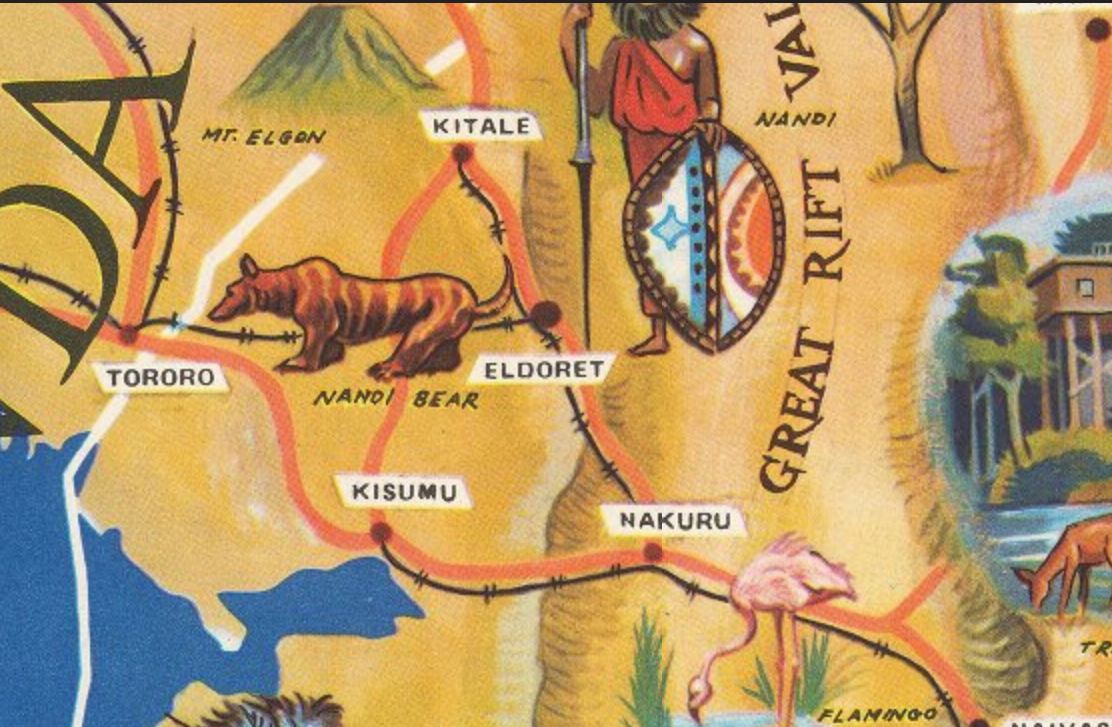
Close-up of the Nandi bear depiction on John McKenzie's 1961 map East Africa (© John McKenzie – reproduced here on a strictly non-commercial Fair Use basis for educational/review purposes only)

Last year on ShukerNature, in my extensive documentation of what may well be the single most significant episode ever recorded concerning Kenya's most infamous cryptid (click here to read my blog article), the ferocious Nandi bear, I made particular reference to an article on this elusive creature by Gordon Boy that had been published in the October-November 1998 issue of the periodical SAFARI Magazine.

However, in his SAFARI article, Boy included one additional but fascinating Nandi bear nugget that I specifically didn't allude to in my own. This was because I felt that it deserved its very own, separate coverage on ShukerNature (and also because I wanted to research it further first, which I have since done). So here it is now.

 
East Africa, John McKenzie's map that contains the tantalizing Nandi bear depiction (© John McKenzie – reproduced here on a strictly non-commercial Fair Use basis for educational/review purposes only)

Boy stated that an illustrated full-colour map of East Africa by John McKenzie and simply entitled East Africa (see above scan of it) included a depiction of a strange-looking creature that was actually labeled on it as a Nandi bear. He also stated that the map had been produced in 1952. In reality, however, when I researched this item, I discovered that it had actually been produced in 1961, not 1952, in Nairobi, Kenya; its printer/engraver was East African Standard Ltd.

Boy included a reduced-size reproduction of the entire map in his article (the map's full size is 70 cm by 57 cm), but this reproduction is not big enough for the individual animal depictions in it to be anything other than minuscule. When enlarged, however, they are all rendered clear enough to be readily identifiable with known species – all, that is, except for the Nandi bear depiction, which does not resemble any species currently known to science. Nor, for that matter, does it correspond with any eyewitness description of the Nandi bear.

 
Nandi bear depiction shown in situ geographically on McKenzie's map East Africa (© John McKenzie – reproduced here on a strictly non-commercial Fair Use basis for educational/review purposes only)

To quote Boy's brief account of it:

On McKenzie's map, the Nandi bear illustration appears north of Eldoret, on the Uasin Gishu Plateau [in western Kenya]. The illustration shows a massive, dog-like quadruped, with short hair, of a banded brown-and-yellow colour, and with very stocky limbs, a humped back, and a sharply pointed snout. But what is the Nandi bear doing here? It is, after all, the only creature depicted on this map whose existence, even now, has not been verified by science. Or was its inclusion just a mischievous prank on the map-maker's part? The legend of the Nandi bear is not without its pranksters...

This is very true. However, tempering Boy's above statement is another one made by him when introducing his account of McKenzie's map:

The Nandi bear is pictured on some of the old illustrated wildlife maps of East Africa, published during the Colonial era.

In short, there are other old maps out there somewhere that also contain Nandi bear depictions, which in turn reduces the possibility that its included portrayal on the McKenzie example was merely a prank. Needless to say, I have sought to uncover such maps, but as yet I have not succeeded in doing so. Consequently, if anyone reading this ShukerNature blog article of mine knows of any or can offer relevant information concerning them, I'd greatly welcome details.

For the most comprehensive modern-day coverage of the Nandi bear in published form, be sure to check out my book Still In Search Of Prehistoric Survivors.


Wednesday, 18 August 2021

THE PEEL STREET MONSTER - LOOKING BACK AT A LOCAL CRYPTID

 
Vintage illustration of a coati (public domain)

It's always good to stumble upon the history of a mystery beast not previously documented in the cryptozoological literature (which it hadn’t been, prior to my doing so in a Fortean Times article and subsequently in my book Extraordinary Animals Revisited), and especially when it happens to be a local one – having occurred just a few miles away from where I was born and still live. Yet although the case of the Peel Street Monster began in high drama, the outcome was distinctly underwhelming.

During winter 1933-34, rumours began circulating within the area of Brickkiln Street and Peel Street in the large urban West Midlands town (now city) of Wolverhampton, England, of a bizarre creature that was attacking children. One bold lad who tried to pursue this beast, which became known as the Peel Street Monster, presumably angered it, because it allegedly leapt at his throat, attempting to bite him.

 
Extraordinary Animals Revisited (© Dr Karl Shuker/CFZ Press)

There came a day in January 1934, however, when this vicious creature made one onslaught too many. A crowd of boys and youths, who included among their number a 17-year-old called Georgie Goodhead, were playing on the corner of St Mark's Street and Raglan Street, when another boy, Jackie Franklin, raced out of Peel Street and up towards them in a state of great alarm. Shouting for help, he told them that a youngster called Billy Wright (but not the famous future Wolverhampton Wanderers footballer of that same name, at least as far as I'm aware) was being attacked by the monster on some waste ground. Georgie and his mates raced back to Peel Street at once with Jackie, where they observed a peculiar-looking animal threatening a small boy. In a later Wolverhampton Express and Star newspaper report, Georgie recalled:

I went and saw a queer animal, far too big for a rat, leaping towards a child about five-year[s]-old. I shouted and the thing turned on me. It crouched, its eyes bulging, then it leaped like lightning.

According to the newspaper report, as the creature neared his throat Georgie picked up a brick and hit it with this hefty implement as hard as he could. The animal collapsed, falling into a pool of water, and was swiftly kicked to death by the crowd that had gathered to watch the boys confronting it. Happily, little Billy was unhurt, and was taken by some of the boys to his parents' sweetshop in Peel Street, while Georgie and Jackie gave a statement at the Red Lion police station and received half a crown each for their bravery.

As for the Peel Street Monster: apart from noting that it was a male, no-one had any idea what this mystifying beast was. According to media reports, naturalists, taxidermists, and vets were all called in to identify it, but to no avail. One unnamed 'expert' did suggest that it may be an anteater – in Wolverhampton?? Another one considered it possible that the creature (despite being dead!) might become a serious rival to the Loch Ness monster.

 
A ring-tailed coati Nasua nasua, the most familiar of the four recognised coati species and native to South America (© Dr Karl Shuker)

Events took an even more surprising turn the following day, when a second mystery beast was found in the Brickkiln region. This one, a female, was already dead, but it closely resembled the Peel Street Monster. Moreover, a photograph of it published in the Express and Star helped to identify its species.

It was a South American coati (coatimundi) – a long-tailed relative of the raccoon and belonging to the genus Nasua, with a head-and-body length of up to 2 ft, a thin tail of much the same length, and distinguished by its very elongate snout (responsible for the 'anteater' identity proffered for the Peel Street Monster?). But where had it, and the Peel Street specimen, come from? And if there had been a pair on the loose, could there be more?

The prospect of a plague of coatis terrorising the good residents of Wolverhampton may seem decidedly slim (not least because the favoured diet of coatis consists of invertebrates and small lizards – as opposed to small children!). Nevertheless, the council was clearly taking no chances, for as the Express and Star duly reported:

And fresh fears arose in Wolverhampton as rumours spread that there may be a colony of the creatures hiding in partly closed cellars. Hundreds of people gathered in Salop Street to watch council workers trying to ascertain if a colony of the creatures were hiding there. The crowds were so great they hampered the efforts of the official rat-catcher. In the search, weapons brought in to confront any coatimundis found included poison gas, traps, sulphur, terriers and ferrets. It was uncertain whether the ferrets were to be used following a suggestion that they might form part of the coatimundi diet [I don't think so!].

 
As ably demonstrated by this white-snouted coati Nasua narica: when walking quadrupedally, coatis are famous for often holding their tails vertically upright with a little curl at the tip, giving them an unexpected superficial resemblance to small furry sauropod dinosaurs! (© Dennis Jarvis/Wikipedia – CC BY-SA 2.0 licence)

Ferrets or no ferrets, the search did not find any other errant coatis. Police investigations did reputedly reveal that the female coati had been in a travelling menagerie that had parked here earlier (circuses and fairs would sometimes set up on this slum-area waste ground at that time), and had discarded the creature's body after it had died. However, the Peel Street Monster's origin remains a mystery to this day – as do various other aspects of this curious case.

Can we even be sure that the Peel Street Monster was a coati? For if the accounts of it are true, it must have been an exceptionally belligerent specimen. The Express and Star published a photo of this creature lying dead with a crowd of onlookers surrounding it, but its form cannot be discerned. And what happened to the two carcases? Some correspondences reminiscing about this incident appeared 50 years later in the Express and Star during March 1994, but conflicting recollections only served to muddy these already murky waters even further.

All in all, after also allowing for the likelihood of embellished descriptions with such an odd episode, the only thing that can be said with certainty regarding the Peel Street Monster is that something unexpected was seen and killed in Wolverhampton – a most unsatisfactory end to one of the most intriguing OOP animal cases on file from the West Midlands. True, coatis (unlike anteaters!) are nowadays often kept as exotic pets – a friend of mine at university owned one, and I also well remember about 10 years ago seeing one with a collar and lead being taken for a walk by its owner through another local Midlands town, duly attracting considerable interest and attention from passers-by, including me – but whether an escaped/released pet coati explains the Peel Street Monster is another matter entirely.

Finally: I was recently reminded of this curious case when Canadian Facebook friend Kevin Stewart kindly sent to me a scan of a Canadian newspaper cutting documenting it, which was particularly interesting to me as I was previously unaware that this relatively obscure, ostensibly local-interest-only UK story had ever attracted any overseas media coverage. The cutting was from Alberta's Edmonton Bulletin for 17 February 1934, so for the purposes of historical documentation, here it is – thanks Kevin!

 
Edmonton Bulletin newspaper report of 17 February 1934 concerning the Peel Street Monster public domain)


Thursday, 10 December 2020

'WOLFEN' VS 'THE WOLFEN' – COMPARING AND CONTRASTING A CRYPTOZOOLOGICAL MOVIE WITH THE CLASSIC NOVEL THAT INSPIRED IT

Front cover of my copy of Whitley Strieber's fascinating novel The Wolfen, upon which the movie Wolfen was loosely based; this is the 1992 resissue of Coronet Books' 1979 paperback edition (© Whitley Strieber/Coronet Books – reproduced here on a strictly non-commercial Fair Use basis for educational/review purposes only)

On 14 July 2020, I finally got around to watching Wolfen, directed by Michael Wadleigh and filmed on location in the South Bronx area of New York City. It is the 1981 movie version of The Wolfen, which is bestselling Communion author Whitley Strieber's fascinating, classic novel from 1978 about a cryptic – and cryptid – species of super-intelligent canid that through convergent evolution has attained a humanoid level of sentience and even certain morphological attributes, such as very dexterous hand-like paws.

Yet it has remained largely unknown to Homo sapiens, except for supposed legends of werewolves and cynocephali that in reality are based upon fleeting and generally fatal (for humans) encounters with wolfen, for whom lost, abandoned, and ill humans are their natural prey. And then, fate steps in, and suddenly a series of grisly human killings in modern-day NYC leads the police to the sensational discovery of this hitherto hidden species of dogman.

The Wolfen is definitely one of my all-time favourite cryptozoology-themed novels, but sadly the movie was for me a distinct disappointment. To begin with, Albert Finney played an increasingly tiresome NYPD cop named Captain Dewey Wilson who was meant to be the dysfunctional anti-social genius character that crops up so regularly in sci-fi movies. Sometimes these work well, other times they are simply irritating – Wilson was definitely drawn from the latter category.

Front cover of the official Wolfen DVD that I own and have now watched (© Michael Wadleigh/Orion Pictures – reproduced here on a strictly non-commercial Fair Use basis for educational/review purposes only)

Also, whereas in the novel the wolfen were categorically cryptozoological – as I noted earlier, even their paws were humanoid – in the movie they are portrayed entirely as morphologically normal wolves, super-intelligent but outwardly indistinguishable from typical black-furred or (in one instance) white-furred wolves, which for me was a major let-down. Conversely, their cunning ability in the movie to lure curious humans within range by imitating a baby crying is conspicuous only by its absence in the novel. There was also a recurrent red herring theme related to shape-shifting and recalling the skinwalkers, which again did not appear in the novel but perhaps featured in the movie in order to distract viewers from the distinct lack of morphological separation here between wolf and wolfen.

A modern CGI-driven remake may well succeed where in my opinion this present almost 40-year-old film has failed in doing justice to the highly original, thought-provoking subject of Strieber's novel. Don't get me wrong, Wolfen is by no means a bad movie, it's just not the movie that I was hoping – expecting – it to be. But everyone has their own opinion – so click here to check out the original theatrical trailer for Wolfen, and make up your own mind.

Also, click here and here to read more on ShukerNature concernng werewolves, wulvers, cynocephali, and other dogmen in traditional legends and lore from around the world.

Dramatic artistic representation of a scene from the movie Wolfen (© Richard Svensson)


Thursday, 7 November 2019

FINDING A FOSSIL NANDI BEAR? - OR, SIMBAKUBWA VS CHEMOSIT

Reconstruction of the likely appearance in life of Simbakubwa kutokaafrika (© Mauricio Anton/Ohio University/AFP/Wikipedia – CC BY-SA 4.0 licence)


Heavy breathing and a grunting noise heralded the brute’s emergence into the open of the runway. It had evidently heard them and was bent on making trouble. Scott had never imagined a beast so peculiar; in size, it was as big as a buffalo and stood fully that height at the shoulder: the hind-quarters sloped down like those of a hyena, and it had the hyena’s short, coarse hair, but here all similarity to that cowardly animal ceased. It had an enormous square head and short ears like those of a lion, a long snout with protruding incisors and a small, red-tinged eye. The creature moved like a large ape, its lengthy arms hanging down before it, the paws just touching the ground, and Scott was amazed to see that these paws were like an ape’s: prehensile, and equipped with thumb and fingers.…‘Ahi…i…e ! the Nandi Bear,’ gasped one of the boys, through chattering teeth.

          C.T. Stoneham – ‘The Bear of the Nandi’, in Killers and Their Prey


The above quote is from a short story of fiction, but its subject may be only too real. Also known variously as the chemosit, kerit, koddoelo, gadett, and khodumodumo, Africa's legendary Nandi bear must surely be one of the (if not THE) most formidable, ferocious mammalian cryptids ever documented, judging at least from the horrific experiences claimed by some of those persons who have allegedly encountered it at close range. Having said that, this infamously-aggressive, murderous monster has scarcely been reported for at least 60 years now, leading even the most optimistic mystery beast investigators to suspect that even if it were indeed real, it may have simply died out, quite probably as a result of its once-extensive, dense, rarely-penetrated Nandi and adjacent (once-contiguous) Kakamega Forest domain having been severely cut back and turned into farmland. Irrespective of its terrifying, ultra-dangerous nature, the loss of such a creature before its very existence had been confirmed and its taxonomic identity formally determined would be a profound zoological tragedy.

However, thanks to an ostensibly unrelated yet very significant (albeit extremely belated) palaeontological discovery made public just a short time ago, some decidedly chemosit-shaped shadows have begun to rise and thence flit tellingly through the collective cryptozoological consciousness.

One day in 2013, while conducting postgraduate research at Kenya's Nairobi Museum, palaeontologist Matthew Borths from Ohio University, USA, happened to open a cabinet drawer, and made a truly incredible discovery. Inside the drawer was an enormous fossil lower jawbone bearing some teeth, plus some individual teeth, a heel bone, and some distal toe bones. When enquiring about these mysterious remains, Borths learned that they had originally been collected as far back as 1978-1980 during various scientific excavations at an early Miocene-aged fossil bed named Meswa Bridge, in western Kenya, but had never been formally examined by anyone, lying forgotten and unstudied in that drawer for over 30 years instead. Moreover, he discovered that another Ohio University palaeontological researcher, Nancy Stevens, had also seen them in that same drawer and had puzzled over them when she too had been conducting research at Nairobi Museum.

Skeleton of Hyaenodon horridus, a North American species of hyaenodontid (public domain)

After Barths contacted her, they lost no time in researching these remains comprehensively, and revealed that they belonged to a hitherto-undescribed but quite enormous species of primitive mammalian creodont carnivore known as a hyaenodontid. The hyaenodontid lineage's most recent fossils are around 5-6 million years old (those of the giant new species were some 22 million years old), after which they apparently became extinct. Using three different methods of size estimate, Borths and Stevens obtained estimated total body masses for this very belatedly-recognised species of 280 kg, 1308 kg, and 1554 kg, plus a total length estimated at up to 2.5 m and a height of up to 0.75 m. If the creature had attained the upper estimates of mass, length, and height, it would have been at least as big as the polar bear, today's largest terrestrial mammalian carnivore, but rather less than that if it had only attained the lowest estimates (something not mentioned in media reports).

In a 17 April 2019 Journal of Vertebrate Paleontology paper, they formally named this giant hyaenodontid Simbakubwa kutokaafrika, which is Swahili for 'big lion from Africa'. For although entirely unrelated to it, this huge beast would definitely have been an apex predator in its time, just like the lion is today. All in all, therefore, an exceedingly interesting and significant palaeontological find - but what bearing (if any) does it have upon cryptozoology? Let's rephrase that question as: don't you just love totally random, meaningless coincidences?

Kisumu County in western Kenya contains Meswa Bridge, the site where the long-overlooked remains of a monstrously-huge fossil mammalian carnivore were discovered; and Kisumu County just so happens to be situated immediately below western Kenya's Nandi County, which contains the dense, once-contiguous Nandi Forest where a monstrously-huge mystery mammalian carnivore dubbed the Nandi bear has been reported many times. But what is, or was, the Nandi bear? (Alleged sightings during the past 70 years have been far fewer than back in the early 20th Century, leading to speculation that even if it were real, it may now have died out.)

Maps revealing the very close proximity of western Kenya's Kisumu County (left) and Nandi County (right); maps created by me from Wikipedia maps - please click to enlarge them (public domain)

In fact, this ferocious, greatly-feared cryptid has been described in so many different ways by eyewitnesses down through the years that some cryptozoologists, including Dr Bernard Heuvelmans and myself, have opined in our respective works that the Nandi bear is almost certainly a non-existent composite. That is to say, it has been 'created' via the erroneous lumping together by native traditions and Western investigators alike of sightings of several very different animals, known and unknown.

These may include such disparate species as hyaenas, baboons, large male ratels, and aardvarks. According to some peoples' views, additionally, one or more prehistoric survivors may also be involved, like the giant short-faced hyaena Pachycrocuta brevirostris, the African bear Agriotheriium africanum, the giant baboon Dinopithecus ingens, and/or maybe one of those bizarre claw-footed ungulates known as chalicotheres.

All of these latter creatures were still in existence in Africa as recently as the Pleistocene (2.5 million to 11.7 thousand years ago), as confirmed by fossil finds. (See my book Still In Search Of Prehistoric Survivors for an extensive documentation of the Nandi bear and its preponderance of proposed identities.)


Should a surviving hyaenodontid (not necessarily Simbakubwa itself, but potentially a reclusive modern-day descendant, one whose morphology and gait may have changed somewhat during the 22 million years of evolution occurring from Simbakubwa's time into modern times) now also be added to this list? Who can say?

Everything about the Nandi bear is highly speculative and fiendishly complicated, but my cryptozoological antennae definitely began twitching when I saw how unexpectedly close to one another were the fossil bed where Simbakubwa's remains were found and the Nandi Forest where the Nandi bear was traditionally reported. Like I said earlier, don't you just love totally random, meaningless coincidences??

Just for the record, I have modified my personal opinion recently as to the most likely identity of the Nandi bear, thanks to a truly remarkable and exceedingly exciting but previously obscure report hitherto unknown to me that I only lately obtained, and which I am now very actively investigating. More news concerning this will appear here on ShukerNature if and when I have it. Meanwhile, for previous ShukerNature accounts appertaining to the Nandi bear, please click here, here, here, here, and here.

Size comparison of Simbakubwa and human (© Mauricio Anton/Wikipedia CC BY-SA 4.0 licence)


Tuesday, 7 February 2017

WATER CIVET VS AQUATIC GENET, OR MORPHOLOGY VS MOLECULAR BIOLOGY - A TALE OF TANGLED TAXONOMY


Painting from 1924 of water civets/aquatic genets in their native habitat (public domain/reproduced here on a strictly non-commercial Fair Use basis only)

Originally a civet, nowadays a genet, unrecorded by science until 1913, never studied alive by scientists, and virtually unknown even to the local native people (a rare event indeed!), Genetta (=Osbornictis) piscivora is surely one of the world's most mystifying mammals.

Yet it is an exceedingly handsome, strikingly-coloured creature, with a densely-furred chestnut head and body, a black bushy tail (constituting almost half of the animal's total length of 3 ft), and white facial markings. The type specimen of this secretive viverrid was obtained on 1 December 1913 in a forest stream at Niapu, in what is now the northeastern portion of the Democratic Congo, by Drs James P. Chapin and Herbert Lang during the American Museum of Natural History's Congo Expedition. Six years later, its species was formally described by Dr Joel A. Allen from the museum, who named it Osbornictis piscivora, in honour of Prof. Henry Fairfield Osborn (who was greatly interested in the Congo Expedition), and recording its fish-eating proclivity.

Dr Joel A. Allen (left) and Prof. Henry Fairfield Osborn (right) (public domain)

Although its anatomy suggests that it is most closely related to the genets, this anomalous species was long referred to as the water civet because it exhibits several features markedly at variance with typical genet morphology. Most obvious of these is its vulpine colouration, totally different from the black-and-white coat patterning of spots and bands synonymous with genets. In addition, the soles of its paws are unfurred, its teeth are much weaker and narrower than those of correspondingly-sized genets, its nose is somewhat smaller, its muzzle is shorter, and its overall size rivals that of the giant genet Genetta victoriae, the largest of the typical spotted Genetta species. Consequently, when formally describing and naming it, Allen assigned this novel viverrid to its very own genus, Osbornictis, in which it remained for many decades.

In 2004, however, a team of researchers who had been conducting a molecular-based comparison of several different viverrid genera, including Osbornictis and Genetta, published their findings in a Zoologica Scripta paper, in which they concluded that these two genera were sufficiently closely related for the water civet to be housed within Genetta, as Genetta piscivora. Since then, it has been known colloquially as the aquatic genet.

My model of this enigmatic species (© Dr Karl Shuker)

Most books state that the water civet (or aquatic genet) was totally unknown to the natives prior to its scientific discovery in 1913; this is not true. Along with the holotype, Lang and Chapin also obtained an incomplete specimen (lacking skull, tail, and feet) from a native; and in the local Kibila and Kipakombe languages, it has its own specific name - the esele.

Nevertheless, for the most part it is truly as much a mystery to them as it is to science, with virtually no information available concerning its natural history, and very few museum specimens.

The type locality of this species (i.e. where its type specimen was obtained), a large forest brook at Niapu, photographed here at the height of the rainy season (public domain)

In 1996, however, a major new chapter was written in this species' sparse history, when veteran wildlife film-maker Alan Root announced that he had succeeded in filming a living specimen in its native Congolese habitat, hunting for fishes by gently tapping the water with its paws and then trailing its long white whiskers on the surface to detect any movements. This unique footage formed part of a special one-hour film of Congolese wildlife by Root entitled A Space in the Heart of Africa, which was first screened on British television within the long-running ITV Survival series in July 1996.

This ShukerNature blog article is adapted and updated from my book The Encyclopaedia of New and Rediscovered Animals, the most comprehensive book on this subject ever published.


Monday, 22 December 2014

SPOTTING A LEOPARD MARTEN ON EBAY


Spotted marten, full view, right-hand side (© Gabriele Lüke)

The global internet auction site Ebay may not seem a particularly likely source of anomalous animal specimens, but over the years some undeniably intriguing examples have turned up on it – from mouse-sized 'venomous water elephants' from Thailand (hoaxes) and a stuffed skunk ape head (hoax) to alleged bigfoot hair (?) and some sea urchins that were found to belong to a species hitherto-undescribed by science (true!).

The most recent addition to this exclusive if eclectic company was kindly brought to my attention on 16 December 2014 by Facebook friend Martin Cotterill. Listed on Ebay's German site, it consisted of a taxiderm marten specimen, but unlike any marten conceived by Mother Nature, this particular individual sported spots - a distinctly eyecatching pelage liberally dappled with large black blotches and also boasting a genet-like or even leopardesque background colouration. Indeed, as I stated when posting the images of this wonderful animal on my own Facebook timeline, if a marten could hybridise with a genet (which it can't!) the offspring might look something like this!

Spotted marten, front view (© Gabriele Lüke)

Obviously it was a fake, and in its Ebay listing's description its seller openly stated that it had been treated to look like a miniature leopard, so its spots had been deliberately added to it (in a decidedly professional, naturalistic manner too, I might add). Consequently, it was not an attempt to hoax anyone, merely to delight – which this veritable leopard marten definitely did. So much so that it attracted a sizeable number of watchers and bidders, and finally sold (on 21 December) for the very hefty price-tag of 208.88 euros! Click here to see its original listing while it is still online – like that of all sold items on Ebay, the listing will disappear within the next month or so.

Prior to its sale, however, and anxious to learn more about it but aware that my fluency in German has its limitations, I asked German cryptozoologists Markus Bühler and Markus Hemmler if they would make some enquiries on my behalf to the seller regarding this fascinating specimen, with particular emphasis upon the precise technique used to apply its coat's spotting in such an impressively naturalistic, expert way. Both of them very kindly did so (thanks guys!), and discovered that this spotted marten's seller was also its creator – a notable German artist called Gabriele Lüke.

Spotted marten, full view, left-hand side (© Gabriele Lüke)

Gabriele stated to Markus Hemmler that she had no objection to my writing about the marten. However – and, albeit frustratingly but totally understandably too – she did not wish to reveal the nature of her technique for applying the spots to its pelage, because it is one to which she has devoted much time and money.

I had a very specific reason for wanting to learn how the spotting had been achieved so masterfully, a reason relating to a certain animal anomaly that has intrigued me for quite some time (and which I plan to document fully in a future ShukerNature post), but naturally I fully appreciate and accept Gabriele's wish for secrecy concerning her own particular technique. I also thank her most sincerely for so kindly permitting me to document her maculate marvel, and I hope that its successful bidder will treasure this unique, delightful animal.

If only such a photogenic creature truly existed – even the giant panda, Bambi, and the Andrex puppy might well struggle to compete with a leopard marten in the cuteness stakes!

Spotted marten, dorsal view (© Gabriele Lüke)


Friday, 26 July 2013

INTRODUCING THE NANDINIA - AFRICA'S PARACHUTING (AND VERY PARADOXICAL) EX-PALM CIVET

Beautiful painting of the nandinia from Robert Wolff's book Animals of Africa (© Robert Dallet)

As many of you know, I've always been interested in the more unusual, enigmatic members of the animal kingdom, those that rarely attract such widespread attention as the giant pandas and great white sharks of this world.

And one creature that certainly embodies 'unusual' and 'enigmatic' is the nandinia Nandinia binotata, which was formally named and described by British zoologist John Edward Gray in 1830 (and originally split into two separate species - one West African and one East African). I first learnt of this cat-sized arboreal creature's existence when, as a child, my mother bought for me a huge lavishly-illustrated book, almost as big as me (or at least it seemed to me to be at the time!), entitled Animals of Africa. Authored by Robert Wolff, it contained dozens of spectacular full-colour paintings by Robert Dallet, including one of the nandinia.

Even its name, 'nandinia', intrigued me, because it sounded so unlike any other animal name I'd ever heard, to the extent that even though I subsequently learnt that this species was also referred to as the African palm civet or two-spotted palm civet, as far as I'm concerned it has been and always will be the nandinia. It is derived, incidentally, from 'nandinie' – a local West African name for this species.

The nandinia depicted upon a Togo postage stamp issued in 1965

Looking at its picture in Animals of Africa, which also opens this present ShukerNature blog post, the nandinia seemed to me to be a curious combination of cat and civet, with an attractive spotted coat and an exceptionally long tail, yet also indefinably different from anything else I'd ever seen. This proved to be quite a prescient assessment on my part, particularly at such a tender age, because although for many years the nandinia has been classed as a viverrid, i.e. a relative of civets and genets, in recent times it has experienced a very dramatic recategorisation.

Genetic studies have suggested that during the evolution of the carnivorans (i.e. those species belonging to the mammalian order Carnivora), the nandinia split off from the lineage leading to cats and viverrids before these latter two taxonomic families split from each other. As a result, it has been assigned to a taxonomic family of its own, Nandiniidae, of which it is the only member. As it is therefore an ex-palm civet now, this renders its alternative name of nandinia taxonomically unambiguous and thus much more desirable for use – another childhood impression of mine that has since proved prophetic.

An engraving of the nandinia from Rev. J.G. Wood's three-volume animal encyclopaedia The Illustrated Natural History (1859-63)

But that was not the only surprise that the fascinating little nandinia had in store for me. While researching gliding vertebrates for a chapter in my book Extraordinary Animals Worldwide (1991), which reappeared in expanded form within its updated edition, Extraordinary Animals Revisited (2007), I accidentally discovered that the nandinia possessed a truly extraordinary but hitherto scarcely-publicised talent.

Taxiderm specimen of a nandinia in front of a taxiderm binturong at Tring Natural History Museum (Dr Karl Shuker)

Resembling a portly, round-headed genet with very dense, woolly brown fur dappled with small black spots, and an extremely long, barred tail, but without any form of gliding membrane or other device for achieving aeronautical success, the nandinia is the most unexpected and least known of all mammals with gliding prowess. Indeed, I learnt of its surprising capability quite by accident myself. While flipping through some African Wild Life issues from 1958 in search of an account on a totally different subject, serendipity brought to my attention a fascinating letter by G.V. Thorneycroft.

The nandinia depicted upon an Ivory Coast postage stamp issued in 1992

In his letter, Thorneycroft recalled seeing two nandinias high up in a tree one morning on his farm at Zomba, Nyasaland (now Malawi). One became frightened by his dogs, standing at the foot of the tree barking loudly, and as a result it chose to exit the tree in a quite astonishing manner. As noted by Thorneycroft, the nandinia:

"...made a leap from a high branch and volplaned to the ground with legs and tail outstretched. It made a perfect landing on the bare ground, ran to another tree from which it again volplaned and repeated the action."

The mechanism responsible for this highly unexpected capability from as bulky and unlikely a gliding animal as the nandinia was revealed by Thorneycroft as follows:

"What struck me was the graceful way it planed or almost floated to the ground at an angle greater than half a right-angle so that it landed at a considerable distance from the tree it was in. Its tail was extended straight behind, the long hair at the base seeming to be ‘on end’ and its legs stretched out as far as possible. On each occasion it made a perfect four-point landing."

In short, the nandinia provided a surprising but nonetheless wholly corresponding verification of naturalist H.B. Cott’s classic findings with gliding frogs back in 1926 – namely, that a fully outstretched body and limbs (with or without the possession of a gliding membrane) is very important for successful aerial accomplishment.

Taxiderm nandinia at Manchester Museum (subhumanfreak at the English Language Wikipedia)

I have never seen any further reports of parachuting ex-palm civets, but the nandinia has a very wide distribution across tropical Africa and has even been described as probably the most common small species of forest-dwelling carnivoran there. So unless this instance of volplaning was unique behaviour exhibiting only by the single specimen observed by Thorneycroft, other occurrences must surely have been spied. Perhaps one day, therefore, some additional cases will be documented, substantiating the nandinia's claim to be the world's only species of temporarily-airborne carnivoran as opposed to merely being dismissed as a furry flight of fancy, in every sense.

One further nandinian controversy. Four nandinia subspecies are currently recognised (namely: Nandinia binotata arborea, N. b. binotata, N. b. gerrardi, and N. b. intensa), but in earlier days a much more mysterious form, nowadays relegated to a mere synonym of Nandinia binotata, was also recognised. This was Paradoxurus hamiltonii, Hamilton's palm civet, formally named and described by John Edward Gray in 1832. The only image of P. hamiltonii that I have seen is the following one, drawn by the eminent natural history artist Benjamin Waterhouse Hawkins in 1833-4:

Benjamin Waterhouse Hawkins's illustration of Paradoxurus hamiltonii

Although a very elegant image, it does not appear to be a particularly accurate depiction of a nandinia (which is itself surprising for an artist of Hawkins's renown), but there may be good reason for this, inasmuch as the creature so depicted might not actually be a nandinia! Why I am so curious about it is the fact that the book in which Hawkins's painting originally appeared is the second volume of a major work authored by Thomas Hardwicke, entitled Illustrations of Indian Zoology.

Yet whereas all other palm civets are indeed Asian, the nandinia has always been an oddity among such civets zoogeographically, in that it is exclusively African. So if P. hamiltonii and N. binotata are truly nothing more than two different names for one and the same species, how can we explain the presence of an illustration of P. hamiltonii in a book devoted to the mammals of India?

As far as I am aware, the aptly-named Paradoxurus hamiltonii remains a paradox today, but one that has long been forgotten. If anyone out there can shed any light on this anomaly, I'd be very happy to receive details.

The nandinia depicted upon a Liberian postage stamp issued in 1918