What strange, secretive, and
sometimes even sinister creatures of cryptozoology – or even of something else
entirely – might still lurk undetected by science amid the shadowy depths of forbidding
forests in the remotest regions of West Africa? (Pixabay/free usage)
Ati, bwana! There is a story you will not believe,
because you are a white man. White men laugh at the stories told by the black
man. They say this is not so, and that is not so. We have not seen this or
that, so how can it be? They say, Ho, Ho! Black men are like little children,
telling tales to each other in the dark. But remember, bwana, white men have
been in this country for a time that is less than the life of one man, so how
can you know all the things that have been known to black men for a hundred
lifetimes and more?
Roger
Courtney – A Greenhorn in Africa, quoting an elderly African
hunter, Ali
Whereas many
mystery animals have been well documented from North, East, Central, and
southern Africa, far fewer have been publicised from West Africa - especially
from its westernmost corner, constituting The Gambia and its encompassing neighbour,
Senegal. Yet these two small countries (sometimes referred to collectively as Senegambia) apparently
harbour a sizeable array of bizarre, unidentified beasts rarely if ever brought
to widespread cryptozoological attention...until now.

Owen Burnham in Kenya's
Namanga Hills Forest
(© Owen Burnham – photograph kindly made available to me by Owen for use in relation
to my cryptozoological writings)
I owe a great
debt of thanks to a longstanding colleague, naturalist Owen Burnham, who spent
his childhood and teenage years in Senegal, for very
kindly supplying me during our longstanding correspondence with information
regarding the creatures documented here. While living in Senegal, Owen became
formally accepted as an honorary member of the native Mandingo (Mandinka)
tribe, and thus learnt much about this land's mystery animals and also those of
Gambia that has
remained unknown to other Westerners.
One such
creature, the Gambian sea serpent, or Gambo for short, launched my own career
in cryptozoology when I investigated its case in detail during the mid-1980s,
and has now become very well known and well-documented in the literature (click
here to access my extensive coverage of
this cryptid on ShukerNature). However, Owen also learnt of several other
mystery beasts that have received far less publicity, and so it is with these
hitherto little-documented yet no less interesting examples that this present
ShukerNature blog article is concerned.

Illustration
of Gambo produced by Mark North for publicity material appertaining to the
Centre for Fortean Zoology's 2006 Gambian expedition (© Mark North/CFZ)
MYSTERY STONE
PARTRIDGE
This enigmatic
Senegalese bird was originally documented by me in a World Pheasant
Association News article (May 1991) on gallinaceous mystery birds.
The stone
partridge is represented in Senegal by its nominate
subspecies Ptilopachus petrosus petrosus – a familiar sight to Owen.
However, he remains perplexed in relation to the covey of stone partridges that
he spied at Fanda, Senegal, in 1985.
Unlike this country’s normal brown-headed, buff-breasted specimens, these were
very finely but noticeably mottled with white upon their head and neck, and
their breast was whitish. They were also rather smaller in size, but most
unexpected of all was their habitat.

A
typical stone partridge, in The Gambia,
which neighbours Senegal
(© Francesco Veronesi/Wikipedia – CC BY-SA 2.0 licence)
Eschewing the
rocky terrain or scrubland normally frequented by Ptilopachus, this
covey was dwelling within a small but dense area of undergrowth in a rice
field, many miles from the nearest expanse of stony ground. Owen saw a second
covey of this strange form of stone partridge at Kouniara, and this time they
were living in thick woodland, comprising a mixture of real forest and palm
trees. Yet despite their radically different habitat, their behaviour was
similar to that of typical stone partridges, scurrying rapidly across the
ground – though in this case over fallen trees and through the forest, rather
than over rocks and through scrub.
Local hunters had
informed Owen that such birds existed, but he had not believed this until he
had encountered them himself. In view of their morphological differences and
markedly distinct habitat, could these stone partridges constitute a separate
subspecies, isolated topographically from the nominate race? Bearing in mind,
however, the tragic, continuing destruction of Senegal’s wildlife habitats,
especially forests, it is to be hoped that this mystifying bird form can be
thoroughly investigated in the near future, to enable it (if still surviving)
to be saved not only from continued scientific obscurity but also from ensuing
extinction. Interestingly, I recently discovered online a vintage colour
illustration that portrays a pair of stone partridges closely matching Owen's
description, complete with white mottling upon their head and neck, plus a
whitish breast, so clearly such a form has been seen and even depicted in the
past.

A
pair of stone partridges resembling those seen by Owen Burnham in Senegal –
this vintage colour illustration was created some time between 1700 and 1880,
and is from Iconographia Zoologica (public domain)
GIANT BUSHBABY
Related to the
Madagascan lemurs and the Asian lorises, as well as to Africa's own pottos
and angwantibos, the bushbabies or galagos constitute 19 currently-recognised
species of primitive primate. Nocturnal and arboreal, they are characterised by
their large ears, long tail, and fairly small size. Currently, the largest
species are the three aptly-named greater bushbabies, with an average total
length of 3 ft, of which over
half comprises the tail.

Bushbaby
– does Senegal
harbour an undiscovered giant species? (public domain)
However, Senegal may be
harbouring a rather more sizeable surprise. In June 1985, while exploring the
heart of the Casamance Forest, Owen spied a
mysterious creature resembling a giant form of bushbaby. It was the size of a
half-grown domestic cat, with pale grey fur, and was accompanied by two or
three young ones. Several years later, a similar animal was also reported from
another West African country, the Ivory Coast. And in 1994,
an assistant of bushbaby taxonomist Dr Simon K. Bearder, from Oxford Brookes University in England, encountered
and even photographed a strange cat-sized creature in Cameroon that once again
was superficially reminiscent of a giant bushbaby. Further details concerning
these perplexing extra-large prosimians can be found in my book The Encyclopaedia of New and Rediscovered Animals.
HAIRY MAN-BEASTS
OF FOREST AND STREAM
Another
mystifying entity reported from Senegambia, and also from Guinea, but
unrecognised by science is the fating'ho. Although still believed in by the
more elderly members of native Senegalese society, younger people here tend to
discount them as mere superstition or folklore, but occasionally something
happens to make them think again.
For instance:
one day in or around November 1992, one of Owen's longtime Senegalese friends,
a youthful native entomological researcher called Malang Mane, was conducting research
in a densely forested area of northern Guinea at an altitude of about 3600
ft when he saw something that drove all thoughts of insects far
from his mind. Without warning, and completely silently, a man-sized entity
stepped out of the undergrowth only a short distance ahead of him. It was
covered in long, shaggy black hair, had a noticeably large head, and emitted a
guttural grunting sound. Most significant of all, however, was the fact that
this veritable man-beast was walking on its hind legs, and was not holding onto
any branches or foliage for support, i.e. it was fully bipedal, just like
humans. Too shocked and frightened to move, Malang watched it
approach to within a few feet of him before it ran away again.

Dramatic artistic
representation of a confrontational Australopithecus group, exhibited in Brazil
(According to Wikipedia, this artwork is in the public domain - click here for full details)
Malang is very
familiar with the West African chimpanzee, and he was certain that the creature
was not a chimp, bearing in mind that he had observed it in detail at very
close range. Nor was it a gorilla, which is not native to this region of West Africa anyway. Only
then did he realise that he must have seen one of the elusive, legendary
fating'ho.
Similar
man-beasts have been reported elsewhere in Africa too, and some
cryptozoologists have suggested that they may be surviving australopithecines -
primitive hominids that officially became extinct at least a million years ago.
Like many West African 'monsters', however, the fating'ho seems to inhabit a
twilit world midway between mythology and mystery, for it combines various
ostensibly physical features with certain purportedly preternatural ones, thus
frustrating traditional attempts at cryptozoological classification.

Artistic
representation of a living australopithecine, as depicted on the front cover of
Dr Bernard Heuvelmans book Les Bêtes Humaines d'Afrique, dealing with
sightings of various mystery man-beasts in this continent (© Plon Publishing –
reproduced here on a strictly non-commercial Fair Use basis for
educational/review purposes only)
Some
eyewitnesses, for example, claim that these entities will sometimes disappear
into thin air in full view of their human observers. It is also believed that
they can fire arrows at humans that are not tangible, but are 'spirit arrows'
instead. These reputedly cause disfiguring ulcers to break out on their
victims' skin, which never heal again.
The fating'ho is
not the only mysterious man-beast reported from Senegal. Also on file
is the wokolo, which is chiefly differentiated from the fating'ho
morphologically by its yellow eyes (those of the fating'ho are red) and long
pointed beard. However, whereas the fating'ho prefers dense forests, the wokolo
is more commonly encountered near streams.
GUIAFAIRO AND
KIKIYAON - ENCOUNTERS OF THE EERIE KIND
Two of the
weirdest and most grotesque monsters reported from Senegambia - or anywhere
else, for that matter - must surely be the guiafairo and the kikiyaon.
Said to remain
hidden by day within the hollow trees and cave-ridden rocky outcrops rising
above the hot savannahs, it is during the evening that the guiafairo takes to
the wing, earning itself a fearful but memorable title - 'the fear that flies
by night'. Few people who have been unfortunate enough to receive a visitation
from this dire entity can agree upon its precise appearance. Some claim that it
is grey in colour and winged, with a human face and clawed feet - a form of
giant bat? Yet others aver that it is phantasmal, with no permanent, corporeal
form, and can even materialise through locked doors.
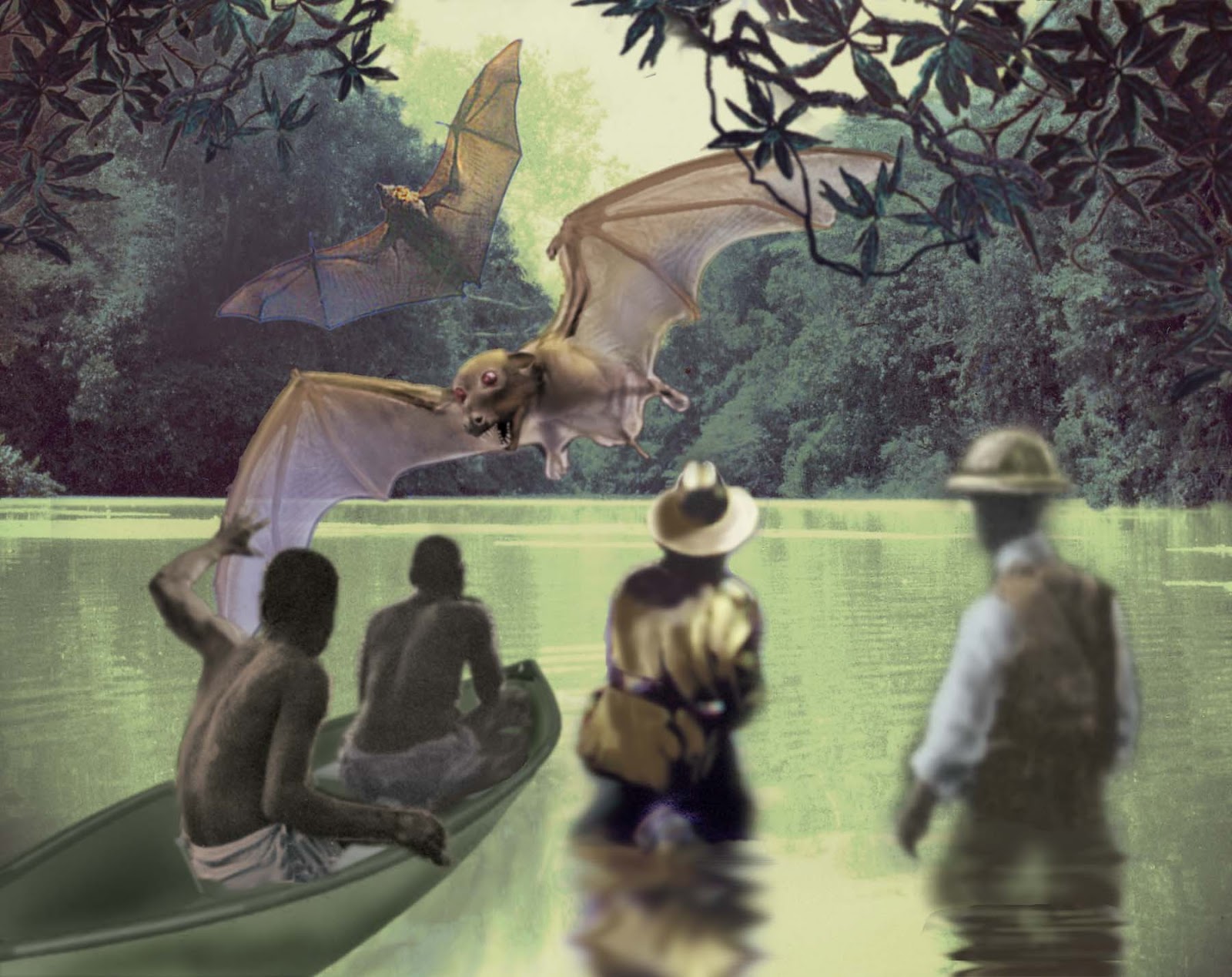
Is
the guiafairo some mysterious form of giant bat? (© William M. Rebsamen)
All confirm,
however, that its arrival is accompanied by a vile, nauseating smell that
engenders a suffocating, mind-numbing fear never forgotten by those who
experience it - always assuming that they do survive. Some of the guiafairo's
victims have died soon afterwards from a creeping, paralysing malaise, almost
as if their fear has itself acquired a lethal, physical reality.
No less deadly,
or dreadful, than the guiafairo is the kikiyaon, which is said by the Bambara
tribe to inhabit only the darkest expanses of forest, and rarely emerges from
this stygian gloom. On those occasions when it is seen, however, it is likened
to a monstrous owl, with a pair of immense wings, huge talons on its feet, and,
most notable of all, a razor-sharp spur projecting from the tip of each of its
two shoulder joints. Yet whereas its wings are feathered like those of normal
owls, the body of this awesome apparition is clothed in short, greenish-grey
fur, and it is even said to possess a short tufted tail.

An
exercise in imagining what form an encounter with the dreaded kikiyaon might
take (Pixabay/free usage)
Most native
people believe the kikiyaon to be a truly supernatural creature, rather than merely
an elusive natural one. They claim that evil sorcerers utilise this entity to
kill people, either physically or spiritually, and can even directly transform
themselves into a kikiyaon.
Yet it can give
voice to some very substantial cries. These include a deep far-reaching
grunting call that has been likened to (albeit not conclusively identified
with) that of Pel's fishing owl Scotopelia peli, a sizeable owl that is
native to Senegambia. However, there is another cry that does
not seem to resemble that of any known species of owl here, and has been
compared to the hideous shrieks of someone being slowly strangled!

Perhaps
Pel's fishing owl will one day prove to be the hitherto-unrevealed identity of
the very vocal kikiyaon? This exquisite chromolithograph was produced in 1859
by Joseph Wolf (public domain)
Intriguingly,
this is precisely the description applied to the voice of another still-unidentified,
exceedingly elusive mystery beast. Namely, the devil bird of Sri Lanka, whose
fascinating if highly frustrating case history I examine and document in
considerable detail within my book From Flying Toads To Snakes With Wings.
Who knows?
Perhaps a real, reclusive creature, possibly even an undescribed species of
owl, originally inspired belief in the kikiyaon, but was gradually
'transformed' by superstition and folklore into the bizarre monster claimed to
exist here today. It certainly wouldn't be the first time that a seemingly
impossible creature has ultimately been shown to have a somewhat less dramatic
and hitherto unrecognised but unequivocally genuine animal at its source.
WERE-HYAENAS AND
SABRE-TOOTHS
Another
Senegalese mystery beast that may be more substantial than surrealistic is the
booa. Although only rarely seen, when it is observed the booa is usually
likened to a giant, abnormally-coloured form of hyaena. In contrast, it is very
frequently heard, especially at night. Indeed, its name is onomatopoeic, being
derived from the hideous screaming cry that reverberates loudly through the
still evening air when one of these creatures is in the vicinity.
As with the
kikiyaon, some Senegalese people are convinced that the booa is actually a
transformed sorcerer, i.e. a were-hyaena. They claim that if a booa is shot and
its trail of blood followed, it will surely lead to a human house, inside which
a man or woman will be found, bleeding profusely from gunshot wounds. (This
scenario closely echoes many medieval Western accounts of werewolves.) There is
a similar Senegalese belief regarding the mo solo - said to be a type of
were-leopard (not to be confused with the leopard-man cults).

Is
the booaa a mysterious giant hyaena, such as the supposedly long-extinct
short-faced hyaena Pachycrocuta brevirostris? (public domain)
However, reports
of the booa also readily call to mind numerous accounts from East Africa, especially Kenya, of a seemingly
allied but corporeal mystery beast variously termed the chemosit, kerit, or
Nandi bear.
Many
descriptions of this infamously ferocious, forest-dwelling creature have
likened it to a huge form of hyaena, of aberrant colouration and with a relatively
short face (click here for a recent
ShukerNature blog article dealing with the Nandi bear). Perhaps the booaa is an
occidental counterpart in Senegal?

Artistic
representation of the wanjilanko's possible appearance (I found this
illustration on the Net, but I am currently unaware of the artist's identity,
despite having made extensive online searches in relation to it – consequently
I am reproducing it here on a strictly non-commercial Fair Use basis for
educational/review purposes only)
Due to poaching
and political unrest, in quite recent times some of Senegal's forests have
been destroyed, and its more exotic, rarer animals have become extinct. In
addition, it is possible that some particularly secretive species have actually
died out here even before their very existence was recognised by science.
During
discussions with native hunters in Senegal's depleted Casamance Forest, Owen has
learnt that they can still readily recall a huge but very mysterious form of
cat, which they refer to as the wanjilanko. According to their descriptions, it
was striped, possessed very large teeth, and was so ferocious that it could
even kill lions. Tragically, however, it appears to have died out, as have the
lions that it allegedly once attacked.

Could
sabre-tooth survival be a reality in the most remote regions of West
Africa? Meanwhile, here's one that I made earlier! (© Dr
Karl Shuker)
Reports of huge
striped cats with very large teeth and savage temperament have also been
recorded elsewhere in West Africa. In Chad, for example,
such a creature is known as the mountain tiger or hadjel, whereas further east,
moving into the Central African Republic, local tribes
speak variously of the gassingram or vassoko. Their descriptions invariably
recall Machairodus, the officially extinct African sabre-toothed tiger.
In addition, when illustrations of this prehistoric stalwart's likely
appearance in life have been shown to native hunters, they have readily
identified them as pictures of their lands' striped, toothy mystery cats (see
my books Mystery Cats of the World
and Cats of Magic, Mythology, and Mystery,
as well as Still In Search Of PrehistoricSurvivors, for additional details).
The prospect of
sabre-tooth persistence into modern times must rate as very slim indeed.
Nevertheless, there are few places on earth more capable of sustaining such
survival beyond the reach of scientific detection than the remote,
little-explored jungle-lands of West Africa.

Proffering
a portrait of Senegal's
red-furred, leonine chakpuar (© Dr Karl Shuker – created by me from a Pixabay/free
usage image)
Also needing an
explanation are Senegalese stories of a strange long-necked red lion known as
the chakpuar, and peculiar ‘cat-wolves’ referred to as the guomna and sing
sing. To quote one of Owen's communications to me concerning the sing sing:
The "cat-wolf" is a strange concept that I have invented
really to explain the oddities of the Sing Sing which seems to have the speed
and stealth of a cat but the tenacity and stamina of a dog. It appears to have
a head like a wolf and non retractable claws. The pelage is said to be somewhat
brindled, like that of a laughing hyena [= the spotted hyaena Crocuta
crocuta] without the spots. Its tail is short and ringed. Again, this
creature inspires fear in hardy hunters and is rarely talked about in case
discussing it causes it to appear suddenly from the depths of the forest.
Except for the
short tail, this description recalls the striped hyaena Hyaena hyaena,
which is indeed native to Senegal. As this
species is normally nocturnal, and therefore not readily seen, it may have
engendered a heightened, exaggerated sense of fear among the local people, thus
explaining their dread of it and its elevation in their minds to the status of
a veritable monster - the sing sing.
THE TANTALISING
TANKONGH
While visiting Guinea, another West
African country that may still contain some intriguing zoological surprises,
Owen learnt of yet another unidentified beast, the diminutive tankongh. This
extremely shy beast is said by local hunters to resemble a small zebra, yet
lives only in the high mountain forests and is rarely seen. However, Owen was
once shown a pair of tiny dull grey hooves and some pieces of black and cream
mottled skin – the remains of a tankongh that had been killed and eaten.
Owen mentions
that according to local reports, this mysterious animal has a pair of small
canine tusks, which makes me think of the water chevrotain Hyemoschus
aquaticus. This is a small, hornless, but tusked ungulate adorned with
stripes and spots, which is native to Guinea’s lowland
forests and swamp margins. Could this known but exceedingly elusive mammal be
the identity of the tankongh, or could the latter even be a related but
scientifically-undescribed species adapted for a montane existence? And what of
the un-named, uncaptured toad, also hailing from Guinea, that reputedly
gives birth to live young – is this a new form?

Vintage
chromolithograph depicting West Africa's
handsomely-marked but extremely reclusive water chevrotain (public domain)
It was Pliny the
Elder who said: "Ex Africa semper aliquod novi" – "There is always
something new out of Africa". Judging
from the cryptic creatures documented here, all currently lurking within that
dusky borderland between reverie and reality, the intrepid cryptozoologist
would do well to heed his words, and pay a keen-eyed visit to this mysterious
continent's all-too-long-overlooked Western quarter. Who knows what
extraordinary revelations may still await formal scientific disclosure here?
This ShukerNature blog article is exclusively
excerpted from my book Dr Shuker's Casebook: In Pursuit of Marvels and Mysteries.


 Posts
Posts