Dr KARL SHUKER

Zoologist, media consultant, and science writer, Dr Karl Shuker is also one of the best known cryptozoologists in the world. He is the author of such seminal works as Mystery Cats of the World (1989), The Lost Ark: New and Rediscovered Animals of the 20th Century (1993; greatly expanded in 2012 as The Encyclopaedia of New and Rediscovered Animals), Dragons: A Natural History (1995), In Search of Prehistoric Survivors (1995), The Unexplained (1996), From Flying Toads To Snakes With Wings (1997), Mysteries of Planet Earth (1999), The Hidden Powers of Animals (2001), The Beasts That Hide From Man (2003), Extraordinary Animals Revisited (2007), Dr Shuker's Casebook (2008), Karl Shuker's Alien Zoo: From the Pages of Fortean Times (2010), Cats of Magic, Mythology, and Mystery (2012), Mirabilis: A Carnival of Cryptozoology and Unnatural History (2013), Dragons in Zoology, Cryptozoology, and Culture (2013), The Menagerie of Marvels (2014), A Manifestation of Monsters (2015), Here's Nessie! (2016), and what is widely considered to be his cryptozoological magnum opus, Still In Search Of Prehistoric Survivors (2016) - plus, very excitingly, his four long-awaited, much-requested ShukerNature blog books (2019-2024).

Dr Karl Shuker's Official Website - http://www.karlshuker.com/index.htm

IMPORTANT: To view a complete, regularly-updated listing of my ShukerNature blog's articles (each one instantly clickable), please click HERE!

IMPORTANT: To view a complete, regularly-updated listing of my published books (each one instantly clickable), please click HERE!

IMPORTANT: To view a complete, regularly-updated listing of my Eclectarium blog's articles (each one instantly clickable), please click HERE!

IMPORTANT: To view a complete, regularly-updated listing of my Starsteeds blog's poetry and other lyrical writings (each one instantly clickable), please click HERE!

IMPORTANT: To view a complete, regularly-updated listing of my Shuker In MovieLand blog's articles (each one instantly clickable), please click HERE!

IMPORTANT: To view a complete, regularly-updated listing of my RebelBikerDude's AI Biker Art blog's thematic text & picture galleries (each one instantly clickable), please click HERE!

Search This Blog


PLEASE COME IN, I'VE BEEN EXPECTING YOU...

PLEASE COME IN, I'VE BEEN EXPECTING YOU...
WELCOME TO SHUKERNATURE - ENJOY YOUR VISIT - BEWARE OF THE RAPTOR!


Showing posts with label Fortean Times. Show all posts

Friday, 28 February 2025

THE TANTALISING TWO-TONGUES IDENTIFIED AFTER ALMOST A CENTURY?

 
A representation of what a two-tongues may have looked like based solely upon the original report's verbal description of this mystery mammal, created by me using Magic Studio

Just over a year ago, in my Alien Zoo column for the British monthly magazine Fortean Times, I introduced readers to a cryptozoological conundrum that had been puzzling me ever since I first encountered it during the 1990s, and which dated back a further six decades, to a 1930s news report from the periodical Modern Wonder.

In December 2024, moreover, I also documented it on ShukerNature (click here to read my blog article) The report, dated 27 May 1939, claimed that some mysterious beasts had been captured by a photographer in the jungles of Malaya (now Malaysia) and had been shown to some officials in Manila, capital of the Philippines, but that no-one had been able to identify them.

They were each said to be quadrupedal and to weigh approximately 200 lb, to possess a raccoon-like head (masked?), a furry mole-like pelage (dense and/or dark?), a pair of owl-like eyes (very large and indicating a nocturnal lifestyle?), an odd dentition combining human-like teeth with cat-like teeth, a fondness for bananas, and – by far their most bizarre feature – each animal possessed two tongues! (Hence I have dubbed their mystifying species the two-tongues.)

 
Native to Malaysia and Indonesia, a Sunda slow loris Nycticebus coucang – note the distinctive black mask-like markins encircling its extremely large eyes and its very dense fur (© David Haring. Duke Lemur Center. North Carolina/Wikipedia – CC BY-SA 3.0 licence)

I'd speculated in AZ and on ShukerNature that were it not for their substantial weight and, needless to say, their extraordinary twin-tongued condition, these cryptids might conceivably have been Malaysian tarsiers, as those very small and single-tongued but decidedly goblinesque creatures always arouse considerable curiosity from observers unfamiliar with them.

Having documented this mystifying case in various of my writings without eliciting any opinions from readers as to what these animals may be, I now hoped that AZ and ShuikerNature aficionados might prove more forthcoming. And sure enough, at long last I have received a suggestion, made by two different ShukerNature readers wholly independently of each other, that may finally have solved this tantalising riddle.

One reader gave his name as Lars Dietz, the other chose to remain anonymous, but both brought to my attention in December 2024 the fascinating fact that lorises – those big-eyed, nocturnal, densely-furred, fruit-eating, Asian relatives of Africa's pottos and bushbabies, as well as Madagascar's lemurs – possess a veritable second tongue, the sublingua. Consisting of a relatively large, muscular tongue-like structure positioned beneath the primary tongue, and also possessed by the lorises' above-named African and Madagascan relatives, and by the tarsiers too, it lacks taste buds, its function instead being to keep clean another dental characteristic of such creatures, the toothcomb, which is used in oral grooming. Outwardly, however, the sublingua does look like a second genuine tongue.

 
In this close-up photograph of a slow loris's face, its pale, pointed sublingua can be clearly seen projecting out of its mouth beneath its longer, pink-coloured primary tongue (© David Haring. Duke Lemur Center. North Carolina/Wikipedia – CC BY-SA 3.0 licence)

Consequently, it is easy to understand how a loris – or a tarsier – may have been described as a two-tongued creature by anyone with no previous experience of it. Having said that: as lorises and tarsiers exist in the Philippines as well as in Malaysia it seems strange that they would not have been recognised by officials there.

Also, of course, there is the not inconsiderable matter of the two-tongues' claimed weight of 200 lb to explain, which is far greater than that of lorises and tarsiers – unless the report had been garbled during its documentation in Modern Wonder, with the animals' true weight having been 200 g, not 200 lb. This would compare well with that of lorises and also that of the heaviest tarsiers.

In view of the sublingua's evident anatomical relevance to this crypto-case (not to mention the black mask-like circles of fur encircling the extremely large eyes of slow lorises, plus their bodies' very dense fur), I feel that some such confusion between the metric and imperial systems of weights may well have occurred, thereby causing the true taxonomic identity of the two-tongues as either lorises (most probably) or tarsiers to become obscured.

 
Tarsiers are nothing if not goblinesque, even otherworldly, in appearance, especially to anyone unfamiliar with these curious yet harmless creatures (© LDC Inc Foundation/Wikipedia – CC BY-SA 3.0 licence / (© Pieere Fidenci/Wikipedia – CC BY-SA 2.0 licence)

Moreover, perhaps the officials who saw these creatures simply weren't well-versed in their country's native fauna anyway. It certainly wouldn't be the first time that this situation has been true!

My sincere thanks to those two ShukerNature readers for steering me in what I feel sure is the right direction in resolving this curious cryptozoological puzzle after almost a century.

And be sure to click here to read my previous ShukerNature article on this subject.

 
Another of my most probably now-obsolete (but still visually-engaging) two-tongues reconstructions, based solely upon the Modern Wonders report's verbal description of these creatures, and created by me using Magic Studio


Tuesday, 31 December 2024

TONGUE-TIED BY THE TWO-TONGUES!

 
Is this what Malaya's mystifying two-tongued cryptids looked like? (created by me using Grok X1)

The days spanning Christmas and the New Year are traditionally ones filled with mystery and magic, a time of weirdness and wonder. So what better day than today, New Year's Eve, to present here on ShukerNature for your entertainment and enjoyument during this time the following cryptozoological conundrum?

In 1997, I included the following account in my book From Flying Toads To Snakes With Wings, hoping that someone reading it might be able to propose an identity for the mysterious creatures described, as I was thoroughly perplexed by them – but no-one ever did. Consequently, I can only assume that these cryptids left them as taxonomically tongue-tied as they have done with me. Nor have I ever uncovered any additional information concerning them. So, 26 years later, in 2023, I reprinted my account in my regular Alien Zoo column on mystery animals and animal mysteries for the British magazine Fortean Times as a fascinating crypto-riddle to ponder over during the festive season, just in case it did elicit a solution from someone that time. Once again, however, answer came there none.

 
My book From Flying Toads To Snakes With Wings (© Dr Karl Shuker/Llewellyn Publications)

Consequently, one year on from its appearance in Alien Zoo, and in the hope that the familiar phrase ""third time lucky" will indeed prove true on this occasion, here yet again is the my account recalling the tangled tale of the two-tongues, in case ShukerNature's redoubtable readers can provide the long-sought key to its locked box of beastly secrets:

On May 27 1939, Modern Wonder documented some 'ultra-mysterious' mammals, allegedly captured by a photographer in the Malayan jungles and later observed by bemused officials in Manila, in the Philippines. Each of the beasts (of unrecorded number) was described as being quadrupedal, weighing about 200 pounds, covered in a furry, mole-like pelage (i.e. dark, dense, and shiny?), with a raccoon-like head [masked?], a pair of owl-like eyes (thus large and staring?), and odd dentition - some of its teeth resembled a man's, others were cat-like – plus a fondness for bananas. Except for their extremely heavy weight (an error on the part of the original report?), there would seem to be a chance of identifying them with some known animal type – until, that is, their most distinctive characteristic is revealed.

For the description also stated that each of these beasts had two tongues! Furthermore, it alleged that they never drank, because they absorbed all of the moisture that they required directly through their skins. This is generally a feature of certain animals living in water or in moist habitats, but the animals concerned are normally amphibians, fishes, and lower life forms, not mammals. Conversely, it is true that many desert-dwelling rodents rarely if ever drink water, because they obtain it from their food (e.g. juicy plant tissues) or from metabolic water released as they digest the dry components of their diet, but they do not absorb water through their skins.


Masked palm civet Paguma larvata, native to Peninsular Malaysia, named after its raccoon-like facial mask (© Denise Chan/Wikipedia – CC BY-SA 2.0 licence)

In general appearance (and excluding weight), they are reminiscent of some of the lesser-known, mask-faced forms of Malay civet and badger – elusive, short-furred creatures of nocturnal lifestyle and partial to fruit within their largely omnivorous diet. Moreover, the owl-like eyes call to mind the tarsiers - those orb-eyed, sucker-fingered, lemur-like primates indigenous to southeast Asia (including the Malay Archipelago), and sufficiently strange in appearance to those not familiar with these rarely-seen nocturnal creatures to attract surprise and newspaper attention.

 
Sunda stink (=skunk) badger Mydaus javanensis, native to Indonesia and Malaysia, photographed in Malaysia (© Thompson Hyggen – copyright-free)

Even so, none of those identities can reconcile the mystery beasts' two tongues and the ability to absorb moisture directly through their skins. Could these attributes have been based upon misunderstanding or mistranslation, rather than upon reality? As nothing more is on record regarding the photographer's mystifying finds, there is no way of knowing. 

 
Tarsiers are nothing if not goblinesque, even otherworldly, in appearance, especially to anyone unfamiliar with these curious yet harmless creatures (© LDC Inc Foundation/Wikipedia – CC BY-SA 3.0 licence / (© Pieere Fidenci/Wikipedia – CC BY-SA 2.0 licence)

So there it is, the owl-eyed, twin-tongued, never-drinking plantain-eater – if nothing else (and confirming that I'm easily pleased!), it scans satisfyingly like the one-eyed, one-horned, flying purple people eater immortalised in a classic 1958 Sheb Wooley novelty song and 30 years later in a 1988 family movie directly inspired by it!

 
Failing abysmally in my attempts to generate a one-eyed, one-horned, flying purple people eater, here's a two-eyed, two-horned flying purple people eater instead! (created by me using Magic Studio)

Meanwhile, any thoughts or suggestions as to the two-tongues' possible identity, or any extra reports/information regarding them, would be very gratefully received!

 
A two-tongue with a banquet of bananas awaiting its pleasure! (created by me using Grok X1)

Incidentally, as some of you know, I've been experimenting with various AI image-generators, testing their capabilities and limitations so as to be better equipped to recognise AI-generated fake cryptozoologically-themed images with which the Net seems to be increasingly awash of late. So, as no image of the Malayan two-tongues has ever been created to my knowledge, I decided to put to the test two different AI image-generators that I've been exploring, Grok X1 and Magic Studio, and see how they performed when prompted to produce pictures of these bizarre beasts.

And, as I'm sure that those out there who are not AI fans will be delighted to learn, both programs were aptly rendered tongue-tied (or whatever the AI equivalent state is!) by the tortuous challenge posed by the two-tongues. Not only did they fail utterly to depict them as the very sizeable animals that anything weighing 200 lb must surely be (instead presenting what look far more like diminutive cubs!), but also, out of all the numerous images that they generated, only one, produced by Grok X1, actually featured creatures possessing two tongues apiece – and here it is:

 
A pair of two-tongues actually depicted with two tongues! (created by me using Grok)

Overall, Grok X1 was the superior creator with regard to this particular pictorial task, as it also created a number of images featuring creatures with a single but bilobed tongue that my own digital addition of a hand-drawn line separating the lobes into two separate tongues was sufficient to engender some satisfactory twin-tongued entities that I've included in this article. Even so, they still did not overly resemble the original 1977 verbal description of these creatures, quoted by me above.

As for Magic Studio: usually a very accurate depicter of animals (give or take some extra or deformed fingers/toes and the occasional additional leg, or two...): faced with providing an accurate portrayal of the two-tongues, it threw a veritable generative gasket, and yielded some illustrations of animals that bore no resemblance whatsoever to the two-tongues' verbal description. It even garbled my prompt for their tongues to be pink, bestowing upon its mixed-up mammals some portions of pink fur instead! However, albeit wholly inaccurate zoologically speaking, aesthetically some of the creatures thus created by Magic Studio were so attractive, appealing, and downright adorable that I couldn't bear to delete them. So here is a selection of them, in all of their delightful dottiness:


All three images created by me using Magic Studio

If nothing else, designers of prospective new cuddly toys could do a lot worse than be inspired by some of these ultra-cute beasties. You can pay me my 10% creator's commission later!

Today would have been the birthday of Nan, my maternal grandmother Gertrude Timmins (who once experienced a decidedly Fortean event of her own – click here to read all about it), who passed away peacefully in her sleep at the grand old age of 99 back in 1994. Just like me, and also like her daughter, my mother Mary Shuker, Nan loved wildlife and Nature in general, so I'm sure that she would have approved of my writing and presenting this fascinating fauna case here today on her birthday. God bless you Nan, and Mom, and all of my family, all of whom are long gone now but never forgotten by me. Ome day we shall be back together, never to be separated again.

 
My late grandmother, Gertrude Timmins, with Patch, my little wire-haired Jack Russell terrier (© Dr Karl Shuker)

Wishing all of my ShukerNature blog readers, and all of my Shuker In MovieLand blog readers too, a Happy New Year – may 2025 prove to be a kindly, successful year for you.

 
And it's toodle-pip from the two-tongues too! (created by me using Grok X1)


Sunday, 9 June 2024

SHARING SOME MONSTROUSLY-ENTERTAINING CRYPTO-CREATURE FEATURE REVIEWS IN FORTEAN TIMES!

 
Front cover of the current issue (#446, dated July 2024) of the British monthly magazine Fortean Times, featuring yours truly as its cover star! (© David Sutton/Etienne Gilfillan/Fortean Times/Diamond Publishing Limited – reproduced here on a strictly non-commercial Fair Use basis for educational/review purposes only)

One of ShukerNature's several sister blogs and now in its fifth year of existence, my film review blog Shuker In MovieLand hits the big time! A selection of its Fortean (and especially monster)-themed creature feature reviews has been compiled by me in the form of a monstrously-entertaining front-cover-linked lead article that has been published in the current issue (#446, dated July 2024) of the iconic British monthly magazine Fortean Times, or simply FT to its worldwide array of fans.

FT via its countless contributors and readers down through the decades has been steadfastly reporting and investigating across the vast and thoroughly fascinating spectrum of mysterious phenomena ever since the early 1970s (when it started out as The News), and I am very privileged to have been contributing articles and news reports (the latter via my regular, longstanding Alien Zoo column) ever since the 1990s, concentrating upon cryptozoology and animal anomalies of every conceivable (and inconceivable!) kind.

Moreover, as readers of Shuker In MovieLand already know (as do more than a fair few ShukerNature readers too), I am also passionately interested in movies, particularly fantasy and sci fi-themed ones, but never more so than those that incorporate monsters and other mystery or fantastical beasts. So in my latest FT article as now highlighted here, I have collated a diverse selection of my Shuker In MovieLand reviews of creature features that I have very much enjoyed watching over the years. And I hope that it will encourage ShukerNature's numerous fellow beast-movie buffs to watch and enjoy them now too.

I'm not going to say anything more regarding my article's contents, so as not to spoil the surprises awaiting FT readers, but I do wish to express my sincere thanks to FT's editor David Sutton and its art director Etienne Gilfillan for making my article an FT reality, with Etienne not only doing us all proud in not only assembling the dazzling collection of illustrations accompanying its text but also creating the front cover's truly amazing associated artwork!

 
Another magazine front-cover appearance, from issue #14 (November 1997) of the now long-defunct British monthly magazine Uri Geller's Encounters, to which I contributed a number of cryptozoological articles (© Nina Pendred/Paragon Publishing Ltd – reproduced here on a strictly non-commercial Fair Use basis for educational/review purposes only)

No doubt you'll recognize the very handsome chap (cough cough!) attired in best Indiana Jones accoutrements taking centre stage on the FT cover as he prepares to cinematically confront a veritable host of horrors...and that's just the audience!  or most of it. For I also wish to highlight the delightful fact that the happy little lady with the extra-large box of popcorn is none other than my dear little Mom, Mary Shuker, who always enjoyed watching monster movies with me back in the good old days. How I wish that she were still here, to know that she was now a front-cover star! She would have been so proud. Thank you so much, Etienne, for such a wonderful and very touching tribute to her.

So, be sure to seek out and purchase a copy of FT #446 if you can (it's out now!), and have a monstrously good time reading about some very varied creature features of the cryptozoological and zoomythological kind. Go on, you know you want to!

For mor information concerning FT, please click here to visit its official website.

Finally: to view a complete chronological listing of all of my Shuker In MovieLand blog's film reviews and articles (each one instantly accessible via a direct clickable link), please click HERE, and please click HERE to view a complete fully-clickable alphabetical listing of them.

 
Close-up of the front cover of FT #446, showing Mom happily selling popcorn to a truly beastly audience! (© David Sutton/Etienne Gilfillan/Fortean Times/Diamond Publishing Limited – reproduced here on a strictly non-commercial Fair Use basis for educational/review purposes only)


Friday, 19 May 2023

FORTEAN TIMES PRESENTS MONSTER HUNTERS: IN SEARCH OF UNKNOWN ANIMALS - MY LATEST MAJOR CRYPTO-CONTRIBUTION

 
The front cover of the new cryptozoology-themed Fortean Times bookazine Monster HuntersFortean Times/Diamond Publishing Limited – reproduced here on a strictly non-commercial Fair Use basis for educational/review purposes only)

Bookazines are increasingly popular and prevalent in bookstores and on news stands nowadays, constituting a handy publication format that, as its name suggests, is midway between a magazine and a book. They sell well too, which is why I am currently involved in what, if all ultimately transpires according to plan, will be a series of bookazines featuring various of my animal anomaly writings from down through the years – but more about that some other time.

Instead, this present ShukerNature blog article focuses upon what is to my knowledge the first UK bookazine concentrating specifically upon cryptozoological subjects, and with which I am extremely happy to be associated via my varied contributions to it.

Published by the UK's veteran strange phenomena periodical Fortean Times, its full title is Fortean Time Presents Monster Hunters: In Search of Unknown Animals, and contains 12 classic cryptozoology-themed articles published by FT down through the years. Some of these are the result of field expeditions, others the product of bibliographical researches.

Moreover, as its in-house cryptozoologist for over 30 years now, I was very kindly invited by FT to prepare not only a general introduction to this bookazine but also a concise summary/update for each of its articles, thereby fulfilling much the same role as performed by the late Arthur C. Clarke for each episode in his famous 1980s TV show Arthur C. Clarke's Mysterious World.

The authors and co-authors of the articles are: Neil Arnold, Loren Coleman, Edward Crabtree, Adam Davies (two articles), Richard Freeman, Martin Gately, Sharon Hill, Ruby Lang, Stu Neville, Todd Prescott, Benjamin Radford, Richard Svensson, Michael Williams, and yours truly (two articles).

To avoid spoiling the many surprises in store when you read Monster Hunters, I don't want to give too much away here, so I'll leave you to pair up the articles' authors with their subjects, but the subjects are: bigfoot, British mystery cats, Loch Ness monster, mokele-mbembe, Mongolian death worm, Nandi bear, Russian yeti, Scape Ore Lizard Man, Swedish lindorms, Tajikistan ghul, Trunko, and yowie.

All of the articles are reproduced here in all of their original full-colour glory, which together with my introduction yields an 80-page bookazine that surveys a vast, global range of cryptids in what is unquestionably one of the most engrossing crypto-compendia that I have read for a very long time. Consequently, I unquestionably recommend anyone who has an interest in mystery beasts, or knows someone else who does, to buy (at just £6.99 in shops, or online here at £8.25 including p&p directly from FT) this masterfully-compiled (and bargain-priced!) anthology of very notable crypto-creatures. I guarantee that you won't regret it!

To give you some additional ideas of what to expect, here is FT's own publicity blurb for Monster Hunters:

From the archives of FORTEAN TIMES, the world’s foremost journal of strange phenomena, comes a new collection exploring the world of cryptozoology – the search for unknown animals.

Join us on expeditions to far-flung Mongolia to find the dreaded DEATH WORM of the Gobi Desert, to the Congo in search of a LIVING DINOSAUR and to Tajikistan on the trail of TERRIFYING APE MEN. Explore the wilds of the USA on the track of BIGFOOT and the South Carolina LIZARD MAN, or venture to the marshes of Sweden to investigate sightings of GIANT SERPENTS. And sign up for closer-to-home hunts for NESSIE and BRITAIN’S MYSTERY BIG CATS, including the infamous ‘Essex Lion’. MONSTER HUNTERS takes readers on an exciting round-the-world quest to track the most amazing, elusive and sometimes unbelievable crypto-creatures. Plus, the collection includes an introduction and updates and commentary on each article by renowned cryptozoologist DR KARL SHUKER.

See also its own dedicated page here on my official website.

Finally: I mentioned above that I've written a summary/update for all 12 of this bookazine's articles, but due to reasons of space one of them had to be omitted – my piece for the Nessie article. So now, as a ShukerNature exclusive, I am including it here, together with the illustration (as seen in the bookazine) that it refers to:

Perusing this article, I noted two very different aspects that resonate with my own Nessie associations. First and foremost is his statement that "people can see the monster in anything". This is extremely pertinent, because just as I've documented elsewhere in this bookazine [regarding another cryptid], eyewitness descriptions of what they claim to have been the LNM are so immensely varied that it should be instantly apparent that no single type of creature is being reported. Instead, a diverse range of different animal species, plus all manner of non-living entities (boats, waves, atmospheric mirages, etc), have been sighted on the loch down through the decades but have been erroneously combined by media reports and others to yield a single impossibly-varied and therefore non-existent composite beast known to us all as Nessie. Having said that, some of the separate, component creatures that have been mistakenly united to yield Nessie may themselves be novel beasts – extra-large eels, for instance, much longer than officially-recognised specimens, and/or covertly-introduced specimens of the European giant catfish (wels). But what of the alleged LNM land sightings, where unfamiliar-looking beasts have supposedly been seen in their entirety? If genuine, these cannot be explained via a composite-identity theory, which is why they intrigue me so much, and deserve far more attention than they generally receive. This article's second aspect of personal relevance to me is its illustration of three people looking across the loch at a classic 'head, neck, and hump' Nessie swimming by. That very same illustration was contained in a book chapter that as a child first made me aware of the LNM – but that's not all. The book, Stranger Than People, published in 1968, also opened my eyes to many other mysteries, lighting within me the flame of fascination for all things Fortean that has burned unabatedly ever since [click here to read more by me re Stranger Than People]. So I have a lot to thank it for!

 
The LNM illustration in question, as contained in Monster HuntersFortean Times/Diamond Publishing Limited – reproduced here on a strictly non-commercial Fair Use basis for educational/review purposes only)


Saturday, 24 December 2022

LISTING THE FULL CONTENTS FOR FORTEAN STUDIES - THE ERSTWHILE SISTER SCHOLARLY JOURNAL OF FORTEAN TIMES

 
Front covers of Vols 1-4 of Fortean StudiesFortean Times/John Brown Publishing – reproduced here on a strictly non-commercial Fair Use basis for educational/review purposes only)

I recently received an enquiry from Facebook follower Mike Robe, asking if I knew of anywhere online that contained a complete list of contents for each of the seven published volumes of Fortean Studies – the scholarly journal published annually-ish from 1994 to 2001 inclusive by John Brown Publishing of London for the long-running monthly British magazine Fortean Times, which is famously devoted to all matters of a mysterious, inexplicable, and truly Fortean nature. After spending some time checking online, I was very surprised to discover that such listings were indeed conspicuous only by their apparent absence there.

Having been fortunate enough to contribute to virtually every Fortean Studies volume an article of my own (each of which I have subsequently expanded, updated, and included as a chapter in one of my books), I'm very familiar with this journal's contents and their outstanding scholarly merit, collectively constituting a very sizeable corpus of in-depth, extensively-researched  contributions too lengthy and specialized for publication in Fortean Times, thus explaining why Fortean Studies was established. It's a great pity that it ceased publication after just seven volumes, but at least many copies of each of these still exist, offering an authoritative, highly-informative, fascinating read for everyone interested in Fortean phenomena.

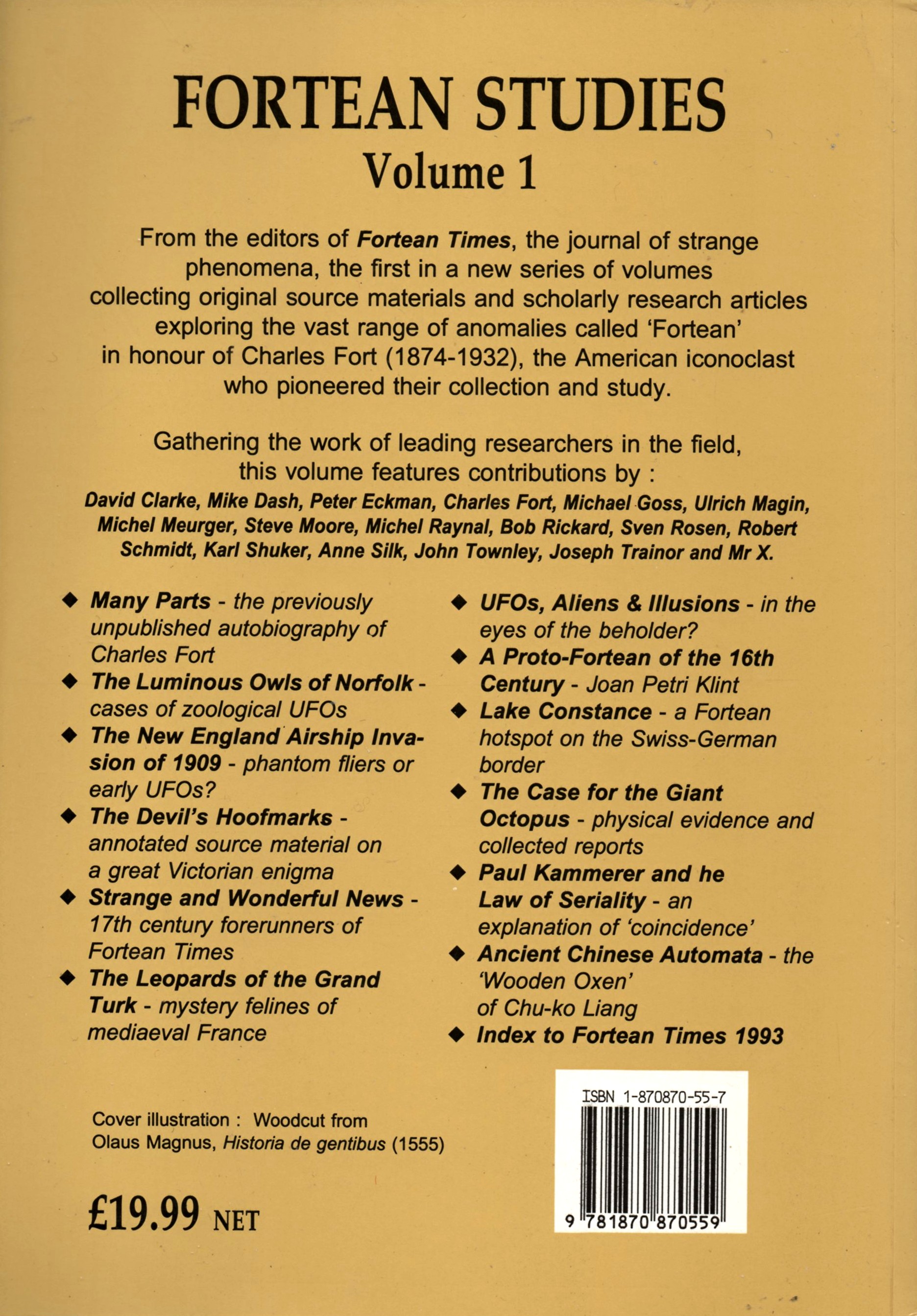
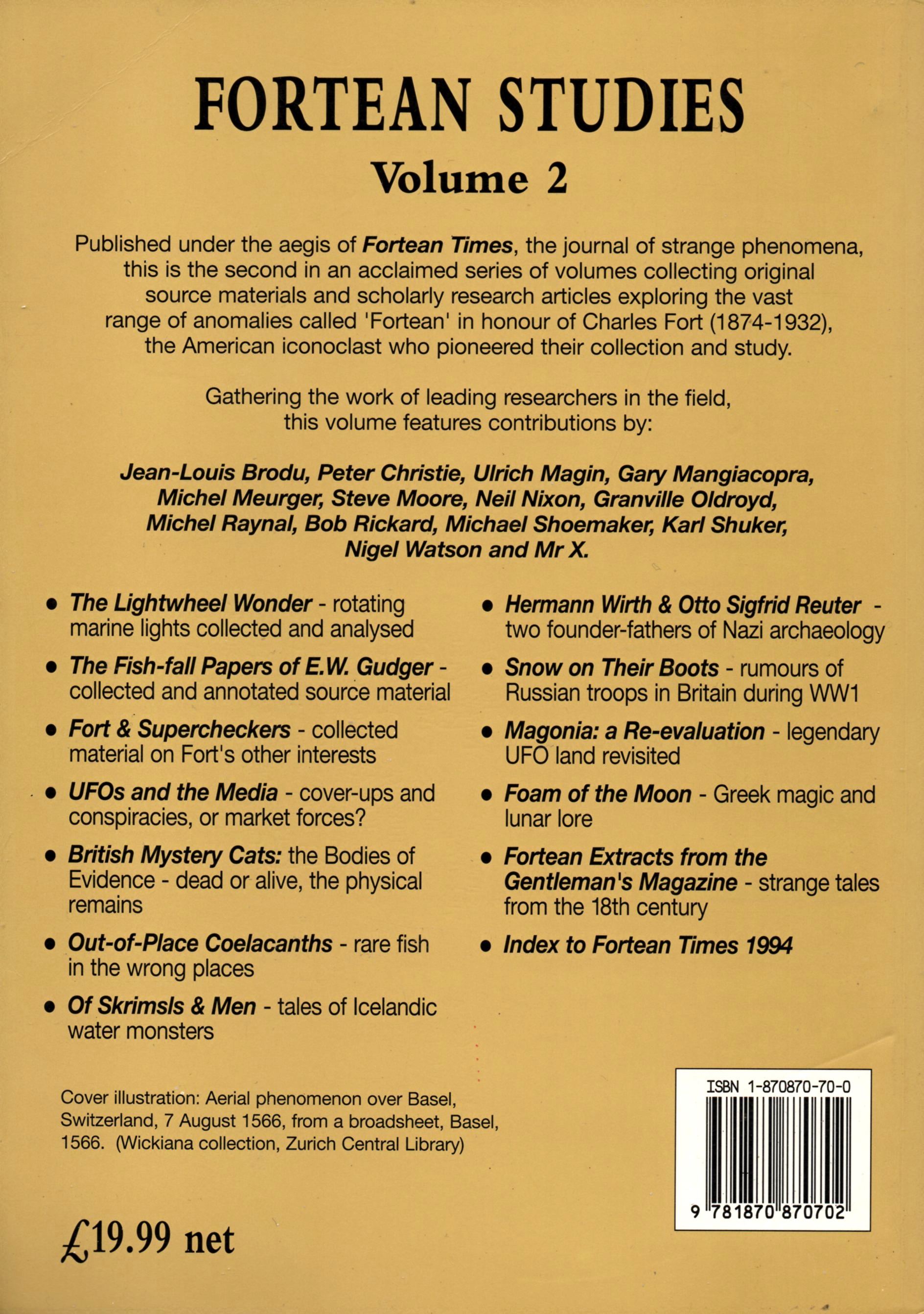
Consequently, as a response both to Mike's enquiry and to what I feel to be a necessity that the contents of Fortean Studies should, very deservedly, be brought to the widespread attention of online readers, I am presenting herewith a series of scans of the front cover and, on the back cover, the list of contents for each Fortean Studies volume from my own library.

NB – Please note that Vol. 1 does contain an article of mine, 'A Belfy of Crypto-Bats', positioned directly after Michel Raynal's giant octopus article, but for some unexplained reason it was omitted from the list of contents.


Fortean Studies, Volume 1, 1994 – click to expand for reading purposes (© Fortean Times/John Brown Publishing – reproduced here on a strictly non-commercial Fair Use basis for educational/review purposes only)


Fortean Studies, Volume 2, 1995 – click to expand for reading purposes (© Fortean Times/John Brown Publishing – reproduced here on a strictly non-commercial Fair Use basis for educational/review purposes only)


Fortean Studies, Volume 3, 1996 – click to expand for reading purposes (© Fortean Times/John Brown Publishing – reproduced here on a strictly non-commercial Fair Use basis for educational/review purposes only)


Fortean Studies, Volume 4, 1998 [for 1997] – click to expand for reading purposes (© Fortean Times/John Brown Publishing – reproduced here on a strictly non-commercial Fair Use basis for educational/review purposes only)


Fortean Studies, Volume 5, 1998 – click to expand for reading purposes (© Fortean Times/John Brown Publishing – reproduced here on a strictly non-commercial Fair Use basis for educational/review purposes only)


Fortean Studies, Volume 6, 1999 – click to expand for reading purposes (© Fortean Times/John Brown Publishing – reproduced here on a strictly non-commercial Fair Use basis for educational/review purposes only)


Fortean Studies, Volume 7, 2001 – click to expand for reading purposes (© Fortean Times/John Brown Publishing – reproduced here on a strictly non-commercial Fair Use basis for educational/review purposes only)
 

Exceptional pressures of work meant that I was unable to contribute an article to Vol. 6, whereas the article on winged cats that I was planning for Vol. 7 proved so arduous in terms of length and required research that I couldn't complete it in time to meet its publication deadline (it finally appeared almost a decade later, in my book Dr Shuker's Casebook). Nevertheless, I did still contribute to Vol. 7, inasmuch as I was nominated as a reviewer by its editors to evaluate Darren Naish's sea serpent article in manuscript form and offer my opinion as to whether it should be published in Fortean Studies. After reading it, I stated that it should be, so it was.

Second-hand copies of Fortean Studies still appear for sale quite frequently on online auction and bookstore sites, but such listings rarely provide full details of these publications' contents. So I hope that this present ShukerNature post will be of benefit to readers who are thinking of purchasing any Fortean Studies volumes but until now have been deterred from doing so by being uncertain of what they contain.

I wish to thank most sincerely my longstanding friend and fellow cryptozoology enthusiast Mike Playfair for very kindly gifting me his spare copy of Fortean Studies Vol. 7 after learning that this was the one volume that I hadn't been able to track down.

I also wish to pay tribute to the memory of the late Steve Moore, who edited all but that final, seventh volume, for encouraging me to contribute to Fortean Studies and also for being another longstanding friend of mine within the Fortean community.

 
Front covers of Vols 5-7 of Fortean StudiesFortean Times/John Brown Publishing – reproduced here on a strictly non-commercial Fair Use basis for educational/review purposes only)