Dr KARL SHUKER

Zoologist, media consultant, and science writer, Dr Karl Shuker is also one of the best known cryptozoologists in the world. He is the author of such seminal works as Mystery Cats of the World (1989), The Lost Ark: New and Rediscovered Animals of the 20th Century (1993; greatly expanded in 2012 as The Encyclopaedia of New and Rediscovered Animals), Dragons: A Natural History (1995), In Search of Prehistoric Survivors (1995), The Unexplained (1996), From Flying Toads To Snakes With Wings (1997), Mysteries of Planet Earth (1999), The Hidden Powers of Animals (2001), The Beasts That Hide From Man (2003), Extraordinary Animals Revisited (2007), Dr Shuker's Casebook (2008), Karl Shuker's Alien Zoo: From the Pages of Fortean Times (2010), Cats of Magic, Mythology, and Mystery (2012), Mirabilis: A Carnival of Cryptozoology and Unnatural History (2013), Dragons in Zoology, Cryptozoology, and Culture (2013), The Menagerie of Marvels (2014), A Manifestation of Monsters (2015), Here's Nessie! (2016), and what is widely considered to be his cryptozoological magnum opus, Still In Search Of Prehistoric Survivors (2016) - plus, very excitingly, his four long-awaited, much-requested ShukerNature blog books (2019-2024).

Dr Karl Shuker's Official Website - http://www.karlshuker.com/index.htm

IMPORTANT: To view a complete, regularly-updated listing of my ShukerNature blog's articles (each one instantly clickable), please click HERE!

IMPORTANT: To view a complete, regularly-updated listing of my published books (each one instantly clickable), please click HERE!

IMPORTANT: To view a complete, regularly-updated listing of my Eclectarium blog's articles (each one instantly clickable), please click HERE!

IMPORTANT: To view a complete, regularly-updated listing of my Starsteeds blog's poetry and other lyrical writings (each one instantly clickable), please click HERE!

IMPORTANT: To view a complete, regularly-updated listing of my Shuker In MovieLand blog's articles (each one instantly clickable), please click HERE!

IMPORTANT: To view a complete, regularly-updated listing of my RebelBikerDude's AI Biker Art blog's thematic text & picture galleries (each one instantly clickable), please click HERE!

Search This Blog


PLEASE COME IN, I'VE BEEN EXPECTING YOU...

PLEASE COME IN, I'VE BEEN EXPECTING YOU...
WELCOME TO SHUKERNATURE - ENJOY YOUR VISIT - BEWARE OF THE RAPTOR!


Showing posts with label flying snakes. Show all posts

Monday, 4 April 2022

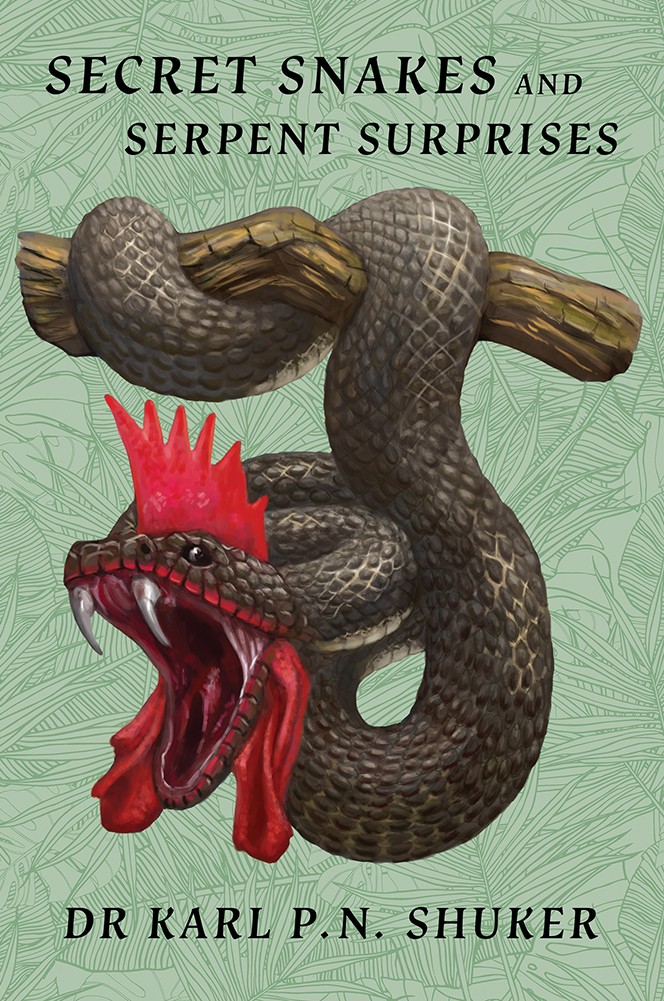
'SECRET SNAKES AND SERPENT SURPRISES' - MY BRAND-NEW, 33RD BOOK IS HERE TO FASCINATE YOU!

 
Front cover of Secret Snakes and Serpent Surprises, depicting the crowing crested cobra as based upon eyewitness descriptions (© Dr Karl Shuker/Coachwhip Publications)

My latest thematic cryptozoology book is finally here, my 33rd book in total, and devoted to a subject that has never previously received book-length treatment.

Few creatures divide human opinion so diametrically regarding their perceived benevolence, or malevolence, as do snakes – the eternally-cursed serpent kind according to Christianity, the most divine and blessèd of reptiles according to Hinduism, vilified and venerated, sanctified and demonised, passively protected, actively annihilated, often overlooked, but never deemed not worthy of notice if or when encountered.

The above is especially true, moreover, when investigating whether our world may contain extraordinary snake forms still undescribed by science and also whether snakes can exhibit bizarre behaviour presently deemed scientifically improbable.

Published by Coachwhip Publications, this uniquely engrossing book provides the most extensive survey of secret snakes and serpent surprises ever published, in which I examine such varied envenomed and constricting controversies as Africa's crowing crested cobra, mystery snakes of the Mediterranean lands, the Mongolian death worm, North America's boss snakes, and Parker's serpentine slayer from Papua, plus St John's viper, the Virgin Mary snakes, and the pre-cursed Eden serpent, Kipling's Karait and Sherlock Holmes's Speckled Band, gargantuan anacondas with horns and the tiny but terrifying pichu-cuate, hairy snakes and feathered serpents, Glycon the talking horse-headed ophidian deity of ancient Rome and venerated king cobras, not to mention vast serpent kings and venom-quelling snake-stones, serpents that shriek, jump, fly, and hypnotise their prey via fatal fascination, plus so much more.

So prepare yourself to be duly fascinated – but only in the most harmless, non-lethal manner! – by the ophidian offerings revealed here. Nevertheless, it may perhaps be best not to stare for too long into the eyes of any of the limbless ones portrayed within this book's comprehensive collection of illustrations, just in case...

Secret Snakes and Serpent Surprises is officially published in 12 April 2022, but can be pre-ordered here on Amazon UK and here on Amazon USA. It is also available on Barnes & Noble's website and can be ordered directly through all good bookstores too. And be sure to check out its dedicated page here on my official website for more information concerning it.

 
The complete wraparound cover of Secret Snakes and Serpent Surprises, depicting the crowing crested cobra as based upon eyewitness descriptions; click picture to enlarge for reading purposes (© Dr Karl Shuker/Coachwhip Publications)


Wednesday, 22 September 2021

SNAKES WITH WINGS - AND OTHER STRANGE THINGS!

 
Artistic representation of the Namibian flying snake based upon eyewitness descriptions (© Philippa Foster)


I went once to a certain place in Arabia, almost exactly opposite the city of Buto, to make inquiries concerning the winged serpents. On my arrival I saw the back-bones and ribs of serpents in such numbers as it is impossible to describe: of the ribs there were a multitude of heaps, some great, some small, some middle-sized. The place where the bones lie is at the entrance of a narrow gorge between steep mountains, where there open upon a spacious plain communicating with the great plain of Egypt. The story goes that with the spring the winged snakes come flying from Arabia towards Egypt, but are met in this gorge by the birds called ibises, who forbid their entrance and destroy them all. The Arabians assert, and the Egyptians also admit, that it is on account of the service thus rendered that the Egyptians hold the ibis in so much reverence.

   Herodotus – The History, Book II


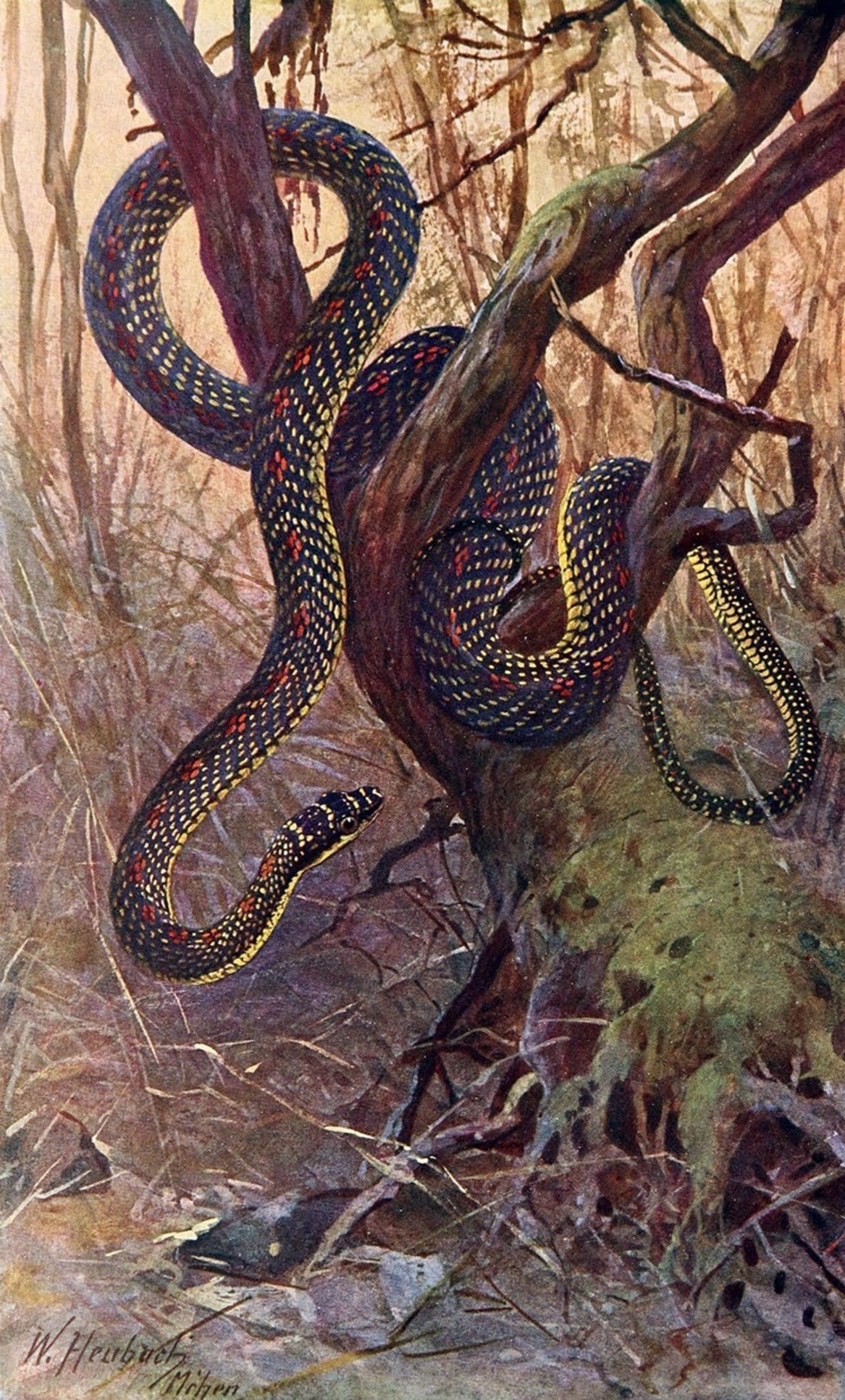
Despite its common name, the so-called flying snake Chrysopelea ornata of southeast Asia cannot actively fly. However, it is well known that this distinctive species can glide for up to 300 ft through the air by launching itself from a tree while simultaneously spreading its ribs and flattening its body, until its undersurface is concave, thereby transforming itself into a ribbon-shaped parachute.

 
Southeast Asia's known flying snake Chrysopelea ornata (public domain)

Yet according to some remarkable reports filed away within the bulging archives of cryptozoology, there may be some currently-undescribed species of snake that are capable of true flight, i.e. achieved with the aid of wings or comparable means of active propulsion.


THE NAMIBIAN FLYING SNAKE

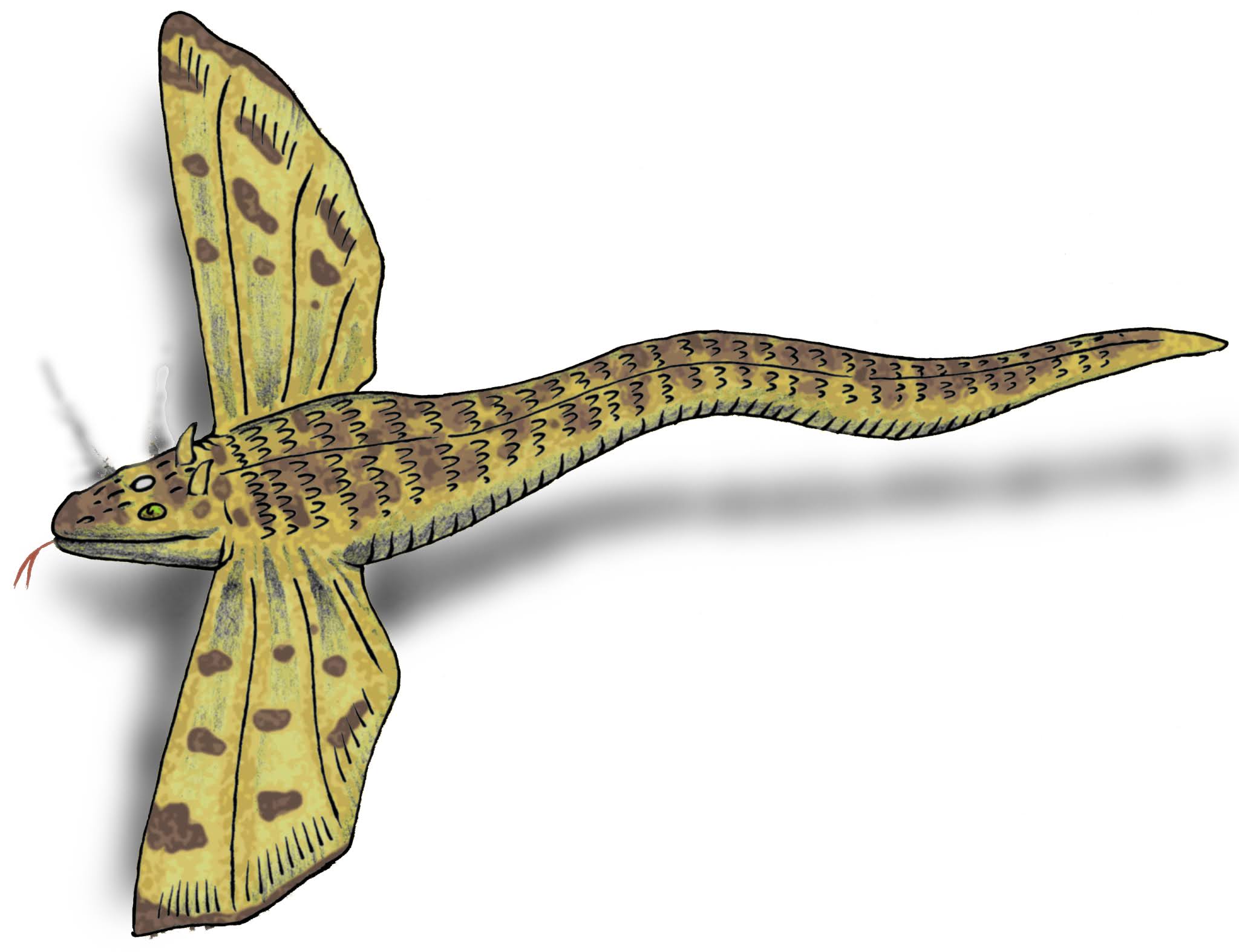
One such mystery beast is the supposed flying snake that has been reported not only by the native Namaqua people but also by a number of European eyewitnesses within the Namib Desert of southern Namibia. According to their generally consistent accounts, it has a brown or yellow body mottled with dark spots, an inflated neck, and a very large head bearing a pair of short backward-pointing horns - plus, very remarkably, a glowing 'torch' in the centre of its brow. Most astonishing of all, however, is the pair of membranous bat-like wings allegedly emerging from the sides of its neck or mouth.

Eyewitnesses have stated that this extraordinary snake launches itself from the summit of a high rocky ledge, then soars down to the ground, landing with an appreciable impact and producing scaly tracks in the dusty earth. In 1942, while tending sheep in the mountains at Keetmanshoop, teenager Michael Esterhuise threw a stone at what he had assumed to be a large monitor lizard lurking inside a rocky crack. When it emerged, however, it revealed itself to be a big snake with a pair of wing-like structures projecting from the sides of its mouth.

 
A second reconstruction of the Namibian flying snake's possible appearance (© Tim Morris)

On a separate occasion, moreover, one of these serpents soared down towards Esterhuise after having launched itself from a rocky ledge. When it landed, hitting the ground with great force, Esterhuise fainted, and when he was later found (unharmed though still unconscious) by a search party, the snake had gone but its tracks remained. They were subsequently examined by no less celebrated a naturalist than Marjorie Courtenay-Latimer – curator of South Africa's East London Museum and immortalised zoologically as the discoverer of that famous 'living fossil' fish the coelacanth Latimeria chalumnae in 1938. In her opinion, these tracks, containing the clear impression of scales, were indeed consistent with the marks that a snake would make.

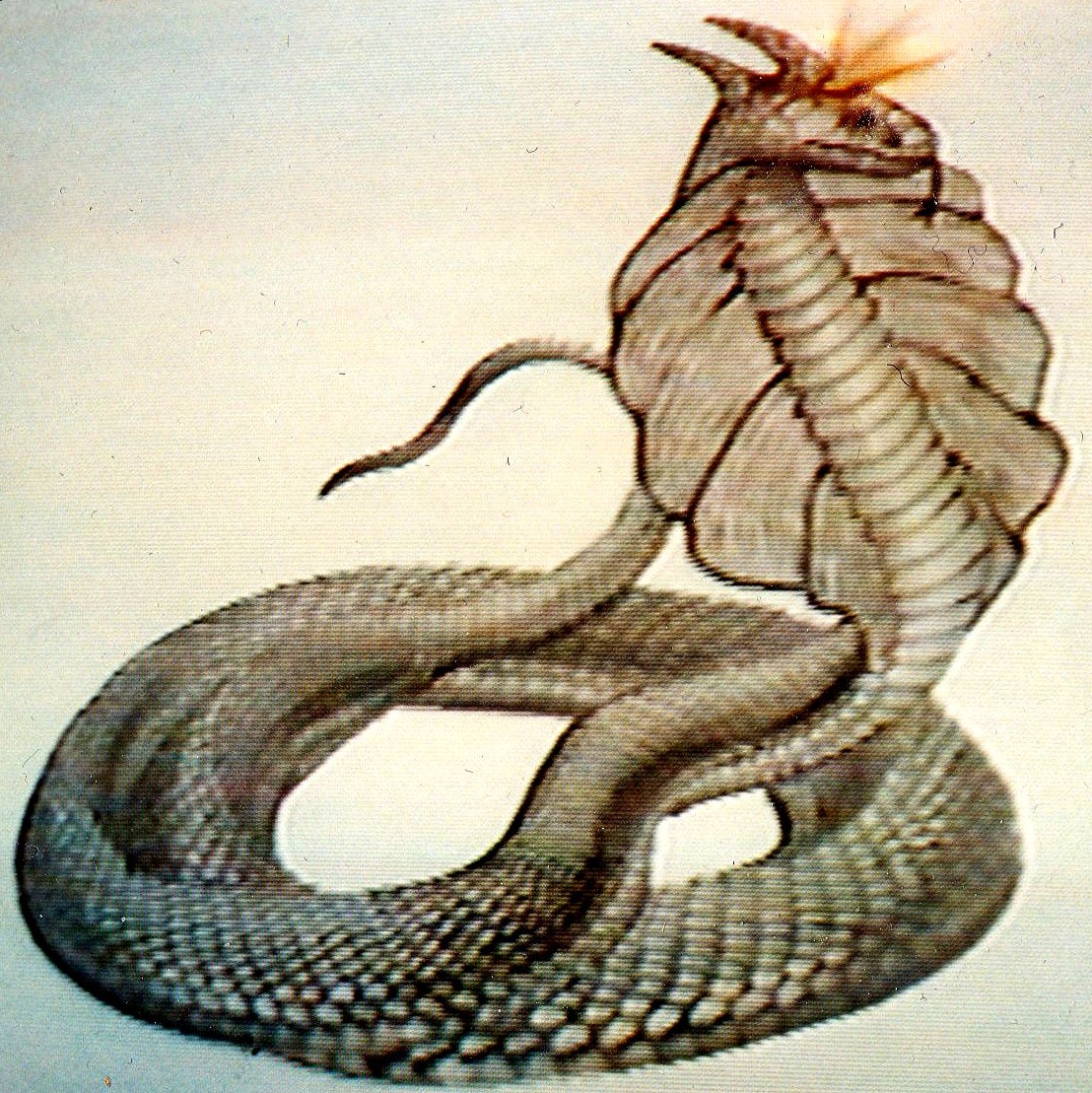
A South African television documentary by Angus Whitty Productions, entitled In Search of the Giant Flying Snake of Namibia and first broadcast in 1995, contained testimony from a number of alleged eyewitnesses, which provided estimates of this mystery serpent's total length that ranged from 9 ft to 15 ft. The programme also specially prepared and featured on-screen a detailed drawing of the latter snake's alleged appearance based upon such testimony.

 
Screenshot of the flying snake drawing from In Search of the Giant Flying Snake of Namibia (© Angus Whitty Productions – reproduced here on a strictly non-commercial Fair Use basis for educational/review purposes only)

Well worth noting is that Namibia is a former German colony, so it is not impossible that Teutonic legends of lightning snakes retold here by German settlers may have infiltrated and influenced native Namibian lore. However, such legends cannot leave physical, tangible tracks like those examined by Miss Courtenay-Latimer, so perhaps a real snake is indeed present but one whose appearance has been exaggerated or distorted in the telling due to shock by those who have unexpectedly encountered it.

If so, the Namibian flying snake may still be an undescribed species, but one that in reality merely sports a pair of extensible lateral membranes similar to those of the famous Asian gliding lizard Draco volans (though whether such structures would be sufficiently adept, aerodynamically, to bear so sizeable a snake through the air is another matter), plus a pair of horny projections resembling the 'eyebrow' horns of certain African vipers. As for its glowing 'torch', this may be nothing more mysterious than a highly-reflective patch of shining scales on its brow.


THE TL'IISH NAAT'A'I OR ARIZONA FLYING SNAKE

For a number of years, American cryptozoologist Nick Sucik has been investigating reports of an equally mystifying but even more obscure aerial anomaly of the serpentine kind - the tl'iish naat'a'í (pronounced 'kleesh-not-ahee' and translated as 'snake that flies'). Also known as the Arizona flying snake, apparently this bizarre reptile is a familiar creature there to the Navajo Nation, and to the Hopi Nation as well (who refer to it by names translating as 'sun snake'). They all describe it as being fundamentally serpentine in form, generally around 2 m long, and dull grey in colour (although sometimes said to have a red belly), but possessing a pair of retractable and virtually transparent wing-like membranes. These emerge from behind its head, run laterally along much of its body's length, can flap vigorously and very rapidly, and are thus used for active flight (rather than passive gliding) purposes.

Some eyewitnesses have stated that these membranes sparkle in the sun when illuminated at certain angles. They also claim that this mysterious reptile constructs a kind of nest from twigs, located along the sides of cliffs or among rocks; and that when airborne, its flying membranes make a hissing sound, likened by some witnesses to a passenger jet's noise when passing by overhead. Comparable reports have also emerged from both the Texas and the Mexican sides of the Rio Grande, including one sighting of an unusual snake-like entity flying amid a group of bats here that was videoed by a security camera at Lajitas, Texas, and can be viewed on YouTube. Sadly, the alleged serpent is only glimpsed briefly and even then not clearly. Some viewers have opined that it may itself have been a bat (albeit a much larger one) or even an owl, but Nick is not convinced by such identities.

The video can presently be accessed here on YouTube, where it was posted by a Gil Bartee on 26 June 2008. Sadly, however, the alleged serpent is only glimpsed very briefly (I assume that it is the entity appearing at 0:54 minutes into the video – Bartee provides no details), and even then not clearly. Some viewers have opined that it may itself have been a bat (albeit a much larger one) or even an owl, but Nick is not convinced by such identities.

 
Artistic representation of the Arizona flying snake (© Tim Morris)

On 10 November 2016, British cryptozoological researcher Richard Muirhead posted in Facebook's Cryptozoology Herpetological Research Group a hitherto-obscure newspaper article dealing principally with the afore-mentioned, long-known Asian flying snake Chrysopelea ornata, but whose final paragraph contained information that is definitely of cryptozoological interest. Published in the Oregonian on 15 March 1942, the paragraph in question reads as follows:

A western prototype [i.e. of Chrysopelea ornata] is reputed to exist somewhere in Southern Mexico, although snake experts have made many fruitless expeditions into the interior for living specimens.

Might this be a previously-unpublicised reference to the tl'iish naat'a'í? If so, however, it indicates that this mystery snake, or something comparable, exists further south in Mexico than the Rio Grande.

In 2004, Nick prepared a detailed paper documenting traditional folklore and contemporary sightings relating to the tl'iish naat'a'í, which could formerly be viewed online (at: http://www.azcentral.com/12news/pics/dragonsofthedine.pdf) but has now disappeared (happily, I downloaded a copy for my files while it was still online), and contains a number of fascinating eyewitness accounts of this truly extraordinary, zoologically-unknown snake.


EUROPEAN WINGED SNAKES

Remarkably, some intriguing but thoroughly mystifying, modern-day reports of aerial snakes have even been filed from Europe. For instance, one day during 1930 or 1931, the mother of André Mellira was preparing lunch in a hut deep within the forest at the mountain village of La Bollène-Vésubie, close to Nice, southern France, when she looked out of the window and saw what looked like a green snake with wings! Moreover, this amazing creature promptly flew down from the branches of a tree close by and landed upon the hut's window sill. When Mellira's mother cried out in fear and alarm, however, her unexpected winged visitor dived down into a bush and vanished. Intriguingly, there is a longstanding tradition of winged snakes inhabiting the southern Alps, but these have always been discounted by scientists as myths.

 
An illustration from a 1723 publication by Swiss scholar Johann Jakob Scheuchzer depicting an alleged alpine winged snake (public domain)

A 12-year-old Bulgarian girl called Hazel Göksu was walking towards a spring very near her home one summer evening in 1947 in order to fill two buckets with water. Suddenly, however, she noticed what initially looked like some branches lying on the path ahead, but as she drew nearer she realised that they were thin snakes. Black, grey, and white in colour, and 1-2 m long, they abruptly emitted a peculiar cry - and then launched themselves into the air, flying 2-3 m above the ground in a straight line to the spring, about 150 m away, before vanishing behind some trees. Hazel was so frightened by what she had seen that she ran back to her home immediately, and never visited the spring again alone.


A COUPLE OF REPTILIAN LONDON PECULIARS?

Perhaps the most unexpected flying snakes ever recorded from Europe, however, were reported even closer to home – West London. According to a correspondent writing as 'SB' in The Gentleman's Magazine on 20 April 1798, a truly remarkable animal was observed during early August 1776 just a few miles west of London:

The strange object was of the serpent kind: its size that of the largest common snake; and as well as it could be discovered from so transient a view of it, resembled it by a kind of grey mottled skin. The head of this extraordinary animal appeared about the size of a small woman's hand. It had a pair of short wings very forward on the body, near its head; and the length of the whole body was about two feet. Its flight was very gentle; it seemed too heavy to fly either fast or high; and its manner of flying was not in an horizontal attitude, but with its head considerably higher than the tail; so that it seemed continually labouring to ascend without ever being able to raise itself much higher than seven or eight feet from the ground.

 
Bestiary illustration of a flying snake-like reptile (public domain)

This same magazine subsequently published a second, more recent report, by a correspondent signing only as 'JR' - describing a sighting by a friend of the same (or a very similar) flying snake encountered at 10.30 pm on 15 July 1797 on the road between Hammersmith and Hyde Park Corner:

The body was of a dark colour, about the thickness of the lower part of a man's arm, about two feet long. The wings were very short, and placed near the head. The head was raised above the body. It was not seven or eight feet from the ground. Being an animal of such uncommon description, I was particular in noticing the day of the month, and likewise being the day preceding a most dreadful storm of thunder and lightning.

If we are willing to accept that these reports are not outright hoaxes (worth noting, however, is that neither of the authors supplied their name), or bizarre exaggerations of some large insect like a damselfly or robber fly (both of which when in flight sometimes hold their body in a similar pose to that described for this winged serpent), or some abstruse example of 18th-Century political satire, we can only assume that the observers were not zoologically-informed, and had mistaken some other, less bizarre creature for a flying snake.

 
 Robber fly (© Vengolis/Wikipedia – CC BY-SA 4.0 licence)

Indeed, this particular case reminds me of those occasions on which I have been asked to remove 'baby horned snakes' from neighbours' gardens during the summer, only to discover time and time again that they are actually the large, distinctive caterpillars of the great elephant hawk moth Deilephila elpenor. Having said that, however, and having read many times the authors' respective descriptions quoted above of what they allegedly saw, I still do not have even the slightest notion of what this enigmatic creature may have been!


EGYPT'S PLAGUE OF FLYING SERPENTS

Finally: no discussion of aerial snakes could be complete without considering the very curious case of Egypt's supposed plague of flying serpents.

In early times, small but highly venomous snakes of many different colours but all possessing membranous bat-like wings reputedly existed in Arabia, and congregated in great throngs upon the trees that produced the much-sought-after frankincense resin.

 
Bestiary engraving of two Arabian flying snakes and an ibis (public domain)

According to the celebrated Greek historian Herodotus of Halicarnassus (c.484–425 BC):

[The Arabians] gather frankincense by burning that storax [styrax resin] which Phoenicians carry to Hellas; they burn this and so get the frankincense; for the spice-bearing trees are guarded by small winged snakes of varied colour, many around each tree; these are the snakes that attack Egypt. Nothing except the smoke of storax will drive them away from the trees.

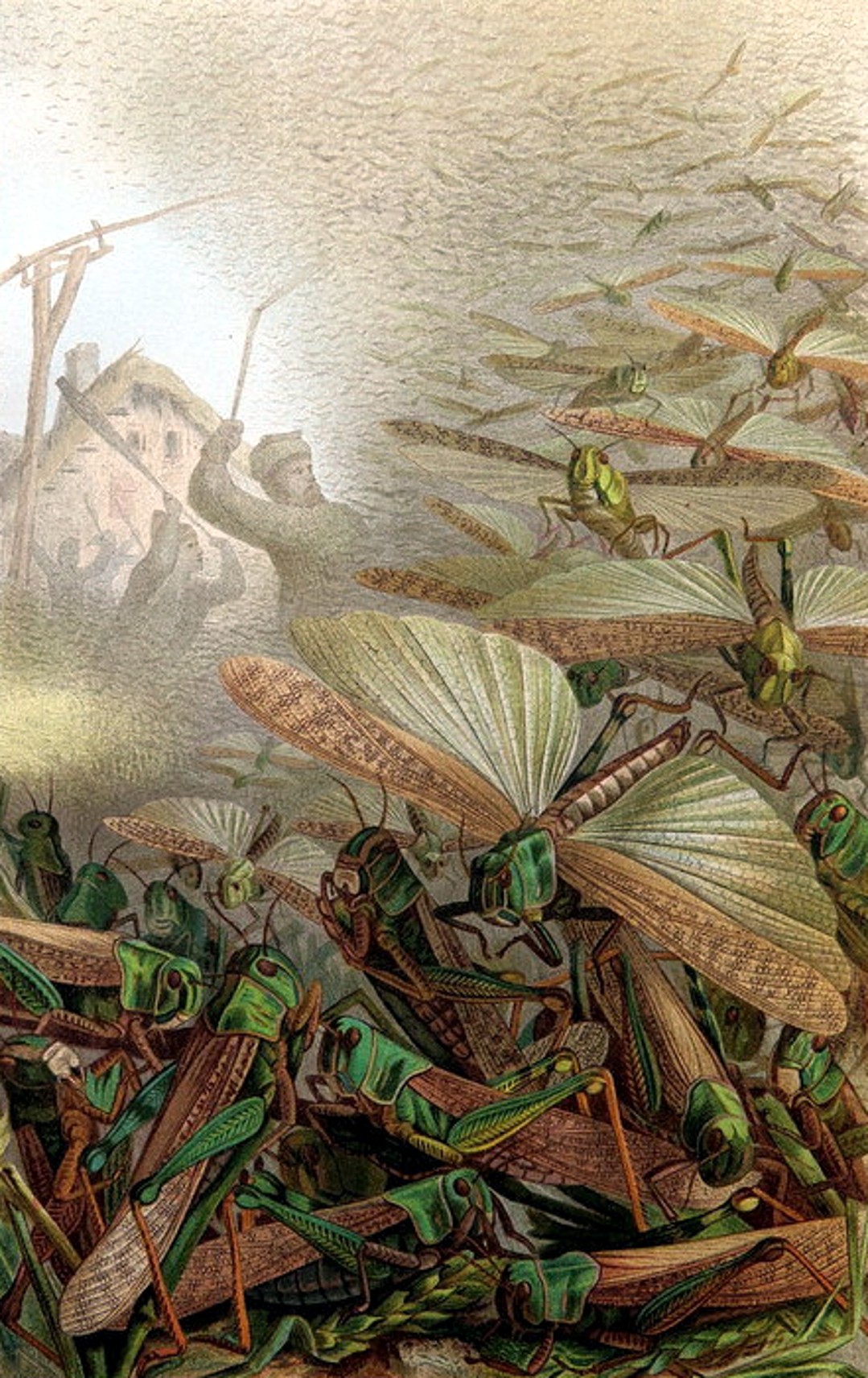
So numerous were they, in fact, that during their springtime migration from Arabia towards Egypt, the very air resounded with their incessant hissing and the unceasing beating of innumerable wings. Happily, however, Egypt's sacred ibises soon decimated these toxic ophidian locusts, devouring them in such vast quantities that none remained.

Many scholars believe that these winged wonders really were locusts, whose 'transformation' into snakes was due merely to exaggerated, elaborated retellings by successive storytellers down through the ages. Others claim that they really were snakes, but that their wings were either hearsay or fictitious additions purposefully supplied later by chroniclers anxious to enhance their tomes' dramatic content.

 
A swarm of locusts vividly depicted in a chromolithograph from 1890 (public domain)

Whatever the explanation, it can be said with certainty that in spite of Herodotus's first-hand observation of what he claimed to be masses of piled-up skeletons of these creatures (see this present ShukerNature article's opening quotation), no such snakes exist in the Middle East today. Presumably, therefore, the skeletons seen by him were not from snakes at all (with no detailed description or illustrations of them to examine, it is impossible to know for sure) – or perhaps their macabre mode of reproduction explains their demise.

For according yet again to the writings of Herodotus (and those of several other ancient historians too), at the very height of passion the female Arabian winged snake would bite her unfortunate partner's head off, rather like a serpentine praying mantis. And when the young snakes developing inside her afterwards had attained the required size for emerging into outside world, they would gnaw their way out of their mother's body, chewing through her uterus and gut, thereby killing her in the process.

Consequently, even if such fanciful creatures really did exist at one time, cursed with such a deadly mode of reproduction and birth it is perhaps little wonder that Arabia's flying serpents became extinct! In reality, however, it seems far more plausible that such claims were based upon misinterpretations of skin sloughing in snakes, with observers of such activity wrongly assuming that a matured snake offspring was bursting out through the skin of a dead parent. Or, to put it another way: in addition to being a highly influential scholar, Herodotus was nothing if not an imaginative one!


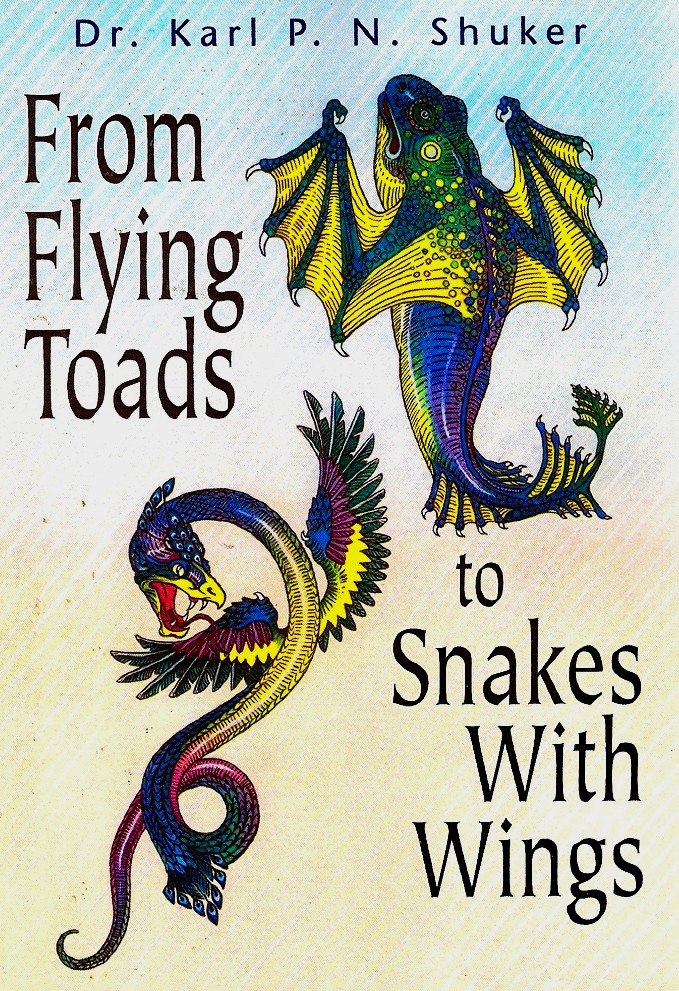
Finally: just in case you may be wondering – I certainly haven't forgotten the extraordinary winged feathered snakes reported from various localities in Wales, as documented by me in my book From Flying Toads To Snakes With Wings and also appearing on its front cover. The reason why they're not included above in this present ShukerNature article is that they've already been featured extensively in a previous one, devoted entirely to them – so please click here to access it.

 
From Flying Toads To Snakes With Wings (© Dr Karl Shuker/Llewellyn Publications)
 

Monday, 25 March 2019

SEALING THE IDENTITY OF AN ALLEGED STELLER'S SEA-COW SKIN


Steller's sea-cows with Kotick the white seal – an 1895 engraving for 'The White Seal', from Rudyard Kipling's The Jungle Book (public domain)


"By the Great Combers of Magellan!" he said, beneath his moustache. "Who in the Deep Sea are these people?"

They were like no walrus, sea-lion, seal, bear, whale, shark, fish, squid, or scallop that Kotick [the white seal] had ever seen before. They were between twenty and thirty feet long, and they had no hind flippers, but a shovel-like tail that looked as if it had been whittled out of wet leather. Their heads were the most foolish-looking things you ever saw, and they balanced on the ends of their tails in deep water when they weren't grazing, bowing solemnly to each other and waving their front flippers as a fat man waves his arm.

"Ahem!" said Kotick. "Good sport, gentlemen?" The big things answered by bowing and waving their flippers like the Frog-Footman [from Alice's Adventures In Wonderland]. When they began feeding again Kotick saw that their upper lip was split into two pieces that they could twitch apart about a foot and bring together again with a whole bushel of seaweed between the splits. They tucked the stuff into their mouths and chumped solemnly…

"Well!" said Kotick. "You're the only people I've ever met uglier than Sea Vitch – and with worse manners."

Then he remembered in a flash what the Burgomaster gull had screamed to him when he was a little yearling at Walrus Islet, and he tumbled backward in the water, for he knew that he had found Sea Cow at last.

   Rudyard Kipling – 'The White Seal', from The Jungle Book


Back in the 1800s, naturalists were much more open to zoological anomalies, mysteries, and curiosities, including those of the cryptozoological kind, than they are today. Never was this openness more readily visible, however, than in the pages of a fascinating British monthly periodical entitled The Zoologist (published 1843-1916), which was packed throughout with contributions from amateur wildlife enthusiasts and eminent biologists alike on every conceivable (and inconceivable!) aspect of natural and, especially, unnatural history.

Today, conversely, such oddities that cannot be readily pigeon-holed into 'acceptable', mainstream zoological categories rarely receive widespread hard-copy coverage outside of newspapers and Fortean publications – which is why Flying Snake, a periodical founded, published, edited, and lovingly compiled every 4-6 months by the indefatigable, inestimable cryptozoological and animal anomalies researcher Richard Muirhead is such an absolute delight, a veritable diamond among so much modern-day dross, especially online.

Steller's sea-cow, depicted on a local postage stamp issued for Russia's Commander (=Komandorski) Islands, a 17-strong group situated in the Bering Sea (east of the Kamchatka Peninsula in the Russian Far East), and around which this huge sea mammal once lived (public domain)

A natural, very worthy successor to The Zoologist, this wonderful little journal contains so much extraordinary, non-conventional Nature, the kind that cannot be readily found in any other present-day publication, that whenever I receive the latest issue I know full well that once I have opened it I shall find it impossible to put down until I have read it from cover to cover.

In the April 2014 issue (vol. 3, #7), however, Richard surpassed even his superlative ability to surprise me with his researches, by virtue of this issue's front cover-highlighted lead article. It consisted of an investigation conducted by Richard that quite simply took my breath away – by featuring the history and two vintage photographs (one of which appeared on the front cover) of what has seemingly long been claimed to be a bona fide torso skin (i.e. lacking the head, flippers, and tail) of Hydrodamalis [=Rhytina] gigas, the long-extinct Steller's sea-cow!

The front cover of Flying Snake, April 2014, showcasing one of the two vintage photographs uncovered by Richard that allegedly depict a preserved Steller's sea-cow skin (© Richard Muirhead/Flying Snake – reproduced here on a strictly non-commercial Fair Use basis for educational/review purposes only)

As I have documented in greater detail within an earlier ShukerNature article (click here to read it), at up to 30 ft long Steller's sea-cow was by far the largest modern-day species of sirenian ever to have existed, very significantly bigger than the dugong and any of the manatees that still survive today. It was discovered in shallow waters around the Commander (aka Komandorski) Islands in what was later dubbed the Bering Sea, separating Russia's Kamchatka Peninsula from Alaska, by Arctic explorer Dr Georg W. Steller in 1741, during Danish explorer Vitus Bering's Russian expeditions there. Tragically, however, the inoffensive, unafraid behaviour of this huge herbivorous marine mammal, coupled with the abundance and very tasty nature of its meat, swiftly proved to be its undoing, dooming it to a rapid extinction despite its great numbers. For it was mercilessly, relentlessly slaughtered by hungry mariners penetrating its icy, inhospitable domain.

By 1768, Steller's sea-cow was no more, exterminated from the Commander Islands' coastal waters that had been its home since time immemorial. Having said that, there have been infrequent subsequent reports from various remote Arctic outposts of extremely large, mystifying sea beasts that may – just may – be surviving sea-cows, but none has ever been confirmed.

Reconstruction of Dr Georg W. Steller measuring a Steller's sea cow on Bering Island, 12 July 1742 (public domain)

As for preserved physical remains of this veritable behemoth: a number of museums around the world have skeletons (complete, partial, or composite), skulls (ditto), or isolated bones (limb bones, vertebrae, ribs, etc) from Steller's sea-cows (click here to access an extensive listing of such specimens).

In addition, there are a few scraps of preserved skin on record that have been claimed to be from this lost species, but there are also counterclaims averring that they are actually from seals or cetaceans. According to the above listing of specimens, one such scrap is present in the Überseemuseum at Bremen, Germany (a photograph of it snapped on 29 January 2011 by Flickriver user MareCrisium can be viewed here). A second is (or was) held by Germany's Hamburg Zoological Museum (it may have been destroyed by bombing during World War II, and the above listing presumes that it is/was a misinterpreted whale skin anyway). And a third is held by the Zoological Institute of the Academy of Sciences in St Petersburg, Russia (queried in the listing as a probable whale skin fragment again, and originally discovered in the Institute's collections by an A. Brandt). However, no museum or scientific institution anywhere in the world lays claim of any kind to possessing an entire torso skin from such a creature – which is why Richard's report and accompanying photographs were of such profound interest to me.

Skeleton of a Steller's sea-cow at the National Museum of Natural History in Paris, France (© FunkMonk/Wikipedia – CC BY-SA 3.0 licence)

I strongly recommend everyone interested in this case to read Richard's original article, but in the meantime here is a summary of what he uncovered.

It all began with a local newspaper article. On 6 April 1956, the Kansas City Star in the U.S.A. published the photograph that appears on the above-reproduced front cover of Flying Snake for April 2014, together with the following details. The person holding the torso skin, and pictured with it in her East Tenth Street, Intercity District, Kansas home's living room, was Mrs Faye Keyton, who had inherited it jointly with her brother, W.L. Shafer, from their aunt, Miss Myrtle Shafer, who had died in May 1955. It was normally kept rolled up inside a long cardboard tube, was quite stiff, and according to Mrs Keyton it was an Alaskan Indian burial robe that had been made from the skin of a Steller's sea-cow. But how did she know this?

Vintage photograph from the late 1800s/very early 1900s depicting Prof. Willoughby with the burial robe (public domain)

Keyton revealed that her aunt had herself inherited it, from Jim Willoughby, a distant relative, who in turn had received it from his father, a certain Prof. Richard ('Dick') D. Willoughby (1832-1902), who had lived in Alaska for half a century, where he had been made an Indian chief and spoke their language. The robe was one of his possessions that he had acquired there during that period, and when he died in 1902 it was placed over him during his funeral as part of a native Alaskan Indian burial ceremony.

Reading this intriguing little history, I was immediately struck by the curious fact that there was no explanation as to why or how this robe was ever deemed to be the skin of a Steller's sea-cow. All that I can assume is that it had been labelled as such by Prof. Willoughby himself, with that identity having subsequently been accepted unquestioningly by, and duly passed on down through, the generations of the robe's inheritors. Unfortunately, however, this in turn leads to a major problem in accepting such an identification. For as revealed by Richard Muirhead in his Flying Snake article, Willoughby was a notorious practical joker and had a longstanding reputation as a teller of exceedingly tall tales. He was also known for attaching highly imaginative and often decidedly lurid back-stories to the many curios contained in his house that he had gathered from different parts of the Alaskan coast, many of which were of native Alaskan Indian origin. Taking all of this into account, it is by no means certain, therefore, that the robe really was a Steller's sea-cow skin – this could just as easily have been yet another fanciful yarn spun by Willoughby.

Steller's sea-cow model at London's Natural History Museum (© Emöke Dénes/Wikipedia CC BY-SA 4.0 licence)

But that is not all. Based upon direct eyewitness descriptions and sketches of Steller's sea-cow by Steller himself and other maritime travellers during the all-too-brief period of time spanning this species' discovery and destruction, the robe doesn't look at all like the skin of this officially extinct species. For whereas the latter's skin was said to be rough and spotted, this robe is smooth and bears two very distinctive, highly conspicuous white rings upon it as well as an upper and a lower white band. True, the robe's leather may have been tanned, making it smooth, but those very large white rings and bands are unlike anything ever recorded for Steller's sea-cow. In addition, judging from the photographs and allowing for forced perspective (in both photos, the skin was closer to the camera than the person was, thereby making the former appear bigger than it actually was), the skin was far smaller than any but the youngest of juvenile sea-cows would have been.

One of Richard's correspondents, regular Flying Snake contributor Richard George, opined that he was certain that these distinctive markings had been painted on the skin. Bearing in mind that it was used as a ceremonial burial robe, adding such decorations to it as some form of symbolic representation would not be at all beyond the realms of possibility. If only the robe could be examined directly, however – this would soon determine whether they were a natural component of it or had been artificially added. Moreover, with today's advances in DNA analyses, a sample of tissue taken from it would readily reveal the true taxonomic nature of the species from which the skin had been obtained. But therein lies a fundamental problem – its current whereabouts are presently unknown.

Exquisite engraving from 1898 depicting mature and juvenile Steller's sea-cows (public domain)

After reading Richard's article, I did consider attempting to trace the robe, by pursuing the current whereabouts of Mrs Keyton, her brother, or any children that either of them may have had. However, as so often happens, other matters diverted my attention, and eventually I forgot about this mysterious object – until this week, that is.

After having read with my usual enthusiasm the latest, newly-published issue (#14, January 2019) of Flying Snake a few days ago, I was about to place it with the other 13 issues on their allotted shelf in my study's cryptozoological section when, while idly flicking through them, I noticed the front cover of the April 2014 issue once more, the first time that I'd looked at it in a very long while – but this time something suddenly clicked inside my mind. I know that ringed patterning on the robe! I've seen it somewhere before, somewhere else.

Steller's sea-cow (right) with a Steller's sea lion and a northern fur seal, from a map of the Commander Islands drawn by Sven Waxell in 1891 (public domain)

Sitting there in thought, I recalled the above-linked listing of Steller's sea-cow material held by various museums around the world, and in particular I remembered those controversial fragments of skin that a few of the museums possessed, claimed by some to be genuine Steller's sea-cow relics but by others to be derived from whales or seals.

And then, without warning, an image flashed into my mind – an image of an extremely distinctive species of sea mammal, one that, uniquely, possessed exactly the same ringed pelage as was so visibly present on the Alaskan burial robe, but a species that unlike Steller's sea-cow was still very much alive today. Suddenly, I knew exactly what the Alaskan burial robe had been obtained from – and it most definitely was not a Steller's sea-cow!

The ribbon or banded seal – an absolutely unmistakeable species (public domain)

Instead, it was from an exceptionally beautiful, exquisitely marked species of phocid (earless) seal – namely, Histriophoca fasciata, the ribbon or banded seal. Up to 5 ft long, it is native to the Arctic and subarctic regions of the northern Pacific Ocean, but especially the Bering Sea…separating Russia from Alaska! Moreover, it is immediately distinguished from all other seal species (and all other species of any kind of mammal, for that matter) by virtue of the two very large white circles on its body (one on each side) and also the two wide white bands encircling its neck and tail respectively that collectively decorate very strikingly its otherwise uniformly dark-brown or black pelage.

All that I needed to do now in order to be absolutely certain was to uncover if I could a photograph of a torso skin of a ribbon seal to compare it directly with the Alaskan burial robe, and once I was on the trail it didn't take me long to find an excellent example. Comparing the two side by side, they were virtually identical, as shown below. Consequently, there could be absolutely no doubt whatsoever – just like so many other examples of his yarns on record, Willoughby's Steller's sea-cow skin was nothing but a tall tale. It was in reality the skin of a ribbon seal. Case closed.

Comparing Willoughby's Alaskan burial skin (left) with the skin of a ribbon seal (right) (© Kansas  City Star, reproduced here on a strictly non-commercial Fair Use basis for educational/review purposes only / public domain)

I am delighted that Richard Muirhead brought this fascinating but hitherto little-publicised case to cryptozoological attention with his customary investigative zeal via his Flying Snake article, and that I in turn have been able to provide the solution to the longstanding riddle that its subject posed.

For anyone seeking more information concerning Flying Snake, a publication that I thoroughly recommend to everyone interested in the more unusual, unexpected facets of natural history, please click here.

Finally: although the following flying snake illustration has nothing to do whatsoever either with Richard's periodical or with Steller's sea-cow, its fictional subject is nonetheless cryptozoological in nature and is such an extraordinary image in its own right that it deserves to be included here, especially as at least to my knowledge it has never before been featured in any cryptozoological article. So here it is, from the front cover of an issue of an American men's magazine entitled Man's Conquest:

Front cover of the March 1967 issue of Man's Conquest, depicting an attack of flying snakes, the subject of a fiction short story contained inside (© Man's Conquest – reproduced here on a strictly non-commercial Fair Use basis for educational/review purposes only)