Native South African legends have long told of magical, elusive white lions inhabiting the Kruger National Park and the neighbouring Transvaal, and a few claimed sightings made by Western non-scientists were reported during the first half of the 20th Century. With no confirmed sightings by scientists, however, these leonine phantoms were not taken seriously by the zoological world – until 1977, that is, when zoologist Chris McBride announced to stunned press reporters across the globe that for the past two years, on a private game reserve called Timbavati adjacent to the Kruger, he had been studying and protecting three blue-eyed, snowy-white lions.
Tragically, as revealed in McBride’s books
The White Lions of Timbavati (1977) and
Operation White Lion (1981), one of them, a female called Phuma, was subsequently shot by a poacher. As a result, the remaining two, Temba (male) and Tombi (female), together with their normal tawny-furred brother, Vela, were successfully captured and rehoused within South Africa’s National Zoo in Pretoria for their own safety. Since then, many white lions have been bred from them and from others in captivity; there are currently around 300 individuals worldwide.

A white lion breeding programme is presently underway at Inkwenkwezi Private Game Reserve in South Africa's Eastern Cape province. In 2009, moreover, confirming that their coat colouration does not prevent them from hunting efficiently, an entire pride of captive-bred white lions was successfully introduced into the wild – the climax of a project initiated in 2003 by the Global White Lion Protection Trust (GWLPT), founded by author and conservationist Linda Tucker in 2002 (click
here to visit the GWLPT's website).
 Blue-eyed Timbvati-type white lion, the focus of conservation efforts by the Global White Lion Protection Trust (Linda Tucker-Global White Lion Protection Trust)
A light-grey cub deemed (tentatively) to be a chinchilla specimen by felid geneticist Roy Robinson back in the 1980s had been born at Alabama’s Birmingham Zoo in 1974. However, this individual was darker than the Timbavati trio.
Genetically, white lions are an intriguing phenomenon. Certain workers claim that some of these lions, including the original Timbavati trio, owe their white coat and blue eyes to the same genetic scenario as that which induces the chinchilla phenotype (coat appearance) in domestic cats. Moreover, they also offer this explanation for the blue-eyed white tigers of Rewa and many of those now in captivity worldwide (see later). But what
is the genetic scenario responsible for the chinchilla phenotype in domestic cats?
Cat geneticists once thought that it was caused by a recessive albino allele (gene form) of the Full Colour gene, but this is no longer the case.
Robinson's Cat Genetics for Breeders and Veterinarians (1999) is the most recent edition of
Cat Genetics for Breeders, authored by the late Roy Robinson. One of the world's leading experts on this subject, Roy very kindly acted as my own mentor in this field for several years via numerous telephone conversations and exchanges of letters following the publication of my book
Mystery Cats of the World (1989) – which he referred to in a review of it as "One of the most fascinating books that I have read for many a long day" (
Cats, 15 December 1989).
 Robinson's Cat Genetics for Breeders and Veterinarians
 remains the internationally-recognised standard work on the genetics of domestic cats, and is the principal publication regarding this subject that I have utilised for reference purposes throughout this present ShukerNature post of mine. According to Roy's book, the chinchilla phenotype in domestic cats is nowadays deemed to be caused by the dominant inhibitor allele of the Inhibitor of Colour gene in combination with the dominant agouti allele of the Agouti gene:
"The dominant inhibitor gene I suppresses pigment fed into the growing hair. This results in the typical expression of white hairs with colored tips...That expression ranges from a barely perceptible white band at the base of the hairs next to the skin, to an almost completely white animal with the pigment restricted to the extreme hair tips...The smoke cat is the non-agouti [recessive, aaI-] expression...while the silver [i.e. the chinchilla] is the agouti [dominant, A-I-] form. The inhibitory qualities of the agouti protein increase the effect of this form of pigment inhibition – silver cats have more white undercoat than smokes."
Moreover, in his publications Roy Robinson considered that parallel variation in different species of cat was likely to be due to the presence of common genetic material, i.e. directly equivalent (homologous) mutant alleles at precisely the same positions (loci) on the chromosomes. As an example, Robinson considered that melanistic (all-black) individuals in as wide a range of species as the leopard, caracal, bobcat, leopard cat, serval, and tiger (but
not the jaguar) may well all be due to the expression of precisely the same mutant allele - the recessive non-agouti allele of the Agouti gene
A.
However, this presents a problem in relation to white big cats For whereas the inhibitor allele of the Inhibitor of Colour gene and the agouti allele of the Agouti gene, which are both present in chinchilla domestic cats, are both dominant, captive breeding programmes have confirmed that in white lions and also in white tigers, the white phenotype is inherited as a recessive trait.
True, there
is a recessive allele of the Inhibitor of Colour gene, but this allele actually
prevents inhibition of colour, resulting in golden-coated cats, not white ones.
So unless in lions and tigers the inhibitor allele is recessive, not dominant as in domestic cats, this genetic scenario (i.e. the recessive white phenotype in lions and tigers being due to the Inhibitor of Colour gene's dominant allele) remains an apparent contradiction.

A second possibility is that although in domestic cats the inheritance of the chinchilla phenotype does not involve the action of a recessive mutant allele of the Full Colour gene (as once believed), perhaps such an allele
is responsible for the white phenotype in lions and tigers. This scenario would certainly explain the inheritance of the white phenotype as a recessive trait in these wild cat species.
Well worth noting here is the following thought-provoking statement (and, in particular, the final sentence in it) made by Roy Robinson noted in a
Genetica paper from 1976:
"For many years it was believed that the silver and chinchilla breeds of cat were due to a mutant allele of the albino locus [i.e. the Full Colour gene C]...However, recent work has shown that the phenotype is a mimic of the typical chinchillated animal and is due to a dominant gene I, independent of the albino series...The gene inhibits the formation of pigment in the coat...No comparable form has yet been described for other Felids." [The change in typeface colour here is mine, for emphasis]
There, in that final line, may well be the key to this whole mystery. Could it be that there really is no Inhibitor of Colour gene in cat species other than the domestic cat, and that, instead, in wild cat species there genuinely is a recessive chinchilla albino mutant allele of the Full Colour gene that is responsible for the expression of the recessive homozygously-inherited white phenotype in tigers and lions?
A third possibility is that the white phenotype in these latter cat species is induced by a recessive allele of a gene separate from both the Inhibitor of Colour gene and the Full Colour gene.
 Model of a blue-eyed Timbavati white lion (Dr Karl Shuker)
Due to the immense amount of observations and studies documented in relation to domestic cat breeding, many of the various genes and their respective alleles responsible for coat phenotypes in this species have been conclusively identified and given specific names. In contrast, far fewer studies have been conducted in relation to the coat phenotypes of wild cat species, so there is far less confirmed information available concerning the specific identities of the genes and alleles involved with them.
As a result, the genetic terminology applied in relation to these latter genes and alleles in wild cat species is much looser – so much so, in fact, that the same name (e.g. 'inhibitor gene') is often applied to alleles of totally different genes if they happen to induce the same phenotype (even if one such allele is dominant and another is recessive), all of which only serves to confuse matters further.
Consequently, if anyone has scientifically-verified and published information concerning the precise genetic basis of white phenotype inheritance in lions or (tigers) that reconciles the apparent anomalies queried by me here, I would be very interested to receive full details.
LEUCISTIC LIONS
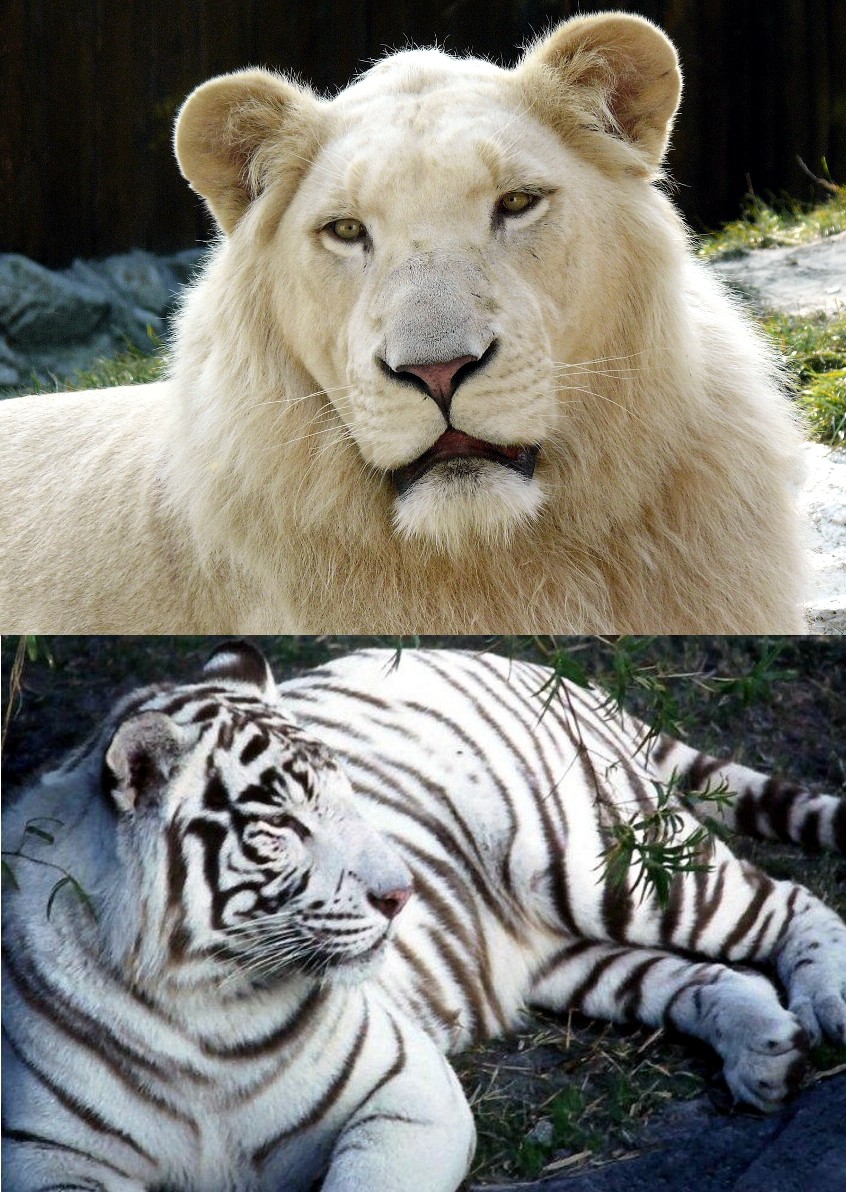
In contrast to the Timbavati-type lions, other white lions have normal eye colouration, and merely appear extremely pale, even blonde, versions of normal lions. This abnormally pale, even washed-out appearance has been reported from many other species too, and is known as leucism.
 Leucistic white lion (Dr Karl Shuker)
Unlike albinism (with which it is often confused), in which only the production of dark pigment (eumelanin) is affected, leucism is caused by the failure during an animal's embryonic development of some or all of the actual pigment cells themselves to differentiate or to migrate properly from the neural crest (where they originate) to the skin, fur, scales, or feathers. And because all types of pigment cell differentiate from the same multi-potent precursor cell type, this means that leucism can cause the reduction of all types of pigment, not just one, resulting in the affected animal exhibiting a characteristic faded or washed-out appearance.
Yet even though leucism is popularly claimed to be the correct explanation for the type of pale lion with normal eye colour, pad colour, etc, documented here, I am presently unaware of any published cytological studies confirming this, i.e. by showing that such lions lack pigment cells rather than merely lacking pigment. The same applies in relation to white tigers, as these are also claimed by certain workers to be leucistic. Consequently, if anyone can provide me with references to such studies, I would very much like to receive them.
 Leucistic white lioness (Dr Karl Shuker)
Various non-leucistic explanations have also been proposed for these lions, but none has been verified to date. They include the action of a gene analogous if not homologous to the version inducing the champagne phenotype in horses; and the expression of the recessive dilute allele of the Dense Pigmentation gene in homozygous state modifying the action of the Red gene to yield the cream phenotype, as occurs in domestic cats.
I saw my first leucistic white lions in 2004, while staying at the Mirage Hotel during a holiday on The Strip in Las Vegas. In the grounds of the Mirage is ‘The Secret Garden of Siegfried & Roy’ – a wildlife park owned by these world-famous American stage magicians – where leucistic white lions, as well as white tigers and even a snow tiger (see later), are exhibited. Since then, moreover, I have seen specimens at a number of other locations around the world, where their pallid beauty never fails to fill me with awe.
 Visiting ‘The Secret Garden of Siegfried & Roy’ at the Mirage Hotel, Las Vegas (Dr Karl Shuker)
WHITE TIGERS
Visiting ‘The Secret Garden of Siegfried & Roy’ at the Mirage Hotel, Las Vegas (Dr Karl Shuker)
WHITE TIGERS
One of the most evocative descriptions of a white tiger that I have ever seen appeared in a
Wild About Animals magazine article from December 1989 dealing with white mutant animals:
The golden paint has been forgotten. Instead of fiery sun, we bathe in the cool moonlight of this wonderful creature. Nature's mistake is our magnificent gain.
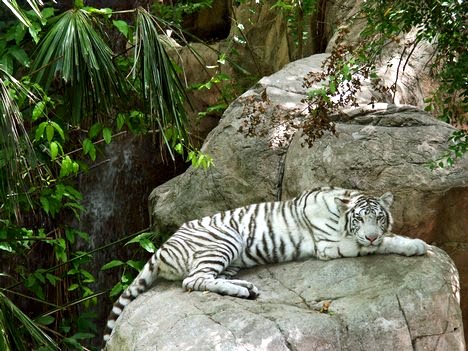
Certainly, the sight of a sepia-striped, ivory-furred tiger, gazing into your eyes through its own twin orbs of glacial blue, is unforgettable - but what is the history of these ethereal creatures?
 A white tiger – not burning bright but moonlight white (Chris Brack)
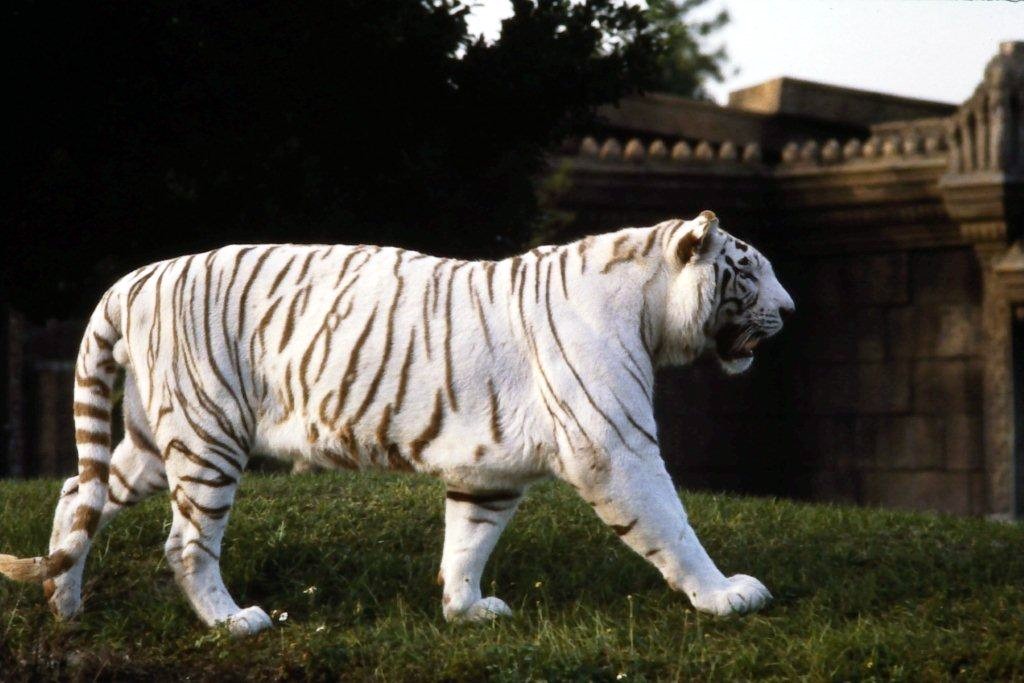
White tigers originated as mutant Bengal tigers
Panthera tigris tigris, and have been reported from many parts of India and its immediate neighbours (although there are even some reports from China and Korea), and appear to have existed for some considerable time. Indeed, the earliest known record dates back to 1561, when the Mogul emperor Akbar slayed a tigress that attacked his royal cavalcade near Gwalior. Two paintings dating from his reign and depicting this scene exist – appearing in his great work, Akbar Nama; one of these reveals that two of the tigress's cubs were white.
Similarly, the inhabitants of Assam have known of white tigers since time immemorial, and believe that anyone who kills one will certainly die himself soon after. Sadly, not everyone shares this conviction, and their striking appearance has inevitably made white tigers prime targets for big game hunters. In
The Royal Natural History (1894-1896), Dr Richard Lydekker recorded a white tiger shot in Upper Assam during March 1889, and in 1891 one was reported from Poona. Pollock and Thom listed several white tigers in 1900 from Burma and the Jynteah hills of Meghalaya; and Indian wildlife researcher Dr E.P. Gee documented the sighting of two specimens (one of which was later shot) towards the onset of the 20th Century at an Assam tea estate - renamed Bogobagh ('White Tiger') tea estate afterwards.
Between 1907 and 1933, the
Journal of the Bombay Natural History Society included no less than 17 reports of shot white tigers, including one in the Dhenkanal State, Orissa, in 1909; another during 1910 in the Bilaspur district of what was then called the Central Provinces; and two in the district of Bhagalpur in Bihar sometime around 1926. More were shot during the 1920s and 1930s, including 15 in Bihar alone! On 22 January 1939, a specimen was killed by the Nepalese prime minister at Barda camp in Terai Nepal.
 A white tiger (Dr Karl Shuker)
Some time before World War I, several white tigers frequented the area of jungle where the districts of Mandla and Bilaspur border on Rewa. In December 1915, one of these (a two-year-old male) was captured near Sohagpur, by the Maharajah Gulab Singh of Rewa. He exhibited it at his summer palace for the next five years, until its death, whereupon it was stuffed and presented to King George V. During later years, eight white tigers were shot in the Rewa forests, the last of which, a male, was bagged by the new Maharajah in 1947.
Disturbingly (though not unexpectedly, in view of such deplorable depletion), sightings of white tigers in the wild within more recent times have been few and far between. Indeed, the last confirmed individual on record appears to have been spied (and, yet again, shot!) in 1958 near Hazaribagh, Bihar, and its skin was displayed at a Calcutta taxidermist's shop. Fortunately, however, not all white tigers shared this tragic fate, and it is the history of one of these lucky few that explains why white tigers still exist today.
 Russian porcelain figures of white tigers (Dr Karl Shuker)
On 27 May 1951, a male white tiger was captured alive in Rewa, and was housed within the now-disused summer palace of the Maharajah. This specimen was the famous Mohan, sire of the pure strain of white Bengal tigers subsequently exhibited in zoos ands circuses all over the world. Mohan was mated with many different tigers, all normal-coloured at first, from which only normal-coloured offspring were produced. However, when one of these was itself mated with Mohan, white tiger cubs were at last obtained, and the strain has thrived ever since, with new tigers introduced intermittently in order to strengthen and perpetuate the line. (Moreover, white tigers have also appeared spontaneously in other captive tiger lineages elsewhere, showing that the genetic basis for white tigers is more widely distributed through the world tiger population than once assumed.)
This captive-breeding programme was studied in depth by Hong Kong University zoologists Drs Ian W.B. Thornton and K.K. Yeung, together with Dr K.S. Sankhala from Delhi Zoological Park, and in 1967 the trio published a
Journal of Zoology paper. In it, they proposed that the white tiger form was caused by a recessive mutant allele when present homozygously (i.e. represented by two copies, as opposed to just one, or none at all). Further studies by Thornton (by then residing at La Trobe University in Victoria, Australia) into the inheritance of the white phenotype (coat appearance) in tigers confirmed this (
Journal of Zoology, 1978).
 Seen Siegfried and Roy’s white tigers, bought the t-shirt! (Dr Karl Shuker)
As discussed earlier here regarding the genetics of white lions, it was once thought that a certain recessive mutant albino allele of the Full Colour gene was responsible for the chinchilla phenotype in domestic cats and, by extension, white tigers and lions. However, cat geneticists later discovered that in domestic cats it is the combined effect of the dominant agouti allele of the Agouti gene and the dominant inhibitor allele of the Inhibitor of Colour gene that is responsible for the chinchilla phenotype. They achieve this by so significantly inhibiting the production of the yellow pigment phaeomelanin, normally present in pigment bands on the hairs of the cats' undercoat, that the hairs' shafts are entirely silver or white - only their very tips are pigmented. Moreover, some workers claim that this same genetic scenario is responsible for the white phenotype in tigers too, but this raises a query.
Thornton's studies had verified that white tigers mated with white tigers can only produce white tigers, whereas normal tigers mated with normal tigers usually produce only normal tigers but can occasionally produce white tigers too. Consequently, it is clear that whichever allele is responsible for white tigers, it is both homozygous and recessive. Consequently, the white phenotype in tigers is inherited as a recessive trait. How, therefore, can the combination of the dominant inhibitor allele of the Inhibitor of Colour gene and the dominant agouti allele of the Agouti gene, responsible for the dominant chinchilla phenotype in domestic cats, also be responsible for the recessive white phenotype in tigers?
As previously noted here regarding the same genetic conundrum with white lions, three different possibilities come to mind:
1) Could it be that in tigers the inhibitor allele of the Inhibitor of Colour gene is recessive, not dominant?
Worth noting is that in domestic cats there
is a recessive allele of the Inhibitor of Colour gene. However, this allele actually
prevents the inhibition of pigment, resulting instead in golden-furred individuals (discussed a little later here), not white ones.
2) Although in domestic cats the chinchilla phenotype is
not induced by a recessive mutant allele of the Full Colour gene (as once believed), perhaps such an allele (or an analogous one) is responsible for the white phenotype in tigers. This would explain the inheritance of the white phenotype as a recessive trait in tigers.
3) Maybe the white phenotype in tigers is due to a recessive allele of a gene distinct from both the Inhibitor of Colour gene and the Full Colour gene.
 White tiger
As discussed earlier, a major problem when investigating the likely genetic scenarios of coat phenotypes in wild cat species is that far fewer studies have been conducted upon such felids than is the case with the domestic cat. This has resulted in the usage of some very loose, non-precise genetic terminology in relation to wild cats – to the extent that totally separate alleles or genes that happen to induce the same phenotype (regardless of whether they are recessive or dominant) are often referred to by the same general name (e.g. 'inhibitor gene'), which obviously can – and does - cause confusion. In contrast, the genetics of the domestic cat has been studied so intensely that many of the alleles and genes responsible for coat phenotype and their respective chromosomal loci have been precisely identified, enabling a series of precise, universally-agreed genetic names to be applied.
In their papers on white tiger genetics, Thornton and colleagues refrained from referring to the recessive allele responsible for the white phenotype as an Inhibitor of Colour allele, a Full Colour allele, or, indeed, an allele of any named gene. Instead, they merely labelled it as w and recessive, and labelled the allele responsible for the wild-type phenotype as W and dominant – which was certainly the wisest, most satisfactory decision in the absence of confirmed data as to which specific locus this recessive allele's gene occupies.
If anyone has scientifically-verified information concerning the precise identity of the allele(s) responsible for white phenotype inheritance in tigers (or lions), and which reconciles the apparent anomalies queried by me here, I would be very interested to receive full details and references to the relevant published scientific papers.
Interestingly, there is a recessive mutant allele of the Full Colour gene that does produce blue-eyed albinos in domestic cats. However, the coat of such animals is entirely white, with no dark markings of any kind. Hence this allele cannot be responsible for white tigers, as their coat is patterned with black, grey, or brown stripes. Equally, the Dominant White gene, responsible for many blue-eyed white domestic cats, cannot be responsible for white tigers (or lions), because, as its name suggests, genetically it is dominant, not recessive.
Muddying the waters even further, some workers refer to white tigers as leucistic. Yet leucism is a wholly separate condition from any of the scenarios considered above, because it involves not merely the absence of pigment but the absence of pigment cells (see earlier).
Irrespective of its genetic or cytological origin, however, the white tiger's beauty is marred by the accompanying presence of certain undesirable afflictions. Most notable of these is a congenital abnormality of the central visual pathway. Some of the optic nerve fibres connect up with the wrong side of the brain - a condition that can be associated with cross-eyes (strabismus).
SNOW TIGERS, PINK-EYED ALBINO TIGERS, AND GOLDEN TABBY TIGERS
Typical white tigers possess narrow, but clearly discernible brown, black, or grey stripes, but very occasionally a specimen has been born that totally or virtually lacks any degree of striping. These white stripeless tigers are popularly referred to as snow tigers, of which perhaps the most famous examples are the magnificent individuals owned by American stage magicians Siegfried and Roy. They own a number of white tigers too, as well as white lions, which can be seen on display in their private wildlife park, ‘The Secret Garden of Siegfried & Roy’, at the Mirage Hotel in Las Vegas. While staying at the Mirage during my 2004 holiday on the Strip, I was able to see these exotic big cats personally.
 Alongside a startlingly-realistic life-sized cut-out of Siegfried & Roy with one of their snow tigers at The Mirage Hotel, Las Vegas (Dr Karl Shuker)
Other notable snow tigers exhibited in captivity include various specimens at Cincinnati Zoo (the first zoo, back in the 1980s, to have such animals; two cubs born at Liberec Zoo in the Czech Republic during the 1990s; and Artico, born in May 2004 to normal tiger parents at a wildlife refuge in Alicante, Spain.
 A rare snow tiger, in which body markings are scarcely visible (Alan Pringle)
Genetically, a snow tiger probably exhibit the same genetic make-up for coat colouration displayed by white tigers but some investigators have speculated that it may additionally possess a gene that has been dubbed the Wide Band gene. This latter allele reputedly doubles the width of the yellow band of pigment on the hair shafts of the white tiger’s fur. As most of its fur is already white, such an allele would have no visible effect – except, that is, on the hairs of the fur’s stripes, which even in white tigers retain brown or otherwise dark pigmentation. Its influence on these hairs, however, would cause the width of their pigmented sections to be greatly reduced, so much so that the stripes would be virtually or even totally lost, resulting in a snow-white, stripeless tiger.
The fundamental problem with this ostensibly plausible theory is that there is no conclusive evidence that the Wide Band gene actually exists, at least in domestic cats. To quote yet again from the standard work on cat genetics,
Robinson's Cat Genetics for Breeders and Veterinarians (1999):
"It has been proposed that the chinchilla and goldens [see later section on golden tabby tigers] owe their unique phenotype to the presence of a wide band gene provisionally denoted by Wb. However, breeding studies appear to contradict this in favor of a more polygenetic model that possibly acts by increasing the amount of agouti protein produced in the melanocytes."
Perhaps, however, such a gene does exist in tigers – though I have yet to see any published scientific research confirming this, merely online speculation.
Snow tigers, which normally have blue eyes like white tigers, should not be confused with true or complete albino tigers, which not only lack stripes but also possess pink eyes. These are exceedingly rare. As I documented in
Mystery Cats of the World (1989), however, during 1922 two sub-adult specimens were shot in the former north-east Indian state of Cooch Behar. As their pink eyes were verified, these tigers were clearly homozygous for the complete albino mutant allele of the Full Colour gene, which is responsible for pure white pelage and pink eyes in a range of mammalian species.
In his
Illustrated Natural History (1859-63), the Reverend J.G. Wood reported that what may (or may not!) have been a similar specimen was on display at the Exeter Change Menagerie in London during the 1820s, which he described as follows:
"The colour of this animal was a creamy white, with the ordinary tigerine stripes so faintly marked that they were only visible in certain lights."
Wood also included an engraving of it (reproduced here) in his book, a copy of which I own. Unfortunately, no mention was made of its eye colour – because had they been blue (as opposed to pink), this enigmatic tiger with only the most ghostly of stripes might have been an early example of a snow tiger. Indeed, this has been claimed as fact on some websites, but as there does not appear to be any record verifying the colour of its eyes, such claims clearly cannot be confirmed.
 Engraving from the Reverend J.G. Wood's book of the ghost-striped white tiger exhibited in London during the 1820s (Dr Karl Shuker)
In his definitive work
La Règne Animal (1836-49), the eminent French naturalist Baron Georges Cuvier had published an almost identical description of a white tigress, which may (or may not) have been the same individual as the Exeter Change specimen.
GOLDEN TABBY TIGERS
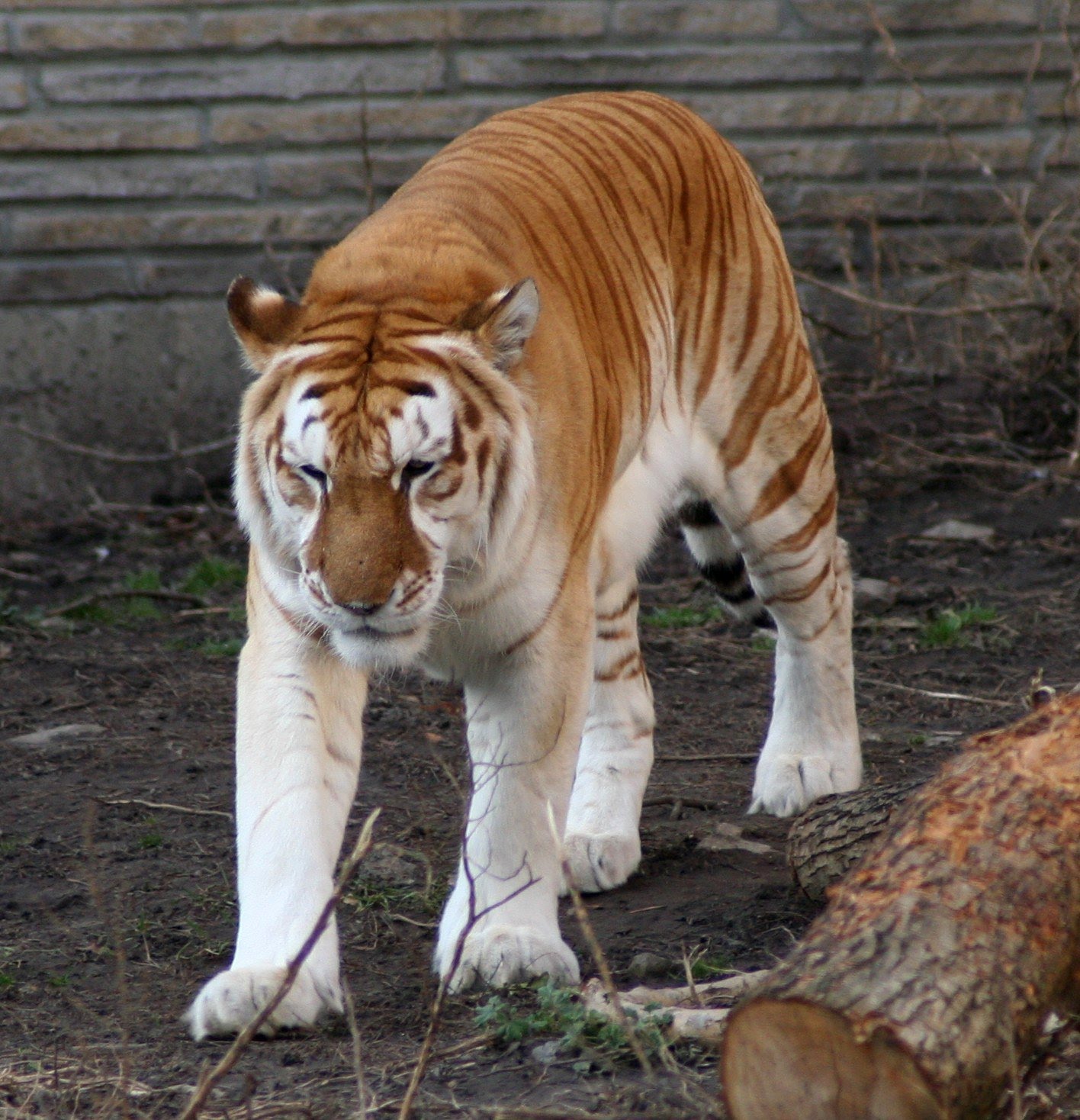
No less spectacular than the white tigers and snow tigers, in recent years a third, equally remarkable strain known variously as the golden tabby, ginger, or strawberry tiger has come to public prominence. These extremely large animals are characterised by a mellow golden-hued pelage, patterned with faint, darker stripes, and complemented by snowy-white underparts.
 A golden tabby tiger, revealing its extensive white underparts and subdued golden upperparts
These tigers are all either homozygous or heterozygous for the dominant wild-type allele of the Full Colour gene, but some investigators have claimed that they are also likely to be homozygous for the Wide Band gene, arguing that this would explain their paler, golden fur dorsally, their reduced striping, plus their snow-white underparts and lower flanks. One such claim was present on the Wikipedia page for white tigers when I accessed it today (31 January 2012):
"...there is a separate "wide-band" gene affecting the distance between the dark bands of colour on agouti hairs. An orange tiger who inherits two copies of this wide-band gene becomes a golden tabby; a white who inherits two copies becomes almost or completely stripeless."
In reality, however, as noted in my snow tiger section above, there is no firm evidence that a Wide Band gene even exists, at least in domestic cats, and I have yet to see any published scientific research verifying its presence in tigers either.
Alternatively, and far more likely, their coat's appearance may have the same genetic explanation as that of golden tabby domestic cats, which is documented as follows in
Robinson's Cat Genetics for Breeders and Veterinarians (1999):
"Non-silver agouti cats (ii) [i.e. homozygous for the recessive inhibitor-preventing non-silver allele of the Inhibitor of Colour gene, and either homozygous or heterozygous for the dominant agouti allele of the Agouti gene] bred from heterozygous chinchilla cats (Ii) are not identical to other tabbies...but are much brighter in color. They have been given the name of golden tabby, Chinchilla golden or shaded golden. In goldens, the agouti band of the tabby pattern is widened. Examination of hairs from goldens reveals that these are nearly all yellow with a dark tip and a slight gray undercolor at the base."
Although specimens of golden tabby tigers were formerly recorded in the wild in India, with records dating back to the onset of the 20th Century, they suffered the same tragic fate as wild white tigers – shot by hunters as unusual trophies, the last just outside Mysore Pradesh during the early 1930s. Today, only around 30 individuals exist in zoos around the world, the first one being born to normal Bengal tiger parents in 1983 at Dr Josip Marcan's Adriatic Animal Attractions in Deland, Florida; and all of today's are descended from Bhim, a male white tiger sired by Tony, who was a part-Siberian white tiger.
 Golden tabby tiger, side view
As with white tigers, golden tabby specimens are unquestionably very eyecatching. Nevertheless, they too have a price to pay for their strange beauty. As I learned from zoo cat expert Graham Law, they suffer from weak pelvic girdles, thus rendering them less able to climb than their normal-coloured brethren.
A sad verification, perhaps of Shakespeare's famous line: "All that glisters is not gold"?
STOP PRESS - 23 May 2013
Today, 23 May 2013, via a paper published in the scientific journal
Current Biology, a team of Chinese scientists that include Dr Shu-Jin Luo of Beijing University revealed the long-awaited genetic basis of white tigers. Mapping a family of 16 tigers living in Chimelong Safari Park, which included both white and normal tiger specimens, the team discovered that the white coat colouration is caused by a single amino acid change, A477V, in a particular transporter protein known as SLC45A2 (which mediates pigment production). This change inhibits the synthesis of red and yellow pigment (phaeomelanin), but not black (eumelanin), thereby explaining why white tigers still possess dark stripes. Moreover, as the team specifically pointed out, white tigers existed in the wild for centuries as a natural and viable morph, until as recently as the 1950s in fact, and that their extinction in the wild was not because of any inability to survive natural conditions there but was instead due entirely to being shot by hunters. Consequently, the team believes that the white tiger represents part of the tiger's natural polymorphic genetic diversity, is therefore worthy of being conserved, and should even be considered for reintroduction into the wild - pointing out that the reason why captive white tigers sometimes exhibit defects and abnormalities is excessive inbreeding, not an inherent factor of the mutant white gene itself.
So now that we finally have the long-awaited, fully-confirmed genetic explanation for white tigers, could this also explain white lions? Watch this space!














 Posts
Posts