Dr KARL SHUKER

Zoologist, media consultant, and science writer, Dr Karl Shuker is also one of the best known cryptozoologists in the world. He is the author of such seminal works as Mystery Cats of the World (1989), The Lost Ark: New and Rediscovered Animals of the 20th Century (1993; greatly expanded in 2012 as The Encyclopaedia of New and Rediscovered Animals), Dragons: A Natural History (1995), In Search of Prehistoric Survivors (1995), The Unexplained (1996), From Flying Toads To Snakes With Wings (1997), Mysteries of Planet Earth (1999), The Hidden Powers of Animals (2001), The Beasts That Hide From Man (2003), Extraordinary Animals Revisited (2007), Dr Shuker's Casebook (2008), Karl Shuker's Alien Zoo: From the Pages of Fortean Times (2010), Cats of Magic, Mythology, and Mystery (2012), Mirabilis: A Carnival of Cryptozoology and Unnatural History (2013), Dragons in Zoology, Cryptozoology, and Culture (2013), The Menagerie of Marvels (2014), A Manifestation of Monsters (2015), Here's Nessie! (2016), and what is widely considered to be his cryptozoological magnum opus, Still In Search Of Prehistoric Survivors (2016) - plus, very excitingly, his four long-awaited, much-requested ShukerNature blog books (2019-2024).

Dr Karl Shuker's Official Website - http://www.karlshuker.com/index.htm

IMPORTANT: To view a complete, regularly-updated listing of my ShukerNature blog's articles (each one instantly clickable), please click HERE!

IMPORTANT: To view a complete, regularly-updated listing of my published books (each one instantly clickable), please click HERE!

IMPORTANT: To view a complete, regularly-updated listing of my Eclectarium blog's articles (each one instantly clickable), please click HERE!

IMPORTANT: To view a complete, regularly-updated listing of my Starsteeds blog's poetry and other lyrical writings (each one instantly clickable), please click HERE!

IMPORTANT: To view a complete, regularly-updated listing of my Shuker In MovieLand blog's articles (each one instantly clickable), please click HERE!

IMPORTANT: To view a complete, regularly-updated listing of my RebelBikerDude's AI Biker Art blog's thematic text & picture galleries (each one instantly clickable), please click HERE!

Search This Blog


PLEASE COME IN, I'VE BEEN EXPECTING YOU...

PLEASE COME IN, I'VE BEEN EXPECTING YOU...
WELCOME TO SHUKERNATURE - ENJOY YOUR VISIT - BEWARE OF THE RAPTOR!


Showing posts with label mokele-mbembe. Show all posts

Friday, 19 May 2023

FORTEAN TIMES PRESENTS MONSTER HUNTERS: IN SEARCH OF UNKNOWN ANIMALS - MY LATEST MAJOR CRYPTO-CONTRIBUTION

 
The front cover of the new cryptozoology-themed Fortean Times bookazine Monster HuntersFortean Times/Diamond Publishing Limited – reproduced here on a strictly non-commercial Fair Use basis for educational/review purposes only)

Bookazines are increasingly popular and prevalent in bookstores and on news stands nowadays, constituting a handy publication format that, as its name suggests, is midway between a magazine and a book. They sell well too, which is why I am currently involved in what, if all ultimately transpires according to plan, will be a series of bookazines featuring various of my animal anomaly writings from down through the years – but more about that some other time.

Instead, this present ShukerNature blog article focuses upon what is to my knowledge the first UK bookazine concentrating specifically upon cryptozoological subjects, and with which I am extremely happy to be associated via my varied contributions to it.

Published by the UK's veteran strange phenomena periodical Fortean Times, its full title is Fortean Time Presents Monster Hunters: In Search of Unknown Animals, and contains 12 classic cryptozoology-themed articles published by FT down through the years. Some of these are the result of field expeditions, others the product of bibliographical researches.

Moreover, as its in-house cryptozoologist for over 30 years now, I was very kindly invited by FT to prepare not only a general introduction to this bookazine but also a concise summary/update for each of its articles, thereby fulfilling much the same role as performed by the late Arthur C. Clarke for each episode in his famous 1980s TV show Arthur C. Clarke's Mysterious World.

The authors and co-authors of the articles are: Neil Arnold, Loren Coleman, Edward Crabtree, Adam Davies (two articles), Richard Freeman, Martin Gately, Sharon Hill, Ruby Lang, Stu Neville, Todd Prescott, Benjamin Radford, Richard Svensson, Michael Williams, and yours truly (two articles).

To avoid spoiling the many surprises in store when you read Monster Hunters, I don't want to give too much away here, so I'll leave you to pair up the articles' authors with their subjects, but the subjects are: bigfoot, British mystery cats, Loch Ness monster, mokele-mbembe, Mongolian death worm, Nandi bear, Russian yeti, Scape Ore Lizard Man, Swedish lindorms, Tajikistan ghul, Trunko, and yowie.

All of the articles are reproduced here in all of their original full-colour glory, which together with my introduction yields an 80-page bookazine that surveys a vast, global range of cryptids in what is unquestionably one of the most engrossing crypto-compendia that I have read for a very long time. Consequently, I unquestionably recommend anyone who has an interest in mystery beasts, or knows someone else who does, to buy (at just £6.99 in shops, or online here at £8.25 including p&p directly from FT) this masterfully-compiled (and bargain-priced!) anthology of very notable crypto-creatures. I guarantee that you won't regret it!

To give you some additional ideas of what to expect, here is FT's own publicity blurb for Monster Hunters:

From the archives of FORTEAN TIMES, the world’s foremost journal of strange phenomena, comes a new collection exploring the world of cryptozoology – the search for unknown animals.

Join us on expeditions to far-flung Mongolia to find the dreaded DEATH WORM of the Gobi Desert, to the Congo in search of a LIVING DINOSAUR and to Tajikistan on the trail of TERRIFYING APE MEN. Explore the wilds of the USA on the track of BIGFOOT and the South Carolina LIZARD MAN, or venture to the marshes of Sweden to investigate sightings of GIANT SERPENTS. And sign up for closer-to-home hunts for NESSIE and BRITAIN’S MYSTERY BIG CATS, including the infamous ‘Essex Lion’. MONSTER HUNTERS takes readers on an exciting round-the-world quest to track the most amazing, elusive and sometimes unbelievable crypto-creatures. Plus, the collection includes an introduction and updates and commentary on each article by renowned cryptozoologist DR KARL SHUKER.

See also its own dedicated page here on my official website.

Finally: I mentioned above that I've written a summary/update for all 12 of this bookazine's articles, but due to reasons of space one of them had to be omitted – my piece for the Nessie article. So now, as a ShukerNature exclusive, I am including it here, together with the illustration (as seen in the bookazine) that it refers to:

Perusing this article, I noted two very different aspects that resonate with my own Nessie associations. First and foremost is his statement that "people can see the monster in anything". This is extremely pertinent, because just as I've documented elsewhere in this bookazine [regarding another cryptid], eyewitness descriptions of what they claim to have been the LNM are so immensely varied that it should be instantly apparent that no single type of creature is being reported. Instead, a diverse range of different animal species, plus all manner of non-living entities (boats, waves, atmospheric mirages, etc), have been sighted on the loch down through the decades but have been erroneously combined by media reports and others to yield a single impossibly-varied and therefore non-existent composite beast known to us all as Nessie. Having said that, some of the separate, component creatures that have been mistakenly united to yield Nessie may themselves be novel beasts – extra-large eels, for instance, much longer than officially-recognised specimens, and/or covertly-introduced specimens of the European giant catfish (wels). But what of the alleged LNM land sightings, where unfamiliar-looking beasts have supposedly been seen in their entirety? If genuine, these cannot be explained via a composite-identity theory, which is why they intrigue me so much, and deserve far more attention than they generally receive. This article's second aspect of personal relevance to me is its illustration of three people looking across the loch at a classic 'head, neck, and hump' Nessie swimming by. That very same illustration was contained in a book chapter that as a child first made me aware of the LNM – but that's not all. The book, Stranger Than People, published in 1968, also opened my eyes to many other mysteries, lighting within me the flame of fascination for all things Fortean that has burned unabatedly ever since [click here to read more by me re Stranger Than People]. So I have a lot to thank it for!

 
The LNM illustration in question, as contained in Monster HuntersFortean Times/Diamond Publishing Limited – reproduced here on a strictly non-commercial Fair Use basis for educational/review purposes only)


Friday, 19 February 2021

MEET THE MBIELU-MBIELU-MBIELU - SO GOOD, THEY NAMED IT THRICE!

 
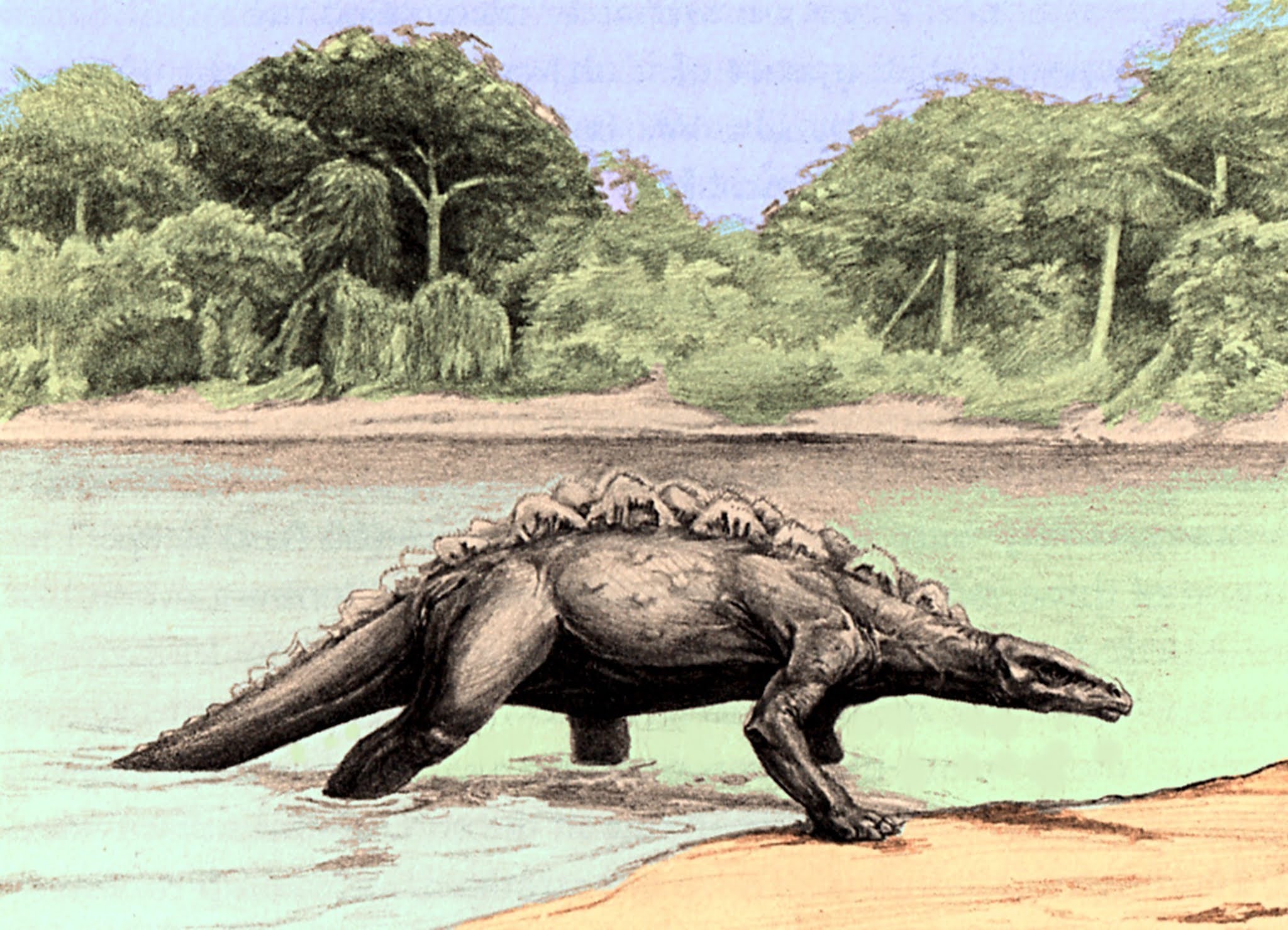
Representation of the mbielu-mbielu-mbielu, based upon eyewitness descriptions (© Drawn by David Miller under the direction of Prof. Roy P. Mackal, colorized here by Dr Karl Shuker)

In addition to the very famous sauropod-lookalike mokele-mbembe and the somewhat less famous nose-horned emela-ntouka (but click here for an extensive ShukerNature article concerning it), a third sizeable cryptid has also been reported from the Republic of the Congo's vast, scarcely penetrable Likouala swamplands. Namely, the mbielu-mbielu-mbielu – so good, they named it thrice! During his two expeditions to this region during the early 1980s, veteran cryptozoologist Prof. Roy P. Mackal collected some interesting anecdotal evidence concerning this hitherto-obscure Congolese mystery beast, and also regarding a fourth, possibly related one, which he duly documented in his classic cryptozoology book A Living Dinosaur? (1987) and which are eminently deserving of being recalled here on ShukerNature.

According to one of the mbielu-mbielu-mbielu's alleged eyewitnesses – a young woman called Odette Gesonget, from the village of Bounila – this triple-termed cryptid is a semi-aquatic beast "with planks growing out of its back". In a bid to identify it, Mackal showed Gesonget several illustrated books depicting animals from the present and also from the distant past – and the picture that she unhesitatingly selected was of the prehistoric plate-bearing non-avian dinosaur Stegosaurus. Comparable descriptions were offered independently by native eyewitnesses s encountered elsewhere during Mackal's Congolese travels too.

 
Life restoration of Kentrosaurus (public domain)

Yet although at least one stegosaur genus, Kentrosaurus, is indeed represented by fossil remains found in tropical Africa, there is no suggestion from fossil evidence that stegosaurs exhibited any amphibious inclination. But who can say whether, during the intervening 65 or more million years from the most recent known fossils to the present day, an evolved surviving stegosaur might have become secondarily aquatic?

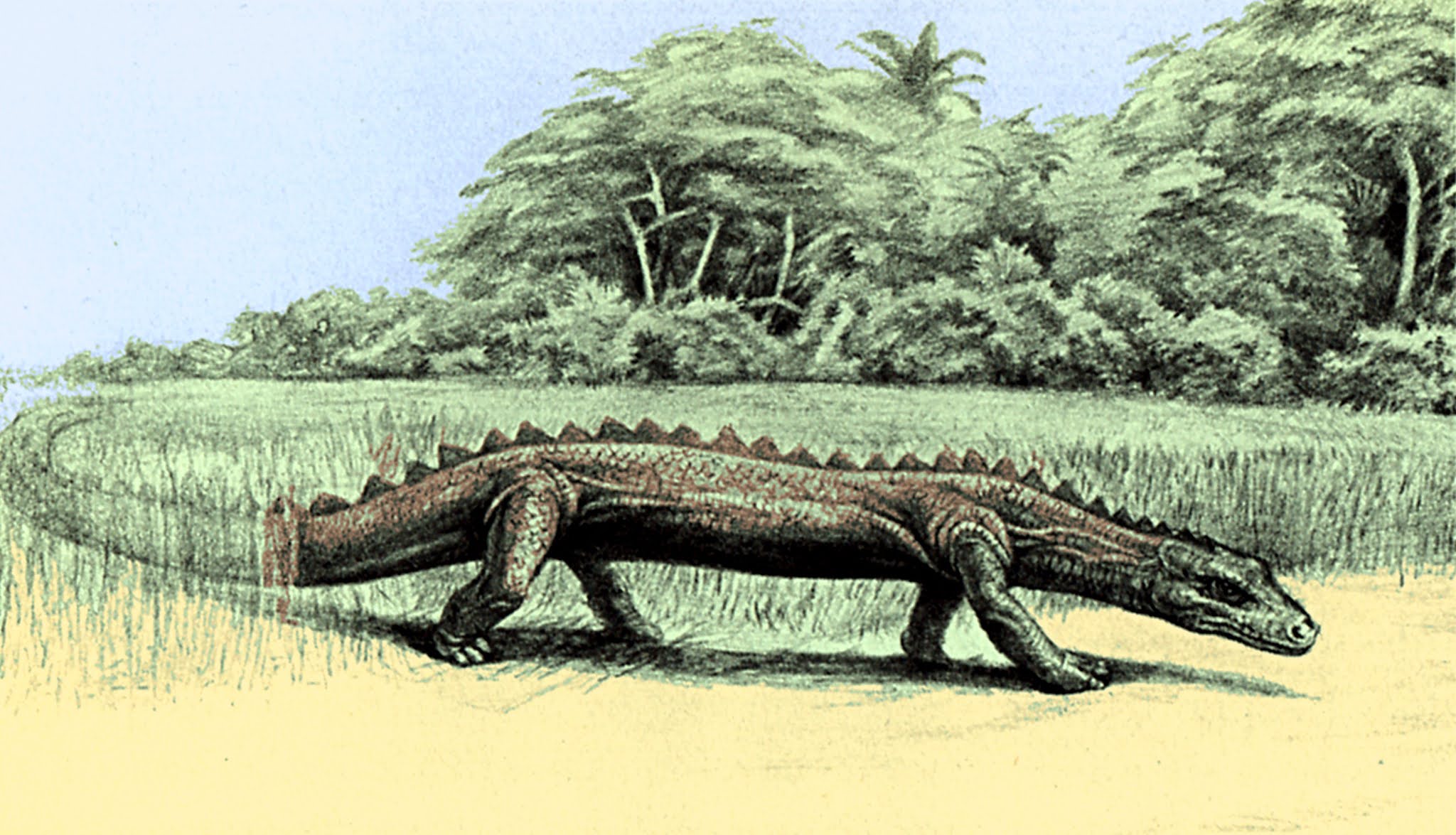
It is possible that this beast, whatever its taxonomic identity may be, is related to (or is even one and the same as) yet another mystery animal from the Likouala swamplands – the nguma-monene, which has been reported from the Mataba tributary of the Ubangi River. According to native descriptions, it resembles a colossal snake (at least 130 ft long!), but bears a serrated dorsal ridge along most of its body's length consisting of numerous triangular protrusions, possesses four short legs, and can walk upon land, with a low-slung body and forked tongue. Suggestions that have been offered for the nguma-monene's taxonomic identity include a snake-like non-avian dinosaur, a very elongate varanid (monitor lizard), and even a primitive reptile descended from the ancestral forms that gave rise to lizards and snakes.

 
Representation of the nguma-monene, based upon eyewitness descriptions (© Drawn by David Miller under the direction of Prof. Roy P. Mackal)

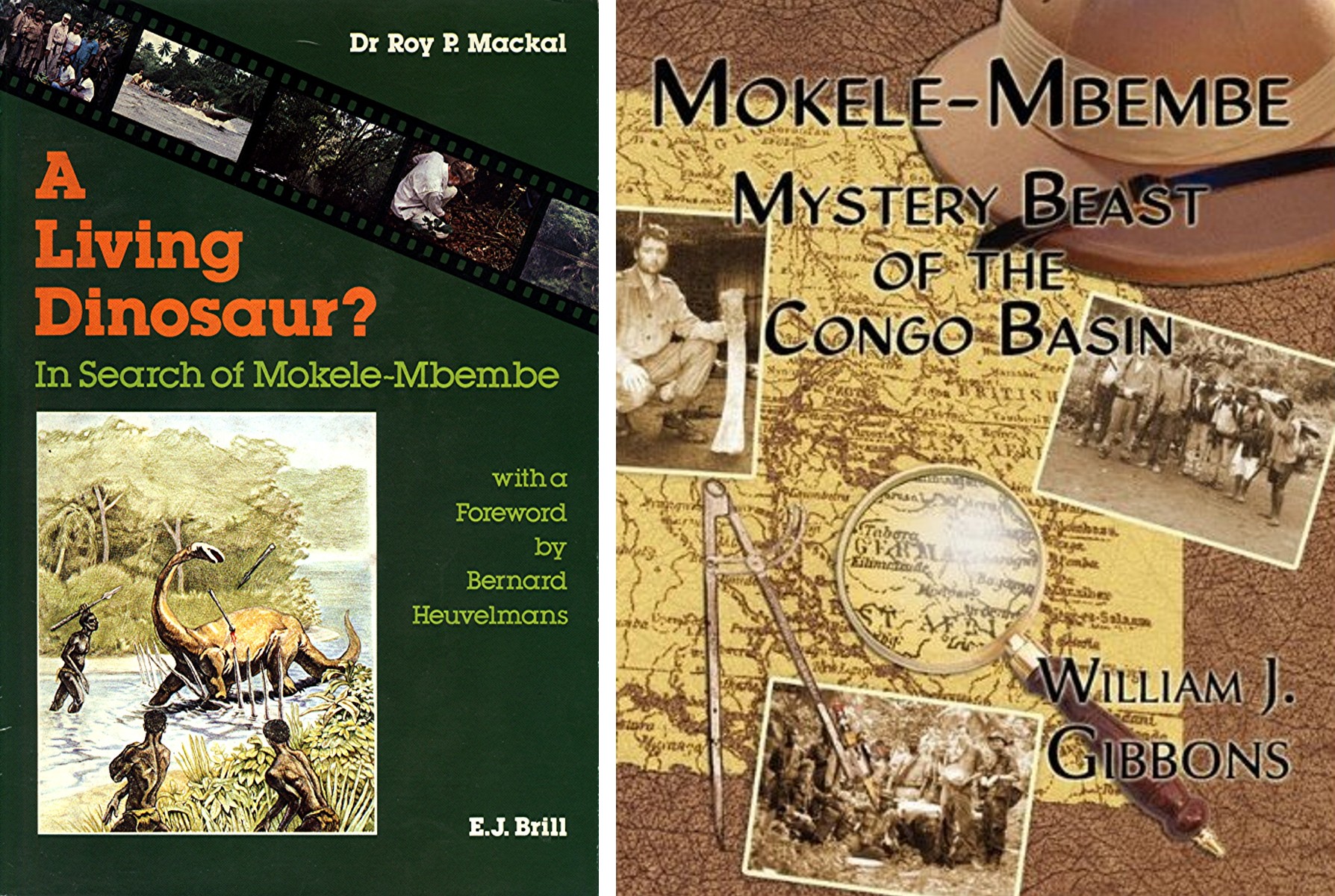
A remarkable modern-day sighting of the nguma-monene by a Westerner was recorded by fellow Congolese cryptid seeker William J. Gibbons in his own book Mokele-Mbembe: Mystery Beast of the Congo (2010), which also documents the various other Congolese and Cameroon cryptids sought by him during his expeditions. The eyewitness in question was Pastor Joseph Ellis, who informed Gibbons personally of his encounter.

It took place one clear sunny day in November 1971, when Ellis was journeying north in his 30-ft-long motorised canoe on the Motaba River. Suddenly he spied a huge, elongated, snake-like creature with a series of ridges like the edge of a saw running the length of its back. It was moving just across the river from the right bank, only around 100 ft away. Turning off his canoe's engine, an astonished Ellis watched as the creature, which he could see was at least as long as his canoe, swam slowly across the river to its left bank, onto which it clambered, crawling through the thick grass and then disappearing into the jungle.

 
Roy Mackal's book and William Gibbons's book (© Roy P. Mackal/E.J. Brill & William Gibbons/Coachwhip Publications)

Ellis never saw its head, but just the section of its body that was visible to him was at least 30 ft long, and was greyish-brown in colour. Although he had personally seen many of this region's large species of animal currently documented by science (including elephants, monitors, pythons, turtles, and crocodiles), he had never spied anything like this creature before, and, having no interest in cryptozoology, had not previously known of its existence here. What could it have been?

Mackal favoured a single, very large, and radically new species of monitor lizard as the most satisfactory explanation for both the nguma-moneme and the mbielu-mbielu-mbielu. Nonetheless, the latter's stegosaurian parallels are evidently difficult to dismiss absolutely – because as he confessed in his book: "For me, mbielu-mbielu-mbielu remains an enigma".

 
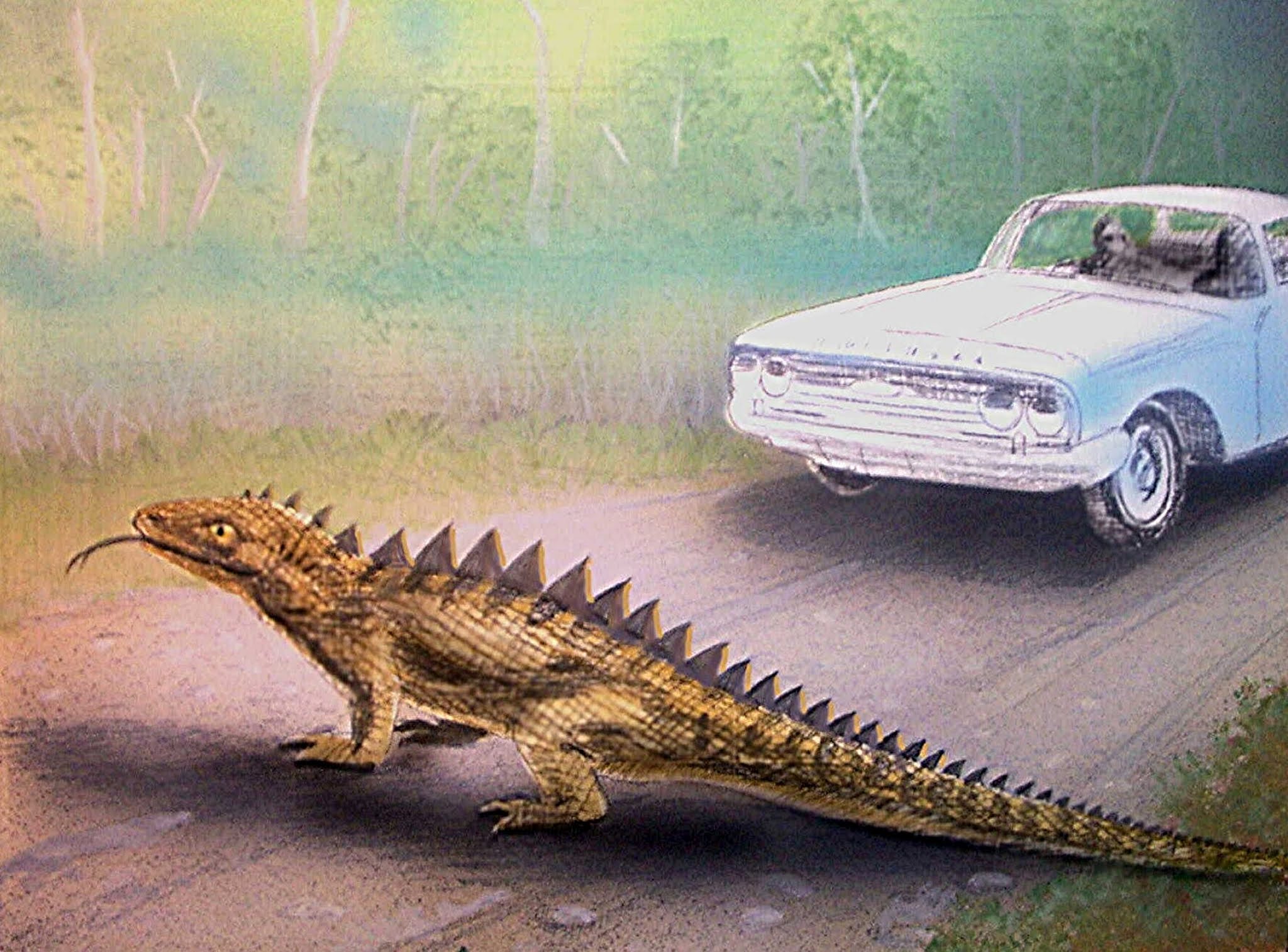
Artistic representation of the Bombays' encounter with a muhuru (© William M. Rebsamen)

Nor are the two Congolese examples documented above the only dorsally-distinctive crypto-reptiles on record from Africa. One day in summer 1961, missionary Cal Bombay and his wife were driving through the Rift Valley on their way to Nairobi, Kenya, when they had to pull up sharply in order to avoid hitting an extremely large reptile apparently sunning itself in the middle of the road. The Bombays estimated that the creature, which was dark grey in colour, measured around 10 ft long, had a snake-like head, four stubby legs, and, most remarkable of all, bore a series of diamond-shaped serrations running down its entire mid-dorsal line, from the back of its head to the tip of its tail.

After about 20 minutes, thus giving its observers plenty of time to peruse it closely, this languorous mystery beast finally stood up, and sauntered lazily into the bush. When some Kenyan natives heard of their encounter, they referred to the creature as a muhuru, but nothing like it is known to Western zoologists.

This ShukerNature article is excerpted and adapted from my book Still In Search Of Prehistoric Survivors.


Sunday, 31 January 2021

THE CONGOLESE NDENDECKI – A VERITABLE DINOSAUR TURTLE?

 
Reconstruction of the possible appearance in life of the Congolese ndendecki, alongside a local pygmy for scale purposes (© David Miller/Prof. Roy P. Mackal)

During the 1980s, Prof. Roy P. Mackal, famous as both a Chicago University biochemist and an enthusiastic spare-time cryptozoologist, led two expeditions to the Republic of the Congo (formerly the French Congo) in search of a mysterious water beast known as the mokele-mbembe, which apparently bears a remarkable resemblance to a small sauropod dinosaur. Sadly, they did not encounter any such creature while there, but they did discover that it was only one of several different types of very large mystery reptile claimed by the local pygmies and Western missionaries to inhabit the vast and virtually inaccessible Likouala swamplands in this country's central region.

Among this assortment of cryptozoological curiosities was the ndendecki, which Mackal's expeditions nicknamed the dinosaur turtle due to its huge size, at least according to reports from eyewitnesses living in the village of Boha and collated by Gilbert Bonguenele Manengue. He was a public security agent commissioned by the military governor general of Brazzaville (this country's capital) to gather together for Mackal's expeditions any available information appertaining to putative unknown animals, and was himself born in Boha.

Life-sized fossil replica of a Stupendemys carapace (
© Chris Gladis aka MShades-Wikipedia - CC BY 2.0 licence)

The shell of this gargantuan freshwater chelonian was claimed by the Boha villagers to be conspicuously rounded in shape and to measure some 12-15 ft in diameter, which is very considerably bigger than that of any known species of aquatic chelonian alive today. It even exceeds the largest known fossil freshwater chelonian, the aptly-named Stupendemys, a side-necked turtle from South America's Miocene epoch that may have grown up to 11 ft long, but slightly less in diameter. Happily, however, the ndendecki apparently poses no threat to humans, browsing harmlessly upon detritus at the bottom of rivers and lakes.

As it happens, the Likouala swamps are already known to harbour one fairly large species of freshwater turtle, the African softshell Trionyx triunguis – a well-documented chelonian found in many parts of Africa. However, this species rarely exceeds 3 ft across. Nevertheless, Congolese zoologist Dr Marcellin Agnagna, who has participated in several mokele-mbembe expeditions and has extensive knowledge of the Likouala's fauna, is convinced that this species and the gigantic ndendecki are one and the same, dismissing the appreciable size difference between the two as nothing more than exaggeration upon the part of the eyewitnesses.

 
Softshells, plus an African hoopoe (public domain)

Yet such exaggeration would need to be on a very grand scale indeed to enlarge a 3-ft turtle by approximately four to five times, and it seems unlikely that locals would be prone to such an overestimation of size for a species that is very common here and must therefore be a familiar sight to them. Consequently, it seems more plausible to believe that amid the Likouala's immense and yet scarcely explored wilderness of lakes, rivers, and swamps are some extra-large individuals of T. triunguis that have lived to great ages and continued growing throughout their protracted lives. Perhaps 13-16.5 ft is indeed an exaggeration, but even a softshell only half as big would still be an extremely imposing creature to encounter, and could certainly explain the ndendecki.

More information concerning the ndendecki can be found in Roy Mackal's book A Living Dinosaur? (1987).

 
Prof. Roy P. Mackal and his book A Living Dinosaur? (© Prof. Roy P. Mackal/E.J. Brill)


Saturday, 16 September 2017

MY INTERVIEW FOR 'THE X FACTOR' - NO, NOT 'THAT' ONE!

Publicity photograph of me with cast of a fossil dinosaur footprint, as featured in my X Factor interview (© Dr Karl Shuker)

Several years before a certain music talent show of the same name first appeared on British television (in 2004, to be exact) and subsequently elsewhere around the world, a superb full-colour partwork magazine published by Marshall Cavendish Limited and devoted to mysteries of many kinds (but particularly strong on cryptozoology) was appearing each fortnight in shops throughout the UK and beyond. Eventually running to 96 issues, this excellent magazine's title was The X Factor.

During its run, The X Factor published a number of cryptozoology-themed articles written by me, and also some interviews that I conducted with various fellow cryptozoologists and forteans. One of those interviews was with veteran British mystery cat investigator Trevor Beer (click here to read a transcript of it), another one was with mokele-mbembe seeker Prof. Roy Mackal (click here for a transcript). And in an enjoyable role-reversal, I was also interviewed myself for The X Factor, by CFZ founder Jonathan Downes, this interview subsequently appearing in issue #67.

Back-cover X Factor advertisement for issue #67, which contained CFZ founder Jonathan Downes's interview with me - click picture to enlarge it for reading purposes (© Marshall Cavendish Limited – reproduced here on a strictly educational, non-commercial Fair Use basis for review purposes only)

The X Factor was a singularly authoritative, fact-filled publication, in many ways the natural successor to an equally significant, earlier partwork, The Unexplained, which was originally published during the early 1980s. Yet whereas the latter has been republished many times and in a number of different formats, The X Factor has never reappeared, tragically, in spite of its considerable popularity, so its contents are nowadays not as readily obtainable. As a result, I have been contacted on numerous occasions down through the years by correspondents and other readers lacking the X Factor issue in question (or the entire series), asking whether there was any possibility of reading Jon's interview with me that featured in issue #67, way back in 1999.

So now, finally, in answer to those many requests, I have scanned the full interview and am presenting the relevant three pages herewith – please click each one to expand it for reading purposes. NB – these pages are © Marshall Cavendish Limited/Jonathan Downes/Dr Karl Shuker, and are reproduced here on a strictly educational, non-commercial Fair Use basis for review purposes only.


My three-page interview in issue #67 of The X Factor ( © Marshall Cavendish Limited/Jonathan Downes/Dr Karl Shuker, and are reproduced here on a strictly educational, non-commercial Fair Use basis for review purposes only)

Finally: Caveat lector – this interview was conducted back in 1999, since when I have read very extensively on the subject of the bigfoot in the USA, and have corresponded with many US bigfoot investigators and alleged observers, as a result of which I am nowadays far less sceptical than I previously was concerning this cryptid's reality there.

Holding the cast of a bigfoot print discovered in Washington State, USA, during the early 1980s, and sent to me by veteran bigfoot researcher Prof. Grover Krantz (© Dr Karl Shuker)


Sunday, 8 January 2017

AN INTERVIEW WITH THE CURIOUS FORTEAN


Wearing my Fortean Times-sponsored 'Operation Congo 1985' mokele-mbembe expedition t-shirt, whose wonderful m-m logo was created by FT's very own Hunt Emerson (© Dr Karl Shuker)

I was recently interviewed by Matt Cook from The Curious Fortean on a wide range of interesting subjects – from classic cryptids such as Nessie and the Congolese mokele-mbembe to the little loriciferan that was named after me, the prestigious Golden Yeti awards bestowed upon me a month ago for my contributions to cryptozoology, and much else besides. You can read the interview in full here, on The Curious Fortean's blog, and also be sure to check out the official Facebook group for The Curious Fortean here.

My sincere thanks to Matt for interviewing me and for posing such a fascinating series of thoughtful, insightful questions.

Also, be sure to check out my two most recent books – Still In Search Of Prehistoric Survivors and Here's Nessie! A Monstrous Compendium From Loch Ness – both of which are referred to in this interview.


Monday, 12 December 2016

A SCALY STATUETTE OF THE MOKELE-MBEMBE?


Carved wooden statuette of a scaly sauropod-like creature and a smaller short-necked mystery beast; probably of West African origin, currently housed at Glencomeragh House, Ireland (© Brother Richard Hendrick)

On 7 April 2013, Brother Richard Hendrick, a Capuchin Franciscan Friar (Monk) of the Irish Province who has long been interested in cryptozoology, posted on my 'Journal of Cryptozoology' Facebook group's page a colour photograph that he had snapped a few days earlier, depicting a very eyecatching wooden statuette, and which I have included above by kind permission of Brother Richard.

He also included the following details about it:

Found this African carving in a collection held by the Rosminian Missionary Fathers in Glencomeragh House, Clonmel [in County Tipperary] Ireland. No provenance or date other than sometime this century probably from west Africa. Intriguing?

The mokele-mbembe rendered as a sauropod, by David Miller under the direction of Prof Roy P Mackal (© Prof. Roy P. Mackal)

After a few replies from others in this FB group were posted in response to his photo and comment, including one from American crypto-author Matt Bille saying that it looked to him like a modern creation, possibly inspired by western interest in the mokele-mbembe (rather than an example of traditional native artwork), Brother Richard responded as follows:

I'm afraid I know very little more than I mentioned above. The Rosminian Fathers are a missionary order and worked for many years in Africa. Many of the Irish fathers brought back souvenirs of their time there on their return to Ireland. I was merely visiting the house on retreat myself and spotted it sitting dusty and forgotten amongst many other carvings. I would guess it has been there since at least the 1950s as no one currently living in the house seemed to know anything about it and didn't see it as anything extraordinary. It does have a "modern" feel but I felt it was worth sharing.

(Judging from his comment that he felt that this carving had probably been at Glencomeragh House since at least the 1950s, his previous comment that it probably dated from "sometime this century" was no doubt simply a slip of the pen, having forgotten momentarily that this is now the 21st Century, not the 20th.)

Close-up of this intriguing 'scaly sauropod' statuette (© Brother Richard Hendrick)

Brother Richard's final posts concerning the carving read as follows:

I have to say I was more intrigued by the second creature? Not sure if it represents a "baby" or another species. I guess at the very least it demonstrates the creature being present in a "culture" even if it was introduced as an idea by those seeking it.

Not sure if it is in a fighting / mating / feeding pose with the larger creature. They both appear to have the same tail, scales and cloacal opening though. A puzzle to add to the connundrum of the whole piece! Never seen anything like it before though!

When I contacted him directly concerning this carving, I learnt that it was roughly 6 in tall, was quite heavy, seemed to have been carved from a single piece of wood, and although he had examined it rather thoroughly he did not see any inscriptions or dates on it.

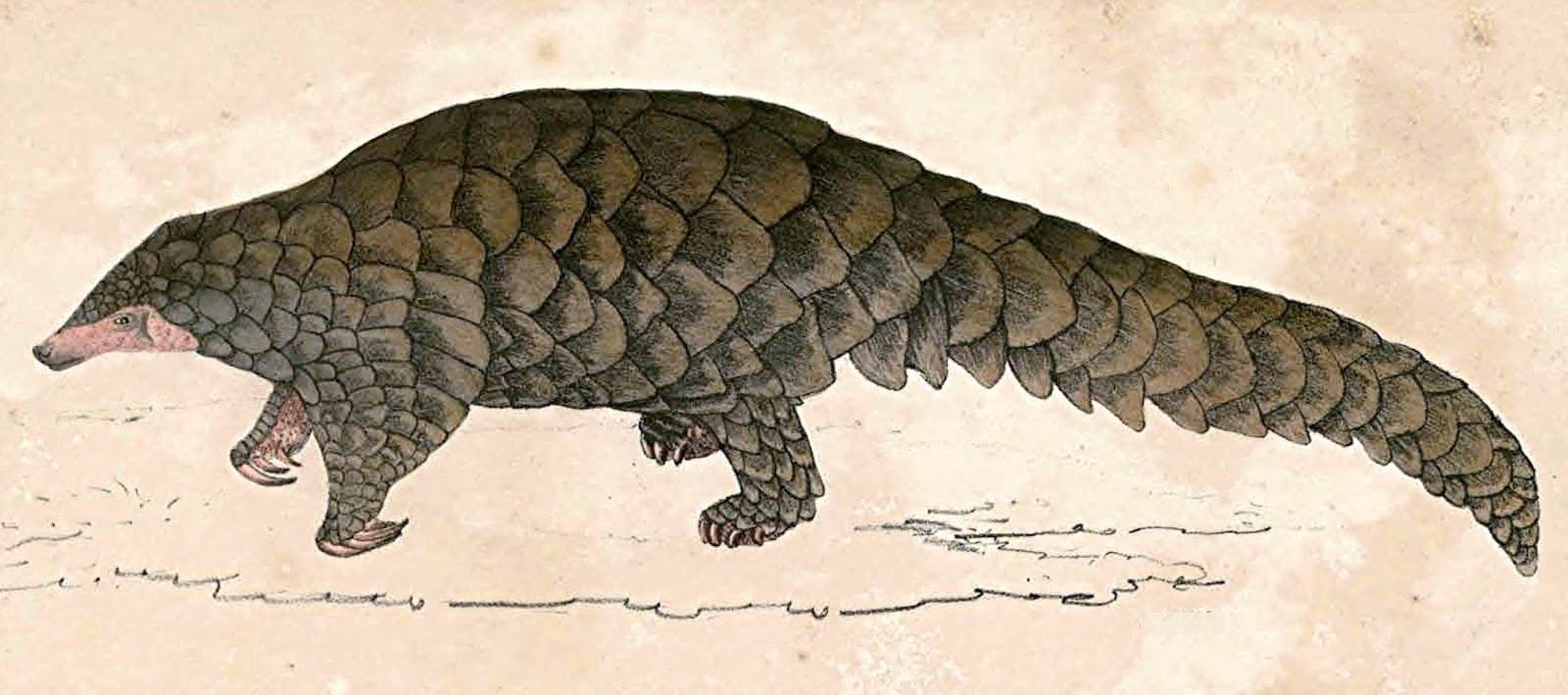
There is no question that the larger of the two animals in this carving closely resembles a sauropod dinosaur in body shape. However, it also sports certain highly unusual features for any such identity. Most obvious of these is its array of extremely large, almost pangolin-like overlapping scales, which are absent only from its face, feet, and, most noticeably, the entire extent of its long tail, and which have not been reported by mokele-mbembe eyewitnesses in the Congo (though crocodile-like scales have been claimed by the Baka pygmies for their Cameroon version, the li'lela-bembe). Nor has the large, even more intriguing – and very odd - rayed fin-like structure visible on the underside of its tail's basal portion, which Brother Richard suggested may be a cloacal opening. And its long pointed teeth are not what one would expect from a herbivore, though these may simply be non-specific, stylised representations.

Pangolin (public domain)

As for the carving's second, smaller animal, standing upright on its hind legs, possibly supported somewhat by its tail, but also resting directly upon the sauropod-like beast's rear body portion, this does not resemble any creature known to me and is something of a paradox. For whereas it sports exactly the same type of body scales as the 'sauropod', and the same kind of tail too, even bearing an identical rayed fin on its tail's basal underside, the body scaling is absent from its lower limbs, it totally lacks the long neck of the 'sauropod', and its face and jaws do not match those of the latter beast either.

Is this small animal meant to represent a young version of the 'sauropod', I wonder? The presence of the same type of scales and in particular the very distinctive underside tail fin (which is unlike anything that I know of in vertebrates present or past), would certainly support such a possibility. Yet its virtually non-existent neck argues in an equally persuasive manner against this option. Even the pose in which the 'sauropod' has been depicted in relation to the small animal is somewhat ambiguous, as recognised by Brother Richard too, and could be construed equally as one of anger toward a potential attacker or as one of response (feeding?) toward its own offspring.

Close-up of the smaller animal in this carving (© Brother Richard Hendrick)

British mystery beast researcher Penny Odell made a very interesting, original contribution to the series of comments posted beneath Brother Richard's photo of the carving that may explain the small creature's contradictory form:

I think it is supposed to be the same species. However the artist only had a certain space and size of wood and ability to carve with. Had the smaller animal been given a longer neck it would have changed the carving making it harder to carve into the space[;] therefore the artist made the smaller animal with a shorter neck for convenience.

With virtually no historical information concerning this fascinating artefact available, there is little more that can be said about it. Despite being for many years a keen visitor to antique/collector/ethnic-craft fairs and shops, and an equally avid online browser relating to such areas of interest, I have never encountered anything even similar, let alone identical, to this carving before. And if it does date back to at least the 1950s, this long precedes the Mackal mokele-mbembe expeditions from the early 1980s that incited the continuing modern-day wave of interest in the latter Congolese cryptid, thereby offering support for believing that this carving's creation was not sparked by any Western interest in such a creature after all. Yet if it is a traditional native depiction of a mokele-mbembe or comparable cryptid, how can the scaling, the tail fin, and the short-necked smaller beast be explained?

Another sauropod-inspired representation of the mokele-mbembe (© Richard Svensson)

My sincere thanks to Brother Richard for so kindly making available to me his photograph of this enigmatic, hitherto-unpublicised statuette and his information concerning it.

This ShukerNature blog article is excerpted from my newly-published mega-book, Still In Search Of Prehistoric Survivors.


Thursday, 17 March 2016

PROF. HENRY BAUER REVIEWS A MANIFESTATION OF MONSTERS IN THE JOURNAL OF SCIENTIFIC EXPLORATION


Below is a very positive review of my recent book A Manifestation of Monsters, which has just appeared in the Journal of Scientific Exploration (vol. 30, no. 1, pp. 133-134, 2016), and was penned by Prof. Henry H. Bauer, whose Loch Ness monster book, The Enigma of Loch Ness, remains one of the standard works on this cryptozoological subject.

As can be seen from my book's front cover (the spectacular artwork is by Michael J. Smith), it contains a vast diversity of subjects, including such cryptozoological stalwarts as Nessie, mokele-mbembe, Jersey devil, thylacine, bigfoot, Mongolian death worm, chupacabra, and coelacanths, as well as many much less familiar, much more obscure mystery beasts too that will not be found in any other crypto-book. So be sure to check it out (published by Anomalist Books, it is available in both paperback and Kindle editions on Amazon and elsewhere, and contains a foreword by Ken Gerhard). Here is Prof. Bauer's review:

Click the above image to enlarge it for reading purposes (© Journal of Scientific Exploration/Prof. Henry H. Bauer)


Sunday, 8 November 2015

SHOOTING DOWN A PTERODACTYLIAN THUNDERBIRD – OR AT LEAST A SUPPOSED PHOTOGRAPH OF ONE!


Sourced at last – this oft-posted online photograph of a supposed pterodactylian thunderbird shot by hunters (© Chris Smith, all rights reserved by him; NB – this picture is reproduced here on a strictly Fair Use non-commercial educational basis only)

The missing thunderbird photograph is among the most famous of all cryptozoological mysteries, and one that I have already documented in detail on ShukerNature (click here). As a result of its fame, over the years it has inspired the creation of many hoax photos purporting to be the real thing, and also many non-hoax pastiches of it – but unfortunately, when such photos appear online and become widely circulated there, it is not always apparent which is which, especially as all too many websites post such photos with credulous claims that they depict real creatures, thereby blurring further an already nebulous situation.

One supposed thunderbird photograph that has been circulated on numerous sites is the very striking illustration opening this present ShukerNature blog article, and which has intrigued me for some time. Looking at the pterosaur in it, it was evident to me that it was a model of a Pteranodon (but based upon a fruit bat's wings instead of a pterosaur's, hence the difference in finger count) that had been added via some form of photo-manipulation process to a possibly genuine, vintage photograph of hunters, thereby creating the oft-described scene that the real missing thunderbird photo allegedly depicts (always assuming, of course, that such a photo itself ever existed!).

Tracing this pterodactylian thunderbird photo from one website to another, the earliest appearances that I've been able to find for it online are from 2012 – but tonight, following yet another online search, inspired by having been alerted by a correspondent to its appearance in the newly-published December 2015 issue of the monthly magazine True West, I finally discovered both its origin and its creator!

A model of Pteranodon in flight (© Dr Karl Shuker)

It turns out that the photo is not a hoax but rather an affectionate homage in pastiche form to the original missing thunderbird photograph, and once you know where to look online it is openly identified as having been created by highly-acclaimed digital illustration artist Chris Smith from Croydon in London, England, who has also created an equally wonderful digital image of a pair of mokele-mbembes encountered by some pygmies in the Congolese swamplands. Click here to view both of these excellent artworks, which were posted on the Vividvisuals website's blog by Chris on 15 April 2013, and where I discovered them tonight.

Also, an enlargement of his pterodactylian thunderbird photo can be viewed here on Chris's own Flickr page, which reveals that he created this spectacular image on 27 October 2010. I strongly recommend all fans of fantasy and science-fiction art to visit Chris's Flickr page (click here), because it contains some of the most spectacular digital artwork from these genres that I have ever seen, and even includes some awesome front-cover illustrations that he has prepared for Fortean Times.

Another cryptozoological case solved and closed!
 
UPDATE: 8 April 2021
A colourised version of this photograph, the colourisation having been carried out by Western author and illustrator Lorin Morgan-Richards, can be found here on his Instagram page, which contains many vintage Wild West photos beautifully colourised by him. From the accompanying description of it, however, Morgan-Richards seems unaware that the original b/w version of this particular photo is not a vintage picture but is instead a modern-day photo that was specially created by Chris Smith, and therefore is not the original thunderbird photo... Many thanks indeed to longstanding friend and fellow cryptozoological enthusiast Mike Playfair for kindly alerting me to this colourised version today.

Further details concerning thunderbirds and the missing thunderbird photograph will appear in Still In Search Of Prehistoric Survivors - the greatly-expanded, massively-updated edition of my 1995 book In Search of Prehistoric Survivors…coming soon.