Dr KARL SHUKER

Zoologist, media consultant, and science writer, Dr Karl Shuker is also one of the best known cryptozoologists in the world. He is the author of such seminal works as Mystery Cats of the World (1989), The Lost Ark: New and Rediscovered Animals of the 20th Century (1993; greatly expanded in 2012 as The Encyclopaedia of New and Rediscovered Animals), Dragons: A Natural History (1995), In Search of Prehistoric Survivors (1995), The Unexplained (1996), From Flying Toads To Snakes With Wings (1997), Mysteries of Planet Earth (1999), The Hidden Powers of Animals (2001), The Beasts That Hide From Man (2003), Extraordinary Animals Revisited (2007), Dr Shuker's Casebook (2008), Karl Shuker's Alien Zoo: From the Pages of Fortean Times (2010), Cats of Magic, Mythology, and Mystery (2012), Mirabilis: A Carnival of Cryptozoology and Unnatural History (2013), Dragons in Zoology, Cryptozoology, and Culture (2013), The Menagerie of Marvels (2014), A Manifestation of Monsters (2015), Here's Nessie! (2016), and what is widely considered to be his cryptozoological magnum opus, Still In Search Of Prehistoric Survivors (2016) - plus, very excitingly, his four long-awaited, much-requested ShukerNature blog books (2019-2024).

Dr Karl Shuker's Official Website - http://www.karlshuker.com/index.htm

IMPORTANT: To view a complete, regularly-updated listing of my ShukerNature blog's articles (each one instantly clickable), please click HERE!

IMPORTANT: To view a complete, regularly-updated listing of my published books (each one instantly clickable), please click HERE!

IMPORTANT: To view a complete, regularly-updated listing of my Eclectarium blog's articles (each one instantly clickable), please click HERE!

IMPORTANT: To view a complete, regularly-updated listing of my Starsteeds blog's poetry and other lyrical writings (each one instantly clickable), please click HERE!

IMPORTANT: To view a complete, regularly-updated listing of my Shuker In MovieLand blog's articles (each one instantly clickable), please click HERE!

IMPORTANT: To view a complete, regularly-updated listing of my RebelBikerDude's AI Biker Art blog's thematic text & picture galleries (each one instantly clickable), please click HERE!

Search This Blog


PLEASE COME IN, I'VE BEEN EXPECTING YOU...

PLEASE COME IN, I'VE BEEN EXPECTING YOU...
WELCOME TO SHUKERNATURE - ENJOY YOUR VISIT - BEWARE OF THE RAPTOR!


Showing posts with label otter. Show all posts

Friday, 27 November 2020

THE DOBHAR-CHÚ - TRAILING IRELAND'S MYSTERIOUS MASTER OTTER. Part 1: GLENADE LAKE AND A GRAVESTONE

Dobhar-chú carved upon Grace Connolly's tombstone (© Daev Walsh)

At no more than 39 in long in total length, the Asian small-clawed otter Aonyx (=Amblyonx) cinereus is the world's smallest species of living otter. As a result of how commonly it is exhibited in British zoos, however, it is possibly the most familiar one to many people here – more so, in fact, than our own larger native species, the Eurasian otter Lutra lutra, up to 4 ft long on average (and confirmed maximum length of 4.5 ft), due to the latter's famous elusiveness.

If we turn from zoos and mainstream zoology to the sequestered realm of cryptozoology, however, its archives of eyewitness reports and folkloric traditions indicate that an even bigger and far more formidable otter might also be encountered in the British Isles. This little-known but thoroughly fascinating mystery beast, known as the dobhar-chú and investigated by me for over 20 years now, is the subject of this present two-part Shukerature article, which as far as I am aware is the most detailed documentation of it ever published.

Asian small-clawed otter (© Dr Karl Shuker) / Eurasian otter (public domain)

The dobhar-chú is a supposedly mythical beast from northwestern and western Ireland, is also called the dobarcu, master otter, and king otter, and was classed by English folklorist Dr Katharine Briggs as a prototype animal representing all of its kind there. For Ireland is indeed home to the afore-mentioned Eurasian otter, where it is referred to as the Irish otter, exists at this species' greatest population density anywhere in Europe, and was once deemed to be a separate species in its own right. In The Anatomy of Puck (1959), Briggs termed the dobhar-chú the master otter, and it was evidently larger than normal otters because she stated that it was said to have appeared once at Dhu-Hill, with "...about a hundred common-sized otters" in attendance. According to legend, an inch of the master otter's pelt will prevent a ship from being wrecked, a horse from injury, and a man from being wounded by gunshot or other means.

In Myth, Legend and Romance. An Encyclopaedia of the Irish Folk Tradition (1990), Dr Dáithí ó hÓgáin described it as a large male otter called the king otter, reiterating much of the information presented by Briggs but also noting that it was totally white in colour except for its black ear tips and a black cross upon its back, and that it never slept. Yielding an unexpected parallel with the werewolf legend, this uncanny creature could only be killed with a silver bullet, and its killer would himself die no longer than 24 hours afterwards.

Artistic representation of the dobhar-chú or master otter, based upon traditional Irish folklore (© Philippa Foster)

For quite some time, the relatively sparse details given above were all that I knew concerning the dobhar-chú - but during the mid-1990s fellow British mystery beast researcher Richard Muirhead kindly supplied me with several additional sources of information. These offer a much more extensive, and sinister, insight into Ireland's most mystifying mammal.

The fascinating excerpt presented below is from Roderic O'Flaherty's book A Chorographical Description Of West Or H-lar Connaught (1684), and chronicles an extremely alarming incident that had reputedly taken place approximately 10 years earlier at a very large, deep, 6-mile-long lake in County Mayo, western Ireland, called Lough Mask (=Measca or Measg):

The man was passing the shore just by the waterside, and spyed far off the head of a beast swimming, which he tooke to have been an otter, and tooke no more notice of it; but the beast it seems there lifted up his head, to discern whereabouts the man was; then diving, swom [sic] under water till he struck ground: whereupon he runned [sic] out of the water suddenly, and tooke the man by the elbow, whereby the man stooped down, and the beast fastened his teeth in his pate, and dragged him into the water; where the man tooke hold on a stone by chance in his way, and calling to minde he had a knife in his pocket, tooke it out and gave a thrust of it to the beast, which thereupon got away from him into the lake. The water about him was all bloody, whether from the beast's bloud [sic], or his own, or from both, he knows not. It was of the pitch of an ordinary greyhound, of a black slimy skin, without hair as he immagined [sic]. Old men acquainted with the lake do tell there is such a beast in it, and that a stout fellow with a wolf dog along with him met the like there once; which after a long strugling [sic] went away in spite of the man and dog, and was a long time after found rotten in a rocky cave of the lake, as the water decreased. The like, they say, is seen in other lakes of Ireland, they call it Dovarchu, i.e. a water-dog, or Anchu, which is the same.

As the above beast was evidently mammalian in nature, it seems reasonable to assume that it was not actually hairless, instead possessing short fur but which, when wet, adhered so closely to its body that the beast seemed to its human victim to be shiny and hairless. This same optical illusion occurs with otters, mink, and other short-furred aquatic mammals when first emerging from water.

Alongside a sculpture of a giant otter (© Dr Karl Shuker)

The following letter, written by Miss L.A. Walkington and published by the journal of the Royal Society of Antiquaries of Ireland in 1896, recalls a second apparently real, violent encounter with a dobhar-chú, but, tragically, there was no happy ending this time:

When on a recent visit to Bundoran [in County Leitrim, northwestern Ireland], we heard a legend concerning a tombstone in the graveyard of Caldwell [Conwall], which induced us to visit the place. The story is as follows:- A young married woman went to wash her clothes in a stream near the house, and an animal called by the natives a dhuraghoo (that is spelled as pronounced, but I have never seen the word written), came out of the river and attacked her. Her husband (or brother according to some accounts) missing her went to look for her, and found her dead and the beast sucking her blood. The dhuraghoo attacked the horse; for the husband seems to have been on horseback. The horse being frightened, ran away, but became exhausted at a village called from this circumstance Garronard ('garron', a bad horse; 'ard', a high place). The dhuraghoo is said to have gone "through" the horse and to have killed it. It was then speared by the husband who at the same time killed its young one. The dhuraghoo is said by some to have been an animal half wolf-dog, half-fish, by others an enormous sea-otter...Two other tombstones are shown in connexion with the story, one bearing an image of the horse, and said to be that of the husband. Perhaps some antiquary may be able to throw light on the legend and on the nature of the dhuraghoo.

In a later issue of this journal for 1896, Miss Walkington's letter drew the following response from H. Chichester Hart:

…I have heard at Ballyshannon, a few miles from Bundoran, the following account of the "Dorraghow," as it was pronounced in that district. He was "The King of all the Lakes, and Father of all the Otters. He can run his muzzle through the rocks. He was as big as five or six otters." My informant thought he was long dead.

The master otter also appeared in a poem entitled 'The Old House', within a 1950s anthology, Further Poems, by Leitrim poetess Katherine A. Fox. The relevant lines read:

The story told of the dobhar-chu

That out from Glenade lake

Had come one morning years ago

A woman's life to take.

Situated between the Arroo mountains to the east and the Dartry mountains to the west, Glenade Lake (aka Glenade Lough) is roughly 1 mile long, half a mile wide, covers an area of approximately 0.3 square mile, and is home to a wide diversity of freshwater fishes, including pike, perch, roach, and eel, as well as a sizeable crustacean called the white-clawed crayfish. Consequently, it could certainly feed a piscivorous mammal, especially one that may not be resident there, but moves around from one such lake to another (and of which Ireland is very plentifully supplied), as otters are wont to do.

Glenade Lake (© Daev Walsh)

During his researches, Richard Muirhead also uncovered a much longer poem, of unverified source (though claimed by some to have been written by a local headmaster). Entitled 'The Dobhar-chú of  Glenade', it is devoted entirely to the master otter's deadly attack upon the hapless maiden and its fatal encounter with her vengeful husband. Regrettably, its style is somewhat lurid and turgid, as witnessed by the following excerpt:

She having gone to bathe it seems within its waters clear

And not returning when she might her husband fraught with fear

Hastening to where he her might find when oh, to his surprise.

Her mangled form still bleeding warm lay stretched before his eyes.

Upon her bosom snow white once but now besmeared with gore

The Dobarcu reposing was his surfeitting been o'er.

Her blood and entrails all around tinged with a reddish hue.

"Oh God", he cried, "tis hard to bear but what am I to do".

Shakespeare it ain't, that's for sure! Nevertheless, its 16 verses yield the most detailed version of this story currently known to me (although some of the details contained in it differ from those noted in Miss Walkington's letter), and it is therefore of great value.

It dates the incident as occurring approximately 200 years prior to the poem's composing (the poem itself may date from around 1920), and features a man called Terence McGloughlan who lived close to the shore of Glenade Lake with his wife, Grace Connolly.

Reconstruction of the master otter's fatal attack upon Grace Connolly (© Randy Merrill)

One bright September morning, Grace visited Glenade Lake to bathe, but when she did not return home Terence retraced her steps, and upon reaching the lake he found her dead body, torn and bloodstained - with her murderous assailant, a dobhar-chú, lying asleep across her bosom. Maddened with grief and rage, Terence raced home for his gun, returned to the scene of the horrific crime and shot his wife's killer dead. In the fleeting moments before it died, however, the dobhar-chú gave voice to a single piercing squeal - which was answered from the depths of the lake. Seconds later, the dead creature's avenging mate surfaced, and Grace's terrified husband fled.

Reaching home, Terence told his neighbours what had happened, and they advised him to flee the area at once. This he did, accompanied by his loyal brother Gilmartin, both riding speedily on horseback, but doggedly pursued by the whistling dobhar-chú. After 20 miles, they reached Castlegarden Hill, dismounted, and placed their horses lengthwise across the path leading into it. Standing nearby, with daggers raised, they awaited the arrival of their shrill-voiced foe - and as it attempted to dash through the horses' limbs, Terence plunged his dagger downwards, burying it up to its hilt within the creature's heart.

Was Glenade Lake once home to a pair of master otters? (an 1856 otter painting, public domain)

Needless to say, it would be easy to dismiss the story of Grace Connolly as nothing more than an interesting item of local folklore - were it not for the existence of two dobhar-chú gravestones, commemorating the above episode. These are documented in an extensive article by Patrick Tohall, published by the journal of the Royal Society of Antiquaries of Ireland in 1948. The first of the two monuments is a gravestone in Congbháil (Conwall) Cemetery in the town of Drumin (Drummans), forming part of the approach to the Valley of Glenade from the coastal plain of north County Leitrim and south County Donegal, and just a few miles south of Kinlough, beside the main road leading from Bundoran to Manorhamilton.

A recumbent flag of sandstone roughly 4.5 ft by 1 ft 10 in and dated 24 September 1722, what makes this the more interesting of the two stones is that it actually portrays the dobhar-chú itself - described by Tohall as follows:

The carved figure is set in a panel about 17.5 ins. by 7 ins. It shows a recumbent animal having body and legs like those of a dog with the characteristic depth of rib and strength of thigh. The tail, long and curved, shows a definite tuft. The rear of the haunch, and still more the tail, are in exceptionally low relief, apparently due to the loss of a thin flake from the face of the slab. So far the description is canine. The paws, however, appear unusually large, while the long, heavy neck and the short head into which it shades off, together with the tiny ears are all like those of an Otter or such Mustelida. 

The head and neck are bent backward to lie flat on the animal's backbone. A human right hand, clenched and with fingers facing the spectator, is shown holding a weapon which has entered the base of the neck and reappears below the body in a short stem which suddenly enlarges to finish as a barb.

The article contains a photo of this depiction, taken by society member Dr J.J. Clarke. Unfortunately, in my files' photocopy of Tohall's article, the illustrations had not reproduced well. In autumn 1997, however, after I had communicated with one of my Irish correspondents, Daev Walsh, concerning it, he and a colleague, Joe Harte, independently visited the dobhar-chú gravestone in autumn 1997. Not only were they both able to confirm that it still existed, they also took some excellent photographs of it, which they kindly passed on to me to use in my own writings as I saw fit. These lucidly portray the carved dobhar-chú, revealing that its head is indeed small and somewhat lutrine. Equally, after studying the photos, I agree with Tohall's description of its body as canine - almost greyhound-like, in fact, except for its large paws and lengthy neck.

Close-up of the dobhar-chú carved upon Grace Connolly's tombstone (© Daev Walsh)

Interestingly, when I showed the pictures of the carved dobhar-chú to various cryptozoological colleagues, some of them mistakenly assumed that the clenched hand of the dobhar-chú's slayer was actually the creature's head! However, it is far too small to be this, and when the photos are viewed closely, the fingers of the clenched hand, which face the camera, can be clearly discerned gripping a spear-like weapon, as can the creature's real head, thrown back across its back. Even the thin line of its mouth is readily visible.

Some of the wording on the gravestone is still legible too, identifying the person buried beneath as Grace Con, wife of Ter MacLoghlin. According to Tohall, she was still spoken of locally, but as Grainne, not Grace, and he also pointed out that Ter is undoubtedly short for Terence, and that it is Gaelic custom for a married woman to retain her maiden name - explaining why Grace was referred to on her gravestone as Con rather than MacLoghlin. Tohall considered it likely that her gravestone was prepared while her death was still fresh in local memory, because similar gravestones in this same cemetery are characteristic of the period 1722 to 1760. This, then, would appear to be the last resting place of the hapless young woman killed by the dobhar-chú, whose own existence is commemorated here too - all of which seemingly elevates the episode from folklore to fact.

Scale illustration providing an estimate of size for the dobhar-chú alongside an average-sized human (© Connor Lachmanec)

As recently as World War I, the second dobhar-chú gravestone, which was that of Grace's husband Terence, was still in the cemetery of Cill Rúisc (Kilroosk), at the southern entrance to Glenade, but had broken into two halves. At some later date, these were apparently placed up onto a boundary wall, and subsequently disappeared. Fortunately, however, at the time of Tohall's researches it was still well-remembered by all of the region's older men, who stated that it depicted some type of animal, and was popularly known as the Dobhar-Chú Stone. When asked whether the animal had resembled a dog, the only person who could recall the creature's appearance stated that it was more like a horse.

Recalling the story of the dobhar-chú in his article, Tohall placed the home of Grace (or Grainne) and her husband in the townland of Creevelea at the northwest corner of Glenade Lake, and (like Miss Walkington, above) stated that Grace visited the lake to wash some clothes (not to bathe, as given in the 16-verse poem). Indeed, several variants of the story exist elsewhere in the general vicinity of Glenade, but Tohall believed that the Conwall gravestone was particularly important - for constituting possibly the only tangible evidence for the reality of the dobhar-chú.

Two views of the dobhar-chú carving (highlighted in white) in situ on Grace Connolly's tombstone (© Joe Harte)

Tohall offered some interesting reflections upon the terminology of the master otter's native name. Both in Ireland and in Scotland, ‘dobhar-chú’, which translates as 'water-hound', has two quite different meanings. One is merely an alternative name for the Eurasian otter, but is rarely used in this capacity nowadays (superseded by 'mada-uisge'). The other is the name of a mythical otter-like beast, and is still widely used in this capacity within the County Leitrim region. Tohall reserved the most intriguing insight into the master otter concept, however, for the closing sentence of his article:

The best summary of the idea is set out in the records of the Coimisium le Béaloideas by Sean ó h-Eochaidh, of Teidhlinn, Co. Donegal, in a phrase which he heard in the Gaeltacht: 'the Dobharchú is the seventh cub of the common otter' (mada-uisge): the Dobhar-chú was thus a super otter.

Today, the world beyond Glenade and its environs in northwestern and western Ireland seems to have largely forgotten about the dobhar-chú and its sinister deeds. However, it may be premature for cryptozoology to assume that this enigmatic animal is entirely confined to the shadows of the distant past, because it might conceivably have made some unexpected appearances in very recent times too, as revealed in Part 2 of this ShukerNature article - click here to read it.


This article is a greatly-expanded, updated version of the dobhar-chú account that appeared in my 2003 book The Beasts That Hide From Man, which in turn was an expanded version of my original 1990s dobhar-chú article that appeared in Strange Magazine.

The Beasts That Hide From Man (© Dr Karl Shuker/Paraview Press)


Saturday, 1 December 2018

REMEMBERING THE BEAST OF BODALOG - A WELSH WATER VAMPIRE?


Something has crept, or has been driven out of dark waters under the mountains...Far, far below the deepest delvings of the Dwarves, the world is gnawed by nameless things.

   J.R.R. Tolkien - The Lord of the Rings


Could the Bodalog Beast have been a large snake species living in Britain and readily able to swim, such as the grass snake, as depicted here in a beautiful illustration by Heinrich Harder from 1912? (public domain)

Thirty years ago, one of the strangest, eeriest cryptozoological cases ever reported from the British Isles was making headlines nationally and even internationally, and three decades later it has still never been satisfactorily resolved. So here is my contribution to its very intriguing history, by way of an article of mine that was subsequently converted into a chapter within my book From Flying Toads To Snakes With Wings (1997) and serves now in updated form as a fitting ShukerNature retrospective to, and reminder of, this macabre yet nowadays all-but-forgotten saga.

To describe one of Britain's most bizarre mystery beasts as a water vampire may not be as melodramatic as one would first suppose - especially after considering its unique characteristics. According to media reports, during September to December 1988 its home was seemingly a lengthy river, the River Wye, situated close to the town of Rhayader in mid-Wales, from which it apparently emerged at night to kill sheep on a nearby 2000-acre farm called Bodalog, owned by the Pugh family. Unlike those of foxes and dogs, however, its victims' carcasses were not ripped or torn in any way. Instead, the only sign of their mystifying marauder's attack was a small but deep, penetrating bite just below the neck, close to the sternum or breast-bone (and which duly earned it the memorable monicker of water vampire in some media accounts). No evidence of the creature feeding upon the carcasses was found either, thus making its predatory behaviour even more weird and difficult to understand.

Nevertheless, by the middle of October 1988 this mysterious beast had killed at least 35 sheep. Its scent had been trailed back and forth to the river by foxhounds, but it was never seen or identified, and no recognisable pawprints were found either. As noted by London's Daily Mail newspaper on 10 October 1988, many suggestions regarding its possible identity had been offered, ranging from otter and dog, to mink and even to some form of snake. University scientists had examined the carcasses and admitted to being thoroughly perplexed.

Their bewilderment is not surprising, as the Bodalog beast clearly poses some singular problems, with none of the more conservative explanations satisfying the facts available.

Could it have been a native European otter (above) or a naturalised American mink (below) (public domain / © Cephas/Wikipedia CC BY-SA 3.0 licence)

Its aquatic habitat immediately rules out a fox, cat (even an escapee big cat), or stray dog as the culprit - as well as a human hunter using a crossbow, which had also been suggested by some authorities. European otters Lutra lutra are relatively large creatures, but are certainly not sheep killers. They are known to take small mammals in their diet from time to time, but nothing approaching the size of a sheep. In any event, their principal sources of food are fishes and aquatic crustaceans - and, needless to say, they do eat prey killed by them and they do leave tell-tale spoor behind.

Mink, although much smaller than otters, are far more bloodthirsty by nature. Not native to the British Isles, they now exist in a naturalised state in many parts of the country - descendants of fur-farm escapees belonging to the American species, Neovison vison. Mink have wide tastes, ranging from fishes to birds as large as moorhens, and mammals as large as young rabbits (reports even exist of mink having killed pet cats and dogs!). Nevertheless, sheep would surely be far too large for any mink to tackle successfully.

One suggestion, from an unnamed 'expert', was that some form of giant mink was responsible! Mink, however, do not normally attain a total length greater than about 26 inches in the wild, and there is no evidence whatsoever that mink of a size commensurate for sheep killing have ever existed in Britain.

A little-known species called the sea mink N. macrodon once inhabited the coastal waters of New England and the Canadian maritime provinces, and was indeed somewhat larger than other mink species, but it became extinct in the early 1880s, and is totally unknown either in living or in fossil form in the Old World.

Artistic representation of the sea mink's likely appearance in life (© Tim Morris)

Britain only has three native species of snake. [NB - herpetological researchers revealed in 2017 that there were actually two taxonomically distinct species of grass snake living here, not just one, but only one of them is native, namely Natrix helvetica; unfortunately, various media reports confusingly and erroneously claimed at the time that both of them were native and that there were therefore four native snake species existing here.] The sole venomous species is the European viper or adder Vipera berus, which is predominantly ground-living, diurnal, and feeds on nothing larger than lizards and small mammals.

Relatively more aquatic by nature are the non-venomous and diurnal eastern grass snake Natrix natrix (represented in Britain via various small, introduced, non-native populations) and its close relative the western or barred grass snake N. helvetica, the new name for Britain's native grass snake species. The preferred prey species of these two species are amphibians and fishes, though nestling birds and small mammals are also occasionally taken.

In addition, Britain has a small number of the smooth snake Coronella austriaca, again native but confined to southern England. This is another non-venomous, diurnal species whose diet consists mainly of lizards and small mammals.

Also worthy of note is the aesculapian snake Zamenis longissimus, which is a mainland European species that has established a couple of small but seemingly thriving naturalised population in Great Britain – one in central London, England, and the other in Colwyn Bay, Wales. Both populations originally arose from escapee/released specimens surviving and mating in the wild in these locations. So might the Beast of Bodalog have been an aesculapian snake, derived from the Welsh contingent? At up to 7 ft long, this species is certainly lengthier than any of Britain's native species, but just like all of them it is diurnal, and it is not venomous. Clearly, therefore, none of these five species constitutes a very convincing candidate for the Welsh sheep killer.

Vintage chromolithograph from 1909 of the aesculapian snake (public domain)

It has never been formally ascertained whether the Pughs' sheep were actually poisoned by their attacker, but if tests were to reveal that this did occur, then it is possible that a non-native and evidently sizeable, aquatic venomous snake was on the loose at that time. It could have been a pet that either escaped or, for some reason, was released, as in the above-noted London and Welsh instances featuring the aesculapian snake. Yet if this were true, then it could have potentially posed a very real, severe dilemma - for there are few animals on Earth as elusive as snakes, especially those species that are adept at travelling not only across the land but also through the water.

Perhaps, then, it is not too surprising that the sinister 'water vampire' of Wales was never seen, let alone tracked down. Its killing spree abruptly ended in early December 1988, and nothing like it has ever been reported since from Bodalog (or anywhere else, for that matter, at least as far as I am aware), so presumably it simply died (see below) - always assuming, of course, that it didn't move elsewhere. Yet if it had indeed been some form of very large, powerful snake, why did it kill so many sheep but never make any attempt to feed upon their carcasses afterwards?

Moreover, how could such a creature have survived for at least two months in the distinctly chilly climate present in mid-Wales during late autumn/early winter? After all, snakes are poikilothermic (cold-blooded) and therefore rely upon warm external, environmental temperatures to maintain their own body heat. Like all others associated with this decidedly strange saga, these questions are likely to remain unanswered indefinitely.

This ShukerNature blog article is excerpted and expanded from my book From Flying Toads To Snakes With Wings.


Wednesday, 12 April 2017

THE WARRACABA TIGER AND OTHER SOUTH AMERICAN PACK-HUNTING MYSTERY CATS


Bush dog (public domain)

According to native Indian testimony, as well as that of certain Western explorers and cryptozoological investigators, South America is home to several different types of mysterious, scientifically-unidentified cat that are very distinct from one another morphologically but which are reputedly united by a single characteristic that if genuine is highly unusual for jungle-dwelling felids – for they supposedly hunt in packs, like dogs. Indeed, so unusual do these ostensibly canine cats seem that, as will be revealed here, some authorities have suggested that perhaps they truly are canids, and not felids at all. (And for another South American mystery cat that may in reality be a dog, click here to read my ShukerNature article re the mitla)..

TRUMPETING ABOUT GUYANA'S FEROCIOUS WARRACABA TIGERS
The warracaba (or waracabra) tiger, as it is known to the Guyanan natives, differs from the typical jaguar (called 'tigre' by Hispanics here) in an extremely significant way with respect to behaviour. For whereas the recognised jaguar Panthera onca (whether spotted or black) is a solitary hunter, Guyana's elusive warracaba tiger allegedly hunts in packs, which in turn may contain dozens of individuals. Needless to say, any felid that hunted in this manner would be a very special kind of cat indeed.

Normal spotted jaguar with black (melanistic) jaguar (public domain)

Not surprisingly, therefore, the warracaba tiger has attracted considerable interest from travellers to Guyana. In an Animal Kingdom periodical article from 1957, the eminent American naturalist and author William Bridges incorporated an impressive series of reports concerning this animal, dating back to the end of the 19th Century (oddly, modern-day reports are all but non-existent). These include the following selection.

In his book Twenty-Five Years in British Guiana, published in 1898, Henry Kirke, a former Sheriff of Demerara, noted:

There is a mysterious beast in the forest called by the native Indians the "waracabra tiger." All travellers in the forests of Guiana speak of this dreaded animal, but strange to say, none of them appear to have seen it. The Indians profess the greatest terror of it. It is said to hunt in packs (which tigers [jaguars] never do), and when its howls awake the echoes of the forest, the Indians at once take to their canoes and wood skins as the only safe refuge from its ravages.

Indeed, this was precisely the action taken by Indian attendants of British explorer C. Barrington Brown upon hearing (though not seeing) the approach of one such pack in an incident occurring at the edge of Guyana's Curiebrong River during the mid-1800s. On this occasion, a single boat was used as the means of escape, which Brown boarded too. Enquiring the nature of these evidently much-feared felids, Brown was informed by the Indians that they were small but exceedingly ferocious tigers; that they hunted in packs; and that they were not frightened by camp fires or anything except the barking of dogs. Upon crossing the river, however:

...a shrill scream rent the air from the opposite side of the river, not two hundred yards above our camp, and waking up echoes in the forest, died away as suddenly as it rose. This was answered by another cry, coming from the depths of the forest, the intervals being filled up by low growls and trumpeting sounds, which smote most disagreeably on the ear. Gradually the cries became fainter and fainter, as the band retired from our vicinity, till they utterly died away.

Brown remarked that these beasts' cry resembled that of the waracabra bird (better known as the grey-winged trumpeter Psophia crepitans, a predominantly glossy-black relative of the cranes, coots and bustards), hence the name 'waracabra tiger'. These latter mystery animals are called y'agamisheri by the Accawoio Indians, who state that they vary in both size and colour and that as many as a hundred individuals can constitute a single pack. Little wonder that Brown's Indian companions were so desperate to depart. The prospect of meeting up with a hundred or so jaguars (even under-sized ones) all at once would surely daunt even the most courageous of human hunters!

Vintage photos of trumpeters (public domain)

In Among the Indians of Guiana, published in 1883, author and explorer Sir Everard F. im Thurn alleged that he had actually encountered three warracaba tiger eyewitnesses but admitted that it was clear that the tale related by one of them was much exaggerated. Im Thurn also offered his own suggestion concerning these fabled felids, that reports of them had taken their roots from the fact that puma families occasionally travel together.

During the early part of the 20th Century, Lee S. Crandall, who went on to become the General Curator of New York's Bronx Zoo, spent time working in Guyana and encountered many reports of the warracaba tiger. Once again, however, he never met an Indian who affirmed unequivocally that he had not merely heard but had also actually seen any of these mysterious creatures. This latter aspect is a frequent but notably perplexing com­ponent of warracaba tiger reports - the creatures are heard but never seen.

Consequently, as a solution to the mystery of the warracaba tiger and especially to this notably strange facet of their case history, Crandall proposed the following elegant explanation. Namely, that this beast was not a special form of jaguar at all; instead, it was simply some animal species that hunted in packs at night, yet which voiced such terrifying sounds whilst doing so that no Indian had ever been brave enough to investigate the identity of these sounds' originators - as a result of which they had never realised that this aurally abhorrent creature was in fact already known to them by sight during the daytime.

Crandall even named the species that he felt was responsible - an animal that is neither jaguar nor, in fact, any form of felid, but is one of South America's most unusual species of wild dog. Namely, the bush dog Speothos (formerly Icticyon) venaticus, a very curious, little-known canid not closely related to other species.

Bush dogs (© Dr Karl Shuker)

Measuring no more than 3 ft in total length and a mere 1 ft in shoulder height, in colour it is dark reddish-brown dorsally and virtually black ventrally (rather rare amongst non-melanistic mammals). The bush dog's distribu­tion extends from Panama and Colombia to northern Venezuela, Brazil, Guyana, Surinam, French Guiana, northernmost Ecuador, eastern Peru, northern Bolivia, and Paraguay. According to certain reports, it does hunt in packs (indeed, it may spend its entire life in packs), but in general behaviour is exceedingly secretive.

Worth noting was the impression by botanist Dr Nicholas Guppy (who had spent much time in Guyana) that, whereas the older Indians still believe that packs of warracaba tigers exist in the more remote mountainous regions, the younger Indians seem more disposed to believing the Western identification of them as bush dogs.

And certainly, as far as its distribution, hunting behaviour, and general elusiveness are concerned, the bush dog does compare favourably with the legendary warracaba tiger (and, as the latter is not normally seen, morphological comparisons are superfluous). Conversely, the famous hideous scream of the warracaba tiger contrasts sharply with the relatively feeble whine voiced by bush dogs. Also, it is rather difficult to believe that the Guyanan Indians, frightened or not, could really confuse - visually and/or aurally, singly and/or in packs - a bush dog with any form of jaguar. The mystery of the warracaba tiger may not be solved after all.

PACK-HUNTING MYSTERY FELIDS OF PERU AND ECUADOR
The most obscure pack-hunting crypto-cats reputedly inhabiting South America, however, are those that have been variously reported from Peru and Ecuador.

During the 1990s, Peru-born zoologist Dr Peter Hocking collected native reports concerning a number of mystifying cat forms allegedly existing in Peru but which are not known to science. One of these is the so-called 'jungle wildcat', reported from montane forests in the lower Urubamba River valley. Apparently, it is no larger than an average domestic cat, is patterned in a varied assortment of blotches, and has noticeably long fangs. Far more distinctive, however, is its apparent proclivity for hunting in packs, containing ten or more individuals.

While visiting southern Ecuador's Morona-Santiago province in July 1999, Spanish cryptozoologist Angel Morant Forés learnt of several mystery cats said to inhabit this country's Amazonian jungles. Upon his return home, he documented them in an online field report, entitled 'An investigation into some unidentified Ecuadorian mammals', which he uploaded in autumn 1999 onto French cryptozoologist Michel Raynal's website, the Virtual Institute of Cryptozoology, and from where I downloaded a copy of it (fortunately, as it turned out, because, like so often happens in the ephemeral world of cyberspace, it now seems to have vanished). These very intriguing crypto-felids included two different alleged pack-hunting forms.

Vintage photograph from 1913 of a captive small-eared dog (public domain)

One of them is the tsere-yawá, which is also said by the native tribes to be semi-aquatic. Angel was informed that this 3-ft-long felid hunted in packs of 8-10 individuals, and was brown in colour, like the brown capuchin monkey whose local name, tsere, it shares. In 1999, a young man named Christian Chumbi from Sauntza allegedly saw eight of these cats less than 50 ft away in the river Yukipa. Unfortunately, there are insufficient morphological details available to attempt any taxonomic identification of this mystery felid.

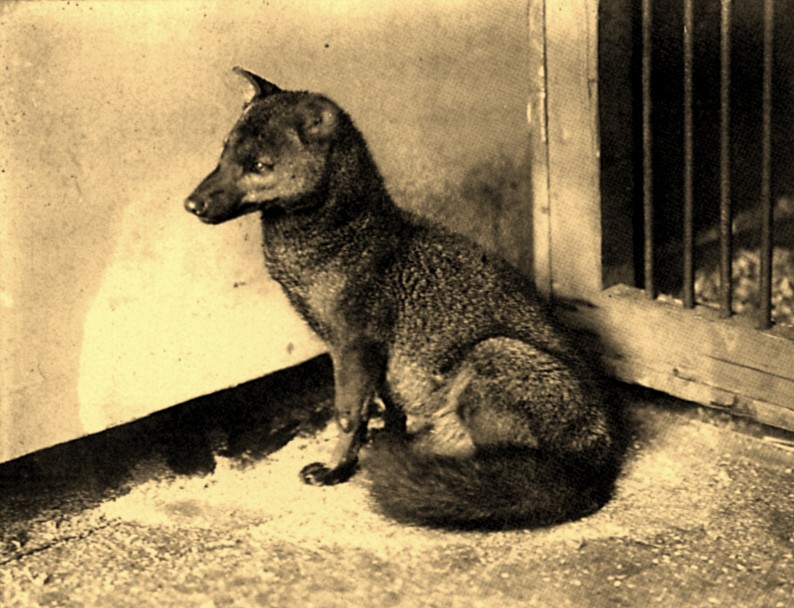
Interestingly, the small-eared dog or zorro Atelocynus microtis, a surprisingly cat-like wild dog, inhabits Ecuador, and is known to be semi-aquatic – it even has partly-webbed feet. So might this reclusive canid species. already proposed elsewhere by me as an identity for a feline mystery mammal called the mitla (click here), once again be in contention as the true identity of a supposed crypto-cat?

Alternatively, otters are social creatures, so could the tsere-yawá actually turn out to be lutrine rather than either feline or canine? Indeed, one South American species, the marine otter Lontra felina, is so feline in outward mien that it is even referred to colloquially as the sea cat (it is predominantly coastal in distribution but will sometimes enter rivers in search of freshwater crustaceans). The other three species of South American otter currently known to science are the neotropical river otter L. longicaudis, the southern river otter L. provocax, and the aptly-named giant otter or saro Pteronura brasiliensis.

An 1848 illustration of the marine otter or sea cat Lontra felina (public domain)

The second Ecuadorian feline pack-hunter is known as the jiukam-yawá. As Angel was only able to collect second-hand reports of it, not personal eyewitness accounts, however, he declined to document this cryptid in his field report.

With so little in terms of morphological details to analyse, the supposed pack-hunting felids of Peru and Ecuador currently remain enigmatic to say the least. However, should any zoologist with cryptozoological interests be visiting either or both of these South American countries on official research business at some stage in the future, they should consider devoting some of their spare time there to the questioning of local inhabitants concerning the above mystery cats(?), in the hope of obtaining additional details.

After all, when dealing with creatures as paradoxical as pack-hunting mystery cats – not to mention a semi-aquatic cat! – every snippet of information procured is a major bonus that may conceivably shed much-needed light upon these baffling beasts' identities.