One of the world's most famous explorers is, or was, Lieutenant-Colonel Percy Fawcett, who mysteriously vanished in 1925 while exploring the vast uncharted jungles of Brazil. Before his tragic disappearance, however, he had penned a fascinating account of his explorations in these lands, which was published in 1953 as Exploration Fawcett. It contains brief accounts of several mystifying creatures, but none more so than his supposed giant toothless shark or manguruyu, to give it its local name.
According to Fawcett, the Paraguay River contains: "a freshwater shark, huge but toothless, said to attack men and swallow them if it gets a chance". In reality, however, very few sharks inhabit freshwater, and those that do are far from toothless. So if such a shark really does exist, it is dramatically different from anything currently known to science. However, it may not be a shark at all.
British cryptozoologist Mike Grayson has opined that it could be a very large sturgeon, some species of which are vaguely shark-like and can attain great sizes. However, he concedes that this is a very tentative identification, acknowledging that sturgeons do not attack and swallow people, and that there is no known species of South American sturgeon to act as a zoogeographical precedent anyway.
My own feeling is that a catfish identity may be more plausible. There are more species of catfishes in South America than anywhere else, and some of these latter are among the world's largest too. In Europe, the giant wels catfish Siluris glanis often been accused (unjustly or otherwise) of swallowing people, but even if this aspect is wholly folkloric, the concept of a giant catfish existing in South America is by no means impossible.
True, catfishes usually possess teeth at least on their vomer bone. However, old specimens of some species are entirely toothless - as in, significantly, the giant pa beuk Pangasianodon gigas of southern Asia's Mekong River. Up to 8 ft long, it is the world's largest species of fish confined entirely to freshwater, yet it amazingly remained undiscovered by science until as late as 1930.
Perhaps Fawcett's giant toothless shark - aptly dubbed 'Gums' by Grayson - is in reality an elderly edentate catfish, belonging to a still-undescribed extra-large species.
Alternatively, as German cryptozoologist Markus Bühler has mentioned to me, South America's piraiba Brachyplatystoma filamentosum, a huge species of goliath catfish, has a deceptively shark-like body outline and is already known to grow up to 12 ft long - so who knows, reports of 'Gums' may have been based upon sightings of exceptionally large, geriatric piraibas.
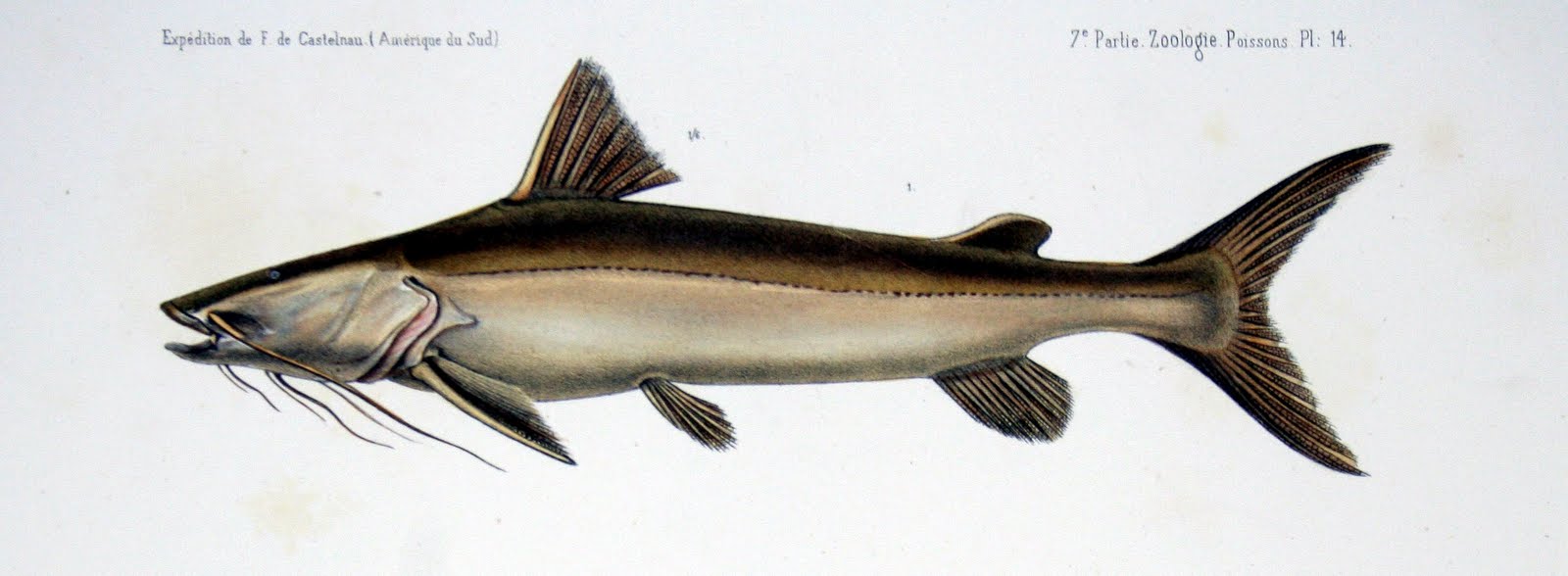 Piraiba (public domain)


 Posts
Posts