Dr KARL SHUKER

Zoologist, media consultant, and science writer, Dr Karl Shuker is also one of the best known cryptozoologists in the world. He is the author of such seminal works as Mystery Cats of the World (1989), The Lost Ark: New and Rediscovered Animals of the 20th Century (1993; greatly expanded in 2012 as The Encyclopaedia of New and Rediscovered Animals), Dragons: A Natural History (1995), In Search of Prehistoric Survivors (1995), The Unexplained (1996), From Flying Toads To Snakes With Wings (1997), Mysteries of Planet Earth (1999), The Hidden Powers of Animals (2001), The Beasts That Hide From Man (2003), Extraordinary Animals Revisited (2007), Dr Shuker's Casebook (2008), Karl Shuker's Alien Zoo: From the Pages of Fortean Times (2010), Cats of Magic, Mythology, and Mystery (2012), Mirabilis: A Carnival of Cryptozoology and Unnatural History (2013), Dragons in Zoology, Cryptozoology, and Culture (2013), The Menagerie of Marvels (2014), A Manifestation of Monsters (2015), Here's Nessie! (2016), and what is widely considered to be his cryptozoological magnum opus, Still In Search Of Prehistoric Survivors (2016) - plus, very excitingly, his four long-awaited, much-requested ShukerNature blog books (2019-2024).

Dr Karl Shuker's Official Website - http://www.karlshuker.com/index.htm

IMPORTANT: To view a complete, regularly-updated listing of my ShukerNature blog's articles (each one instantly clickable), please click HERE!

IMPORTANT: To view a complete, regularly-updated listing of my published books (each one instantly clickable), please click HERE!

IMPORTANT: To view a complete, regularly-updated listing of my Eclectarium blog's articles (each one instantly clickable), please click HERE!

IMPORTANT: To view a complete, regularly-updated listing of my Starsteeds blog's poetry and other lyrical writings (each one instantly clickable), please click HERE!

IMPORTANT: To view a complete, regularly-updated listing of my Shuker In MovieLand blog's articles (each one instantly clickable), please click HERE!

IMPORTANT: To view a complete, regularly-updated listing of my RebelBikerDude's AI Biker Art blog's thematic text & picture galleries (each one instantly clickable), please click HERE!

Search This Blog


PLEASE COME IN, I'VE BEEN EXPECTING YOU...

PLEASE COME IN, I'VE BEEN EXPECTING YOU...
WELCOME TO SHUKERNATURE - ENJOY YOUR VISIT - BEWARE OF THE RAPTOR!


Showing posts with label winged snakes. Show all posts

Wednesday, 22 September 2021

SNAKES WITH WINGS - AND OTHER STRANGE THINGS!

 
Artistic representation of the Namibian flying snake based upon eyewitness descriptions (© Philippa Foster)


I went once to a certain place in Arabia, almost exactly opposite the city of Buto, to make inquiries concerning the winged serpents. On my arrival I saw the back-bones and ribs of serpents in such numbers as it is impossible to describe: of the ribs there were a multitude of heaps, some great, some small, some middle-sized. The place where the bones lie is at the entrance of a narrow gorge between steep mountains, where there open upon a spacious plain communicating with the great plain of Egypt. The story goes that with the spring the winged snakes come flying from Arabia towards Egypt, but are met in this gorge by the birds called ibises, who forbid their entrance and destroy them all. The Arabians assert, and the Egyptians also admit, that it is on account of the service thus rendered that the Egyptians hold the ibis in so much reverence.

   Herodotus – The History, Book II


Despite its common name, the so-called flying snake Chrysopelea ornata of southeast Asia cannot actively fly. However, it is well known that this distinctive species can glide for up to 300 ft through the air by launching itself from a tree while simultaneously spreading its ribs and flattening its body, until its undersurface is concave, thereby transforming itself into a ribbon-shaped parachute.
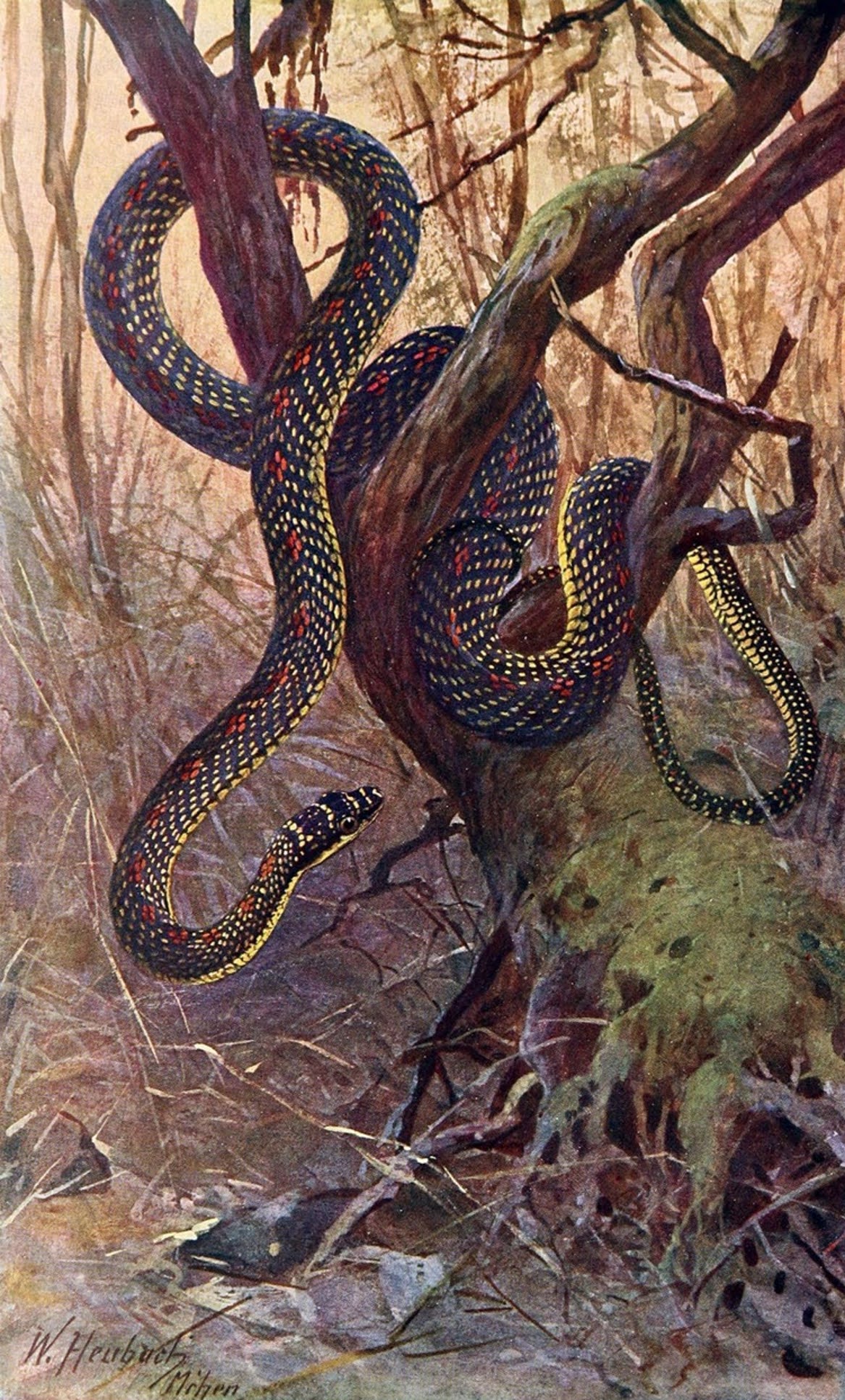
 
Southeast Asia's known flying snake Chrysopelea ornata (public domain)

Yet according to some remarkable reports filed away within the bulging archives of cryptozoology, there may be some currently-undescribed species of snake that are capable of true flight, i.e. achieved with the aid of wings or comparable means of active propulsion.


THE NAMIBIAN FLYING SNAKE

One such mystery beast is the supposed flying snake that has been reported not only by the native Namaqua people but also by a number of European eyewitnesses within the Namib Desert of southern Namibia. According to their generally consistent accounts, it has a brown or yellow body mottled with dark spots, an inflated neck, and a very large head bearing a pair of short backward-pointing horns - plus, very remarkably, a glowing 'torch' in the centre of its brow. Most astonishing of all, however, is the pair of membranous bat-like wings allegedly emerging from the sides of its neck or mouth.

Eyewitnesses have stated that this extraordinary snake launches itself from the summit of a high rocky ledge, then soars down to the ground, landing with an appreciable impact and producing scaly tracks in the dusty earth. In 1942, while tending sheep in the mountains at Keetmanshoop, teenager Michael Esterhuise threw a stone at what he had assumed to be a large monitor lizard lurking inside a rocky crack. When it emerged, however, it revealed itself to be a big snake with a pair of wing-like structures projecting from the sides of its mouth.
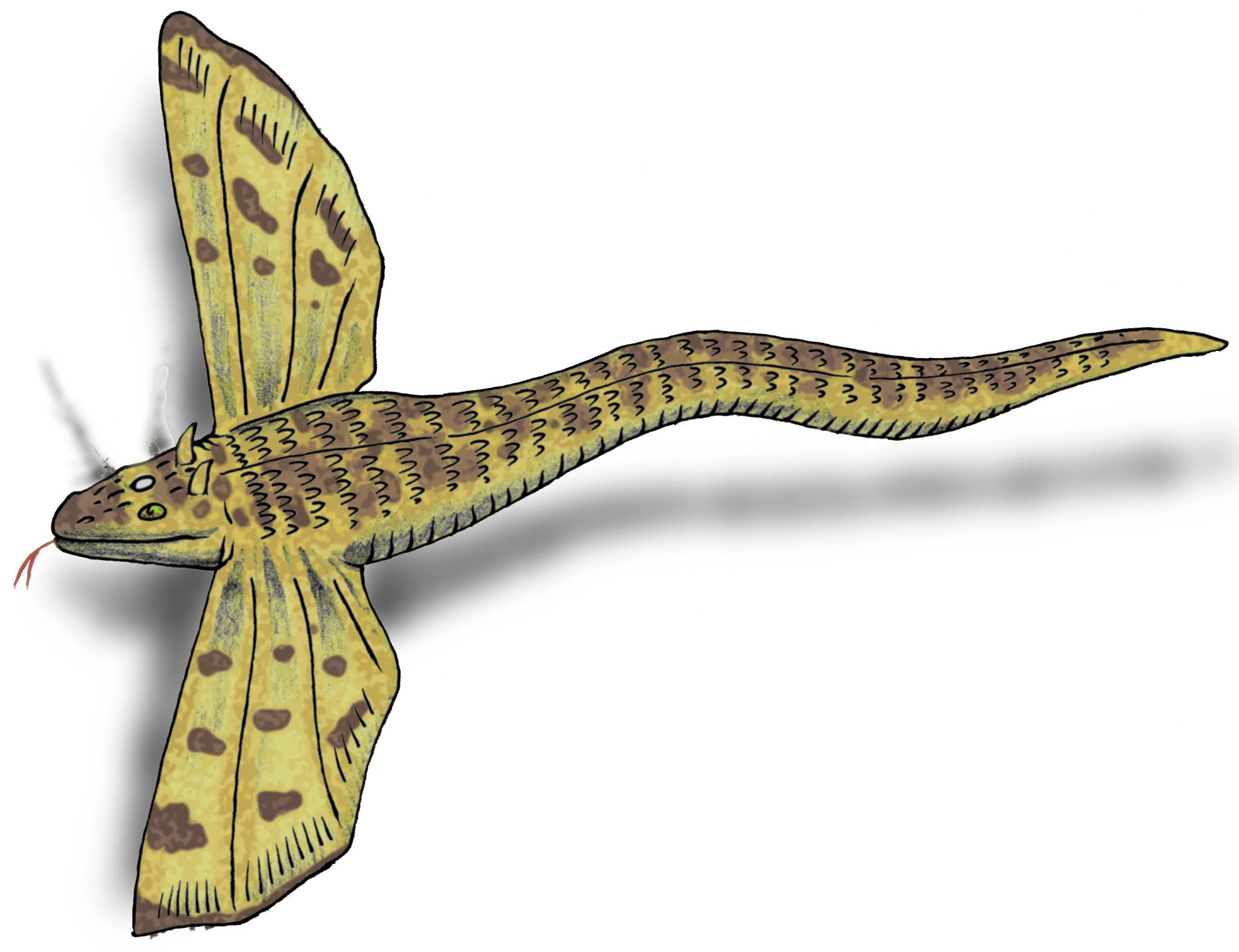
 
A second reconstruction of the Namibian flying snake's possible appearance (© Tim Morris)

On a separate occasion, moreover, one of these serpents soared down towards Esterhuise after having launched itself from a rocky ledge. When it landed, hitting the ground with great force, Esterhuise fainted, and when he was later found (unharmed though still unconscious) by a search party, the snake had gone but its tracks remained. They were subsequently examined by no less celebrated a naturalist than Marjorie Courtenay-Latimer – curator of South Africa's East London Museum and immortalised zoologically as the discoverer of that famous 'living fossil' fish the coelacanth Latimeria chalumnae in 1938. In her opinion, these tracks, containing the clear impression of scales, were indeed consistent with the marks that a snake would make.

A South African television documentary by Angus Whitty Productions, entitled In Search of the Giant Flying Snake of Namibia and first broadcast in 1995, contained testimony from a number of alleged eyewitnesses, which provided estimates of this mystery serpent's total length that ranged from 9 ft to 15 ft. The programme also specially prepared and featured on-screen a detailed drawing of the latter snake's alleged appearance based upon such testimony.
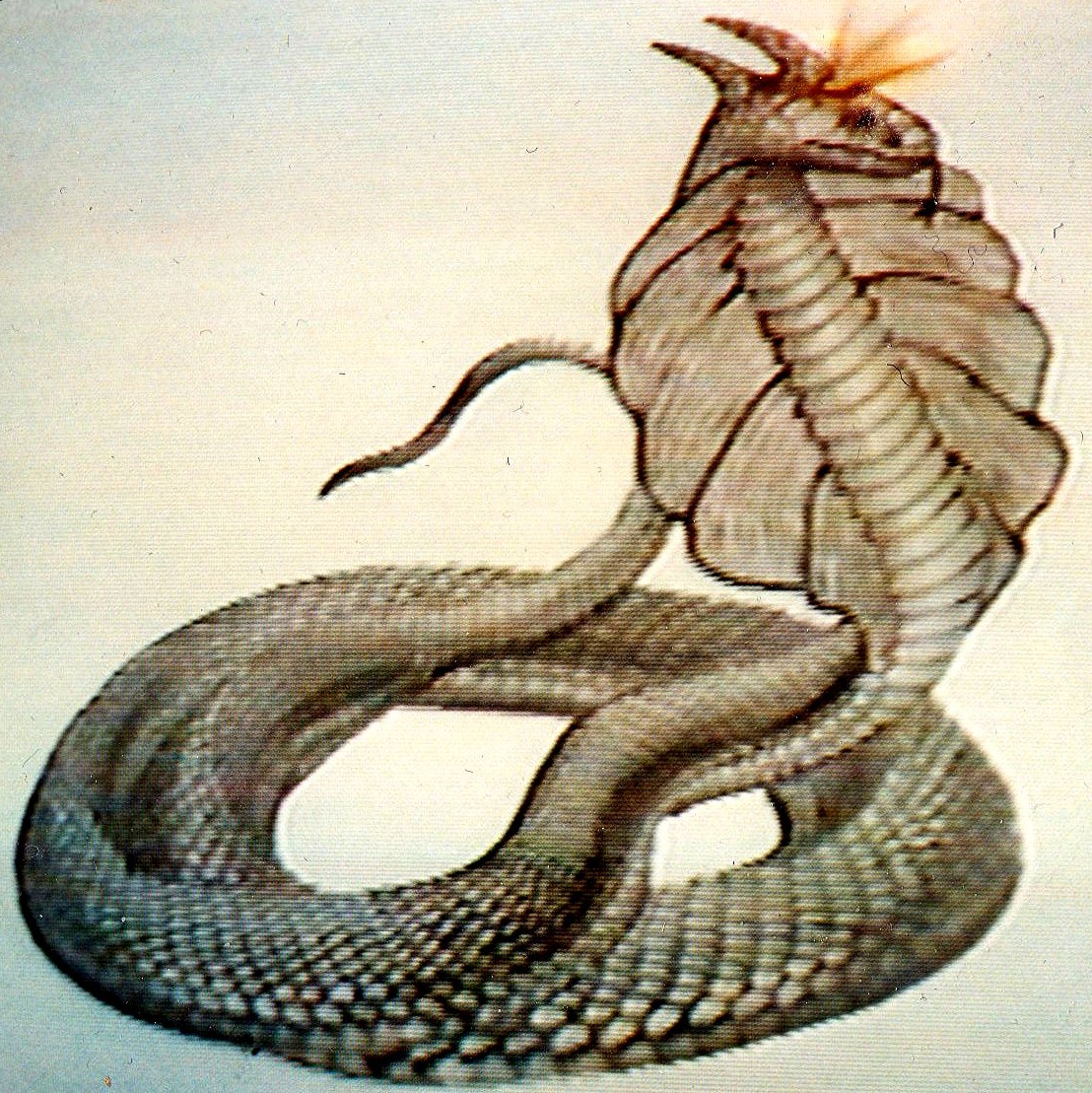
 
Screenshot of the flying snake drawing from In Search of the Giant Flying Snake of Namibia (© Angus Whitty Productions – reproduced here on a strictly non-commercial Fair Use basis for educational/review purposes only)

Well worth noting is that Namibia is a former German colony, so it is not impossible that Teutonic legends of lightning snakes retold here by German settlers may have infiltrated and influenced native Namibian lore. However, such legends cannot leave physical, tangible tracks like those examined by Miss Courtenay-Latimer, so perhaps a real snake is indeed present but one whose appearance has been exaggerated or distorted in the telling due to shock by those who have unexpectedly encountered it.

If so, the Namibian flying snake may still be an undescribed species, but one that in reality merely sports a pair of extensible lateral membranes similar to those of the famous Asian gliding lizard Draco volans (though whether such structures would be sufficiently adept, aerodynamically, to bear so sizeable a snake through the air is another matter), plus a pair of horny projections resembling the 'eyebrow' horns of certain African vipers. As for its glowing 'torch', this may be nothing more mysterious than a highly-reflective patch of shining scales on its brow.


THE TL'IISH NAAT'A'I OR ARIZONA FLYING SNAKE

For a number of years, American cryptozoologist Nick Sucik has been investigating reports of an equally mystifying but even more obscure aerial anomaly of the serpentine kind - the tl'iish naat'a'í (pronounced 'kleesh-not-ahee' and translated as 'snake that flies'). Also known as the Arizona flying snake, apparently this bizarre reptile is a familiar creature there to the Navajo Nation, and to the Hopi Nation as well (who refer to it by names translating as 'sun snake'). They all describe it as being fundamentally serpentine in form, generally around 2 m long, and dull grey in colour (although sometimes said to have a red belly), but possessing a pair of retractable and virtually transparent wing-like membranes. These emerge from behind its head, run laterally along much of its body's length, can flap vigorously and very rapidly, and are thus used for active flight (rather than passive gliding) purposes.

Some eyewitnesses have stated that these membranes sparkle in the sun when illuminated at certain angles. They also claim that this mysterious reptile constructs a kind of nest from twigs, located along the sides of cliffs or among rocks; and that when airborne, its flying membranes make a hissing sound, likened by some witnesses to a passenger jet's noise when passing by overhead. Comparable reports have also emerged from both the Texas and the Mexican sides of the Rio Grande, including one sighting of an unusual snake-like entity flying amid a group of bats here that was videoed by a security camera at Lajitas, Texas, and can be viewed on YouTube. Sadly, the alleged serpent is only glimpsed briefly and even then not clearly. Some viewers have opined that it may itself have been a bat (albeit a much larger one) or even an owl, but Nick is not convinced by such identities.

The video can presently be accessed here on YouTube, where it was posted by a Gil Bartee on 26 June 2008. Sadly, however, the alleged serpent is only glimpsed very briefly (I assume that it is the entity appearing at 0:54 minutes into the video – Bartee provides no details), and even then not clearly. Some viewers have opined that it may itself have been a bat (albeit a much larger one) or even an owl, but Nick is not convinced by such identities.

 
Artistic representation of the Arizona flying snake (© Tim Morris)

On 10 November 2016, British cryptozoological researcher Richard Muirhead posted in Facebook's Cryptozoology Herpetological Research Group a hitherto-obscure newspaper article dealing principally with the afore-mentioned, long-known Asian flying snake Chrysopelea ornata, but whose final paragraph contained information that is definitely of cryptozoological interest. Published in the Oregonian on 15 March 1942, the paragraph in question reads as follows:

A western prototype [i.e. of Chrysopelea ornata] is reputed to exist somewhere in Southern Mexico, although snake experts have made many fruitless expeditions into the interior for living specimens.

Might this be a previously-unpublicised reference to the tl'iish naat'a'í? If so, however, it indicates that this mystery snake, or something comparable, exists further south in Mexico than the Rio Grande.

In 2004, Nick prepared a detailed paper documenting traditional folklore and contemporary sightings relating to the tl'iish naat'a'í, which could formerly be viewed online (at: http://www.azcentral.com/12news/pics/dragonsofthedine.pdf) but has now disappeared (happily, I downloaded a copy for my files while it was still online), and contains a number of fascinating eyewitness accounts of this truly extraordinary, zoologically-unknown snake.


EUROPEAN WINGED SNAKES

Remarkably, some intriguing but thoroughly mystifying, modern-day reports of aerial snakes have even been filed from Europe. For instance, one day during 1930 or 1931, the mother of André Mellira was preparing lunch in a hut deep within the forest at the mountain village of La Bollène-Vésubie, close to Nice, southern France, when she looked out of the window and saw what looked like a green snake with wings! Moreover, this amazing creature promptly flew down from the branches of a tree close by and landed upon the hut's window sill. When Mellira's mother cried out in fear and alarm, however, her unexpected winged visitor dived down into a bush and vanished. Intriguingly, there is a longstanding tradition of winged snakes inhabiting the southern Alps, but these have always been discounted by scientists as myths.

 
An illustration from a 1723 publication by Swiss scholar Johann Jakob Scheuchzer depicting an alleged alpine winged snake (public domain)

A 12-year-old Bulgarian girl called Hazel Göksu was walking towards a spring very near her home one summer evening in 1947 in order to fill two buckets with water. Suddenly, however, she noticed what initially looked like some branches lying on the path ahead, but as she drew nearer she realised that they were thin snakes. Black, grey, and white in colour, and 1-2 m long, they abruptly emitted a peculiar cry - and then launched themselves into the air, flying 2-3 m above the ground in a straight line to the spring, about 150 m away, before vanishing behind some trees. Hazel was so frightened by what she had seen that she ran back to her home immediately, and never visited the spring again alone.


A COUPLE OF REPTILIAN LONDON PECULIARS?

Perhaps the most unexpected flying snakes ever recorded from Europe, however, were reported even closer to home – West London. According to a correspondent writing as 'SB' in The Gentleman's Magazine on 20 April 1798, a truly remarkable animal was observed during early August 1776 just a few miles west of London:

The strange object was of the serpent kind: its size that of the largest common snake; and as well as it could be discovered from so transient a view of it, resembled it by a kind of grey mottled skin. The head of this extraordinary animal appeared about the size of a small woman's hand. It had a pair of short wings very forward on the body, near its head; and the length of the whole body was about two feet. Its flight was very gentle; it seemed too heavy to fly either fast or high; and its manner of flying was not in an horizontal attitude, but with its head considerably higher than the tail; so that it seemed continually labouring to ascend without ever being able to raise itself much higher than seven or eight feet from the ground.

 
Bestiary illustration of a flying snake-like reptile (public domain)

This same magazine subsequently published a second, more recent report, by a correspondent signing only as 'JR' - describing a sighting by a friend of the same (or a very similar) flying snake encountered at 10.30 pm on 15 July 1797 on the road between Hammersmith and Hyde Park Corner:

The body was of a dark colour, about the thickness of the lower part of a man's arm, about two feet long. The wings were very short, and placed near the head. The head was raised above the body. It was not seven or eight feet from the ground. Being an animal of such uncommon description, I was particular in noticing the day of the month, and likewise being the day preceding a most dreadful storm of thunder and lightning.

If we are willing to accept that these reports are not outright hoaxes (worth noting, however, is that neither of the authors supplied their name), or bizarre exaggerations of some large insect like a damselfly or robber fly (both of which when in flight sometimes hold their body in a similar pose to that described for this winged serpent), or some abstruse example of 18th-Century political satire, we can only assume that the observers were not zoologically-informed, and had mistaken some other, less bizarre creature for a flying snake.

 
 Robber fly (© Vengolis/Wikipedia – CC BY-SA 4.0 licence)

Indeed, this particular case reminds me of those occasions on which I have been asked to remove 'baby horned snakes' from neighbours' gardens during the summer, only to discover time and time again that they are actually the large, distinctive caterpillars of the great elephant hawk moth Deilephila elpenor. Having said that, however, and having read many times the authors' respective descriptions quoted above of what they allegedly saw, I still do not have even the slightest notion of what this enigmatic creature may have been!


EGYPT'S PLAGUE OF FLYING SERPENTS

Finally: no discussion of aerial snakes could be complete without considering the very curious case of Egypt's supposed plague of flying serpents.

In early times, small but highly venomous snakes of many different colours but all possessing membranous bat-like wings reputedly existed in Arabia, and congregated in great throngs upon the trees that produced the much-sought-after frankincense resin.

 
Bestiary engraving of two Arabian flying snakes and an ibis (public domain)

According to the celebrated Greek historian Herodotus of Halicarnassus (c.484–425 BC):

[The Arabians] gather frankincense by burning that storax [styrax resin] which Phoenicians carry to Hellas; they burn this and so get the frankincense; for the spice-bearing trees are guarded by small winged snakes of varied colour, many around each tree; these are the snakes that attack Egypt. Nothing except the smoke of storax will drive them away from the trees.

So numerous were they, in fact, that during their springtime migration from Arabia towards Egypt, the very air resounded with their incessant hissing and the unceasing beating of innumerable wings. Happily, however, Egypt's sacred ibises soon decimated these toxic ophidian locusts, devouring them in such vast quantities that none remained.

Many scholars believe that these winged wonders really were locusts, whose 'transformation' into snakes was due merely to exaggerated, elaborated retellings by successive storytellers down through the ages. Others claim that they really were snakes, but that their wings were either hearsay or fictitious additions purposefully supplied later by chroniclers anxious to enhance their tomes' dramatic content.
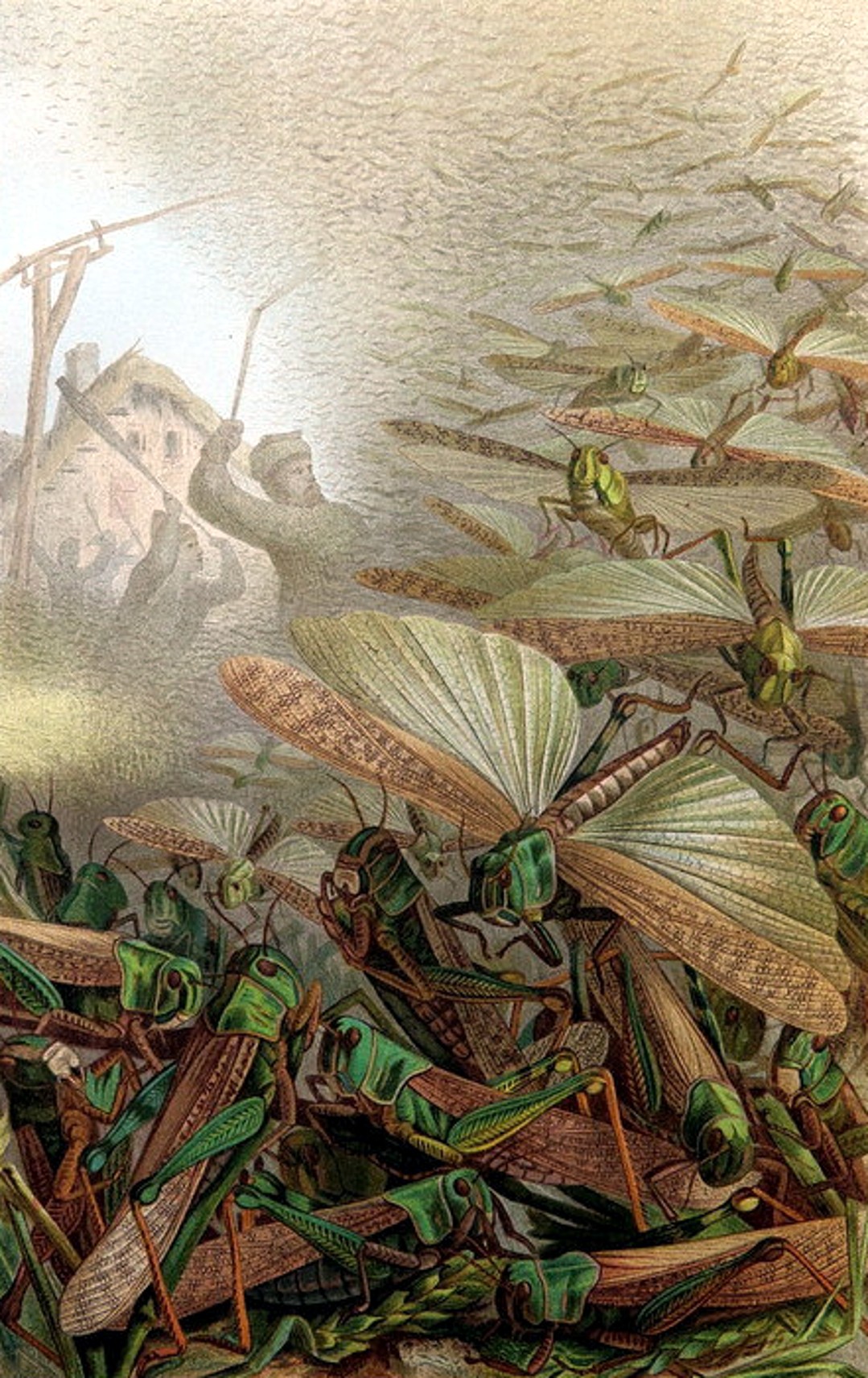
 
A swarm of locusts vividly depicted in a chromolithograph from 1890 (public domain)

Whatever the explanation, it can be said with certainty that in spite of Herodotus's first-hand observation of what he claimed to be masses of piled-up skeletons of these creatures (see this present ShukerNature article's opening quotation), no such snakes exist in the Middle East today. Presumably, therefore, the skeletons seen by him were not from snakes at all (with no detailed description or illustrations of them to examine, it is impossible to know for sure) – or perhaps their macabre mode of reproduction explains their demise.

For according yet again to the writings of Herodotus (and those of several other ancient historians too), at the very height of passion the female Arabian winged snake would bite her unfortunate partner's head off, rather like a serpentine praying mantis. And when the young snakes developing inside her afterwards had attained the required size for emerging into outside world, they would gnaw their way out of their mother's body, chewing through her uterus and gut, thereby killing her in the process.

Consequently, even if such fanciful creatures really did exist at one time, cursed with such a deadly mode of reproduction and birth it is perhaps little wonder that Arabia's flying serpents became extinct! In reality, however, it seems far more plausible that such claims were based upon misinterpretations of skin sloughing in snakes, with observers of such activity wrongly assuming that a matured snake offspring was bursting out through the skin of a dead parent. Or, to put it another way: in addition to being a highly influential scholar, Herodotus was nothing if not an imaginative one!


Finally: just in case you may be wondering – I certainly haven't forgotten the extraordinary winged feathered snakes reported from various localities in Wales, as documented by me in my book From Flying Toads To Snakes With Wings and also appearing on its front cover. The reason why they're not included above in this present ShukerNature article is that they've already been featured extensively in a previous one, devoted entirely to them – so please click here to access it.
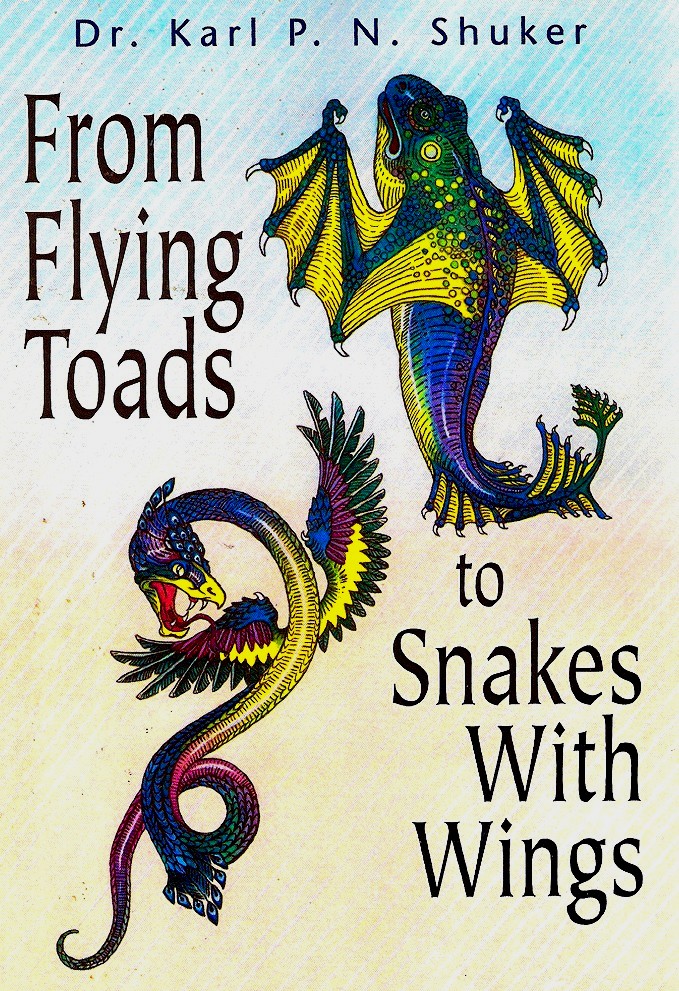
 
From Flying Toads To Snakes With Wings (© Dr Karl Shuker/Llewellyn Publications)
 

Wednesday, 13 April 2016

FROM BARGUEST AND BOOBRIE TO BLUE MEN OF THE MINCH - A SHUKERNATURE SELECTION OF ESOTERIC ENTITIES FROM THE BRITISH ISLES


A Blue Man of the Minch (I found this image online some time ago, unsourced and uncredited, but it looks like it may be a modified version – by person(s) unknown – of a picture from highly-acclaimed London-based photographer Chris Parkes's spectacular 'All that Glitter is Green' series; if so, © Chris Parkes, and thus used here on a strictly non-commercial, Fair Use basis only; also, please click here to visit Chris Parkes's website and see some of his wonderful photographs)

The British Isles are said to contain more ghosts than anywhere else in the world. Less well-known is that a remarkable diversity of monsters, mythological creatures, and mystery beasts have also been reported from these ancient lands, as will be seen here in this exclusive ShukerNature selection of some notably esoteric entities from my homeland. The trick, however, is trying to decide which category each of them belongs to - fact or fable, legend or reality, the natural world or the supernatural realm - a perilous choice that I will leave, gentle reader, to you!


BAISTE-NA-SCOGHAIGH
It is not widely known that Britain can lay claim to its very own indigenous species of unicorn. Yet according to Hebridean folklore, the lochs on the Inner Hebrides island of Skye are home to just such a creature, called the baiste-na-Scoghaigh (aka biasd na Srogaig). Despite its long legs, however, its bulky, lumbering form renders it more akin to a rhinoceros than to the elegant unicorn of classical legend; and as it can assume human form, this deceptive creature is technically a were-unicorn. See also here for more details.

Is this what the baiste-na-Scoghaigh looks like? (public domain)


BARGUEST
One of England's most dreadful bogey-beasts, the barguest is able to assume several different guises, but its most common form is as a huge, shaggy-furred black dog with enormous fiery eyes, and sometimes even a pair of horns. According to tradition, this spectral hound haunts lonely areas of wasteland in Yorkshire, but especially between Wreghorn and Headingley Hill, near Leeds. Its appearance is widely believed to foretell an impending death, usually of some important figure living locally, and is often accompanied by fearful howling, baying, and sometimes the sound of rattling chains.

Beware of the barguest! (© Jane Cooper)


BLUE MEN OF THE MINCH
The Minch is a strait separating the largest Outer Hebridean island, Lewis-and-Harris, from the Scottish mainland. According to local maritime tradition, it is also home to a fierce race of mermen, distinguished from other fish-tailed folk by their vivid blue skin. Happily, however, their fondness for attacking sailors can be readily countered, simply by berating them exclusively in rhyme!


BOOBRIE
Scottish Highland lore describes the boobrie as a black lake-dwelling bird with white marks upon its neck and breast, resembling the great northern diver Gavia immer but very much bigger, and deadlier. For whereas divers (or loons, as these birds are referred to in North America) are content to feed upon fishes, the boobrie will allegedly seize any sheep or cow that dares venture near this monstrous bird's aquatic abode, and haul it beneath the water, thereafter to feed upon its drowned carcase.


HAIRLESS BLUE HORSE
During 1868, a very unusual horse was exhibited at London's famous Crystal Palace. Not only was it completely hairless, but its skin was blue, so that it looked as if it had been sculpted from some rare form of oriental blue marble. This singular steed had been captured on the plains of South Africa by a merchant called Lashmar in 1860, and had been associating with a herd of those now-extinct, incompletely-striped zebras known as quaggas. The fate of the hairless blue horse after its Crystal Palace days is unknown - as is its identity. Could it have been a freak quagga, rather than merely a freak domestic horse run wild? See also here for more details.

Photoshopped image of a horse resembling the Crystal Palace-exhibited curiosity described here (© Daisiem worth1000 – reproduced here on a strictly non-commercial Fair Use basis only)


LOUGH DUBH MONSTER
One day in March 1962, schoolteacher Alphonsus Mullaney and his son went fishing to Lough Dubh ('Black Lake') in County Galway, Ireland...and caught a monster instead. Suddenly, their line became taut, and when they attempted to reel in their catch, they saw to their horror that they were hauling up an incredible water beast like nothing ever reported before - or since. The size of a cow, it had short thick legs, small ears, dark grey skin covered in short bristles, and a large hippopotamus-like face - with a sharp rhinoceros-like horn on the end of its snout! Not surprisingly, the two anglers fled away, but when they returned with a posse of local men, the lake's mysterious monster had vanished again. See also here for further details.

Artistic representation of the Lough Dubh monster (© Orbis Publishing - reproduced here on a strictly non-commercial Fair Use basis only)


LYMINSTER KNUCKER
An unexpectedly loquacious English dragon, the knucker lived in a deep pool near the church at Lyminster, close to Arundel, in Sussex. Unfortunately, however, it developed a great liking (in the gastronomic sense!) for sheep, pigs, and even the odd farmer or two...until a local youth called Jim Puttock came along. After deliberately over-feeding the knucker with a heavy pudding that gave it severe indigestion, Puttock promised to provide a remedy for curing its stomach ache. The remedy in question, albeit decidedly unorthodox, was also undeniably effective - after engaging it in seemingly innocent conversation, Puttock abruptly wielded his trusty sword and chopped off the knucker's head!


MINIATURE WOLVES OF ACHILL ISLAND
According to Irish tradition, County Mayo's Achill Island was home to a type of small wolf-like beast long after true wolves had died out elsewhere in the British Isles. They were said to resemble normal wolves in overall appearance except for their relatively small stature. No such creatures have been reported here in recent times, however, so even if they really did once exist they have now presumably died out.


ORKNEY BOAR-WHALE
According to Swedish archbishop Olaus Magnus (1490-1557), an extraordinary sea monster resembling a hybrid of whale and wild boar was sighted in the sea north of Scotland's Orkney Islands in 1537. In bestiary compiler Conrad Gesner's tome, Nomenclator Aquatilium Animantium... (1560), this Orcadian boar-whale was depicted with the head and body of a boar but with scales instead of fur, flippers instead of feet, and a fish-like tail. Not surprisingly, it has never been identified.

The Orkney boar-whale as depicted in Gesner's tome (public domain)


RENWICK COCKATRICE
During the demolition of an old church at Renwick in Cumbria, northern England, during 1733, workmen were terrified when a huge winged apparition rose up out of the foundations, for in appearance it closely resembled a cockatrice. According to legend, this was a lethal dragonesque monster combining reptilian scales,  leathery bat-like wings, and a snake-like tail with the feathered body and also the wattled, coxcomb-surmounted head of a farmyard rooster, and which was hatched by a toad from a shell-less egg laid by a cockerel! As this hideous creature sallied forth, the Renwick villagers fled in all directions - except for one brave man named John Tallantine. Armed with a lance hewn from the rowan tree, which is famed for its reputed power in warding off evil, Tallantine pursued the cockatrice into the churchyard, and after a fierce battle he succeeded in slaying it. As a reward, the grateful people of Renwick decreed that for ever afterwards Tallantine's descendants would be exempt from paying tithes. A copy of an account describing this alleged occurrence is preserved in Renwick's current church.

Cockatrice, depicted by Wenceslaus Hollar, 1600s (public domain)


ST SEONAN'S MONSTER
Like an amphibious cyclops, this maned water monster had a single eye gleaming brightly in the centre of its forehead. It also had a whale's fluked tail, and a mighty chest that sounded like a pair of huge bellows when it exhaled its scorching breath. It frequented the island of Iniscathy (aka Inis Cathaigh), located in Ireland's Shannon Estuary, and whenever it sharpened its razor-sharp iron talons, sparks of fire would dance upon the island's rocky surface. Eventually, however, it was allegedly banished by St Seonan.


SCREAMING WHITE RABBIT
Reputedly, an eerie spectral rabbit, pure white in colour and emitting a hideous screaming cry, has been encountered spasmodically in an area of Cobridge in northern Staffordshire, England, that is known locally as The Grove. It is claimed that this white rabbit is the restless ghost of teenager John Holdcroft, who was strangled to death by fellow teenager Charles Shaw one day in August 1833 after Shaw had accused him of cheating at a game of pitch and toss. Terrified by what he had done, Shaw hung a noose around his friend's neck and tried to pretend that he had committed suicide, but he later confessed to the murder and was sentenced to transportation. As for the rabbit, its eldritch shrieks are supposedly John Holdcroft's death screams.


WINGED FEATHERED SNAKES
Remarkably, until as recently as the early 1800s some local inhabitants believed that creatures apparently resembling winged feathered snakes congregated in large numbers within the wooded vales of Penllyne and Penmark in Glamorgan. Extraordinarily beautiful, they had shimmering bodies whose scales sparkled like multicoloured jewels, rainbow-hued crests, and outspread plumed wings. Despite their flamboyant finery, however, Glamorgan's feathered flying snakes were reputedly slaughtered like common vermin by farmers, on account of their taste for the farmers' poultry, until at last they were completely exterminated. See also here for more details.

Depiction of one of the winged feathered snakes that appeared on the front cover of the original 1997 American edition of my book From Flying Toads To Snakes With Wings (© Dr Karl Shuker/Llewellyn Publications)


YELPING BEAST OF MANY COLOURS
Finally, but staying with extraordinarily beautiful creatures: Loosely connected to the Arthurian corpus of legends and originally composed anonymously in French during the 1300s, Perceforest is a 6-volume prose romance presenting a fictionalised origin of Great Britain. One memorable scene from it features Maronex the Gilded Knight, magnificently bedecked in brilliant golden armour, encountering a huge and equally dazzling, rainbow-hued creature that gave voice to ear-splitting yelping cries when it was pursued by him after it seized a stag in its jaws. Hence it is generally referred to as the Yelping Beast or the Beast of Many Colours. After dropping the deer as it fled headlong through the forest, the Yelping Beast finally reached its lair, a dense thicket in the midst of a deep marsh, and successfully eluded Maronex when his horse became enmired up to its belly in the marsh's black mud. Although Maronex was eventually able to free his horse, he conceded that it would be perilous in the extreme to attempt any further pursuit of the Yelping Beast through such treacherous, potentially lethal terrain, so he reluctantly turned back, his multicoloured quarry far beyond his reach by now. The creature's penchant for exceedingly loud yelping cries, incidentally, readily calls to mind comparable behaviour described for the snake-headed, leopard-bodied, hart-footed Questing Beast in traditional Arthurian legend.

The Yelping Beast of Many Colours and Maronex the Gilded Knight, from Royal 19 E II mss, Perceforest, Anciennes croniques Dangleterre, faictz et gestes du roy Perceforest, et des chevaliers du Franc Palais, version transcribed by David Aubert in late 1400s, Holland (public domain)


Friday, 13 July 2012

THE PEACOCK-PLUMED WINGED SERPENTS OF GLAMORGAN – A ZOOMYTHOLOGICAL CURIOSITY FROM WALES

A winged feathered serpent from Glamorgan (as appearing on the front cover of my book From Flying Toads To Snakes With Wings (Llewellyn: St Paul, 1997))


British mythology is replete with folktales and legends of fabulous beasts, including many that feature dragons and other reptilian monsters. Surely the most remarkable of these, however, are the jewel-scaled, plume-winged wonders that were reportedly still existing in Wales as recently as the 1800s.

Marie Trevelyan brought these exquisite creatures to widespread attention in her book Folk-Lore and Folk Stories of Wales (1909), and her description of them is so vibrant and uniquely detailed for such an ostensibly implausible type of beast that it deserves quoting here:

"The woods round Penllyne Castle, Glamorgan, had the reputation of being frequented by winged serpents, and these were the terror of old and young alike. An aged inhabitant of Penllyne, who died a few years ago [c.1900], said that in his boyhood the winged serpents were described as very beautiful. They were coiled when in repose, and "looked as if they were covered with jewels of all sorts. Some of them had crests sparkling with all the colours of the rainbow." When disturbed they glided swiftly, "sparkling all over," to their hiding places. When angry, they "flew over people's heads, with outspread wings bright, and sometimes with eyes too, like the feathers in a peacock's tail." He said it was "no story invented to frighten children," but a real fact. His father and uncle had killed some of them, for they were "as bad as foxes for poultry." The old man attributed the extinction of the winged serpents to the fact that they were "terrors in the farmyards and coverts."

"An old woman, whose parents in her early childhood took her to visit Penmark Place, Glamorgan, said she often heard the people talking about the ravages of the winged serpents in that neighbourhood. She described them in the same way as the man of Penllyne. There was a "king and queen" of winged serpents, she said, in the woods round Bewper. The old people in her early days said that wherever winged serpents were to be seen "there was sure to be buried money or something of value" near at hand. Her grandfather told her of an encounter with a winged serpent in the woods near Porthkerry Park, not far from Penmark. He and his brother "made up their minds to catch one, and watched a whole day for the serpent to rise. Then they shot at it, and the creature fell wounded, only to rise and attack my uncle, beating him about the head with its wings." She said a fierce fight ensured between the men and the serpent, which was at last killed. She had seen its skin and feathers, but after the grandfather's death they were thrown away. That serpent was as notorious "as any fox" in the farmyards and coverts around Penmark."

In 1812, very similar beasts were also reported in the Vale of Edeirnion, northern Wales.

What could have inspired such astonishing accounts? Remarkably, it has been suggested by one or two folklorists and cryptozoologists that these truly exceptional creatures were pheasants. As the ring-necked pheasant Phasianus colchicus (the only species present in Wales during the early 19th Century) was introduced into Britain back in Roman times, however, it seems unlikely that a species so well-established here by the 1800s could be mistaken for anything as exotic as a plumed serpent with wings. In any case, only the males of this pheasant species possess colourful feathers.

19th-Century colour illustration of a pair of ring-necked pheasants

Even less likely is the prospect that they represented an unknown species of pheasant, one perhaps that was more elongate in form than usual (possessing a longer-than-typical neck and tail?), so as to present a vaguely serpentine appearance. For if this were so, there is no doubt whatsoever that many specimens of such a distinctive and extremely eyecatching bird would have been diligently preserved as prized taxiderm exhibits in country manors and museums. Such a striking form of game bird would also have been extensively documented and depicted in countryside magazines or those devoted to hunting and shooting - sports that were extremely prevalent and popular throughout Britain two centuries ago, and obviously it would have been instantly recognised by hunters, poachers, and gamekeepers alike as a mere bird, not some bizarre reptilian entity more akin to the Aztecs' deified Quetzalcoatl!

In short, if such a spectacular, impossible-to-overlook bird had ever inhabited Wales as late in time as the 1800s, it would have been formally discovered and described long before it was ultimately exterminated. Instead, it is conspicuous only by its absence from natural history tomes and from any other wildlife publications, being solely confined to the pages of Trevelyan's book and to scant mentions elsewhere in other works of British mythology.

Equally difficult to explain if these bedazzling beasts were genuinely pheasants (known or unknown species notwithstanding) is their appetite for the farmers' chickens, earning them the reputation of being as troublesome on this score as foxes. Whereas male pheasants can be aggressive, it hardly need be pointed out that they do not feast upon chickens. Ditto for the possibility that they constituted escapee peacocks. And there is no known bird of prey native to Britain (or, indeed, anywhere else in the world for that matter) that matches the multicoloured, glittering appearance described for the thoroughly baffling albeit very beautiful creatures under consideration here.

An amphiptere, as depicted in a medieval bestiary

The same situation also arises when seeking parallels outside the confines of recognised natural history, by venturing forth instead within the more flexible boundaries of zoomythology. An association with buried treasure or similar hoards of riches is of course a familiar theme in dragon myths, but otherwise there is nothing even vaguely comparable between Wales's winged feathered serpents and any other beast in British legends and folklore. (True, a few amphipteres occur - winged serpent dragons, i.e. resembling snakes but dragon-headed and possessing a pair of bat-like wings - but these are not clothed in flamboyant plumage.) For not only is their morphology exceptional, so too are their surprising erstwhile abundance and the acceptance of them by the local people as relatively mundane members of the area's fauna.

If only the skin and feathers of a killed specimen had been preserved and submitted for scientific examination instead of being discarded. After all, it's not every day that the opportunity to examine the mortal remains of a winged, feathered, serpent arises!

Monday, 20 April 2009

OTTER KINGS TO EARTH HOUNDS - IN SEARCH OF BRITAIN'S LESSER-KNOWN MYSTERY BEASTS

Grace Connolly was a recently-married young woman who lived in the townland of Creevelea, at the northwestern corner of Glenade Lake, just inside County Leitrim's border with County Sligo, in Ireland. One bright morning in September 1722, Grace went down to the lake, to bathe and perhaps also to wash clothes. Tragically, however, she did neither, for while there she was attacked and killed by a water monster that rose up out of the lake's depths.


Carving of the dobhar-chú on Grace Connolly's tombstone (Dave Walsh)

When her husband, Terence McGloughlan (in keeping with Gaelic custom, Grace had retained her maiden name after marrying him), discovered Grace's body lying at the lake's edge later that day, he was half-crazed with grief. However, his grief turned to fury when he saw that his wife's assassin was actually lying asleep across her prone form. It was a dobhar-chú - a mysterious, elusive beast of Irish folk tradition, also known as a king otter or master otter, because it superficially resembled a normal otter but was much bigger, with powerful hound-like limbs.

Terence lost no time in slaying the monster, but its death cries alerted its equally formidable mate, which emerged from the lake and pursued Terence, who fled on horseback. Eventually, however, he ambushed the avenging dobhar-chú and slew it.

Needless to say, this could be readily discounted as just another traditional Irish folk story - were it not for the stark fact that Grace Connolly's grave exists. And carved upon her tombstone is a detailed depiction of her cryptozoological nemesis - the dobhar-chú.

This still-unidentified mystery beast is just one of many strange, enigmatic beasts reported over the years - and centuries - from the British Isles, thereby demonstrating that Nessie and various pantheresque or puma-resembling big cats are not the only mystery creatures associated with our green and pleasant lands.

MASTERING THE MASTER OTTER

The mystery of the dobhar-chú or master otter is particularly intriguing, thanks to the existence of Grace Connolly's tombstone and the portrait depicted upon it. As revealed in my books Mysteries of Planet Earth (1999) and The Beasts That Hide From Man (2003), both of which contain a detailed account of this remarkable case, Grace's grave can be found in Conwall Cemetery, in the town of Drummans, forming part of the approach to the Valley of Glenade from the coastal plain of north County Leitrim and south County Donegal, and not far from Bundoran.

Grace's name, and that of her husband, together with the year of her death, are still legible, as is the remarkable carved image of the dobhar-chú. The creature is depicted lying down with its head and neck flung backwards so as to lie flat along its back, thus representing it in its death throes, because a spear-like weapon (gripped at its upper end by a human fist) is piercing the base of its neck and re-emerging below its body. The creature itself curiously combines the short head and tiny ears, large paws, and long heavy neck of an otter with the long limbs and powerful thighs, deep-chested body, and lengthy curved tuft-tipped tail of a hound-like dog.

As true otters are very familiar beasts in Ireland, it would seem unlikely that this is merely a badly-executed portrayal of a normal otter. Yet if it is an accurate depiction, then the creature that it illustrates would appear to be unknown to science. Even more intriguing is that whereas this carving represents a creature killed back in 1722, a very similar beast has also been reported from this same area of Ireland in much more recent times.

Immediately to the west of County Sligo is County Mayo, off whose western coast is a small isle called Achill Island, containing a lake known as Sraheens Lough. During May 1968, several observers independently reported seeing a strange creature either running on land near to the lake or emerging directly from it. The mystery beast was said to be 8-10 ft long, roughly 2.5 ft high, and shiny black or very dark brown in colour, with a small head but a long neck and tail, and four powerful legs on which it rocked from side to side as it ran. A modern-day dobhar-chú? Perhaps - but until a specimen is (if ever) obtained, this mystifying mammal will continue to linger with leprechaun-like evanescence amid the twilight limbo between Celtic folklore and contemporary fact.

WHEN A SEA MONSTER SET FORTH FROM THE FIRTH OF TAY?

It's not every day that you see a sea serpent - and certainly not one that is actually making its way laboriously on land, along a major road, in full view of passing traffic. Yet that is what at least two eyewitnesses may well have seen, judging from their independent yet closely corroborating statements. The first of these was Maureen Ford, driving with some friends along the A85 towards Perth at 11.30 pm on 30 September 1965. Suddenly, as she neared Perth, she saw what she subsequently described as "a long grey shape [which] had no legs but I'm sure I saw long pointed ears", by the roadside yet only a few yards from the banks of the River Tay, which enters close by into a North Sea inlet - the Firth of Tay.

At 1.00 am the very next morning, this bizarre beast was seen again, but on the opposite side of the road, to which it had apparently crossed meanwhile. Its eyewitness this time was Robert Swankie, driving along the same road but in the opposite direction from Ford, i.e. away from Perth and on towards Dundee. As he drove along, however, his vehicle's headlights abruptly exposed an extraordinary sight - a weird creature with a 20-ft-long body that was "...humped like that of a giant caterpillar" (i.e. undulating vertically), and a head over 2 ft long, bearing a pair of pointed ear-like appendages. The creature was moving very slowly, making "...a noise like someone dragging a heavy weight through the grass".

Swankie wanted to stop, in order to obtain an even closer look at this scientifically-unidentified animal, but there was a car close behind him, so he deemed it best to carry on driving; however, he did subsequently report his sighting to the police. Suggestions that perhaps it had all simply been a trick of the light have since been discounted by cryptozoological investigators, pointing out that if this had indeed been true, why then had Swankie not seen monsters elsewhere on his journey?

After all, there was nothing special, optically speaking, about the particular stretch of road along which he and Ford had independently, and on opposite sides, spied an elongate mystery beast - one which, moreover, closely recalls many sightings of comparably serpentiform sea serpents and also lake monsters, including the equally inexplicable horse-eels of Lough Nahooin and elsewhere in Ireland. And optical illusions in any event do not normally feature an accompanying soundtrack of dragging noises.

Perhaps therefore, some highly elusive, still-unrecognised water beast did indeed emerge from the sea that evening under the cover of darkness, to make a rare, short foray overland, but by sheer chance had been spotted separately by two late-night travellers.

TEGGIE OF BALA LAKE

Also called Llyn Tegid, Bala Lake is Wales's largest lake, and, thanks to Teggie, its resident monster, it has also lately become its most famous, cryptozoologically speaking. In recent times, a number of sightings have been claimed here, featuring a reclusive creature variously likened to a crocodile or to the long-necked Nessie-type beasts more famously reported from Scotland. For example, while fishing from a small boat on the lake in March 1995, Paul and Andrew Delaney, visiting from London and unaware of Teggie reports, peered in great surprise at a small head that appeared at the lake's surface only 80 yards or so away, then proceeded to raise itself on a long slender neck until it was about 10 ft above the surface. This and other reports prompted an investigation of the lake later that same year by a Japanese TV crew, who obtained a sonar trace of a very large, unidentified object moving swiftly under the water, but failed to film Teggie, who remains steadfastly aloof.

THE EARTH HOUND OF BANFFSHIRE


The earth hound (William Rebsamen)


One of Britain's most macabre mystery beasts must surely be the earth hound or yard pig of Banffshire, northern Scotland, which allegedly lives in or near graveyards and digs inside coffins to feed upon corpses. Alexander Fenton and veteran Scottish cryptozoological chronicler David Heppell have uncovered a number of fascinating accounts regarding this creature.

One such account, written in 1917 by a Mr A. Smith, documents the description of an earth hound by a gardener who had dug up and killed it about half a century earlier, while ploughing some haughs (alluvial flats) close to a churchyard. According to the gardener, it was brown in colour rather like a rat, but had a long hound-like head, and a tail bushier than a rat's. This same specimen was later seen by a second eyewitness, who stated that it was:

"...something between a rat and a weasel, and about the size of a ferret, head very like that of a dog...the tail was not very long. At a casual glance it would be mistaken for a rat, but was quite unlike on close examination."

An earth hound killed in c.1915 near Mastrick, again near a churchyard, was said to have mole-like feet, white tusks, and prominent pig-like nostrils. Even as recently as spring 1990, Fenton was soberly informed of the earth hound by a Banffshire friend. Yet surely, if such a creature truly existed on Scotland, there would be specimens of it in museums by now - unless the very unsavoury nature of its lifestyle has effectively warded off attempts to seek out and preserve specimens of this weird animal?

CENAPRUGWIRION

Among the least-known yet most mystifying of British cryptozoological beasts is a curious 1-ft-long lizard-like reptile supposedly inhabiting burrows in and around Abersoch in North Wales. Known as the cenaprugwirion or genaprugwirion (sometimes translated as 'daft flycatcher'), it is readily distinguished from all species of native lizards not only by its length but also by its combination of an orange-sized head, dewlap (skin flap) beneath its chin, large mobile eyes, long fly-catching tongue, and mud-brown colour. Apparently once common here, it is rarely reported nowadays, which is a great tragedy, because this tantalising creature bears more than a passing resemblance to one of the world's most remarkable reptiles - the tuatara Sphenodon punctatus of New Zealand.

Tuatara (Dr Karl Shuker)

A veritable 'living fossil', the tuatara is the only modern-day representative of an otherwise long-extinct reptilian lineage known as the sphenodontids, and is found nowhere else in the world - officially. During the 19th Century, however, tuataras were commonly imported into Britain, and as they are not only well-suited to surviving Britain's climate but also have an extremely long lifespan (several decades), it has been suggested that perhaps some tuataras escaped into the Welsh countryside a century ago and established a viable colony, whose members were ultimately dubbed cenaprugwirions by the local people.

THE BEAST OF SOAY

Soay is a small unassuming island just south of Skye, largest of the Inner Hebridean isles. On 13 September 1959, however, the waters surrounding it witnessed an extraordinary incident - a decidedly close encounter between two fishermen and an incredible reptilian sea monster. Swimming to within 20 yards of the dinghy containing angler Tex Geddes and engineer James Gavin came a huge sea creature with a blunt tortoise-like head and gaping toothless mouth (through which they could plainly hear it breathing), red mouth lining, cylindrical neck, rounded face, and two large protruding eyes. Its body was scaly, burly, and the expanse visible above the sea surface was estimated by the two men to be 8-10 ft long. Overall, therefore, Soay's unwonted visitor may well have recalled a giant marine turtle - had it not been for the row of distinctive triangular spines running along the midline of its back, which bestowed upon it a disturbingly prehistoric appearance. Some zoologists sought to identify it as an escapee iguana, but there is even less resemblance between this lizard and the Soay beast than between the latter and a turtle. Happily, the bizarre creature posed no threat to its eyewitnesses, and was last spied by them swimming away towards the island of Barra.

EYEWITNESS REPORT - HOOKING THE HORNED MONSTER OF LOUGH DUBH

One of the most terrifying mystery beasts ever recorded within the chronicles of British cryptozoology was encountered by schoolteacher Alphonsus Mullaney and his young son, also called Alphonsus, while fishing one day after school in mid-March 1962 at Lough Dubh in County Galway, Ireland. As the shocked teacher later recalled to a Sunday Review reporter:


“Suddenly there was a tugging on the line. I thought it might be caught on a root, so I took it gently. It did not give. I hauled it slowly ashore, and the line snapped. I was examining the line when the lad screamed.

"Then I saw the animal. It was not a seal or anything I had ever seen. It had for instance short thick legs, and a hippo face. It was as big as a cow or an ass, square faced, with small ears and a white pointed horn on its snout. It was dark grey in colour, and covered with bristles or short hair, like a pig.”

After the two Mullaneys promptly fled, a party of brave locals with guns later returned, but no trace of the monster was found. However, as noted by lake monster author Peter Costello, far from basking in the resulting publicity of their amazing sighting the Mullaneys actively shunned all television interviews, and the father did everything to assist his son in blotting their very frightening experience from his young mind. Accordingly, Costello considers a hoax to be out of the question. As for the creature itself, of which no further sightings have been reported: it bears no resemblance to any other lake monster on file - or indeed, to any other beast of any kind - and therefore remains a total enigma.

UNSOLVED HISTORICAL CASES - THE WINGED SNAKE OF HYDE PARK AND HAMMERSMITH

Perusing old back issues of long-vanished British journals can be a surprisingly successful means of uncovering baffling yet fascinating cryptozoological reports - as evinced by the following still-unexplained account, which appeared in The Gentleman's Magazine on 20 April 1798. Penned by a correspondent identified only as 'SB', it concerned a surrealistic snake(?) allegedly sighted a few miles west of London at the beginning of August 1776:

“The strange object was of the serpent kind: its size that of the largest common snake; and as well as it could be discovered from so transient a view of it, resembled it by a kind of grey mottled skin. The head of this extraordinary animal appeared about the size of a small woman's hand. It had a pair of short wings very forward on the body, near its head; and the length of the whole body was about two feet. Its flight was very gentle; it seemed too heavy to fly either fast or high; and its manner of flying was not in an horizontal attitude, but with its head considerably higher than the tail; so that it seemed continually labouring to ascend without ever being able to raise itself much higher than seven or eight feet from the ground.”

Not long afterwards, the same magazine published a second account, by a pseudonymous correspondent identified only as 'JR', describing a supposed sighting by a friend of a similar (or even the same?) creature, this time encountered on the road between Hammersmith and Hyde Park Corner on the evening of 15 July 1797. Dark in colour, roughly 2 ft long, and "about the thickness of the lower part of a man's arm", it had very short wings placed near the head, and flew less than 7-8 ft above the ground, with its head raised above its body.

With no details supplied concerning the correspondents' identities, an outright hoax or a somewhat abstruse example of 18th Century satire cannot be discounted. Certainly, to the best of my knowledge Hyde Park and Hammersmith are not renowned nowadays for visitations from serpents of the winged variety, which is probably no bad thing!

THE WALKING FIR CONE OF DUMPTON PARK

It was on 16 April 1954 when Police Constable S. Bishop, while walking through Dumpton Park in Ramsgate, Kent, encountered a bizarre-sounding beast that he likened to "a walking fir-cone". Since then, nothing more has been heard of this novel creature, but PC Bishop's evocative description of it continues to tease and torment. What could it have been?

When I first read it, Bishop's description immediately conjured up images of pangolins. Also known as scaly anteaters, these extraordinary beasts, covered in huge brown scales, really do resemble animated pine or fir cones. However, they are wholly confined to tropical Asia and Africa, and due to their insectivorous diet are very difficult to maintain in captivity. Accordingly, they are rarely exhibited in zoos, and are seldom if ever kept as pets in the western world. Thus, despite being fir cone lookalikes, pangolins surely cannot be considered seriously as candidates for the Dumpton Park beast's identity.

More recently, however, a second identity was suggested to me that offers a greater degree of plausibility, yet does not compromise the fir cone similarity factor. John Mitchell from San Francisco had read my account of the Dumpton Park beast in my book From Flying Toads To Snakes With Wings (1997), and offered a most intriguing identity for consideration. Namely, the Australian stumpytail or shingleback skink Trachydosaurus rugosus - also called the pine-cone skink, because its large brown overlapping scales make this lizard look uncannily like a pine or fir cone on legs, as discovered by Mitchell when introduced to a pet specimen owned by a friend. Around 14 in long when adult, with a tail so closely resembling its head that it is difficult to distinguish one end of the creature from the other, the stumpytail is possibly the best-known lizard in Australia, due to its abundance and presence in or around a number of Australian suburbs. Moreover, its placid temperament and tough survival ability make this lizard a popular pet, frequently maintained by herpetological enthusiasts worldwide. Hence there is rather more potential for the Dumpton Park beast being an escapee stumpytail skink than an absconded pangolin.

As with all of the cryptic beasts documented here, however, in the absence of a specimen or even a good photo of one, any attempt at identification is fraught with difficulty - and especially so with those that seemingly bear little if any resemblance to animals currently known to science. Far too much hot air is generated within cryptozoological circles arguing vehemently but vainly about what a given mystery beast is and is not, instead of sensibly accepting that without a physical specimen to examine, all that we can have are theories and opinions, not facts. In the case of the animals surveyed here, although they are less famous than Nessie and Britain's mystery cats, they are no less fascinating, and certainly are no less deserving of further investigation, in the hope that one day theories and opinions regarding them can indeed be replaced by hard facts - the true goal of any serious cryptozoologist.