Dr KARL SHUKER

Zoologist, media consultant, and science writer, Dr Karl Shuker is also one of the best known cryptozoologists in the world. He is the author of such seminal works as Mystery Cats of the World (1989), The Lost Ark: New and Rediscovered Animals of the 20th Century (1993; greatly expanded in 2012 as The Encyclopaedia of New and Rediscovered Animals), Dragons: A Natural History (1995), In Search of Prehistoric Survivors (1995), The Unexplained (1996), From Flying Toads To Snakes With Wings (1997), Mysteries of Planet Earth (1999), The Hidden Powers of Animals (2001), The Beasts That Hide From Man (2003), Extraordinary Animals Revisited (2007), Dr Shuker's Casebook (2008), Karl Shuker's Alien Zoo: From the Pages of Fortean Times (2010), Cats of Magic, Mythology, and Mystery (2012), Mirabilis: A Carnival of Cryptozoology and Unnatural History (2013), Dragons in Zoology, Cryptozoology, and Culture (2013), The Menagerie of Marvels (2014), A Manifestation of Monsters (2015), Here's Nessie! (2016), and what is widely considered to be his cryptozoological magnum opus, Still In Search Of Prehistoric Survivors (2016) - plus, very excitingly, his four long-awaited, much-requested ShukerNature blog books (2019-2024).

Dr Karl Shuker's Official Website - http://www.karlshuker.com/index.htm

IMPORTANT: To view a complete, regularly-updated listing of my ShukerNature blog's articles (each one instantly clickable), please click HERE!

IMPORTANT: To view a complete, regularly-updated listing of my published books (each one instantly clickable), please click HERE!

IMPORTANT: To view a complete, regularly-updated listing of my Eclectarium blog's articles (each one instantly clickable), please click HERE!

IMPORTANT: To view a complete, regularly-updated listing of my Starsteeds blog's poetry and other lyrical writings (each one instantly clickable), please click HERE!

IMPORTANT: To view a complete, regularly-updated listing of my Shuker In MovieLand blog's articles (each one instantly clickable), please click HERE!

IMPORTANT: To view a complete, regularly-updated listing of my RebelBikerDude's AI Biker Art blog's thematic text & picture galleries (each one instantly clickable), please click HERE!

Search This Blog


PLEASE COME IN, I'VE BEEN EXPECTING YOU...

PLEASE COME IN, I'VE BEEN EXPECTING YOU...
WELCOME TO SHUKERNATURE - ENJOY YOUR VISIT - BEWARE OF THE RAPTOR!


Showing posts with label Loys's ape. Show all posts

Sunday, 30 November 2025

HIDING IN PLAIN SIGHT - TWO RECENTLY-REVEALED CRYPTOZOOLOGICAL EXAMPLES

 
What happens when you ask AI to generate an image of a tall bipedal tailless monkey confronting a gigantic octopus emerging from the sea onto the shore (Created by Dr Karl Shuker using Grok)

Cryptozoology is full of examples of cryptids that once their existence was finally confirmed officially by science were shown to have been long since known to the world anyway, but had somehow been overlooked, veritably rendered invisible – in other words, they had remained hidden in plain sight. So here are two recently-revealed additional examples.


MAPPING A CRYPTO-SPECIMEN

Cryptozoological specimens are notorious for being almost as elusive as the cryptids themselves, with a worrying tendency to vanish out of sight, never to be recorded again. So it is always a pleasant albeit rare surprise if such a specimen reappears somewhere, as was the case recently with one that has apparently been hidden in plain sight for quite some time.

On 26 August 2025, I was startled but delighted to learn from Florida resident and longstanding Facebook friend Adam Naworal that he had recently encountered a sample of tissue from the famous St Augustine globster. The sample was preserved and on public yet wholly unpublicised display in the map room at the St Augustine Historical Society – Oldest House Museum Complex – in Florida.

 
Aimee's photograph of the sample of St Augustine globster tissue (© Aimee & Adam Naworal, but free to use by any researcher)

As revealed in the above photograph snapped of this remarkable specimen by Adam's wife Aimee and included here with her and Adam's kind permission, it consists of several chunks of whitened flesh preserved in fluid (formalin?) inside a large vertical glass jar, labelled and firmly stoppered. The St Augustine globster is – or was – the huge rotting carcase that washed ashore on a beach near St Augustine during November 1896. Eminent cephalopod (octopus/squid/cuttlefish) expert Prof. A.E. Verrill from Yale University deemed it to be the remains of a hitherto-unknown species of truly gigantic octopus, but since then there has been a long-running dispute among scientists as to whether this is indeed what it was or whether, alternatively, it was simply the partial, highly-decomposed carcase of a whale, composed largely of blubber, and assuming an amorphous mass nowadays referred to as a globster.

Samples were taken from it at the time, and analysed, yielding contentious, contradictory results, but most of these samples were thought to have been lost or discarded. So this confirmed example at the St Augustine Historical Society is of special interest and scientific value, and now, thanks to keen-eyed Adam and Aimee, is duly documented here for cryptozoological posterity. Also, they have asked me to note here that they are making their photograph of this specimen freely available for all researchers to use at no charge, only a credit to Aimee is required – thanks guys! Incidentally, Adam has since informed me that the sample has now been taken off display, so it was extremely fortuitous that he and Aimee were visiting during the time when it was accessible for viewing by the public and were therefore able to place its existence on record.


AN INFERNAL FIND!

And staying with crypto-discoveries hidden in plain sight: Just two days before I learnt from Adam and Aimee about the St Augustine globster sample, another longstanding Facebook friend, Robert Schneck, had drawn my attention to an illustration that he'd lately discovered and had now uploaded to his Facebook page 'Historian of the Strange'. Prepared by German artist Hermann Wöhler (1897-1961) in c.1930, it was an exceedingly detailed line drawing entitled 'Inferno', depicting all manner of hideous monsters and other terrifying entities envisaged by him to be inhabiting Hell. But what had attracted Robert's particular attention was the creature depicted almost at the very centre of the illustration, because as he pointed out, it looked more than a little reminiscent of a certain alleged cryptid depicted in a notorious photograph during the early 1920s.

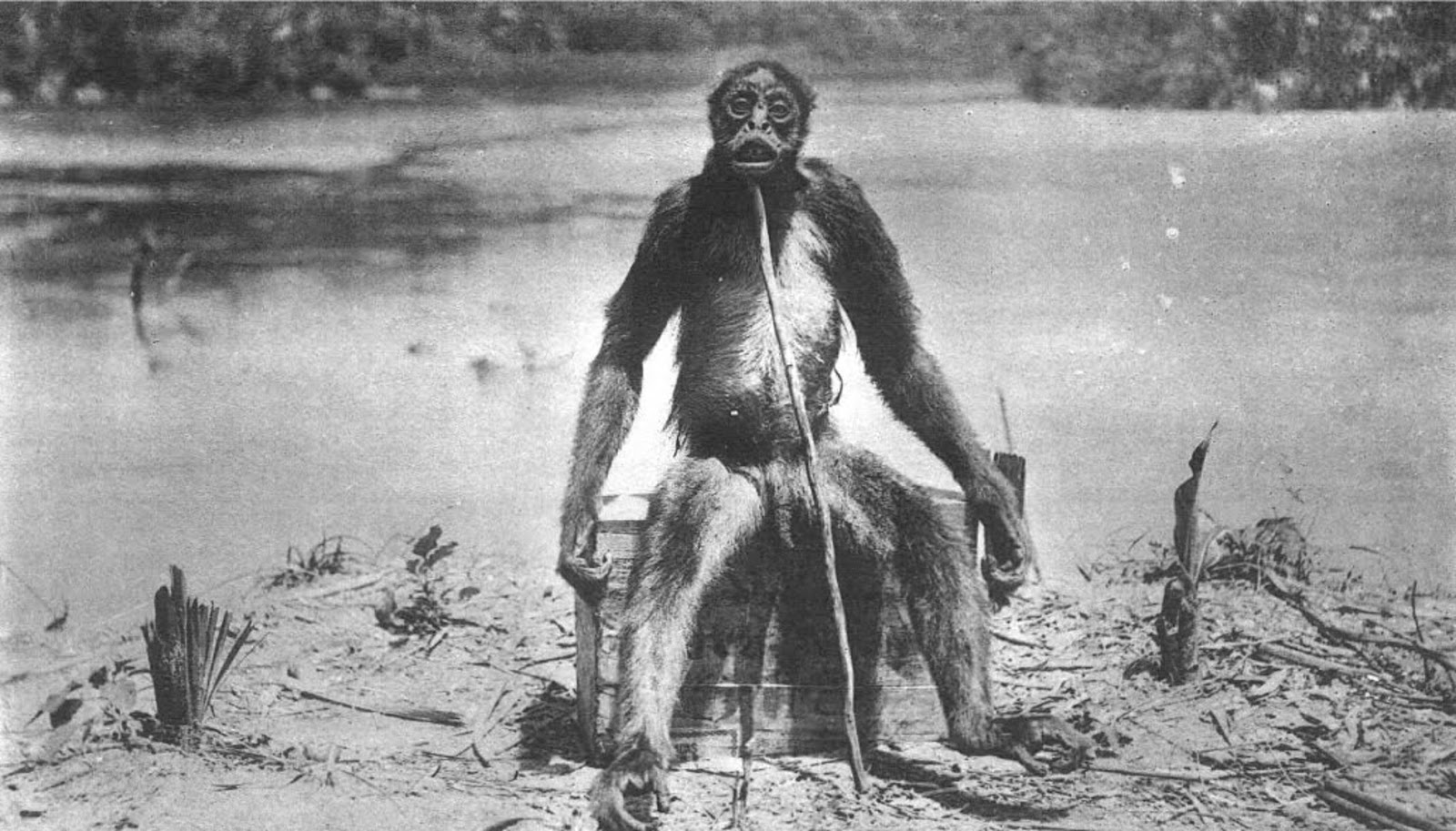
The cryptid in question was the so-called Loys's ape, reputedly encountered in the jungles on the border of Colombia and Venezuela by Swiss geologist Dr François de Loys while leading a party of explorers through this difficult, inhospitable terrain. The official narrative as provided by Loys was that they'd encountered two such creatures walking together on their hind legs and lacking tails. Threatened by them, the explorers shot one, the female, causing the male to flee. Taking the creature's lifeless carcase back to camp, they sat it on a crate, propped it upright with a long stick placed vertically beneath its chin, and photographed it. The carcase did not survive but the photo did, and for decades led to supposition that it portrayed one of the mysterious bipedal ape-like entities long reported from many different regions of South America, and inducing French/Swiss anthropologist Prof. George Montandon to formally dub their scientifically-undescribed species Ameranthropoides loysi.

 
'Inferno' by Hermann Wöhler, with the Loy's ape lookalike creature appearing almost dead-centre (left) and the hoax photo of Loys's ape (right) - please click dual image to enlarge it for viewing purposes (both images are now in the public domain)

Ultimately, however, long after Loys himself had died, one of his team's still-living members confessed that it had all been a hoax – the creature in the photo was nothing more than their pet spider monkey, which, after eventually dying, had been propped up and photographed (with its long tail either hidden or cut off) to yield the famous, but now infamous, Loys's ape picture. (The entire sordid saga of this hoax has already been documented by me in full here, here, and here on ShukerNature, so check it out.)

Bearing in mind that Wöhler's illustration had been created no more than ten years after Loys's photograph had first been published and had duly hit the headlines, it does indeed seem likely that this eyecatching image had directly inspired Wöhler to include a representation of it within his line drawing. For there is no doubt that the facial expression of Loys's ape as captured in the photo, with mouth agape and eyes staring widely, is certainly more than a little hellish, positively infernal, in fact! So, many thanks indeed to Robert for alerting me to a fascinating yet previously unrevealed and undocumented cryptozoological connection concealed within the art archives.

 
Another of my AI images, this time generated by Magic Studio, which took my verbal prompt to depict a giant ape confronting a giant octopus a little too far, inasmuch as it yielded a fascinating if wholly fictitious monkey-octopus hybrid! (Created by Dr Karl Shuker using Magic Studio)

This ShukerNature article originally appeared in the form of one of my regular Alien Zoo columns for the famous long-running British monthly magazine Fortean Times.


Sunday, 28 September 2025

BRINGING TO LIFE THE (IN)FAMOUS PHOTOGRAPH OF LOYS'S APE: A SHUKERNATURE VIDEO(S) OF THE DAY

 
A couple of photo-stills from my two AI-generated video clips of the familiar cropped version of the notorious Ameranthropoides loysi photograph (the centre image here) coming to life (AI photo-stills and videos created by me using Adobe Firefly)

It's been several months since I posted here on ShukerNature a ShukerNature Picture of the Day (click here to access the most recent one), and I have never posted a ShukerNature Video of the Day – until now, that is. Moreover, because I'm a generous kind of guy, I've posted two, not just one, as you can see. But what is their theme, their subject matter? Here's my answer:

Have you ever wondered what would have happened if Loys's ape Ameranthropoides loysi had been genuine, not a hoax, and its fake photograph had come to life? Wonder no longer!


These two video clips were generated for me yesterday by the AI image-generation program Adobe Firefly in response to two separate prompts provided to it by me – one was a detailed verbal description written by me, the other was a visual prompt consisting of the original Ameranthropoides loysi photograph, reproduced below:

Allegedly dating from 1917, this is the less familiar uncropped version of the notorious Loys's ape photograph, revealed several decades later to have been a hoax, featuring the dead body of a pet spider monkey (public domain)

One ever-present, ever-surprising factor that I've encountered numerous times when utilizing various different AI image-generation programs to create the pictures and most of the videos appearing in my pictorial biker/motorcycling-themed blog RebelBikerDude's AI Biker Art, is the sheer unpredictability and often truly surreal nature of their output, in which all manner of unexpected, wholly unprompted visual details are frequently included by the programs in their generated images (bikers anomalously sprouting wings comes readily to mind with my AI biker art blog!). Sure enough, the second video in this present ShukerNature article will be seen to include – albeit only very briefly – some strange large object appearing and disappearing behind the creature's back. What it is is anyone's guess!

To read my comprehensive three-part coverage on ShukerNature of the entire A. loysi photo saga, be sure to click here, here, and here. It also appears as an entire, fully-updated chapter in my book ShukerNature Book 2: Living Gorgons, Bottled Homunculi, And Other Monstous Blog Beasts.

There is also a shorter version in one of my earlier books, Extraordinary Animals Revisited: From Singing Dogs To Serpent Kings, which features a sepia-tinted version of the Loys's ape cropped photo on its front cover:

And which has an unnerving habit of coming to life if not watched closely!


Video created by me using Grok Imagine


Saturday, 17 December 2022

JOCKO IS NO JOKE! A SHUKERNATURE PICTURE OF THE DAY

 
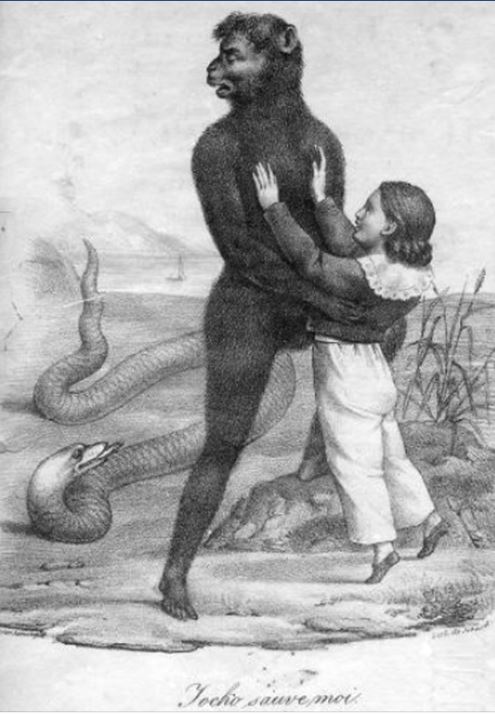
Vintage illustration for Jocko ou le Singe du Brésil (public domain)

It’s been quite a while since I last posted a ShukerNature Picture of the Day, so the recently-received eyecatching illustration presented above provides an ideal example with which to remedy this situation.

Not so long ago, I was sent this picture by a correspondent who had encountered it by chance online but without any accompanying details. So he wondered whether it may depict anything of cryptozoological interest or significance.

I had never seen this very dramatic-looking but decidedly strange image before, and was greatly intrigued by it, bearing in mind that it seemingly portrayed some form of giant indri-like lemur abducting a young child while being viewed closely by a large aquatic serpent. As I was unaware of any such event ever having been reported, however, I wondered whether it may instead be some form of satirical representation, a pictorial joke of some kind, rather than any literal depiction.

But as is so often the case with cryptozoological matters, first impressions can be deceiving, as I soon discovered after conducting an image search online.

It turns out that this picture is actually an illustration of an event in a two-act play by French writer and dramatist Edmond Rochefort entitled Jocko ou le Singe du Brésil ('Jocko or the Monkey of Brazil'), first staged in 1825, and inspired by Jocko, a bestselling novel by French author Charles de Pougens, published the previous year. Also inspired by this novel and again first staged in 1825 was a ballet by Fredéric-Auguste Blache, with music by Alexandre Piccinni, and sets by Pierre-Luc-Charles Cicéri, which proved so successful that numerous adaptations and copies of it were subsequently produced and staged for many years thereafter.

 
Famous French dancer and mime artist Charles-François Mazurier taking the role of Jocko in the original ballet version, as illustrated by French artist Godefroy Engelmann, 1825 (public domain)

The principal storyline of Jocko centres upon the capture of a large monkey in Brazil by a rich travelling Portuguese man, who names his captive Jocko. During the subsequent Atlantic crossing back to Europe, the man's vessel is shipwrecked, but Jocko saves the man's small son, Laurençon, from drowning, though in so doing Jocko is himself killed. When the play was performed for the very first time, however, the audience was so outraged by the death of the brave Jocko that it insisted he survive, and so in all subsequent performances he did!

What I find so interesting about the above picture, in which Jocko is in fact rescuing Laurençon from the clutches of the snake, is just how lemur-like, and just how monkey-unlike, he is portrayed, not to mention his great size and bipedal stance. Whoever had depicted him had clearly not based their portrayal upon an actual specimen of any known modern-day species of New World primate, that's for sure!

Speaking of known – or, rather, unknown – modern-day species of New World primate, however, Jocko's great size and bipedal nature do readily call to mind various cryptozoological reports describing alleged encounters with very large bipedal ape-like monkeys in many different parts of South America, including Brazil (where they are known locally as the caipora) – creatures that still remain undescribed by science.

(Indeed, incidentally, such reports even inspired the infamous hoax photograph of a supposed shot specimen of just such an entity that was published in an Illustrated London News article by Swiss geologist and Venezuelan explorer Dr François de Loys in 1929, and which French zoologist Prof. George Montandon deemed to be a major new species, naming it Ameranthropoides loysi – click here for Part 1 of my extensive 3-part ShukerNature coverage of this controversial saga, which is also contained in my book ShukerNature Book 2.)

Is it possible, I wonder, that the artist responsible for this illustration of Jocko had also heard of such reports, some of which do indeed date back as far as the early 19th Century (and even earlier, in fact), which duly influenced his portrayal of his simian subject? A memorable example, if true, of cryptozoology and culture combined!

 
De Loys's infamous fake photograph of a supposed bipedal South American ape-like monkey shot by him in 1917 and subsequently dubbed Ameranthropoides loysi by Montandon – it was actually a dead pet spider monkey artfully arranged to look bigger than it actually was (public domain)


Thursday, 2 November 2017

MORE PICTURES OF MONKEY BUSINESS? - DOES AT LEAST ONE OF THE 'LOST' AMERANTHROPOIDES LOYSI PHOTOGRAPHS EXIST?


Could there be a 'lost' Ameranthropoides loysi photograph out there somewhere, awaiting rediscovery and looking something like this? (original photograph © Attilio Gatti, utilised here on a strictly non-commercial, educational Fair Use basis only; photo-manipulation © Dr Karl Shuker)

Earlier this year, I posted here on ShukerNature an extensive two-part article of mine concerning Ameranthropoides loysi, the supposed bipedal, tailless ape encountered and shot dead in the Venezuelan jungle in 1920 by a team of geologists led by Dr François de Loys, but whose carcase was subsequently propped upright on a crate in a sitting position and photographed – the resulting picture becoming one of the most iconic but contentious images in the entire annals of cryptozoology, and which was finally, conclusively exposed as a blatant hoax earlier this present century. To read my article on ShukerNature, please click here for Part 1 and here for Part 2.

One of the many curious aspects of this case that had already raised suspicions among its more sceptical investigators several decades before the true nature of the creature in the photograph was finally exposed, however, was why only a single photograph existed of such an ostensibly momentous zoological discovery as a South American ape. In particular, critics queried why no photos had been snapped of the creature's back view, in order to confirm that it was naturally (not artificially) tailless, as claimed by de Loys, and as seen in all Old World apes.

In response, as noted in my earlier article, de Loys had explained away this anomalous situation by alleging that there had indeed been more photographs but that only the famous one known today had survived a subsequent capsizing of the boat that had been carrying them and its crew down a river – the other photos had all been lost. How convenient.

The familiar background-cropped version of the only known photograph of de Loys's supposed 'ape' – in reality nothing more than the deftly-posed body of his pet marimonda spider monkey that had died recently at the team's camp and whose tail had earlier been amputated after it had become infected (public domain)

In view of how de Loys had hoaxed the world for so long with that single photograph, it is not surprising that today few people believe that any other photos had ever even been taken, let alone lost. Yet if some additional pictures had genuinely existed and had actually survived, especially any that portrayed some of de Loys's party standing alongside the carcase, that would have provided a much clearer guide to the creature's size. True, it would still have been only a marimonda spider monkey, but who knows, it might have been an unusually large specimen and therefore worthy of note in its own right.

And indeed, as I discovered to my great surprise while researching the complicated case of Ameranthropoides, and in flagrant disregard of de Loys's claim to the contrary, at least one such photo might truly have existed, and survived. Not only that, in a fascinating scenario readily recalling the equally tantalising case of the supposedly missing thunderbird photograph (click here to read all about this), it may even have been published - judging from the fact that I have on file the testimonies of several wholly independent but highly qualified eyewitnesses who all claim to have seen it! First made public by me in a series of accounts published variously in Strange Magazine and Fortean Times, read them all here now, and then judge for yourself.

Back in the late 1990s, Dr Susan M. Ford was an Associate Professor and Director of Graduate Studies at Southern Illinois University's Department of Anthropology. During correspondence in November 1997 concerning Ameranthropoides, Dr Ford informed me that sometime in the early 1980s a student had shown her a popular-format wildlife book that included a spread containing an Ameranthropoides photograph - but not the famous one reproduced by me in this present article in both cropped and uncropped form, and which, as already noted here, is the only such photo presently known to cryptozoologists. According to her recollection of the photo, it was:

…a black and white photo of the animal (looking a lot like a big spider monkey), dead, propped between two native males who were standing. They appeared to be adult but of possibly short stature; I recall no scale in the picture or reference in the text to the height of the humans. It was a chapter specifically dealing with this animal, in a book about unusual animal discoveries. I seem to recall it being hard bound with a dark cover, and not a large or thick book. It was small [in a separate communication she suggested that it was possibly 100 pages long, probably had an 8" x 6" format, and was a rather old book], the size perhaps of an average journal today. I recall neither title nor author of the book...I can visualize the picture quite clearly, however, and there were two males on either side of the dead monkey.

The native men were presumably two of the geological expedition's local Indian helpers. As for the student who showed Dr Ford the book, she could no longer remember who this was.

A marimonda spider monkey, the true identity of Loy's 'ape' (© Ewa-Flickr/Wikipedia – CC BY 2.0 licence)

Moving from one side of the Atlantic to the other, I also learned in 1997 from Scottish-born zoo keeper Alan Pringle that one of his colleagues, education officer Jon Flynn at Cricket St Thomas Wildlife Park in Somerset, England, was convinced that several years previously, he too had seen a photograph of de Loys's ape that included some men standing on either side of it. Unfortunately, however, he could not recall any details of the publication containing this picture.

Furthermore, in a letter to me of 15 January 1998, Steven Shipp, then proprietor of the mail-order book service Midnight Books, based in Sidmouth, Devon, England, wrote:

I am certain that I too have seen a picture of this monkey flanked by two people! My first thought when I saw the photograph [the familiar cropped version] (before reading the text) was why has it been cropped, leaving out the people either side? Then I read the article and realised it was a different photograph! I believe that I saw the picture in one of those mysteries anthologies covering all aspects of the unexplained - probably during the time I would have been buying books for the catalogue [Steven's own mail-order catalogue of books for sale] - so that pins it down to the last nine years! It may have been in an older book as Susan Ford says but I am sure it was in a big format, well illustrated book. Of course I cannot remember which. But I will certainly keep an eye out for it again and let you know immediately if I locate it. I don't believe this is a case of my memory deceiving me as I can clearly see the image in my mind's eye.

Several months after receiving Steven Shipp's communication, I received a letter on this same subject from Lawrence Brennan, hailing from Liverpool, England, which (curiously) was dated 31 June 1998! (I am assuming that he meant 30 June.) Anyway: in his letter, Lawrence was adamant that he too had seen such a photograph - so much so that until reading my account on this subject, he had no idea that there was any mystery surrounding it. According to his testimony, he saw it in a book when he was aged around 13-15; and as he was 30 at the time of his letter to me, this means that the book had been published no later than the early 1980s.

The photo depicted de Loys's 'ape' sitting upright on a crate, flanked by at least two humans - who were also sitting, one on either side of it, and likewise presumably on crates, as they seemed to be of comparable height to the ape. At least one of the humans may have been dressed in what Lawrence referred to as "full 'Great White Hunter' garb", with a rifle resting in his hands, but he was not absolutely certain of this because, as he pointed out: "The ape is obviously the thing you tend to concentrate on and remember!". He went on to say that there were possibly other persons, probably natives, standing behind, and he reiterated that the creature was of similar size to the humans.

As for the book that contained this photo: Lawrence claimed that his father had obtained it for him from the local library, and that its subject was man-beasts from around the world. He believed that the book was entitled something like "Giants Walk the Earth", or "There are Giants Among Us", and was certain that the word 'Giants' featured in it somewhere.

There are Giants in the Earth, by Michael Grumley (© Michael Grumley/Panther Books – reproduced here on a strictly non-commercial, educational Fair Use basis only)

Needless to say, as soon as I read this, I immediately thought of the book by Michael Grumley entitled There are Giants in the Earth, first published in 1975, which is indeed a book surveying man-beasts worldwide, including de Loys's 'ape'. I lost no time in seizing my own copy of this volume from my cryptozoology bookshelves, and painstakingly going through it - how ironic (and embarrassing!) it would be if the 'missing' photo proved to be in a book that I actually owned!

Consequently, it was with somewhat mixed feelings that I ascertained that it was not present in the book. True, the familiar photo of Ameranthropoides was included, but far from showing anyone standing alongside the ape, it had been so extensively cropped for publication in this particular book that the creature's hands, feet, and even the top of its head had been cut off! Another dead end.

Rough mock-up of what a photograph snapped at the same time as the familiar one but featuring a western 'big game' hunter and some smaller, native hunters alongside Loys's 'ape' sitting upright on a crate might look like (original photograph © Attilio Gatti, utilised here on a strictly non-commercial, educational Fair Use basis only; photo-manipulation © Dr Karl Shuker)

In October 1998, I received a letter from Robert Hill of Cardiff, Wales, who claimed to have seen a photograph of de Loys's ape with two persons alongside it when he was younger than twelve, i.e. before November 1976. He was sure of this because he remembered seeing it while he was on one of his childhood holidays in Porthcawl, South Wales. He looked at it while inside a newsagent's shop or bookstore, and, interestingly, he went on to say: "It sticks in my mind because I had just bought (or had bought for me) a copy of There are Giants in the Earth by Michael Grumley (which I still have!)".

Robert's statement is important, demonstrating independently of my own search through it that Grumley's book and the book containing the mystery photograph are indeed different, notwithstanding Lawrence Brennan's thoughts regarding the latter's title. It also pinpoints Robert's sighting of the mystery photo to the years 1975-76 (1975 being the publication date of Grumley's book, which he had received before seeing the mystery book; and 1976 being the last year in which, until November, he was still less than 12 years old).

Robert believed that the publication in which he saw it was a wildlife book of some sort. Moreover, since seeing it he had always assumed (until reading one of my afore-mentioned magazine accounts) that the familiar photograph depicting the ape by itself was simply a cropped version of the picture that he had seen in the mysterious wildlife book encountered by him all those years ago in Wales.

Echoing comments by Steven Shipp and Robert Hill, when I first began investigating the mystery of the 'lost' Ameranthropoides photograph(s) I too had initially speculated that perhaps the explanation was simply that the familiar Ameranthropoides photo was indeed a cropped image, which had originally contained people standing on either side of the animal, i.e. that the 'lost' photo was merely the original, uncropped version of the familiar one.

However, I subsequently recalled having seen a copy of the familiar picture in its rarely reproduced, uncropped form – it appeared in the 1995 reprint of Heuvelmans's book On the Track of Unknown Animals, which contains several pictures not present in the original edition from 1958. It is also reproduced below – and as can readily be seen, there are no people in it.

The uncropped version of de Loys's famous Ameranthropoides loysi photograph (public domain)

In view of the above-quoted testimonies, I feel that there really could be a second 'missing' Ameranthropoides photograph somewhere out there, inconspicuously residing amid the vast worldwide library of wildlife literature - and also, I would assume, held (apparently without knowledge of its cryptozoological value) in one or two picture libraries. Who knows - there may even have been others too, judging at least from the differing numbers and descriptions of persons reportedly seen in the mystery Ameranthropoides photos alluded to by the above eyewitnesses (plus an additional one included by me in an update of 20 November 2017 below) in their testimonies presented here.

De Loys's own, now-discredited account of encountering the creature and its mate first appeared as an article in the Illustrated London News on 15 June 1929, with the famous photograph as its illustration. One plausible scenario that comes to mind is that when de Loys sent in his article to the ILN, he submitted with it not just one but a selection of photos from which the magazine's picture editor could select the most eyecatching example with which to illustrate it - a common enough occurrence in publishing. Judging from Dr Ford's account, the second, 'lost' photo, depicting the creature's dead carcase supported between two men, would be less dramatic, and certainly less photogenic, than the famous photo, depicting the creature by itself, deftly propped upright in quite an arresting, life-like pose by the long slender pole.

Consequently, if both of these images were indeed submitted (and perhaps others, too, maybe even depicting the geologists alongside it in similar poses to those adopted by the native men, and also showing the creature from the back as well as the front?), it can be readily appreciated why the now-famous photograph would have been the one selected for reproduction. The other(s) would normally have been returned to de Loys, but what if they were mislaid somehow, going astray, and were therefore never returned? Where might they be now?

There is, of course, another, decidedly different interpretation of this tantalising case, one with which devotees of the long-running saga of the missing thunderbird photograph will be only too familiar. For, just as with that latter 'lost' crypto-image, sceptics will no doubt claim that such a photo never existed - that it is merely a figment of the imagination, or is a half-remembered, distorted memory of some superficially similar picture.

Might some early photograph such as this one, from 1912, depicting two native hunters holding upright a very large dead chimpanzee (now known to be one of the elusive Bili apes), have elicited false memories of a comparable but non-existent photo featuring Ameranthropoides loysi? (public domain)

Certainly, just as there are many early pictures in existence of large birds with their wings outstretched that mirror the alleged thunderbird photograph, so too are there numerous early pictures of hunters standing alongside carcases or stuffed specimens of gorillas and other large primates that might conceivably be capable of generating false memories of Ameranthropoides images with some eyewitnesses.

Moreover, in a letter to me of 12 January 1998, Alan Gardiner of West Sussex, England, even nominated, as a possible false-memory trigger, a famous hoax photograph consisting of a photomontage that depicts a supposed alien bipedal entity flanked by two government agents (in reality, this picture was part of a satirical section making fun of UFO/aliens hysteria that was published by the German photo-magazine Neue Illustrierte in its 1 April 1950 issue).

The above-mentioned hoax 'alien' photograph published on 1 April 1950 by Neue IllustrierteNeue Illustrierte – reproduced here on a strictly non-commercial, educational Fair Use basis only)

Could a distant, confused or mis-remembered memory of one such photograph explain why my correspondents believe that they have seen a currently unknown photo (or even photos) of Ameranthropoides? An intriguing variation on this theme was proffered by Argentinian biologist Mariano Moldes in a letter to me of 2 February 1998. Discounting the false memory scenario, he suggested that what may have happened is as follows:

The book alluded to by them [the eyewitnesses of the missing photograph] probably existed and had a chapter on Ameranthropoides loysi - illustrated with a wrong photograph. It's quite common that laypeople in charge of editorial technical tasks mistake similar illustrations on a subject, and the frequency of such an event increases with decreasing general quality of the publication. Dr Ford says that it was a "rather old" book with forgettable author and title. It's true that the witnesses couldn't have mistaken an allusion to a well-known simian...But what if they saw a bad photograph of, say, a bonobo chimp (Pan paniscus) or a siamang (genus Symphalangus) surrounded by misleading text?

All of the above-proposed explanations undeniably have merit, but in this particular instance I consider them unsatisfactory. After all, the eyewitnesses of the missing photograph(s) whose vocations are known to me include a wildlife education officer, a highly-qualified university anthropologist, and a dealer in cryptozoology books - hardly the kinds of eyewitness likely to suffer problems in distinguishing (or subsequently remembering) photos of gorillas and other extremely familiar primates from that of a highly distinctive, wholly unfamiliar beast resembling an exceptionally large ape-like spider monkey.

Mariano Moldes's suggestion has more merit - I am certainly aware of many instances, especially in older wildlife books, in which photos have been wrongly identified, or a section of text concerning a particular species has been accompanied by a photo of the wrong species. Even so, I still consider it unlikely that those eyewitnesses with zoology-related expertise would fail to spot such a mistake.

Consequently, I am currently willing to believe that one or even more additional Ameranthropoides photos may indeed exist, concealed somewhere amid the world's vast archives of wildlife literature. Perhaps there is someone reading this present ShukerNature blog article of mine who has seen a 'lost' Ameranthropoides photo, or knows where such an image has been published. If so, I would greatly welcome any information that you may wish to send to me – many thanks indeed! Clearly, even though the history of Ameranthropoides loysi is nowadays totally discredited as a hoax, it may still be capable of offering up some genuine surprises.

Finally: When deciding to prepare and now included as this present ShukerNature article's opening illustration (and reproduced a second time halfway through this same article of mine) the mock-up photograph of Ameranthropoides posed alongside people, and knowing all too well how effectively the internet works when it comes to disseminating fake news, it occurred to me that my mock-up may subsequently be reproduced on other websites and be erroneously claimed on at least some of them to be a genuine, hitherto-lost de Loys photograph of Ameranthropoides! Consequently, in order to defeat any such claims, not only have I painstakingly captioned it here with full details of its nature and origin, but also, when creating it, I deliberately sabotaged any chance of it being deemed genuine by using as my original image a photograph that featured recognisably African native hunters (two Congolese pygmies) rather than South American ones, plus a readily-identifiable western hunter (Italian explorer Commander Attilio Gatti), who, moreover, had no links whatsoever to South America. So please bear all of that in mind if you should indeed see this mock-up photo turning up elsewhere online, which no doubt it will, sooner or later...
 
And sure enough, here is one especially preposterous use of it, in a YouTube video whose creator ludicrously claims that it depicts a British(!) explorer posing alongside some pygmies and a "hominid" in wait for it New Guinea! Is it any wonder that cryptozoology nowadays receives such short shrift from many mainstream zoologists when this kind of wholly inaccurate reporting fills the internet?

A different time, a different outlook: the original vintage photograph – featuring Commander Attilio Gatti, two Congolese pygmies, and a hunting-trophy gorilla – that I photo-manipulated to create the mock-up photo of Ameranthropoides loysi with people alongside it (original photograph © Commander Attilio Gatti, utilised here on a strictly non-commercial, educational Fair Use basis only; photo-manipulation © Dr Karl Shuker)


UPDATE - 20 November 2017

Today, I received the following very interesting email from American correspondent Glen McClelland, who has most kindly permitted me to include it here - many thanks indeed, Glen! It constitutes a hitherto-unpublished and therefore very valuable first-hand sighting by him of what he believes may have been a second Ameranthropoides loysi photograph:

I have debated with myself about emailing you about the Ameranthropoides loysi photo discussed in your blog of November 2nd, but have decided to do it.

I saw the photo of Ameranthropoides loysi with an individual standing next to the animal while I was attending the University of Nevada, Las Vegas between 1974 and 1979. I don’t remember the exact year. The photo was in a book in the university library. I wish I could remember the title, but it escapes me. I do remember there were other topics concerning cryptozoology but I don’t remember if the entire book was dedicated to the subject. I do remember that the book appeared to be fairly new and probably a recent publication. Also in the book was the un-cropped photo of Ameranthropoides on the wooden box. This was one of the very few times I have seen that photo. I have never seen the photo with the person in it again. The fact that both photos were in the book really stood out. I do remember thinking that with a person standing next to the animal it showed that it was large and not a small spider monkey.

I have a degree in chemistry and supervise a quality control lab. In that environment the work is scientifically based. I mention this because I do not believe this is case of false memory inspired by reading about the photo.  Hopefully I am more analytical about things I see and read.


Monday, 31 July 2017

A PICTURE OF MONKEY BUSINESS - OR, HOW A SMALL FURRY PET BECAME A GIANT MYSTERY APE. PART 2: THE TRUE HISTORY OF AMERANTHROPOIDES LOYSI


The uncropped version of Dr François de Loys's photograph of the supposed South American ape Ameranthropoides loysi – one of the most controversial cryptozoological images of all time (public domain)

Welcome to my 600th post on ShukerNature! Befitting of such a momentous occasion, the subject documented by me in this post is of profound cryptozoological significance – revealing how one of the most infamous mystery beast frauds of all time was finally exposed. In Part 1 (click here) of this two-part ShukerNature article, I documented the 'official' history of a truly extraordinary mystery creature - a supposedly genuine, tailless, bipedal South American ape, reputedly encountered and killed in the Venezuelan jungle almost exactly a century ago by a team of geologists led by one Dr François de Loys, and subsequently dubbed Ameranthropoides loysi ('Loys's American ape') by a radical French zoologist called Prof. George Montandon who held very extreme, controversial views concerning human evolution. Now it's time to document this creature's true history, by presenting the crucial yet all-too-long-overlooked information that conclusively exposed the entire Ameranthropoides episode as a blatant, deliberate hoax.

The 'official' history of Ameranthropoides loysi began to unravel on 16 July 1962. This was when the Caracas, Venezuela, newspaper El Universal's historian Guillermo José Schael published in the paper a telegram lately received from the village of Casigua, in the Tarra River region of Venezuela, concerning a supposed giant spider that had allegedly strangled to death a ranch worker named Juancho. Not surprisingly, this dramatic news attracted considerable interest from readers, and elicited a letter from a hunter named Jerónimo Martínez-Mendoza, which was published on 18 July by El Universal.

In it, Martínez-Mendoza suggested that the report was mistaken, that it had probably been a giant spider monkey which had attacked and killed Juancho, and he drew comparisons in his letter with the Ameranthropoides incident from 1917. This letter was in turn read by Dr Enrique Tejera Guevara (1899-1980), a Venezuelan-born friend of de Loys in the field (as well as a decorated tropical physician and pathologist, ambassador, and minister in the Venezuelan government), who lost no time in replying via a letter of his own, but which contained a truly sensational disclosure.

Enrique Tejera Guevara (Wikipedia CC BY 4.0 licence)

Published in El Universal on 19 July 1962, Dr Tejera's letter revealed that back on 11 March 1929 (mistakenly given as 1919 in the newspaper-published version of his letter) he had attended a lecture at the Academy of Sciences in Paris, France, given by Montandon concerning Ameranthropoides, but that he had been very surprised to hear Montandon's claims about the creature being a very tall, bipedal, tailless South American ape. Consequently, at the end of the lecture Tejera had stood up, and, to a hushed audience, had brusquely dismissed Montandon's claims as nonsense.

Tejera informed them that he had actually been in the company of de Loys in 1917 when the famous encounter with the two apes and the shooting of one of them had supposedly taken place – but affirmed that no such encounter or shooting had in fact occurred. Instead, the creature in the photograph was nothing more than de Loys's own normal-sized pet marimonda spider monkey, which he had dubbed 'the monkey-man', and whose tail had been amputated after it had become infected. Moreover, after his pet spider monkey had later died, and again in the presence of Tejera, de Loys had decided, as a joke, to take a photo of its body propped upright and sitting on a crate.

And as the climax of his dramatic exposé, Tejera proclaimed that it was this joke picture that had subsequently become known as the now-infamous Ameranthropoides 'ape' photograph, thanks to Montandon, and which with Frankensteinian vigour had swiftly raged out of its creator's control - until in order to preserve his reputation as a serious scientist, a highly embarrassed de Loys, seeing no way of extricating himself from this most unwelcome situation without looking very foolish indeed, had thereby found himself unable to confess the truth.

Banana trees (public domain)

But that was not all. Far from being in an area of wild, uncharted jungle in peril from attacks by Motilone Indians at the time when the photograph was taken as claimed by de Loys, he and his party were actually in an oil exploration camp very close to civilisation. Furthermore, there was vital, conclusive proof of this statement contained in the uncropped version of the Ameranthropoides photograph, yet which had been overlooked by everyone for decades, even after Tejera's earth-shattering announcement in front of a shocked and stunned Montandon back in 1929.

The proof was the presence in this picture of a banana crop on the opposite side of the river from where the dead spider monkey was propped up and photographed. Banana trees are of Asian and Australasian origin, they are not native to the New World, having been introduced there by humans, and they can only grow near civilisation, not in the wild jungle region of South America where de Loys had averred that the photograph had been snapped. So the presence of banana trees in that picture verified that it had been snapped in the former location, not in the latter one that de Loys had alleged. This in turn also negates a claim made by him that whilst supposedly in the remote jungle, no fewer than 17 of his men had died due to the inhospitable conditions and the hostile Motilone Indians (in reality, there is no independent confirmation of this). In addition, Tejera revealed that rather than de Loys having led a single 4-year expedition to the Tarra River region as so frequently claimed in subsequent accounts of the Ameranthropoides case, he had instead led several much shorter ones (Tejera even provided their respective specific dates), and rarely beyond the perimeter of civilisation, as demonstrated, for instance, by the presence of banana trees in the Ameranthropoides photo.

Having said that, the portion of the photograph showing these trees is sufficiently blurred for their conclusive identification to be somewhat tricky. Tejera was there when the photo was taken, so obviously he could clearly discern their true nature, but the evidence for them from the photo alone is less certain. Happily, however, there is one additional aspect of this image that vindicates his statement. In the lower right quadrant of the photo, alongside the monkey in the foreground, a leafy shoot is present that is identifiable as a chopped-down but now-regenerating banana tree (I have shown this to various friends who have kept banana trees, and they have all affirmed that this shoot is indeed one). I have arrowed it in the uncropped photo reproduced below.

De Loys's full, uncropped Ameranthropoides photograph with the banana tree shoot in the foreground arrowed (public domain)

In addition, an aspect that, very surprisingly, seems not to have been considered previously is that for a creature supposedly killed by a hail of bullets, it seems in the photograph to be remarkably free of bullet holes or wounds, especially as it was supposedly shot from the front, not from the back or side. This of course is readily explained by the fact that, thanks to Tejera, we now know that the creature wasn't an attacking ape that had been shot, it was merely a pet monkey that had died of natural causes.

Equally, as the photographed 'ape' specimen was merely a marimonda spider monkey after all, de Loys's allegation that its dentition was different from that of spider monkeys was clearly yet another falsehood. And no doubt his so-convenient explanation of why the skull had not been retained for formal scientific examination (he claimed that the camp cook had converted it into a salt container and that it had then fallen apart), which of course would have readily identified its true taxonomic nature and exposed his dentition claim as false, was also a blatant lie. Little wonder, then, why de Loys was not able to escape from the web of deceit that he had spun when carrying out his joke, and which had ultimately and inextricably enveloped him.

But that was still not everything. At least two years before penning to El Universal his devastating letter outing and condemning Montandon and the entire Ameranthropoides charade, Tejera had actually revealed all of this to fellow medical practitioner Dr Raymond Fiasson, who had documented it in his book Des Indiens et des Mouches: Dans les Llanos du Vénézuela (1960). Yet this too had escaped attention from cryptozoologists and zoologists alike. So also had a section included by American physical anthropologist Prof. Earnest A. Hooton in his book Man's Poor Relations (1942) – a significant but hitherto-overlooked snippet until French cryptozoologist Michel Raynal had rediscovered it in 2007 (during that same year, Michel had also been instrumental in bringing Fiasson's documentation to public notice). Prof. Hooton had revealed that in late 1932, American geologist A. James Durlacher had written to him announcing that in 1927 he had spoken to various former members of de Loys's expeditions and had learnt from them that Ameranthropoides had indeed merely been a marimonda spider monkey. Even more frustrating, in 2001 Spanish researchers Bernardo Urbani, Dr Ángel L. Viloria, and Franco Urbani had presented much of this key information in a paper published by the Venezuelan journal Anartia, Publicaciones Ocasionales del Museo de Biologia de La Universidad del Zulia, in which they had concluded that the Ameranthropoides saga was certainly a hoax – but yet again, this revelation had somehow evaded widespread attention! (It is even possible that Tejera's dramatic intervention at the end of Montandon's lecture back in 1929 was subsequently documented in some French newspaper(s) and/or periodical(s), but if so these too failed to attract any public notice and still await rediscovery.)

The revelatory book by Bernardo Urbani and Dr Ángel L. ViloriaAmeranthropoides loysi Montandon 1929: The History of a Primatological FraudBernardo Urbani and Dr Ángel L. Viloria/Editorial LibrosEnRed – reproduced here on a strictly educational, non-commercial Fair Use basis only)

Happily, however, their skilful detective work uncovering this hoax was at last given its long-deserved international attention when, in 2008, Bernardo Urbani and Dr Viloria published all of their findings in book form – Ameranthropoides loysi Montandon 1929: The History of a Primatological Fraud. The book's text was presented in two separate languages, English and Spanish, and was fully referenced, thus constituting the most comprehensive, and now-definitive, study and exposé of the whole sorry Ameranthropoides saga.

One final point to consider here, which I haven't seen mentioned before but which has intrigued me for some time, is whether de Loys was at least partly inspired when setting up his hoax photo by a very distinctive illustration that was still famous back then, although much less so today.

In 1758, eminent English naturalist and wildlife painter George Edwards wrote and illustrated Gleanings of Natural History, an authoritative tome that would remain a major work on that subject for well over a century. One of its illustrations was a hand-coloured copper engraving by Edwards of a young orang utan, among the first pictures ever prepared of this great ape, in which the orang utan was portrayed sitting upright on a wooden bench holding a long tall wooden stick in one hand. If this illustration is compared with the iconic Ameranthropoides photo, a number of striking similarities can be seen, including the orientation and/or form of the feet, limbs, facial expression, and even the stick (albeit utilised for different purposes).

Comparison of the Ameranthropoides loysi photograph with the George Edwards illustration of an orang utan (public domain)

Consequently, as Gleanings of Natural History was still well known during the early 20th Century, it is not beyond the realms of possibility that de Loys had seen Edwards's orang utan illustration in it and had elected to reconstruct it using the dead spider monkey, but for practical purposes had transformed the stick into a supporting prop in his photo.

Ameranthropoides loysi RIP...? Although this specific case was a fraud from beginning to end, it should be noted that mystery animal researchers are well aware that large ape-like creatures, walking bipedally and lacking tails, have been frequently reported by natives and Western explorers alike from many parts of Central and South America, where they are referred to locally and variously by such names as the sisimite (in Belize), xipe (Nicaragua), shiru (Colombia), vasitri (Venezuela), didi (Guyana), tarma (Peru), mono rey (Bolivia), caipora and curupira (Brazil), and others too. Detailed documentation of such sightings lies outside the scope of this present article, but one extremely noteworthy, representative encounter occurred as recently as 1987, so is deserving of inclusion here.

That was when New York Botanical Gardens mycologist Gary Samuels was crouching down on the forest floor in Guyana, investigating fungi. Looking up, he was very startled to see a 5-ft-tall hairy ape-man, walking by at close range on its hind legs but seemingly unaware of him as he stayed kneeling, concealed on the ground. This remarkable entity, which uttered an occasional "hoo" cry as it passed by him, was presumably a didi.

O Curupira, by Brazilian painter Manoel Santiago, produced in 1926 and depicting the mythical(?) red-haired man-beast of Brazil known as the curupira (Wikipedia CC BY 4.0 licence)

Explorer Simon Chapman's book, The Monster of the Madidi: Searching For the Giant Ape of the Bolivian Jungle (2001), documented his search in Bolivia's Madidi region for the mono rey. Although he failed to find it, his book does contain a couple of tantalising snippets that were new to me. One was his claim that until recently, a local Bolivian actually owned a pelt from a mono rey, which was then purchased by "a gringo" (European) who took it home and sent it (or samples from it) off for DNA analysis, but the results (if any) were never revealed. No details were given in his book as to who the "gringo" was, where he came from, or where he sent the pelt/samples. The other snippet, which Chapman had apparently attempted unsuccessfully to substantiate, was that a living mono rey had allegedly once been exhibited at Bolivia's Santa Cruz Zoo! (This zoo is known in full as the Santa Cruz de la Sierra Municipal Zoo to distinguish it from others.)

Also worthy of note here is the existence of centuries-old carvings and statues depicting large, tailless, ape-like beasts, found among the crumbling relics from long-gone civilisations in various South American (and also Mexican) localities. Just coincidence – or representations of genuine creatures? There is even an unequivocally ape-like mask preserved at Chicago's Field Museum of Natural History, which had been carved in stone by Costa Rica's Guetar Indians and dates from 1200 to 1500 AD.

At one time, a major zoological stumbling block to accepting the possibility that any such entities actually do exist today in Latin America was the absence of fossil precedents. That all changed in 1995, however, with the publication of a paper by American anthropologist Dr Walter Hartwig in the Journal of Human Evolution, which documented the remains of a very sizeable Pleistocene monkey discovered in the Lagoa Santa cave system of Minas Gerais in southeastern Brazil. In fact, this large-bodied species had originally been described as long ago as 1838, by Danish naturalist Peter Lund, who had named the extinct species Protopithecus brasiliensis. However, later publications concerning it had not examined the original fossils and had underestimated this species' actual size. In his paper, however, Hartwig rectified that error, and estimated that P. brasiliensis may well have been more than twice as massive as any living New World monkey.

Reconstruction of Cartelles coimbrafilhoi (© Hodari Nundu)

Just a year later, on 23 May 1996, Hartwig published a second Protopithecus paper, this time in Nature and co-authored with Brazilian palaeontologist Dr Castor Cartelle. In it, they described a near-complete skeleton, which had been found in 1992 within Pleistocene cave deposits in Brazil's 60-mile-long Toca da Boa Vista, the longest cave in the Southern Hemisphere, located in the Brazilian state of Bahia. Intriguingly, this skeleton combined a howler monkey-like vocal sac with a spider monkey-like cranium, and sported a robust body with limbs adapted for brachiation (arm-swinging locomotion), similar to both spider monkeys and woolly monkeys (and also Old World gibbons).

The giant species represented by it, which would have weighed around 50 lb (in comparison, a marimonda spider monkey weighs 13-23 lb), is now housed within the spider monkey subfamily, Atelinae. Moreover, after detailed studies it was considered sufficiently distinct from the earlier Protopithecus material to warrant its reclassification as a new species (and genus) in its own right, which in 2013 was formally christened Cartelles coimbrafilhoi in a Journal of Human Evolution paper written by Drs Lauren B. Halenar and Alfred L. Rosenberger.

Also found in that same cave and at the same time was a near-complete skeleton of another, hitherto-unknown, species of giant Pleistocene ateline monkey. In a Proceedings of the National Academy of Science, USA paper published on 25 June 1996, Cartelle and Hartwig duly christened this new species Caipora bambuiorum (after the caipora, a small, peccary-riding humanoid entity in Brazilian Tupi-Guarani mythology), which would have weighed around 45 lb in life. And in 2000, after co-leading a palaeontological expedition to Toca de Boa Vista, Hartwig announced that thousands of fossils, mostly from extinct mammals, had been unearthed there – including the skull of a 55-lb giant spider monkey, over twice the size of any species alive today.

Artistic representation of a caipora riding a peccary (© Jakared/Wikipedia CC BY-SA 3.0 licence)

So perhaps it is premature after all to dismiss entirely the prospect that the Neotropical (platyrrhine) primate lineage may indeed have evolved a larger, ape-like representative via convergent evolution, one that occupies some of the ecological niches filled in the Old World by the apes, and which still awaits formal zoological discovery and recognition.

A very exciting possibility if true, that's for sure!

Further information concerning the history of Ameranthropoides loysi (including evidence supporting the intriguing prospect that some additional photographs taken by de Loys of his spider monkey in Ameranthropoides pose may also exist - click here for my examination of this possibility on ShukerNature too) can be found in my book Extraordinary Animals Revisited. It also features on its front cover a colourised version of de Loys's notorious yet never-to-be-forgotten South American 'ape' photograph – truly a cryptozoological icon, albeit for all the wrong reasons.