Dr KARL SHUKER

Zoologist, media consultant, and science writer, Dr Karl Shuker is also one of the best known cryptozoologists in the world. He is the author of such seminal works as Mystery Cats of the World (1989), The Lost Ark: New and Rediscovered Animals of the 20th Century (1993; greatly expanded in 2012 as The Encyclopaedia of New and Rediscovered Animals), Dragons: A Natural History (1995), In Search of Prehistoric Survivors (1995), The Unexplained (1996), From Flying Toads To Snakes With Wings (1997), Mysteries of Planet Earth (1999), The Hidden Powers of Animals (2001), The Beasts That Hide From Man (2003), Extraordinary Animals Revisited (2007), Dr Shuker's Casebook (2008), Karl Shuker's Alien Zoo: From the Pages of Fortean Times (2010), Cats of Magic, Mythology, and Mystery (2012), Mirabilis: A Carnival of Cryptozoology and Unnatural History (2013), Dragons in Zoology, Cryptozoology, and Culture (2013), The Menagerie of Marvels (2014), A Manifestation of Monsters (2015), Here's Nessie! (2016), and what is widely considered to be his cryptozoological magnum opus, Still In Search Of Prehistoric Survivors (2016) - plus, very excitingly, his four long-awaited, much-requested ShukerNature blog books (2019-2024).

Dr Karl Shuker's Official Website - http://www.karlshuker.com/index.htm

IMPORTANT: To view a complete, regularly-updated listing of my ShukerNature blog's articles (each one instantly clickable), please click HERE!

IMPORTANT: To view a complete, regularly-updated listing of my published books (each one instantly clickable), please click HERE!

IMPORTANT: To view a complete, regularly-updated listing of my Eclectarium blog's articles (each one instantly clickable), please click HERE!

IMPORTANT: To view a complete, regularly-updated listing of my Starsteeds blog's poetry and other lyrical writings (each one instantly clickable), please click HERE!

IMPORTANT: To view a complete, regularly-updated listing of my Shuker In MovieLand blog's articles (each one instantly clickable), please click HERE!

IMPORTANT: To view a complete, regularly-updated listing of my RebelBikerDude's AI Biker Art blog's thematic text & picture galleries (each one instantly clickable), please click HERE!

Search This Blog


PLEASE COME IN, I'VE BEEN EXPECTING YOU...

PLEASE COME IN, I'VE BEEN EXPECTING YOU...
WELCOME TO SHUKERNATURE - ENJOY YOUR VISIT - BEWARE OF THE RAPTOR!


Showing posts with label bunyip. Show all posts

Sunday, 5 June 2022

THE MOUNTAIN OF THE MOON AND AN AFRICAN BUNYIP

 
Photo-still of the dingonek-inspired African bunyip featured in the Bengali blockbuster movie Chander Pahar (© Kamaleshwar Mukherjee/Shree Venkatesh Films – reproduced here on a strictly non-commercial Fair Use basis for educational/review purposes only)

Yes, you read this ShukerNature article's title correctly – an African bunyip, not an Australian one. Allow me to explain.

One of the most famous Bengali adventure novels is Chander Pahar (retitled as Mountain of the Moon in subsequent English-language translations), which was written by Bibhutibhushan Bandyopadhyay, an Indian writer in the Bengali language, and was originally published in 1937. Just under a decade ago, it was turned into a blockbuster Bengali movie that I have long wanted to watch, and finally succeeded in doing so a fortnight ago, thanks to local friend and Amazon Prime subscriber Jane Cooper, who very kindly enabled me to watch it at long last by purchasing it on AP – thanks Jane!

Directed by Kamaleshwar Mukherjee, released in 2013 by Shree Venkatesh Films, and set in the years 1909-1910, Chander Pahar follows the exciting (albeit sometimes positively Munchausenesque!) adventures of a 20-year-old Bengali man named Shankar Ray Choudhuri (played by Indian movie/singing megastar Dev). He has long dreamed of being a derring-do explorer in Africa, but seems destined to spend his life much more mundanely, working as an administrator at the local jute mill in his small Bengali town instead. Happily, however, fate steps in, in the shape of a relative who secures for Shankar a job in Kenya, as the station-master of a tiny railway terminus miles from anywhere.

 
Bibhutibhushan Bandyopadhyay (public domain)

This posting becomes the vital stepping stone that Shankar has long sought, to set him on the path to becoming a daring African explorer. Many thrilling exploits duly follow, so be sure to click here in order to read my comprehensive plot description and review of Chander Pahar on my companion Shuker In MovieLand blog. Some of these, moreover, are so implausible that Baron Munchausen himself may well have thrown up his hands in despair!

However, the movie's principal focus is Shankar's eventful journey with an older, veteran Portuguese explorer named Diego Alvarez (played by celebrated South African actor Gérard Rudolf) to an inhospitable and virtually inaccessible arid land of high hills and even higher mountains known as the Richtersveld, situated in the northwestern corner of what is today South Africa's Northern Cape province. They are seeking a legendary diamond mine supposedly hidden inside a cave deep within a mysterious Richtersveld mountain known as Chander Pahar – the Mountain of the Moon.

According to local legend, however, this diamond mine is fiercely guarded by the cave's monstrous inhabitant – a gigantic beast still-undescribed by science, but which for reasons never explained either in this movie or in Bandyopadhyay's original novel is known here as the bunyip (despite the latter name being in reality an aboriginal name specifically applied to Australia's most famous indigenous mystery beast!). It turns out that the bunyip has already killed one explorer who accompanied Alvarez during an earlier attempt by him to locate the mine and relieve it of some of its hidden treasures. Will history repeat itself during this latest expedition, in which Shankar is now Alvarez's companion? I'll leave you to read up the full storyline here on my Shuker In MovieLand blog, and concentrate now in this ShukerNature article upon this movie's cryptozoology content – the bunyip.

 
Three more photo-stills of the ferocious bunyip (© Kamaleshwar Mukherjee/Shree Venkatesh Films – reproduced here on a strictly non-commercial Fair Use basis for educational/review purposes only)

Chander Pahar has proved hugely popular – having grossed US$ 3.41 million worldwide so far, it is the second highest grossing Bengali movie of all time (indeed, the only Bengali movie to exceed its takings is Amazon Obhijaan, released in 2017, which is itself a sequel to Chander Pahar, once again centering upon the character of Sankhar, but this time the action takes place in South America). Nevertheless, it has not been without its critics, especially among literary purists who believe that it has taken too many liberties in adapting Bandyopadhyay's novel for the big screen – but none more so than with its presentation of the bunyip.

In the novel, the bunyip is never directly seen – a shadow of it moving outside the tent of Shankar and Alvarez one evening is as much as is offered to the readers, leaving the rest to their imagination. In contrast, this movie presents the viewers with a truly memorable CGI bunyip in all its hideous glory, and gory activity, but which some reviewers have denigrated for destroying the monster's mystique, and others for what they considered to be its inferior quality (similar criticisms regarding their quality, or lack of it, have also been aimed at a CGI-engendered volcanic eruption).

As revealed here via the above series of photo-stills, the bunyip is undeniably a startling creation – unlike any beast known to science, that's for sure. A waddling, feline-faced abomination with a swollen, toad-like body and an exceedingly long, whip-like tail, plus a huge and revoltingly-vascular, pendant throat-sac, livid crimson in colour and hanging down so far that the creature seems in permanent danger of tripping over it when galumphing after one of its potential human victims. Most noticeable of all, however, is its pair of truly enormous vertical fangs that any prehistoric sabre-toothed cat would have given its high teeth for (so to speak!). (In fact, a Kindle e-book edition of Bandyopadhyay's novel actually depicts the bunyip on the front cover as a bona fide living sabre-tooth.)

 
A Kindle edition of Bandyopadhyay's novel Chander Pahar in which the bunyip is depicted as a living sabre-tooth (© Kindle – reproduced here on a strictly non-commercial Fair Use basis for educational/review purposes only)

Interestingly, however, this terrifying apparition does recall a traditional African mystery beast known as the dingonek (click here to read my extensive ShukerNature article surveying this and various other comparable African cryptids, the so-called jungle walruses). Moreover, the dingonek is actually mentioned in Bandyopadhyay's novel in addition to the bunyip. In contrast, as noted earlier, I have yet to discover why Bandyopadhyay applied the name of an exclusively Australian water monster to his terrestrial African mystery beast.

According to traditional African lore, conversely, the dingonek is amphibious in nature, i.e. both an adept swimmer in rivers and a formidable adversary on land – so why didn't Bandyopadhyay simply call his monster the dingonek instead of distinguishing it from the latter? Notwithstanding this etymological enigma, there is no denying that the climactic scene featuring a veritable duel to the death between Shankar's inventive brain and the bunyip's immense brawn is a highlight of the entire movie.

So, if you'd like to experience for yourself a glimpse of the thrills and spills that Shankar experiences during his search for the Mountain of the Moon and its hidden diamonds, be sure to click here to watch an official Chander Pahar trailer on YouTube showcasing its very stirring title song. (You can also watch the entire movie free here on YT, but only in the form of an Odia-language version with no English subtitles, sadly.) And don't forget to click here if you'd like to view an excerpt from Shankar's chilling confrontation with the belligerent bunyip! And for further details regarding the dingonek and other African sabre-toothed cryptids, check out my recent book Mystery Cats of the World Revisited.

 
Publicity posters for the original Bengali (top) and American (bottom) cinema releases of Chander Pahar (© Kamaleshwar Mukherjee/Shree Venkatesh Films – reproduced here on a strictly non-commercial Fair Use basis for educational/review purposes only)


Thursday, 8 December 2016

VOLUME 4 OF THE JOURNAL OF CRYPTOZOOLOGY IS NOW PUBLISHED


I'm very happy to announce that Vol. 4 of the Journal of Cryptozoology – currently the world's only peer-reviewed scientific journal devoted to mystery animals – is now published.

The four papers contained in this volume constitute a quartet of very different but equally interesting and significant contributions to cryptozoology. Namely:

An insightful examination by Paul Michael Donovan of the original occurrence and subsequent dispersal and gradual generalisation in meaning of a famous cryptid term – 'bunyip'.

An exhaustive and exceedingly valuable checklist compiled by Dr Charles G.M. Paxton and Adrian J. Shine of identities proposed over time for what must surely be the world's premier cryptid – the Loch Ness monster.

A very pertinent application of DNA analysis by Dr Haskell V. Hart to alleged cryptozoological (bigfoot) samples, a practical approach that I anticipate becoming ever more important in this field.

The presentation by Bruce A. Champagne of a very comprehensive, novel type proposal for water monsters.

The journal is now actively calling for submissions in relation to Vol. 5. These should be emailed directly to me. Before doing so, however, all contributors must ensure that their manuscripts have adhered to the journal's presentation style and requirements, as given in each volume's Instructions to Contributors section, and online in the journal's website (click here) - where this newest volume of the journal (and all of its earlier ones too) can be purchased directly. In addition, Vol. 4 can be purchased here on Amazon US, and here on Amazon UK.

Scale illustration of the possible appearance of the long-necked variety of bunyip (© Connor Lachmanec)


Sunday, 15 December 2013

THE DRAGONS OF OCEANIA


Bunyip (© Richard Svensson)

Dragons belonging to the wingless but quadrupedal classical category are most closely associated with Europe, but some have been reported far away from that continent. Among the most fascinating yet least-known of these remotely-located classical dragons were those of Oceania.

Australia was home to several very different forms. One of them was a freshwater version known as the kurreah, which inhabited Boobera Lagoon's deep lakes and underground springs in New South Wales. Thanks to its crocodilian jaws, it was sometimes assumed by Westerners to be nothing more than a real crocodile, but was much more than that. Not only was its body very elongate and snake-like, its extremely lengthy, slender tail was prehensile, able to grip anything that it wrapped its tip around. Its feet were broadly webbed, it sometimes sported exotic frills around its neck, was of colossal size, covered in thick scales, and occurred in several different colours, including green and orange. If a kurreah spied anyone swimming in its abode, it would not hesitate to seize the hapless human in its huge jaws and haul him underwater, to drown and then devour him.

Kurreahs (© Janet & Anne Grahame Johnstone/Purnell & Sons Ltd)

Even more ferocious than the kurreah, however, was the burrunjor, a huge wingless dragon named after a remote expanse of Arnhem Land in northern Australia called Burrunjor where it allegedly roamed – and still does today, at least according to local aboriginal testimony. Whereas most classical dragons were quadrupeds, the burrunjor was bipedal, striding purposefully along upon its hind limbs like a carnivorous theropod dinosaur from prehistory, and aboriginal cave art portraying a creature fitting this description still exists in the Burrunjor region. Similar monsters also exist in the folklore of several tribes inhabiting Papua New Guinea.

Burrunjor (© William Rebsamen)

Another bipedal dragon Down Under was the gauarge or gowargay. Resembling a featherless emu, this pitiless monster frequented water holes. If anyone were foolish enough to bathe in a gauarge's water hole, it would whip it up into a mighty whirlpool and drag the unfortunate bather down into its swirling depths to drown him.

A notably dragonesque bunyip (© Angus McBride)

The most famous freshwater dragon in Australia, however, was definitely the bunyip. Although modern reports of mysterious creatures reputed to be bunyips are often likened to dog-headed mammalian creatures, the traditional bunyip of aboriginal lore was a huge aquatic wingless dragon, whose fearsome presence was readily made apparent by its spine-chilling, ear-splitting bellow.

Bunyips were fiercely protective of their young, and one famous myth tells of how a whole tribe was transformed into black swans when one of their hunters abducted a young bunyip from its lake and was relentlessly pursued by its enraged mother, in whose wake the entire lake was drawn up, completely submerging the tribe's village.

The story of the bunyip and the villagers transformed into black swans, in Once Long Ago (1962), retold by Roger Lancelyn Green and illustrated by  Vojtěch Kubašta (© Roger Lancelyn Green/ Vojtěch Kubašta/Golden Pleasure Books) [to read these pages, click their images to enlarge them]

The mindi was a very specialised form of bunyip, very serpentine in body form, so was sometimes referred to as a bunyip-snake and deemed to be a rainbow dragon too. Of immense size, and possessing magical powers according to the ancient lore of the Yarra Yarra aboriginal people, it could readily poison any would-be attacker and also spread disease.

Yet another water dragon of Australia was the oorundoo, native to the Murray River. According to aboriginal legends, this enormous aquatic beast created Lakes Victoria and Albert.

New Zealand's native dragons were (or are?) the taniwha. Looking somewhat like gigantic gecko lizards or colossal tuataras (the tuatara being a unique, primitive reptile surviving only in New Zealand), but bearing a row of long sharp spines along the centre of their back, taniwha are still seriously believed in even today by the Maori people, and are said to have formidable supernatural powers.

Taniwha carving (public domain)

In 2002, a major highway in New Zealand had to be rerouted because of Maori claims that it would otherwise intrude upon the abode of a taniwha. And as recently as 2012, a similar objection arose in relation to the planned $2.6 billion construction of a tunnel in Auckland, with protestors claiming that this would disturb a taniwha that lived under the city.

Auckland notwithstanding, these formidable dragons normally inhabited dark, secluded localities on land, as well as in large freshwater pools, and sometimes in the sea too, and were reputedly able to tunnel directly through the earth, often causing floods or landslides as a result. Each taniwha was allied to a specific Maori tribe that it protected as long as it received a fitting level of respect and veneration, but it would often attack and devour members of other tribes.

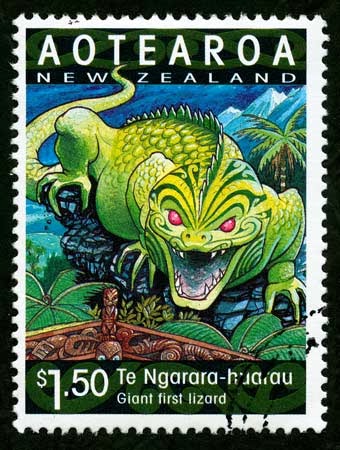
Also present in Maori traditions are the ngarara – giant lizard-like land dragons seemingly resembling monitor lizards (even though these are not known to be native to New Zealand). Various ngarara could assume the form of a beautiful young woman (as could some taniwha).

An ngarara depicted upon a New Zealand postage stamp issued in 2000 (© New Zealand Post Office/New Zealand Government)

Very prevalent in traditional Hawaiian mythology is an enormous shiny-black wingless dragon of infamously mercurial temperament known as the moho or mo'o. Like certain dragons of New Zealand but otherwise unlike most dragons elsewhere in the world outside the Orient, the moho was a skilled shape-shifter, normally measuring 10-30 ft long but able to transform instantly if need be into a tiny, inconspicuous gecko-like lizard, as well as a beautiful seductive woman.

Invariably associated with water, the moho was predominantly a guardian spirit deity, protecting individuals or entire families, as well as districts, and specific localities such as fishponds – which if deep enough were frequently inhabited by these dragon deities. Although they would often remain hidden beneath the water, consuming in ecstasy the intoxicating kava root, their presence in such ponds was betrayed if there was foam upon the surface, or if fishes caught there tasted bitter.

Mo'o carved from stone, by Hoaka Delos Reyes (© Honolulu Advertiser)

Similar dragons were reported from other Pacific Ocean islands or island groups too, including Tahiti and Tonga. Indeed, they were actively worshipped on Tahiti by the royal Oropa'a family. And on Tonga, lizard-like or crocodile-like dragons of prodigious size and lake-dwelling propensity, reputedly sent by the gods, would seize unwary bathers or women washing items in their lakes, and promptly plunge down into the water with them, drowning their unfortunate victims beneath the surface.

My favourite bunyip-featuring newspaper cartoon (© Daily Mirror, Sydney, 9 June 1978)

This ShukerNature blog is an exclusive excerpt from my latest, newly-published book, Dragons in Zoology, Cryptozoology, and Culture (Coachwhip Publications: Greenville, 2013).