Dr KARL SHUKER

Zoologist, media consultant, and science writer, Dr Karl Shuker is also one of the best known cryptozoologists in the world. He is the author of such seminal works as Mystery Cats of the World (1989), The Lost Ark: New and Rediscovered Animals of the 20th Century (1993; greatly expanded in 2012 as The Encyclopaedia of New and Rediscovered Animals), Dragons: A Natural History (1995), In Search of Prehistoric Survivors (1995), The Unexplained (1996), From Flying Toads To Snakes With Wings (1997), Mysteries of Planet Earth (1999), The Hidden Powers of Animals (2001), The Beasts That Hide From Man (2003), Extraordinary Animals Revisited (2007), Dr Shuker's Casebook (2008), Karl Shuker's Alien Zoo: From the Pages of Fortean Times (2010), Cats of Magic, Mythology, and Mystery (2012), Mirabilis: A Carnival of Cryptozoology and Unnatural History (2013), Dragons in Zoology, Cryptozoology, and Culture (2013), The Menagerie of Marvels (2014), A Manifestation of Monsters (2015), Here's Nessie! (2016), and what is widely considered to be his cryptozoological magnum opus, Still In Search Of Prehistoric Survivors (2016) - plus, very excitingly, his four long-awaited, much-requested ShukerNature blog books (2019-2024).

Dr Karl Shuker's Official Website - http://www.karlshuker.com/index.htm

IMPORTANT: To view a complete, regularly-updated listing of my ShukerNature blog's articles (each one instantly clickable), please click HERE!

IMPORTANT: To view a complete, regularly-updated listing of my published books (each one instantly clickable), please click HERE!

IMPORTANT: To view a complete, regularly-updated listing of my Eclectarium blog's articles (each one instantly clickable), please click HERE!

IMPORTANT: To view a complete, regularly-updated listing of my Starsteeds blog's poetry and other lyrical writings (each one instantly clickable), please click HERE!

IMPORTANT: To view a complete, regularly-updated listing of my Shuker In MovieLand blog's articles (each one instantly clickable), please click HERE!

IMPORTANT: To view a complete, regularly-updated listing of my RebelBikerDude's AI Biker Art blog's thematic text & picture galleries (each one instantly clickable), please click HERE!

Search This Blog


PLEASE COME IN, I'VE BEEN EXPECTING YOU...

PLEASE COME IN, I'VE BEEN EXPECTING YOU...
WELCOME TO SHUKERNATURE - ENJOY YOUR VISIT - BEWARE OF THE RAPTOR!


Showing posts with label animal freaks. Show all posts

Saturday, 24 February 2024

DANIELL'S QUAGGA AND WARD'S ZEBRA - ANOTHER TWO STRIPED CURIOSITIES OF THE EQUINE KIND

 
Daniell's quagga (left) and Ward's zebra (right) (public domain)

Following on from my previous ShukerNature article concerning the beautiful but long-forgotten isabella quagga (click here to access it), here are another two eyecatching but exceedingly obscure striped curiosities of the equine kind, retrieved from the annals of zoological history.


DANIELL'S QUAGGA – THE MOST EXTREME QUAGGA OF ALL?

Yes indeed, this particular quagga specimen is so extreme that it makes even the isabella quagga seem positively commonplace by comparison!

The specimen in question is a truly remarkable beast known as Daniell's quagga, after the artist Samuel Daniell (1775-1811), who produced a very handsome aquatint of it in 1804 for his African Scenery and Animals at the Cape of Good Hope two-part series (1804-1805). He based it upon this quagga form's only known specimen, which had been shot in southern Africa's so-called Square Mountains (currently unidentified by me) during 1801, but whose skin was not retained.

 
Daniell's quagga, painted by Samuel Daniell as it would have looked when alive in 1801 (public domain)

What was so extraordinary about it, as readily seen in Daniell's painting, is that this quagga specimen had exceptionally reduced striping. Indeed, the latter markings were confined almost entirely to the sides of the animal's neck, with only a few very faint lines upon its throat and shoulders, and none at all upon its torso. (True, I have seen paintings of certain other quagga specimens with stripeless torsos, but their throat and shoulders in addition to their neck all bore distinct, conspicuous stripes.) It also had a noticeably large head.

As with the isabella quagga, this specimen was initially deemed to represent a new zebra species, dubbed Daniell's quagga, and was accordingly given the species name danielli. However, and once again like its isabelline relative, Daniell's quagga was later subsumed into the plains zebra species Equus quagga as merely a non-taxonomic freak individual.


WARD'S ZEBRA – A ZEBRA CROSSING IN EVERY SENSE!

Ward's zebra is a distinctively-striped, long-eared interspecific hybrid resulting from matings between plains zebras E. quagga and mountain zebras E. zebra that was first brought to scientific attention in 1904 via a Proceedings of the Zoological Society of London report by British zoologist Prof. J.C. Ewart. In his report, Ewart stated that some years previously he had been presented with a taxiderm zebra specimen, the subject of his report, by Rowland Ward, who was a very famous London-based taxidermist at that time. Ewart had subsequently donated it to Edinburgh's Royal Scottish Museum (now part of the National Museum of Scotland).

According to Ward, the specimen had originally been "traded out of Somaliland", Somaliland nowadays being recognized as a region within Somalia. However, Ewart speculated that its kind "probably inhabits part of the area between the upper reaches of the Tana River and Lake Rudolf [later renamed Lake Turkana]", in Kenya.

 
Ward's zebra - two views of Ewart's erstwhile taxiderm hybrid specimen, from his 1904 PZSL report (public domain)

Ewart was struck by the specimen's overall similarities to South Africa's Cape mountain zebra (E. z. zebra; Hartmann's mountain zebra E. z. hartmannae occurs in Namibia and Angola), but also noting in detail various differences in its striping, as well as its very long ears. Clearly not suspecting its hybrid nature, Ewart concluded his report by suggesting that it may constitute a new form of Kenyan plains zebra, duly dubbing it Ward's zebra in honour of its procurer, which "is adapted to a habitat similar to that of the mountain zebra", i.e. an example of convergent evolution.

In 1910, moreover, Ward's zebra was formally named Equus wardi, but its hybrid status was revealed via the discovery that specimens of this zebra form had been obtained repeatedly in the Jardin des Plantes, Paris, around 1900. And in 1915, a male specimen was obtained at London Zoo. Indeed, some authorities have opined that Ewart's specimen had itself probably been bred in a menagerie, rather than originating from either the wilds of Somaliland or of Kenya.

 
Vintage engraving of the Cape mountain zebra, 1830 (public domain)


Monday, 19 February 2024

THE ISABELLA QUAGGA - A LONG-LOST, LONG-FORGOTTEN EQUINE ENIGMA

 
A beautiful vintage (1800s) full-colour illustration of the unique isabella quagga (public domain)

The quagga Equus quagga quagga is nowadays famous for two very different reasons. Firstly: it is – or was – the only semi-striped form of zebra, its striping being confined to its foreparts. Secondly: although once common in its South African veldt habitat, it was hunted into extinction there during the second half of the 19th Century, with the very last captive specimen's death in Amsterdam Zoo on 12 August 1883 marking the tragic disappearance of this highly distinctive equid from the face of our planet – though The Quagga Project continues its aim to recreate this vanished creature's characteristic phenotype (external appearance) via back-breeding, using striping-deplete specimens of other Equus quagga subspecies to produce quagga facsimiles.

Speaking of which: today, the quagga is classed as a subspecies of the plains zebra Equus quagga, but back in the mid-1800s when still very much alive it was deemed to be a valid, distinct species in its own right, and was dubbed Hippotigris quacka (hippotigris being the name given to zebras by ancient scholars who believed these exotic-looking striped equids to be the product of matings between horses and tigers!) – see later for further taxonomic details. But that is not all.

 
One of five precious photographs of an adult quagga mare living at London Zoo from 15 March 1851 until her death there on 15 July 1872 – these are the only known photos of a live quagga (click here for more details concerning this quagga quintet)

For a time during that same period, a second, very remarkable quagga species was also recognized, despite being known from just a single specimen – a poorly-preserved skin formerly held at the British Museum in London. This unique, extraordinary-looking animal became known as the isabella quagga, but today the skin is long lost and the isabella quagga itself is long forgotten. Consequently, I felt that what (very) little is known about this beautiful if baffling enigma of an equid richly deserved to be collated and presented in article form in order for modern-day readers to become aware of its erstwhile existence. So here is the hitherto-obscure history of the long-overlooked isabella quagga – a ShukerNature exclusive.

I first learned of the isabella quagga Hippotigris isabellinus many years ago, when I chanced upon the following previously-obscure yet fascinating excerpt from a quagga-themed communication by famous British zoologist Richard Lydekker that had been published by the scientific journal Nature on 10 January 1901. The excerpt alluded to a supposedly separate, second species of quagga, again extinct:

...the British Museum formerly had the skin of a young quagga, in very bad condition, which was presented by the traveller William Burchell [after whom Burchell's zebra is named], and was subsequently described by Hamilton Smith as a distinct species, under the name of Hippotigris isabellinus.

Two points to note here. Firstly: the above-mentioned Hamilton Smith was Charles Hamilton Smith (1776–1859), a lieutenant-colonel in the British Army. He was also a naturalist who scientifically described and named several equine species and subspecies. In two 1841-published tomes referred to later here, he dubbed this enigmatic animal the isabella quagga. Secondly: whereas all zebra species and subspecies are nowadays housed in the genus Equus (alongside horses and asses), back in Lt-Col. Hamilton Smith's time several were housed in their own separate genus, Hippotigris, including the normal quagga, which was formally deemed back them to be a valid species in its own right (rather than merely a subspecies of the plains sebra, as it is classified today) and was duly known as Hippotigris quacka

 
Late 1800s chromolithograph from my personal collection, depicting a normal quagga with a bushbuck and a gnu (public domain)

Lydekker's communication then continued with the following text, but it is unclear whether this text was still referring to the isabella quagga or (as I suspect) had returned to the communication's primary subject, the normal quagga:

Apparently London museums possess no other relics of this lost species, of which, however, we believe there is a specimen in the museum at Edinburgh. As the animal yielded no trophies worthy the attention of the sportsman, it is unlikely that there are any specimens in private collections, unless, perchance, a skull or two may be in existence.

The remaining text in Lydekker's communication unequivocally referred to the normal quagga, so it needn't be quoted here.

What exactly was the isabella quagga, I wondered, when I first began researching this curious creature, and what did it even look like, bearing in mind that Lydekker provided no description of it in his communication and the British Museum no longer has it?

Back in pre-internet times, it was by no means easy to research anything as unimaginably obscure as the isabella quagga, so after various attemptss to solicit more information concerning it all proved futile, I placed Lydekker's intriguing communication on file and directed my attention to other subjects. Notwithstanding these failures, however, I never forgot about it, so when I was checking some details recently while completing some other researches and noticed it again, still on file, I decided to reinvestigate its elusive subject, but now assisted enormously by the vast wealth of data readily accessible online. And this time, finally, I was successful, as now revealed.

Originally, my only clue had lain in its moniker. For in this instance, isabella refers not to a woman's name but instead to a colour, known in full as isabelline, and which constitutes this mystery quagga's species name, isabellinus. It is variously defined as pale grey-yellow, pale fawn, pale cream-brown or parchment colour, and is primarily utilised in relation to mammalian coat colour and bird plumage.

Presumably, therefore, I mused, this shade was the background colouration of the coat of this unique specimen (a male, incidentally), meaning, if so, that it was paler in appearance than normal quaggas and probably with fainter stripes too. Whether such a difference warranted Hamilton Smith naming it as a separate species, however, when it was surely nothing more than an aberrantly pallid (possibly leucistic?) specimen of the normal quagga (see later), was another matter.

 
The pale-coloured engraving of the isabella quagga from Hamilton Smith's two 1841 tomes (public domain)

During my recent researches, I uncovered two beautiful vintage illustrations depicting the isabella quagga, both of which represent it in the living state. One of these illustrations is a hand-coloured engraving in very pale shades with minimal background colouration. The other illustration is in full-colour, so it is much more vibrant.

I traced the pale engraving back to a couple of tomes from 1841, which upon close examination turned out to be identical in content but bearing different titles. One is entitled Horses, and constitutes Volume 20 of the massive 40-volume series edited by Sir William Jardine and entitled The Naturalist's Library. The other tome is exactly the same but is retitled as The Natural History of the Horse and constitutes a stand-alone volume. In both tomes, the author is given as Charles Hamilton Smith, and a concise section documenting what he specifically refers to as the isabella quagga is included, containing the pale engraving of this specimen. In both tomes, it is designated as Plate 25, and is credited to Hamilton Smith.

In his duplicated 1841 tomes, Hamilton Smith began his brief coverage of the isabella quagga (pp. 332-334, and which constitutes this claimed species' formal scientific description and naming) by stating that although this animal's body shape (including its head) compared closely with that of the normal quagga, he had separated it from the latter equid because it differed by virtue of its smaller size (barely 10 hands, i.e. 40 in, tall) and even more so by the forms and colour of its stripes.

He then referred to an unidentified equid seen by travelling French naturalist François Le Vaillant (1753-1824), presumably in South Africa's Cape as this is where he had spent time collecting animal specimens, and which he'd named the zebre but was apparently different from those zebras already known from there. Some zoological authorities, including Dutch zoologist Coenraad Temminck (whose father was Le Vaillant's employer) had considered the isabella quagga to be Le Vaillant's zebre, but Hamilton Smith disagreed with their opinion.

The remainder of Hamilton Smith's account consisted of a verbal description of the isabella quagga skin (augmenting the engraving of this animal portrayed in the living state), which included his belief that it was an adult rather than a juvenile specimen despite its small size, and was not albinistic. Conversely, when concluding his account by mentioning that a Dr Leach had believed the skin (which still existed at the British Museum at this time) to have originally come from the Cape, he conceded that Leach had considered its pale colouration, especially its white stripes, to be due to the animal's 'nonage' (young age).

Moreover, it should be noted here that back in Hamilton Smith's time, there was a somewhat naïve but very prevalent tendency among taxonomists to over-emphasise the significance of individual variation within species, leading to the splitting off and naming of many spurious animal species that in reality were nothing more than freakishly-coloured/patterned individuals of already known, confirmed species. Eventually, however, such shortcomings were rectified by lumping these unsubstantiated species back together – as happened with the isabella quagga, subsequently being subsumed by zoologists into the normal quagga species (now subspecies).

 
Hamilton Smith's undated full-colour wtarcolour painting of the isabella quagga (public domain)

As for the full-colour isabella quagga illustration: it is an undated watercolour painting, again by Hamilton Smith, and is contained with various others of his watercolours in an unpublished manuscript by him held in the library and archives of London's Natural History Museum. Moreover, this beautiful painting remained unpublished until as recently as 2010, when it appeared in a Zeitschrift des Kolner Zoos article on quaggas by Lothar Schwahle and Wolfgang Wozniak.

Hamilton Smith's two illustrations readily confirm my early deductions as to the isabella quagga's likely appearance – namely, an aberrantly pale, isabelline-coloured quagga with only very faint, white striping.

Having viewed several comprehensive lists of quagga material currently housed in museums worldwide, I can confirm Lydekker's statement that the isabella quagga skin deposited by Burchell at what is now London's Natural History Museum is no longer there, and is therefore lost. Presumably it was discarded due to its very poor condition, but a tragic loss nonetheless of such an exceptional, unique specimen, and which nowadays might well have yielded much useful information via DNA tests conducte3d upon samples of this skin's tissues.

Yet despite the isabella quagga having long since been reduced in status from a taxonomically-discrete species to a non-taxonomic mutant oddity, its delicate pallid beauty deserves to be remembered and celebrated. So I am very glad that I discovered this elegant animal hidden away as the briefest of footnotes within the dusty archives of the past, and have been able to revive it, even if only in words and pictures, within this present article, written up at last.

 
Alongside a mounted quagga specimen at Tring Natural History Museum, England (© Dr Karl Shuker)


Monday, 20 September 2021

ALL FINGERS AND THUMBS – INVESTIGATING FELINE POLYDACTYLY

 
A male polydactylous kitten, sporting 23 toes (© Howie831/Wikipedia – CC BY-SA 3.0 licence)

One of the most frequently reported and familiar teratological conditions exhibited by humans is the possession of extra fingers, toes, or both which is known as polydactyly or hyperdactyly. This genetically-induced phenomenon has also been widely reported among many other animals, including the domestic cat Felis catus a species that normally has five toes on each of its fore paws, and four on each of its hind paws.

Monitored breeding programmes with polydactylous cats (which are also known as mitten cats, boxer cats, or thumb cats, depending upon toe numbers present) suggest that the trait is dominant and autosomal (i.e. not sex-linked), but the variation of phenotypic expression is so great that more than one mutant allele may well be responsible.

In its least visible form, feline polydactyly results in one or both of the fore paws sporting a slightly larger than normal first digit (as it contains an extra phalanx bone), which stands apart from the rest of the paw like a false thumb. Sometimes, however, this 'false thumb' is flanked by one or even two well-formed supernumerary toes, thereby raising the paw's total number to six or seven.

 
Right front paw of a male polydactylous domestic cat; each circle indicates a toe (six confirmed), and the circle with a question mark indicates what might be a further, seventh toe (public domain)

Feline polydactyly can be limited to the fore paws (but not normally to the hind paws), or can be exhibited by fore and hind paws. A classic example of the latter state was displayed by a very handsome polydactylous tabby called Vodka, who shared his long and happy life with Frances Shipp, at that time co-proprietor of Midnight Books in Sidmouth, Devon.

Frances received Vodka as a Christmas present from her mother in 1980 when he was just a few weeks old, and she soon discovered that her delightful feline friend had six toes on each paw. Throughout the 13 years of his life, Vodka was very fond of climbing trees, an activity that would surely benefit from the bonus of having extra toes.

Vodka possessed 24 toes in total, but the current record for the greatest number exhibited by a polydactylous cat has apparently been held since the early 1970s by an extraordinary tom memorably named Mickey Mouse, and owned by Renee Delgade of Westlake Village, California. In October 1974, a report revealed that Mickey had eight toes on each paw, yielding an astonishing count of 32 in total.

 
Vodka, Frances Shipp's polydactylous cat (© Frances Shipp)

A polydactylous cat of very notable prominence was a grey-furred six-toed tom called Slippers, who was owned by none other than President Theodore Roosevelt of the United States. Yet Slippers gained feline immortality not through any colossal toe count. Instead, he chose simply to take a siesta one day stretched right across a rug occupying the entire floor space of a certain corridor in the White House - at the very time that a dignified procession of top-level diplomats, including a renowned ambassador's wife escorted by the president, was making its way down this same corridor!

Wars have been initiated over far less than the deliberate obstruction of such a glittering assemblage's movements but in Slipper's case, feline felicity evidently prevailed. For with great deference and care in order to avoid disturbing his slumber, every member of the procession stepped very delicately around Slipper's reposing form, after which this eminent ensemble of some of the world's most important political figures continued its ceremonious passage down the corridor. A cat may indeed look at a king or, in this particular instance, divert a diplomat or two!

President Roosevelt was not the only famous owner of a polydactylous cat. Author Ernest Hemingway owned several at his mansion in Key West, Florida. The very first was presented to him by a sea captain who believed that the presence of such animals on board brought good luck. Indeed, so closely linked did Hemingway's name eventually become with polydactylous cats that 'Hemingway cat' has become a widely-used common name for these extra-toed domestic felids.

 
One of the many polydactylous cats living on Ernest Hemingway's Key West estate; photo snapped by Marc Averette on 10 February 2007 (© Marc Averette/Wikipedia – CC BY 3.0 licence)

Although feline polydactyly has been well documented from domestic cats, it is not so widely known that a few examples are also on record from their larger, wild brethren. In 1925, for instance, the Maharaj Kumar Shree Vijayarajji of Cutch in India published a photograph in the Journal of the Bombay Natural History Society depicting a leopard Panthera pardus with an extra claw-bearing toe on each hind paw.

Several years earlier, this same journal had carried a letter by S. Eardley-Wilmot referring to a leopard shot by him in Oude, which had sported five fully-developed toes and claws on each hind paw. And in 1946, the journal published a letter by Virbhadrasinh, H.H. Maharana of Lunawada, who had lately bagged a leopard with an extra fully-functional retractile claw on each of its hind paws.

These reports are particularly interesting, because in stark contrast to the polydactylous condition recorded from domestic cats, it would appear that in the leopard this teratological trait can be wholly restricted to the hind paws (thereby indicating that a different mutant allele is responsible).

 
A polydactylous kitten (© Catxx/Wikipedia – CC BY-SA 3.0 licence)

The last word on feline polydactyly, however, must surely be left to the following couple of truly exceptional examples:

One of these was a singularly special queen called Triple, born on 5 March 1976 and owned by Mr and Mrs Bertram Bobnock of Iron River, Michigan. As noted in Gerald Wood's Guinness Book of Pet Records (1984), Triple had no less than 30 toes – but this is not too surprising. After all, she did have five legs...and six paws! The other example was a male polydactylous orange tabby named Gizmo, who sported two paws on each of his front limbs, with each of these four paws possessing 4 toes, plus 7 toes on each of his two hind paws, thereby yielding a grand total of 30 toes!

And be sure to click here to read a ShukerNature article devoted to polydactylous ('horned') horses!

 
A photograph of Gizmo snapped by his owner in April 2017, revealing his extraordinary toe (and paw!) count (© Watching 4 Jesus/Wikipedia – CC BY-SA 4.0 licence)


Saturday, 18 July 2015

DEBUNKING A TRIO OF QUASI-COLOURED MOCK PYTHONS


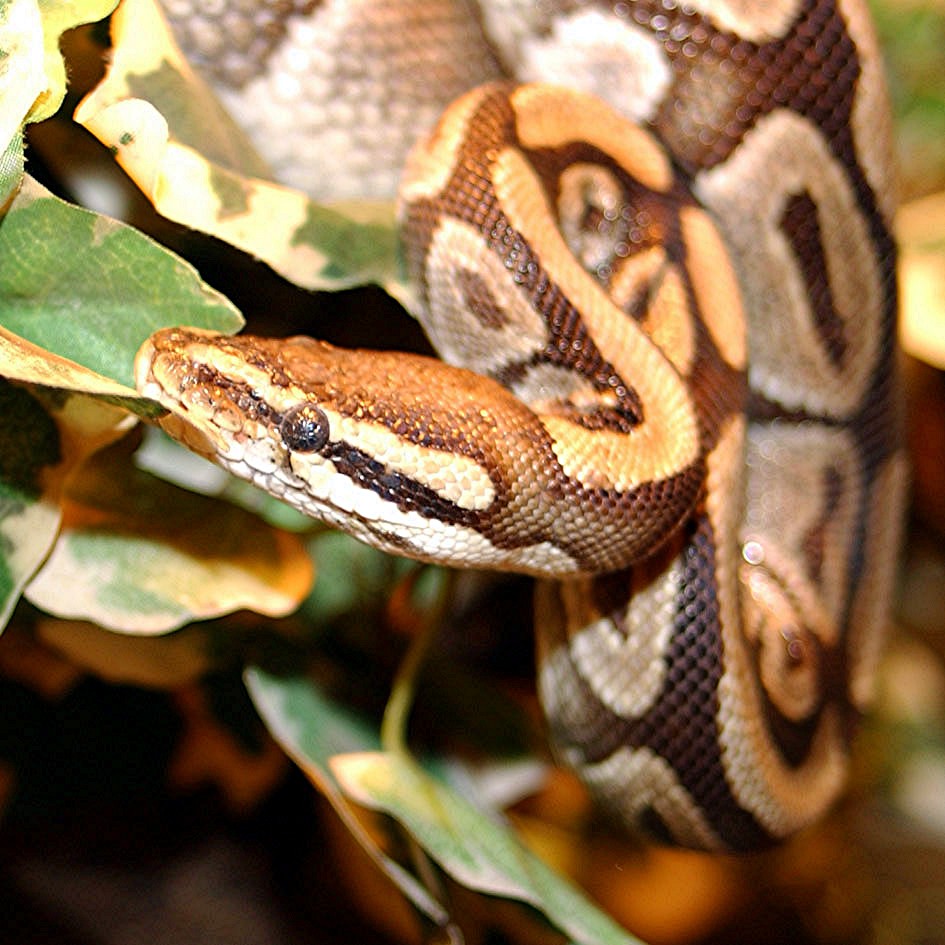
Photograph of a supposed green and white ball python, found by me on Pinterest (see below for © of original photograph)

Having a longstanding interest in animal colour morphs, I knew that something was very wrong – distinctly off-colour, in every sense – when, while browsing on the image-sharing/-hosting website Pinterest a couple of days ago in search of some unusual animal photographs to pin to my recently-created Pinterest board devoted to cryptozoology, animal mythology, and (un) natural history, I came upon the remarkable picture opening this present ShukerNature blog article. (Click here to view my Pinterest board - but you'll need to sign into Pinterest's site once you've clicked this link before it will let you see my board.)

For although I knew that a dazzling range and vast number of colour morphs have been developed for many snake species (including various pythons and boas) commonly sold in the pet trade (such selectively-bred forms being referred to as designer snakes), I felt pretty sure that these did not include a green and white variety for the African ball python Python regius (aka the royal python), regardless of what my eyes were seeing when looking at this particular photograph. (I know that a morph dubbed 'green' does exist, but in reality it is merely khaki, not grass-green like the specimen in this photo.) Anxious not to lose it, however, I swiftly pinned it to my Pinterest board, and then did what I always do as standard practice nowadays whenever confronted by a strange or unexpected animal picture – I conducted a Google image search for it online, in the hope of tracing its origin.

A normal, wild-type specimen of the ball python (public domain)

But all that I could find, pages and pages of them, were links to this self-same image on dozens of other Pinterest pages as well as many pages on other image-sharing/-hosting websites too, such as Tumblr and Flickr, yet with no clues whatsoever as to where it had originated. I didn't even come upon a single comment from any of these numerous image-sharers that queried whether these pythons of a very different colour were genuine. (Then again, if it's on the internet it must be true! lol)

Something that I did find, however, was that this photo of a green-and-white ball python was not one of a kind, because during my search I discovered two equally unlikely variations upon its crazy colour scheme.

The same photograph as the one opening this ShukerNature blog article, and again common on image-sharing/-hosting websites, but in which the green hue has been replaced by a pink hue (see below for © of original photograph)

That is to say, I found some copies of exactly the same photo but in which the green hue had been replaced by pink, and some other copies in which it had been replaced by lilac – both of them once again being shared ad infinitum on Pinterest, Flickr, Tumbr, etc, but also once again with no clues as to where either of these variants had originated, and no challenges to their serpentine subjects' authenticity.

The same photograph as the one opening this ShukerNature blog article, and again common on image-sharing/-hosting websites, but in which the green hue has been replaced by a lilac hue (see below for © of original photograph)

The fact that I had now uncovered three different colour versions of the very same photograph meant either that two of these versions were fakes, photo-manipulated by person(s) unknown from the third, or that all three were fakes, photo-manipulated from a true-to-life original version that I had yet to locate online. I favoured the latter possibility, because, as already noted, I was not aware of any comparable yet genuine green, pink, or lilac colour morphs existing for the ball python, and after checking a number of websites devoted to ball python morphs I found no evidence whatsoever that any of the three did indeed exist. Clearly, therefore, there was a fourth, original, unmodified version of the photo out there somewhere, currently unseen by me, and which would prove to be the original version – but what might the snake in it look like, what would its true colouration be?

When I had first seen the green version, it had struck me straight away that, ignoring its markings' bizarre colouration and focusing instead upon their form and paleness, the snake recalled the ball python's very abundant golden colour morph. This particular colour morph has been developed by selective captive breeding in a number of other constrictor species too, perhaps most famously in the Burmese python P. bivittatus. Golden specimens of this latter species are exceptionally popular, very highly-prized pets due to the enhancement of their already beautiful appearance by way of the huge and extremely impressive body size for which this species is renowned (and which, again, is actively selected for when captive-bred by the pet trade).

A xanthistic Burmese python (© Dr Karl Shuker)

Genetically speaking, this golden morph is xanthistic, i.e. it occurs due to the expression of a certain specific mutant gene allele that causes a specimen possessing this allele to produce an excess of yellow pigmentation; sometimes the specimen's normal red pigment for its species is lacking and has been replaced entirely by yellow pigment. Despite this, however, in the pet trade xanthistic snake specimens are often confusingly called albinos (yet, genetically, this term should only be used to describe pure-white specimens with pink eyes, such specimens being caused by different gene alleles from those responsible for xanthism). The most sought-after xanthistic pythons of all are ones that lack both red and black pigmentation, resulting in exceptionally handsome specimens that seem almost to emit a golden glow when viewed under certain levels of illumination, and are known technically as amelanic xanthistic pythons.

Consequently, I decided to conduct another Google image search, but this time using the specific search phrase 'albino ball python' – and sure enough, after scouring through countless photos of such snakes, I finally came upon one that, except for the snake's colour in it, was identical to the green, pink, and lilac versions that I'd previously encountered online. There could be no doubt – this particular photograph of a normal, real-life golden ball python was the original that had been photo-manipulated very professionally if anonymously by agent(s) unknown. And here, as absolute proof, is that original, undoctored photograph.

Golden (or so-called 'albino') ball python (© Nat Turner/all rights reserved – fair use only here on ShukerNature; click here to access Nat's webpage containing full  technical details for this photograph)

This photograph had been snapped without flash by American photographer Nat Turner on 22 May 2004, it depicts what Nat describes as a large female specimen, and it had been posted by him onto his Flickr site, which is where I found it. Moreover, it is one of several photos by Nat that seem to depict the same specimen, and which are all contained in an online Flickr album of his entitled 'Snakes'.

The quasi-coloured mock pythons beloved and believed in by so many online image sharers were no more – a trio of counterfeit serpents duly debunked and discarded, yet another case of photo-manipulation chicanery summarily expunged from the archives of valid zoological anomalies.

A specimen of the ball python's black-eyed leucistic ('snow') morph (© The Urban Zoo – be sure to click here to visit their excellent pet-store website)

Incidentally, another very popular python morph that is sometimes termed albino in the pet trade, but which once again is very different genetically, is the snow python. For although it does possess the albino mutant gene allele, it also possesses the axanthic mutant gene allele, whose effect is the exact opposite of the xanthic version, because it does not increase yellow pigmentation but reduces it instead. The combined effect of these two alleles' expression is an ethereal-looking snake that is pure-white all over like a bona fide albino specimen, but has blue or black eyes, instead of pink ones like an albino.

Finally: it may seem scarcely believable but it is not unknown for park rangers and others to witness occasionally the astonishing spectacle of an enormous Burmese python locked in mortal combat with a mighty American alligator in the Florida Everglades. Such titanic battles occur because this huge non-native ophidian species has successfully established breeding populations here following pet specimens having escaped and/or been deliberately released during the 20th Century. And because both are top reptilian predators, whenever they encounter one another neither one of them is willing to back down.

Battle of the reptilian behemoths – a naturalised python versus an adult American alligator (public domain)


Wednesday, 7 May 2014

WHEN JULIUS CAESAR MET THE HERCYNIAN UNICORN


The Hercynian unicorn if indeed a uni-stag (© Markus Bühler)

Germany has long been associated with unicorn traditions, in particular with the supposed occurrence of dainty white unicorns in the Harz Mountains. In addition, a far more exotic, bizarre version was allegedly sighted in Germany's Hercynian Forest by no less eminent an eyewitness than Julius Caesar.

He described it as being an ox but shaped like a stag, the centre of whose brow, between its ears, bore a single horn, taller and straighter than normal horns. Moreover, later eyewitnesses claimed that a series of branches sprouted forth from the tip of this creature's horn.

Bust of Julius Caesar in the National Archaeological Museum, Naples (public domain)

Long forgotten, the case of this very curious, atypical unicorn has lately been re-examined by German cryptozoologist Markus Bühler, who has proposed a very ingenious, plausible explanation for it.

Occasionally, a freak deer is born, bearing a single horn-like structure upon the centre of its skull, instead of its species' normal paired laterally-sited antlers. One recently-recorded example, pictured above, is a roe deer Capreolus capreolus 'uni-stag' aptly dubbed 'Unicorn' and born during 2007 in a park belonging to the Center of Natural Sciences in Prato, near Florence, Italy.

Unicorn, the uni-stag roe deer (© Center of Natural Sciences, Prata, Italy)

But what if, as speculated by Markus, some rudimentary antlers develop at the tip of this aberrant central horn?

The result would be a creature bearing a very similar appearance to the extraordinary Hercynian unicorn. So perhaps the latter beast, if truly real, was not a unicorn at all, but merely a freak uni-stag!


This ShukerNature post is excerpted from my book Mirabilis: A Carnival ofCryptozoology and Unnatural History (Anomalist Books: New York, 2013)