Dr KARL SHUKER

Zoologist, media consultant, and science writer, Dr Karl Shuker is also one of the best known cryptozoologists in the world. He is the author of such seminal works as Mystery Cats of the World (1989), The Lost Ark: New and Rediscovered Animals of the 20th Century (1993; greatly expanded in 2012 as The Encyclopaedia of New and Rediscovered Animals), Dragons: A Natural History (1995), In Search of Prehistoric Survivors (1995), The Unexplained (1996), From Flying Toads To Snakes With Wings (1997), Mysteries of Planet Earth (1999), The Hidden Powers of Animals (2001), The Beasts That Hide From Man (2003), Extraordinary Animals Revisited (2007), Dr Shuker's Casebook (2008), Karl Shuker's Alien Zoo: From the Pages of Fortean Times (2010), Cats of Magic, Mythology, and Mystery (2012), Mirabilis: A Carnival of Cryptozoology and Unnatural History (2013), Dragons in Zoology, Cryptozoology, and Culture (2013), The Menagerie of Marvels (2014), A Manifestation of Monsters (2015), Here's Nessie! (2016), and what is widely considered to be his cryptozoological magnum opus, Still In Search Of Prehistoric Survivors (2016) - plus, very excitingly, his four long-awaited, much-requested ShukerNature blog books (2019-2024).

Dr Karl Shuker's Official Website - http://www.karlshuker.com/index.htm

IMPORTANT: To view a complete, regularly-updated listing of my ShukerNature blog's articles (each one instantly clickable), please click HERE!

IMPORTANT: To view a complete, regularly-updated listing of my published books (each one instantly clickable), please click HERE!

IMPORTANT: To view a complete, regularly-updated listing of my Eclectarium blog's articles (each one instantly clickable), please click HERE!

IMPORTANT: To view a complete, regularly-updated listing of my Starsteeds blog's poetry and other lyrical writings (each one instantly clickable), please click HERE!

IMPORTANT: To view a complete, regularly-updated listing of my Shuker In MovieLand blog's articles (each one instantly clickable), please click HERE!

IMPORTANT: To view a complete, regularly-updated listing of my RebelBikerDude's AI Biker Art blog's thematic text & picture galleries (each one instantly clickable), please click HERE!

Search This Blog


PLEASE COME IN, I'VE BEEN EXPECTING YOU...

PLEASE COME IN, I'VE BEEN EXPECTING YOU...
WELCOME TO SHUKERNATURE - ENJOY YOUR VISIT - BEWARE OF THE RAPTOR!


Showing posts with label two-headed animals. Show all posts

Tuesday, 10 February 2015

SURREAL SYNCEPHALI – A TRIPLICATE LAMB FROM HUNGARY, AND RIPLEY'S DOUBLE-BODIED DONKEY


Engraving of an extraordinary triple-bodied, single-headed lamb that reputedly existed in Hungary in 1620

Many years ago, a correspondent sent me a photocopy of the remarkable engraving that opens this present ShukerNature article. It depicts what was allegedly a living lamb with three fully-formed bodies united by a single head. According to the caption included in the engraving, this extreme developmental monstrosity (the study of such freaks is known as teratology, which translates as 'the study of monsters') had been seen in Klausenburg, Hungary, during July 1620. (Incidentally, I have never been able to trace the original source of this engraving, so if anyone reading my article has any information concerning it, I'd welcome all details. Also: Klausenburg was technically part of Transylvania during the 1600s, which in turn was assimilated into Hungary before eventually becoming part of present-day Romania.)

A developmental monstrosity born with a single head but two bodies is known technically as a syncephalus or monocephalus, and is basically a pair of incompletely-separated (conjoined) twins in which, during embrogeny, the head (cephalic) portion of the originally-single embryo has not differentiated into two separate heads but has instead remained as a solitary undivided unit, thus developing into only a single head, whereas the body portion of the originally-single embryo has split into two halves with each half developing into a body. (Less common and more deleterious to survival is the reverse derivation of a syncephalus, in which a pair of separate twins originally develop but the heads of the two twins subsequently fuse during embryogeny with one head becoming reabsorbed into the other.) There is, however, a great deal of variation on record with regard to the degree of body-portion splitting occurring, so that in some cases the two bodies remain joined together rather than separating from each other – as seen with the following syncephalic lamb, illustrated in an early engraving of unknown origin (at least to me).

Engraving of a syncephalic lamb displaying incomplete separation of its two bodies

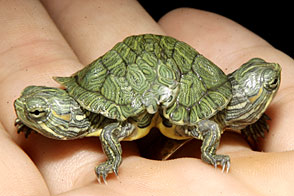
Examples of syncephaly have been recorded from many different animal species, including our own Homo sapiens. However, because of internal anatomical complications, not to mention the physiological strain of a single head attempting to maintain full neurological control and metabolic functioning of two bodies, syncephalic individuals possessing totally discrete bodies rarely survive for very long following birth. (In contrast, bicephalic or dicephalous individuals, possessing a single body but two heads, do sometimes survive to maturity, especially in certain creatures such as terrapins and snakes – click here for more information concerning two-headed snakes.)

Consequently, the concept of a surviving syncephalic lamb that possessed not just two but three completely separated bodies seemed too surreal, let alone too implausible, to warrant even the most cursory of considerations. So I simply filed away the engraving in one of my folders of teratological material and forgot all about it – until last Friday, 6 February 2015. For that was when I paid a visit to a very special attraction and saw something there that totally challenged my previous assumptions concerning syncephalic animals and their likelihood of surviving for any notable length of time following birth – and, in turn, made me think again about that anomalous triplicate lamb from Hungary.

Robert Ripley, founder of the Ripley's Believe It Or Not! franchise (public domain/Wikipedia)

The attraction in question was Ripley's Believe It Or Not! Odditorium London (click here to visit its official website). Situated on the corner of London's Piccadilly Circus, this is a spectacular six-storey exhibition centre that is packed throughout with bizarre curiosities and interactive displays celebrating the famous books, TV shows, and newspaper strips documenting all manner of incredibly weird yet wonderful people, animals, buildings, creations, and much much more that were originally compiled, collected, and drawn by entrepreneur-cartoonist Robert Ripley (1890-1949) for his countless publications.
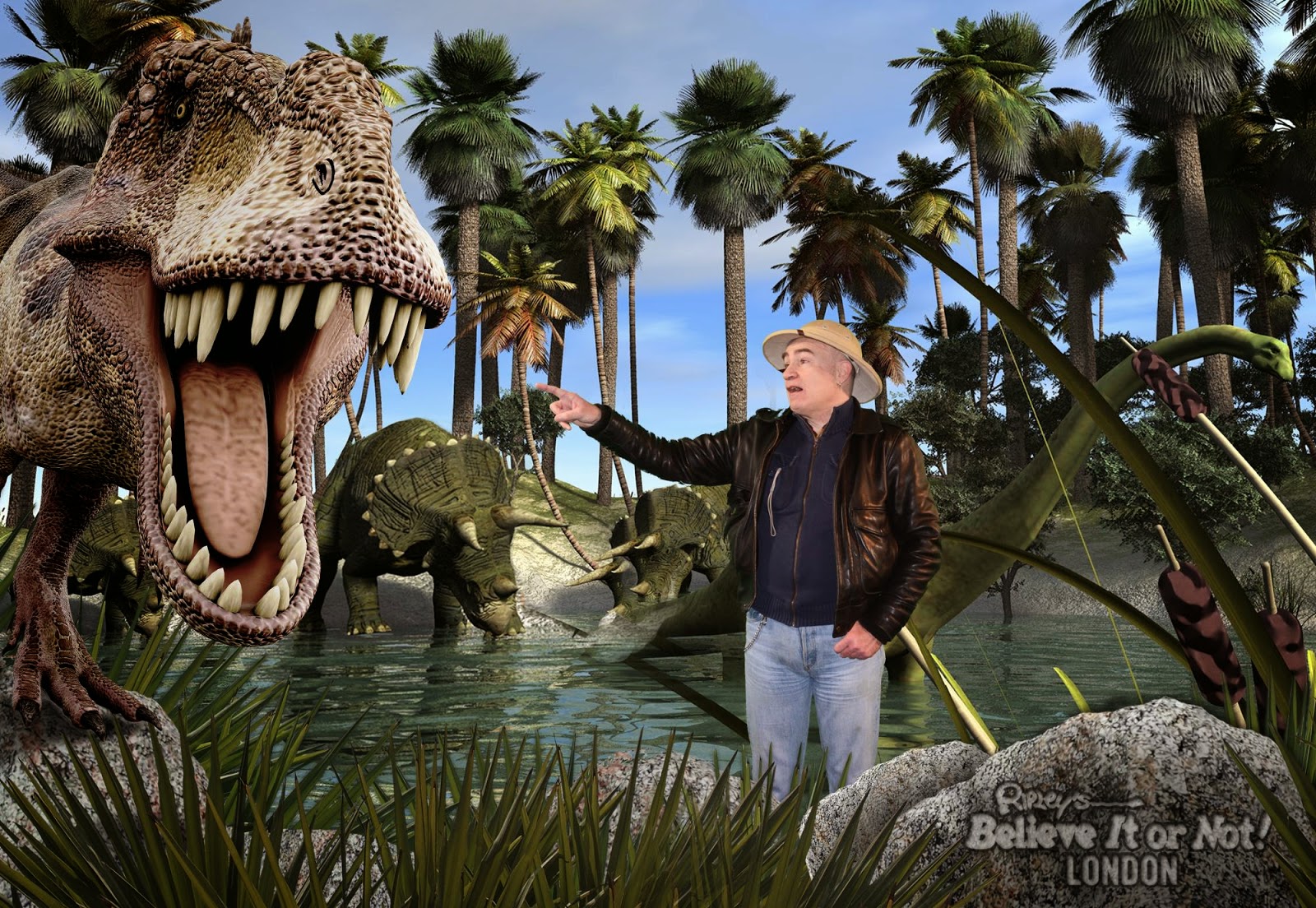
Experiencing some Mesozoic mayhem at Ripley's Believe It Or Not! Odditorium London (© Dr Karl Shuker)

As a zoologist, it was obviously the various –and extremely varied – animal attractions that particularly interested me, and I was certainly not disappointed in the array on display. There are many Ripley's Believe It Or Not! Odditoriums worldwide, especially in the USA (but with London's being the largest one of all), and they have become synonymous with teratological animals. There was certainly a goodly selection here in London (some of which were actual taxiderm specimens, others models of real specimens), including several two-headed creatures, animals with extra (supernumerary) limbs (a condition known as polymelia), and other equally curious caprices.

One such creature was a rooster with three separate legs that had been found in 1998 in England (exact location not specified), and was on display alongside a five-legged lamb (its right hind limb was a double leg), again from England and found during the early 1990s.

A three-legged rooster and a five-legged lamb – two polymelic animals at Ripley's Believe It Or Not! Odditorium London (© Dr Karl Shuker)

The two-headed lamb standing close by had been born in Shandong, China, in 2006, and both of its heads were fully functioning, with separate personalities.

Ripley's two-headed lamb from Shandong, China (© Dr Karl Shuker)

Just behind it was a pair of conjoined ('Siamese') piglets, joined back-to-back but with separate necks and heads (thus constituting a lesser version of the controversial rachipagus condition, in which conjoined twins are joined dorsally from the back of their heads down the entire length of their backs). These conjoined piglet twins were apparently similar in form to a pair possessed by the eminent Russian tsar Peter the Great (1672-1725), who famously owned a sizeable collection of scientific curiosities (click here for more information concerning this).

The conjoined piglets at Ripley's Believe It Or Not! Odditorium London (© Dr Karl Shuker)

Just inside the entrance to the odditorium was a taxiderm specimen of an adult black-and-white Friesian cow, which looked totally normal – until I realised that a fully-formed fifth leg complete with hoofed foot was growing outwards and upwards from between its shoulders! This bizarre teratological condition is called notomelia, and indicates that during this cow's embryogeny a supernumerary, aberrantly-located limb bud had developed. Alternatively, but more dramatically, as an example of what could be termed pseudonotomelia it is possible that the cow had originated as a pair of twins but that one of these two twins had subsequently degenerated and had been almost totally reabsorbed into the other one during their embryonic development, with only the single limb providing external evidence of the absorbed twin's former existence as a separate entity. (A very similar instance of notomelia, featuring a male Friesian calf, was published in the July 2014 issue of the Canadian Veterinary Journal.)

Ripley's notomelic Friesian cow possessing a dorsally-sited supernumerary leg, plus the heads and forequarters of a small white two-headed calf (© Dr Karl Shuker)

Here's another two-headed calf that was on display:

Two-headed calf at Ripley's Believe It Or Not! Odditorium London (© Dr Karl Shuker)

And here's an albino alligator, complete with ruby-red eyes:

Albino alligator at Ripley's Believe It Or Not! Odditorium London (© Dr Karl Shuker)

There were also a number of life-sized models of famous human curiosities. At one extreme was a model of Alypius, a dwarf from Alexandria during ancient Egyptian times, who was only 43 cm (17 in) tall, and whose fitting punishment for committing treason was imprisonment inside a parrot cage!

Model of Alypius at Ripley's Believe It Or Not! Odditorium London (© Dr Karl Shuker)

And at the other extreme, standing in front of a full-sized American mastodon skeleton that only served to emphasise his truly exceptional stature, was a full-sized model of Robert Wadlow (1918-1940), immortalised in the record books as the world's tallest man. Suffering from pituitary-induced gigantism, when he died aged just 22 years old he was already a little over 8 ft 11 in tall, and was still growing. Indeed, had he grown just under one inch more, he would have been the only confirmed 9-ft-tall human ever recorded. Standing alongside this real-life giant's model, even at a respectable 5 ft 10 in tall I still felt totally overshadowed by him, and overawed too.

Standing alongside the life-sized model of Robert Wadlow at Ripley's Believe It Or Not! Odditorium London (© Dr Karl Shuker)

Equally eyecatching was a full-sized bust of a man exhibiting hypertrichosis, also known as werewolf syndrome as persons displaying this condition of extreme hairiness were once believed by the superstitious to be lycanthropes.

Bust of a man exhibiting hypertrichosis at Ripley's Believe It Or Not! Odditorium London (© Dr Karl Shuker)

Also well worthy of attention was the conical, elongated skull of an ancient Peruvian, its extreme shape having resulted from the practice prevalent then and there of using tightly-wrapped cloth, boards, and rope to distort the shape of a child's growing skull via rigorous binding.

Manually-distorted conical skull of an ancient Peruvian at Ripley's Believe It Or Not! Odditorium London (© Dr Karl Shuker)

Yet despite all of these wonders and marvels, the specimen that startled me most at Ripley's Believe It Or Not Odditorium London was not actually on physical display there. Instead, it appeared – and even then only very fleetingly – on  a video being played in loop format on a screen close to most of the teratological animal specimens. The video showed a selection of teratological animals that were on display at various odditoriums around the world, and also included some footage of certain of these animals when they were still alive. Watching this video, I was astonished when a couple of seconds of film was shown of a living, seemingly adult, and clearly perfectly healthy syncephalic donkey, which consisted of a single head to which were connected two completely separated, fully-formed bodies!

By the time that my mind had registered this astonishing image, the video had moved on to showing other specimens, so I waited until it looped back to the beginning and then looked out for the donkey footage. After studying it intently when it reappeared, there was no doubt in my mind about what I had seen. It was indeed as I'd thought it to be on first viewing, both in form and in condition, though even now I struggle to comprehend how such a creature could survive to maturity – two independent four-legged bodies linked to a single controlling head.

After then waiting for the footage to come round a third time, when it did so I snapped a photo of this amazing donkey-in-duplicate, which although of poor quality would serve as a visual record of it for my files, and I vowed to investigate the matter further when I returned home. After all, if such a creature could truly exist and survive to adulthood, even the ostensibly impossible triplicate-bodied syncephalic lamb of Hungary suddenly seemed less implausible.

My photographic record of the syncephalic donkey as featured in the video shown at Ripley's Believe It or Not! Odditorium London (© Dr Karl Shuker/Ripley's Believe It or Not! Odditorium London)

And sure enough, my online researches have indeed confirmed the donkey's reality. Named Rascal, he was a miniature donkey owned by farmer Paul Springer whose farm is situated near Mineral Point, Wisconsin, USA. Paul's longstanding interest in teratological livestock has led him over the years to purchase a number of specimens that exhibit some anatomical peculiarity but are otherwise healthy and not suffering in any way, and allow them to live out a full, happy life on his farm instead of being slaughtered by their original owners either for their meat or simply because they were different.

Paul's first purchase was a six-legged calf called Boldegard during the 1970s, who went on to enjoy a long 14-year life on Paul's farm, followed by a range of other animals with extra legs, additional horns, two heads, or, in Rascal's case, one head and two bodies. Following their eventual deaths, half a dozen of the most striking individuals have been sold by Paul to the Ripley's Believe It Or Not! franchise for exhibition in various of their odditoriums. So it is possible that Rascal is on display in one of them, somewhere in the world. Consequently, if any of my readers have seen him, and can send me details, I'd very much like to receive them here – many thanks indeed in advance!

How uplifting it is to read of Paul Springer's compassion for all of the out-of-the-ordinary creatures that he has rescued from certain premature death. When asked in a media interview (WSAW.com 15 November 2009) what compelled him to rescue and care for animals with abnormalities, his answer was as inspirational as it was direct:

"There's something about them that maybe I feel sorry for. I give them a life. Most people will put them down and sell them. I am proud of them. People who see them, it gives them a chance to realize that everything isn't [normal], whether it be human beings or pigs or people or cats or dogs, we're not all born normal. Just because somebody has a handicap, they shouldn't be shunned. They should be given every chance, and love and attention that's possible."

Amen to that!

Rascal when alive (© Paul Springer)


Sunday, 30 September 2012

MY TWO-HEADED KESTREL – ALL IS REVEALED!


Testament to the skills of an extremely accomplished taxidermist, the two-headed kestrel that is lost no longer (© Dr Karl Shuker)


When I encountered the above taxiderm specimen of a European kestrel Falco tinnunculus with two heads while browsing in a local market on 28 September 2012 (click here to read my ShukerNature blog post concerning it), I was very surprised to SEE it, but not at all surprised BY it. And if that in itself sounds surprising – and possibly even a little confusing! – please allow me to explain, via the following sequel, which in reality is a prequel.

Freak shows and travelling circuses usually display at least one two-headed lamb or pig amidst their panorama of curiosities and caprices, so such entities are far from uncommon. The same can certainly not be said, however, for the erstwhile prize exhibit of a private natural history collection amassed some years ago by a friend of mine whom I shall refer to as Nigel F, from the West Midlands. Among his array of fossils and stuffed animals was a winged wonder unlike no other – dating from Victorian times, it was a perfectly preserved taxiderm kestrel, with two heads.

Silent testimony to the art of the expert taxidermist, it astonished and entranced all who viewed it, until eventually, along with most of his other specimens, Nigel sold it several years ago. Only then did he confess the truth to me – it was a fraud, albeit a truly amazing one. The left head was from another specimen entirely, which the taxidermist had meticulously attached to an already-prepared stuffed kestrel from Victorian times, to create this twin-headed falcon.

Nigel's photograph of his two-headed kestrel (© Nigel F.)

So superb was the artifice, however, as seen in this photograph which he had snapped of his dicephalous marvel some time before selling it (and which, amusingly, depicts the kestrel wearing a gold medallion and chain around its necks!), that even though Nigel knew which head was fake, he had great difficulty in detecting the zone of attachment, artfully concealed beneath its neck feathers. Indeed, to quote the famous words spoken by British television comedian Eric Morecambe concerning his comedy partner Ernie Wise’s alleged wig: “You can’t see the join!”.

Close-up of the kestrel's two heads (© Dr Karl Shuker)

After Nigel sold his two-headed kestrel, however, the whereabouts of this wonderful specimen were no longer known, and there seemed little hope of ever tracing it again. Until 28 September 2012, that is, when I was extremely shocked, but delighted, to discover it for sale on a stall in the very same town where Nigel had sold it all those years previously! In any case, I recognised it instantly from Nigel's photograph (a copy of which he had given to me some time ago) – its pose, tree branch mount, and base were all identical, as can be readily confirmed here by comparing Nigel's photo of it with one of mine, snapped on 28 September.

Nigel's photo (top) and one of mine (bottom) (© Nigel F. and Dr Karl Shuker)

Clearly, therefore, the kestrel had been sold either directly to the stall holder by whoever had owned it after having purchased it from Nigel, or via one or more intermediary purchasers/owners if such existed. Whatever the explanation, I certainly had no intention of allowing such an astonishing (un)natural history exhibit to disappear into obscurity again – as would almost certainly have happened if someone else had purchased it. So I duly bought it myself.

And once I inform him of its current whereabouts, Nigel will be happy knowing not only that his unique kestrel has resurfaced after all this time but also that it has found a good home again! Result!!

With my two-headed taxiderm kestrel (© Dr Karl Shuker)


Friday, 28 September 2012

THE TWO-HEADED KESTREL THAT CAME HOME WITH THE GROCERIES!

With my newly-acquired two-headed kestrel (© Dr Karl Shuker)


I may be a cryptozoologist and animal anomalist, but even I have to admit that it's not every day I go into town to buy some groceries and return home with a two-headed kestrel – but today was one such day!

Browsing in a local market that contains a number of antique/collectors' stalls, I came upon one stall that I hadn't seen before. And there, directly before me, was this truly extraordinary exhibit – a two-headed taxiderm specimen of the European kestrel Falco tinnunculus.

Two heads are certainly more eyecatching than one! (© Dr Karl Shuker)

To cut an extremely short story even shorter: reader, I purchased it! It is an adult female specimen (judging from its brown heads), is in excellent condition; and although I have seen various dicephalous chickens and ducks in the past, this is certainly the very first bicephalic bird of prey that I have ever encountered.

Did this bird get ahead by having two heads? (© Karl Shuker)

But is it genuine, a bona fide teratological raptor, or – to use a very apt falconry term - has it been created in order to hoodwink its observers? That is a very good question!

What do you think?


UPDATE: 30 September 2012

Okay - I've kept you all in suspense long enough! Click here for the answer to this double-headed riddle!

Not quite what I expected when shopping for my groceries! (© Dr Karl Shuker)


Friday, 18 March 2011

THE CRYPTOZOOLOGICAL WORLD OF DOCTOR DOLITTLE. PART 1: IN PRAISE OF THE PUSHMI-PULLYU.


Long before I’d even heard of Dr Bernard Heuvelmans, let alone read his seminal cryptozoological tome, On the Track of Unknown Animals, I’d already been greatly influenced by a very noteworthy, albeit entirely fictitious, figure of considerable relevance to mysterious and undiscovered beasts. I am referring of course to animal linguist genius Doctor Dolittle (or Dr John Dolittle MD, to give him his full title), created by Hugh Lofting. His fascinating adventures and discoveries featured in no less than 12 wonderful children’s novels by Lofting - all of which I had read and re-read many times with great joy during my formative pre-teen years.

They also formed the basis for an equally delightful film musical, ‘Doctor Dolittle’, released by 20th Century Fox Studios in 1967. One of my all-time favourite films, it starred Rex Harrison in the eponymous role, alongside Anthony Newley, Samantha Eggar, Richard Attenborough, and a scene-stealing supporting cast of real-life animals. It featured a very tuneful selection of thoroughly charming songs too, composed by Leslie Bricusse (one of which, ‘Talk to the Animals’, went on to win an Academy Award for Best Song).

Showing the film musical's version of the pushmi-pullyu (Dr Karl Shuker)

During his varied escapades as chronicled by Lofting, the good Doctor encountered many different kinds of animal, ranging from the mundane to the marvellous - including a select few that were unquestionably unknown to modern-day science, and which so enthralled me that I can state in all honesty that the onset in my childhood of what would become a lifelong interest for me in cryptozoology was due in no small way to my fascination with these latter mystery beasts.

Consequently, it seemed only right that ShukerNature should survey some of Lofting’s most significant literary cryptids from the Doctor Dolittle series of novels, so here are six of my particular favourites.


THE PUSHMI-PULLYU
 
Out of all of the extraordinary creatures that appeared in Hugh Lofting’s series of Doctor Dolittle novels, it was the pushmi-pullyu that was unquestionably the most readily identifiable member of Dolittle’s marvellous menagerie, due not only to Lofting’s own input but also to this bicranial wonder’s very memorable appearance in the afore-mentioned Doctor Dolittle film musical from 1967.

Here is how Lofting introduced the pushmi-pullyu, native to darkest Africa and exceptionally elusive, in the very first Dolittle novel, The Story of Doctor Dolittle (1920):

"Pushmi-pullyus are now extinct. That means, there aren't any more. But long ago, when Doctor Dolittle was alive [early 1800s], there were some of them still left in the deepest jungles of Africa; and even then they were very, very scarce. They had no tail, but a head at each end, and sharp horns on each head. They were very shy and terribly hard to catch...[The native people] get most of their animals by sneaking up behind them while they are not looking. But you could not do this with the pushmi-pullyu because, no matter which way you came towards him, he was always facing you. And besides, only one half of him slept at a time. The other head was always awake and watching. This was why they were never caught and never seen in Zoos. Though many of the greatest huntsmen and the cleverest menagerie-keepers spent years of their lives searching through the jungles in all weathers for pushmi-pullyus, not a single one had ever been caught. Even then, years ago, he was the only animal in the world with two heads."

This is not entirely true, of course. There are many fully-confirmed cases of dicephalous or bicephalic (i.e. two-headed) animals on record, including various specimens of two-headed snakes, terrapins, lambs, calves, and even, rarely, humans. However, in every one of these cases, the two heads emerge either from a single neck or, if each head has its own neck, from a single upper torso. What made the pushmi-pullyu so very special is that its heads emerged from opposite ends of its body. Indeed, its body was actually two front halves fused together in opposite directions at their mid-riff.

Such an extraordinary entity is known technically as an amphicephalus, and in reality is exceedingly rare. Indeed, I know only of a few semi-amphicephalic terrapins, which were conjoined twins joined end to end, and, in contrast to the pushmi-pullyu, each twin had an almost fully-formed body, not just a front half.

A semi-amphicephalic terrapin (public domain)

The much more extreme condition exhibited by the pushmi-pullyu, conversely, would have rendered it an anatomical impossibility in real life – if only for the fundamental physiological reason that it would not have been able to defaecate, having no anus! Happily, such indelicate matters were discreetly passed over by Lofting, who wrote his novels in a more genteel age when, unlike in today’s brasher times, such subjects were most definitely off-limits in a children’s book (even though I would hazard a guess that, schoolboys being schoolboys whatever decade they happened to be born in, the pushmi-pullyu’s excretory paradox attracted its fair share of sniggers and risible comments even back in the 1920s!).

What an amphicephalic llama would look like

Moving swiftly on: just as intriguing as its anatomy was its taxonomy. Just what was the pushmi-pullyu? In the film musical, it was simply portrayed as an amphicephalic Tibetan llama (even though Tibet is normally home to lamas, not llamas!), but in the novel Lofting revealed that it had a much more complex, interesting ancestry:

"Excuse me, [said Doctor Dolittle] surely you are related to the Deer Family, are you not?"

"Yes," said the pushmi-pullyu "to the Abyssinian Gazelles and the Asiatic Chamois on my mother's side. My father's greatgrandfather was the last of the Unicorns."


Lofting's own drawing of the pushmi-pullyu (public domain)

Lofting also included the sketch of the pushmi-pullyu reproduced here (Lofting provided all of the illustrations himself for the Dolittle books), which portrays each of its heads with a pair of short horns, curling backwards slightly at their tips, and each head also possesses an extraordinarily large lower jaw (mandibular prognathism?). Whatever it was, therefore, it clearly was not of llama extraction.

Reading through the pushmi-pullyu’s description of its own ancestry, one might initially assume that the most cryptozoological aspect of it was this very curious creature’s derivation on its paternal side from the unicorn lineage. In reality, however, its maternal side was no less interesting either, because there is no such animal as the Asiatic chamois known to science. The only modern-day chamois, Rupicapra rupicapra, is almost entirely confined to Europe (it also exists a little way into Asian Turkey). So how can we explain Lofting’s assertion?

It may of course simply be that Lofting was mistaken, wrongly assuming that the chamois was Asian in zoogeographical distribution. Alternatively, he may have been loosely referring to one of the chamois’s close relatives - the serows, the gorals, the tahrs, or the takins, all of which, like the chamois, are known as goat-antelopes, but all of which, unlike the chamois, are Asian.

Chamois on Czechoslovakian postage stamp (public domain)

Back in the age when the Doctor Dolittle books were set (the early 1800s), anything – or anyone – with two heads invariably winded up on display in a sideshow or circus. And sure enough, so did the pushmi-pullyu, though in this instance it was a voluntary act, as it wanted to help the Doctor raise enough money to pay for a boat that he had borrowed but which had later been shipwrecked. The pushmi-pullyu’s arrival at the circus - whose astonished owner, the normally world-weary, seen-it-all showman Albert Blossom, was forced to concede in a boisterous song-and-dance number that “I’ve never seen anything like it!” (listen to it here) - provides one of the most entertaining scenes of all in the film musical, enhanced enormously by a glorious, deliberately over-the-top performance by none other than Richard Attenborough, the eminent actor brother of Britain’s foremost television naturalist, David Attenborough.

The pushmi-pullyu at Blossom's Circus in the 1967 20th Century Fox Studios film musical, 'Doctor Dolittle' ((c) 20th Century Fox - reproduced here on a strictly non-commercial Fair Use basis for educational/review purposes only)

How sad, therefore, that the pushmi-pullyu was not real – one could well imagine the whispered, reverential tones of Richard’s brother discussing its origins and behaviour in an episode of ‘Life On Earth’!

Join me again for Part 2 of this article (click here to access it), when I’ll be casting a glance over a couple of giant aquatic cryptids encountered by the good Doctor on his travels; and click here to access Part 3, when I'll be investigating two huge insects and a beautiful bird all known well to him but not known at all to the rest of science.

 
And here's one I made earlier - my very own pushmi-pullyu! ((c) Dr Karl Shuker) 


Sunday, 19 December 2010

WHEN TWO HEADS WEREN'T BETTER THAN ONE!


A two-headed rat snake


I am greatly indebted to Markus Bühler for drawing my attention to a recent paper documenting the first recorded example of a dicephalic (two-headed) anaconda, specifically a young female yellow anaconda Eunectes notaeus encountered in 1985 on the right margin of the Paraguay River in Southern Pantanal, Brazil. The paper can be accessed at:

http://www.informaworld.com/smpp/section~fulltext=713240928~dontcount=true~content=a924020673

As Markus pointed out to me:

"It looks especially weird, because not only the head is double, but also a big part of the postcranial body, that makes it look somehow like one of those mythical entities which are shown as multiple headed snakes with long necks."

What a shame, though, that as soon as this extraordinary snake was found it was killed - or 'sacrificed', to quote the paper's authors! It was only a juvenile specimen, so surely it could have been captured alive? After all, some dicephalic snakes maintained in captivity have lived for a number of years. Ah well, even in today's conservation-emphatic times, it seems that the 'collection' of rare and sometimes unique specimens is still very much alive, unlike this two-headed anaconda, unfortunately. Instead, its preserved, now-faded corpse resides in the Coleção Zoológica de Referência of the Campus do Pantanal/UFMS (CEUCH 6024).

Consequently, the single most interesting and informative aspect of the paper for me can be found in its introduction, where the authors note that fellow researcher Van Wallach has published an extensive review of dicephalic snakes, containing a checklist of no less than 950 cases, featuring 169 species in 93 genera! He also summarises their internal anatomy and discusses the available information on these double-headed serpents' natural history and behaviour - fascinating! The full reference to this groundbreaking publication is:

WALLACH, V. (2007). 2007. Axial bifurcation and duplication in snakes. Part I. A synopsis of authentic and anecdotal cases. Bull. Md. Herpetol. Soc., 43(2): 57–95.

Back in 2000, this is what I wrote about dicephalic snakes for a 'Lost Ark' article of mine published in Fortean Times:

Cryptozoologists are (or should be) used to receiving healthy doses of scepticism from mainstream zoological colleagues concerning reports of mysterious, exotic-sounding creatures. I was very startled to discover recently, however, that much the same response can be elicited by teratologists (researchers studying biological freaks and monstrosities) when speaking to mainstream colleagues regarding zoological caprices and curiosities of the teratological kind. A short while ago, I happened to mention casually to some zoologist friends a quite recent newspaper report about the finding of a two-headed (dicephalic) snake. To my great surprise, no amount of persuading would convince any of them that freaks of this kind do genuinely occur from time to time (usually due to duplication of the embryonic snake's cephalic region during development). Instead, they were adamant that such sports were total fabrications invented by the media to fool gullible readers! Needless to say, this spurred me to research the subject of ophidian dicephaly; and in order to dispel any additional scepticism that may exist concerning it, there now follows a brief selection of some of the most celebrated, fully-confirmed serpentine dicephali on record.

In his Log-Book of a Fisherman and Zoologist, the noted Victorian naturalist and eccentric Frank Buckland recorded receiving an odder-than-normal two-headed grass snake Natrix natrix, aged at least 3-4 months old. Whereas many dicephalic snakes have similar heads, those of Buckland's grass snake differed both in size and in location. The larger of the two heads was positioned at the end of the snake's neck (i.e. the normal position). However, the smaller head emerged directly (i.e. not borne upon any neck of its own) from a lateral location some distance further down - thereby emerging from the neck of the principal head, and comprising a parasitic twin. A dicephalic snake (or other animal) exhibiting this condition - in which one head (that of the parasitic twin) is attached either to the neck or lower jaw of the other head - is said to be desmiognathous.

During the 1920s, a wild dicephalic specimen of the milk snake Lampropeltis triangulum was discovered living in New York's Bronx Zoo. Unlike Buckland's grass snake, however, its two heads were of equal size, and each was borne upon its own 1-inch-long neck (dicephalic animals with two necks as well as two heads are described as diauchenic). Not surprisingly, this highly distinctive serpent was swiftly captured, thereafter acquiring permanent residence at the zoo as a special exhibit, and was the focus of considerable attention - not least from its own keeper, particularly at feeding time. This was because both of its heads ingested food, which meant that great care had to be taken to ensure that its single gullet did not become blocked by the double stream of food passing into it from the snake's two mouths.

Similarly, from 19 March to July 1955 the Arizona-Sonora Desert Museum was the proud owner of a juvenile dicephalic pine snake Pituophis melanoleucus, which lived upon lizards devoured only by the left head. More recently, a dicephalic water snake Natrix sipedon became a major attraction at Miami's Serpentarium, and was featured in numerous newspaper accounts. The Serpentarium's director, Bill Haast, named the two heads Hatfield and McCoy, after the notorious feuding families from West Virginia. As it happened, however, these names would have been far more apt if they had been applied to the heads of what is probably the most remarkable two-headed snake recorded from captivity.

Instead, the heads of this latter serpentine dicephalus were respectively named Dudley and Duplex, by staff at San Diego Zoo where it lived for some time during the 1970s. A diauchenic example, it was a king snake Lampropeltis getulus - a zoological identity destined to cause major problems for any two-headed representative, due to this particular species' dietary preference. For the king snake is ophiophagous - it eats other snakes! Imagine, then, the psychological turmoil that must have been taking place within the twin minds of Dudley-Duplex. For here was a situation in which two mentally-independent snakes, both instinctive serpent-eaters, were, by a developmental quirk of fate, doomed to be perpetually in one another's closest of close company. Tormented by continuous temptation, it could surely be only a matter of time before the inevitable happened.

And one day it nearly did - keepers arrived only just in time to prevent Dudley from bring swallowed by Duplex! On this occasion, peace was restored, and the crisis was averted, but quite evidently the memory lingered. For not long afterwards, Dudley took his revenge and actually succeeded in swallowing Duplex - only to discover too late of course that in killing Duplex he had fatally wounded himself. A short time later, this extraordinary but ultimately tragic double-act died - a victim of a truly unique case of fatal attraction.

Finally, a notably unusual dicephalic snake was captured on 13 May 1975 at Salta, Argentina. This specimen's single body not only sported two heads but also possessed two tails. An individual that displays duplication of its anterior and posterior ends while its body region remains a single entity is referred to as a dicephalus dipygus (or, less commonly nowadays, an anakatadidymus). Measuring 18 in long, Salta's two-headed snake was also unusual in that only one head ingested food (albeit voraciously), the other not functioning at all - though in view of the Dudley-Duplex saga, this may have been no bad thing. Clearly, two heads are not always better than one after all!