Dr KARL SHUKER

Zoologist, media consultant, and science writer, Dr Karl Shuker is also one of the best known cryptozoologists in the world. He is the author of such seminal works as Mystery Cats of the World (1989), The Lost Ark: New and Rediscovered Animals of the 20th Century (1993; greatly expanded in 2012 as The Encyclopaedia of New and Rediscovered Animals), Dragons: A Natural History (1995), In Search of Prehistoric Survivors (1995), The Unexplained (1996), From Flying Toads To Snakes With Wings (1997), Mysteries of Planet Earth (1999), The Hidden Powers of Animals (2001), The Beasts That Hide From Man (2003), Extraordinary Animals Revisited (2007), Dr Shuker's Casebook (2008), Karl Shuker's Alien Zoo: From the Pages of Fortean Times (2010), Cats of Magic, Mythology, and Mystery (2012), Mirabilis: A Carnival of Cryptozoology and Unnatural History (2013), Dragons in Zoology, Cryptozoology, and Culture (2013), The Menagerie of Marvels (2014), A Manifestation of Monsters (2015), Here's Nessie! (2016), and what is widely considered to be his cryptozoological magnum opus, Still In Search Of Prehistoric Survivors (2016) - plus, very excitingly, his four long-awaited, much-requested ShukerNature blog books (2019-2024).

Dr Karl Shuker's Official Website - http://www.karlshuker.com/index.htm

IMPORTANT: To view a complete, regularly-updated listing of my ShukerNature blog's articles (each one instantly clickable), please click HERE!

IMPORTANT: To view a complete, regularly-updated listing of my published books (each one instantly clickable), please click HERE!

IMPORTANT: To view a complete, regularly-updated listing of my Eclectarium blog's articles (each one instantly clickable), please click HERE!

IMPORTANT: To view a complete, regularly-updated listing of my Starsteeds blog's poetry and other lyrical writings (each one instantly clickable), please click HERE!

IMPORTANT: To view a complete, regularly-updated listing of my Shuker In MovieLand blog's articles (each one instantly clickable), please click HERE!

IMPORTANT: To view a complete, regularly-updated listing of my RebelBikerDude's AI Biker Art blog's thematic text & picture galleries (each one instantly clickable), please click HERE!

Search This Blog


PLEASE COME IN, I'VE BEEN EXPECTING YOU...

PLEASE COME IN, I'VE BEEN EXPECTING YOU...
WELCOME TO SHUKERNATURE - ENJOY YOUR VISIT - BEWARE OF THE RAPTOR!


Wednesday, 20 October 2010

FROM WAR-TIME VAMPIRE TO MODERN-DAY CHUPACABRA?


Highly-acclaimed graphics artist Andy Paciorek sent me yesterday (19 October 2010) the upper of the two illustrations reproduced above, which has a fascinating if totally mystifying cryptozoological connection. The picture is a war cartoon, entitled 'De Vampyr' and was prepared by L J Jordaan for Der Groene Amsterdammer (an underground Dutch periodical) in 1940.

Yet this claw-footed, long-tailed, gasmask-wearing(!) 'vampire' bears scant similarity to the familiar Draculaesque variety with hypertrophied canines, prominent widow's peak, and a talent for melodramatic cloak-swishing!

Instead, as Andy so rightly pointed out, what it does resemble, and to a remarkable degree, is the chupacabra - a Hispanic mystery beast that did not come to widespread public and media attention until the mid-1990s. Of particular note is the Dutch war vampire's row of long dorsal spines, a very distinctive characteristic frequently reported for the chupacabra but not usually for other cryptids. Wings have also been cited for the chupacabra on occasion, as have powerful hind limbs, and its blood-sucking behaviour, often totally draining of blood the carcases of its animal victims, is well-documented - all features exhibited here by Jordaan's vampire, more than half a century before the chupacabra.

For visual comparison, the painting positioned directly below 'De Vampyr' here is of a chupacabra, produced by celebrated cryptozoological artist William Rebsamen, based upon eyewitness descriptions, and except for the chupacabra's quadrupedal rather than bipedal form, fundamental morphological similarities between the two entities are undeniable.

Just a baffling coincidence, or are the history and public evolution of the chupacabra more complex and of earlier origin than previously thought? Over to you...


Sunday, 17 October 2010

HAVE YOU SEEN THESE ENTITIES?


Don't you just hate it when you discover some fascinating information somewhere, then, at some later date, you can't remember where you'd read it?

This happened lately to Martin Phillipps, a colleague of mine from New Zealand, who has contacted me to ask if either of the following two reports sounded familiar, as he cannot recall where he read them originally. Sadly, I had to confess that both of them were new to me, so is there anyone out there in cyberland who can offer any suggestions? Here are the two reports, as quoted directly from Martin's email of 9 October 2010 to me:

"I was wondering if you would be able to help me identify the source of two stories which I believe to be somewhere in my frustratingly large collection of books on paranormal and occult matters.

"In one story, if I remember correctly, there were two men walking along some rough coastal cliffs (it may have been in Britain but I cannot be sure) when they came over a rise and saw a very large orange bat-like creature sunning itself on the rocks just above the water line.

"I believe they described it as being a good thirty or forty feet across but I just cannot find this story anywhere now and it is very frustrating. You know how it is when your mind gets stuck on one particular problem and you are unable to find the relevant information!

"The other story, which I believe is likewise hiding amongst my collection, concerns a man, again I believe walking near the sea, and coming across a being who sounded exactly like a satyr or a Pan-like entity - cloven hooves and all. When this being became aware that he had been noticed he apparently said something along the lines of... "You are not meant to be able to see me!"

"As I cannot locate the book which included this marvelous tale I am not sure if there was much more to the conversation after that very intriguing opening line!

"Do either of these stories ring any bells with you? They were both recounted as non-fiction."

The first report is vaguely reminiscent of an account describing a huge winged nature deva that I documented in my book Mysteries of Planet Earth (1999).

And the second report is reminiscent of a section that I remember reading a long time ago in Paul Hawken's book The Magic of Findhorn, but is not identical, as the entity in the latter book was indeed Pan but was invisible.

Any thoughts regarding either or both of these reports would be very welcome!

Monday, 11 October 2010

FROM 'JAWS' TO 'GUMS' !!

The European giant catfish or wels - could 'Gums' be an undiscovered relative? (public domain)
 
One of the world's most famous explorers is, or was, Lieutenant-Colonel Percy Fawcett, who mysteriously vanished in 1925 while exploring the vast uncharted jungles of Brazil. Before his tragic disappearance, however, he had penned a fascinating account of his explorations in these lands, which was published in 1953 as Exploration Fawcett. It contains brief accounts of several mystifying creatures, but none more so than his supposed giant toothless shark or manguruyu, to give it its local name.
 
According to Fawcett, the Paraguay River contains: "a freshwater shark, huge but toothless, said to attack men and swallow them if it gets a chance". In reality, however, very few sharks inhabit freshwater, and those that do are far from toothless. So if such a shark really does exist, it is dramatically different from anything currently known to science. However, it may not be a shark at all.
 
British cryptozoologist Mike Grayson has opined that it could be a very large sturgeon, some species of which are vaguely shark-like and can attain great sizes. However, he concedes that this is a very tentative identification, acknowledging that sturgeons do not attack and swallow people, and that there is no known species of South American sturgeon to act as a zoogeographical precedent anyway.
 
My own feeling is that a catfish identity may be more plausible. There are more species of catfishes in South America than anywhere else, and some of these latter are among the world's largest too. In Europe, the giant wels catfish Siluris glanis often been accused (unjustly or otherwise) of swallowing people, but even if this aspect is wholly folkloric, the concept of a giant catfish existing in South America is by no means impossible. True, catfishes usually possess teeth at least on their vomer bone. However, old specimens of some species are entirely toothless - as in, significantly, the giant pa beuk Pangasianodon gigas of southern Asia's Mekong River. Up to 8 ft long, it is the world's largest species of fish confined entirely to freshwater, yet it amazingly remained undiscovered by science until as late as 1930.
 
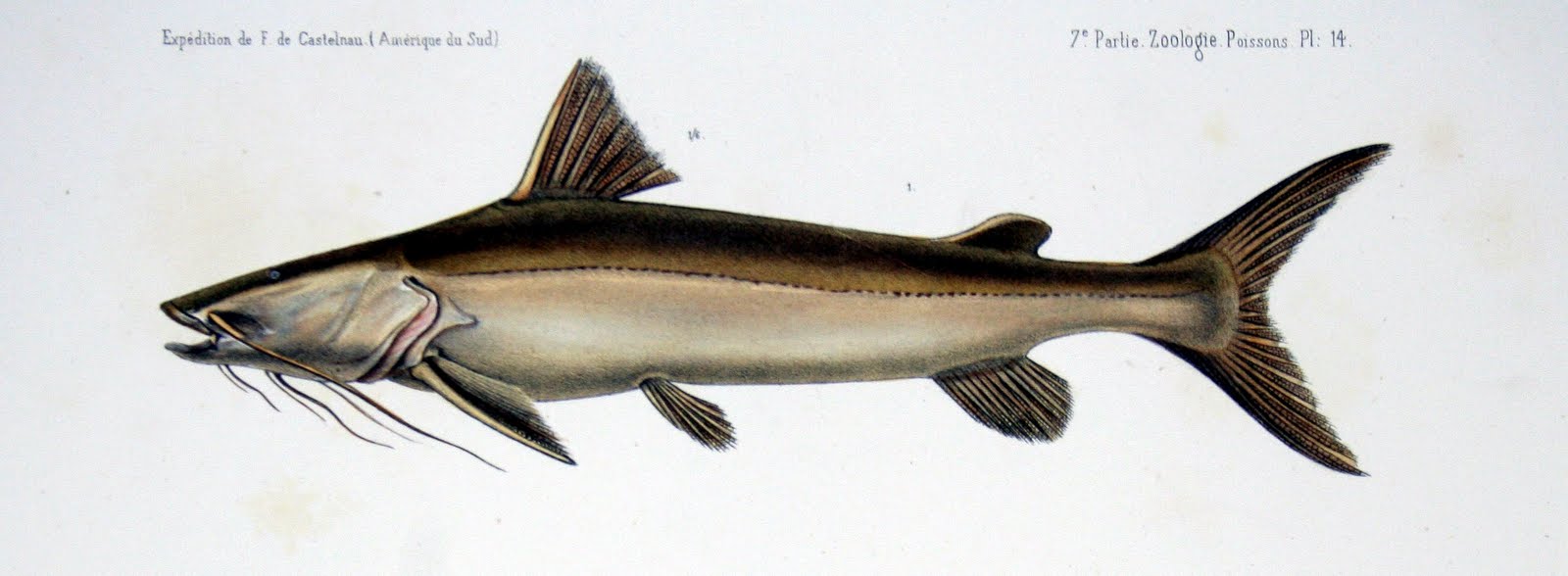
Perhaps Fawcett's giant toothless shark - aptly dubbed 'Gums' by Grayson - is in reality an elderly edentate catfish, belonging to a still-undescribed extra-large species. Alternatively, as German cryptozoologist Markus Bühler has mentioned to me, South America's piraiba Brachyplatystoma filamentosum, a huge species of goliath catfish, has a deceptively shark-like body outline and is already known to grow up to 12 ft long - so who knows, reports of 'Gums' may have been based upon sightings of exceptionally large, geriatric piraibas.

Piraiba (public domain)


Sunday, 3 October 2010

SACHAMAMA - A SNAKE IN A SHELL?


Sachamama-like beast on 16th-Century Peruvian pottery
(Dr Karl Shuker)


In recent times, reports of giant anacondas and other serpentine colossi in South America have attracted notable media attention. Some of these reports, moreover, have referred to the sachamama, but in reality the latter is no 'ordinary' giant snake, because according to the local people who claim to have seen it, this bizarre Peruvian mystery creature resembles a snake with a shell!

On 14 August 1997, the villagers of Nueva Tacna, near Iquitos, in northern Peru, witnessed an incredible event. According to one eyewitness, local fisherman Maximo Inuacari, a loud rumbling sound reverberated from a patch of jungle, as if something large and heavy were roaming through it. Inuacari, sitting in his boat on the Napo River nearby, began to paddle away, and as he did so a 'monster' emerged from the jungle onto the shore behind him, having uprooted many trees and gouged a 1600-ft-long, 30-ft-wide trench during its noisy progression towards the river. According to Inuacari, it resembled a huge black cylinder, and dived into the water, creating a huge whirlpool that submerged several boats.

Another eyewitness, Luis Iluma, who had a better view of this bizarre beast, claimed that it had two tentacles like elephant trunks and two 3-ft-long 'ears' on its head, a muzzle, and a long black snake-like body bearing a shell-like structure in the middle of its back.

This is not an isolated record. Following the above incident, explorer-journalist Arnost Vasícek visited South America, and spoke to several people during his preparation of a detailed account (Blesk Magazin, 14 November 1997). Two were biology teacher Nelly Armos and director Carlos Quinto, both of whom were from a school near Oran, and who had spent a considerable time researching traditional accounts and lore of strange South American animals. One such creature, referred to in old Peruvian Indian legends, is the sachamama - a giant black snake with a large head bearing tentacles, and a calcareous shell upon its back.

According to the legends, this mysterious creature appears only very rarely, and can remain in a state of torpor underwater for many years. When it wakes, however, it can suck prey into its mouth from quite a distance, but cannot pursue prey through the jungle because its progression is impeded by its large shell. So was the beast seen by Inuacari and Iluma in August 1997 a real-life sachamama?

Its description in legends was echoed during the 19th Century by a missionary called de Vernazz, who claimed to have shot one that measured over 45 ft long and 6 ft thick while boating on the Pastaza River bordering Peru and Ecuador. Moreover, there are examples of ceramic pots and saucers from Peru's ancient Moche culture, dating back over 1500 years and owned by the Casinelli Museum in northern Peru's Trujillo region, which depict a huge black snake-like or slug-like beast with tentacles, and a conch-like shell on its back. In addition, Vasícek documented some 16th-Century examples of Peruvian pottery depicting a very similar animal, which also sported a forked tongue and two pairs of snail-like, bulbous-tipped feelers - one pair at the base of its snout, and the other pair at its snout's tip.

Assuming that the sachamama does exist - which is in itself a very big assumption - and that its local description is accurate, it is hardly likely to be a snake, judging from its tentacles and shell. But could it possibly be a giant species of slug? Slugs do possess cephalic (head-borne) tentacles, and some have an external shell on their back too. The existence of such a monstrous mollusc seems highly unlikely, but there is no doubt that something created havoc near Nueva Tacna on 14 August 1997 - as confirmed by local governor Jorge Chavez and various Peruvian journalists who flew over the area by helicopter shortly afterwards to survey the devastation. If it were not for its shell, the sachamama is very reminiscent of another trench-excavating mystery beast from South America - the Brazilian minhocão, which I believe may be a giant form of limbless amphibian called a caecilian.

Iquitos scientist Nixon Reugifa attempted to explain this destructive August 1997 visitation as the work of floodwater, and another idea offered by sceptics was that a wind vortex was responsible, but both were subsequently rejected. Indeed, Reugifa eventually discounted his own idea when more eyewitness accounts and details came to light that revealed the path taken by the destroying agent to be too selective to be satisfactorily explained by flooding. Similarly, none of the fishermen recalled feeling any sensation of wind movement during the incident, thereby eliminating the vortex hypothesis. So was the culprit a living legend? A snake with a shell? As yet, we simply have no answer.

Monday, 27 September 2010

CHRISTOPHER COLUMBUS AND THE SKINNED 'SERPENT'


Posthumous portrait of Christopher Columbus by Ridolfo Ghirlandaio


What's in a name? Not a lot, it would seem, at least as far as cryptozoological reports are concerned. Take, for instance, the intriguing yet lately-forgotten controversy surrounding the mysterious 'serpent' killed by Christopher Columbus during his first voyage to the New World.

In his diary entry for 21 October 1492, Columbus reported killing and skinning a 'serpent' measuring almost 5 ft long that he had seen entering a lake on the Bahamian island which he later dubbed Isabela. Another of these 'serpents', of similar size, was killed at a different lake on that same island a day later, this time by Martin Alonso Pinzon - the captain of one of Columbus's ships, the Pinta.

Regrettably, the skin of Columbus's serpent does not appear to have been preserved, which is a great pity, bearing in mind that zoologists have never been able to identify its species. Indeed, for a long time the prevailing opinion was that the creature was not a snake at all, but was instead a giant iguana. Unfortunately, however, as pointed out by Florida State Museum's assistant curator, Bill Keegan, in a fascinating Schenectady Gazette report (12 October 1987) concerning this cryptozoological conundrum, the iguana identity is far from satisfactory.

Iguanas do not tend to enter lakes as a rule, and there was no fossil evidence for the erstwhile existence of such creatures on this island. Also, in his diary Columbus used the word 'lagartos' when referring to lizards, and 'culebra' for a snake, whereas he called the type of beast that he and Pinzon killed a 'sierpe' or serpent.

In bygone days, the word 'serpent' had a much broader meaning than its more limited present-day usage as an alternative name for a snake. Indeed, it was often utilised as a general term for anything large and reptilian - including big snakes, lizards...and crocodiles. However, the reason why a crocodile had never been offered as a candidate for the identity of Columbus's 'serpent' was that no physical evidence existed to suggest such animals had ever inhabited the Bahamas - until 1987, that is.

When Keegan led an archaeological expedition that year to Isabela, they examined the ruins of a village believed to have been visited by Columbus - and there they unearthed the left femur (thigh bone) of a crocodile. The bone was 3.5 in long, indicating that the entire crocodile had measured around 4 ft long. So despite the fact that there are no crocodiles here today, it would seem that in Columbus's time these reptiles did indeed exist on Isabela - and that one such creature had suffered a grim fate at the hands of this now-famous explorer.

Thursday, 16 September 2010

SON OF TRUNKO!


South Africa's original Trunko attacked by killer whales as envisaged by American artist Bill Asmussen


When documenting Trunko in various books of mine, I have noted briefly that a second, much less famous Trunko of sorts has also been recorded. Here is what I wrote about this 'Son of Trunko' in From Flying Toads To Snakes With Wings (1997):

"In November 1936, the carcase of a 24-foot-long elephant-headed sea monster with white fur and a 14-foot tail was found on Alaska's desolate Glacier Island. Yet despite being examined by a team led by W.J. McDonald, supervisor of the Chugach National Forest, its remains were not preserved, and its ultimate fate is unknown."

And here is my version of events as included 10 years later in Extraordinary Animals Revisited (2007):

"As I noted in From Flying Toads To Snakes With Wings (1997), which also contains coverage of Trunko, in November 1936 the carcase of an elephant-headed, white-furred, long-tailed sea serpent measuring 24 ft in total length was discovered on Alaska’s desolate Glacier Island. This time, moreover, its remains were examined, by a team led by Chugach National Forest supervisor W.J. McDonald, but no news of their findings has ever been released, and, as with Trunko, the Glacier Island sea serpent’s remains were not retained."

Not long after that book was published, I read a very brief note somewhere online that the examination of this carcase had in fact revealed it to be that of a minke whale Balaeonoptera acutorostrata, but no further information was provided.

Thanks to two documents (one hitherto-unpublicised) kindly made available to me yet again by longstanding German correspondent and Trunko co-investigator Markus Hemmler, however, I am now able to reveal here, for the first time in any cryptozoological publication, not only the complete history of the Glacier Island Trunko carcase but also its conclusive identification and current location (complete with museum catalogue number!).

The first of these two documents is an article dated 2 May 2008, written by Dixie Lambert, that was published in Alaska's Cordova Times newspaper. In it, contradicting earlier accounts (including my own), the date of the carcase's discovery is given as 10 November 1930, not 1936, and it was found floating on its back in Glacier Island's Eagle Bay amid icebergs from the Columbia Glacier by fox farmer Jerry O'Leary and his employee Charles Gibson. The only flesh remaining on it was confined to the mostly-intact mid-section; the head and tail were totally denuded. After they had towed it to shore, they chopped off the flesh, to use as fox bait. They also saved the skeleton, whose total length (including the skull) was said to be anything from 27 ft to 42 ft, and which was distinguished by its long tail and unusual flat, triangular head. The men speculated that perhaps it had previously been entombed within the Columbia Glacier before breaking off and floating away.

When word of this remarkable find reached W.J. McDonald, district forest supervisor of Alaska's Chugach National Forest, and also Charles Flory of the U.S. Forest Service, they organised an expedition that included several other interested parties, to visit and document its remains. When the expedition reached the carcase and examined it, they found that it measured precisely 24 ft and 1 in. Moreover, quoting from the Cordova Times article:

"Its snout or beak from the tip to the center of the forehead was 3 feet 3 inches with a width of 11 inches at midsection and a circumference of 29 inches. Only the upper left jawbone was found, and it was described to be devoid of teeth.

"The head was 4 feet 7 inches long and 3 feet wide at the widest part. The body section from the back of the head to the end of the rib cage was 6 feet 2 inches, and the tail was 14 feet long. The head attached directly to the torso with no visible neck. The skeleton's flippers were 3 feet 11 inches long with an average width of 8 inches.

"The width of the skeleton at its widest part was 3 feet 2 inches, not including the flippers. It contained 37 vertebrae and it was thought that the skeleton was missing a few on the tail."


Numerous photographs of the carcase were taken by expedition member Howard Stewart, who sent them to the Associated Press, and the skeleton was tentatively identified as that of a pike whale (another name for the minke whale). In January 1931, taxicab company owner Tom Vevig paid the sum of $600 for the skeleton, planning to mount and exhibit it, which is precisely what happened, with its debut taking place on 12 February 1931 in the Seattle Room on First Street in Cordova. Later that same year, Vevig and his wife transported the skeleton in a specially-outfitted truck far and wide across the USA, Canada, and also Mexico, exhibiting it as:

"Alaska's Prehistoric Monster – Millions of years old. Nearly 30 feet long. Baffles the scientific world. Queerest monster ever found. Discovered in Columbia Glacier. Now on Exhibit. Here for a short time. Don't miss it. 25 cents Adults, 15 cents, children any time."

At the end of their grand tour, before returning home to Cordova in September 1931, the Vevigs donated the skeleton to the National Museum of Natural History in Washington DC (administered by the Smithsonian Institution). Concluding her article, Dixie Lambert commented:

"I was able to confirm that the skeleton is in storage at the museum and has been identified as that of a minke whale. It is said to be one of better specimens owned by the museum and has been made available to researchers from around the world."

Nevertheless, just like the Wide World Magazine article from August 1925 that contained two photographs of the beached Trunko carcase, documented by me in my previous blog, its public existence has somehow managed to remain undiscovered by cryptozoological investigators and chroniclers for decades - until now.

Verifying its continuing presence at the National Museum of Natural History, the second document sent to me by Markus Hemmler is a listing of this specimen's details as recently prepared by the Museum's Department of Vertebrate Zoology, which confirms that the skeleton (including its skull) is retained here, its original collection date was indeed 10 November 1930, and its National Museum of Natural History catalogue number is USNM 256498.

Another mystery beast is a mystery no longer!

Thursday, 9 September 2010

TRUNKO - TWO MORE PHOTOGRAPHS!!


Wide World Magazine article, August 1925

Hot on the heels of my last blog re Trunko, which documented a hitherto-unpublished Trunko photo (one of three snapped by the photographer in question), here is a second Trunko world-exclusive!

Thanks once again to the indefatigable efforts of my Trunko co-researcher Markus Hemmler, and also, independently, to the greatly-appreciated assistance of Paranormal Magazine editor Richard Holland (who owns a sizeable collection of the following publication), I am delighted to be able to present here an article published in August 1925 by Wide World Magazine that contains a detailed historical and eyewitness account of Trunko written by that same photographer, Mr A.K. Jones (named as Mr A.C. Jones in my previous blog because that was how he was referred to in the Margate Business Association website containing the Trunko photo by him that I blogged about previously), and which contains his other two Trunko photos! Please note that these photos are copyright to Mr A.K. Jones, and are presented here within the Wide World article solely for review/scientific critique purposes in accordance with the Fair Dealing/Fair Use convention on a strictly non-commercial basis.

So enjoy the article, and the Trunko photos, which in my view now make it absolutely certain that Trunko was indeed a globsterised whale carcase, and therefore was never alive in the oft-depicted exotic form of a white-furred, trunk-bearing, lobster-tailed marine cryptid.

To think that this article has been publicly available for 85 years, yet until now no-one in the cryptozoological or wider Fortean community had known about it! Suddenly, the prospect of the missing thunderbird photo no longer seems quite so unlikely after all!

As before, my most sincere and grateful thanks to Markus Hemmler (http://www.kryptozoologie-online.de/) for sharing his momentous finds with me.