Dr KARL SHUKER

Zoologist, media consultant, and science writer, Dr Karl Shuker is also one of the best known cryptozoologists in the world. He is the author of such seminal works as Mystery Cats of the World (1989), The Lost Ark: New and Rediscovered Animals of the 20th Century (1993; greatly expanded in 2012 as The Encyclopaedia of New and Rediscovered Animals), Dragons: A Natural History (1995), In Search of Prehistoric Survivors (1995), The Unexplained (1996), From Flying Toads To Snakes With Wings (1997), Mysteries of Planet Earth (1999), The Hidden Powers of Animals (2001), The Beasts That Hide From Man (2003), Extraordinary Animals Revisited (2007), Dr Shuker's Casebook (2008), Karl Shuker's Alien Zoo: From the Pages of Fortean Times (2010), Cats of Magic, Mythology, and Mystery (2012), Mirabilis: A Carnival of Cryptozoology and Unnatural History (2013), Dragons in Zoology, Cryptozoology, and Culture (2013), The Menagerie of Marvels (2014), A Manifestation of Monsters (2015), Here's Nessie! (2016), and what is widely considered to be his cryptozoological magnum opus, Still In Search Of Prehistoric Survivors (2016) - plus, very excitingly, his four long-awaited, much-requested ShukerNature blog books (2019-2024).

Dr Karl Shuker's Official Website - http://www.karlshuker.com/index.htm

IMPORTANT: To view a complete, regularly-updated listing of my ShukerNature blog's articles (each one instantly clickable), please click HERE!

IMPORTANT: To view a complete, regularly-updated listing of my published books (each one instantly clickable), please click HERE!

IMPORTANT: To view a complete, regularly-updated listing of my Eclectarium blog's articles (each one instantly clickable), please click HERE!

IMPORTANT: To view a complete, regularly-updated listing of my Starsteeds blog's poetry and other lyrical writings (each one instantly clickable), please click HERE!

IMPORTANT: To view a complete, regularly-updated listing of my Shuker In MovieLand blog's articles (each one instantly clickable), please click HERE!

IMPORTANT: To view a complete, regularly-updated listing of my RebelBikerDude's AI Biker Art blog's thematic text & picture galleries (each one instantly clickable), please click HERE!

Search This Blog


PLEASE COME IN, I'VE BEEN EXPECTING YOU...

PLEASE COME IN, I'VE BEEN EXPECTING YOU...
WELCOME TO SHUKERNATURE - ENJOY YOUR VISIT - BEWARE OF THE RAPTOR!


Wednesday, 21 December 2022

FIRE SERPENTS, SAND SERPENTS, AND A SERPENT KING – A TRIO OF CRYPTO-CREATURE FEATURES UNCOILING ON-SCREEN!

 
Publicity posters for Fire Serpent, Sand Serpents, and Basilisk: The Serpent King (© John Terlesky/CineTel Films/Kandu Entertainment/Outrage Productions/Premiere Bobine/S.V. Scary Films/Sci-Fi Channel/Lionsgate Home Entertainment // Jeff Renfroe/Media Pro Pictures/Muse Entertainment/SyFy/RHI Entertainment // Stephen Furst/BUFO/Curmudgeon Films/Sci Fi Pictures – all three posters reproduced here on a strictly non-commercial Fair Use basis for educational/review purposes only)

It's always a pleasure to watch creature features in which the monsters in question are far removed from the usual cinematic stereotypes (e.g. ferocious man-beasts, werewolves, sea monsters, gargantuan insects, prehistoric survivors), and the three examples appearing in the trio of monster movies reviewed by me here, courtesy originally of ShukerNature's sister blog, Shuker In MovieLand, are definitely out of the ordinary, that's for sure! They display a vermiform similarity, but their respective origins could not be more dissimilar – cast down to Earth from the scorching surface of the sun, rudely awoken from deep subterranean desert dreaming, and resurrected from a very lengthy petrified past.


A second publicity poster for Fire SerpentJohn Terlesky/CineTel Films/Kandu Entertainment/Outrage Productions/Premiere Bobine/S.V. Scary Films/Sci-Fi Channel/Lionsgate Home Entertainment – reproduced here on a strictly non-commercial Fair Use basis for educational/review purposes only)

FIRE SERPENT

My movie watch on 25 August 2022 was a highly original sci fi/monster movie entitled Fire Serpent.

Directed by John Terlesky, created by celebrated Star Trek actor William Shatner, and originally screened in 2007 by the Sci-Fi Channel, Fire Serpent has as its central concept the notion that every so often throughout history, one of these eponymous fire-embodied serpentine entities is shot forth via solar flares from the sun's scorching surface down to Earth, where it commits all manner of mayhem, inducing large-scale blazes, forest fires, etc in its search for fuel to revitalise it.

In so doing, this ophidian flame-spreader will even take over humans in its bid to destroy anyone who stands in its path before incinerating them internally yet without leaving a mark on them externally. Needless to say, spontaneous human combustion instantly comes to mind here, but sadly – and strangely – this extraordinary yet still-unexplained fiery phenomenon is neither mentioned by name nor incorporated in any way within the movie.

The existence of fire serpents is known to the US government but is kept a closely-guarded secret until maverick firefighter Dutch Fallon (played by Randolph Mantooth), whose girlfriend was killed by one of these flying furnaces, decides to devise a means of destroying them. This does not go down well with one mysterious government agent in particular, however, a religious fanatic and covert arsonist named Cooke (Robert Beltran) who believes that they are fiery angels sent by God to cleanse the world by fire in order to renew it.

Can Dutch and a couple of semi-believing associates put a stop both to the fire serpents and to the fire-preaching maniac Cooke who seeks to harness them in his mad bid for catastrophic global conflagration?

The CGI fire serpents are well executed, and, as I say, this movie's theme is unusual enough to keep even a hardened seen-it-all creature feature fan like me interested and entertained.

If you'd care to gaze from the flame-retardant safety of your sofa at the coruscating creatures featured in this incandescent movie, be sure to click here to watch an official Fire Serpent trailer on YouTube that won't leave you feeling hot under the collar!


Close-up of a giant sand serpent in Sand Serpents (© Jeff Renfroe/Media Pro Pictures/Muse Entertainment/Syfy/RHI Entertainment – reproduced here on a strictly non-commercial Fair Use basis for educational/review purposes only)

SAND SERPENTS

On 29 June 2022, my movie watch was the crypto-themed Canadian film Sand Serpents.

Directed by Jeff Renfroe, and released on the Syfy Channel in 2009, Sand Serpents is definitely one of the better entries in the long-running made-for-TV 'Maneater' series of sci fi/horror creature features produced by RHI Entertainment for Syfy and released from 2007 onwards.

Think Tremors, but set in Afghanistan (although filmed in Romania), Sand Serpents centres upon a small US special forces military squad led by Lieutenant Richard Stanley (played by Jason Gedrick) and seeking to elude the Taliban, but also facing an even deadlier and far more unexpected foe – 60-ft-long predatory worms disturbed from their subterranean realm by a massive explosion and now hunting down and devouring or destroying anything that betrays its presence to them via loud sounds or other vibrations. Not even helicopters flying overhead are safe from these voracious vermiforms that rear up into the sky and swallow the whirlybirds in a single gulp. Gulp!

The squad's only hope is to make its way through a series of underground tunnels to a location where yet another helicopter will attempt to rescue them, but the worms seem intent upon picking them off, one by one... Make sure that you watch this movie right to the very end, because the closing scene contains a very dramatic and unexpected albeit somewhat unnecessary twist.

For a low-budget movie, its CGI mega-worms are excellent, with Sand Serpents a worthy homage to the Tremors franchise, and an equally worthy addition to my crypto-cinema collection.

Moreover, if what I've read in various reviews of it elsewhere is true, this movie's portrayal of the US military in action in Afghanistan is a decent, relatively accurate representation (though apparently there are various authenticity issues concerning the soldiers' outfits and insignia – as someone not well-informed on military matters, however, I couldn't say).

For a spectacular taster of what to expect down deep in the desert where the giant sand serpents dwell, be sure to click here to view a trailer of sand serpent excerpts from this movie on YouTube.


A French publicity poster for Basilisk: The Serpent King (© Stephen Furst/BUFO/Curmudgeon Films/Sci Fi Pictures – reproduced here on a strictly non-commercial Fair Use basis for educational/review purposes only)

BASILISK: THE SERPENT KING

Viewed on the UK's Horror [now renamed Legend] TV Channel, my movie watch for 18 June 2022 was the creature feature Basilisk: The Serpent King.

Directed by Stephen Furst, filmed in Bulgaria, and released in 2006 on the Sci Fi Channel, Basilisk: The Serpent King opens with a modern-day discovery in the Middle East of what appear on first sight to be a series of stone statues of soldiers dating back two millennia. These are brought back to the States by the archaeological team that has discovered them, led by Dr Harrison 'Harry' McColl (played by Jeremy London), together with their most extraordinary find there – namely, what again seems to be a stone statue, but this time of an enormous serpentine dragon, plus a very ornate serpent-ornamented sceptre containing a beautiful precious stone.

However, it's not long before the terrifying truth emerges – these 'statues' are actually petrified humans. Moreover, when the giant serpentine dragon 'statue' is put on display in the Colorado university museum sponsoring Harry's archaeological dig, and sensationally comes to life during a major reception there for the museum's wealthy patrons via an unexpected photo-reaction involving the sceptre and a solar eclipse, it turns out to be a basilisk, which spits forth a deadly white liquid that when activated by its incandescent gaze promptly turns to stone a fair few of its awe-struck audience. Not only that, it's pregnant! (Not so much a Serpent King as a Serpent Queen, therefore, or are there aspects of basilisk reproduction that I have yet to learn about??)

Anyway, much mayhem results, especially when the basilisk lays waste to a multi-story indoor shopping centre (whose property & contents insurance is unlikely to cover wholesale destruction caused by a mythical mega-monster!), and the U.S. army is brought into play in a desperate bid to nullify this Medusa-mouthed Middle Eastern mall-wrecker.

Meanwhile, Harry and friends (one of whom, Carlton, is played by director Furst) no less desperately attempt to regain possession of the sceptre that has been stolen by a wily and wealthy albeit decidedly wacky villainess named Hannah (Yancy Butler). She plans to use it to uncover a priceless cache of treasure, uncaring that it also happens to be the only object in existence that can counter the basilisk.

Notwithstanding its ostensibly incongruous, spindly little legs (even though some traditional basilisk depictions do indeed supply it with limbs), the CGI basilisk is very acceptable, and whereas there is an emphasis upon wisecracks and goofy characters, this monster movie still boasts its fair share of thrills along the way too. Basilisk: The Serpent King was a film hitherto unknown to me but one that I certainly enjoyed, and also recorded in order to add it to the crypto-themed section of my movie collection, as I have so far been unable to locate it on DVD.

Incidentally, for the benefit of zoomythology zealots, I must point out two intrinsic discrepancies between this movie's basilisk and traditional ones. Firstly: although the basilisk is indeed referred to in classical legends as the king of the serpents, it is usually represented as being quite small, certainly nothing remotely as sizeable as this film's gargantuan representative. Secondly: and according once again to legends, should a basilisk direct its gaze or its venom upon anyone (or any other living thing), the latter is instantly killed, not turned to stone – that more specialised slaying ability is instead reserved for the trio of  gorgons in Greek mythology.

Nevertheless, here and here, to petrify you, but, happily, not in a gorgonesque manner, are a couple of Basilisk: The Serpent King clips on YouTube.

 
A close encounter of the basilisk variety in Basilisk: The Serpent King(© Stephen Furst/BUFO/Curmudgeon Films/Sci Fi Pictures – reproduced here on a strictly non-commercial Fair Use basis for educational/review purposes only)


Sunday, 18 December 2022

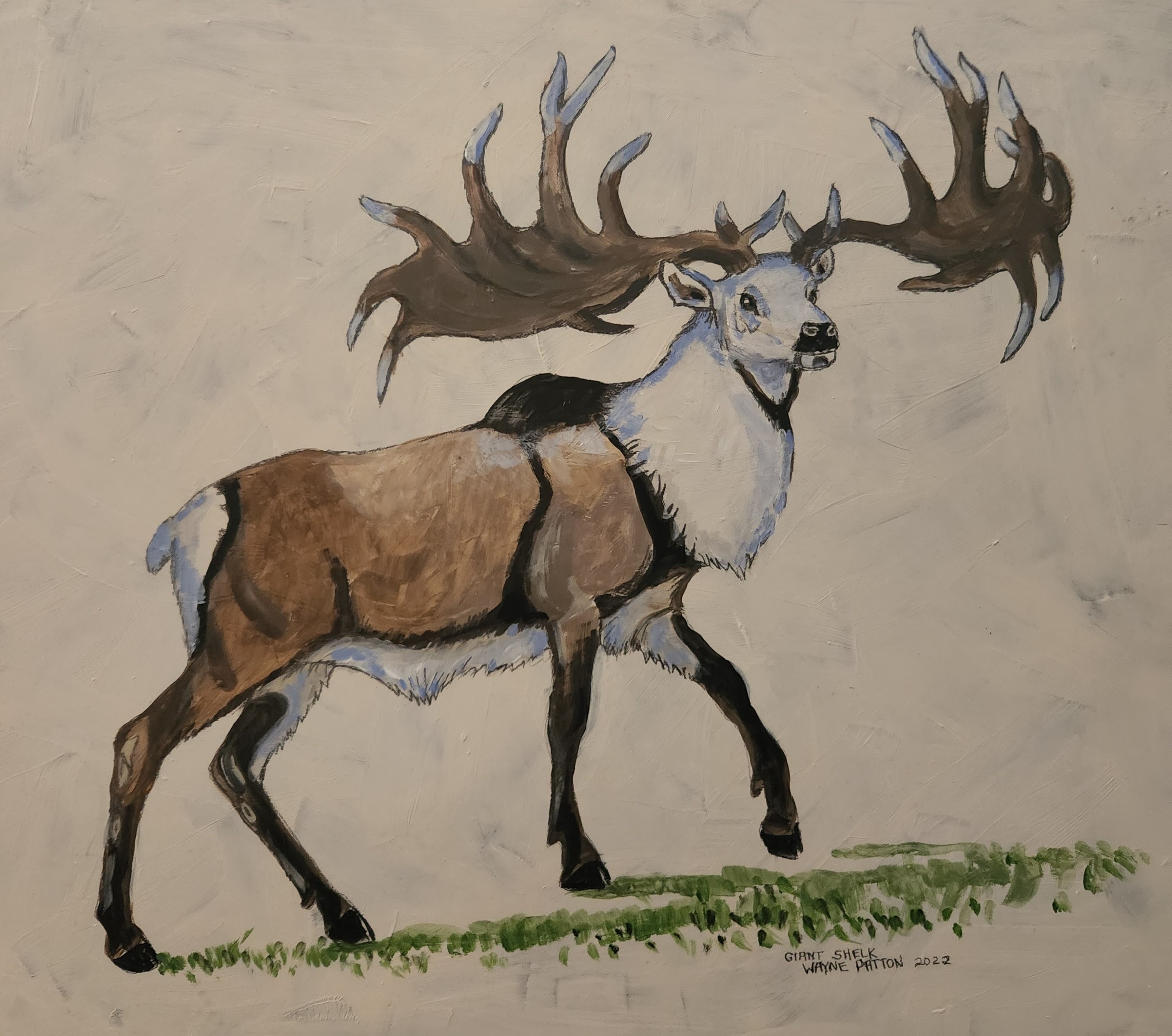
AN EXCLUSIVE NEW PORTRAIT OF THE IRISH ELK – A SHUKERNATURE PICTURE OF THE DAY

 
A dramatic, previously-unpublished portrait of an adult male Irish elk aka the giant deer Megaloceros giganteus (© Wayne Patton)

They say that good things come in pairs, so after the very favourable response recently received by my first ShukerNature Picture of the Day posted by me for quite some time (click here to access it), without further ado I am very happy to proffer a second one right now. Namely, the dramatic and exceedingly impressive but previously-unpublished portrait by American scholar/wildlife artist Wayne Patton (kindly forwarded to me earlier this year upon his behalf by his daughter, Alison Fielding) of one of prehistory's most spectacular mammals – the Irish elk, also known very aptly as the giant deer, and scientifically as Megaloceros giganteus.

Famed for the adult male's immense antlers, this awe-inspiring species was traditionally believed to have become extinct throughout its Eurasian distribution range during the Pleistocene epoch, i.e. prior to the onset of the Holocene, approximately 10,600 years ago. However, within my book In Search of Prehistoric Survivors (1995), I presented some intriguing evidence for its possible survival into the early Holocene (including mention of a mysterious, still-unidentified European beast named the schelk or shelk that may allude to Holocene representatives of Megaloceros).

Moreover, some years later, as I duly updated in a ShukerNature article (click here) as well as in my subsequent book Still In Search Of Prehistoric Survivors (2016), conclusive evidence for this species' Holocene survival in two widely separate Eurasian localities – the Isle of Man off the British mainland, and western Siberia in far-eastern Russia – was indeed obtained.

Inspired by my writings as well as those of many others dealing with this magnificent species, together with all manner of artistic representations of it, including cave paintings, and being an accomplished artist himself, Wayne decided to prepare his own entirely original reconstruction of its likely appearance in life, and when it was complete he very kindly offered me the opportunity to reproduce it exclusively on ShukerNature, which I was only too happy to accept. And so, showcased above as a wonderful ShukerNature Picture of the Day, is Wayne's stunning adult male Megaloceros painting, together with his verbatim account below of how he came to prepare it, his influences, and personal thoughts and ideas concerning Megaloceros, presented once again with his kind permission.

[Incidentally, please note that Wayne is using the term 'shelk' in his account merely as a common name for Megaloceros, rather than claiming a direct link between the latter deer and the mysterious still-unidentified beast of that name.]

 
One of Charles R. Knight's classic Irish elk paintings (public domain)

My name is Wayne Patton, I am a botanist and soil scientist by training and experience. I worked a career for the US Forest Service. I also worked in Mexico, Canada, and collaborated with groups from Romania, and Israel. I am a big game hunter and I took game with ancient systems like the bow and arrow and atlatl darts. I also tanned my own hide and made all manner of leather goods like saddle, tack, etc… Art has been a hobby for as long as I can remember. Now I am too old to hunt, so I spend a lot of time painting and selling my work through several galleries. I got very interested in the Megaloceros giganteus (shelk) through both my hunting and art experiences. I decided to paint a bull shelk as exampled above, starting with photos of mounted skeleton in museums in Ireland, Germany, and Scotland. There are even a couple mounted skeletons in the US that were obtained from Ireland. I fleshed out the bones based on my art experience as well as butchering big game animals like the American elk as well as mule deer, goats, sheep, and some African animals like the kudu. This part was easy, however, virtually all paintings of shelks by Charles R. Knight, who did early work for the Chicago Museum of Natural History, as well as the paintings available on the internet, are sourced from the zoo, mostly, red deer and American elk. The artists painted these fat animals that are standing around at half-mast from eating the wrong diet and being trapped, and then showing them with the giant horns of the giant shelk. Perhaps the best artwork is by the current great Dutch painter Rien Poortvliet [but] he copied the colors of the red deer and missed key anatomical features like the Adams apple and shoulder hump of the real shelk. What about the color? All paintings seem to be copies of the red deer and American or Mongolian elk – is this correct?

I thought not, so I did a bunch of research to find out if any information exists and I stumbled on to a fabulous book called The Nature of Paleolithic Art by Dr R. Dale Guthrie, who was a professor at the University of Alaska. He visited caves in France, Northern Spain and Italy, as well as museums containing engravings of animals on rocks, bones, and ivory from sites in Europe. This formed a basis for his reconstruction of the bull and cow shelks. He also did a lot of work comparing Pleistocene cave art with animals that survived the Pleistocene extinctions like the Chamois, the Reindeer and the Muskox and found this art to be very accurate and can be relied upon to help make decisions about color and animal appearance. The early people lived with the animals and were keen observers and used their knowledge to hunt them, maybe hastened extinction in some cases. So, I used my firsthand knowledge of using skeletal remains to flesh out realistic animal anatomy, and I used most of Dr R. Dale Guthrie’s conclusions from his experience looking at Pleistocene art to get the best color information. My try at a painting of the Bull Shelk is enclosed. 

Give me feedback of what you all think!

Also, use Amazon on the internet to track down copies of the book I used for reference (The Nature of Paleolithic Art).

Also, have a look at Rien Poortvliet in his book A Journey to The Ice Age (mammoths and other animals of the wild).

Now, back to some ideas of why many shelk remains and those of perhaps of red deer or European elk (American Moose) have holes knocked in the top of their skulls. These animals were herded in to marl pits and peat bogs where they became mired and trapped after which early people, especially in Ireland, went out and killed them where they were. Then they butchered out the best cuts of meat including the heart, liver, and tongues. Along with the brains, all of which were considered delicacies as I have on occasion. Use the 'Meat Eater' series on Netflix as a reference. The main use for brains, however, was not eating even though they are good! The primary reason for use is stabilizing and tanning leather, as I have done also. Leather has been used since the Pleistocene to make all kinds of clothing, gear and weapons. Use of brains or urine can be a smelly operation. 

 
Life-sized statue of an adult male Megaloceros on display at Crystal Palace, London, originally created by Benjamin Waterhouse Hawkins during the 1850s (© Dr Karl Shuker)

Wayne has raised some very interesting points here. In particdular, it is certainly true that observing cave paintings can offer various visual clues to the physical appearance of prehistoric beasts that cannot be procured from fossils alone. Perhaps the most famous example of this is the apparent presence of striped markings on the body of the cave lion, as depicted in cave paintings of this extinct felid. So it is very significant that Wayne's Megaloceros painting has incorporated information encapsulated in these early firsthand eyewitness artworks.

Additionally, Wayne's information concerning the use of brains for tanning leather does indeed offer at least a partial explanation for the skull holes observed in Megaloceros remains that I documented in my first Prehistoric Survivors book and subsequently reiterated in my second one as well as my ShukerNature article. And as it was entirely new to me, this information is very welcome.

In short, I am delighted to be able to share with you Wayne's extremely striking, wholly original interpretation of what the adult male Megaloceros may have looked like in life, and his input to what is known about the use by human hunters of the brains extracted from the skulls of  butchered deer that may well have applied to this prehistoric species.

Once again, I thank Wayne most sincerely for permitting me to share all of this here on ShukerNature, and also his daughter Alison for kindly making contact with me in order to bring Wayne's work to my attention.

For an extensive coverage of possible and definite examples of Megaloceros post-Pleistocene survival, be sure to check out my book Still In Search Of Prehistoric Survivors.


Saturday, 17 December 2022

JOCKO IS NO JOKE! A SHUKERNATURE PICTURE OF THE DAY

 
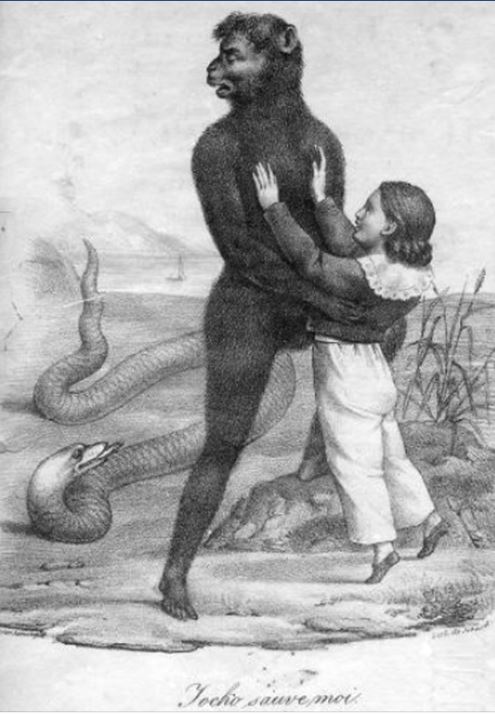
Vintage illustration for Jocko ou le Singe du Brésil (public domain)

It’s been quite a while since I last posted a ShukerNature Picture of the Day, so the recently-received eyecatching illustration presented above provides an ideal example with which to remedy this situation.

Not so long ago, I was sent this picture by a correspondent who had encountered it by chance online but without any accompanying details. So he wondered whether it may depict anything of cryptozoological interest or significance.

I had never seen this very dramatic-looking but decidedly strange image before, and was greatly intrigued by it, bearing in mind that it seemingly portrayed some form of giant indri-like lemur abducting a young child while being viewed closely by a large aquatic serpent. As I was unaware of any such event ever having been reported, however, I wondered whether it may instead be some form of satirical representation, a pictorial joke of some kind, rather than any literal depiction.

But as is so often the case with cryptozoological matters, first impressions can be deceiving, as I soon discovered after conducting an image search online.

It turns out that this picture is actually an illustration of an event in a two-act play by French writer and dramatist Edmond Rochefort entitled Jocko ou le Singe du Brésil ('Jocko or the Monkey of Brazil'), first staged in 1825, and inspired by Jocko, a bestselling novel by French author Charles de Pougens, published the previous year. Also inspired by this novel and again first staged in 1825 was a ballet by Fredéric-Auguste Blache, with music by Alexandre Piccinni, and sets by Pierre-Luc-Charles Cicéri, which proved so successful that numerous adaptations and copies of it were subsequently produced and staged for many years thereafter.

 
Famous French dancer and mime artist Charles-François Mazurier taking the role of Jocko in the original ballet version, as illustrated by French artist Godefroy Engelmann, 1825 (public domain)

The principal storyline of Jocko centres upon the capture of a large monkey in Brazil by a rich travelling Portuguese man, who names his captive Jocko. During the subsequent Atlantic crossing back to Europe, the man's vessel is shipwrecked, but Jocko saves the man's small son, Laurençon, from drowning, though in so doing Jocko is himself killed. When the play was performed for the very first time, however, the audience was so outraged by the death of the brave Jocko that it insisted he survive, and so in all subsequent performances he did!

What I find so interesting about the above picture, in which Jocko is in fact rescuing Laurençon from the clutches of the snake, is just how lemur-like, and just how monkey-unlike, he is portrayed, not to mention his great size and bipedal stance. Whoever had depicted him had clearly not based their portrayal upon an actual specimen of any known modern-day species of New World primate, that's for sure!

Speaking of known – or, rather, unknown – modern-day species of New World primate, however, Jocko's great size and bipedal nature do readily call to mind various cryptozoological reports describing alleged encounters with very large bipedal ape-like monkeys in many different parts of South America, including Brazil (where they are known locally as the caipora) – creatures that still remain undescribed by science.

(Indeed, incidentally, such reports even inspired the infamous hoax photograph of a supposed shot specimen of just such an entity that was published in an Illustrated London News article by Swiss geologist and Venezuelan explorer Dr François de Loys in 1929, and which French zoologist Prof. George Montandon deemed to be a major new species, naming it Ameranthropoides loysi – click here for Part 1 of my extensive 3-part ShukerNature coverage of this controversial saga, which is also contained in my book ShukerNature Book 2.)

Is it possible, I wonder, that the artist responsible for this illustration of Jocko had also heard of such reports, some of which do indeed date back as far as the early 19th Century (and even earlier, in fact), which duly influenced his portrayal of his simian subject? A memorable example, if true, of cryptozoology and culture combined!

 
De Loys's infamous fake photograph of a supposed bipedal South American ape-like monkey shot by him in 1917 and subsequently dubbed Ameranthropoides loysi by Montandon – it was actually a dead pet spider monkey artfully arranged to look bigger than it actually was (public domain)


Wednesday, 30 November 2022

WOOLLY BEARS AND HAIRY HUBERTS

 
Vintage illustration of a woolly bear, aka Hairy Hubert in County Durham (public domain)

As you all know, I love delving through old books and periodicals in search of odd little titbits of obscure zoological trivia, and not so long ago I found the following interesting snippet of information in William Brockie's book Legends and Superstitions of the County of Durham (1886), which was entirely new to me and certainly warrants a mention on ShukerNature.

So here it is:

HAIRY HUBERT

If you throw a hairy worm, in the North called Hairy Hubert, over your head, and take care not to look to see where it alights, you are sure to get something new before long.

 
The 1974 EP Publishing edition of William Brockie's book Legends and Superstitions of the County of Durham, originally published in 1886 (public domain/EP Publishing – reproduced here on a strictly non-commercial Fair Use basis for educational/review purposes only)

County Durham is in the northeast of England, and although I had never heard of Hairy Hubert before, I suspected that it was probably a local name used there for some form of hairy caterpillar.

And sure enough, when I investigated it I discovered that the creature in question was none other than the woolly bear, the famously furry caterpillar of the garden tiger moth Arctia caja, a common species in Great Britain. Another nomenclatural novelty duly deciphered!

 
Adult garden tiger moth Arctia caja, one of Britain's most attractive native moth species (public domain)

This ShukerNature blog article is excerpted from my latest book, Secret Snakes and Serpent Surprises, published earlier this year by Coachwhip Publications and available from Amazon UK, Amazon USA, and all other good online and physical bookstores.


Monday, 31 October 2022

THE ELEPHANT DUNG BAT - OR, A CRYPTIC CRYPTO-CHIROPTERAN FROM KENYA

 
Might Kenya's elusive elephant dung bat be an unidentified relative of Britain's familiar serotine bat Eptesicus serotinus, as exquisitely painted here by Archibald Thornburn? (public domain)

Bats are an intrinsic insignia of Halloween – so what better subject to write about today than a cryptic crypto-chiropteran, or, in plainer parlance, a hidden mystery bat?

Whereas cryptozoology's most famous mystery bats are distinguished by their huge size (viz. the Javanese ahool and African olitiau – click here to read all about them on ShukerNature), the example under consideration in this present blog article of mine is of notably diminutive dimensions. Indeed, this is the very characteristic that enables it to indulge in the bizarre day-roosting activity that has incited such scientific curiosity.

 
Two of my many ornithological field guides are authored by John G. Williams (© John G. Williams Estate/HarperCollins – reproduced here on a strictly non-commercial Fair Use basis for educational/review purposes only)

On 23 May 1990, Welsh-born ornithologist John G. Williams (1913-1997), a renowned expert on African avifauna, wrote me a detailed 3-page letter concerning this mystery bat, as reproduced in full by me further down here for the very first time anywhere, and which provided me with valuable background information. In 1955, Williams was taking part in the MacChesney Expedition to Kenya, from Cornell University's Laboratory of Ornithology, and in June of that year he encountered Terence Adamson, brother of the late George Adamson of Born Free fame. During a conversation concerning the wildlife inhabiting the little-explored forests of Mount Kulal, an extinct volcano just east of Lake Turkana in northern Kenya, Adamson casually mentioned a peculiar little bat that had attracted his particular interest – by virtue of its unique predilection for spending its days snugly concealed inside dry piles of elephant dung!

Bats are well known for selecting unusual hideaways during the daylight hours, requisitioning everything from birds' nests to aardvark burrows, even concealing themselves in the centre of rolled banana leaves. However, there was no species known to science that habitually secreted itself within the crevices present in deposits of elephant excrement. As a consequence, Adamson had been eager to discover all that he could regarding this extraordinary creature.

 
African avifauna expert John G. Williams (public domain)

He had first encountered one of its cryptic kind during a walk through Kenya's Marsabit Forest (of which he was warden). After idly kicking a pile of elephant dung lying on the path along which he was strolling, he saw a small grey creature fly out of it and alight upon a tree nearby. Expecting it to be nothing more notable than some form of large moth, Adamson was very startled to find that it was an exceedingly small bat, with silver brownish-grey fur, paler upon its underparts. He was especially surprised by its tiny size – its wingspan was even less than that of the familiar pipistrelles, which are among the smallest of bats. Unfortunately, he was only able to observe it for a few moments before it took to the air again and disappeared, but his interest was sufficiently stirred for him to make a determined effort thereafter to seek out other specimens of this odd little animal.

Moreover, Adamson also informed Williams that during his visit to Mount Kulal he had succeeded in spotting a second one – unceremoniously ejected from its diurnal seclusion when he had kicked over a pile of pachyderm droppings at the base of the Kulal foothills. Unlike the first specimen, however, this one had flown away without making any attempt to land close by, so Adamson had been unable to make any additional observations.


The full 3-page letter regarding the mystifying elephant dung bat that John G. Williams kindly wrote to me on 23 May 1990 following an enquiry of mine concerning this creature (please click each page to enlarge for reading purposes) (© Dr Karl Shuker/John G. Williams)

As Williams noted in a short article published within the June 1967 issue of the British wildlife magazine Animals (which as far as I am aware is the only account published regarding this coprophilic chiropteran prior to my own writings), and which is what prompted me 23 years later to contact him, he too became very keen to espy, and possibly even capture, one of these elusive denizens of the dung piles, in the hope of identifying their species. And so, to his travelling companions' great amusement, he made a special point thereafter of zealously felling as many dry mounds of elephant excrement as he could, in the the Katamayu Forest of the Kenya Highlands, and elsewhere too, on the off-chance that he might conjure forth one of these perplexing little bats.

Despite such valiant efforts, however, Williams never did succeed in flushing one forth. Moreover, to the best of my knowledge the elephant dung bat has still not been captured, and its identity remains unresolved. However, as he opined in his letter to me above, one species already known to science may provide the answer.

 
A mystery within a mystery – I have seen various postings of this photograph online with claims that it depicts a horn-skinned bat Eptesicus floweri and was snapped by a Hugh Clark; conversely, on Wikipedia this same photo's subject is claimed to be an Austrian Tyrol specimen of a closely-related Eurasian species E. nilssonii, the northern bat, and the photo itself is attributed to someone with the Wikipedia username Mnolf who has made it available for public usage under the CC BY-SA 3.0 sharing licence (Consequently, because which bat species this picture truly depicts and who the picture belongs to are presently unknown to me, I am reproducing it here on a strictly non-commercial Fair Use basis for educational/review purposes only.)

The species in question is a rare vespertilionid micro-bat called Eptesicus (Rhinopterus) floweri, formally described in 1901 by British zoologist William E. de Winton, and currently recorded only from Mali and Sudan (but possibly also Niger and Chad, directly sandwiched as they are between those two countries). It is commonly termed the horn-skinned bat, calling to attention the tiny horny excrescences that it bears upon the upper surface of its limbs and tail. This species resembles the elephant dung bat in general size and colour, but an important additional reason why Williams favoured its candidature as the latter creature's identity is its remarkable preference for day-roosting within holes in the ground, especially among the roots of acacia trees.

As he pointed out to me, this habitat is really quite similar to the crevices and cracks present within dry heaps of elephant dung, hence it is not difficult to believe that this species would utilise these useful sources of daytime roosting sites if such were available. And as the Mount Kulal region of northern Kenya is not only little-explored but also not too far beyond its known distribution range, this provides further reason for looking favourably upon the horn-skinned bat as a realistic answer to the mystery of the latter country's curious little elephant dung bat.

This ShukerNature blog article is excerpted and expanded from my book The Beasts That Hide From Man: Seeking The World's Last Undiscovered Animals.


Friday, 30 September 2022

OFF WITH THEIR HEADS! HUNTING HANYUSUCHUS INTO EXTINCTION

 
Reconstruction of the likely appearance in life of Hanyusuchus sinensis (© Hikaru Amemiya/Wikipedia – CC BY 4.0 licence)

Some truly extraordinary creatures may well have lived alongside humanity long ago but became extinct before being recognised and catalogued by modern-day science.

According to recent findings, one such beast appears to have been a hitherto-unknown species (and genus) of gharial-related gavialid crocodilian from southern China, as now revealed.

This newly-revealed species was dubbed Hanyusuchus sinensis when formally described on 9 March 2022 in a Proceedings of the Royal Society B paper authored by a team of researchers that included Dr Masaya Iijima from Hefei University of Technology's School of Resource and Environmental Engineering. And like the modern-day gavialid known as the gharial Gavialis gangeticus, it can be readily distinguished from typical crocodiles and alligators by its noticeably long, thin skull and snout.

 
Size comparison of known skeleton elements of Hanyusuchus sinensis with human (© Masaya, I., et al., 2022/Wikipedia CC BY 4.0 licence)

Three millennia ago, during China's Bronze Age, this very imposing 19-ft reptile was undoubtedly a top predator. However, the two subfossil specimens of it recently documented, and which date from that time period, show evidence of vicious weaponised attacks by humans and possibly even ritual beheading. Clearly, this species was seen as a major threat by the area's expanding human population back then.

Moreover, based upon a lengthy history of chronicles relating to crocodile killings there, Prof. Minoru Yoneda, of the University Museum at the University of Tokyo, suspects that H. sinensis was systematically wiped out via prolonged, ruthless hunting during the past 3000 years, but with its last representatives conceivably dying as recently as just a few centuries ago.

Tragically, therefore, this remarkable animal may have been lost to science, and thence to the prospect of saving it from extinction, by only the narrowest of chronological margins.

 
Vintage engraving of the familiar but critically-endangered gharial Gavialis gangeticus, one of only two gavialid species known still to exist today; the other is the false gharial Tomistoma schlegelii.