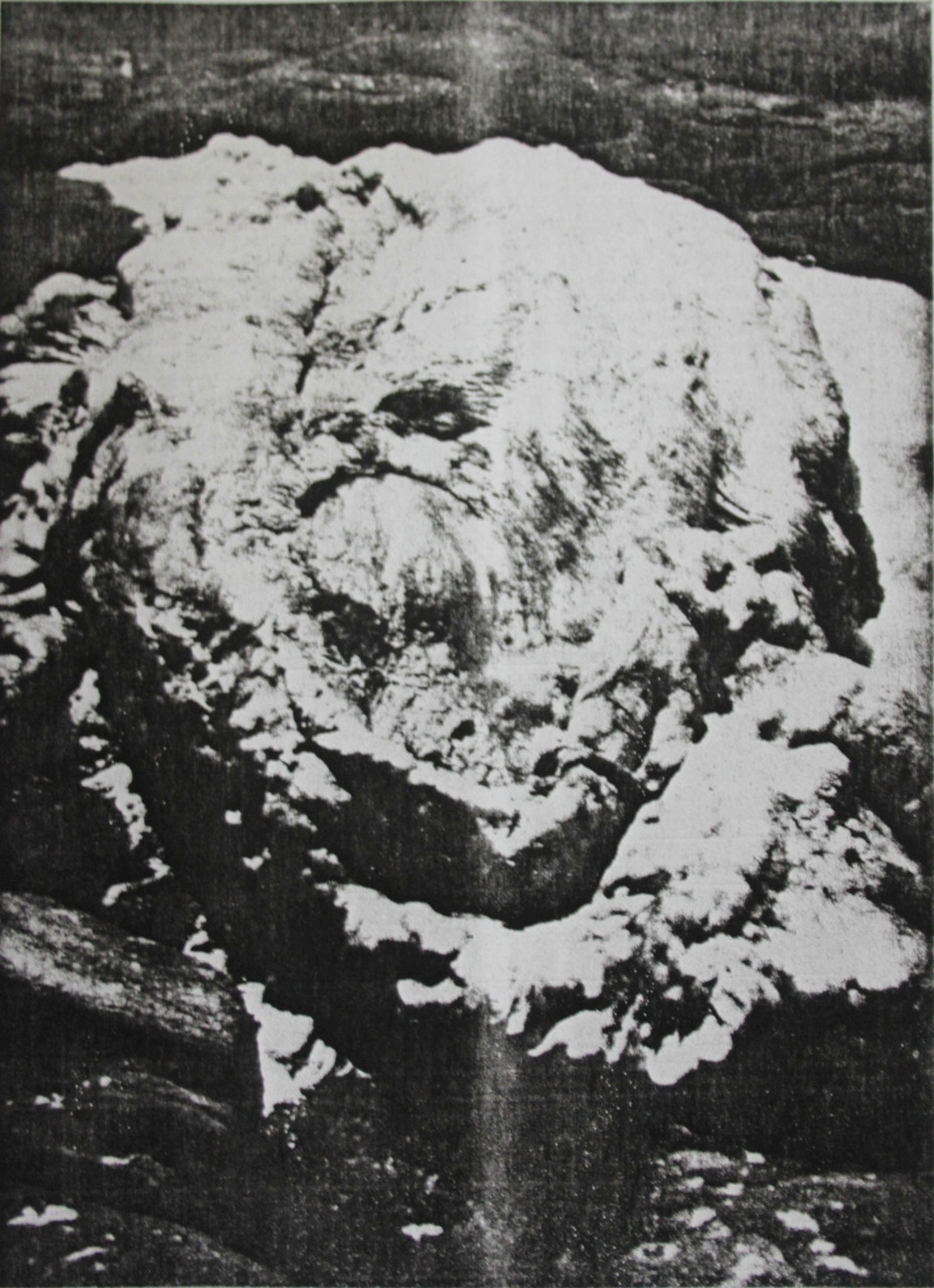
Higher-resolution close-up
version of the fifth Trunko photograph to be made known to cryptozoologists (©
owner unknown, but image dates from early 1920s, so now likely to be in public
domain – reproduced here on a strictly non-commercial Fair Use basis for
educational/review purposes only)
As ShukerNature readers will no doubt
already know, Trunko is the name that within my 1996 book The Unexplained I light-heartedly coined (but which to my great
surprise duly became globally accepted) for the hitherto nameless yet very
enigmatic 'sea monster' carcase washed ashore on a beach at the coastal town of
Margate, in what is now Kwa-Zulu Natal, South Africa, during November 1924 (or 1922, according to certain dubious claims), and
characterised by its coating of snow-white 'fur' plus a long elephantine
trunk-like projection.
Sadly, no tissue samples were taken from
this strange specimen for formal scientific analysis before it was washed back
out to sea and lost forever; nor, seemingly, were any photographs snapped of
it. Consequently, Trunko appeared destined to remain perpetually unidentified,
eternally unexplained, but nonetheless inspiring all manner of highly
imaginative but often extremely eyecatching artistic representations of what it
may have looked like in life – bizarre hairy marine pachyderms bearing no
resemblance to anything ever known to have existed on Earth.
William Asmussen's vibrant representation of a living Trunko
battling two killer whales, inspired by various eyewitness claims back in early 1920s
(© William Asmussen)
Almost 90 years later, however, in
September 2010, German cryptozoological co-researcher Markus Hemmler and I were
very startled but delighted to discover no fewer than three Trunko photos,
which had been snapped by a Mr A.K. Jones while this curious carcase had lain
ashore.
One was featured on the Margate Business
Association (MBA) website, the other two had been published in a Wide World Magazine article way back in
August 1925 (click here
and here to
read my two world-exclusive ShukerNature articles that documented these
extraordinary discoveries immediately after they had been made).
A.K. Jones's Trunko photograph that had appeared on the MBA
website (originally © A.K. Jones, but image
dates from early 1920s, so now likely to be in public domain – reproduced here on a strictly non-commercial Fair Use
basis for educational/review purposes only)
Yet until now, all three had remained
entirely unknown to the cryptozoological community.
Moreover, these photos were of sufficiently
good quality for me to be able to recognise that this entity was a globster,
i.e. a decomposed whale carcase from which the skeletal contents have fallen
away, leaving behind a thick gelatinous matrix of collagen protein, still
encased inside the whale's skin sac of rotting blubber, with the carcase's
famous 'trunk' most likely an enclosed rib covered in fibrous tissue, and the
carcase's white 'fur' being exposed connective tissue fibres.
A.K. Jones's two Trunko photograph that had appeared on the Wide World Magazine article of August
1925 (originally © A.K. Jones, but images
date from early 1920s, so now likely to be in public domain – reproduced here
on a strictly non-commercial Fair Use basis for educational/review purposes
only)
After more than 80 years, the mystery of
Trunko had finally been solved (for full details, see my extensive May 2011 Fortean Times article – the most
comprehensive coverage of Trunko's convoluted history ever published, and
subsequently republished in ShukerNature Book 1).
But that was not all.
In March 2011, I learnt from Markus that a
fourth Trunko photograph had been discovered, by Margate-based South African
artist and Trunko researcher Bianca Baldi, in the archives of Margate Museum,
which showed an amorphous blob that again confirmed Trunko's identity as a
globster (click here to
read my ShukerNature account of this dramatic find).
The fourth Trunko photograph (© owner unknown, but image dates from early 1920s, so now likely to be in
public domain – reproduced here on a strictly non-commercial Fair Use basis for
educational/review purposes only)
And now, most recently of all, on 19 April
2022 and courtesy yet again of the indefatigable Markus, I was made aware of a
fifth Trunko photo. As with the previous quartet, it had been hiding in plain public
sight for quite a while.
Markus had discovered that on 4 March 2015,
Margate businessman Lencel Celliers had posted in a Facebook group entitled
'MARGATE, Natal, South Africa – NOSTALGIA', a clickable link to a then-online
album of vintage Margate-based photographs on the website of a South African
news/Information channel called eHowzit that included two Trunko photographs.
One of these is the Jones image that had appeared on the MBA website, but the
other is entirely new to cryptozoologists.
Lower-resolution full version
of the fifth Trunko photograph to be made known to cryptozoologists (© owner
unknown, but image dates from early 1920s, so now likely to be in public domain
– reproduced here on a strictly non-commercial Fair Use basis for
educational/review purposes only)
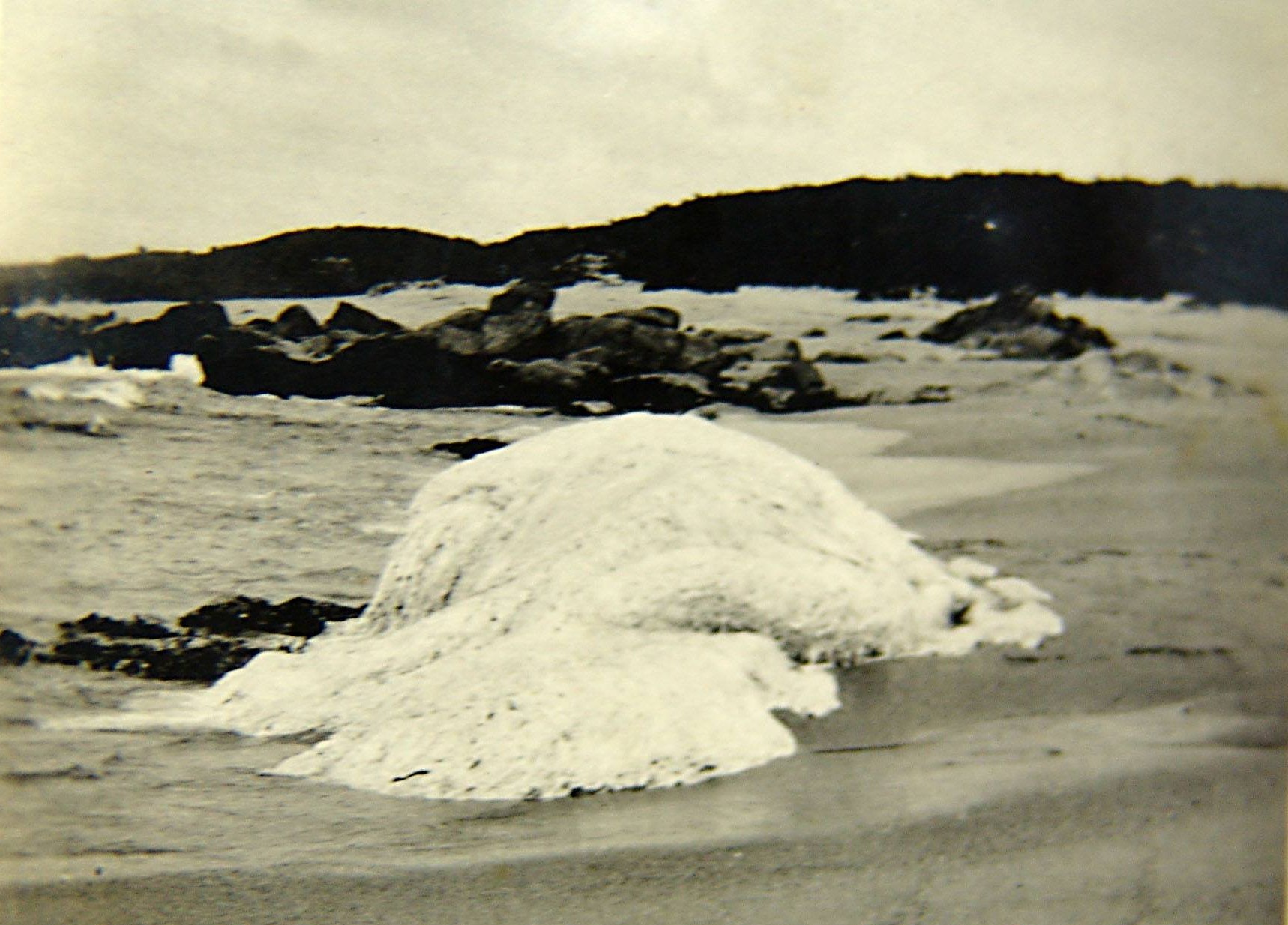
The album provided no details concerning
who had snapped this latter photo (it is reproduced here, at the opening to
this present ShukerNature article, on a strictly non-commercial Fair Use basis
for educational/review purposes only). As can be seen, it depicts the by-now
familiar Trunko form of a huge white globster, but, interestingly, it shows a
large fan-shaped projection from the carcase that was not visible in previous
Trunko photos but which may explain various previously-mystifying claims by
some original Trunko eyewitnesses that the carcase had possessed a lobster-like
'tail' (lobster tails are indeed fan-shaped). In addition, the specific
location depicted in this photo, where Trunko was stranded, is revealed to have
been the principal Margate beach at Tragedy Bay.
Markus subsequently contacted Mr Celliers
on FB for more information regarding this highly significant photo, and
Celliers replied that he had obtained both of them from the Margate Museum
"when it was still in existence in 2000". (He also provided a link to
a Margate-themed YouTube video produced by him and uploaded on 21 July 2012
that includes these same two Trunko pictures – click here
to view it.) Presently unable to identify with certainty which
establishment Celliers was alluding to, however, Markus speculates that it may
in fact be the Margate Art Museum, but if so, it is still in existence today.
Modern-day view of Margate's principal beach; click picture to enlarge for viewing purposes (© T866/Wikipedia –
CC BY-SA 4.0
licence)
Consequently, Markus has now contacted this
museum in the hope that it is indeed the correct one and can therefore provide
some information concerning this fifth Trunko image.
My sincere thanks as always to Markus
Hemmler for so kindly bringing this latest unearthed Trunko photo to my
attention and for sharing with me his information concerning it.
My ShukerNature Book 1, whose front cover
illustration includes a delightful rendition by artist Anthony Wallis of what
Trunko might have looked like had it indeed been an exotic species unknown to
science – ah, if only… (© Dr Karl Shuker/Anthony Wallis/Coachwhip Publications)




jpg.jpg)






 Posts
Posts